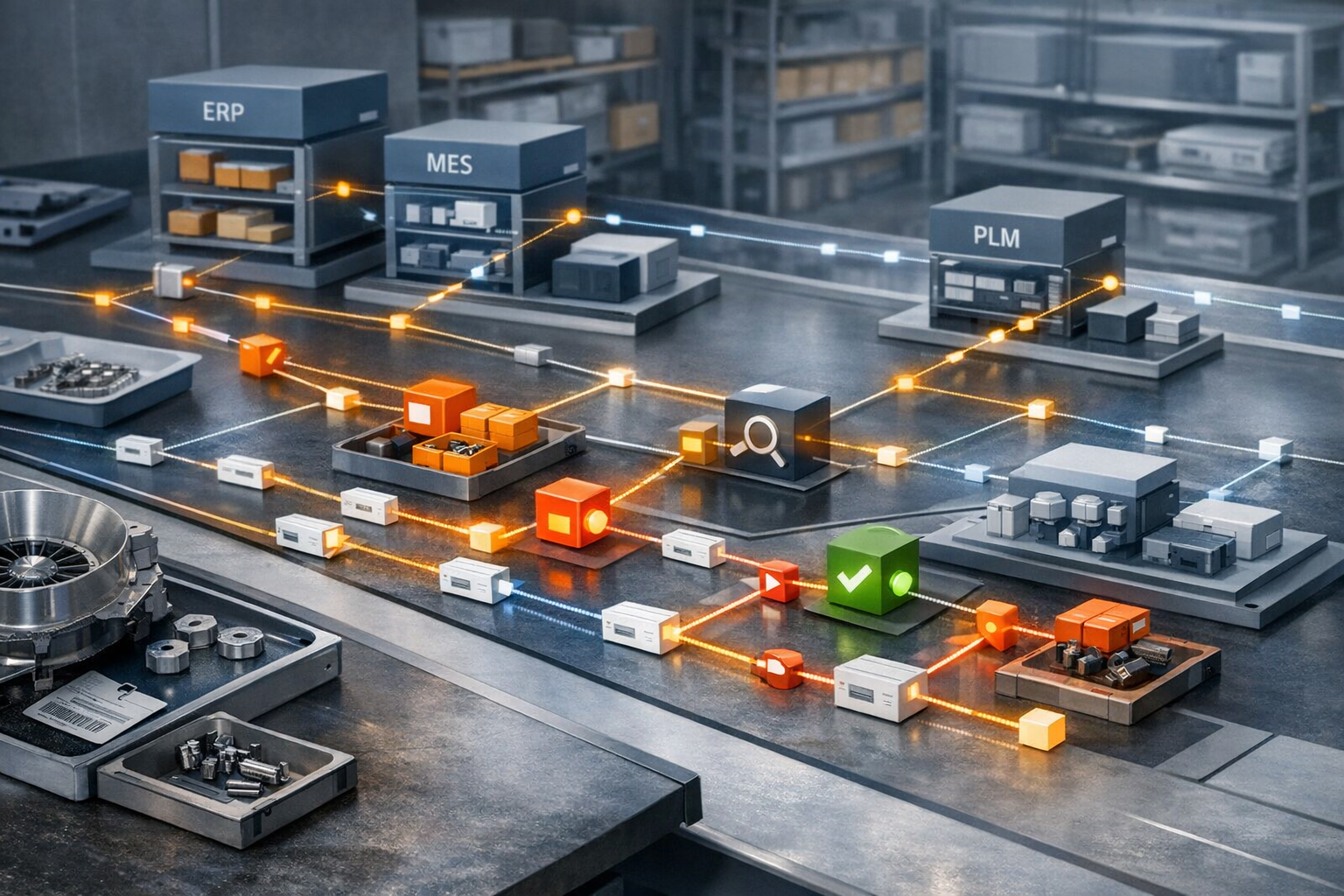
Category: ERP / MES / PLM Interoperability

How to connect systems without duplicating truth or breaking traceability across handoffs. Covers mapping strategy, ownership, sync risks, and governance for change control.

  • ISA-95 in Aerospace: Defining What ERP, MES, QMS, and PLM Should Own

    Aerospace teams rarely fail audits because nobody collected data. They fail because nobody can prove which system owned the data, which revision was current, or which decision blocked release.

    ISA-95, also known as ANSI/ISA-95 or IEC 62264, is an international standard for enterprise control system integration and for integrating enterprise office systems with factory floor control systems. In aerospace and MRO, isa 95 matters because AS9100, NADCAP, FAA, EASA, ITAR, CoCs, FAI packages, serial genealogy, and supplier evidence all depend on clean boundaries.

    Connect981 applies this boundary thinking as a unified operations layer between ERP, MES, PLM, QMS, suppliers, and the connected shopfloor.

    Quick overview: ISA-95 levels and aerospace system roles

    The ISA-95 model consists of five levels that describe the flow of information and activities within an organization, from the plant floor up to the enterprise level. ISA-95 defines a five-level model that describes the flow of information and activities within an organization, from the physical production processes at Level 0 to business planning and logistics at Level 4.

    • Level 0 describes physical production processes, machinery, raw materials, and physical assets on the floor.
    • Level 1 focuses on sensing and manipulating the production process through control devices, sensors, actuators, intelligent devices, and basic control functions.
    • Level 2 involves monitoring and supervisory control using programmable logic controllers, distributed control systems, SCADA, batch control, control module logic, and industrial control systems.
    • Level 3 is the manufacturing operations management level. It includes manufacturing execution systems, manufacturing execution systems mes, manufacturing operations management systems, manufacturing operations systems, quality control, maintenance activities, production scheduling, inventory control, and operational control.
    • Level 4 covers business planning and logistics. This includes enterprise resource planning, enterprise resource planning erp, erp systems, logistics systems, business systems, enterprise systems, business operations, and business processes.

    ISA-95 provides standard terminology and models to bridge the gap between information technology and operational technology. The common data model established by ISA-95 ensures consistent information exchange between enterprise and control systems. The framework is based on the Purdue Reference Model, also called the purdue enterprise reference architecture, with hierarchy models and a hierarchical structure for industrial automation.

    What belongs in ERP at ISA‑95 Level 4

    Level 4 owns the commercial plan, not the detailed build method. Enterprise resource planning ERP should own:

    • Customer contracts, demand, shipsets, sales orders, project accounting, and earned value.
    • Item master basics: part number, description, UOM, make/buy, cost category, high-level revision.
    • Inventory management: on-hand stock, warehouse balances, batch or lot quantities.
    • Purchase orders, approved supplier commercial records, delivery schedules, and raw materials commitments.
    • High-level routings and work centers for capacity and costing, not operator instructions.

    ERP decisions include MPS, MRP, material allocation, make-vs-buy, PO expedite logic, and release of production orders. ISA-95 Part 1 and Part 2 define object models, object model attributes, production capability, inventory, and schedule objects that support those decisions.

    Avoid using ERP for torque readings, inspection signoffs, NC program tracking, NADCAP parameters, or quality gate enforcement. That creates static PDFs, duplicate entry, and weak traceability.

    What belongs in MES / MOM at ISA‑95 Level 3

    Level 3 turns plans into executable manufacturing activities. Manufacturing operations management covers production operations, quality operations, maintenance operations, and inventory operations through operations activity models and production segments.

    MES, MOM, or Connect981 should own:

    • Detailed routing, operation sequence, dependencies, and station instructions.
    • Digital work instructions tied to PLM drawings, models, and revision control.
    • WIP status by serial, lot, tail number, station, operator, and timestamp.
    • Data acquisition from tools, equipment, and manufacturing systems.
    • Operator signatures, time-on-task, resource usage, and inspection evidence.
    • Local dispatching based on tooling, skills, machine status, shortages, and holds.

    In practice, MES is the execution truth for an engine MRO visit, a composite layup, a wing panel, or a heat treat load. It captures historical data, furnace curves, NDT results, serialized genealogy, and links to calibrated equipment.

    MES should not own long-term forecasting, engineering authority, or final MRB policy.

    What belongs in QMS: quality planning, records, and decisions

    QMS spans Level 3 and Level 4. It defines quality policy, while execution systems capture evidence.

    QMS should own:

    • AS9100, NADCAP, FAA/EASA, ITAR, and customer procedure requirements.
    • Inspection plans, control plans, sampling rules, acceptance criteria, and FAI requirements.
    • Nonconformance, MRB, CAPA, concessions, deviations, escapes, and customer returns.
    • Supplier approval, audit findings, calibration evidence, and supplier quality metrics.

    AS9100 traceability requires documented identification, status, acceptance authority, and unique identification where required. QMS defines conforming versus nonconforming product. MES or Connect981 presents the checks, captures measurements, blocks progression, and returns structured evidence.

    Avoid scanned forms buried in ERP attachments. They slow audits and weaken regulatory compliance.

    What belongs in PLM: product definition and engineering authority

    PLM owns product definition outside the ISA-95 pyramid but tightly feeds it.

    PLM should own:

    • eBOM, design intent, tolerances, specifications, MBD, drawings, and 3D models.
    • Configuration rules for aircraft, engines, structures, repair schemes, and modification kits.
    • ECR, ECO, revision effectivity by serial number, block number, or tail number.
    • Engineering requirements, verification, and validation data.

    PLM decides how the part is designed and when a revision becomes effective. ERP consumes released commercial attributes. MES consumes released work content. QMS aligns inspection characteristics and special process rules. Connect981 helps keep data flows synchronized so operators do not build from obsolete instructions.

    Control level (ISA‑95 Levels 0–2): what stays on the machines

    The isa 95 standard keeps the control level focused on physical processes and control processes. Level 0 of the ISA-95 model describes the physical production processes, including machinery and other assets in the field or on the floor. Level 1 focuses on sensing and manipulating the production process, which includes devices like sensors and actuators that collect data and affect production. Level 2 involves monitoring and supervising control, which refers to systems like programmable logic controllers and distributed control systems that manage physical processes.

    Typical aerospace assets include CNC machines, CMMs, autoclaves, test cells, torque tools, shot peen machines, NDT stations, and automated riveting systems.

    Control level systems own immediate safety, interlocks, recipes, NC code, PLC logic, and local cycle data. They should not own part revision, quality policy, supplier status, or full traceability chains. Critical results must flow upward through standardized data exchange.

    Ownership by data type: who is the system of record?

    • Product definition and design intent: PLM, read by ERP, MES, QMS.
    • Item master and commercial attributes: ERP, referenced by other systems.
    • Detailed routing and work instructions: MES or Connect981, linked to PLM.
    • Production orders: ERP owns order creation; MES owns execution status.
    • WIP and operation completions: MES, summarized back to ERP.
    • Quality plans and criteria: QMS, enforced in the execution layer.
    • Inspection evidence: MES or Connect981 captures it; QMS governs it.
    • NCR, MRB, CAPA: QMS owns decisions; MES supplies context.
    • Serial genealogy: MES or execution layer, with rollups to ERP and QMS.
    • Equipment capability: CMMS/EAM, integrated with MES and QMS.
    • Supplier approval: QMS owns qualification; ERP implements purchasing controls.

    ISA-95 prevents redundant work and reduces costly custom integrations by clearly defining software system responsibilities.

    Ownership by decision type: planning, execution, and quality calls

    ISA-95 is also a decision model.

    • Long-term capacity, site moves, and investment: ERP and program governance.
    • Master scheduling and MRP: ERP at the enterprise level.
    • Finite scheduling and short-interval control: Level 3 execution system.
    • Work instruction content: PLM defines design intent; manufacturing engineering authors executable steps in MES or Connect981.
    • Rework, concessions, alternate methods: QMS and PLM define rules; execution applies them.
    • Product acceptance and release: QMS owns release; ERP ships only after release.
    • Supplier changes: QMS and supply chain governance decide; ERP enforces purchasing status.

    Example: a new NADCAP rule changes a heat treat requirement. QMS updates the procedure, PLM confirms affected specs, Connect981 updates instructions and blocks noncompliant work, and ERP reflects schedule impact.

    Common overlaps, gaps, and failure modes in aerospace ISA‑95 implementations

    Most failures are boundary failures.

    Common overlaps:

    • ERP and MES both owning routings.
    • QMS and MES duplicating inspection results.
    • PLM and QMS holding different inspection characteristics.

    Common gaps:

    • No real-time WIP view across plants and suppliers.
    • Serial genealogy trapped in spreadsheets, HMIs, or PDFs.
    • ECOs not propagated to work instructions or supplier packets.
    • ERP showing “released” while MES has a quality hold.

    Failure modes include missed FAI updates, wrong-revision builds, incomplete CoC links, inconsistent special process coverage, and MRO return-to-service delays. A clear isa 95 model reduces these risks.

    How Connect981 applies ISA‑95 to unify aerospace operations

    Connect981 is not a monolithic ERP or MES replacement. It is an aerospace operations platform that uses isa 95 principles for seamless integration across ERP, PLM, QMS, suppliers, and shopfloor systems.

    It supports:

    • Level 3 execution: digital work instructions, WIP tracking, serial traceability, operator guidance, and audit evidence.
    • Enterprise and supplier workflows: PO collaboration, contract review, supplier visibility, and shared documentation.
    • Better information exchange across complex systems without forcing replacement of existing manufacturing systems.

    Properly implemented, ISA-95 eliminates data silos between IT and OT, reducing integration costs and enhancing data visibility. Reduced integration costs are achieved by eliminating the need for custom, expensive, point-to-point software code between different vendor systems.

    Next steps: applying ISA‑95 boundaries in your aerospace plant

    ISA-95 is an international set of standards aimed at integrating logistics systems with manufacturing control systems, facilitating communication among various manufacturing layers. The primary goal of ISA-95 is to ensure that different systems and software can communicate effectively, enabling real-time visibility into production, assets, and workforce activity, which is crucial for scaling operations consistently across plants and regions.

    More than 90% of manufacturers use ISA-95 to improve automation, ensuring that different systems and software can communicate effectively, which is crucial for real-time visibility into production and workforce activity. ISA-95 is widely used in modern manufacturing, with over 90% of manufacturers adopting it to improve automation and ensure that different systems and software can communicate effectively, which is crucial for Industry 4.0 initiatives.

    Use this action plan:

    • Map current systems to ISA-95 Levels 0 through 4.
    • Assign each data type and decision type to one system of record.
    • Identify overlaps that create rework, delays, audit exposure, or custom code.
    • Pilot Connect981 on one value stream, such as a nacelle line or engine MRO program.

    Real-time shop floor visibility reduces safety stock and raw material waste, optimizing inventory management. Implementing ISA-95 can help manufacturers navigate evolving regulatory expectations and drive better business outcomes, including improved efficiency and reduced operational costs. ISA-95 enhances scalability by allowing for the addition of new production lines or software modules without disrupting the existing architecture.

    Challenges in implementing ISA-95 often include legacy infrastructure complexity, data cleansing and classification issues, and the need for workforce training and change management to ensure successful deployment. Standardizing data exchange is key to ensuring that critical information flows between business systems and plant operations.

    The ISA-95 standards framework is designed to facilitate the integration of logistics systems with manufacturing control systems, which is essential for the implementation of Industry 4.0 and the Internet of Things. ISA-95 provides a tech-agnostic communication model that remains relevant in the era of Industry 4.0, allowing global manufacturers to define, develop, and integrate complex systems and processes effectively.

    To map your ERP, MES, QMS, PLM, and supplier landscape to practical desired outcomes, request a demo of Connect981 or ask for an ISA-95 boundary workshop.

  • ERP vs MES: Who Owns What in Day-to-Day Manufacturing Transactions?

    ERP vs MES: Who Owns What in Day-to-Day Manufacturing Transactions?

    Introduction: ERP vs MES in Daily Production Decisions

    Most aerospace plants do not struggle because people misunderstand software definitions. They struggle because nobody has agreed which system owns the transaction at the moment work happens. This erp vs mes article focuses on that practical line: production orders, routing execution, WIP, quality holds, completions, scrap, and duplicate records.

    In aerospace manufacturing and MRO, the answer matters because AS9100, FAA, EASA, and ITAR expectations require traceability by part, serial number, operator, timestamp, procedure, and revision. ERP systems, meaning enterprise resource planning, are optimized for financial management, inventory management, planning, raw materials, and customer demand. MES, meaning manufacturing execution system, and connected operations platforms like Connect981, are optimized for shop floor execution, production data, and data accuracy.

    ERP creates a single source of truth for all business departments and coordinates raw material ordering with customer demand. The rest of this article walks through transaction-by-transaction examples and a practical ownership matrix for ERP and MES.

    An aerospace technician is carefully inspecting a component on a clean shop floor, ensuring quality management and adherence to manufacturing processes. The environment reflects advanced technologies and efficient production operations, emphasizing the importance of real-time data collection in the manufacturing industry.

    Quick Answer: ERP vs MES Responsibilities at a Glance

    ERP owns the enterprise commitment. MES owns the execution reality. In most aerospace factories from 2015 to 2026, ERP is the system of record for cost, inventory value, customer orders, and planned production orders. MES systems, or a connected operations layer like Connect981, are the system of record for real-time WIP, operator actions, quality checks, equipment status, and traceability.

    Use this cheat sheet: ERP owns customer orders, master data, standard routings, planned orders, procurement, and valuation. MES owns detailed routing execution, production execution, signoffs, inspections, machine status, and real time data from production operations. Production orders typically originate in ERP; routing execution, holds, and completions are driven by MES and posted back through erp integration. Confusion across mes and erp systems is the usual cause of duplicate records, mismatched inventory, and conflicting completion dates.

    Most modern manufacturing businesses use both ERP and MES integrated together. Integrating ERP and MES systems creates a closed-loop system where production plans flow from ERP to MES, while actual production results flow back to ERP, enhancing visibility and efficiency across manufacturing operations. Done well, erp and mes systems improve production efficiency, operational efficiency, optimized production planning, and help teams maximize production efficiency without adding manual data entry.

    ERP vs MES: Focused Definitions for Transaction Ownership

    An Enterprise Resource Planning (ERP) system integrates data and workflows from various departments, including finance, supply chain, and HR, into a unified database, acting as the central nervous system of an organization. ERP systems typically include modules for managing procurement, order management, warehouse management, supply chain management, human resources, and customer relationship management, providing a comprehensive framework for business operations.

    ERP systems provide a unified view of enterprise data, allowing companies to automate business processes and generate insights across multiple departments, which helps identify areas for improvement and drive efficiencies. An enterprise resource planning system integrates data and workflows from various departments, including finance, supply chain, and manufacturing, into a unified database, while an MES focuses specifically on managing production and inventory processes on the shop floor. ERP systems provide a broad overview of business operations, enabling managers to automate processes and generate insights across multiple departments, whereas MES systems offer real-time visibility and control over manufacturing operations.

    Deploying an ERP requires a significant upfront investment and can take months or years to implement across all departments. MES solutions also require planning. Implementing an MES system can be complex and time-consuming, requiring significant planning, configuration, and integration with existing systems, which can lead to delays and budget overruns. This article uses MES broadly to include manufacturing execution systems mes, mes software, manufacturing operations management tools, and Connect981 where the platform governs manufacturing execution, inventory and production processes, production scheduling, and specific manufacturing processes.

    Who Owns What? Practical ERP vs MES Ownership Matrix

    This ownership matrix is the working rule set. The ISA-95 model separates enterprise and control systems: ERP sits with business systems, while MES connects to manufacturing systems, process control systems, and control systems.

    Transaction

    System of Record

    Where the transaction is initiated

    How the other system is updated

    Production order

    ERP for header, MES for actuals

    ERP

    MES sends confirmations, labor, and status

    Routing execution

    MES

    MES

    ERP receives variances and confirmations

    WIP move

    MES

    MES scan or signoff

    ERP receives milestone updates

    Material consumption

    MES for exact lot use, ERP for valuation

    MES or backflush rule

    ERP posts issue and cost

    Completion

    MES triggers, ERP records receipt

    MES after inspection

    ERP posts goods receipt

    Scrap and rework

    MES for reason, ERP for cost

    MES

    ERP posts scrap, rework, variance

    Quality hold

    MES triggers, ERP mirrors status

    MES

    ERP blocks planning or shipment

    Production Orders and Work Orders

    In SAP, Oracle, NetSuite, IFS, and similar erp software, work orders are created and numbered in ERP to align MRP, resource management, finance, and inventory. ERP is the system of record for order header, quantity, due date, BOM, standard routing, and cost structure.

    MES or Connect981 consumes the order and breaks it into executable tasks. It owns timestamps, operator IDs, deviations, exception paths, labor, and machine usage. In a 2024 aerospace assembly plant using SAP ERP and a dedicated MES, SAP creates a planned production order; the MES breaks this into operator-level tasks and reports confirmations to SAP at each operation or final completion.

    For a C-check in an MRO facility, the ERP work order defines aircraft tail number, scope, planned labor, and cost center. Connect981 manages task-by-task completion, signoffs, and required inspections. Duplicate production orders usually appear when a shopfloor tool creates local jobs independently of ERP without one-to-one data mapping.

    Routing Execution and Operation Sequencing

    ERP stores standard routings: operation list, work centers, planned time, and costing assumptions. MES owns what really happened: which operation ran first, what was skipped, what rework loop occurred, and which operator or cell performed the work.

    For complex assembly processes, MES or Connect981 also owns digital work instructions, in-process checks, revision control, and signoff workflow tied to each routing step. Routing changes for one order belong in MES and return to ERP as variance. Routing template changes for all future orders belong in ERP master data.

    Process engineers should standardize data formats such as operation codes, work center IDs, status codes, and inspection points. Without that discipline, confirmations become orphaned and production units appear complete in one system but open in another.

    Quality Holds, Nonconformances, and Dispositions

    Shopfloor quality events belong in MES because they happen in real time and require immediate control. An MES can enforce quality control procedures by capturing quality data during production, triggering alerts for quality issues, and maintaining records for analysis and traceability.

    When an operator logs a defect on a turbine blade in MES, the system applies a quality hold to that serial number and operation. ERP then reflects blocked inventory so the part cannot be issued, shipped, or consumed by planning. MRB decisions, scrap, use-as-is, or rework, stay in MES with evidence; ERP receives the resulting postings.

    Using ERP alone for holds delays reaction on the floor. Using MES alone without ERP updates leaves planning teams seeing blocked parts as available.

    WIP, Inventory Movements, and Completion Signals

    ERP tracks inventory at a macro level, warehouse storage, while MES tracks inventory at a micro level, exact material consumption on the assembly line. The primary function of an MES is to track and monitor production processes in real-time, providing detailed control over production scheduling and quality management, which is not the focus of ERP systems.

    MES records each WIP move, station arrival, start, pause, completion, and inspection result. ERP remains the record for inventory value, finished goods, and financial close. In a 3-shift composites facility, MES posts every panel move between layup, cure, and trim; ERP receives a goods receipt only after inspection passes.

    With integrated ERP and MES systems, companies can achieve improved inventory management, as the MES updates ERP inventory based on actual production events, leading to more accurate demand forecasting and resource allocation. This supports accurate demand forecasting without pretending ERP sees every micro-event.

    Scrap, Rework, and Yield

    Scrap and rework detail lives in MES: defect code, operator note, photo, operation, fixture, machine, and referenced procedure. ERP receives financial impact: scrap posting, rework order, inventory adjustment, and standard-versus-actual variance.

    If 2 of 10 landing gear components fail NDT in MES, the system records defect type and location. ERP is updated with 8 completed units, 2 scrapped, and the cost variance. Capturing scrap only in ERP weakens root cause analysis. Capturing it only in MES damages margin and yield reporting.

    Connect981 can support AI-assisted root cause analysis from MES-level detail while still feeding clean ERP postings.

    How ERP and MES Share Data: Integration, Data Mapping, and Formats

    Ownership only works when integration rules are predictable. Orders and routings usually move ERP to MES. Confirmations, quality results, material consumption, and completions move MES to ERP.

    Data integration between an MES and other software systems, such as ERP or PLM, can be challenging, often requiring extensive customization and data mapping to ensure seamless data exchange and synchronization. The integration of MES with other systems, such as ERP, allows for the synchronization of information and alignment of manufacturing processes with overall business operations, enhancing efficiency.

    Connect981 is designed as a unifying operations layer that maps erp data, PLM data, MES events, supplier records, and manufacturing data without forcing a full rebuild.

    A technician is scanning a serialized aerospace part at a workstation, utilizing a manufacturing execution system to ensure accurate production data and enhance efficiency in the manufacturing operations. The scene highlights the integration of advanced technologies in the aerospace industry to optimize production processes and inventory management.

    Typical ERP–MES Integration Flows in Aerospace and MRO

    A 2025 airframe plant using Oracle ERP and legacy MES may use nightly batch for order updates, but real-time APIs for quality holds and final completions. That split is common. Finance can tolerate some batch. Shipping and compliance cannot.

    A Manufacturing Execution System (MES) captures real-time data from various sources on the factory floor, including machines, sensors, and operators, to monitor and control manufacturing operations. MES provides real-time operational visibility, allowing users to track every work order, material movement, quality check, and process parameter as production occurs. The integration of ERP and MES allows for real-time data synchronization, providing manufacturers with up-to-the-minute insights into production processes, which facilitates informed decision-making and rapid problem resolution.

    Financial management in ERP depends on accurate labor, machine time, scrap, and rework data from MES. Integration capabilities determine whether that data arrives cleanly.

    Data Mapping, Data Accuracy, and Preventing Duplication

    Data mapping means aligning item IDs, serial formats, lot numbers, routing steps, work centers, and quality codes so each transaction has one meaning. Common duplication causes include both systems creating work orders, separate local item codes, failed imports, and manual ERP adjustments after MES completion.

    The rule is simple: one system creates each entity. ERP creates order numbers. MES creates nonconformance records. Updates can be bidirectional, but origination is controlled.

    Connect981 can normalize data formats across multiple ERPs and MES instances, detect multiple active execution records for one ERP order, and reduce manual operations.

    Data Security, Compliance, and Audit Trails

    Combining ERP and MES raises data security stakes. Ensuring data security is crucial when implementing an MES, as these systems handle sensitive production data, and robust security measures must be in place to protect against unauthorized access and cyber threats.

    MES holds operator names, timestamps, inspection results, and serial-level history. ERP holds financial and customer-level data. Together they form the audit trail. Role-based access, ITAR controls, logs, and authoritative timestamps must be explicit.

    Integrating ERP with MES enhances quality management by enabling the collection and analysis of historical data, which helps identify patterns and trends, allowing companies to proactively address potential quality issues. Teams can analyze historical data for recurring defects, but only if the data collection and real time data collection are structured.

    Day-in-the-Life: Transaction-by-Transaction Examples

    Consider 5 shipsets of composite control surfaces due in Q4 2026. ERP transaction: create customer order, production order, BOM, material reservations, and planned cost. MES transaction: import the order, assign tasks, execute work instructions, capture inspections, and manage the entire production cycle.

    Material issue is an MES scan with lot traceability and an ERP goods issue. First article inspection is MES evidence with ERP status visibility. Nonconformance is MES-controlled with ERP blocked status. Final acceptance is MES completion plus ERP goods receipt and shipment readiness.

    Connect981 can orchestrate this when a plant still relies on spreadsheets, email, or tribal knowledge instead of a full MES.

    Example 1: New Production Build (Greenfield Assembly Line)

    A manufacturer launches a 2025 actuator production line using existing ERP and Connect981. ERP creates the production order and BOM. Manufacturing engineers build digital work instructions in Connect981. Operators execute steps, scan components, and record torque values.

    If torque is out of spec, the hold is triggered in Connect981. ERP receives blocked status, preventing shipment. Operators do not log twice, finance receives one clean posting stream, and planners see one completion quantity.

    Compared with paper packets and end-of-shift ERP updates, the outcome is better data accuracy and less rework in administration.

    Example 2: MRO Work Package with Heavy Rework

    In a 2026 C-check on a regional jet, ERP owns the work package, cost center, customer billing structure, and procurement demand. Connect981 owns hundreds of task-level operations, inspection signoffs, nonconformances, parts requests, and supplier responses.

    Each finding creates an execution record. Approved material movement and cost flow back to ERP. Quality holds live in MES against affected serials and tasks; ERP mirrors blocked status so the order cannot close prematurely.

    Resistance to change from employees can pose significant challenges during the implementation of an MES, as it often involves changes in business processes and workflows that may not be readily accepted by all stakeholders. A phased rollout keeps adoption practical.

    Common Failure Modes: Where ERP–MES Boundaries Go Wrong

    Most failures are governance failures, not product failures. The symptoms are familiar: double WIP entry, parallel work order numbering, unsynchronized holds, inconsistent routing versions, wrong inventory balances, disputed financial results, and audit gaps.

    The integration of ERP and MES reduces human error by automating data collection and minimizing manual operations, which leads to more reliable data and better decision-making. Without that discipline, manufacturing companies end up reconciling software systems instead of running production.

    Duplicate Records and Conflicting Truths

    A rush order is created in ERP. A supervisor also opens a local MES job to start immediately. Later, both records show partial completion. Nobody trusts either record.

    The fix is access control and automated checks: ERP originates the order, MES executes it, and Connect981 flags duplicate execution records before financial close.

    Misplaced Quality Holds and Inconsistent Inventory Status

    If a hold is applied only in ERP, operators may continue working suspect parts. If a hold is applied only in MES, planning may still see available stock.

    Example: fasteners flagged for hydrogen embrittlement are quarantined in MES but appear on-hand in ERP. The rule should be clear: MES triggers the hold, ERP mirrors it, MES releases it after inspection or MRB, and ERP follows automatically.

    Designing Your ERP–MES Ownership Model

    Document the model. List orders, routings, WIP, holds, scrap, rework, completions, inventory, and supplier transactions. For each one, define system of record, originating system, synced attributes, timing, and security rule.

    Start with operations, quality, finance, IT, and supply chain. Prioritize the transactions that reduce manual data entry, improve traceability, and protect compliance. Advanced technologies help only when the workflow is clear first.

    Connect981 gives aerospace and MRO teams a practical operations layer over existing enterprise resource planning and MES environments, with templates for routing, inspection, traceability, supplier collaboration, and audit-ready execution. Request a Demo to review a sample ownership matrix for your production and MRO workflows.

    An aerospace assembly team is gathered around a workstation, reviewing a component to ensure quality and precision in their manufacturing processes. The scene reflects the integration of manufacturing execution systems (MES) and enterprise resource planning (ERP) systems, highlighting the importance of production efficiency and quality management in the aerospace industry.