Scrap in aerospace manufacturing is not a shopfloor housekeeping issue. It is a program-level financial event with direct consequences for margin, capacity, and contractual performance. When a titanium forging or a machined nickel superalloy component fails inspection late in its routing, the loss extends far beyond material cost. The hours of machining, special processing, and skilled labor invested in that part are gone. The machine capacity consumed cannot be recovered. The delivery slot committed to Boeing or Airbus is now at risk.
Aerospace programs operate on long timelines, often spanning 10 to 15 years of production. Within those programs, scrap rates compound. A 2% yield loss on a flight-critical subassembly does not stay at 2% in isolation. It displaces capacity needed for on-time new production, drives expedited remake orders, and creates ripple effects across suppliers, inspection queues, and program schedules. For organizations managing multiple programs across multiple sites, these effects multiply further.
This article provides an executive-level framework for understanding scrap and cost of poor quality in aerospace manufacturing. The goal is not to prescribe a checklist but to offer a structured way of thinking about where scrap originates, how its costs propagate, and what governance and process disciplines protect margin and program performance. Connect981 works with aerospace manufacturing and MRO organizations, so the perspective here is grounded in regulated operations. However, the focus remains on strategy and framework rather than tools.
Defining Scrap and Nonconformance in an Aerospace Context
Precision in terminology matters when discussing aerospace scrap reduction. The word “scrap” often gets used loosely, but in regulated aerospace environments, it carries specific meaning within a broader system of nonconformance management.
Scrap refers to material that cannot be brought into conformance with approved requirements and must be destroyed or disposed of outside the aerospace supply chain. Once a part is scrapped, all invested labor, material, and processing are unrecoverable.
Rework is the process of bringing nonconforming material into full conformance with the original design requirements through additional processing. A machined dimension that falls slightly outside tolerance may be corrected through additional machining, provided the correction remains within drawing limits.
Repair differs from rework in that the part is brought to a condition that meets the intended function but does not fully conform to the original design. Repairs require engineering approval and often customer or design authority concurrence.
Concession (sometimes called a deviation or use-as-is disposition) allows a nonconforming condition to be accepted without correction. This requires formal engineering evaluation and documented approval, typically from the design authority or customer.
Nonconforming material, in the broader sense, includes any deviation from the approved configuration, drawing, specification, or process plan. A flight-critical turbine blade failing dimensional inspection is nonconforming. A composite spoiler panel with porosity outside specification limits is nonconforming. A fastener lot missing required certifications is nonconforming. The eventual disposition may be scrap, rework, repair, or concession, but the material is nonconforming from the moment the deviation is identified.
Understanding nonconformance rates requires looking at both part family and process. Special processes such as heat treatment, NDT, plating, and welding often generate characteristic nonconformance patterns that differ from machining or assembly operations. Tracking nonconformance by process family reveals systemic issues that part-level tracking alone may obscure.
Scrap as a Financial and Program Risk Event
In aerospace manufacturing, each scrap event is both a financial loss and a program risk event. The financial dimension is visible; the program risk dimension is often underestimated.
Consider a concrete example. A titanium forging enters the factory with a raw material value of approximately $18,000. By the time it has undergone 40 hours of precision machining and multiple special processes, the invested value may exceed $50,000. If that part fails inspection at a late operation and cannot be reworked, the entire invested value is lost. The material cost is substantial, but the capacity consumed is equally significant. Those 40 machine hours, the skilled labor, the special process slots, and the floor space occupied during work-in-process are unrecoverable. They were consumed producing a part that will never ship.
This capacity displacement effect is central to understanding aerospace scrap economics. Rework and remake orders compete for the same limited resources needed for on-time new production. When a serialized assembly is scrapped late in its routing, the replacement order does not simply queue behind existing work. It often triggers expedited processing, overtime, and priority scheduling that disrupts the flow of other orders. The true cost includes not only the direct loss but also the indirect impact on overall production efficiency.
Schedule and delivery risk compounds the financial impact. Aerospace programs operate on tightly coordinated delivery schedules. A scrapped configuration-controlled assembly destined for an Airbus A350 or a Boeing 787 does not merely represent a financial loss. It may jeopardize a contractually committed delivery slot. Missed milestones, whether during CDR, LRIP volume ramps, or retrofit campaigns, can trigger penalties, liquidated damages, or fee-at-risk clauses on performance-based contracts.
For MRO operations, the dynamics are even more compressed. Scrapping an in-service component during repair can trigger AOG exposure, customer penalties, and unplanned material replacement costs. The timeline for recovery is measured in days rather than weeks, and customer satisfaction depends on timely delivery that scrap events directly threaten.
The True Cost of Poor Quality in Aerospace Manufacturing
The classic cost of poor quality framework divides quality costs into four categories: prevention, appraisal, internal failure, and external failure. In aerospace, each category carries specific operational meaning that differs from general manufacturing.
Prevention costs represent investments made to prevent defects from occurring. In aerospace, this includes defining robust special process controls, training licensed inspectors, developing and qualifying suppliers, conducting detailed Failure Modes and Effects Analyses (FMEAs), and performing process capability studies. Prevention costs are proactive investments that reduce the probability of nonconformance downstream. Organizations that underinvest in prevention often see the consequences surface as chronic yield loss and elevated rework rates.
Appraisal costs are the expenses incurred to detect nonconformance before it reaches the customer. Aerospace appraisal costs are substantial because of the nature of flight-critical hardware. They include 100% inspection of critical characteristics, first article inspection (FAI) requirements, NDT across multiple methods, functional testing, and the redundant signoffs required by AS9100 and customer quality standards. These costs are necessary but represent resources that do not directly add value to the product.
Internal failure costs arise when nonconformance is detected before delivery. This category includes scrap, rework, re-inspection, MRB (Material Review Board) activity, engineering dispositions, line stoppages, and expedited remake orders. Internal failures consume capacity, extend lead times, and generate administrative burden. In many aerospace facilities, internal failure costs represent the largest component of COPQ but are often underreported because rework hours and MRB activity are not always tracked as distinct cost categories.
External failure costs occur when nonconformance escapes to the customer or into service. In aerospace, external failures can be severe: field findings, service bulletins, warranty claims, retrofit campaigns, and in the most serious cases, reportable events to the Federal Aviation Administration or EASA. External failure costs extend beyond direct remediation to include reputational damage, customer relationship strain, and potential regulatory action that affects future business. The safety risks associated with external failures in aerospace mean that even low-frequency events carry disproportionate consequence.
A critical insight for aerospace executives is that internal failures often mask external risk. Parts “saved” through repair or concession still add lifecycle cost. A component that required multiple engineering dispositions during production may perform adequately in service but represents elevated operational risk and reduced margin. Concession volume is a leading indicator of process capability issues that, left unaddressed, eventually surface as external failures.
In many mid-size aerospace plants, COPQ silently consumes 3% to 8% of sales revenue. This figure is rarely visible in standard financial reporting because quality costs are distributed across labor, material, and overhead accounts. Making COPQ visible as a distinct metric is a precondition for managing it strategically.
Aerospace Quality Cost Drivers: Where Scrap Really Starts
Most aerospace scrap and manufacturing waste originate upstream, in design decisions, process discipline, and configuration control, rather than at final inspection. Understanding where scrap starts is essential for executives who want to target prevention rather than remediation.
Complex geometries and tight tolerances create inherent process risk. Aerospace components frequently require tolerances that approach the limits of available process capability. When design specifications leave insufficient margin for normal process variation, chronic yield loss becomes inevitable regardless of operator skill or equipment condition. This is a design-manufacturing interface issue that requires early collaboration between engineering and production.
Late design changes disrupt established processes and introduce new failure modes. A drawing revision late in the production stage may invalidate existing tooling, work instructions, and inspection criteria. The transition period between revisions often generates elevated scrap rates as the production process adjusts to new requirements. Effective change management includes assessing the production impact of design changes before release.
Inadequate process FMEAs leave potential failure modes unaddressed. When process failure mode analysis is superficial or incomplete, controls are not put in place for high-risk operations. The consequence is that defects are detected only at inspection rather than prevented through process discipline. Process improvement depends on rigorous upfront analysis that anticipates where problems will occur.
Configuration control issues represent a systemic source of nonconformance. When the wrong revision of a drawing or work instruction reaches the production line, when obsolete specifications are applied, or when software part numbers do not match hardware configurations, systemic scrap results. These are not operator errors but governance failures that affect entire production lots.
Supplier-related drivers extend the quality cost picture beyond the factory walls. Inconsistent raw material properties, incomplete certification packages, unqualified special process sources at sub-tier suppliers, and poor change control across the supply chain all generate nonconformance that surfaces during receiving inspection or, worse, during production. Supply chain efficiency depends on supplier quality management that extends beyond audit compliance to genuine process capability at source.
Human factors contribute to quality issues even when processes are well-designed. Overloaded operators, unclear work instructions, ambiguous inspection criteria, and shift-to-shift variation in interpretation all generate inconsistency. Reducing human error requires not only training but also clear, unambiguous work standards that leave minimal room for interpretation.
A hidden driver of aerospace COPQ is the “heroic recovery culture” that develops in some organizations. When MRB activity, engineering dispositions, and last-minute concessions become routine rather than exceptional, the organization has normalized nonconformance. The costs are absorbed into standard operations and become invisible. Breaking this pattern requires making the cost of recovery visible and shifting investment toward prevention.
Scrap, Process Capability, and Special Process Control
Persistent scrap rates often trace back to inadequate process capability and weak control of special processes. In aerospace manufacturing, process capability indices (Cp, Cpk) are not academic exercises but operational predictors of yield and scrap.
Special processes present particular challenges. Heat treatment, shot peening, NDT, bonding, plating, and welding produce characteristics that are not fully verifiable by subsequent inspection. The material properties imparted by heat treatment, for example, cannot be confirmed by measuring a finished dimension. Process discipline becomes the primary safeguard against nonconformance. When special process controls are weak, defects escape detection until much later in the routing or, in some cases, until service.
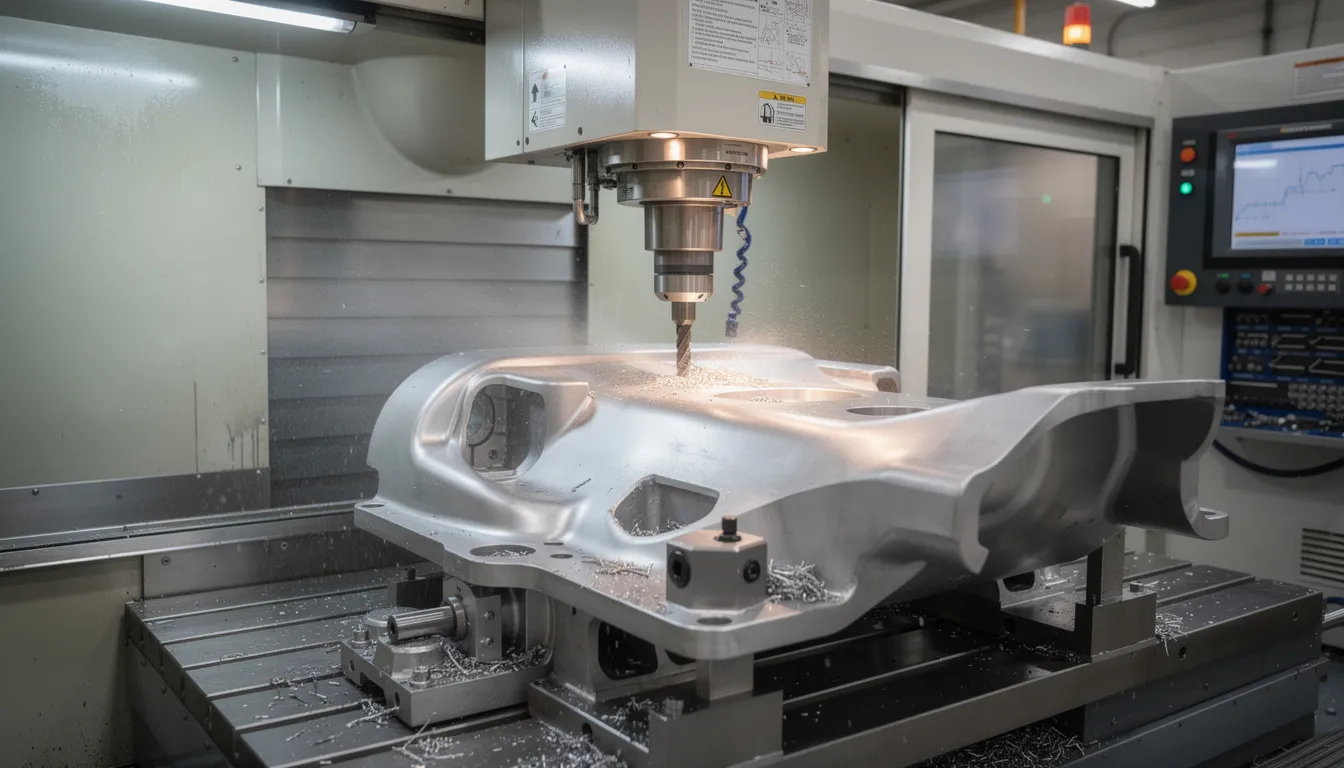
For machining, forming, and composite layup, low process capability translates directly into chronic yield loss. Consider a recurring problem with out-of-tolerance bores on landing gear components. If tool stability is marginal and the process Cpk is below 1.0, the operation will produce 15% to 20% scrap and rework at that step regardless of operator attention. The solution is not additional inspection or operator discipline but addressing the process capability gap through tooling, fixturing, or method changes.
Complex routings amplify capability issues. When a part passes through multiple special processes and inspections, yield loss at each stage compounds. A 95% yield at each of five sequential operations results in overall yield below 77%. Tracking scrap rates only at final inspection obscures where in the routing the losses actually occur.
Executives should ensure that yield and scrap are tracked by operation and by process family, not only by finished part number. This visibility enables targeted investment in process optimization, tooling upgrades, and vendor qualification where the impact is greatest. Process capability improvement is a capital allocation decision, not merely a quality function responsibility.
Nonconforming Material as a Capacity and Governance Problem
Nonconforming material control is often treated as a paperwork function, managed by quality specialists and handled through MRB procedures. In practice, NCM control is a capacity and governance discipline that affects flow, inventory accuracy, and compliance posture.
Uncontrolled NCM creates operational drag. Parts waiting for MRB disposition occupy floor space, tie up WIP inventory, and delay downstream operations. When segregation is unclear or disposition cycles are slow, the true status of work-in-process becomes uncertain. Production schedules are built on assumptions that are not aligned with actual material availability. The consequence is expedited orders, missed deliveries, and reactive firefighting that consumes management attention.
The typical MRB bottleneck reflects organizational rather than technical constraints. Engineering signoff delays, incomplete defect descriptions, and back-and-forth with design authorities or OEM customers extend disposition cycles. Each day a nonconforming part waits for disposition is a day it occupies capacity and distorts inventory reporting. Streamlining MRB processes requires clear responsibility assignments, consistent criteria for repair versus scrap versus concession, and predefined escalation paths for complex dispositions.
Governance risks accompany operational risks. Incomplete traceability, missing inspection records, and undocumented use-as-is decisions threaten AS9100 certification and regulatory compliance. Auditors, whether internal, customer, or regulatory, examine NCM handling as a leading indicator of quality management system effectiveness. Findings in NCM control often signal broader governance issues that affect the organization’s competitive position.
Consider a scenario: a batch of brackets with missing torque records arrives at final assembly. It is unclear whether re-torque is possible or whether the parts must be scrapped. The uncertainty triggers re-inspection, engineering involvement, and schedule slip. The customer escalates the issue, questioning the organization’s process discipline. What began as a documentation gap becomes a customer relationship issue with implications for future contract awards.
Disciplined NCM control, including prompt containment, clear responsibility, and consistent disposition criteria, protects both capacity and certification posture. NCM metrics belong on executive dashboards alongside delivery performance and financial results.
Containment Discipline: Protecting Programs From Cascading Scrap
Containment in aerospace refers to the rapid identification, segregation, and risk assessment actions taken when a defect or process escape is detected. Effective containment limits the scope of a quality event and prevents localized issues from becoming program-wide problems.
The near-term objectives of containment are clear: stop further escapes, protect flight safety, and prevent the spread of a defect across multiple serial numbers or lots. Containment actions must be immediate and decisive. Delay allows additional nonconforming product to be produced, shipped, or installed, increasing the eventual remediation cost.
Consider an example: in May 2024, a heat treatment load for engine mount brackets is discovered to have experienced a process deviation. The affected serials must be traced, and all potentially nonconforming material must be contained, whether in the factory, at customer facilities, or in service. The scope of the containment action depends on the quality of traceability data and the speed of the response. Weak traceability extends the containment boundary; slow response allows escapes to propagate.
Strong containment discipline requires predefined elements: clear triggers for containment actions, predefined cross-functional teams with authority to act, and standardized decision trees for determining whether inspection, rework, or recall is appropriate. These elements must be established before an event occurs, not improvised during a crisis.
The connection to program risk is direct. Weak containment can transform a localized scrap event into a fleetwide retrofit campaign. A defect that could have been contained to 50 serial numbers may spread to 500 or 5,000 if identification and segregation are slow. The financial and reputational damage scales accordingly.
Root Cause Rigor in Aerospace Scrap Reduction
In aerospace, superficial root cause analysis leads to recurring scrap on serialized, high-value parts. When the same nonconformance recurs month after month, margin erodes and customer confidence declines. Rigorous RCA is a capability that distinguishes organizations that achieve continuous improvement from those that remain stuck in reactive cycles.
Structured RCA methods are familiar in aerospace: 8D, 5-Why, fishbone (Ishikawa) diagrams, and fault tree analysis. The choice of method matters less than the rigor with which it is applied. The critical distinction is between symptom-level fixes and systemic root causes.
Symptom-level fixes address the immediate manifestation of a problem without resolving its underlying cause. Adding inspection, issuing temporary rework instructions, or increasing sample rates may reduce escapes in the short term but do not prevent recurrence. Systemic root causes require deeper investigation: process windows that are too narrow, tooling concepts that are fundamentally flawed, or specification misalignment between customer requirements and supplier capabilities.
A concrete example illustrates the distinction. Repeated concessions on fastener hole mismatch during 2022 and 2023 were initially attributed to operator variability. Additional training was provided, but concessions continued. A data-driven investigation eventually traced the issue to misinterpreted GD&T in a legacy drawing combined with inconsistent fixture datum schemes across production cells. The root cause was not operator performance but a design-manufacturing interface issue that required drawing clarification and fixture standardization.
Data-backed RCA is essential for avoiding bias and tribal explanations. Linking nonconformance codes to process parameters, supplier lots, and equipment identifiers enables pattern recognition that anecdotal analysis cannot achieve. Advanced analytics and predictive analytics can accelerate this process by surfacing correlations across large datasets.
RCA outcomes must translate to controlled change: updating process plans, re-qualifying special processes, revising training and competency requirements, and, when necessary, updating FAIs. Corrective and preventive actions that exist only in documentation without operational implementation provide no benefit. The measure of RCA effectiveness is whether the nonconformance recurs.

Governance, AS9100, and the Cost of Nonconformance
AS9100 and related aerospace quality standards are often viewed as compliance obligations. In practice, they are governance frameworks that shape how scrap and nonconformance are prevented, detected, and managed. Weak governance surfaces as quality cost; strong governance protects margin.
Key governance elements include documented configuration control, formal change management, supplier approval and monitoring, and structured handling of concessions and deviations. Each element affects COPQ outcomes. Uncontrolled design changes generate nonconformance when production builds to obsolete requirements. Inconsistent application of customer specifications leads to parts that meet internal standards but fail customer inspection. Ad hoc dispositions create precedents that are difficult to sustain under audit scrutiny.
Audit and regulatory exposure is a practical consequence of governance gaps. Incomplete traceability, missing inspection records, and inconsistent MRB decisions trigger findings from customer quality representatives, FAA Designated Engineering Representatives, or EASA auditors. These findings are not merely administrative inconveniences. They signal to customers that the organization’s quality management system may not be reliable, affecting future business and contract negotiations.
Governance is a shared responsibility across operations, quality, engineering, and program management. Treating it as solely a quality function responsibility guarantees gaps. When engineering releases changes without assessing production impact, when operations deviates from approved methods to meet schedule, or when program management accepts elevated risk without documented justification, governance erodes. The costs surface later as scrap, rework, concessions, and audit findings.
Tightening governance directly reduces chronic NCM. When change control is rigorous, configuration errors decline. When MRB criteria are consistent and well-documented, disposition cycles shorten. When supplier approval includes process capability requirements, incoming material quality improves. Governance investment is prevention investment.
From Local Fixes to a Coherent Scrap Reduction Strategy
Isolated lean projects or local quality campaigns are insufficient for sustainable aerospace scrap reduction. A coherent, cross-functional strategy is required to achieve lasting improvement.
The strategic framework for aerospace scrap reduction aligns around four pillars:
Pillar
Focus
Key Actions
Process Capability
Ensure processes can consistently meet specifications
Capability studies, tooling investment, method optimization
Governance
Maintain configuration control and change discipline
Drawing control, change management, supplier approval
Containment Discipline
Limit scope when nonconformance occurs
Rapid identification, segregation, predefined response protocols
Root Cause Rigor
Prevent recurrence through systemic correction
Data-driven RCA, controlled change implementation, effectiveness verification
A consistent set of metrics enables tracking progress and identifying areas for focus:
- Yield by process step and operation
- Rework hours as a percentage of production hours
- MRB cycle time (days from identification to disposition)
- Concession volume by part family and customer
- Internal failure cost versus external failure cost
Strategic focus should target high-leverage areas: flight-critical assemblies, bottleneck special processes, and chronic nonconformance families. Not all scrap events are equal. A 5% reduction in scrap on a high-value, long-lead titanium forging generates more margin impact than a 20% reduction on low-value standard hardware.
For multi-site organizations, standardizing definitions, codes, and escalation paths across plants is essential to understanding enterprise-level scrap impact. When each site uses different nonconformance codes or different criteria for classifying scrap versus rework, enterprise reporting becomes unreliable. Standardization enables meaningful comparison and the identification of best practices for transfer across sites.
Implications for Aerospace MRO and In-Service Operations
Scrap and nonconformance dynamics differ in MRO environments, where the asset is already in service and turnaround time is critical. The cost structures and time pressures create distinct challenges that require adapted approaches.
The cost of scrapping a repairable unit in MRO extends beyond material value. Unplanned procurement of new hardware extends turnaround time. Extended TAT may trigger AOG events, with operators unable to return aircraft to service. Contract penalties with airlines or operators compound the direct cost. The ripple effects on customer satisfaction and future business can exceed the immediate financial loss.
Repair development, repair station capability, and configuration control of service bulletins and Airworthiness Directives all affect MRO scrap rates. When repair methods are marginal, blending limits are tight, or inspection interpretations vary between shifts, scrap of otherwise serviceable components increases. Consider a CFM56 or LEAP engine shop facing repeated scrap of fan blades due to marginal blending limits and inconsistent inspection interpretations. Each scrapped blade represents both a direct loss and a potential TAT extension.
The same strategic levers apply in MRO: process capability, governance, containment, and root cause rigor. However, timelines are compressed and customer pressures are immediate. Efficient operations depend on having repair methods qualified, inspection criteria clear, and disposition authority delegated to the appropriate level. Delays that might be tolerable in OEM production become unacceptable in MRO, where every day of TAT affects customer operations.

How Connect981 Fits: Unified View of Scrap, Nonconformance, and Operational Risk
The strategic themes in this article require operational implementation. Organizations need visibility into where scrap originates, which processes drive chronic nonconformance, and how containment actions propagate across plants and suppliers.
Connect981 provides a unified operations layer that brings work instructions, nonconformance records, quality inspection data, and supplier interactions into a single view. This unified visibility supports governance, traceability, and root cause analysis by eliminating the fragmentation that characterizes many aerospace operations today. When nonconformance data, process parameters, and supplier lot information exist in disconnected systems, the data-driven RCA required for reducing scrap becomes impractical.
The platform’s focus on aerospace manufacturing and MRO enables consistent handling of serial numbers, configurations, concessions, and inspection history across plants and suppliers. Decision quality improves when leaders can see patterns across the organization rather than relying on site-by-site reporting with inconsistent definitions.
Organizations that want to explore how their current scrap and COPQ picture could be made visible at an enterprise level can request a demo of Connect981.
Conclusion: Treating Scrap as a Managed, Measured Risk
Aerospace scrap reduction is about managing financial and program risk through disciplined processes and governance. Reducing scrap is not a housekeeping exercise or an environmental initiative. It is a margin protection strategy with direct consequences for program performance, customer relationships, and competitive position.
The structural levers are clear: process capability that matches specification requirements, special process control that prevents unverifiable defects, strong NCM governance that accelerates disposition and protects traceability, containment discipline that limits the scope of quality events, and root cause rigor that prevents recurrence.
Future articles in this series will address detailed COPQ modeling methods, advanced root cause analysis techniques for aerospace applications, special process qualification strategies, and AS9100-aligned governance structures. Each topic connects to the framework established here.
For executives, the call to action is straightforward: treat scrap and nonconformance data as core performance indicators, reviewed at the same cadence as schedule adherence and EBITDA. The organizations that achieve operational excellence in aerospace are those that treat cost of poor quality as a strategic variable they intentionally design and govern, not as an unavoidable cost of doing business.