Category: Uncategorized

  • Corrective and Preventive Action (CAPA) Best Practices for Aerospace Non-Conformances

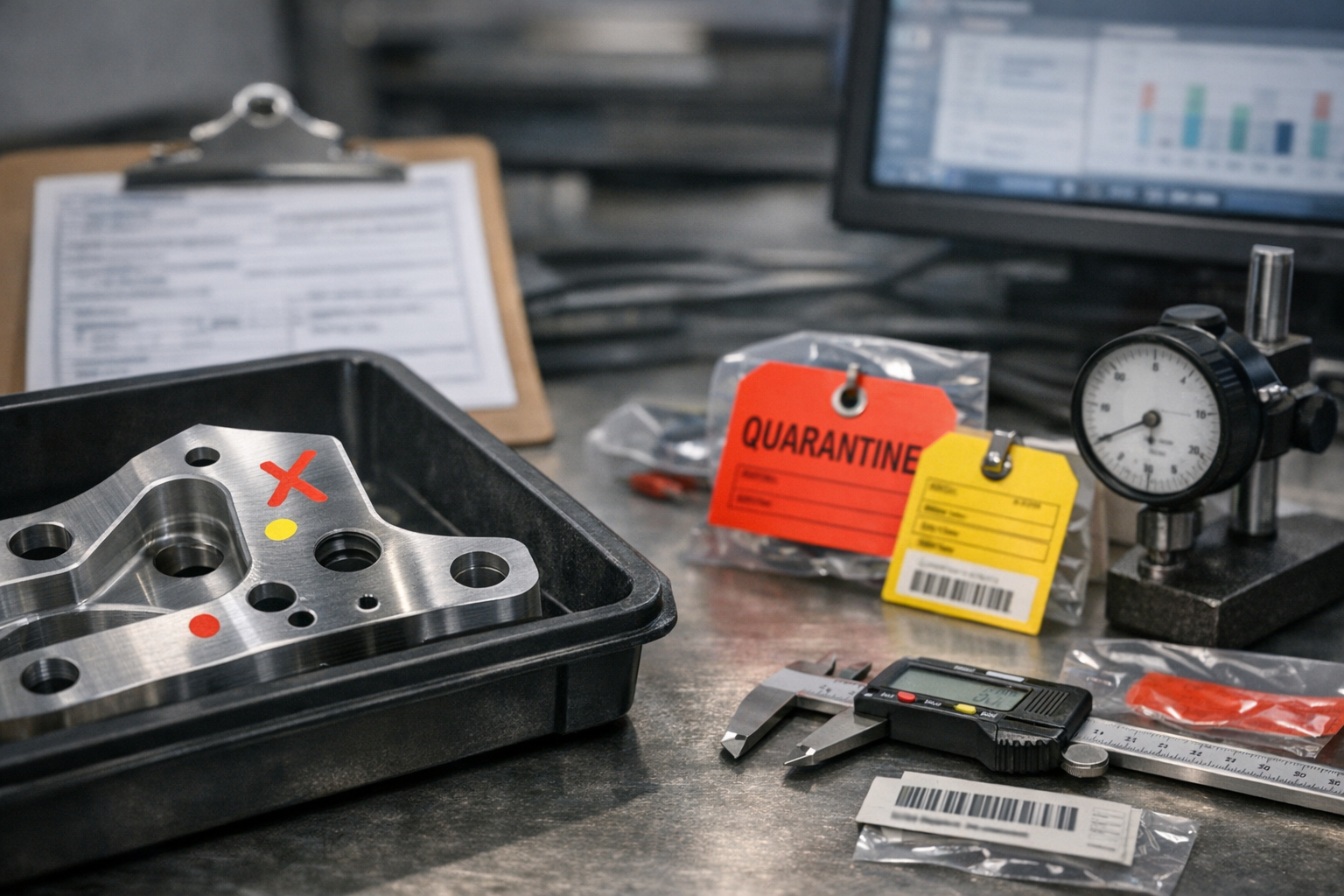
    In aerospace manufacturing, a single non-conformance can ground an aircraft program, trigger regulatory attention, or disrupt delivery schedules for weeks. Corrective and preventive action (CAPA) is the mechanism that turns these events into structured, traceable improvement. When CAPA is weak, repeat issues proliferate, audit exposure grows, and non-conformance cycles drag on. When it is designed well—supported by data, clear ownership, and digital workflows—CAPA becomes a core engine of continuous improvement.

    This article is for aerospace operations, quality, and compliance teams who need to understand Corrective and Preventive Action (CAPA) Best Practices for Aerospace Non-Conformances. It explains the practical question this topic answers in a manufacturing execution context.

    This article outlines aerospace CAPA best practices: when to escalate from an NCR, how to structure the process, what effective actions look like, how to verify results, and how digital tools support non-conformance management across aerospace operations at scale.

    For teams putting this topic into daily operation, non-conformance management, quality management workflows, a connected execution platform help connect the concept to traceability, work-order reality, and audit-ready evidence.

    The same operating model also depends on Connect 981’s aerospace execution solutions, real aerospace execution examples, Connect 981’s aerospace operations guidance, practical aerospace operations FAQs, especially when decisions have to move across quality, production, suppliers, and program leadership without losing context.

    The Role of CAPA in Aerospace Quality Systems

    How CAPA Relates to Non-Conformance Management

    Non-conformance reports (NCRs) capture discrete deviations from requirements—dimensional out-of-tolerance conditions, missing process records, unapproved configuration, or test failures. CAPA sits on top of this workflow as the formal problem-solving layer that asks: why did this issue occur, and how do we prevent it from happening again, either here or elsewhere?

    In a mature aerospace quality system, every NCR does not automatically generate a CAPA. Instead, NCRs are triaged and analyzed for patterns. CAPA is reserved for significant, recurring, or high-risk problems that warrant a structured investigation, cross-functional involvement, and documented long-term actions. The CAPA record then references the underlying NCRs, audit findings, or customer complaints that triggered it, providing full traceability.

    Regulatory, AS9100, and Customer Expectations

    AS9100 requires organizations to investigate causes of nonconformities, implement actions to prevent recurrence, and review the effectiveness of those actions. Regulators and major OEM customers expect that significant findings—especially those with potential safety, airworthiness, or configuration impact—are handled through a disciplined CAPA process, not informal fixes.

    Practically, this means aerospace manufacturers must be able to show auditors:

    • Clear linkage between a problem (NCR, audit, customer escape) and the associated CAPA.
    • Documented root cause analysis that goes beyond operator error.
    • Defined corrective and preventive actions with owners and due dates.
    • Evidence that changes were implemented and their effectiveness verified.

    Customer-specific clauses often tighten expectations, such as maximum response times for containment, mandatory use of structured methods like 8D, or specific reporting formats for safety-critical issues.

    When an NCR Should Escalate to a Formal CAPA

    Not every non-conformance needs a CAPA. Over-escalation clogs the system and delays truly critical work; under-escalation leads to repeat incidents and audit risk. Effective aerospace organizations apply simple, explicit criteria to determine when a CAPA is required. Typical triggers include:

    • Safety or airworthiness impact, or potential to affect flight-critical functions.
    • Customer escapes—issues detected at the customer or in the field.
    • Regulatory findings (authority audits, oversight inspections).
    • Repeat occurrences of similar NCRs across lines, shifts, or sites.
    • Systemic signals: multiple NCRs pointing to common processes, tooling, or suppliers.

    A risk-based escalation matrix that considers severity, occurrence, and detectability helps teams decide when a non-conformance stays at the NCR level and when it requires a formal CAPA project with cross-functional involvement.

    Structuring an Effective CAPA Process

    Standard Stages: Containment, Root Cause, Action, Verification

    Most effective aerospace CAPA workflows share a common structure, even if terminology varies by site or system. A clear stage model avoids confusion and supports consistent execution across programs and suppliers. A typical structure includes:

    • 1. Containment: Immediate actions to protect the customer and production flow—segregating suspect material, placing work orders on hold, issuing stop work for affected operations, and defining inspection or test expansions.
    • 2. Problem Definition: Precise, data-backed description of the issue. This includes affected part numbers, serials or lot IDs, processes, documents, and detection points.
    • 3. Root Cause Analysis: Structured analysis of the true causes (technical and systemic), not just the symptoms observed on the floor.
    • 4. Corrective Actions: Measures to eliminate the root cause and prevent recurrence for the same process, part, or configuration.
    • 5. Preventive Actions: Measures to extend the learning—e.g., applying controls to similar processes, related programs, or sister facilities.
    • 6. Effectiveness Verification: Planned checks and metrics to confirm the problem does not reappear and that the system change is sustained.

    A digital workflow that enforces these stages, with required fields and approvals, reduces variability and gives leaders consistent visibility into CAPA progress.

    Defining Roles and Responsibilities

    Aerospace CAPA typically involves multiple functions: quality engineering, manufacturing engineering, design engineering, production, supply chain, and sometimes field support. Without clear ownership, actions stall, investigations remain superficial, and audit readiness suffers. A RACI-style assignment for each CAPA stage is particularly useful:

    • CAPA owner: Usually a quality or manufacturing engineer responsible for coordination, schedule, and documentation.
    • Investigators: Functional experts (e.g., design engineers for configuration or stress issues, process engineers for manufacturing defects, supplier quality for vendor-related non-conformances).
    • Approvers: Quality leadership, program management, and, where needed, design authority or delegated signatories.
    • Implementers: Line supervisors, trainers, document control, and IT/automation teams who execute process, training, tooling, or system changes.

    Defining these roles in the CAPA procedure and embedding them in workflow rules (e.g., routing based on part family, process, or customer) prevents ambiguity and improves response times.

    Risk-Based Prioritization of CAPA Projects

    Most aerospace organizations have more potential CAPAs than resources to execute them simultaneously. Risk-based prioritization avoids a first-in-first-out queue that ignores criticality. Criteria typically include:

    • Impact on safety, airworthiness, or regulatory compliance.
    • Impact on key customers, strategic programs, or fielded fleet.
    • Frequency of occurrence and trend across lines or suppliers.
    • Cost and schedule impact—scrap, rework, AOG events, delayed deliveries.

    Prioritization should be visible in CAPA dashboards so management can reallocate engineering and quality resources as risks shift. Digital systems that score CAPAs based on configured rules help ensure critical work is not buried under low-impact items.

    Writing Strong Corrective and Preventive Actions

    Avoiding Vague or Person-Dependent Actions

    One of the most common weaknesses in aerospace CAPA is actions that depend on individuals rather than systems: “retrain operator,” “remind inspector,” or “be more careful.” These may be necessary in the short term but rarely change underlying conditions. Effective actions are specific, observable, and verifiable. For example:

    Clarify the operational risk

    When the work behind Corrective and Preventive Action (CAPA) affects quality, delivery, or compliance, teams need one place to connect evidence, decisions, and shop-floor follow-through.

    Map the risk in Corrective and Preventive Action (CAPA)

    • Instead of “retrain inspectors,” specify “update inspection work instruction WI-123 to include gage set-up checklist and require sign-off; train all inspectors on revision C by [date].”
    • Instead of “tighten documentation discipline,” specify “modify MES routing to block operation close-out until torque value field is completed and verified by barcode scan.”

    Action descriptions should clearly state what will change, where it applies, who owns it, and how completion will be evidenced in the digital record.

    Addressing Process, Design, Training, and Supplier Factors

    Root causes in aerospace rarely belong to a single category. A robust CAPA portfolio covers multiple levers:

    • Process: Changes to routings, parameter limits, inspection plans, process FMEAs, tooling, or fixtures.
    • Design: Drawing clarifications, tolerance adjustments (with rigorous justification), interface definitions, and configuration baselines.
    • Training and Competence: Updating curricula, qualification requirements, or recurring assessments for sensitive operations (e.g., special processes, NDT).
    • Supplier and External: Flow-down of requirements, updated specifications or quality clauses, supplier process audits, or dual sourcing strategies.

    During CAPA review, leaders should ask whether actions address only local symptoms or also the system-level contributors: planning, tooling standardization, data visibility, or supplier controls.

    Ensuring Feasibility and Clear Ownership

    Actions that look good on paper but are impractical in the plant or supply chain will either never be implemented or will be quietly bypassed. Feasibility checks should consider:

    • Required downtime for implementation and validation.
    • Impact on takt time and station cycle times.
    • Availability of required skills, test equipment, or IT changes.
    • Change management for planning, tooling, and configuration documentation.

    Each action must have a named owner and a realistic due date aligned with program schedules. In digital CAPA systems, owners should receive automated tasks and reminders, and management dashboards should highlight late or at-risk actions for escalation.

    Verifying and Sustaining CAPA Effectiveness

    Verification Plans and Success Criteria

    Verification is where many CAPAs fail. Closure is granted based on completion of tasks, not on demonstrated reduction of risk. To avoid this, define verification plans and success criteria when creating the CAPA, not at the end. A good plan answers:

    • What metrics or signals will show that the issue has not recurred?
    • Over what period or volume of production will we observe?
    • What specific records, inspections, or test results will we review?

    Examples include zero recurrence of a defect over a defined number of units or hours, stable yield above a target level, audit results confirming proper use of new work instructions, or process data demonstrating control within revised limits.

    Monitoring Over Time for Recurrence

    Complex aerospace products often have long cycle times, and some failure modes may only surface in downstream tests or in the field. Short verification windows are rarely sufficient. Instead, organizations should:

    • Tag NCRs, test records, and field events with relevant CAPA identifiers.
    • Use dashboards and trend charts to watch for re-emergence of similar issues across lines and sites.
    • Require periodic CAPA reviews for high-criticality issues, even after formal closure, especially during ramp-ups or configuration changes.

    Data integration between MES, QMS, test systems, and field support improves the ability to detect weak signals early and re-open or extend CAPAs when necessary.

    Closing CAPAs with Documented Evidence

    CAPA closure should be a deliberate decision, supported by objective evidence rather than elapsed time. Typical closure evidence includes:

    • Records of implemented process or document changes (revised routings, work instructions, or control plans).
    • Training completion logs and competence assessments for affected roles.
    • Before/after metrics showing improved yield, reduced scrap, or absence of specific defects.
    • Results of targeted audits or inspections confirming adherence to new standards.

    Auditors and customers often sample closed CAPAs during assessments. A well-structured digital record—linking underlying NCRs, design changes, supplier responses, and verification data—demonstrates control and maturity.

    Digitizing CAPA Workflows in Aerospace

    Linking CAPAs to NCRs, Audits, and Risks

    Effective aerospace CAPA requires a unified view across quality events. This is difficult when NCRs live in spreadsheets, audit findings in separate tools, and risk registers in static documents. A digital manufacturing quality platform should allow CAPAs to be:

    • Initiated directly from NCRs, internal audits, customer findings, or FMEA outputs.
    • Linked to specific part numbers, serial numbers, work orders, and configurations.
    • Associated with risk assessments so that controls are updated consistently.

    This connectivity supports traceability: when a regulator or OEM asks how you mitigated a particular risk, you can show the related CAPA, its implementation status, and resulting performance trends.

    Dashboards to Monitor CAPA Status and Backlog

    Without real-time visibility, CAPA portfolios quickly become unmanageable. Leaders need dashboards that provide:

    Connect decisions to execution

    Connect 981 helps turn this kind of operational detail into traceable action, so the context behind each decision does not get lost.

    Discuss the workflow for Corrective and Preventive Action (CAPA)

    • Counts and aging of open CAPAs by criticality, program, and site.
    • Stage distribution (containment, analysis, implementation, verification) to identify bottlenecks.
    • On-time completion rates for actions and verification activities.
    • Heat maps of repeat issues by process or supplier.

    These insights enable proactive management instead of end-of-quarter firefighting. In environments with multiple sites or complex supply chains, standardized KPIs across locations support consistent governance.

    Cross-Site Sharing of Lessons Learned

    Many aerospace manufacturers build similar components across multiple sites or suppliers. When a CAPA at one facility identifies an effective control, the benefit multiplies if the lesson is shared and applied elsewhere. Digital systems can support this by:

    • Tagging CAPAs with technology, process, and product families.
    • Providing search and reporting on resolved CAPAs for use in design reviews, PFMEAs, and new line launches.
    • Allowing controlled replication of actions—e.g., copying a proven inspection enhancement into routings for comparable parts at other sites.

    This turns CAPA from a purely local problem-solving tool into an enterprise knowledge asset that strengthens the overall aerospace production network.

    Common CAPA Pitfalls and How to Avoid Them

    Superficial Root Cause Statements

    “Operator error” and “did not follow procedure” are red flags in aerospace CAPA. They rarely satisfy auditors or prevent recurrence. To avoid superficiality:

    • Require structured analysis methods (e.g., 5 Whys, cause-and-effect diagrams, fault tree analysis) for significant CAPAs.
    • Challenge teams to identify systemic contributors—unclear instructions, poor ergonomics, missing error-proofing, insufficient training criteria, or inadequate system validations.
    • Use cross-functional reviews to test whether the stated root cause would reasonably lead to the observed pattern of non-conformances.

    Over time, organizations can build libraries of common root cause categories aligned with aerospace realities—special process controls, configuration errors, tooling variation, data integration gaps—to prompt more rigorous analysis.

    Actions That Fail to Address System Causes

    Even when the root cause analysis is sound, actions often remain focused at the local level. For example, a torque miss might lead only to local training, when the deeper issue is that the MES does not enforce data entry or gage calibration tracking. To counter this, CAPA reviews should explicitly ask:

    • Have we addressed the process or system feature that allowed the error?
    • Could similar failures occur in other cells, lines, or suppliers using the same tools or documents?
    • Have we updated relevant risk assessments (e.g., PFMEA) and control plans to reflect the learning?

    Embedding these questions into digital approval workflows helps drive actions that strengthen the underlying aerospace production system, not just the point of failure.

    Premature Closure Without Adequate Verification

    Closing CAPAs purely based on task completion is risky in aerospace. Pressure to reduce backlogs can lead to early closure before meaningful data is collected. To avoid this pitfall:

    • Make verification criteria mandatory fields when creating the CAPA, not optional at closure.
    • Link CAPA verification to live data sources where possible—NCR trends, test yields, escape rates—rather than anecdotal reports.
    • Require independent review (e.g., quality management) to confirm that verification evidence matches predefined criteria.

    For high-severity issues, consider staged closure: provisional closure after initial verification, followed by scheduled reviews during program milestones or configuration changes.

    Integrating CAPA with Digital Non-Conformance Management

    CAPA effectiveness is heavily influenced by how well it is connected to day-to-day non-conformance handling. When NCR creation, disposition, and CAPA initiation all occur in a unified digital environment, organizations gain:

    • End-to-end traceability from detection through resolution and verification.
    • Consistent data structures for part IDs, serials, work orders, and configurations.
    • Faster pattern recognition across plants and suppliers, enabling earlier CAPA triggers.

    Platforms that integrate NCRs, CAPAs, engineering changes, and supplier responses into a single digital thread align well with AS9100 expectations and reduce the burden of audit preparation. They also provide a foundation for analytics that identify where additional CAPAs—or preventive design and process changes—will yield the greatest risk reduction.

    For aerospace manufacturers looking to move beyond reactive firefighting, strengthening CAPA within a unified non-conformance management and quality workflow is a high-leverage step toward more predictable, compliant, and efficient operations.
  • ISO 22400 KPI Governance: Keeping Metrics Consistent Across Time and Sites

    ISO 22400 gives aerospace manufacturers a shared language for manufacturing KPIs, but it does not tell you how to keep those KPIs trustworthy as systems, programs, and plants evolve. That requires governance: clear ownership, robust data quality controls, versioning, and auditability around every KPI that influences production decisions, compliance reporting, or supplier performance management. When this governance is missing, the same KPI name can mean different things in different factories, and leadership can no longer rely on cross-site comparisons.

    For aerospace and defense programs operating under AS9100, tight configuration control, traceability, and repeatable decision logic are non‑negotiable. Applying an ISO 22400 manufacturing KPI framework without governance leaves too much to interpretation: data mappings drift, new dashboards appear without review, and suppliers report inconsistent values. This article outlines how to put practical governance around ISO 22400‑aligned KPIs in a connected aerospace manufacturing environment.

    Why ISO 22400 Alone Is Not Enough for KPI Reliability

    The gap between conceptual definitions and real-world data

    ISO 22400 defines KPI concepts such as availability, utilization, and order execution reliability in a technology‑neutral way. In a real aerospace factory, those concepts are instantiated through MES events, NC program states, machine signals, quality records, and ERP order data. Every mapping from a real data field to a conceptual time or quantity element is an implementation choice—and that is where divergence begins.

    For example, two composite layup cells might both report an “availability” KPI aligned to ISO 22400. One site may classify operator setup time as planned production time; another may treat it as a separate state. Both claim ISO 22400 compliance, but the values are not comparable. The standard alone cannot resolve these differences; governance must define and document how local data is interpreted, and how exceptions (such as manual rework steps or engineering holds) are captured in the time model.

    Risk of KPI drift without governance

    In long‑lived aerospace programs, production systems and data sources evolve. A new MES release changes state codes, a different test stand is introduced, or a supplier portal is added. Unless there is explicit change control, KPIs can “drift” over time: the label and dashboard stay the same, but the underlying logic quietly changes.

    This KPI drift undermines trend analysis and audits. A plant manager may believe that scrap rate has improved year‑over‑year, when in reality the definition was relaxed or a failure category was reclassified. In a regulated environment, such silent changes raise uncomfortable questions: was a certification report built on a stable definition, and can the organization reconstruct prior logic if an authority asks? ISO 22400 clarifies what a scrap‑related KPI should mean in principle; governance ensures that meaning remains stable and transparent in practice.

    Assigning Ownership for KPI Definitions and Data

    RACI for KPI design, maintenance, and use

    Robust KPI governance starts with unambiguous ownership. Each ISO 22400‑aligned KPI should have a named owner, typically at the plant or program level, who is accountable for the definition, its correct implementation, and its ongoing suitability. A simple RACI (Responsible, Accountable, Consulted, Informed) model helps prevent gaps and overlap:

    • Responsible: Process or manufacturing engineering defines how the conceptual KPI maps to operations (states, events, orders, and quantities).
    • Accountable: A production or operations leader signs off that the KPI is fit for decision‑making and aligned with program goals.
    • Consulted: Quality, supply chain, and program management provide input on how the KPI will be used for compliance, supplier evaluation, or contract reporting.
    • Informed: Cell supervisors, planners, and analysts who consume KPI outputs in day‑to‑day work.

    Formalizing this RACI in a KPI catalog prevents classic failure modes, like IT quietly changing an ETL job to fix a performance issue while inadvertently breaking the KPI logic, or a supplier quality team redefining “on‑time delivery” locally without updating cross‑site reports.

    Role of IT, operations, and finance in KPI governance

    In aerospace manufacturing, KPI governance intersects multiple functions:

    • IT / digital manufacturing teams implement the data pipelines, MES configurations, historian tags, and reporting tools that operationalize ISO 22400 concepts. They are stewards of technical correctness and data lineage.
    • Operations and engineering ensure that the mapping from machine states, work orders, and routings to ISO 22400 time and quantity structures reflects reality on the shop floor, including complex flows such as rework, partial assemblies, and serialized part swaps.
    • Finance and program control care about how KPIs link to cost models, learning curves, and contract deliverables. They need confidence that site‑to‑site comparisons and long‑term trends reflect consistent logic.

    Effective KPI governance bodies—including a cross‑functional KPI board or steering group—bring these perspectives together. That group owns the KPI catalog, approves new KPIs, arbitrates conflicts, and ensures that changes are implemented consistently across plants and suppliers where common reporting is required.

    Data Quality Management for ISO 22400 KPIs

    Validation rules for time, quantity, and state data

    ISO 22400 assumes that underlying data is coherent: time intervals do not overlap incorrectly, quantities reconcile, and state transitions are logically possible. In an aerospace production environment with complex routings, long cycle times, and serialized components, that assumption must be actively maintained.

    Practical data quality controls for ISO 22400 KPIs often include:

    • Time continuity checks: No overlapping equipment states for the same resource; no gaps that exceed predefined thresholds without a known reason (e.g., scheduled shutdown).
    • State transition validation: Only allowed transitions are permitted (e.g., RUN → STOP → MAINT, but not RUN → MAINT without STOP), aligned with the plant’s state model.
    • Quantity reconciliation: For each operation, the relationship between input quantity, good output, nonconforming quantity, and scrap is consistent with routing logic and quality records.
    • Order lifecycle checks: Start and finish timestamps exist for every order phase expected in the KPI scope; no negative or impossibly short durations relative to process physics.

    These rules are best implemented close to the data source—in MES, data integration layers, or a dedicated industrial data platform—so that invalid data is detected before it propagates into KPI dashboards and regulatory reports.

    Detecting anomalies and missing data

    Beyond basic validation, aerospace manufacturers benefit from anomaly detection tailored to ISO 22400 structures. Because the standard organizes KPIs around time categories and quantities, deviations in those patterns can highlight either process issues or data defects.

    Examples include:

    • Unusual state distributions: A test stand showing 95% RUN time during a known maintenance window suggests missing downtime events.
    • Zero‑variance KPIs: An equipment utilization KPI that is exactly 85% for weeks across multiple shifts is likely driven by a static default or failed data feed.
    • Missing segments: Serial‑numbered assemblies with production history gaps (e.g., no recorded inspection step for a mandatory operation) may indicate integration failures between MES and QMS.

    Flagging such anomalies and routing them to data stewards or cell leaders is part of KPI governance. ISO 22400 provides the semantic structure; governance defines what constitutes a suspicious pattern and how it is resolved to maintain trust in cross‑plant reporting.

    Versioning and Change Control for KPIs

    Tracking changes in definitions and mappings

    In aerospace and defense, configuration management disciplines applied to hardware and software should also apply to KPIs. Every ISO 22400‑aligned KPI needs a controlled definition, including version history, approval dates, and rationale for changes. This avoids confusion when auditors or program teams compare data across time.

    A practical pattern is to maintain a centralized KPI registry or catalog with the following for each KPI:

    • A stable identifier and current name.
    • Link to the relevant ISO 22400 concept(s) and formal description.
    • Explicit formula, data sources, state mappings, and filters (e.g., which work centers or part families are included).
    • Version number, effective date, and change log describing what was modified (for example, introduction of a new downtime category or reclassification of rework).
    • Impact analysis notes indicating which dashboards, plants, and reports are affected.

    When a version change is significant—for instance, redefining how planned vs. unplanned downtime is separated—governance should support running both the old and new definition in parallel for a period. This allows stakeholders to understand breakpoints in trend lines and update targets and contracts accordingly.

    Communicating KPI changes to stakeholders

    Change control is only effective if it is visible. In a multi‑site aerospace environment, KPI changes can affect tier‑1 supplier scorecards, internal incentive metrics, and reports used in customer or authority communications. Governance should define communication paths and timing for different types of changes.

    Typical practices include:

    • Requiring a formal change request and impact assessment for any KPI definition change that affects more than one cell or plant.
    • Publishing release notes when KPI logic is updated, ideally alongside the analytics portal or MES dashboards where users see the KPIs.
    • Training for supervisors and planners when changes alter how they should interpret utilization, cycle time, or quality‑related KPIs.
    • Flagging historical charts with visual markers at the date of major KPI definition changes, so users are not misled by apparent discontinuities.

    This level of transparency supports informed decision‑making, reduces disputes over performance trends, and provides clear evidence during internal and external reviews that KPI changes are managed systematically.

    Auditability and Compliance Considerations

    Retaining evidence for KPI calculations

    For aerospace organizations working under AS9100 and similar frameworks, it is not enough to report a KPI value; you must also be able to demonstrate how that number was produced. Auditability for ISO 22400‑aligned KPIs means retaining a chain of evidence from raw events to final figures.

    Key elements include:

    • Data lineage: The ability to trace a KPI back to specific MES events, machine states, quality records, and orders that contributed to the calculated value.
    • Transformation logic: Documented and version‑controlled ETL jobs, calculation scripts, or report definitions that show how raw data is transformed into ISO 22400 time categories and quantities.
    • Context data: Associated configuration (such as routing revisions, NC program versions, and work instructions) that may explain changes in KPI behavior over time.

    Platforms that maintain an industrial data model aligned to ISO 22400 can help by structuring these connections explicitly, but governance defines the retention policies and the level of traceability required for each KPI, especially where metrics feed into regulatory submissions or contract deliverables. Organizations should consult their legal and compliance teams when defining these policies; the governance practices described here do not constitute legal advice.

    Supporting internal and external audits

    During internal audits or external assessments by customers or authorities, KPI governance often comes under scrutiny. Auditors may ask not only what the current OEE or on‑time delivery performance is, but also how the organization ensures the numbers are consistent, controlled, and repeatable.

    Well‑governed ISO 22400 KPIs allow you to:

    • Show a clear mapping from the standard’s conceptual definitions to your plant‑specific state model and systems.
    • Demonstrate that KPI definitions are approved, versioned, and applied consistently across relevant sites.
    • Reproduce historical KPI values or explain why they differ given definition changes or data corrections.

    This reduces the risk that audits uncover conflicting KPI definitions between sites, or that program stakeholders challenge performance reports because the underlying logic is undocumented or opaque.

    Templates and Processes for Sustainable KPI Governance

    Definition templates and approval workflows

    To make ISO 22400 KPI governance sustainable, aerospace manufacturers benefit from standard templates and lightweight workflows rather than ad‑hoc documents. A KPI definition template can ensure that each KPI captures the information needed for consistent implementation and review.

    Typical fields in such a template include:

    • KPI name, identifier, and related ISO 22400 reference.
    • Business purpose and primary decision‑makers who use the KPI.
    • Scope (plants, programs, part families, work centers) and aggregation level (work unit, line, area, site).
    • Data elements and systems used: MES events, historian tags, ERP orders, QMS records, and supplier portals.
    • Formula, time horizon, and filtering rules.
    • Known limitations or caveats (for example, certain legacy lines not yet integrated).

    The approval workflow can mirror engineering change processes: a request, impact analysis, cross‑functional review, and final approval by the KPI board. Digital manufacturing platforms can embed this workflow so that no new KPI appears in production dashboards without going through the defined gate.

    Governance metrics for your KPI program

    Finally, organizations can—and should—measure the health of their KPI governance itself. These meta‑metrics are not part of ISO 22400, but they help ensure that the ISO 22400‑aligned KPI framework remains credible across aerospace plants and suppliers.

    Examples of governance metrics include:

    • Coverage: Percentage of production‑critical KPIs registered in the KPI catalog with complete definitions and ownership assigned.
    • Compliance: Share of active dashboards and reports that use only approved KPI definitions and data sources.
    • Change discipline: Ratio of KPI definition changes executed through the formal workflow versus ad‑hoc changes detected in production.
    • Data quality: Number of KPI‑blocking data quality incidents per period, and mean time to resolution.

    Tracking these metrics makes KPI governance tangible and allows leadership to prioritize investments in integration, master data, and process improvements. In a connected aerospace manufacturing environment—where MES, ERP, PLM, and QMS are all feeding into a shared KPI layer—this governance becomes an essential part of the digital thread, ensuring that performance data is as rigorously controlled as the hardware it represents.

  • Designing Dashboards with ISO 22400 KPIs: Examples and Patterns

    ISO 22400 can improve dashboard design by giving manufacturing teams a consistent way to name, group, and describe performance indicators. In aerospace manufacturing, that consistency matters because operators, manufacturing engineers, quality teams, and plant management often look at the same production system from very different decision horizons. A well-designed ISO 22400 KPI definitions used in dashboards approach helps each role see the right metrics without changing what those metrics mean.

    This article is for aerospace operations, quality, and compliance teams who need to understand Designing Dashboards with ISO 22400 KPIs: Examples and Patterns. It explains the practical question this topic answers in a manufacturing execution context.

    This is especially useful in regulated environments where production visibility, traceability, and comparability across lines or sites must be defensible. ISO 22400 does not prescribe dashboard layouts, color schemes, or chart types. What it does provide is a reference model for KPI meaning, time behavior, units, and user context. That makes it a strong foundation for tool-agnostic dashboard design in MES, BI, historian, and operations reporting systems.

    For teams putting this topic into daily operation, ISO 22400 KPI governance help connect the concept to traceability, work-order reality, and audit-ready evidence.

    For teams putting this topic into daily operation, a connected execution platform, Connect 981’s aerospace execution solutions, real aerospace execution examples help connect the concept to traceability, work-order reality, and audit-ready evidence.

    The same operating model also depends on Connect 981’s aerospace operations guidance, practical aerospace operations FAQs, ISO 22400 KPI governance, especially when decisions have to move across quality, production, suppliers, and program leadership without losing context.

    The examples below are illustrative design patterns, not requirements of the standard. The goal is to show how aerospace manufacturers can build clearer dashboards for operators, engineers, and managers while keeping KPI labels and interpretations aligned.

    Why Standardized KPI Definitions Matter for Dashboards

    Reducing confusion over similar-looking metrics

    Many dashboard problems start with metrics that appear similar but are defined differently across systems. One screen may show uptime, another availability, and a third utilization, even though users assume they mean the same thing. In practice, those values may rely on different state models, time exclusions, or quantity assumptions.

    Using ISO 22400 as a reference reduces that ambiguity. If a dashboard presents a KPI with a standard-aligned name, description, and unit, the user has a better chance of understanding what is included, what is excluded, and how to compare it with another view.

    Making cross-plant dashboards reliable and comparable

    Aerospace manufacturers often need to compare performance across cells, programs, suppliers, or sites. Those comparisons are only useful when the KPI definitions are stable. A plant-level dashboard that aggregates work center data from multiple facilities can become misleading if each facility classifies states or labels losses differently.

    Standardized definitions create a shared reporting baseline. That is particularly important for enterprise manufacturing teams trying to understand whether variation reflects actual operational differences or only reporting inconsistencies.

    Using ISO 22400 as a reference for labels and descriptions

    Even when an organization uses custom calculations or aerospace-specific supplemental metrics, ISO 22400 can still guide the descriptive layer of the dashboard. KPI names, tooltips, metadata panels, and data dictionaries can reference standardized concepts so users know whether a metric is equipment-oriented, order-oriented, time-based, or quantity-based.

    This improves handoffs between operations, industrial engineering, and compliance teams. It also supports cleaner integration between MES, ERP, QMS, and site reporting tools.

    Design Principles for ISO 22400-Aligned Dashboards

    Clear naming and tooltips with standardized definitions

    The first principle is simple: every KPI tile, chart, or table should use explicit naming. Avoid abbreviations unless the user group is already trained on them. Where possible, include a hover tooltip or details panel that explains the KPI definition, unit of measure, aggregation level, and reporting period.

    For example, a dashboard should not just show a value labeled performance. It should indicate whether that is an equipment-oriented KPI, what time basis it uses, and whether it applies to a work unit, production line, or plant summary. In regulated aerospace environments, this level of clarity also helps when metrics are reviewed during audits, quality investigations, or supplier performance discussions.

    Consistent units, ranges, and trend directions

    Users should not have to guess whether higher is better, whether a metric is expressed as a percentage or absolute duration, or whether a chart compares hours, parts, or orders. ISO 22400 concepts support more disciplined KPI presentation by encouraging consistent attributes around units and trend interpretation.

    In practice, this means dashboards should standardize how percentages are displayed, how durations are rounded, and how red-yellow-green logic is applied. If one KPI improves when it rises and another improves when it falls, the trend indicators should make that explicit rather than relying on user memory.

    Clarify the operational risk

    When the work behind Designing Dashboards with ISO 22400 affects quality, delivery, or compliance, teams need one place to connect evidence, decisions, and shop-floor follow-through.

    Map the risk in Designing Dashboards with ISO 22400

    Separating real-time views from aggregated performance views

    One common design mistake is mixing live operational status with shift, weekly, or monthly performance in the same visual block. Real-time equipment states answer immediate execution questions. Aggregated KPIs answer performance review questions. They should support one another, but they should not be confused.

    A useful pattern is to separate dashboards into at least two layers: a live operating view and a summarized performance view. The live layer can show current state, alerts, and active disruptions. The summary layer can show trends, comparisons, and loss structures over a completed period. This keeps decision-making aligned with the actual time horizon.

    Dashboards for Operators and Shift Supervisors

    Focusing on equipment states and immediate KPIs

    Operator-facing dashboards should emphasize what requires action now. In an aerospace machining, assembly, or test environment, this usually means current equipment state, order status, queue condition, and short-horizon KPIs tied to immediate execution. The user should be able to identify whether a station is running, idle, stopped, or producing below expected pace without opening a second report.

    A practical layout is a top row of state tiles by work unit, followed by a small set of shift KPIs such as good quantity, stop duration, schedule adherence, or quality exceptions. The screen should privilege speed of interpretation over analytical depth.

    Visual cues for downtime, speed loss, and quality issues

    Supervisors benefit from cues that distinguish different loss types instead of combining them into one generic exception state. A downtime banner can separate planned from unplanned events. A speed-loss indicator can show when a process is running but below expected output. A quality panel can flag held units, inspection failures, or rework events requiring immediate coordination with quality personnel.

    These cues are especially valuable in aerospace production, where nonconformance response and material segregation may be just as important as throughput. The dashboard should help the team see where flow is disrupted without oversimplifying the operational context.

    Using state-based indicators aligned with ISO 22400

    ISO 22400 concepts are helpful here because operator dashboards often depend on state classifications more than on high-level rolled-up metrics. If the dashboard consistently maps RUN, STOP, IDLE, or similar state categories into defined time structures, users can trust that the shift summary is based on the same logic as the real-time display.

    An example pattern is a left-side live state panel, a center shift timeline of state transitions, and a right-side exception list tied to open orders or quality events. This works well in control rooms, supervisor stations, and digital production boards.

    Dashboards for Engineers and Continuous Improvement Teams

    Deeper breakdowns of time and quantity categories

    Engineering and continuous improvement users need more than live status. They need to understand how KPI values were formed. That means dashboards for these roles should support breakdown analysis across time categories, quantity categories, equipment groups, and product families.

    A good engineering dashboard typically starts with a summary KPI layer, then offers drill-downs into the time model behind those KPIs. For example, a team reviewing a composite layup area or precision assembly line may want to trace reduced performance to waiting time, setup patterns, recurring micro-stops, or inspection bottlenecks.

    Correlations among related ISO 22400 KPIs

    ISO 22400 KPIs should not be treated as isolated numbers. Many are related through common time and quantity structures, so dashboard design should make those relationships visible. If one KPI deteriorates, users should be able to see adjacent indicators that explain whether the issue is state-related, quality-related, or order-related.

    A useful pattern is a dashboard that pairs trend charts with decomposition views. For example, a weekly equipment effectiveness trend can sit above a stacked time-loss chart and a quality yield panel. This allows engineers to evaluate whether changes are driven by downtime concentration, reduced operating performance, or rising defect activity.

    Identifying patterns across lines and work centers

    For multi-line or multi-cell aerospace operations, engineering teams often need comparison views. Heat maps, ranked tables, and small-multiple trend charts are effective when the underlying KPI definitions are consistent. The point is not just to identify the worst area, but to determine whether a recurring pattern exists across similar work centers, programs, or shifts.

    Where traceability is important, dashboards can also connect summarized KPI deviations to contextual data such as part family, route step, tooling set, or supplier lot category. That does not change the ISO 22400 KPI itself, but it gives engineers operational context for investigation.

    Dashboards for Plant and Enterprise Management

    Aggregated ISO 22400 KPIs across areas and sites

    Management dashboards should summarize performance at the level required for planning, review, and escalation. Plant leaders rarely need second-by-second state detail, but they do need confidence that aggregated values are comparable across areas. This is where ISO 22400-aligned definitions are particularly useful.

    Connect decisions to execution

    Connect 981 helps turn this kind of operational detail into traceable action, so the context behind each decision does not get lost.

    Discuss the workflow for Designing Dashboards with ISO 22400

    A plant dashboard may organize KPIs by area, value stream, or program, with weekly and monthly trend windows. An enterprise dashboard may compare sites while preserving the same KPI meaning across all sources. This supports more defensible reviews and reduces arguments over local naming conventions.

    Benchmarking plants and suppliers on common definitions

    In aerospace supply chains, internal plants and external suppliers may report similar production outcomes using different tools. Benchmarking becomes more reliable when dashboards reference common KPI semantics. If supplier review packs and internal site scorecards use aligned definitions, management can compare performance without extensive manual translation.

    This does not mean every supplier dashboard must look the same. It means the underlying KPI descriptions, aggregation rules, and units should be harmonized enough to support fair interpretation.

    Blending standardized KPIs with financial indicators

    Management dashboards often combine operational KPIs with business indicators such as cost of nonconformance, labor efficiency, schedule risk, or inventory exposure. That is appropriate, as long as the dashboard makes a clear distinction between ISO 22400-aligned manufacturing KPIs and organization-specific financial measures.

    A simple design rule is to visually separate standardized operational metrics from financial or strategic overlays. This preserves clarity and prevents users from assuming that every number on the page is governed by the same standard reference.

    Implementation Tips Across BI and Operations Tools

    Using a platform like Connect 981 as a single KPI source

    Many manufacturers struggle because KPI logic is duplicated across MES screens, spreadsheet reports, data warehouse models, and executive dashboards. A better pattern is to maintain a governed KPI layer in a platform like Connect 981, then expose the same definitions into different tools depending on user need.

    That approach helps aerospace manufacturers maintain consistency across production visibility boards, engineering analysis tools, and management scorecards. It also improves traceability when a KPI definition changes or a data source is reclassified.

    Maintaining definition consistency across tools

    Consistency requires more than a common metric name. Teams should maintain metadata for each KPI including description, unit, aggregation logic, object of measurement, and intended user group. Tooltips, data catalogs, and dashboard footnotes should all draw from that same governed source.

    If a BI tool uses one label while the MES uses another, users will create their own interpretations. That is exactly the drift ISO 22400 can help avoid when applied as a reference model.

    Periodic reviews to prevent KPI drift and clutter

    Dashboards should be reviewed on a regular cadence. Over time, organizations add metrics, duplicate existing indicators, or keep outdated views alive after process changes. The result is clutter, inconsistent definitions, and declining user trust.

    A periodic review should check whether each KPI still has a clear owner, whether the definition remains aligned with the current production model, and whether each user group still needs the metric on its main screen. For aerospace and defense manufacturing, these reviews are also a good point to verify that KPI displays still match current process controls, quality workflows, and reporting obligations.

    When dashboard design follows role-based decision needs and references ISO 22400 for KPI meaning, the result is not a generic report library. It is a structured operating view that helps people at different levels see the same manufacturing system with less ambiguity and better context.

  • How to Roll Out Connect 981 for Aerospace Non-Conformance Management

    How to Roll Out Connect 981 for Aerospace Non-Conformance Management

    In aerospace manufacturing, moving non-conformance reporting (NCR) from spreadsheets and email into a digital platform such as Connect 981 changes more than where data lives. It reshapes how quality, engineering, production, and suppliers collaborate under AS9100 and regulatory expectations. A disciplined implementation roadmap is essential to avoid disruption on the shop floor and to realize measurable improvements in cycle time, traceability, and audit readiness.

    This article is for aerospace operations, quality, and compliance teams who need to understand How to Roll Out Connect 981 for Aerospace Non-Conformance Management. It explains the practical question this topic answers in a manufacturing execution context.

    This guide outlines a practical, phased roadmap for implementing a digital non-conformance platform in regulated aerospace environments. It assumes an AS9100 context, integration with ERP/MES/PLM, and the need for complete traceability across the non-conformance management workflow in aerospace operations.

    For teams putting this topic into daily operation, non-conformance management, quality management workflows, a connected execution platform help connect the concept to traceability, work-order reality, and audit-ready evidence.

    The same operating model also depends on Connect 981’s aerospace execution solutions, real aerospace execution examples, Connect 981’s aerospace operations guidance, practical aerospace operations FAQs, especially when decisions have to move across quality, production, suppliers, and program leadership without losing context.

    Clarifying Objectives and Scope

    Defining business goals and success criteria

    Before configuring a single form in Connect 981, aerospace organizations need clear business objectives. Common goals include reducing NCR cycle time, improving on-time closure against customer or regulatory targets, strengthening part and configuration traceability, and simplifying audit preparation. Each objective should translate into measurable success criteria, such as percentage reduction in average closure time or improvement in first-pass containment rates.

    In an aerospace plant, these criteria should be directly linked to operational realities: aircraft-on-ground (AOG) exposure, impact on critical work orders, scrap and rework costs, and customer scorecards. Defining these targets early guides configuration decisions later, such as which data fields are mandatory, which escalations are required, and what KPIs must be available in dashboards.

    Prioritizing plants, programs, and supplier involvement

    Few organizations can move the entire enterprise onto a new non-conformance platform in a single step without risk. A practical approach is to prioritize by a combination of volume, criticality, and readiness. Examples include selecting:

    • A flagship final-assembly line with high NCR volume and strong local leadership.
    • A development or low-rate initial production program where teams are accustomed to process change.
    • A subset of strategic suppliers that already collaborate closely on quality topics.

    For each selected area, define whether suppliers will be onboarded in the first phase or in a later wave. Some aerospace organizations begin with internal NCRs only, then add external supplier access to Connect 981 once internal workflows are stable and data ownership is clear.

    Aligning quality, IT, and operations stakeholders

    Successful deployment of a digital NCR platform requires tight alignment between quality, IT, operations, and engineering. Quality typically owns process definitions and compliance; IT owns infrastructure, identity management, and integration; operations own daily use on the shop floor; and engineering controls dispositions and technical decisions.

    Establishing a cross-functional implementation team early helps manage competing constraints. For example, quality may insist on additional mandatory data for investigations, while operations may be concerned about inspection takt time. Connect 981 configuration choices—such as conditional fields or role-based layouts—rely on resolving these trade-offs in design workshops rather than during go-live firefighting.

    Assessing Current Non-Conformance Processes

    Mapping as-is workflows and systems

    A realistic roadmap starts from a clear understanding of how NCRs work today. This means documenting detection points, data capture methods, routing paths, and approval steps across the full lifecycle: initial report, containment, investigation, disposition, corrective action, and verification of effectiveness.

    In aerospace environments, this often reveals parallel processes: one for internal findings in production, another for supplier-related issues, and yet another for customer or regulatory escapes. It also exposes system handoffs—for example, an MES used for work orders, an ERP for material, separate quality databases, and spreadsheet trackers for investigations. These handoffs are precisely where a platform like Connect 981 can remove friction, but only if they are clearly understood in advance.

    Identifying pain points and quick wins

    Process mapping should explicitly capture pain points rather than just the nominal workflow. Typical issues include NCRs stalled waiting for engineering disposition, limited visibility across shifts, non-standard defect coding, and fragmented supplier communications. For each pain point, determine whether it can be addressed by configuration (such as mandatory fields, routing rules, or notifications) or requires deeper process change.

    Quick wins often come from simple changes: standardizing non-conformance categories, automating notifications when NCRs sit beyond target timelines, or giving production supervisors real-time dashboards. Highlighting these early wins in the roadmap helps sustain support from plant leadership and frontline teams during later phases.

    Gathering baseline metrics for later comparison

    Without baseline data, it is difficult to quantify the value of digital transformation. Before rolling out Connect 981, capture basic metrics from legacy systems, even if this requires manual sampling. Examples include:

    Clarify the operational risk

    When the work behind How to Roll Out Connect affects quality, delivery, or compliance, teams need one place to connect evidence, decisions, and shop-floor follow-through.

    Map the risk in How to Roll Out Connect

    • Average and median NCR closure time by severity.
    • Percentage of NCRs closed within customer or internal targets.
    • Reopen rates due to incomplete root cause or corrective actions.
    • Proportion of NCRs with missing or incomplete traceability attributes (e.g., serial numbers, lot, work order).

    These metrics serve two purposes: they shape configuration priorities (for example, focusing on bottlenecks in disposition) and later allow objective comparison to demonstrate improvements after Connect 981 is in production. Actual results will depend on scope, complexity, and governance discipline.

    Designing the Future-State Digital Workflow

    Standardizing core NCR steps across the enterprise

    Connect 981 is most effective when the underlying process is consistent across sites and programs, with clear variations only where justified by customer or regulatory requirements. Start by agreeing on an enterprise-level, end-to-end workflow: detection, containment, analysis, disposition, corrective/preventive action, verification, and closure.

    Within aerospace manufacturers, this standardization supports clearer training, simpler audits, and more meaningful enterprise-wide analytics. It also underpins a digital thread for quality—linking NCRs to work orders, parts, and configurations regardless of production site. Local differences (for example, specialized repair stations or space-flight hardware lines) can then be handled through configurable routing or additional steps rather than completely separate processes.

    Configuring forms, fields, and approval paths

    The heart of a digital non-conformance platform is the form structure and associated workflows. From an aerospace standpoint, certain data elements are non-negotiable: part and serial numbers, work order or operation, defect classification, detection point, configuration identifiers, and operator or inspector details. Connect 981 forms should enforce consistent capture of these elements, with validation where appropriate (for example, verifying part numbers against master data).

    Approval paths must reflect real technical authority. This usually means separating quality review, technical disposition (often engineering), and any approvals required by design authority or airworthiness representatives. Conditional routing can ensure that safety-critical parts, customer-specified features, or regulatory findings receive additional scrutiny. The intent is not to add bureaucracy but to ensure that the right experts are engaged automatically, without relying on informal email chains.

    Handling customer-specific and regulatory variations

    Aerospace organizations frequently face customer-specific requirements for notification, categorization, and response time, as well as regulatory expectations tied to authorities such as FAA or EASA. In Connect 981, these variations can be expressed through attributes such as program, customer, or type of hardware and then used to adjust routing, required fields, and timelines.

    Examples include requiring additional sign-off for customer-owned tooling, different categories for in-service events versus production findings, or dedicated workflows for export-controlled hardware. The aim is to encode these rules directly in the system so that compliance does not depend on each inspector remembering which template to use for each contract.

    Integration and Data Strategy

    Planning interfaces with ERP, MES, and PLM

    For aerospace manufacturers, a non-conformance platform cannot operate as a standalone silo. Connect 981 should exchange data with ERP for material, customers, and suppliers; MES or shop-floor systems for work orders and operations; and PLM or configuration management systems for product structure and design authority references.

    A practical roadmap identifies minimum viable integrations for initial phases, then deeper connections over time. Early on, read-only reference to work orders and part structures may be sufficient; later, write-back of holds, scrap decisions, or rework instructions can be added. Interface design should respect existing validation rules, change-control processes, and regulatory logging requirements.

    Managing master data and access rights

    A digital NCR process is only as reliable as the master data it consumes. Part numbers, serial number rules, supplier codes, and user roles must be consistent across platforms. Decide which system is the source of truth for each data domain and how Connect 981 will consume updates, whether via batch synchronization or real-time APIs.

    Access rights are particularly sensitive in aerospace due to export controls, proprietary designs, and customer confidentiality. Role-based access in Connect 981 should align with existing identity and access management policies. For example, a supplier might see only their own NCRs and related corrective actions, while internal engineering has broader visibility. Segmented visibility also reduces noise for users, improving adoption.

    Migrating or referencing historical NCR records

    Most organizations have years of non-conformance history spread across multiple systems. A decision is needed on whether to migrate legacy data into Connect 981, maintain it read-only in prior systems, or selectively import high-value records (for example, safety-related or recurring issues).

    A common pattern is to migrate a limited history window and key attributes while retaining original documents in existing repositories. The goal is to enable trending over time without delaying go-live with an extensive data-conversion project. Where full migration is not undertaken, ensure that NCR numbers, part identifiers, and tail or serial numbers are mapped in a way that allows investigators to find relevant historical context efficiently.

    Pilot, Training, and Change Management

    Running pilots in representative environments

    Aerospace production lines differ significantly—by product complexity, level of automation, and degree of customer oversight. Pilots for Connect 981 should be run in environments that collectively represent these differences: for instance, a high-volume machining cell, a complex assembly line, and a repair or MRO station.

    Each pilot should have clear entry and exit criteria: which NCR types are in scope, which legacy tools are being replaced, and what metrics will be tracked. During pilots, it is normal to discover gaps in routing rules, missing fields, or unclear responsibilities; the key is to capture these systematically and feed them into a controlled iteration cycle rather than making ad-hoc changes during production use.

    Connect decisions to execution

    Connect 981 helps turn this kind of operational detail into traceable action, so the context behind each decision does not get lost.

    Discuss the workflow for How to Roll Out Connect

    Training inspectors, engineers, and suppliers

    Digital tooling only improves outcomes if the people who detect, investigate, and disposition non-conformances understand how to use it in context. Training plans should be role-based: inspectors focus on creating and updating NCRs at the point of detection, engineers on investigations and dispositions, supervisors on monitoring backlogs, and suppliers on participating in corrective actions.

    Hands-on exercises using realistic aerospace scenarios are more effective than generic system demos. For example, simulate a non-conformance on a serialized flight-critical component, complete with traceability requirements, or a supplier escape requiring containment across multiple lots. Recording short, role-specific reference videos or job aids helps reinforce training after initial sessions.

    Collecting feedback and iterating configurations

    Within regulated manufacturing, changing quality workflows must remain controlled, but that does not mean Connect 981 configuration is static. During and after pilots, establish a structured feedback process: regular touchpoints with frontline users, a channel for raising issues, and a review board to decide on configuration changes.

    Feedback often highlights opportunities to streamline screens, refine defect codes, or adjust notifications to reduce alert fatigue. Each approved change should follow a documented change-control process, including impact assessment and communication, to maintain auditability and avoid confusion on the shop floor.

    Scaling, Governing, and Improving Over Time

    Rolling out to additional sites and programs

    Once pilot configurations have stabilized, Connect 981 can be rolled out progressively to additional plants and programs. A repeatable deployment playbook is useful here: pre-deployment readiness checks, data validation, training steps, cutover plans, and post-go-live support arrangements.

    Each site should adopt the enterprise-standard process and configuration by default, with controlled exceptions for genuinely unique requirements. This discipline is what enables cross-site analytics, common KPI definitions, and consistent experience for engineers and suppliers who work across multiple facilities.

    Establishing governance and ownership

    A digital non-conformance platform must be actively governed, not simply maintained. Define clear ownership for both the process and the system. Typically, quality leadership owns the standard process and defect taxonomy, while IT or a digital operations team owns the platform, integrations, and technical performance.

    A governance board can review requested changes, ensure alignment with AS9100 and customer requirements, and prioritize enhancements. This group should also define policies for data retention, electronic signatures, and audit access, ensuring that Connect 981 remains aligned with evolving regulatory interpretations and customer contracts.

    Using KPIs and audits to refine the system

    Over time, Connect 981 becomes a rich source of information about how non-conformance management actually works in your aerospace operations. Use this data to track core KPIs such as mean time to closure, containment timeliness, recurrence rates, and backlog by functional owner. Where performance diverges between sites or programs, investigate whether configuration, training, or local practices differ.

    Internal audits can also use Connect 981 as a primary evidence source, reviewing samples of NCRs from detection through closure. Findings from these audits should lead not only to corrective actions on the shop floor but also to refinements in workflow rules, mandatory fields, and reporting structures within the platform.

    Positioning Connect 981 Within the Digital Manufacturing Landscape

    Implementing a digital non-conformance platform is not an isolated project; it is part of a broader digital manufacturing and quality strategy. In aerospace, Connect 981 should connect naturally into the digital thread linking requirements, design, production, and in-service performance. NCRs then become structured events along this thread, tied to part genealogy, configuration states, and process conditions.

    Over time, this enables more advanced use cases: predictive quality based on patterns in defect data, supplier performance management grounded in precise metrics, and faster response to regulatory or customer inquiries. Achieving these benefits depends less on any single feature and more on disciplined implementation, realistic scoping, and strong cross-functional governance. With a structured roadmap, aerospace manufacturers can move from fragmented, reactive non-conformance handling to an integrated, data-driven system anchored by Connect981.

  • Tribal Knowledge Loss in Aerospace Manufacturing: How to Capture Expertise Before It Walks Out the Door

    In aerospace manufacturing and MRO, some of the most important process knowledge is never fully written down. It lives in the heads of veteran assemblers, inspectors, planners, repair technicians, and manufacturing engineers who know how a process really behaves under production pressure. They know where a drawing is technically complete but operationally ambiguous, when a legacy platform needs a different inspection emphasis, and which routing exception requires escalation instead of informal workarounds.

    That undocumented expertise is often called tribal knowledge. In aerospace, losing it creates outsized risk because products stay in service for decades, special processes are tightly controlled, and every build or maintenance action must stand up to customer and regulatory scrutiny. As retirement waves, turnover, and supplier transitions accelerate, manufacturers need a repeatable way to capture tacit know-how and convert it into governed digital instructions, training assets, and in-context shopfloor guidance.

    For teams putting this topic into daily operation, aerospace workforce training and knowledge capture, shop floor execution control, a connected execution platform help connect the concept to traceability, work-order reality, and audit-ready evidence.

    The same operating model also depends on Connect 981’s aerospace execution solutions, real aerospace execution examples, Connect 981’s aerospace operations guidance, practical aerospace operations FAQs, especially when decisions have to move across quality, production, suppliers, and program leadership without losing context.

    This is one reason aerospace workforce training and connected shopfloor strategy has become an operational priority rather than a side initiative. Knowledge capture affects throughput, nonconformance rates, audit readiness, and the ability to scale work across sites and suppliers.

    Why Tribal Knowledge Is a Structural Risk in Aerospace Manufacturing

    Aging workforces and long-lived aircraft platforms

    Aerospace programs and fleets routinely outlast the careers of the people who launched them. Legacy commercial aircraft, defense platforms, and long-service components may require support well beyond 2040, while the technicians and engineers who developed practical ways to build, inspect, repair, or modify them are steadily retiring. When process know-how is tied to individuals rather than controlled systems, capability disappears faster than organizations expect.

    This challenge is magnified by current labor demographics. Experienced personnel often hold the deepest understanding of platform-specific nuances, concession history, and recurring execution risks. A new hire may receive the approved procedure, but not the judgment developed over years of dealing with marginal fits, recurring discrepancy patterns, or unusual rework scenarios.

    Dependence on single experts for special processes and legacy fleets

    Many aerospace operations still rely on a small number of experts for complex assembly steps, composite repair methods, NDT interpretation, thermal processing decisions, tooling setup, or legacy fleet maintenance practices. Sometimes only one or two people know the practical sequence needed to execute work efficiently without creating downstream defects.

    That dependency is especially dangerous in regulated environments. If a special process or repair method effectively depends on a single expert’s memory, the organization has a hidden single point of failure. The risk is not only slower execution after that person leaves. It can also mean inconsistent training, variable inspection outcomes, and delayed disposition when unusual conditions arise.

    How tribal knowledge gaps surface in quality and delivery metrics

    Knowledge loss rarely appears first as an HR problem. It usually surfaces operationally. Common signals include increased rework on specific assemblies, more frequent nonconformances at the same step, longer turnaround time for certain repairs, repeat questions from operators on one route, and growing dependence on informal escalations.

    In MRO, a missing expert may show up as delayed task card completion, slower troubleshooting, or repeated findings on work package audits. In production, the same issue might appear as uneven first-pass yield, elongated cycle times, or recurring planning exceptions. These are often symptoms of undocumented expertise rather than purely procedural noncompliance.

    Mapping Where Critical Tribal Knowledge Lives Today

    Using skills matrices and organizational charts to find single points of failure

    The first step is to identify where critical knowledge resides. A role-based skills matrix can reveal whether only one person is qualified, trusted, or practically capable of performing a certain task. Organizational charts help, but they are not enough on their own. The goal is to understand real execution dependence, not just reporting structure.

    For example, a shop may have several authorized inspectors on paper, but only one who can confidently assess a particular composite repair geometry or navigate a recurring documentation issue on a legacy platform. Mapping these realities exposes the difference between formal coverage and actual operational resilience.

    Reading nonconformance, rework, and delay data for hidden expertise hotspots

    Quality and production data can point to knowledge concentration. Review nonconformance trends, rework records, route delays, hold reasons, engineering clarification requests, and inspection escapes by part family, operation, and shift. If one area performs well only when a specific person is present, that is a likely knowledge hotspot.

    Likewise, recurring delays tied to deviations, concessions, or unusual routing decisions often indicate decision criteria that remain tacit. If teams repeatedly pause to ask the same senior expert how to proceed, the organization has already identified content that should be captured and formalized.

    Involving quality, ME, and frontline leads in risk-based knowledge mapping

    Knowledge mapping works best when quality leaders, manufacturing engineering, production supervision, and frontline team leads evaluate risk together. Each function sees a different part of the problem. Quality understands where process variation creates escapes. Manufacturing engineering sees where instructions are incomplete or overly generic. Supervisors know who people actually go to when work gets difficult.

    A practical approach is to rank processes by a combination of business impact and knowledge fragility. Prioritize tasks that are difficult to learn, tied to safety or compliance, dependent on legacy experience, or connected to recurring defects and delays. This keeps the capture program focused on the highest-value areas first.

    Practical Methods for Capturing Aerospace Tribal Knowledge

    Structured expert walkthroughs for complex assembly and repair

    One of the most effective capture methods is a structured walkthrough with the subject matter expert performing or explaining the task in context. Rather than asking for general advice, the interviewer should guide the expert through the exact operation, including setup, decision points, common mistakes, inspection expectations, and downstream consequences if the step is done poorly.

    In aerospace, this should be tied to the approved process definition. The purpose is not to let informal habits replace released engineering data. It is to document the practical execution knowledge that helps personnel apply approved requirements correctly and consistently.

    For example, a veteran technician might explain how to recognize when a clamp arrangement is likely to create distortion before drilling, or an inspector may describe visual cues that indicate a likely mismatch between actual condition and the nominal route. Those observations are precisely the tacit signals newer workers often lack.

    Capturing decision criteria: deviations, concessions, and routing exceptions

    Some of the most valuable tribal knowledge is not about the basic step sequence. It is about decision-making when reality departs from the nominal case. Aerospace operations frequently encounter ambiguous conditions, documentation conflicts, hardware availability constraints, or inspection results that require escalation.

    Capture should therefore include decision criteria such as when to stop and call engineering, when a concession path has historically been required, which condition changes the routing, and what evidence should be documented before disposition. These practical rules help prevent unauthorized workarounds while speeding correct escalation.

    Leveraging video, markups, and annotated drawings inside a digital platform

    Raw text alone is rarely enough for complex shopfloor knowledge. Video walkthroughs, photos, screen captures, markups on drawings, annotated work instructions, and recorded commentary are often more effective for preserving how work is actually executed. In aerospace, these assets should be stored in a controlled environment where references, revision status, and approvals are visible.

    A digital platform makes it easier to organize expert content by part number, operation, work center, platform, or process family. Instead of leaving knowledge in personal notebooks, disconnected files, or email chains, teams can place it where operators and inspectors can access it in context.

    Normalizing Captured Knowledge Into Usable Training and Work Content

    From raw recordings to controlled digital work instructions

    Capture by itself does not solve the problem. Raw interviews and videos must be converted into usable, governed content. That typically means extracting repeatable instruction elements, clarifying where the insight supports versus modifies the approved procedure, and formatting content so it can be consumed at the point of use.

    The result may be a revised digital work instruction, a role-specific training module, a setup checklist, or an escalation guide for atypical conditions. What matters is that expert knowledge becomes structured operational content instead of a passive archive no one uses.

    Embedding expert tips into inspection checklists and task cards

    Many organizations make the mistake of storing knowledge capture only in training libraries. In aerospace, the highest value usually comes when relevant insights are embedded directly into execution artifacts such as task cards, inspection checklists, traveler steps, and workstation prompts.

    For instance, an inspection checklist can include known defect patterns for a certain assembly feature. A repair task card can include approved visual references showing acceptable versus rejectable conditions. A workstation instruction can surface common setup errors that historically caused rework. This transforms expert memory into repeatable process control.

    Ensuring configuration control, references, and approvals in Connect981

    Any operationalized knowledge must remain under configuration control. Expert tips cannot override engineering definitions, customer requirements, regulatory obligations, or released process specifications. Instead, they should be linked to the governing source documents and routed through appropriate review and approval paths.

    Within Connect981, organizations can align captured knowledge to specific part numbers, routes, work instructions, and training records so the content appears where it is needed and remains traceable. This is critical in AS9100 environments, where revision discipline and evidence of controlled change matter as much as the content itself.

    Governance: Keeping the Knowledge Base Alive Over Program Lifecycles

    Assigning process owners and review cadences

    A tribal knowledge program fails when it is treated as a one-time retirement project. Aerospace manufacturers need ongoing governance with named process owners, review intervals, approval responsibilities, and clear triggers for updates. Otherwise, captured content becomes stale and eventually loses credibility with the workforce.

    Process owners should be accountable for ensuring that knowledge assets still match current tooling, effectivity, specifications, and shop practices. Review cadence may vary by process criticality, but ownership cannot be optional.

    Using nonconformances and audit findings to trigger content updates

    The best knowledge bases evolve from operational feedback. Nonconformances, escape investigations, internal audits, customer findings, and recurring training questions should all feed content maintenance. If the same issue reappears, teams should ask not only what went wrong, but whether the instruction or training content failed to convey practical execution knowledge.

    This creates a closed loop between quality events and workforce enablement. Over time, the organization builds a stronger connected layer between lessons learned, process control, and operator guidance.

    Extending tribal knowledge capture into the supplier network

    Knowledge loss risk is not limited to one facility. Aerospace suppliers often hold platform-specific know-how that affects lead times, quality performance, and transfer readiness. When programs shift between internal sites or external partners, undocumented local practices can become major sources of disruption.

    A mature approach extends governed knowledge capture into the supplier network where appropriate, especially for complex build sequences, special handling requirements, and recurring quality sensitivities. This supports more consistent execution across the broader aerospace supply chain without sacrificing traceability.

    How Connect981 Operationalizes Tribal Knowledge for the Connected Shopfloor

    Linking expert content to specific part numbers, routes, and work orders

    The practical challenge is not just collecting knowledge. It is delivering that knowledge at the right moment. Connect981 helps operationalize captured expertise by tying content to the real objects of execution: part numbers, work orders, operations, effectivity, and process routes.

    That means an operator does not need to search a disconnected repository for guidance. Relevant content can be surfaced in relation to the exact task being performed, which improves consistency and reduces dependence on hallway consultations or memory.

    Surfacing captured expertise in-context at the workstation

    When guidance appears in context, it becomes part of execution rather than an optional reference. Annotated visuals, inspection cues, approved process notes, escalation criteria, and role-based training aids can support workers directly at the workstation or in the hangar. This is especially valuable for newer employees who have not yet built diagnostic judgment through years of repetition.

    It also supports cross-training. As organizations broaden capability coverage, in-context expert content helps less experienced personnel perform within controlled boundaries while still knowing when to escalate.

    Measuring impact on rework, TAT, and audit performance

    Knowledge capture should be measured like any other operational improvement. Useful indicators include reduced rework on targeted processes, faster turnaround time on recurring repair categories, fewer clarification requests, improved first-pass yield, lower dependence on single experts, and stronger audit evidence for training and instruction control.

    For organizations building a broader connected workforce model, this article fits into the larger discussion of connected shopfloor training and knowledge transfer. The central idea is straightforward: preserving expertise is not merely a retention effort. It is a way to improve quality performance, protect program continuity, and make aerospace execution more resilient over long product lifecycles.

    In aerospace manufacturing and MRO, tribal knowledge will always exist. The question is whether it remains locked inside a shrinking group of experts or becomes a governed operational asset that improves training, execution, and compliance across the enterprise.

  • Designing Dashboards for ISO 22400-Aligned Manufacturing KPIs

    Designing Dashboards for ISO 22400-Aligned Manufacturing KPIs

    For aerospace manufacturers, MRO organizations, and defense suppliers, ISO 22400 provides a common language for manufacturing KPIs. The challenge is translating that language into dashboards and reports that people actually use: operators on the line, methods and ME teams, quality leaders in AS9100 environments, and executives comparing performance across sites and suppliers. This article focuses on how to design the information layer of ISO 22400 dashboards — naming, grouping, and documenting KPIs — rather than prescribing any specific analytics or visualization tool.

    This article is for aerospace operations, quality, and compliance teams who need to understand Designing Dashboards for ISO 22400-Aligned Manufacturing KPIs. It explains the practical question this topic answers in a manufacturing execution context.

    If you need a deeper explanation of how ISO 22400 defines KPIs and their structure, see the related overview on ISO 22400 manufacturing KPIs first; this article assumes those concepts and applies them to day-to-day reporting design in aerospace production systems.

    For teams putting this topic into daily operation, ISO 22400 KPI governance help connect the concept to traceability, work-order reality, and audit-ready evidence.

    For teams putting this topic into daily operation, ISO 22400 KPI governance, a connected execution platform, Connect 981’s aerospace execution solutions help connect the concept to traceability, work-order reality, and audit-ready evidence.

    The same operating model also depends on real aerospace execution examples, Connect 981’s aerospace operations guidance, practical aerospace operations FAQs, especially when decisions have to move across quality, production, suppliers, and program leadership without losing context.

    User Roles and Information Needs in ISO 22400

    ISO 22400 classifies KPIs partly by typical user group, but aerospace programs add further complexity: long program lifecycles, configuration-controlled hardware, and strict traceability. Before designing dashboards, clarify who will use each KPI and what decision they need to make with it.

    Operators, supervisors, engineers, and managers

    In an aerospace factory or MRO shop, four broad user groups show up repeatedly in ISO 22400-aligned reporting:

    • Operators and technicians need immediate, localized feedback: station status, current order progress, rework queues, hold tags, and whether the next job can start on time. ISO 22400 equipment- and order-oriented KPIs are typically shown at shift or near-real-time granularity.
    • Supervisors and cell leads care about a work center, line, or bay: adherence to the plan for the shift, overtime risk, bottleneck equipment utilization, and the status of critical path orders (e.g., flight-critical assemblies or critical spares).
    • Manufacturing / industrial engineers and quality engineers focus on patterns: chronic downtime categories, recurring nonconformance drivers, order execution reliability across product families, and resource utilization related to new product introduction or engineering changes.
    • Managers and executives need comparable summaries across sites and suppliers: throughput versus plan, capacity utilization on constrained resources (e.g., autoclaves, test stands), and schedule adherence for contract milestones.

    ISO 22400 describes which type of user typically consumes a KPI; your dashboard strategy should respect this by avoiding a single, generic view for everyone. Instead, use those user categories to structure your dashboard catalog.

    Mapping KPI visibility to decision rights

    The most effective ISO 22400 dashboards reflect decision rights rather than organizational charts. Ask for each KPI: who is allowed to act on this information?

    • Local control decisions (e.g., move a technician to another cell, re-sequence a small batch, rerun a test) usually sit with supervisors. Dashboards for these decisions highlight short-horizon ISO 22400 KPIs such as order execution reliability, equipment utilization, and quality yield at the area or work center level.
    • Cross-site trade-offs (e.g., where to route a high-value engine module, which site picks up surge work) belong to program leadership. Here, site-level ISO 22400 KPIs should be standardized so that “availability” and “utilization” mean precisely the same thing across plants.
    • Compliance-critical decisions (e.g., whether to re-release hardware after a deviation, or pause a line for investigation) sit with quality and airworthiness authorities. Their dashboards combine ISO 22400 quality-related KPIs with AS9100 evidence such as nonconformance trends, escape incidents, and containment status.

    Aligning dashboard audiences with decision rights helps avoid two extremes: operators being overwhelmed with strategic KPIs they cannot influence, and executives looking at detailed, non-comparable line metrics that do not support portfolio decisions.

    Naming and Labeling KPIs for Clarity

    ISO 22400 is fundamentally about unambiguous definitions. Poor naming on dashboards destroys that benefit. In aerospace environments with multiple primes, risk-sharing partners, and tiered suppliers, the label attached to a KPI often becomes part of contractual discussions, so consistency matters.

    Using ISO 22400-compliant names and descriptions

    The safest approach is to treat the ISO 22400 name as the authoritative label and expose it visibly on dashboards and reports. For example:

    • Use “Equipment utilization (ISO 22400)” instead of “Machine loading” or “Uptime.”
    • Use “Order execution reliability (ISO 22400)” instead of “Schedule adherence” if it is aligned with the ISO definition.

    Then, attach the ISO 22400 description in a tooltip, metadata panel, or an expandable “definition” widget. For example:

    • Tooltip: “Equipment utilization (ISO 22400): ratio of busy time to available time for the work unit over the selected period.”
    • Details panel: include applicable time behavior, unit of measure, direction of improvement (e.g., “higher is better”), and intended user group.

    By exposing these ISO attributes directly in the dashboard, you make it far easier for engineers and suppliers to confirm whether they are interpreting a metric the same way.

    Annotating non-standard or local KPIs

    Aerospace operations often need KPIs that ISO 22400 does not define, such as “First-Pass Yield on critical characteristics” or “Turnaround time for serviceable engines under specific contracts.” These can coexist with ISO 22400 KPIs, but they should never be labeled as if they were part of the standard.

    Good practices include:

    Clarify the operational risk

    When the work behind Designing Dashboards for ISO 22400-Aligned affects quality, delivery, or compliance, teams need one place to connect evidence, decisions, and shop-floor follow-through.

    Map the risk in Designing Dashboards for ISO 22400-Aligned

    • Label non-standard KPIs explicitly, for example: “Autoclave queue time (local)” or “Hangar induction cycle (program-specific)”.
    • Include a short note in the definition: “Not defined in ISO 22400; maintained in the aerospace KPI catalog.”
    • Where a local KPI is derived from ISO 22400 concepts (e.g., composite utilization that merges several equipment utilization indicators), mention the relationship, but keep the naming distinct.

    This separation is particularly helpful in program reviews and audits, where teams must defend how a number is computed and whether it is comparable to other sites or suppliers.

    Grouping ISO 22400 KPIs on Dashboards

    After naming, grouping is the next major design lever. ISO 22400 groups KPIs conceptually by operations domain and object of measurement; an effective aerospace dashboard echoes those groupings so that users can navigate intuitively.

    Function-based views (production, maintenance, quality)

    A simple but powerful pattern is to arrange cockpit-style dashboards by function:

    • Production dashboards center on order- and equipment-oriented ISO 22400 KPIs: production time structures, order execution reliability, equipment availability and utilization, and work-in-progress behavior. In aerospace, this often maps to FALs, structural assembly lines, or engine module cells.
    • Maintenance dashboards emphasize equipment-oriented KPIs that reflect planned versus unplanned downtime, maintenance-induced stoppages, and the effectiveness of preventive maintenance for critical assets (e.g., test stands, NDI equipment, environmental chambers).
    • Quality dashboards combine ISO 22400 quality-related KPIs with AS9100 evidence: nonconformance rates by operation, escape incidents, rework workload, and delays introduced by quality holds.

    Users should be able to move between these functional views while retaining the same underlying KPI definitions. That way, a downtime category seen on a maintenance view is numerically identical to what a production supervisor sees when asking why a line missed its planned output.

    Equipment vs. order vs. resource-focused layouts

    ISO 22400 distinguishes between KPIs whose primary object is equipment, those centered on orders, and those focused on resources (materials, energy, personnel). Reflect that distinction directly in dashboard layouts:

    • Equipment-centric views work best for constraints and capital-intensive assets, such as autoclaves, engine test cells, composite layup machines, or thermal vacuum chambers in space hardware production. Here, group KPIs by asset: utilization, availability, time in state, and failure-related downtime.
    • Order-centric views are critical for configuration-controlled aerospace assemblies and MRO work packages. Group KPIs by order or work order family: lead time, execution reliability, queue times between key operations, and yield at defined inspection gates.
    • Resource-centric views provide perspective on how energy, labor, and specialized skills are used. In defense manufacturing, for example, a resource-centric dashboard might show utilization of certified welders or inspectors in relation to order mix.

    Keeping these perspectives explicit helps avoid conflicting stories. If an order is late but equipment utilization is apparently high, the dashboards should make it easy to see whether the constraint is actually labor skills, quality holds, or upstream material readiness.

    Multi-Site and Supplier-Facing KPI Reporting

    One of ISO 22400’s primary goals is comparability across plants. In aerospace and defense, that extends naturally to supplier performance reporting and shared views across joint ventures, risk-sharing partners, and MRO networks.

    Standardizing views across locations

    For multi-site aerospace manufacturers, a central lesson is that you cannot get reliable portfolio dashboards without first hardening the KPI catalog. Practice shows that the following steps are essential:

    • Central definition management: maintain a KPI catalog where ISO 22400-aligned definitions are owned centrally, and each plant maps its data to those structures.
    • Consistent roll-ups: if Site A reports equipment utilization at the work center level and Site B at the area level, your site-comparison dashboard must be explicit about that difference or standardize it before aggregation.
    • Data quality checks: ensure that upstream MES, historian, and ERP integrations actually populate the time categories and states required by the ISO definitions. Without comparable input data, apparent KPI alignment is misleading.

    Once this discipline is in place, a leadership view can legitimately compare, for example, engine build cell utilization across regions, or structural assembly downtime driven by specific categories of quality holds.

    Defining a contract-friendly KPI reporting format

    Supplier scorecards and contract data requirements lists increasingly reference standardized KPIs. ISO 22400 can anchor those references, but only if dashboards and reports implement definitions faithfully.

    For supplier-facing reports, it is useful to:

    • Include the ISO 22400 KPI name, a short definition, and the applicable hierarchy level (site, area, work center) in the report header or metadata section.
    • Clearly indicate any additional, non-standard KPIs that are contract-specific, such as “turn-around time for repairable units under contract X,” and keep them visually distinguishable from ISO 22400 metrics.
    • Provide an appendix or data dictionary page with a stable list of KPIs, their ISO references where applicable, and version history.

    This level of transparency makes it easier to integrate supplier performance into your own ISO 22400-aligned dashboards without endless debates about what each indicator “really” means.

    Documenting KPI Definitions Alongside Dashboards

    No dashboard design is complete without accessible, version-controlled documentation of the KPIs it shows. In regulated aerospace environments, that documentation is not just up-front design work; it becomes part of the compliance evidence trail.

    Connect decisions to execution

    Connect 981 helps turn this kind of operational detail into traceable action, so the context behind each decision does not get lost.

    Discuss the workflow for Designing Dashboards for ISO 22400-Aligned

    Embedding data dictionaries and glossaries

    A practical pattern is to link each dashboard to a KPI data dictionary and an ISO 22400 glossary:

    • Data dictionary: a structured list where every KPI on the dashboard has a unique identifier, definition, unit, calculation logic, applicable time behavior, valid ranges, and reference (e.g., “ISO 22400-2” or “local aerospace catalog”).
    • Glossary: higher-level terms such as “work unit,” “order execution reliability,” or “busy time” with short explanations aligned with the ISO standard.

    In day-to-day use, these can appear as “Details” side panels, context-sensitive help buttons, or embedded links that open the relevant definition. For audits and program reviews, you should also be able to export them as a static reference document that matches the current dashboard configuration.

    Versioning KPI definitions over time

    Programs in aerospace and defense can run for decades. Over that timespan, both the interpretation of KPIs and the supporting data pipelines will evolve. Without versioning, long-term trend lines become unreliable because you cannot tell when the meaning of the number changed.

    Effective versioning practices include:

    • Assigning each KPI definition a version identifier (e.g., “OER_001_v3”) and storing effective dates.
    • Tagging historical data with the KPI definition version in use at the time of computation, or at least recording when calculation logic changed and how backfills were handled.
    • Marking visual transitions on long-term trend dashboards, for example with an annotation like “Calculation updated to ISO 22400-2:2014-compliant definition as of 2024-07-01.”

    This discipline gives confidence that multi-year analyses — for example, availability of a critical test cell over the life of a platform — are not comparing incompatible metrics.

    Examples of ISO 22400-Aligned KPI Cockpits

    While ISO 22400 does not prescribe specific chart types or layouts, you can still design consistent, role-focused “cockpits” by applying its categorization logic. The following examples illustrate how that might look in an aerospace context.

    Shift-level production dashboards

    A shift-level dashboard for a composite wing assembly line might include:

    • Order-focused KPIs: order execution reliability for the shift, queue time at critical stations (e.g., cure, drilling), and yield at major inspection gates.
    • Equipment-focused KPIs: utilization and availability for key assets such as autoclaves, automated drilling machines, and NDI stations, grouped by work center.
    • Resource-focused indicators: utilization of specialized labor qualifications, such as certified inspectors or welders, if relevant to the line.

    Operators see a simplified version centered on their station: current order progress, local downtime reasons, and immediate quality status. Supervisors see a roll-up for the entire area, with the same KPIs but aggregated to the work center or area level. The definitions remain consistent with ISO 22400; only the scope and level change.

    Executive site-comparison views

    For a head of operations overseeing multiple aerospace plants and MRO facilities, a site-comparison cockpit might show:

    • Site-level equipment utilization by major value stream (e.g., final assembly, engine build, structural component manufacturing).
    • Order execution reliability for key contract families or aircraft programs across plants.
    • Quality-related KPIs such as rework rates and scrap ratios, standardized via ISO 22400 where possible and clearly labeled as local where not.

    The critical feature is consistency: a “utilization” number means the same thing at every site, both in name and in calculation. Supporting documentation ensures that when a site questions a comparison, the discussion focuses on operational reality, not definitional confusion.

    In both examples, the underlying principle is the same: use ISO 22400 as a stable semantic layer, build role-focused dashboards that respect that layer, and maintain strong documentation and versioning so that KPI trends remain trustworthy over the life of aerospace programs.

  • KPIs and Analytics for Aerospace Non-Conformance Management

    In aerospace manufacturing, a single non-conformance report (NCR) can ground aircraft, stall a production line, or trigger a regulatory review. Most organizations now recognize that they need a robust non-conformance management process, but far fewer measure that process with the same discipline they apply to yield, throughput, or on-time delivery.

    This article is for aerospace operations, quality, and compliance teams who need to understand KPIs and Analytics for Aerospace Non-Conformance Management. It explains the practical question this topic answers in a manufacturing execution context.

    Well-designed KPIs and analytics transform NCRs from compliance paperwork into a continuous-improvement engine. Instead of counting how many issues were logged, aerospace plants can quantify how quickly risks are contained, how effective corrective actions are, and where systemic weaknesses live in their processes, designs, and supply base.

    For teams putting this topic into daily operation, non-conformance management, quality management workflows, a connected execution platform help connect the concept to traceability, work-order reality, and audit-ready evidence.

    The same operating model also depends on Connect 981’s aerospace execution solutions, real aerospace execution examples, Connect 981’s aerospace operations guidance, practical aerospace operations FAQs, especially when decisions have to move across quality, production, suppliers, and program leadership without losing context.

    This article outlines practical KPIs and analytics patterns tailored to aerospace operations, AS9100 environments, and digital manufacturing infrastructures such as MES, QMS, and integrated NCR workflows.

    Why Measure Non-Conformance Performance?

    Linking NCR Metrics to Quality, Cost, and Delivery

    Every NCR has a quality, cost, and delivery (QCD) footprint. Quality leaders typically feel that impact qualitatively, but targeted KPIs make it explicit:

    • Quality: Recurrent NCRs often indicate unstable processes, incomplete work instructions, or weak configuration control. Trend-based KPIs expose these patterns early.
    • Cost: Each non-conformance carries rework, scrap, disruption, and sometimes warranty cost. Analytics help separate high-cost events from low-impact noise.
    • Delivery: Slow dispositions and long rework loops translate directly into missed milestones, aircraft-on-ground (AOG) events, and late shipments.

    When KPIs explicitly tie NCR behavior to QCD, it becomes easier for engineering, operations, and finance to align around the same improvement priorities.

    Aligning KPIs with Regulatory and Customer Expectations

    In regulated aerospace environments, non-conformance metrics also signal whether an organization is truly in control of its processes. Auditors and customers may not prescribe exact KPI thresholds, but they do expect:

    • Evidence that critical issues are contained rapidly and tracked until closure.
    • Data showing that corrective actions prevent recurrence, not just document fixes.
    • Traceability between NCRs, affected serial numbers, and configuration changes.

    KPIs around cycle time, backlog, and recurrence demonstrate that the NCR process is systematic and effective, rather than reactive and paper-driven.

    Supporting Investment Decisions for Digital Tools

    Many aerospace organizations know they need to move away from fragmented spreadsheets and email-driven NCR workflows but struggle to build a business case. Baseline metrics provide that justification. For example:

    • Current mean time to closure (MTTC) for safety-related NCRs.
    • Percentage of NCRs missing required fields or attachments at first submission.
    • Share of repeat NCRs in the last 12 months for the same part family or process.

    When organizations can show that a unified digital workflow or integrated MES–QMS environment cuts MTTC and repeat events, investment decisions become data-backed rather than anecdotal.

    Core NCR KPIs for Aerospace Operations

    Mean Time to Detection and Closure

    Mean Time to Detection (MTTD) measures how quickly non-conformances are discovered after they occur. In aerospace, long detection lags increase the risk that nonconforming hardware escapes to downstream processes, assembly, or even in-service fleets.

    Mean Time to Closure (MTTC) measures how long it takes to move an NCR from initial detection through containment, root cause analysis, corrective action, verification, and formal closure. Aerospace plants often break this into sub-metrics:

    • Time from detection to containment implemented.
    • Time from containment to engineering disposition.
    • Time from disposition to corrective action verification.

    These cycle-time KPIs are sensitive to part criticality and customer expectations. They should usually be segmented by severity (e.g., safety-critical, major, minor) and by detection stage (incoming inspection, in-process, final inspection, in-service).

    First-Pass Containment and Corrective Action Effectiveness

    First-pass containment rate focuses on how often the first containment plan fully prevents further escape of similar issues. In practice, this might be measured as the percentage of NCRs for which no additional impacted units are found after initial containment.

    Corrective Action Effectiveness (CAE) tracks whether the corrective actions taken actually prevent recurrence. A practical operational formula is:

    • For a given NCR category or root cause, compare the rate of new NCRs in a defined window before and after corrective action implementation, adjusting for production volume.

    CAE should not be judged on a single incident. In aerospace quality systems, organizations typically monitor a cause category for months after closure to validate that the solution is stable under real production conditions.

    Frequency and Recurrence Rates by Category

    A simple count of NCRs often hides the most valuable signals. Two structure-defining metrics are:

    • Frequency: number of NCRs per million units, per work order, or per production hour, segmented by process, cell, or supplier.
    • Recurrence rate: proportion of NCRs that belong to previously identified failure modes or root cause categories.

    Clarify the operational risk

    When the work behind KPIs and Analytics for Aerospace affects quality, delivery, or compliance, teams need one place to connect evidence, decisions, and shop-floor follow-through.

    Map the risk in KPIs and Analytics for Aerospace

    Recurrence rate is especially important in AS9100 environments, where the expectation is not only that issues are corrected, but that systemic causes are removed. High recurrence in a specific category usually indicates:

    • Superficial root cause analysis (e.g., “operator error” without deeper process review).
    • Corrective actions that were not fully implemented or verified.
    • Configuration changes that did not propagate through the digital thread to all affected work instructions and sites.

    Analyzing Non-Conformance Trends

    Breakdowns by Part Family, Process, and Supplier

    Once the core metrics are defined, value comes from how they are sliced. Effective aerospace NCR analytics rarely look at the plant as a monolith. Instead, they drill down by:

    • Part family or assembly: to identify where complex geometries, new designs, or tight tolerances drive instability.
    • Process step or work center: to highlight machining cells, special processes, or test operations with elevated NCR rates.
    • Supplier or sub-tier network: to show where incoming quality is degrading and which partners require deeper technical engagement.

    To make these views credible, the NCR system should be integrated with master data from ERP/MRP and MES so that part numbers, routings, process IDs, and supplier codes are consistent and not retyped manually.

    Geographic and Site-Level Comparisons

    For enterprises with multiple sites or regions, site-level NCR analytics are often the fastest way to surface best practices. Typical comparisons include:

    • MTTC by site for similar products and processes.
    • First-pass containment on common critical characteristics.
    • Recurrence rates for standardized work instructions or special processes.

    Differences should not be used solely for ranking; they are starting points for cross-site learning. A facility with faster dispositions for the same type of welding NCRs might have clearer engineering workflows, better digital access to specifications, or closer collaboration with design authorities.

    Identifying Emerging Risks Before They Escalate

    Trend analysis is most valuable when it protects future aircraft and missions, not just explains past scrap. Techniques aerospace teams can apply with relatively simple tools include:

    • Short-term moving averages of NCR counts for key part families to flag sudden increases after design or process changes.
    • Control charts on NCR rates per work center to detect process drift.
    • Heat maps combining severity and frequency to prioritize technical investigations.

    Even without advanced machine learning, disciplined trending can catch, for example, a subtle shift in surface-treatment quality across several programs that would otherwise only be visible after months of field issues.

    Cost and Financial Impact Analysis

    Estimating Rework, Scrap, and Disruption Costs

    Cost-focused NCR analytics provide a direct link between quality performance and P&L outcomes. At minimum, aerospace organizations should capture for each NCR:

    • Labor hours spent on investigation and rework.
    • Material impact, including scrapped parts and consumed consumables.
    • Schedule disruption, such as line stops, resequencing, and expedited logistics.

    These elements can be translated into approximate cost using standard rates. While exact precision is often impossible, consistent estimates over time are sufficient to identify which families of non-conformances are truly driving quality cost in aerospace plants and maintenance operations.

    Tracking Savings from Improvement Projects

    To close the loop, savings from improvement projects should be measured via NCR analytics. Examples include:

    • Comparing scrap value and rework hours before and after a process upgrade.
    • Monitoring reduction in high-severity NCRs after revising special process qualifications.
    • Quantifying reduced backlog of open NCRs after implementing a digital workflow.

    The aim is not to attribute every dollar precisely, but to demonstrate that targeted technical and systems changes translate into lower non-conformance cost per unit shipped.

    Building Dashboards for Executives and Plant Leaders

    Executives and plant leaders need a different view than NCR coordinators. Effective dashboards in aerospace organizations typically include:

    • Top NCR drivers by cost (part family, process, supplier) over the last quarter.
    • Cycle-time performance versus internal expectations for critical NCR categories.
    • Trend lines on total quality cost attributable to NCRs as a percentage of sales or production value.

    These dashboards should be fed by a single, consistent data source—ideally a connected digital thread that links NCR records to part genealogy, work orders, and configuration history—so that leadership discussions are grounded in shared facts.

    Using Analytics to Prioritize Improvement Efforts

    Focusing on High-Impact Issues and Root Causes

    Not every NCR warrants the same level of engineering effort. Analytics help triage by combining severity, frequency, and cost. A common pattern is to build a prioritization matrix:

    • High-severity, low-frequency issues (e.g., potential safety impacts) that demand deep root cause analysis even if few units are affected.
    • Low-severity, high-frequency issues that erode capacity and drive rework hours, such as repeated minor dimensional deviations in a common machining step.

    By mapping NCR categories into these quadrants, aerospace organizations can focus structured problem-solving (8D, fault-tree analysis, FMEA updates) where it will benefit safety, compliance, and throughput most.

    Connect decisions to execution

    Connect 981 helps turn this kind of operational detail into traceable action, so the context behind each decision does not get lost.

    Discuss the workflow for KPIs and Analytics for Aerospace

    Aligning with Safety and Regulatory Priorities

    In flight-critical programs, safety and regulatory considerations override pure cost optimization. NCR analytics should therefore be layered with:

    • Criticality classifications from design engineering and safety assessments.
    • Regulatory exposure, highlighting NCRs that involve approved repairs, concessions, or deviations from type design.
    • Customer notifications or airworthiness impacts linked to specific non-conformances.

    This alignment ensures that improvement resources are not pulled entirely toward high-cost but low-risk issues, leaving latent hazards under-analyzed. Data should support engineering and regulatory judgment, not replace it.

    Linking NCR Analytics to CAPA and Project Portfolios

    Many aerospace organizations run parallel streams of work: NCR closures, corrective and preventive actions (CAPA), and formal improvement projects. Without integration, effort is duplicated and lessons are lost. A mature analytics approach:

    • Tags CAPAs and projects to the NCR categories they are intended to address.
    • Monitors KPI changes (frequency, recurrence, MTTC) after project completion.
    • Feeds results back into engineering and program reviews.

    In a connected digital environment, this linkage can be automated: an NCR record, its associated CAPA, and the resulting change in process capability are tied through part numbers, process IDs, and configuration baselines.

    Maturing Toward Predictive Quality

    Leveraging Historical NCR Data for Prediction

    Predictive quality in aerospace does not start with complex algorithms; it starts with clean, structured historical data. With several years of consistent NCR records, organizations can begin to:

    • Identify seasonal or program-phase patterns, such as higher NCR rates during ramp-up or during major design transitions.
    • Flag combinations of factors—supplier, process, shift, material lot—that historically correlate with higher non-conformance risk.
    • Estimate likely NCR load for upcoming builds, which can be used for staffing and inspection planning.

    Further along the maturity curve, statistical models or machine learning can assist in predicting which work orders or serial numbers are more likely to generate non-conformances, so additional checks or containment can be applied proactively.

    Integrating Process and Sensor Data Where Appropriate

    For certain aerospace processes—composites curing, heat treatment, engine testing—the richest predictive signals live in process and sensor data rather than in NCR records alone. Integration opportunities include:

    • Linking process parameters (temperatures, pressures, times) from MES or data historians to individual serial numbers.
    • Correlating process excursions with later NCRs to identify hidden process windows that are formally in tolerance but practically unstable.
    • Flagging at-risk hardware for additional inspection based on deviant process signatures.

    This requires a digital thread that connects sensor data, work orders, and NCRs. Without that connection, analytics are limited to post-factum explanations instead of forward-looking risk management.

    Governance and Data Quality Needs for Advanced Analytics

    Advanced NCR analytics depend on disciplined data governance. Aerospace organizations aiming for predictive quality should focus on:

    • Standardized categorizations for defect types, root causes, and dispositions across sites.
    • Mandatory fields and validation rules in digital NCR forms to avoid free-text-only entries.
    • Clear ownership for data quality, including periodic reviews for inconsistent coding or missing information.

    Without this foundation, sophisticated algorithms will simply amplify noise. With it, NCR analytics become a trusted input into engineering decisions, program risk reviews, and long-term quality strategy.

    Bringing It Together in a Connected NCR Analytics Environment

    The most effective aerospace organizations treat NCR data as part of their core operational intelligence, not a standalone compliance archive. Practically, that means:

    • Running NCR workflows on a digital manufacturing infrastructure that connects quality, engineering, and production systems.
    • Integrating NCR records with MES, ERP, and PLM so that each non-conformance is automatically tied to part genealogy, work order history, and configuration baselines.
    • Using standard dashboards for day-to-day management, with the ability to drill down into individual records when technical investigation is required.

    When KPIs and analytics are built on this connected foundation, non-conformance management shifts from firefighting to controlled, data-driven improvement. Plants close NCRs faster, suppliers understand expectations and trends, and engineering teams can focus on the changes that most improve safety, compliance, and throughput.

  • Part Genealogy in Aerospace Manufacturing: Building Traceability From Raw Material to Aircraft

    In aerospace manufacturing, identifying a part by number or serial alone is not enough. When a quality issue, supplier concern, or audit request surfaces, teams need to know exactly which raw material went into a component, which operations transformed it, which intermediate assemblies it joined, and which finished serialized unit ultimately received it. That full relationship chain is part genealogy.

    Part genealogy is one of the most practical expressions of the digital thread in aerospace traceability. It links design definitions, manufacturing events, inspection evidence, operator actions, and quality dispositions into a usable as-built history. For regulated aerospace programs, that history supports containment, root cause analysis, airworthiness evidence, and customer confidence.

    For teams putting this topic into daily operation, part genealogy and traceability, part traceability and as-built evidence, a connected execution platform help connect the concept to traceability, work-order reality, and audit-ready evidence.

    The same operating model also depends on Connect 981’s aerospace execution solutions, real aerospace execution examples, Connect 981’s aerospace operations guidance, practical aerospace operations FAQs, especially when decisions have to move across quality, production, suppliers, and program leadership without losing context.

    This article explains how aerospace manufacturers design and run part-level genealogy systems. The focus is not just on labeling or serial assignment, but on the data structures, shopfloor workflows, and system integrations required to prove what material and process history sits behind any given part number or serial number.

    Why Part Genealogy Matters in Aerospace Programs

    Regulatory and customer drivers for detailed genealogy

    Aerospace programs operate under strict traceability expectations from regulators, primes, defense customers, and internal quality systems. Requirements may be interpreted through AS9100-aligned procedures, customer contracts, engineering specifications, and program-specific quality plans rather than one universal mandated genealogy format. Still, the operational expectation is clear: manufacturers must be able to trace what was built, from what, under which controlled process, and with what evidence.

    This matters most where material pedigree, special process status, serialized installation, and configuration control affect safety or certification. A team may need to retrieve heat lot certifications, inspection records, tool histories, operator sign-offs, and nonconformance dispositions tied to a specific delivered unit. If those records exist but are not linked, retrieval becomes slow and unreliable.

    Recent incidents highlighting genealogy gaps

    Recent aerospace manufacturing failures have reinforced the cost of fragmented traceability. Public attention around assembly documentation gaps and supplier material record issues has shown that organizations can have large volumes of data while still lacking a trustworthy chain of relationships. In practice, genealogy breaks down when the industry cannot quickly answer questions such as: which exact assemblies used this suspect material batch, which serialized units passed through a rework loop, or where a removed and replaced component was reintroduced.

    The risk is not only compliance exposure. Genealogy gaps increase containment scope, delay root cause analysis, and can force broad inspections when a narrow targeted response would otherwise be possible.

    How genealogy underpins airworthiness and safety cases

    Airworthiness decisions rely on evidence, not assumptions. Genealogy provides the as-built chain that connects a finished aircraft assembly or serialized component back to approved materials, controlled process steps, inspections, and deviations. For safety-critical hardware, that relationship map helps prove that the physical article conforms to the approved baseline or that any departures were formally dispositioned.

    Without part genealogy, teams may know the intended configuration but not the real production path. In aerospace, that distinction matters.

    Defining Part Genealogy in an Aerospace Context

    Core entities: part numbers, revisions, serials, and configurations

    At minimum, an aerospace part genealogy model needs to connect several core entities:

    • Part number: the designed item definition
    • Revision: the approved design state or manufacturing definition in effect
    • Serial number: the unique identity of an individual unit where serialization applies
    • Lot or batch: grouped material or production quantity where tracking is collective rather than unit-unique
    • Work order or traveler: the execution container for manufacturing steps
    • Operation record: evidence of what occurred at a process step
    • Configuration context: the approved options, effectivity, substitutions, and dispositions that define what was acceptable for that build

    The genealogy record is built from relationships among these entities. A serialized bracket may consume material from a specific titanium lot, pass through machining and inspection operations, get installed into a subassembly, be removed during rework, and then be replaced by another serialized unit. Good genealogy preserves each of those events.

    Differences between genealogy, traceability, and configuration management

    These concepts overlap, but they are not the same. Traceability is the broad ability to follow relevant records forward or backward across the lifecycle. Configuration management controls what the product definition should be at a given revision and effectivity. Part genealogy focuses on the actual parent-child relationships and execution history that describe how a specific unit was built.

    A useful way to distinguish them is:

    • Configuration management answers: What was approved?
    • Traceability answers: Can we find the evidence?
    • Genealogy answers: What exactly went into this specific built unit, and how did it get there?

    This distinction is important because many organizations store identifiers and revisions but still lack the relationship modeling needed for true genealogy.

    Typical genealogy depth for structures, engines, and avionics

    Genealogy depth varies by product type and risk profile. Structural components may require strong linkage to raw material certs, heat lots, machining history, and special processes. Engine hardware often demands deeper control over serialized components, process parameters, inspections, and life-limited part histories. Avionics and electromechanical assemblies may add board-level or module-level traceability, software or firmware configuration references, and installation relationships into higher-level line replaceable units.

    The practical rule is to capture genealogy deeply enough to support containment, compliance, and service-life decisions at the level the program actually manages risk.

    Data Model for Aerospace Part Genealogy

    Linking BOM structures to manufacturing routings

    Aerospace genealogy starts with two different but related structures: the engineering bill of materials and the manufacturing routing. The BOM defines what should exist in the product. The routing defines how the product is built. A genealogy system must connect both.

    That means the system should not only store that assembly A contains components B and C, but also which operation introduced B into A, under which traveler, at what revision, and with which inspection or sign-off. This becomes especially important when the same part number can be installed in different routing branches or when alternative approved process paths exist.

    In practice, manufacturers often need a relationship model that ties:

    • planned BOM parent-child relationships
    • as-built installation events
    • consumption of raw and intermediate materials
    • inspection and test records
    • nonconformance and rework events

    Capturing parent-child relationships across operations

    The core of aerospace part genealogy is the parent-child chain. Every time one item is consumed into another, transformed into a new state, or associated with an operation record, the system should create a relationship event. For serialized assemblies, that event should record the parent serial, child serial or lot, operation step, timestamp, operator or machine context, and applicable revision.

    Consider a machined fitting produced from a controlled raw stock lot. The genealogy should show the raw material lot consumed into a work order, the resulting serialized fitting generated after machining, the anodize process linked by cert and load, final inspection acceptance, and installation into a higher assembly serial. This is more than inventory movement; it is a causal chain of manufacturing evidence.

    Representing rework, splits, merges, and scrapped units

    Many genealogy implementations fail because they assume a clean one-direction build path. Aerospace production rarely behaves that way. Real shops split lots, merge kits, replace damaged components, disassemble for inspection, scrap partial units, and route hardware through rework loops. The data model must support these realities explicitly.

    Examples include:

    • Split: one material lot yields multiple serialized or batched downstream units
    • Merge: several child items combine into a serialized parent assembly
    • Rework: an existing relationship is superseded but retained historically
    • Removal and replacement: a child is de-installed from one parent and another child takes its place
    • Scrap: a lineage branch terminates but remains searchable for audit purposes

    Genealogy systems should preserve history rather than overwrite it. In aerospace, replaced relationships are often just as important as current ones.

    Capturing Genealogy on the Shopfloor

    Role of digital work travelers and MES in genealogy capture

    Most genealogy data is created on the shopfloor, not in a conference room. Digital work travelers and MES workflows provide the execution layer where material consumption, operation completion, inspection results, and assembly events can be recorded in real time. If genealogy is left to retrospective manual compilation, completeness and accuracy usually degrade quickly.

    A good traveler workflow prompts the operator or inspector to capture only the relationships that matter at that step: which serial was installed, which lot was consumed, which tool or machine was used where required, and whether any deviation occurred. This minimizes free-text dependence and makes the resulting genealogy more consistent.

    Scanning, labeling, and station-level data entry practices

    Reliable genealogy depends on disciplined identification practices. Aerospace manufacturers commonly use barcode or data matrix labels, traveler-driven scans, controlled serialization logic, and station-level validations to reduce data entry errors. The objective is not to force operators into excessive transactions, but to make the correct relationship capture the easiest available action.

    Operationally, strong genealogy capture often includes:

    • scan-to-consume material and component records
    • forced serial verification before assembly closeout
    • revision checks tied to active traveler steps
    • inspection gates before parent-child commitment is finalized
    • reason-coded rework and removal transactions

    These controls are especially important in mixed-mode environments where some records still originate from paper, spreadsheets, or legacy terminals.

    Ensuring operators record the right relationships without friction

    The biggest implementation mistake is designing genealogy around ideal data models while ignoring operator workflow. If the system asks for too many fields, hides the purpose of each transaction, or requires duplicate entry across systems, users will work around it. Effective aerospace genealogy capture is selective and contextual.

    For example, a station assembling serialized actuators may need to record child serial installation and torque sign-off, but not re-enter upstream material cert details already inherited through previous operations. The platform should expose what the operator must confirm, while preserving linked upstream evidence in the background.

    Integrating Genealogy Across PLM, ERP, MES, and QMS

    Using the digital thread to connect design intent to as-built history

    Part genealogy becomes far more useful when it spans systems rather than living in a single application silo. PLM holds the design definition and revision logic. ERP manages orders, inventory, and supply transactions. MES or execution tools capture shopfloor events. QMS stores nonconformance, corrective action, and audit evidence. A practical genealogy capability depends on connecting these layers into one coherent relationship chain.

    That is why manufacturers often treat genealogy as a specific operational layer within a broader digital thread in aerospace traceability strategy. The digital thread provides continuity across systems; genealogy provides the exact as-built parent-child lineage inside that continuity.

    Synchronizing identifiers and revisions across systems

    Integration problems usually begin with inconsistent identifiers. The same item may appear under a part number in PLM, an inventory code in ERP, a traveler reference in MES, and a quality record number in QMS. If those identities are not mapped consistently, the genealogy chain will fragment.

    Manufacturers should define authoritative rules for part numbers, revisions, serial formats, lot IDs, operation codes, and supplier references. They also need event logic for when relationships are created, updated, superseded, or closed. Integration is not just about moving data; it is about preserving meaning across systems.

    Handling changes to routings and alternative process paths

    Aerospace programs rarely run one static routing forever. Engineering changes, concession paths, customer options, supplier shifts, and temporary rework instructions all affect how a part is built. Genealogy systems must record the actual executed path without losing the approved baseline context.

    That means capturing both the planned route and the performed route, along with the authorization for any departure. If a serialized unit followed an alternate process path, the genealogy should show that clearly, including applicable approvals and resulting evidence. This prevents confusion during audits and gives root cause teams the context they need.

    Using Genealogy for Containment, RCA, and Audits

    Targeted recall and containment scenarios

    The fastest proof of genealogy value often comes during containment. If a supplier cert issue, process drift event, or inspection escape affects a material lot or operation window, teams need to identify impacted units immediately. Strong genealogy allows them to query from the suspect source forward into all affected intermediate and finished assemblies, or backward from a delivered serial into all upstream contributors.

    Without that capability, organizations often widen the containment scope to stay safe, increasing disruption and cost.

    Leveraging genealogy in root cause and corrective action workflows

    Genealogy also improves root cause analysis. When quality teams can compare failed units against unaffected units across material source, routing path, machine history, operator steps, rework events, and installed child components, patterns emerge faster. The genealogy chain provides structure for investigation instead of leaving teams to manually reconstruct history from disconnected files.

    In corrective action workflows, genealogy helps verify exposure, determine recurrence risk, and confirm whether process changes need to apply to all units or only a defined lineage branch.

    Producing audit-ready genealogy reports in hours, not weeks

    Audit readiness is not just about storing records; it is about assembling evidence quickly and defensibly. A mature genealogy system can produce reports showing a serialized part’s upstream material pedigree, operation history, special process references, inspections, nonconformance dispositions, and assembly installation path with timestamps and approvals. That shortens response time for customer inquiries, regulator visits, and internal compliance reviews.

    The goal is not a single giant report for every case. It is the ability to retrieve the right chain of evidence, on demand, with minimal manual reconciliation.

    Implementing Part Genealogy with Connect981

    Configuring genealogy capture in Connect981 workflows

    Connect981 can support aerospace genealogy by acting as a connected operations layer between engineering, planning, execution, and quality systems. In practice, that means configuring workflow steps that capture parent-child installation, material consumption, inspection acceptance, rework events, and disposition history without requiring a full rip-and-replace of ERP or PLM.

    Because many aerospace environments are hybrid, the value is often in orchestrating the relationship logic: prompting the right data capture on the floor, validating identifiers and revisions, and maintaining a searchable event chain across systems already in use.

    Visualizing parent-child chains for complex assemblies

    For complex assemblies, genealogy becomes difficult to use if it is only available as raw tables. Teams need visual lineage views that show where-used impact, upstream provenance, removed-and-replaced histories, and operation-level context. A usable interface helps quality, manufacturing, and engineering teams answer practical questions quickly instead of exporting records for manual reconstruction.

    This is especially useful in serialized aerospace assemblies where a single issue can affect multiple build stages, suppliers, and quality records at once.

    Rollout patterns for brownfield aerospace environments

    Most aerospace manufacturers implement genealogy incrementally. A common rollout pattern starts with one high-risk product family or process area, such as serialized assemblies, special processes, or critical material pedigree. From there, teams standardize identifiers, digitize key traveler events, connect nonconformance and inspection records, and expand coverage across adjacent work centers and suppliers.

    The practical objective is to improve relationship visibility step by step. Mature part genealogy is usually built through disciplined integration and workflow design, not through one large software switch-over.

    For aerospace manufacturers, the payoff is significant: faster containment, stronger audit response, clearer as-built evidence, and more confidence that every delivered unit can be traced back through the material and process history that created it.

  • How Non-Conformance Management Impacts AOG and Delivery Performance

    How Non-Conformance Management Impacts AOG and Delivery Performance

    How Non-Conformance Management Impacts AOG and Delivery Performance

    In aerospace manufacturing and in-service support, non-conformances are not just quality records; they are potential triggers for Aircraft-on-Ground (AOG) events, missed delivery milestones, and strained customer relationships. The way an organization contains, investigates, and approves non-conformance reports (NCRs) has a measurable impact on operational stability and contractual performance.

    This article is for aerospace operations, quality, and compliance teams who need to understand How Non-Conformance Management Impacts AOG and Delivery Performance. It explains the practical question this topic answers in a manufacturing execution context.

    When NCRs are processed through fragmented tools and manual handoffs, engineering decisions arrive late, material status is unclear, and program teams struggle to predict when assets will be available. By contrast, a connected non-conformance management workflow for aerospace operations can shorten cycle times, reduce AOG exposure, and give customers reliable visibility into risk and recovery plans.

    For teams putting this topic into daily operation, non-conformance management, quality management workflows, a connected execution platform help connect the concept to traceability, work-order reality, and audit-ready evidence.

    The same operating model also depends on Connect 981’s aerospace execution solutions, real aerospace execution examples, Connect 981’s aerospace operations guidance, practical aerospace operations FAQs, especially when decisions have to move across quality, production, suppliers, and program leadership without losing context.

    AOG and Delivery Commitments in the Aerospace Context

    Why Even Single Non-Conformances Can Ground Aircraft

    Because aerospace operates in a heavily regulated, safety-critical environment, a single non-conformance affecting a flight or mission-critical component can ground an aircraft or delay a delivery indefinitely. If the discrepancy touches structure, primary flight controls, landing gear, propulsion, or critical avionics, the asset cannot be released until engineering issues a disposition and any required rework, repair, or part replacement is complete.

    On the production side, a non-conforming subassembly might block multiple downstream operations if the affected hardware is on the critical path. In service, an unexpected finding during maintenance can turn a planned check into an AOG event if there is no approved repair and no conforming replacement part in stock. In both cases, the speed and clarity of the NCR workflow directly influences how long the aircraft remains unavailable.

    The Cost and Reputation Impact of AOG Situations

    AOG events drive a combination of hard and soft costs. Direct costs include premium freight for replacement parts, overtime labor, line rescheduling, and potential penalties tied to availability guarantees or delivery performance clauses. Indirectly, repeated AOG events erode confidence in the OEM or supplier, leading to tougher contract terms, more intensive oversight, and more conservative ordering behavior from customers.

    Non-conformances are rarely the sole cause of AOG, but poor control over NCR cycle time, material status, and engineering approvals can turn manageable technical issues into prolonged disruptions. Programs that consistently close high-criticality NCRs late send a clear signal to operators and regulators that their quality and engineering workflows are not fully under control.

    How NCR Processes Intersect With Maintenance and Delivery

    Non-conformance workflows sit at the intersection of manufacturing, maintenance, and configuration management. In production, findings from incoming inspection, in-process checks, or final acceptance can hold work orders and delay delivery. Every day spent waiting for dispositions or rework capacity may push contract milestones to the right.

    In maintenance environments, non-conformances raised during heavy checks or unscheduled inspections tie directly to aircraft availability. The NCR record must connect to the tail number, configuration, and maintenance event, and often requires coordination between the operator, OEM, and key suppliers. If these interactions are handled by email and spreadsheets instead of a structured digital thread, it is difficult to coordinate decisions fast enough to protect dispatch and turnaround targets.

    Where Non-Conformance Processes Slow Down Operations

    Waiting for Engineering Dispositions

    In many aerospace organizations, engineering disposition time is the single biggest driver of NCR cycle time. Requests arrive via attachments, PDFs, or screenshots, often missing critical data such as serial numbers, measurements, or photos. Engineers must reconstruct the situation before they can assess risk and specify a disposition.

    When the queue of pending dispositions is not prioritized by part criticality or delivery impact, safety-critical issues compete with cosmetic discrepancies. The result is unpredictable turnaround, frustrated production planners, and maintenance teams unable to provide reliable estimates to operators and program managers.

    Unclear Ownership of Containment Actions

    Containment determines whether a non-conformance stays localized or propagates across lots, assemblies, and aircraft. In practice, ownership is often ambiguous: quality assumes production will quarantine material, production assumes supply chain will block additional receipts, and maintenance assumes the operator will ground affected tail numbers.

    Without explicit responsibility and digital confirmation, containment can lag behind detection by hours or days. That delay increases the volume of suspect parts in WIP and inventory, amplifying the scale of subsequent rework, retest, or recertification. For in-service issues, weak containment processes may mean more aircraft or mission sets are impacted than necessary.

    Fragmented Tracking Across Sites and Shifts

    Many aerospace programs span multiple plants, repair stations, and time zones. When each site has its own NCR spreadsheet, document template, or local quality tool, there is no unified view of open issues, their criticality, or their potential to cause AOG. Handovers between shifts and facilities rely on manual emails or status meetings.

    This fragmentation leads to repeated investigations of similar issues, uncoordinated holds on shared part numbers, and inconsistent communication with customers. It also makes it difficult for central quality or program management teams to understand which non-conformances threaten key milestones or fleet readiness.

    Clarify the operational risk

    When the work behind How Non-Conformance Management Impacts AOG affects quality, delivery, or compliance, teams need one place to connect evidence, decisions, and shop-floor follow-through.

    Map the risk in How Non-Conformance Management Impacts AOG

    Key Levers to Reduce NCR-Related AOG Risk

    Risk-Based Prioritization and Routing

    Not every non-conformance carries the same risk. A robust, AS9100-aligned process classifies NCRs by factors such as safety criticality, configuration impact, customer exposure, and schedule sensitivity. That classification should drive routing, required approvals, and target cycle times.

    For example, any discrepancy involving a safety-critical component on an aircraft scheduled for delivery or return to service within days should automatically trigger a high-priority route to engineering, stress, and airworthiness authorities as needed. Conversely, minor cosmetic issues can follow a standard path. Digital workflows inside the MES or quality system are well suited to enforcing these rules consistently across sites and shifts.

    Automated Notifications and Escalations

    Once criticality is known, the workflow should automatically notify the right stakeholders: responsible engineers, program quality leads, planners, and, when agreed by contract, customer representatives. Manual forwarding or ad hoc email lists inevitably miss people and delay responses.

    Escalation is equally important. If a high-criticality NCR remains in a pending state beyond the defined threshold, supervisors and program leadership should receive alerts. This keeps AOG and delivery risk visible at the right level of the organization and encourages rapid reallocation of resources—additional analysts, extended shifts, or temporary re-prioritization of lower-risk work.

    Standardized Templates for High-Risk Parts and Systems

    Certain part families—engine mounts, structural joints, flight-control linkages, spaceflight mechanisms—appear repeatedly in AOG and major delay investigations. For these, standardized NCR templates can predefine required data elements and checklists, ensuring engineers receive complete information from the outset.

    Templates might require specific measurements, photo angles, reference drawings, material lot traceability, or test results, depending on the component. Capturing this data at the point of detection reduces back-and-forth, enabling engineering to make dispositions faster while maintaining or improving safety margins. Over time, these templates can be refined based on lessons learned from previous AOG-related incidents.

    Using Data to Predict and Prevent Disruptions

    Identifying Patterns Tied to AOG Events

    When NCR data is centralized and linked to production orders, tail numbers, and maintenance events, analytical patterns begin to emerge. Organizations can correlate specific non-conformance types, suppliers, or process steps with subsequent AOG events or schedule slips.

    For example, repeated NCRs on a particular harness assembly may precede electrical squawks during flight testing and early service. Recognizing this trend early allows engineering and supplier quality to intervene—adjusting design, tightening process controls, or adding interim inspection points—before patterns translate into more AOG or missed milestones.

    Monitoring Cycle Time for Safety-Critical NCRs

    Overall average NCR closure time can obscure the metrics that matter most for AOG risk. A more useful view separates safety-critical and mission-critical NCRs and tracks their containment and disposition lead times explicitly.

    By creating dashboards that show mean and 90th-percentile cycle times for these categories, quality and program teams can gauge whether response capacity is adequate. If safety-critical NCRs consistently exceed defined targets, it is a signal to add engineering resources, refine templates, or automate more of the data capture needed for dispositions.

    Proactive Maintenance and Design Improvements

    Non-conformance data is effectively a structured set of weak signals about future reliability and maintainability. When NCRs for a given design begin to cluster around specific features, interfaces, or environmental conditions, design authorities can evaluate whether modest changes would reduce future findings and associated aircraft downtime.

    Similarly, for in-service fleets, trends in maintenance-related NCRs can support predictive maintenance strategies. Rather than waiting for unplanned AOG events, operators and OEMs can plan targeted inspections or part replacements at scheduled maintenance intervals, minimizing operational disruption while maintaining safety margins.

    Collaborating With Customers on Critical Non-Conformances

    Communication Protocols During AOG-Related Issues

    When a non-conformance contributes to an actual or imminent AOG situation, the quality and program teams must switch from routine processing to a coordinated response. Clear communication protocols—who informs the customer, what information is shared, how frequently updates are provided—are essential.

    Many aerospace contracts define notification thresholds, such as any NCR affecting delivered configurations, safety-critical features, or airworthiness limitations. Embedding these triggers into the digital workflow ensures that the right contacts are informed without relying on memory or ad hoc decisions under time pressure.

    Connect decisions to execution

    Connect 981 helps turn this kind of operational detail into traceable action, so the context behind each decision does not get lost.

    Discuss the workflow for How Non-Conformance Management Impacts AOG

    Sharing Status and Documentation Securely

    Customers facing AOG or delivery risk expect timely, accurate updates on containment, engineering decisions, and estimated recovery plans. Email threads and one-off file transfers are brittle and difficult to audit. A better approach is to use secure portals or controlled workspaces linked to the internal non-conformance system.

    These portals can expose selected NCR data, redacted drawings, and finalized dispositions while preserving export control and proprietary information boundaries. They also provide a verifiable record of what was communicated and when, which is valuable in both regulatory and commercial discussions.

    Balancing Transparency With Data Protection

    Aerospace organizations must balance transparency with obligations related to export control, defense program restrictions, and confidential design data. This means not every internal detail of the NCR is suitable for external sharing, even when the customer is heavily impacted by an AOG event.

    Digital platforms that support role-based access, data segmentation, and redaction make it easier to share enough information for operational decision-making without exposing sensitive content unnecessarily. The goal is to give customers confidence in the rigor and pace of the response while respecting regulatory and contractual boundaries.

    Embedding Lessons Learned Back Into Operations

    Updating Procedures and Training

    Every significant non-conformance represents an opportunity to improve. However, in many organizations, lessons learned remain trapped in investigation reports or corrective action forms that are rarely revisited. To reduce AOG and delay risk over time, these insights must feed into procedures, work instructions, and training content.

    This often means updating inspection criteria, clarifying torque values or assembly sequences, or revising acceptance standards. Equally important is ensuring that operators, inspectors, and maintainers are made aware of the changes and understand why they matter. Integrating NCR-driven updates into digital training and certification systems helps close this loop.

    Adjusting Inspection Points and Sampling Plans

    Trend analysis across NCRs may reveal process steps where the current inspection regime is insufficient to catch issues early but where additional 100% inspection would be excessive. In these cases, risk-based sampling plans or targeted in-process checks can provide a better balance between cost and protection against disruptive findings late in the build or maintenance cycle.

    For critical hardware that has previously contributed to AOG events, organizations may temporarily tighten inspection to confirm the effectiveness of corrective actions. Over time, if non-conformance rates and severity decline, inspection intensity can be recalibrated while maintaining confidence in process capability.

    Tracking Whether Improvements Reduce Future AOG Incidents

    Closing the feedback loop requires more than implementing corrective actions; it requires verifying that those actions reduce the operational impact of future non-conformances. This means aligning quality metrics with fleet availability and delivery performance metrics, not just counting NCRs.

    Organizations can track AOG events and major delivery slippages alongside NCR patterns for the associated hardware, processes, or suppliers. If specific corrective actions correlate with fewer disruptions over time, they can be standardized and extended to similar areas. If not, the root cause analysis and response strategy should be revisited.

    Connecting NCR Performance to the Broader Digital Thread

    Non-conformance records are a critical element of the aerospace digital thread, linking design intent, manufacturing execution, supplier performance, and in-service behavior. When NCR data is integrated with ERP, MES, and engineering systems rather than managed in isolation, it provides context for configuration decisions, capacity planning, and risk assessments.

    For example, connecting NCRs to work orders and serial numbers allows traceability from a discrepancy to specific aircraft or mission hardware in the field. Integrating with engineering change management ensures that systemic issues discovered through non-conformances inform design updates and configuration baselines. As organizations move toward more connected aerospace production workflows, the ability to treat non-conformance performance as a controllable lever on AOG and delivery risk becomes a competitive advantage, not just a compliance requirement.

  • ISO 22400 for Aerospace and MRO: Standard KPIs in Highly Regulated Operations

    ISO 22400 for Aerospace and MRO: Standard KPIs in Highly Regulated Operations

    ISO 22400 for Aerospace and MRO: Standard KPIs in Highly Regulated Operations

    ISO 22400 defines a standardized vocabulary and structure for manufacturing key performance indicators (KPIs). For aerospace manufacturing and maintenance, repair, and overhaul (MRO) organizations, this common language can remove ambiguity from performance reporting across plants, partners, and digital systems. It does not tell you which KPIs to use or how to improve them; it clarifies what those KPIs mean so that an engine assembly line, a composite layup cell, and an MRO hangar can talk about performance in the same way.

    This article is for aerospace operations, quality, and compliance teams who need to understand ISO 22400 for Aerospace and MRO: Standard KPIs in Highly Regulated Operations. It explains the practical question this topic answers in a manufacturing execution context.

    This article explains how aerospace and defense manufacturers, space hardware producers, and MRO organizations can apply ISO 22400 concepts in regulated environments such as AS9100-certified operations. It focuses on practical use cases where standardized KPI definitions improve interoperability between MES, ERP, PLM, QMS, and specialized MRO systems. For a broader view of the standard itself and its role in manufacturing operations management, see ISO 22400 manufacturing KPI standard.

    For teams putting this topic into daily operation, ISO 22400 KPI governance, MRO execution workflows, a connected execution platform help connect the concept to traceability, work-order reality, and audit-ready evidence.

    The same operating model also depends on Connect 981’s aerospace execution solutions, real aerospace execution examples, especially when decisions have to move across quality, production, suppliers, and program leadership without losing context.

    Why Aerospace and MRO Benefit from KPI Standardization

    Aerospace and defense programs typically span multiple final assembly lines, tiered suppliers, repair facilities, and logistics providers. Each may use different systems and local terminology for performance. ISO 2240 0 helps ensure that when two organizations talk about “availability” or “utilization,” they are referring to the same underlying concepts, even if their systems and processes differ.

    Multi-party collaboration and regulatory oversight

    In aerospace, performance data does not stay inside a single plant. Program primes, regulators, and sometimes end customers require structured reporting on schedule adherence, quality, and maintenance behavior. Typical multi-party scenarios include:

    • Engine and avionics programs where OEMs, module suppliers, test facilities, and MRO providers all contribute to a shared view of fleet readiness and production performance.
    • Defense programs where contractual KPIs must be reported across multiple contractors and depots under stringent audit and data retention requirements.
    • Space hardware production where integration facilities, test sites, and launch operations need consistent performance language across the full build and maintenance lifecycle.

    Regulatory bodies and customers may not mandate ISO 22400 specifically, but they do expect traceable, unambiguous performance evidence. When KPIs draw on ISO 22400 definitions—especially around equipment time states, order execution, and resource utilization—organizations can show how numbers are constructed and maintain consistency over time.

    Aligning OEM, tier suppliers, and MRO performance language

    One of the biggest barriers to cross-enterprise visibility in aerospace supply chains is inconsistent KPI semantics. A tier-1 composite supplier might report “press utilization” differently from a final assembly site that consumes those parts, and an MRO shop that later repairs them may use yet another language for turnaround and resource usage.

    Using ISO 22400 as a reference model allows contracts, supplier scorecards, and depot performance reports to specify KPIs in a neutral, standards-based way. For example:

    • A contract clause might reference “equipment utilization as defined according to ISO 22400 Level 3 concepts for the work unit.”
    • A supplier portal may map internally calculated indicators onto ISO 22400 categories for exchange with the OEM.
    • An MRO depot can align its reported turnaround elements with order-related concepts from the standard.

    The result is not identical dashboards everywhere, but a shared semantic backbone that makes multi-party KPI comparison possible without manual translation each time data is exchanged.

    ISO 22400 Concepts in Aerospace Manufacturing

    ISO 22400 sits at the manufacturing operations management (MOM) layer, aligned with the IEC 62264 hierarchy. In aerospace production systems, this roughly corresponds to the domain of MES, station-level execution, and short-interval control—between ERP planning and equipment control.

    Equipment and order KPIs on complex assembly lines

    Aerospace final assembly and subsystem build lines are characterized by long cycle times, complex routings, and a mix of automated and manual operations. Two categories from ISO 22400 are especially relevant:

    • Equipment-oriented KPIs at the work-unit or work-center level, based on time spent in defined states (RUN, STOP, IDLE, etc.).
    • Order-related KPIs that compare planned vs. executed time, quantities, and sequencing for production orders and lots.

    Typical applications on an aerospace assembly line include:

    • Assembly cell utilization: Using ISO 22400 time categories to separate planned maintenance, setup, unplanned downtime, and active assembly time for jigs, fixtures, and test stands.
    • Order execution reliability: Comparing planned station dwell times to actual execution for fuselage sections, wing assemblies, or avionics integration orders.
    • Constraint resource analysis: Applying standardized availability and utilization concepts to scarce resources such as autoclaves, large machining centers, or non-destructive inspection (NDI) cells.

    By mapping equipment events and order milestones into ISO 22400 structures, aerospace MES or MOM systems can provide consistent KPIs even when the physical configurations of lines differ significantly across plants or programs.

    Managing rework, quality, and traceability data

    Rework and repair are normal in aerospace manufacturing given tight tolerances and complex processes. The challenge is to connect rework activity with standardized KPIs without losing traceability context. ISO 22400 helps structure this data through:

    Clarify the operational risk

    When the work behind ISO 22400 for Aerospace and affects quality, delivery, or compliance, teams need one place to connect evidence, decisions, and shop-floor follow-through.

    Map the risk in ISO 22400 for Aerospace and

    • Quantity-based indicators that distinguish accepted quantities, nonconforming quantities, and scrap, all tied to specific orders and work units.
    • Time-based indicators that allocate time spent in inspection, rework, and retest categories.

    In practice, a digital thread environment will link nonconformance records, concessions, and repair dispositions from the QMS to the execution history in MES. ISO 22400 does not define aerospace-specific quality codes, but it provides a neutral framework for expressing how much time and quantity impact those quality events have on production and resource usage. This is critical when regulators or customers ask for evidence linking part genealogy to production performance.

    Using ISO 22400 KPIs in MRO Operations

    MRO environments deal with variable workscopes, uncertain findings, and high expectations for turnaround time (TAT). ISO 22400 is not an MRO standard, but its MOM-level KPI structures can be applied to repair orders, bays, and resources in a way that makes depot performance more comparable across sites.

    Turnaround-time breakdowns and resource utilization

    Turnaround time is central to MRO contracts, but TAT is often treated as a single number. ISO 22400 concepts allow MRO organizations to decompose that number into standardized time categories and indicators:

    • Order-related time structures: Separating active maintenance time from waiting on parts, engineering holds, quality inspections, or customer approvals.
    • Equipment and bay utilization: Tracking how test cells, repair bays, and tooling spend their available time using the same state-based concepts applied in production environments.
    • Personnel-linked resource indicators: Associating labor effort with orders and time categories, while still using the same KPI structures across different depots.

    For example, a depot could express “mean bay utilization” or “mean order execution time” in strict ISO 22400 terms, then overlay its own MRO-specific TAT breakdowns. This helps when comparing performance across geographically dispersed repair facilities or between OEM and third-party MRO providers.

    Coordinating maintenance, logistics, and quality KPIs

    MRO performance depends on the coordination of multiple functions: maintenance execution, parts logistics, and regulatory-compliant quality inspection. ISO 22400 does not replace specialized maintenance or airworthiness standards, but it supports consistent KPI language across:

    • Maintenance operations: Time spent in inspection, disassembly, repair, modification, and reassembly steps.
    • Logistics: KPIs related to part availability, internal transport, and staging of repair kits for orders.
    • Quality operations: Time and quantities associated with incoming inspection, in-process checks, and final release.

    When MES or MRO systems map their operational data to ISO 22400-conformant indicators, depot managers and program owners can view combined dashboards that maintain semantic consistency. A “waiting on parts” delay has the same meaning across all sites, even if underlying logistics systems are different, and “inspection time” reflects the same conceptual category in every hangar.

    Combining ISO 22400 with Aerospace-Specific Metrics

    Aerospace and MRO organizations must handle many indicators that ISO 22400 does not attempt to define, particularly around airworthiness, safety, and regulatory compliance. The most effective KPI frameworks deliberately distinguish between standardized ISO 22400 KPIs and domain-specific indicators.

    Non-standard indicators for airworthiness and safety

    Examples of aerospace-specific indicators that sit alongside ISO 22400 KPIs include:

    • Airworthiness release cycle metrics (e.g., time from final inspection completion to issuance of certificates or logbook entries).
    • Findings per flight hour or cycle for fielded fleets, mapped back to production lots or repair orders via part genealogy.
    • Regulatory escape indicators, such as count of issues identified after delivery that require corrective action under a safety management system.

    These indicators rely heavily on digital thread capability—linking configuration control in PLM, manufacturing execution history in MES, and continued airworthiness data in MRO and operational systems. ISO 22400 provides the underlying performance language for how production or maintenance behaved; aerospace-specific metrics translate those behaviors into safety and regulatory context.

    Keeping ISO vs. non-ISO KPIs clearly distinguished

    To avoid confusion, aerospace organizations should label KPIs explicitly in their data models and dashboards, for example:

    • Tagging a metric as “ISO 22400-aligned KPI” when its meaning follows the standard’s definitions.
    • Tagging a metric as “program-specific” or “regulatory-specific” when it is not defined in ISO 22400.

    This separation is especially valuable when integrating multiple sites or suppliers into a shared reporting environment. It allows program teams to see which metrics can be compared directly across all participants and which require program- or authority-specific interpretation. Platforms like Connect 981 typically implement this by maintaining separate namespaces or categories for ISO 22400 KPIs and aerospace-specific indicators within the same data model.

    Integration with Digital Work Instructions and Traceability

    ISO 22400 is most effective in aerospace when embedded into the digital execution layer—where work instructions, part genealogy, and quality records are captured. The goal is for every reported KPI to be traceable back to concrete execution events and states.

    Linking MOM-level KPIs to digital execution records

    In a typical aerospace MES implementation, operators execute digital work instructions, record measurements, and capture nonconformances. ISO 22400 provides the structure to convert that granular data into KPIs:

    Connect decisions to execution

    Connect 981 helps turn this kind of operational detail into traceable action, so the context behind each decision does not get lost.

    Discuss the workflow for ISO 22400 for Aerospace and

    • Equipment states derived from machine signals and manual inputs are mapped into standardized time categories.
    • Order states and transitions are recorded when operations start, pause, resume, or complete.
    • Quantity outcomes (accept, rework, scrap) are captured against specific operations and serialized parts.

    By aligning these records with the ISO 22400 conceptual model, the KPIs shown on a supervisor’s dashboard can be traced directly to timestamps, operator actions, and sensor events in the digital thread. This is essential in regulated environments, where auditors may ask how a specific availability or utilization figure was derived for a given period.

    Ensuring KPI semantics survive across systems and sites

    Aerospace organizations often run multiple generations of MES, ERP, and QMS across plants and depots. Without semantic alignment, the same KPI name can mean different things in each system. ISO 22400 provides a stable reference point that integration platforms and data warehouses can use to normalize metrics.

    Typical integration practices include:

    • Mapping tables that associate legacy KPI names and fields with ISO 22400 concepts.
    • Canonical data models in the integration layer that store KPIs using ISO 22400 terminology, even if source systems remain heterogeneous.
    • Validation rules that check incoming KPI feeds against logical ranges and time behaviors specified by the standard.

    When combined with a digital manufacturing platform, this approach ensures that KPI semantics survive plant upgrades, system replacements, and new depot onboarding. The underlying data schemas may evolve, but the meaning of a KPI labeled as “equipment utilization” remains anchored in the ISO 22400 definition.

    Practical Lessons from Early ISO 22400 Adoption in Aerospace and MRO

    Organizations that have begun aligning their aerospace manufacturing and MRO KPIs to ISO 22400 report both benefits and challenges. The benefits are mostly in comparability and integration; the challenges are mostly organizational.

    Governance challenges in complex supply chains

    The most significant difficulty is not technical—it is governance. Aerospace programs often span multiple companies, each with its own reporting culture. Introducing ISO 22400 requires:

    • Clear ownership for KPI definitions at the program or enterprise level.
    • Change management for plant and depot teams accustomed to local metric definitions.
    • Contractual alignment where KPIs are used in supplier scorecards, performance-based logistics agreements, or availability-based contracts.

    A phased approach tends to work best: start by aligning a small set of high-impact KPIs—such as equipment utilization, order execution reliability, and key turnaround elements—before expanding to a broader set of ISO 22400 definitions. Throughout, it is important to emphasize that ISO 22400 supports regulatory and customer reporting but does not replace airworthiness or safety standards.

    Success factors for cross-organizational KPI alignment

    Several patterns have emerged as success factors when applying ISO 22400 in aerospace and MRO:

    • Anchor on the MOM layer: Treat ISO 22400 as the reference language for Level 3 operations, bridging between ERP and equipment controls.
    • Integrate with digital thread initiatives: Ensure ISO 22400-aligned KPIs can be traced back to part genealogy, configuration baselines, and nonconformance histories.
    • Explicit separation of KPI classes: Distinguish clearly between ISO 22400 KPIs and aviation- or defense-specific safety and compliance indicators.
    • Tooling support: Use platforms like Connect 981 to operationalize the standard in data models, integration pipelines, and dashboards instead of treating it as a static document.

    When these conditions are met, ISO 22400 becomes a durable backbone for performance measurement across aerospace manufacturing and MRO networks. It gives program teams a consistent way to talk about how operations behave, while leaving room for each organization to decide which KPIs matter most for their business and regulatory context.

    Conclusion

    ISO 22400 is not an aerospace-specific or MRO-specific standard, but its definitions for manufacturing KPIs are directly useful in these highly regulated environments. By standardizing the language for equipment states, order execution, quantities, and resource utilization, it enables more reliable performance comparisons across plants, depots, and suppliers.

    For aerospace manufacturers and MRO organizations building digital thread capabilities, integrating ISO 22400 into MES, data integration layers, and reporting tools helps ensure that KPIs stay consistent even as systems evolve. The standard provides the conceptual backbone; organizations still choose their own KPI sets, targets, and improvement strategies in line with AS9100, airworthiness regulations, and program requirements.