Aerospace manufacturing and MRO operations face a fundamental challenge that paper procedures and shared drives cannot solve. Regulatory requirements from AS9100, AS9102, FAA, EASA, ITAR, and NADCAP demand more than documented policies. They demand executable workflows that capture evidence at the point of work, maintain traceability across complex supply chains, and produce audit-ready records without weeks of preparation. This is where aerospace compliance software becomes essential.
The aviation compliance monitoring software market grew from USD 10.1 billion in 2024 and is projected to reach USD 18.2 billion by 2032. That growth reflects a shift from manual, reactive compliance to digital systems that operationalize quality management at the shopfloor level. For aerospace manufacturers, MRO facilities, and their sub tier suppliers, the question is no longer whether to digitize compliance but how to do it without disrupting production.
Connect981 addresses this challenge as a unified aerospace operations platform that connects ERP, MES, PLM, QMS, and supplier systems into a single compliance execution layer. Rather than adding another disconnected point tool, it replaces paper packets, spreadsheets, and tribal knowledge with digital work instructions, automated quality checks, and traceable documentation workflows. The result is reduced audit prep time, higher first-pass yield, and faster customer approvals.
This article covers the key capabilities that quality managers and compliance leaders need to understand: digital audit trails that capture every action, layered process audits that maintain continuous compliance monitoring, CAPA traceability that links findings to root causes, and automated documentation workflows that keep pace with evolving standards. Each section provides practical context for aerospace and defense organizations evaluating software solutions for 2025 and beyond.
The Aerospace Regulatory Environment: Standards Driving Compliance Software
The aerospace industry operates under regulatory scrutiny that far exceeds most other discrete manufacturing sectors. A single component failure can endanger lives and aircraft. Liability exposure is substantial. Airworthiness certification requires meticulous documentation that traces every part, process, and decision. Export controls under ITAR and EAR add another layer of complexity, demanding that technical data access be controlled and auditable. These constraints make compliance execution fundamentally different from industries where quality issues result in warranty claims rather than safety incidents.
AS9100 Revision D serves as the foundation for quality management in aerospace and defense industries. Built on ISO 9001:2015, it adds aerospace-specific requirements across critical clauses. Clause 7.5 governs documented information control, ensuring that work instructions and procedures remain current and accessible. Clause 8.5 addresses production and service provision, requiring controlled processes with defined inspection points. Clause 10.2 mandates structured approaches to nonconformity and corrective action. Aerospace compliance software operationalizes these clauses by automating record-keeping, workflow routing, and evidence capture at each step.
AS9102 standardizes First Article Inspection processes that verify production capability against engineering drawings before full-rate production begins. The traditional approach involved manual forms, hand-entered measurements, and paper packages prone to transcription errors. Digital FAI tools replace this with automated data pulls from PLM and ERP systems, attaching CMM measurements, photos, and electronic signatures to ballooned drawings. In high-volume airframe component manufacturing, this approach has reduced FAI errors by up to 50%.
Beyond AS9100 and AS9102, aerospace organizations must address multiple overlapping frameworks:
- FAA Part 21 governs design and production approvals for civil aviation products in the United States
- FAA Part 145 establishes requirements for repair station certification and MRO operations
- EASA Part 21 and Part 145 provide equivalent European airworthiness and maintenance requirements
- ITAR and EAR impose export restrictions on technical data, requiring role-based access controls and comprehensive audit logs
- NADCAP accredits special processes like heat treating, welding, and non-destructive testing through rigorous audits
An engine MRO facility might use aerospace compliance software to centralize NADCAP evidence, linking supplier certificates to serial-numbered parts across multiple overhaul cycles. An airframe structural component producer tracks ITAR-controlled drawings through production, ensuring that only authorized personnel access sensitive data while the system logs every interaction.
Key terminology that appears throughout aerospace quality management system documentation:
- Quality management system (QMS): The holistic framework encompassing policies, procedures, and processes that ensure consistent quality
- Audit trail: An immutable, time-stamped log capturing who performed what action, when, and under which document revision
- Nonconformance: Any deviation from specifications, drawings, procedures, or customer requirements
- Corrective action: Root-cause remediation that addresses why a nonconformance occurred
- CAPA (Corrective and Preventive Action): The structured process to fix issues and prevent their recurrence
From Quality Manual to Digital Compliance Workflows
Traditional aerospace organizations maintained compliance through paper procedures stored in binders, PDFs on shared drives, and institutional knowledge held by experienced personnel. This approach works tolerably well for a single facility with stable products and long-tenured staff. It breaks down when operations span multiple sites, when new programs ramp quickly, or when supplier networks must execute to the same industry standards.
The constraint becomes clear during audits. Quality managers spend weeks gathering evidence. Revision control depends on manual processes that fail silently. Work instructions exist in document management systems but never reach the shopfloor in a format operators can execute. Compliance documentation exists, but the connection between the documented procedure and actual production practice requires human interpretation at every step.
Compliance workflows represent the operationalization of AS9100 and customer requirements into executable digital sequences. Rather than procedures that describe what should happen, these workflows enforce what actually happens: routing approvals through designated reviewers, triggering inspection checkpoints at defined process steps, capturing electronic signatures from authorized personnel, and preventing work from proceeding until required evidence exists.
Connect981 enables teams to design low-code workflows that mirror actual production and MRO steps without requiring IT projects. A contract review workflow routes incoming customer requirements through engineering, quality, and program management with automated checks against production capability. An in-process inspection workflow presents operators with the correct measurement criteria, captures their inputs, and routes failures to disposition. A final release workflow verifies that all FAI requirements, in-process inspections, and documentation exist before permitting shipment.

AS9102 integration illustrates how digital compliance workflows replace manual processes. Digital FAI form templates automatically populate part numbers, revision levels, and ballooning data from PLM systems like Teamcenter or Windchill. Operators attach CMM measurements, photos, and comments directly within the workflow. Electronic signoffs route through layered approvals. The cycle time from first article completion to customer approval drops from days to hours.
Layered process audits (LPAs) represent another structured workflow type essential for maintaining compliance between formal audits. These scheduled checks occur at operator, supervisor, and manager levels using standardized question sets that verify process adherence in real time. When an LPA identifies a finding, the system automatically creates a nonconformance record and initiates the appropriate escalation workflow.
Concrete workflow examples from aerospace operations include:
- A machining cell where a work order release from ERP triggers a digital traveler with inspection checkpoints linked to AS9100 Clause 8.5 requirements
- An MRO bay where variable aircraft configurations pull tail-number-specific service bulletins from a centralized repository, ensuring mechanics follow the correct revision
- A receiving inspection workflow that verifies supplier FAI packages and certificates of conformity before releasing material to stock
Digital Documentation and Audit Trail Management
An audit trail in aerospace terms means more than a log file. It represents a comprehensive, time-stamped, immutable record capturing who performed what action, on which document or part, under which revision, and at what location. These records are essential for demonstrating airworthiness, defending against liability claims, and satisfying regulatory requirements during internal and external audits.
Aerospace compliance software centralizes diverse documentation into a single source of truth. This includes procedures and work instructions, FAI reports conforming to AS9102 forms, certificates of conformity, shop travelers, inspection logs, supplier 8130 tags, and teardown documentation for MRO operations. Version control ensures that every user accesses the current revision while maintaining complete revision history for audit purposes.
Connect981 provides this document control capability with effectivity dates that determine when specific revisions become active across production. Role-based access addresses ITAR requirements for export-controlled information, partitioning sensitive data so that only authorized personnel can view or modify restricted content. The system automatically archives changes, creating the audit trails that regulators and customers expect.
The linkage between documentation and physical assets enables end-to-end traceability. Each record connects to specific part numbers, serial numbers, lot numbers, work orders, and tail numbers. Reconstructing a turbine blade’s complete history from forging through installation becomes straightforward: every revision, approval, inspection result, and nonconformance appears in a connected view.
Document types commonly digitized in aerospace manufacturing and MRO between 2024 and 2026 include:
- Digital shop travelers: Build packages that capture every step of fabrication and assembly with electronic signoffs
- Supplier FAI packages: First article documentation from sub tier suppliers with embedded metrology data and material certifications
- Inspection records: In-process and final inspection results linked to specific serial numbers and work orders
- MRO return-to-service documentation: 8130-3 tags with dual releases and complete maintenance histories
- Certificates of conformity: Supplier and internal certifications linked to receiving records and production batches
- Engineering changes: Revision-controlled drawings with approval workflows and effectivity tracking
Automatic capture of e-signatures follows 21 CFR Part 11-style controls where required, ensuring that electronic records carry the same legal weight as paper signatures. The system maintains the integrity of these records through immutable logging, preventing modification without creating an auditable trail.
Nonconformance, CAPA, and Traceability in Aerospace Operations
Nonconformance management sits at the heart of any aerospace quality management system. Every machining defect, documentation error, or supplier discrepancy requires structured handling that captures the issue, prevents further processing of affected material, and initiates appropriate remediation. Without digital systems, these records scatter across forms, emails, and spreadsheets, making pattern detection nearly impossible.
CAPA represents the structured response to nonconformance. In practical terms, this means:
- Issue capture: Documenting what went wrong with sufficient detail for analysis
- Containment: Quarantining affected parts or halting affected processes
- Root cause analysis: Using methods like 8D or fishbone diagrams to identify why the issue occurred
- Corrective action: Implementing fixes that address the root cause
- Verification: Confirming that corrections actually resolved the issue
- Preventive action: Deploying changes that prevent recurrence across similar processes
Aerospace compliance software links each nonconformance record with associated contextual data: operator ID, machine, shift, work order, serial number, supplier lot, and process step. This preserves traceability so that root cause analysis can identify patterns that manual systems miss.
Connect981 supports CAPA traceability by connecting findings from multiple sources into unified records. An LPA finding, a customer complaint, an in-process inspection failure, and a supplier quality escape can all link to the same underlying CAPA if they share a common root cause. Each CAPA record carries tasks, owners, due dates, and verification requirements, ensuring that corrective actions proceed to completion.

AI-assisted root cause analysis within modern platforms detects patterns across historical data. Repeated torque verification misses on a specific assembly line become visible as trends rather than isolated incidents. Supplier quality issues cluster by material lot or production date. These insights enable preventive action before nonconformances multiply.
Consider two real-world scenarios that illustrate digital traceability in action:
Scenario 1: Missed Torque Verification A landing gear overhaul facility discovers that a torque verification step was missed during assembly. The digital system traces the specific assembly, operator, shift, and tooling involved. Investigation reveals that the torque wrench had a lapsed calibration, which the paper-based calibration tracking failed to flag. The CAPA links to updated calibration tracking workflows and new system interlocks that prevent assembly progression without verified tool calibration.
Scenario 2: Repeated Paint Adhesion Failures Composite panels from multiple production lots exhibit paint adhesion failures during final inspection. The compliance system aggregates nonconformance records and identifies that all failures share a common supplier material lot. Root cause analysis traces the issue to batch contamination at the supplier. The CAPA feeds outcomes back to ERP for vendor scorecard updates and triggers enhanced incoming inspection requirements for the supplier.
Layered Process Audits and Continuous Compliance Monitoring
Layered process audits have gained significant adoption among OEMs and Tier 1 suppliers from 2024 through 2026. These audits extend beyond annual AS9100 surveillance to create continuous improvement through daily or weekly verification at multiple organizational levels. The principle is straightforward: compliance is not a point-in-time event but an ongoing state that requires regular confirmation.
LPAs involve cross-hierarchical checks where operators, supervisors, and managers each conduct audits using standardized question sets. Operators might verify daily setup parameters. Supervisors check that work instruction adherence matches requirements. Managers audit that safety protocols and FOD (foreign object debris) controls remain effective. This layered approach catches deviations early, before they become systemic issues.
Aerospace compliance software automates the scheduling, assignment, and tracking of LPAs across multiple cells, lines, and sites. Connect981 assigns auditors via mobile access interfaces with geofenced checklists that guide them through each verification step. Results flow into a centralized repository where pass/fail outcomes, photos, and comments create trendable data.
When an LPA identifies a failure, the system automatically generates a nonconformance record and initiates appropriate escalation. A missed calibration verification triggers a CAPA. A work instruction deviation creates a corrective action requirement. This automation ensures that findings receive appropriate attention rather than disappearing into email threads.
Example LPA question sets for aerospace operations include:
- Torque wrench calibration: Is the torque wrench within calibration date per NADCAP requirements?
- Work instruction adherence: Is the operator using the correct revision of the work instruction for this operation?
- FOD controls: Are FOD covers in place on all open aircraft areas per the posted procedure?
- Measurement equipment: Are all gauges and instruments within calibration and properly stored?
- Safety equipment: Is required personal protective equipment present and being used correctly?
Dashboards and real-time reporting show audit completion rates, with targets typically exceeding 95%. Quality leaders see recurring findings by process step, shift, or location. Open corrective actions appear with aging indicators. This visibility transforms LPAs from administrative burden into actionable intelligence for continual improvement.
Audit Readiness: Turning Audit Trails into Evidence
The traditional approach to audit preparation involved quality teams spending weeks gathering documents from shared drives, tracking down paper records from archives, and assembling binders organized by audit criteria. This process consumed significant labor, created stress, and frequently revealed gaps that required frantic last-minute remediation.
Digital aerospace compliance software inverts this paradigm. When audit trails capture evidence at the point of work, audit preparation becomes retrieval rather than assembly. Connect981 allows AS9100 surveillance auditors, FAA Part 145 inspectors, NADCAP assessors, and customer quality representatives to receive supporting evidence within minutes of requesting it.
Typical auditor requests and how digital systems answer them:
Auditor Request
Digital Response
Show the QMS procedure for Clause 10.2
Versioned procedure document with usage log showing which operations reference it
Show the work instruction revision used on a specific date
Effectivity-linked traveler showing exact revision active during production
Show NC/CAPA records for a part family
Filtered view with full traceability graphs linking parts, work orders, and suppliers
Show training records for operator performing this task
Digital training matrix with completion dates and qualification evidence
Show supplier FAI package for incoming material
Embedded metrology data, certificates, and approval workflow history
Features like saved auditor views and pre-configured evidence packages simplify managing audits across different audit types. Filters for date ranges, processes, suppliers, and nonconformance codes allow rapid response to specific queries. The system maintains these records in formats that auditors can navigate directly, reducing the interpretation burden on quality staff.
One aerospace manufacturer reduced AS9100 surveillance audit preparation from three weeks to two days by implementing a connected compliance execution platform. Real-time auditor portals allowed external auditors to navigate relevant records with quality team guidance rather than waiting for document retrieval. Audit findings decreased by 40% because discrepancies were identified and corrected during normal operations rather than discovered during audits.
Integrating Aerospace Compliance Software with ERP, MES, PLM, and Supplier Systems
Compliance cannot function in isolation from production reality. When quality systems exist separately from ERP, engineering data resides in disconnected PLM, and supplier information lives in email attachments, the documentation burden multiplies and traceability breaks down.
Connect981 bridges these systems without requiring full replacement of existing infrastructure. The platform integrates seamlessly with ERP systems like SAP, Oracle, and Epicor to pull work order data, bills of material, and routings into compliance workflows. It connects with PLM systems like CATIA/ENOVIA, Teamcenter, and Windchill to access revision-controlled drawings and engineering metadata. It feeds nonconformance and CAPA outcomes back into ERP for production planning adjustments.
Practical integration flows include:
ERP Integration: Work order release triggers digital traveler creation with correct BOM, routing, and inspection requirements. Material consumption updates inventory. Nonconformance dispositions update production scheduling.
PLM Integration: Drawing revisions automatically update work instructions with current geometry and tolerance requirements. AS9102 FAI forms auto-populate with ballooned characteristics from PLM metadata. Engineering change effectivity synchronizes across production documentation.
MES Integration: In-process measurements captured at CNC machines or CMMs feed directly into inspection records. Process parameters log against specific serial numbers. Machine status affects workflow routing for dependent operations.
Supplier collaboration extends compliance execution beyond factory walls. Digital portals allow external suppliers to upload certificates, FAI packages, and inspection reports directly into the compliance system. Connect981 enables shared workflows where supplier quality data becomes immediately visible to receiving inspection, eliminating the delays of email-based document exchange.
Security and access controls for ITAR and export-controlled data require careful integration design. Role-based permissions ensure that only authorized users access restricted information. Data partitioning separates export-controlled content from general quality records. The system logs every access attempt, creating audit trails that demonstrate compliance with arms regulations and international traffic restrictions.
Operationalizing Compliance in MRO and Aftermarket Environments
MRO operations face compliance challenges distinct from new production. Aircraft arrive with incomplete paperwork, unknown maintenance histories, and configuration variability that spans decades of modifications. Turnaround time pressures conflict with the meticulous documentation requirements of FAA Part 145 and EASA Part 145. Mechanics must execute complex tasks using the correct revision of maintenance manuals, service bulletins, and customer-specific procedures.
Aerospace compliance software addresses these challenges by digitizing repair dispositions, task card execution, and return-to-service documentation through standardized workflows. Rather than paper forms that risk loss or illegibility, digital checklists capture each step with electronic signatures, timestamps, and linked evidence.
Connect981 tracks component and assembly histories across multiple shop visits. Life-limited parts display time since overhaul, cycles remaining, and applicable service bulletin compliance. Airworthiness directives appear linked to specific tail numbers, ensuring that mechanics address required modifications during each visit.
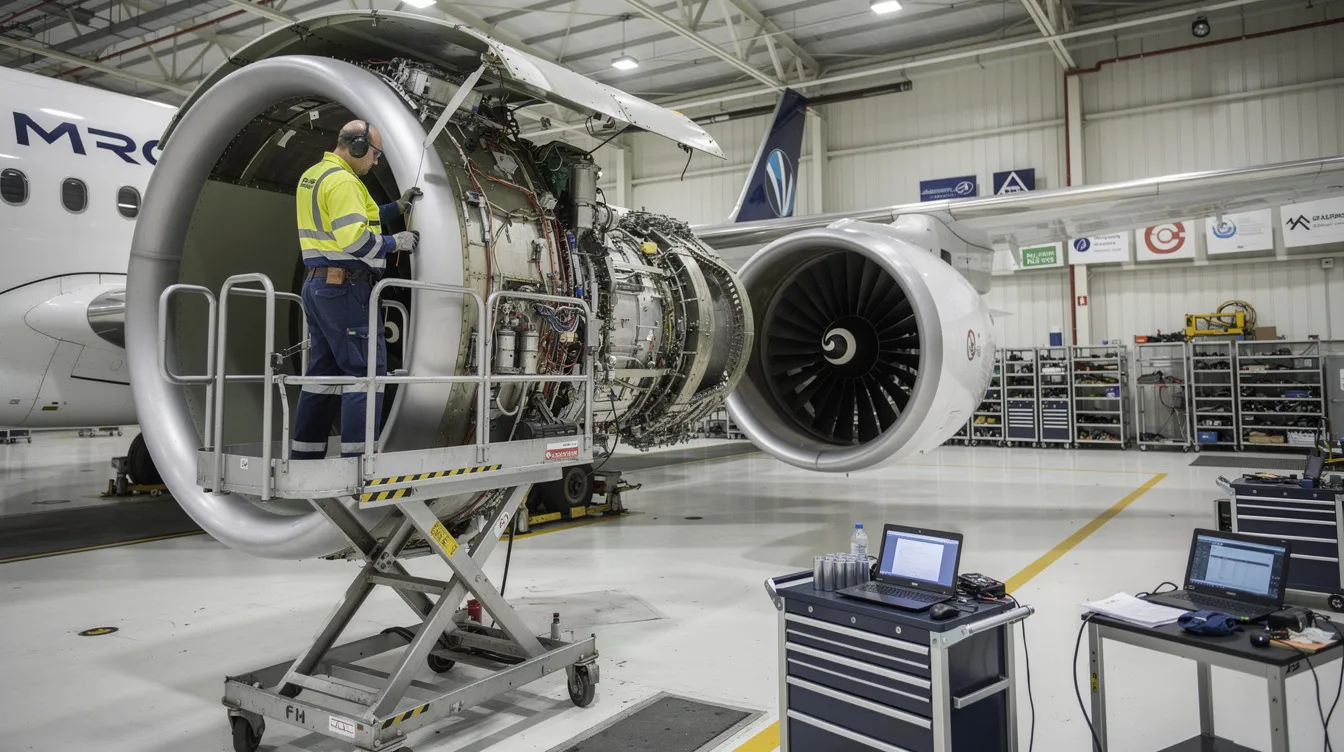
Digital work instructions ensure that mechanics use the correct procedure revision. When service bulletins update, the system reflects changes immediately in applicable task cards. Configuration control prevents the common MRO failure mode where outdated procedures cause rework or regulatory findings.
Typical MRO compliance documents and steps that benefit from digitization:
- Repair dispositions: Documented decisions on repair versus replace, with engineering authority approvals and supporting analysis
- Task cards: Step-by-step maintenance instructions with inspection points, measurement requirements, and signoffs
- Return-to-service tags: 8130-3 documentation with dual releases capturing both inspection and airworthiness authority
- Life-limited part tracking: Time since overhaul, cycles, and calendar limits for components requiring scheduled replacement
- Service bulletin compliance: Records of which SBs have been incorporated on specific aircraft or components
- Teardown documentation: Detailed records of component condition at induction, supporting repair scope decisions
An engine shop using digital audit trails demonstrates airworthiness and configuration control to regulators by producing complete component histories on demand. Studies on integrated tracking indicate that such facilities reduce turnaround delays by approximately 25% through elimination of documentation bottlenecks.
Key Capabilities to Look for in Aerospace Compliance Software
Quality managers and compliance leaders evaluating aerospace compliance software for 2025 and 2026 should prioritize capabilities that address aerospace-specific requirements rather than generic manufacturing features.
Core Compliance Capabilities
- Native AS9100 support with workflow templates aligned to key clauses
- AS9102 FAI management with digital forms, auto-population from PLM/ERP, and layered approval routing
- Nonconformance and CAPA management with full traceability to parts, serials, suppliers, and processes
- LPA scheduling and execution with mobile interfaces and automatic finding escalation
- Document control with version control, effectivity dating, and 21 CFR Part 11-compliant e-signatures
Digital Factory Capabilities
- Low-code workflow builder for rapid adaptation to new customer requirements or regulatory changes
- Mobile-friendly shopfloor interfaces that work in manufacturing environments
- Real-time dashboards showing compliance health, open actions, and trend data
- Configurable analytics for predictive quality insights and pattern detection
Integration Requirements
- Connectors for existing ERP systems (SAP, Oracle, Epicor, and similar platforms)
- PLM integration for revision-controlled drawing and BOM data
- MES integration for capturing in-process measurements and machine data
- Supplier portals for secure document exchange and collaborative workflows
- ITAR-compliant data handling with role-based permissions and access logging
Aerospace-Specific Data Models
Generic manufacturing software treats parts as interchangeable items. Aerospace operations require data models that understand serial numbers, work orders, tail numbers, build packages, and travelers as first-class objects. The difference affects every workflow, query, and report.
Connect981 bundles these capabilities into a unified operations layer purpose-built for aerospace and MRO environments. Rather than assembling point solutions for QMS, document management, and workflow execution, the platform provides comprehensive features across compliance domains.
Connect981: A Unified Operations Layer for Aerospace Compliance Execution
Connect981 operates as a B2B SaaS platform purpose-built for aerospace manufacturing and MRO compliance workflows. The platform addresses the fundamental problem that aerospace organizations face: disconnected systems, paper processes, and tribal knowledge that cannot scale across facilities and supplier networks.
The unified platform replaces paper packets and spreadsheets by connecting work instructions, quality checks, supplier data, and documentation into a single execution layer. Zero and low-code workflow configuration allows teams to adapt quickly to new AS9100 revisions, customer requirements, and regulatory changes without extended IT projects. Drag and drop templates enable rapid deployment of repeatable processes.
Core compliance-related features include:
- Digital work instructions with revision control and shopfloor-ready presentation
- First article inspection templates aligned with AS9102 requirements
- Nonconformance and CAPA workflows with full traceability
- Layered process audit scheduling and mobile execution
- Audit-ready reporting with instant retrieval of evidence packages
- Supplier workflow integration for sub tier suppliers visibility
Organizations implementing Connect981 report measurable outcomes. Quality teams reduce audit prep time from weeks to days. Repeat nonconformances decrease as root cause analysis becomes data-driven. New programs ramp faster across multiple factories and suppliers because workflows deploy without site-specific customization.
The platform integrates with existing ERP, MES, PLM, and QMS infrastructure rather than requiring wholesale system replacement. This approach protects existing investments while establishing the unified operations layer that aerospace compliance execution demands.
Next Steps: Building a Digital Aerospace Compliance Execution Strategy
Aerospace compliance in 2025 and beyond requires more than documented procedures in quality manuals. It requires integrated digital execution systems that capture evidence at the point of work, maintain traceability across complex supply chains, and produce audit-ready records without heroic manual effort.
A practical roadmap starts with assessing current documentation and audit trail gaps. Where does paper still control critical processes? Where do spreadsheets bridge gaps between systems? Where does tribal knowledge create risk when experienced personnel leave? These assessments identify high-risk workflows for initial digitization.
Prioritize FAI, nonconformance, and CAPA workflows first. These areas carry the highest regulatory and operational risk, and improvements create immediate visibility. Then expand to layered process audits and supplier collaboration, extending digital compliance execution across the operation and supply chain.
Related topics that support this compliance execution strategy include AS9100 vs AS9102 requirements analysis, digital audit trail implementation, layered process audit design, CAPA traceability methods, and compliance workflow automation techniques. Each represents a deeper exploration of capabilities introduced in this overview.
Quality leaders, compliance managers, and operations executives ready to move from reactive compliance to proactive digital execution should evaluate platforms like Connect981 that unify workflows across factories and suppliers. Request a Connect981 demo to see AS9100/AS9102 support, audit readiness, and CAPA traceability in a live environment built for aerospace operations.