RSC Cluster: aerospace-compliance-software-digital-systems-for-as9100-as9102-audit-ready-operations-20260314

  • AS9100 Aerospace Quality Standard

    AS9100 Aerospace Quality Standard

    Overview: What AS9100 Is and Why It Exists

    AS9100 is the primary quality management system standard for organizations operating in the aviation, space, and defense sectors. The current version, AS9100 Rev D, was released in 2016 and remains the benchmark for aerospace quality management worldwide. It establishes requirements for how aerospace organizations design, manufacture, assemble, test, and service products that must perform reliably under the most demanding conditions.

    The standard is published by SAE International and was primarily developed through the collaborative work of the International Aerospace Quality Group, which includes representatives from major aerospace manufacturers and suppliers across the Americas, Europe, and Asia-Pacific. AS9100 is built directly on the ISO 9001:2015 framework, incorporating all of its requirements while adding over 100 aerospace-specific mandates that address the unique demands of safety-critical products and complex global supply chains.

    This article focuses on the conceptual and industry-level understanding of AS9100. It does not provide certification guidance, audit preparation advice, or compliance recommendations.

    Core characteristics of AS9100 as a standard:

    • Defines quality management systems requirements specifically for aviation space and defense organizations
    • Builds on ISO 9001 with additional requirements addressing product safety, risk management, configuration management, and traceability
    • Applies across all tiers of the aerospace supply chain, from prime contractors to subcontractors and service providers
    • Serves as a common quality language recognized by aerospace manufacturers, regulators, and defense organizations globally

    Industry Context: Why Aerospace Needs a Dedicated Quality Standard

    The aerospace industry operates under conditions that differ fundamentally from most other industry sectors. Products such as commercial aircraft, military platforms, satellites, launch vehicles, and propulsion systems have lifecycles measured in decades. A single airframe may remain in service for 30 years or more, accumulating hundreds of thousands of flight hours while passing through multiple maintenance, repair, and overhaul cycles. Throughout that lifecycle, every component must perform as designed, every modification must be traceable, and every maintenance action must be documented.

    The regulatory environment reinforces this reality. Authorities like the Federal Aviation Administration in the United States, EASA in Europe, and defense agencies worldwide impose stringent oversight on design, production, and continued airworthiness. These regulatory requirements reflect the consequences of failure: a nonconforming part in a flight control system, a counterfeit fastener in a structural assembly, or a software anomaly in avionics can result in loss of life, mission failure, or catastrophic asset destruction. The aerospace sector operates with zero tolerance for such outcomes.

    A generic ISO 9001 quality management system, while effective for many industries, does not address these specific conditions. ISO 9001 establishes foundational quality management principles around process control, customer satisfaction, and continual improvement. However, it does not require the depth of configuration management, traceability, risk controls, or supplier oversight that aerospace demands. When AS9100 was first released in March 1999, it formalized what aerospace primes and space and defense organizations had already learned: that a sector-specific standard was necessary to codify good practices and reduce organization unique requirements across the supply chain.

    The practical environment where AS9100 applies includes OEM final assembly lines building complete aircraft or spacecraft, tier-1 and tier-2 suppliers manufacturing engines, landing gear, avionics, and structural assemblies, and MRO facilities performing heavy maintenance checks on aging fleets. These operations span multiple countries, involve thousands of suppliers, and require consistent quality systems that can coordinate across organizational and geographic boundaries. The result of traceability gaps, configuration errors, or quality escapes in any part of this network can propagate through the entire product lifecycle.

    The image depicts a commercial aircraft on an assembly line within a large manufacturing facility, showcasing the meticulous processes involved in the aerospace industry. This setting emphasizes the importance of quality management systems and regulatory compliance, ensuring that the aircraft meets the rigorous standards of the aviation space and defense sectors.

    Relationship Between AS9100 and ISO 9001

    AS9100 Rev D incorporates all requirements of ISO 9001:2015 verbatim. Every clause, every expectation, and every process requirement in ISO 9001 appears identically in AS9100. Organizations that achieve AS9100 certification inherently satisfy ISO 9001 requirements as well.

    ISO 9001 functions as a generic quality management system standard applicable to any organization in any sector. It establishes a process-based approach to managing quality, emphasizing customer focus, leadership engagement, planning, operational controls, performance evaluation, and continual improvement. These quality standards provide a solid foundation for organizations seeking to enhance customer satisfaction and deliver products and services consistently.

    AS9100 extends this foundation with aerospace-specific additions that address the elevated risk profile of the sector. Where ISO 9001 introduces risk-based thinking at a conceptual level, AS9100 mandates structured operational risk assessment and mitigation for activities that could affect flight safety, mission success, or regulatory compliance. Where ISO 9001 expects organizations to control documented information, AS9100 adds requirements for configuration management that ensure every product matches its intended design baseline and every change is controlled and traceable throughout the product lifecycle.

    The conceptual scope differences are significant. ISO 9001 aims for consistent product quality and customer requirements fulfillment across diverse industries. AS9100 narrows this focus to aerospace operations, where product quality intersects with product safety, where reliability requirements must account for extreme environmental conditions, and where regulatory compliance is not optional but foundational. Specific thematic additions in AS9100 include:

    • Extended risk management protocols covering operational, safety, and supply chain vulnerabilities
    • Explicit product safety requirements ensuring products perform safely under specified conditions
    • Heightened configuration management controls for tracking design baselines, modifications, and as-built records
    • Strengthened oversight of external providers, including supplier selection criteria, performance monitoring, and flow-down of quality requirements
    • Requirements for counterfeit parts prevention to detect and block unapproved materials from entering the supply chain
    • Focus on critical items whose failure could affect safety or mission success
    • Emphasis on delivery performance and on-time metrics given the tight schedules of aerospace programs

    For readers familiar with ISO 9001, the relationship is straightforward: AS9100 is ISO 9001 plus the additional requirements that aerospace demands.

    Development History and Governance of AS9100

    The first version of AS9100 was published in March 1999, developed by the Society of Automotive Engineers in collaboration with aerospace industry stakeholders. This original release aligned with ISO 9001:1994 and represented the sector’s first unified attempt to standardize quality practices beyond the patchwork of organization unique requirements that primes had historically imposed on their suppliers.

    Subsequent revisions tracked changes in ISO 9001 while incorporating lessons learned from aerospace operations. AS9100 Revision B emerged in the early 2000s, followed by Revision C, which aligned with ISO 9001:2008. The current version, AS9100 Rev D, was released in 2016 to align with the updated QMS model aligned with ISO 9001:2015. Each revision has strengthened requirements around risk management, product safety, and supply chain controls based on industry experience and regulatory expectations.

    The International Aerospace Quality Group governs AS9100’s development and maintenance. IAQG includes representatives from three regional groups: AAQG in the Americas, EAQG in Europe, and APAQG in Asia-Pacific. This structure ensures that the standard reflects global aerospace needs rather than the requirements of any single region or prime manufacturer. Major aerospace manufacturers participate directly in IAQG working groups, contributing operational experience and technical expertise to revision cycles.

    SAE International serves as the publisher for AS9100 in the Americas. In Europe, the equivalent standard is published as EN9100, and in Japan as JISQ9100. Despite different document numbers, these are technically equivalent standards, ensuring that certification to any one of them is recognized globally. This harmonization supports the international standard recognition that aerospace supply chains require.

    Revision cycles are driven by changes in the underlying ISO 9001 framework, lessons learned from aerospace incidents and near-misses, evolving regulatory expectations, and technological advances in areas like composite materials, avionics software, additive manufacturing, and space systems. The forthcoming IA9100 revision is expected to introduce expanded product safety requirements, quality culture and ethical behavior integration, Advanced Product Quality Planning linkages, and a new information security clause reflecting the sector’s digital transformation.

    Conceptual Scope of AS9100 in Aerospace Operations

    AS9100 covers the full aerospace product lifecycle, from initial design and development through manufacturing, assembly, testing, delivery, and post-delivery support. This scope extends to maintenance, repair, and overhaul activities that sustain products throughout decades of operational service. The standard applies wherever aerospace products and services are realized, regardless of whether the organization is an OEM, a tiered supplier, a distributor, or a maintenance provider.

    The types of aerospace organizations that AS9100 targets include:

    • Original equipment manufacturers producing complete aircraft, spacecraft, engines, or major assemblies
    • Tier-1 and tier-2 suppliers manufacturing components such as landing gear, avionics systems, hydraulic actuators, and structural parts
    • Tier-3 and lower suppliers providing raw materials, fasteners, electronic components, and specialized hardware
    • Maintenance, repair, and overhaul organizations performing scheduled maintenance, modifications, and repairs on operational fleets
    • Service providers supporting aerospace programs through engineering, testing, calibration, or logistics functions

    AS9100 emphasizes process-based management. Organizations must define the processes that affect product conformity and safety, establish controls to ensure these processes operate as intended, measure performance to identify gaps, and implement continual improvement to address weaknesses. This approach requires documented process flows, clear responsibilities, defined interfaces between functions, and mechanisms for detecting and correcting nonconformities before they reach customers.

    In daily operations, AS9100 requirements manifest in tangible ways. Build packages contain controlled work instructions with revision control ensuring every operator follows current procedures. Serialized parts carry documented histories that trace their origin, processing, inspection results, and installation location. Nonconformities trigger formal disposition processes that evaluate impact, determine root causes, and implement recurring corrective actions to prevent recurrence. Internal audits verify that processes operate as designed and that records support the objective evidence required by interested parties including regulators, primes, and customers.

    Core Aerospace-Specific Quality Themes in AS9100

    AS9100’s differentiation from ISO 9001 centers on several major aerospace-specific themes that reflect the sector’s risk profile, regulatory environment, and operational complexity. These themes are not isolated clauses but interconnected concepts that shape how aerospace organizations manage quality throughout the product lifecycle.

    The key themes include:

    • Product safety: Requirements ensuring that aerospace products can be safely used under specified conditions, with controls that identify and mitigate potential risks to passengers, crew, and ground personnel
    • Operational risk management: Structured approaches to identifying, assessing, and controlling risks that could affect product conformity, flight safety, mission success, or regulatory compliance
    • Configuration management: Disciplines ensuring that each product conforms to its intended design baseline, with every change controlled, documented, and traceable
    • Reliability and maintainability: Considerations for how products will perform over extended service lives and how maintenance requirements are addressed in design and documentation
    • External provider controls: Expanded oversight of suppliers, subcontractors, and special process houses to ensure quality requirements flow down through the supply chain

    Digital traceability and documentation integrity are woven throughout these themes. Serial and lot management, first article inspection records, lifetime maintenance histories, and engineering change documentation all depend on accurate, accessible, and controlled information systems. The data that supports AS9100 compliance must be consistent across factories, suppliers, and MRO facilities.

    These themes connect directly to typical aerospace workflows: build packages that guide assembly operations, engineering change incorporation that modifies production configurations, maintenance records that document every action performed on an aircraft, and cross-site data consistency that enables global supply chain management.

    Risk-Based Thinking and Operational Risk in Aerospace

    AS9100 extends ISO 9001’s risk-based thinking into structured operational risk management with explicit focus on aerospace-specific hazards. While ISO 9001 expects organizations to consider risks and opportunities when planning their quality management system, AS9100 mandates that this thinking be applied systematically to activities that could affect flight safety, mission success, and regulatory compliance.

    Aerospace operational risks take many forms. Hardware failures in flight-critical systems can result in loss of control. Software anomalies in avionics can corrupt navigation or flight management data. Maintenance errors during heavy checks can introduce latent defects that remain undetected until operational stress reveals them. Disruptions to single-source critical suppliers can halt production lines and delay aircraft deliveries. Human factors in assembly or maintenance can lead to incorrectly installed components, missed inspection steps, or documentation errors that mask nonconformities.

    AS9100 expects organizations to identify, assess, and control these potential risks not only during product design but also throughout production, servicing, and change management activities. A missed torque sequence on a flight-critical fastener, a misrouted wire harness in an avionics bay, or an undocumented deviation from an approved repair procedure all represent operational risks that the standard requires organizations to address through their quality systems.

    The emphasis is on prevention rather than detection. AS9100’s approach to risk management aims to build controls into processes before problems occur, reducing variation and eliminating conditions that could lead to nonconforming outputs.

    Product Safety and Configuration Management

    Product safety in AS9100 refers to the state where an aerospace product can be safely used under specified conditions throughout its lifecycle. This concept extends beyond manufacturing quality to encompass design decisions, maintenance procedures, operational limits, and documentation that together ensure safe operation in service.

    Configuration management is the discipline that binds design intent to physical reality. Every aircraft, engine, or subsystem exists in a specific configuration state defined by its design baseline, approved modifications, and as-built records. Configuration management ensures that:

    • Design data accurately reflects the intended product configuration
    • Production documentation translates design intent into manufacturing instructions
    • As-built records capture the actual configuration of each delivered product
    • Changes are controlled through formal processes that evaluate impact, approve modifications, and update affected documentation

    Concrete examples illustrate why this matters. An aircraft fleet may include airframes at different modification states, some incorporating service bulletins while others remain at the original configuration. Managing this variation requires precise records that show exactly which modifications have been incorporated on each tail number. Avionics systems may run different software versions depending on when they were manufactured or last updated, and tracking these versions is essential for troubleshooting, maintenance planning, and regulatory compliance. Composite structures may be produced using approved process variations that affect material properties, and knowing which variation applies to each part is critical for structural analysis and repair decisions.

    AS9100 conceptually binds design data, production documentation, and actual physical configuration together. When these elements align, products conform to their approved design and can be certified as airworthy. When mismatches occur, the consequences can include grounded aircraft, costly rework, regulatory findings, or safety events.

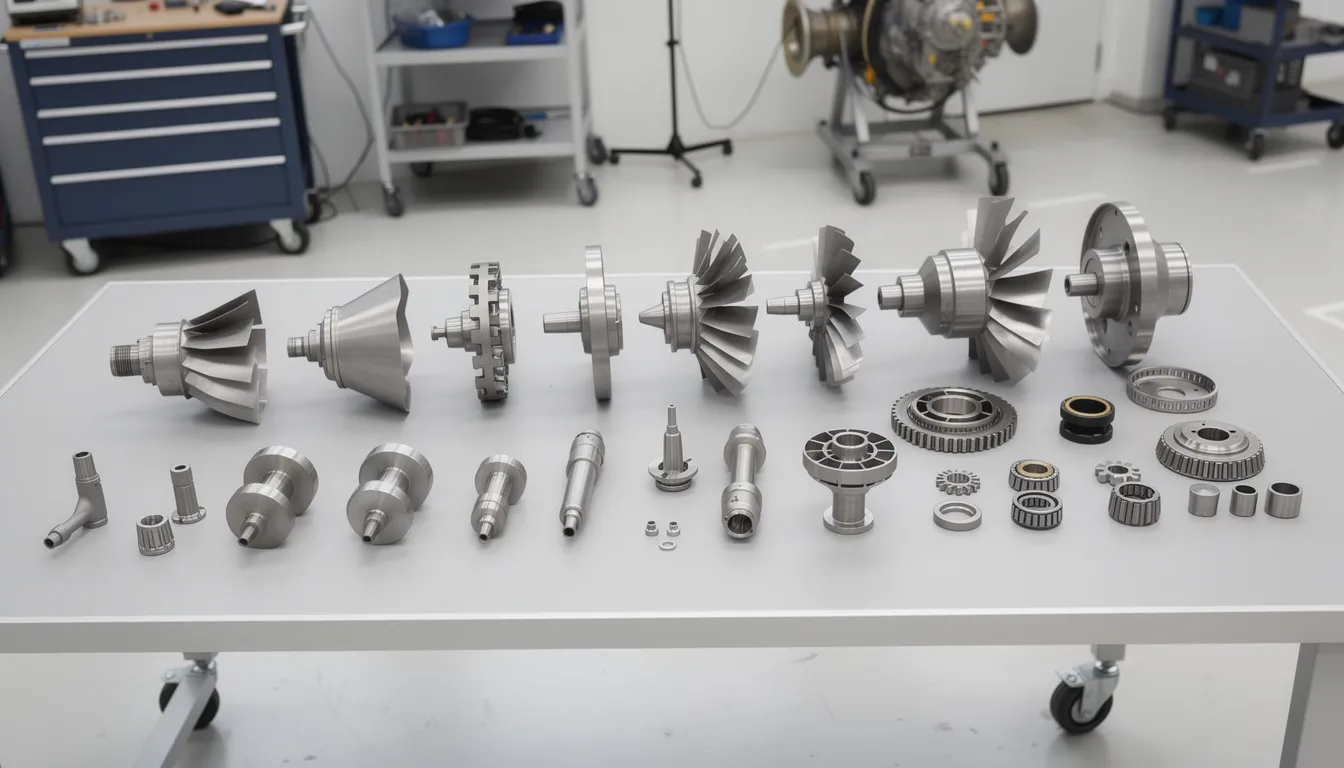
    The image depicts various aerospace engine components meticulously arranged for inspection, highlighting the importance of quality management systems in the aerospace industry. This setup emphasizes adherence to quality standards and regulatory requirements, ensuring product safety and customer satisfaction in the aviation space and defense sectors.

    Counterfeit Parts, Traceability, and External Providers

    The aerospace sector faces particular exposure to risks from counterfeit or unapproved parts. Global supply chains, long product lifecycles, and high component values create incentives for fraudulent materials to enter the system. Examples include unauthorized fasteners that fail to meet strength specifications, electronic components with falsified certifications, and so-called “paper parts” that exist only in documentation while substandard materials are actually supplied.

    AS9100 addresses counterfeit parts prevention through requirements that organizations detect and block unapproved materials before they enter production or maintenance activities. This includes supplier controls, incoming inspection protocols, documentation verification, and awareness training for personnel who handle parts and materials.

    Traceability is the foundation that makes counterfeit detection possible. AS9100 requires that aerospace components carry documented histories tracing their origin, material certifications, processing records, inspection results, and movement through the supply chain. For safety-critical items, this traceability extends throughout the product lifecycle, enabling investigations when anomalies occur and supporting airworthiness determinations during maintenance events.

    The standard also places significant emphasis on controlling external providers. Aerospace organizations depend on suppliers, subcontractors, and special process houses that perform work affecting product conformity. AS9100 requires that quality requirements flow down to these external providers, that their performance is monitored through supplier selection and evaluation processes, and that objective evidence confirms requirements conformance. The OASIS database maintained by IAQG provides a registry where aerospace suppliers can demonstrate their certification status, supporting supply chain visibility across the aerospace and defense industry.

    These themes connect to the reality of globalized aerospace supply networks. OEMs, suppliers, and MRO partners must share reliable data to maintain the integrity of products that may cross dozens of organizational boundaries before reaching operational service.

    AS9100 in the Broader Aerospace Standards Ecosystem

    AS9100 serves as the core quality management system reference for aerospace, but it operates within a broader ecosystem of standards that address specific segments, processes, and requirements. Understanding this ecosystem helps clarify how AS9100 relates to other standards referenced in contracts, specifications, and regulatory frameworks.

    Related aerospace management systems standards include:

    Standard

    Scope

    AS9100

    QMS for design, manufacturing, and service organizations

    AS9110

    QMS for maintenance, repair, and overhaul organizations

    AS9120

    QMS for stockists and distributors

    AS9102

    First article inspection requirements

    AS9103

    Requirements conformance measure variation management

    AS9145

    Requirements for Advanced Product Quality Planning

    These standards share a common foundation in ISO 9001 but add specific requirements relevant to their scope. An MRO organization might hold AS9110 certification, while a hardware distributor might hold AS9120. Both standards build on the same quality management principles but address the distinct operational realities of their sectors.

    Regulators, primes, and defense organizations often expect alignment with AS9100 principles even when contracts reference additional quality standards. NADCAP accreditation for special processes like heat treatment, welding, or nondestructive testing represents another layer of aerospace quality assurance that works alongside AS9100 certification. An aerospace company may require certification to AS9100 as a baseline while also requiring NADCAP accreditation for suppliers performing critical processes.

    AS9100 sits at the center of this layered environment, providing the foundational management system structure that other standards and requirements build upon.

    Digital Operations, AS9100, and the Role of Platforms like Connect981

    Modern aerospace operations increasingly depend on digital systems to uphold AS9100 expectations around documentation control, traceability, quality assurance, and record retention. The volume and complexity of data that aerospace organizations must manage, from build packages and work instructions to serial number histories and nonconformance records, exceeds what paper-based or disconnected systems can reliably handle.

    Connecting ERP, MES, PLM, QMS, and supplier data into a single operational layer helps organizations maintain consistent, audit-ready information across factories and supply chains. When data flows seamlessly between systems, the risk of configuration mismatches, traceability gaps, and documentation errors decreases. Quality leaders can monitor requirements conformance measure metrics in real time rather than discovering problems during internal audits or customer reviews.

    Typical AS9100-relevant workflows that benefit from digitalization include:

    • Electronic work instructions with version control ensuring operators follow current procedures
    • Serialized parts tracking that maintains documented histories from receiving through final assembly
    • Defect logging and nonconformance documentation with automated routing for disposition decisions
    • Supplier quality visibility enabling real-time insight into external provider performance
    • First article inspection records linked to production data for validation of new parts or processes
    • Audit trail generation that demonstrates objective evidence of conformance to interested parties

    The Connect981 platform is an aerospace-focused operations layer that supports these kinds of AS9100-aligned quality and traceability workflows. By connecting shopfloor execution, supplier data, documentation control, and quality processes in a unified system, Connect981 helps aerospace organizations maintain the data integrity and process control that AS9100 conceptually requires. The platform is designed for fast deployment with minimal IT overhead, enabling organizations to digitize critical workflows without the complexity of full MES or ERP replacement.

    This digital infrastructure does not guarantee compliance; that remains the responsibility of each organization’s management system. However, connected operations make it easier to operate within AS9100’s conceptual framework and demonstrate conformance when customers, regulators, or certification bodies require evidence.

    The image depicts a modern factory floor bustling with workers who are actively engaging with digital displays and tablets, showcasing the integration of technology in the aerospace and defense industry. This environment reflects effective quality management systems and emphasizes continual improvement in customer satisfaction and regulatory compliance.

    Summary: Conceptual Impact of AS9100 on Aerospace Quality

    AS9100 represents the aerospace-specific extension of ISO 9001 that formalizes how organizations manage quality, safety, and risk across complex, regulated product lifecycles. It provides the structural foundation for effective quality management system implementation in aviation, space, and defense while addressing the sector’s unique demands for product safety, configuration control, and supply chain integrity.

    The main conceptual differences from ISO 9001 center on deeper risk integration, explicit product safety focus, rigorous configuration management, heightened traceability requirements, and elevated expectations for supplier oversight. These additions reflect the aerospace sector’s reality: products must perform reliably under extreme conditions, regulatory requirements must be satisfied, and failures carry consequences that extend far beyond typical manufacturing environments.

    Industry-wide, AS9100 provides a common language and structure for OEMs, aerospace suppliers, and MRO providers to align their quality systems, data flows, and daily operations. This standardization reduces organization unique requirements, minimizes supply chain variation, and enables the consistent delivery of products that meet customer requirements and regulatory expectations.

    Evolving aerospace technologies, including advanced materials, digital systems, additive manufacturing, and autonomous platforms, will continue to shape future revisions of AS9100. The digital infrastructures that support these quality systems, including platforms like Connect981, will play an increasingly important role in helping aerospace organizations maintain the documentation control, traceability, and process visibility that the standard demands. Organizations that understand AS9100 conceptually are better positioned to operationalize its requirements and deliver products that meet the aerospace industry’s uncompromising standards for safety and reliability.

    For aerospace manufacturing and MRO teams seeking digital support for AS9100-aligned workflows, request a demo of Connect981 to see how a unified operations layer can strengthen documentation control, traceability, and quality processes across your organization.

  • Supplier Collaboration in Aerospace: Digital Systems, Portals, and Workflows

    Supplier Collaboration in Aerospace: Digital Systems, Portals, and Workflows

    Modern aerospace programs depend on thousands of suppliers spread across continents. An A320neo program sources structural components, avionics, engines, and special processes from Tier 1 integrators down to Tier 3 machine shops and heat treaters. A single Boeing 737 MAX involves precision castings from one region, composite layups from another, and NADCAP-certified surface treatments from a third. When any link in this aerospace supply chain breaks down, the consequences cascade through the entire value chain.

    The years between 2020 and 2024 exposed just how fragile manual, email-driven collaboration can be. COVID-19 factory shutdowns delayed deliveries by up to 50% in some cases. The 737 MAX recertification process extended supplier requalification timelines by 12 to 18 months. Persistent LEAP engine delivery delays, attributed to titanium forging bottlenecks, forced production rate adjustments across narrow-body programs. Industry-wide, on-time delivery shortfalls of 20 to 30% became common. These disruptions proved that spreadsheets, scattered email chains, and disconnected file shares cannot support the pace and precision aerospace demands.

    This article serves as a practical guide for aerospace OEMs, Tier 1 suppliers, and MRO organizations evaluating supplier collaboration systems. The focus is on purpose-built aerospace tools rather than generic procurement software or spend analysis platforms. Connect981 is designed specifically for aerospace and MRO workflows, sitting on top of existing ERP, MES, and QMS systems to connect suppliers, factories, and engineering data in one shared layer. The core capabilities covered here include supplier portals, digital RFQ workflows, supplier scorecards, change order management, and supplier documentation systems.

    What “Supplier Collaboration” Really Means in Aerospace Operations

    Supplier collaboration in aerospace extends far beyond purchase orders and invoice processing. It encompasses joint planning for lead times, quality standards, configuration management, and documentation exchange across a tiered network of suppliers. When an OEM and its suppliers are aligned, parts arrive on time, conform to specifications, and carry complete certification records. When alignment fails, programs stall.

    The typical aerospace value chain flows from OEMs through Tier 1 structural and systems integrators, who in turn rely on Tier 2 and Tier 3 specialists in machining, composites, chemical processing, and special processes. A Tier 3 heat treater using an outdated furnace qualification can cascade into airworthiness risks, delaying programs by months and costing millions. The 737 MAX supply chain disruptions post-2019 grounding demonstrated exactly how misalignment at any tier can ripple through the entire network.

    Key collaboration areas in aerospace include:

    • RFQs and sourcing for complex parts with multi-page specifications
    • Order promise and capacity visibility to match production ramps
    • Engineering change propagation across multiple supplier tiers
    • Quality and nonconformance resolution via supplier corrective action request workflows
    • Documentation and certifications tied to specific serial and lot numbers
    • MRO spares and repairs coordination for in-service fleet support

    A regulatory overlay of AS9100, NADCAP, FAA/EASA airworthiness directives, and ITAR export controls makes casual, spreadsheet-based collaboration both risky and difficult to audit. Supplier management processes must generate audit trails that withstand scrutiny from customers, regulators, and internal quality teams. A modern supplier management system ties these touchpoints into unified, automated workflows rather than scattered portals, emails, and file shares.

    Core Capabilities of Modern Aerospace Supplier Collaboration Systems

    An aerospace-ready supplier management platform differs fundamentally from generic vendor management software. The workflows, data models, and compliance requirements are specific to this industry. The following five pillars define what a mature aerospace supplier collaboration system should provide.

    • Supplier portals: Secure access for suppliers to view RFQs, purchase orders, engineering drawings, quality specs, and delivery forecasts in one place
    • Digital RFQ and sourcing workflows: Structured processes for complex aerospace parts that capture specifications, certifications, and evaluation criteria in auditable records
    • Supplier scorecards and performance reviews: Automated tracking of quality, delivery, cost, and responsiveness metrics over the life of the supplier relationship
    • Engineering and change order management: Controlled propagation of design changes, process updates, and configuration revisions across all impacted suppliers
    • Supplier documentation and traceability systems: Digital capture and linkage of certificates, test reports, FAI records, and process documentation to specific parts and serials

    Supporting capabilities include integration with ERP, MES, PLM, and QMS systems, role-based access control for ITAR and export control compliance, and audit-ready logging for AS9100 and FAA/EASA requirements. The sections that follow examine each pillar with aerospace-specific examples and practical implementation guidance.

    The image depicts a bustling industrial aerospace factory floor, where workers are actively assembling various aircraft components. The scene highlights the importance of supplier management processes and efficient supply chain management in the aerospace industry, showcasing a collaborative environment focused on product quality and operational efficiency.

    Supplier Portals for Aerospace: The Front Door to Collaboration

    Supplier portals are often the first visible component of a collaboration system. In aerospace, they must go well beyond basic PO views and invoice uploads. A portal that only shows order status fails to address the real coordination needs of complex programs.

    A modern aerospace supplier portal should allow secure access for suppliers to view RFQs, active purchase orders, quality requirements, the latest revisions of engineering drawings, process specifications, and delivery forecasts. Suppliers maintain their own certification records, upload required documentation, and respond to requests without waiting for emails or phone calls. The portal becomes the single source of truth for the commercial and technical relationship.

    Concrete aerospace use cases demonstrate the value:

    • A NADCAP-accredited heat-treat house uploads furnace run charts tied to specific lot numbers
    • A composite fabricator accesses updated layup sequences for LEAP engine fan blades
    • A precision machinist confirms capacity for a production ramp on A320neo brackets

    Self-service profile and certification management reduces manual follow-ups. Suppliers update their AS9100, NADCAP, and ITAR registration status, insurance certificates, and contact information directly. This approach cuts manual chases by an estimated 60% and eliminates audit surprises from expired certifications.

    Connect981 provides a shared portal that syncs with existing ERP systems like SAP or Oracle and quality management systems. This avoids duplicate data entry for supplier master records and ensures that supplier data remains consistent across systems.

    Designing a Supplier Portal That Aerospace Suppliers Actually Use

    Many suppliers ignore portals that are slow, confusing, or redundant with email. Legacy portal adoption rates often fall below 40% because the systems create more work rather than less. An effective supplier portal requires deliberate attention to usability and value.

    Usability requirements for high adoption include:

    • Simple navigation with clear task queues showing actions like “respond to RFQ” or “upload FAI report”
    • Mobile-ready interface for shop supervisors who work on the floor, not at desks
    • Minimal training needed for occasional users who may interact with the portal monthly
    • Transparent change logs showing what was updated and when

    Permission models must separate commercial data from technical data. ITAR and EAR export-controlled drawings require controls that limit access by user role and geography. A machining supplier in a non-U.S. location should not see controlled drawings unless proper export licenses are in place.

    Features that build trust include shared status trackers for RFQs and change requests, consistent notification rules that avoid email overload, and clear visibility into where a request sits in the approval process. When suppliers see value in using the portal, they engage.

    Connect981 emphasizes low-friction portal design. Small and mid-size machine shops, plating houses, and MRO partners can participate without requiring an IT department. High adoption correlates with 30% faster response times according to industry studies on digital supply chains.

    Digital RFQ and Sourcing Workflows for Complex Aerospace Parts

    RFQs for aerospace parts bear little resemblance to commodity purchasing. A request for landing gear actuators, composite spars, or engine mounts can span dozens of pages detailing materials like Ti-6Al-4V, special processes with NADCAP requirements for welding or coating, qualification cycles running 6 to 12 months for first article inspection, and volumes that may reach thousands of units per year across multiple aircraft programs.

    Managing these RFQs via email and spreadsheets generates predictable problems. Version confusion, lost attachments, and misinterpretation of requirements occur at rates approaching 25%. Digital RFQ workflows eliminate these failure modes.

    A structured digital RFQ workflow allows engineering and sourcing teams to publish controlled packages to pre-qualified supplier lists, solicit structured bids covering price breakdowns, lead times, capability matrices, and risk factors, and then generate automatic comparisons across all responses. A Tier 1 integrator issuing RFQs for A321XLR structural brackets to eight machine shops with different NADCAP coating requirements can streamline award decisions using weighted scoring models.

    Evaluation Criterion

    Weight

    Cost

    40%

    On-time delivery history

    30%

    Capacity and capability

    20%

    Geography and offset requirements

    10%

    The workflow supports iterative RFQs. When design changes occur, re-bids can be issued with updated requirements. Batch updates to due dates, captured clarifications, and Q&A threads remain inside the RFQ record for future audits and reference.

    Connect981 pulls BOM and configuration data from PLM and ERP, packages it into RFQs, and mirrors awarded work into execution workflows. This eliminates re-typing and reduces errors in translating requirements from sourcing into production.

    Standardizing RFQ Data and Evaluation Criteria

    Standard RFQ templates reduce ambiguity and supplier misinterpretation. When every RFQ follows a consistent format, suppliers know what to expect and procurement teams can compare responses directly.

    Mandatory data for aerospace RFQs should include:

    • Part numbers and revision levels
    • Material specifications and process requirements
    • Required certifications such as EN 9100 and specific NADCAP codes
    • Expected annual volumes and program duration
    • Target first article inspection dates
    • Packaging, shipping, and labeling standards

    Evaluation criteria should be visible and consistent across RFQs. Suppliers benefit from understanding how their bids will be scored, and sourcing leaders can justify award decisions to internal stakeholders and auditors using documented scoring models.

    Connect981 embeds these templates and scoring models as reusable, configurable workflows. Separate templates for rotorcraft, business jets, and defense programs ensure that program-specific requirements are captured without starting from scratch each time.

    Supplier Scorecards and Performance Management in Aerospace

    Aerospace supplier relationships often span 10 to 20 years. Supplier performance management must go beyond transactional metrics to encompass long-term capability evaluation, risk management, and collaborative improvement.

    A comprehensive supplier scorecard for aerospace typically tracks:

    Category

    Metrics

    Target

    Quality

    PPM defect rate, escape rate, FAI first-pass yield

    PPM <100, FAI yield >95%

    Delivery

    On-time delivery percentage, schedule adherence

    OTD >98%

    Cost

    Price trends, cost reduction contributions

    Per program targets

    Responsiveness

    Change acknowledgment time, corrective action closure

    <7 days acknowledgment

    Compliance

    Audit findings, certification status

    Zero open findings

    Consider tracking a precision machining supplier from 2021 through 2025 as build rates increased on a narrow-body program. Digital systems automatically pull data from ERP for delivery performance, QMS for nonconformances and SCARs, and MES for scrap and rework rates. This automation avoids the manual effort of spreadsheet scorecards that become stale within days of creation.

    The collaboration platform shares scorecards with suppliers regularly. Quarterly business reviews use shared dashboards to review trends and agree on improvement targets. This approach transforms scorecards from punitive reporting artifacts into joint improvement tools.

    Turning Scorecards into Joint Improvement Programs

    Scorecards should drive corrective and preventive actions rather than serve only as reporting artifacts. Supplier relationship management depends on converting performance data into concrete improvements.

    A structured cadence supports this transformation:

    • Quarterly business reviews with strategic suppliers using shared dashboards
    • Review of OTD, scrap/rework, and change responsiveness trends
    • Agreement on specific improvement targets for the next quarter
    • Documented action plans with owners and due dates

    Scorecard results link directly to improvement projects in the system. These may include process capability studies, additional inspection points, operator certification training, or co-investment in tooling and automation. When a scorecard shows recurring issues, the system generates workflows for root cause analysis and tracks closure of corrective actions.

    Tracking SCARs and 8D/CAPA outcomes against the supplier’s scorecard demonstrates trending improvements or highlights persistent problems. Connect981 logs supplier-specific actions, owners, due dates, and verification steps, creating audit trails that satisfy AS9100 requirements and customer audit expectations.

    Engineering Change and Change Order Management with Suppliers

    Design changes in aerospace programs are inevitable. Weight reduction initiatives, new alloy specifications, updated fastener requirements, and customer configuration requests generate engineering change notices that must propagate accurately across the supply chain. When changes are not controlled, costly deviations result.

    Types of changes relevant to aerospace supplier management include:

    • Engineering change notices from design and engineering teams
    • Change orders to contracts and purchase orders
    • Process changes at supplier facilities
    • Customer-driven configuration changes for specific aircraft tail numbers or operators

    Real programs have demonstrated the risks. The F-35 program experienced supplier-related deviations costing over $100 million when suppliers continued building to obsolete prints after weight reduction changes. Suppliers building to outdated revisions, making unapproved process substitutions, or missing serial-number trace updates following changes create airworthiness risks and delivery delays.

    A robust digital change management workflow notifies impacted suppliers, requires acknowledgment, tracks re-qualification requirements such as new FAIs or special process approvals, and ensures that ERP, MES, and portal data stay synchronized. The system prevents anyone from building or repairing to obsolete information.

    Connect981 serves as a coordination layer linking PLM and engineering changes to on-the-floor work instructions and supplier tasks. When an engineering change is released, the system propagates it to all affected parties with clear task assignments and acknowledgment requirements.

    An engineering team is intently reviewing technical documents displayed on their computer screens, focusing on supplier management processes and compliance monitoring within the aerospace supply chain. The collaborative atmosphere highlights their commitment to maintaining accurate supplier records and enhancing supplier relationships through effective vendor management software.

    Coordinating Multi-Tier Change Propagation

    A change to a single drawing can affect multiple tiers of suppliers. A casting foundry, machining shop, heat treater, and surface finisher may all be impacted by a material specification change. Digital systems must map BOM relationships and supplier assignments so that a single ECN triggers tasks and notifications across all affected parties.

    Workflows for supplier-initiated changes are equally important. Suppliers may propose alternative materials, new machining sequences, or different coating processes. These proposals require formal review and approval via documented processes that maintain accurate supplier records of what was approved and when.

    Full traceability requires recording which serial numbers or lots were built under which revision and change approvals. This data proves critical during FAA/EASA investigations or customer queries about specific aircraft. The digital thread must link changes to physical parts throughout the supply chain.

    Connect981’s audit logs and version control on work instructions and supplier documentation reduce disputes between engineering and suppliers about approval status. When questions arise, the system provides up to date data on exactly what was approved, who approved it, and when.

    Supplier Documentation, Traceability, and Compliance Systems

    In aerospace, documentation carries equal importance to the physical part. Incomplete certifications can ground aircraft or force scrapping of otherwise conforming material. Supplier documentation systems must capture, validate, and link documents to specific parts, serials, and lots.

    Typical supplier documents in aerospace include:

    • Certificates of conformity (CoC)
    • Material test reports (MTRs)
    • Special process certifications
    • First article inspection reports per AS9102
    • Process control records
    • Shipping documentation tied to serial and lot numbers

    Problems with paper and email-based documentation are well documented. Lost certificates, mismatched lot numbers, inconsistent naming conventions, and last-minute “doc hunts” before delivery or audits plague organizations using manual methods. Industry data suggests 10 to 15% loss or mismatch rates with paper-based approaches, causing 2 to 5 day shipment delays.

    A supplier documentation system addresses these issues by requiring suppliers to upload documents directly in the portal, tied to specific POs, parts, and serials. Validation rules and mandatory fields reduce errors at the point of upload. The system rejects submissions with missing information rather than discovering problems at inspection.

    Connect981 is designed around aerospace-grade traceability, linking supplier documents to shopfloor execution, inspection results, and MRO histories. This creates complete digital records that support both production and long-term maintenance requirements.

    Building End-to-End Digital Traceability Across Suppliers and MRO

    The same supplier documentation that supports initial production also supports maintenance and overhaul decisions years or decades later. Serial number tracking must flow continuously from raw material heats through supplier operations, special processes, assembly, installation, and future MRO events.

    AS9100 and customer audits require quick retrieval of all supplier records for a given serial, lot, or event. Auditors expect response times measured in minutes, not days. Organizations still relying on paper archives or scattered electronic files struggle to meet these expectations.

    Digital traceability has prevented major issues in real programs. When a supplier process deviation is discovered, organizations with strong traceability systems can quickly isolate affected serials and limit inspections to specific parts. Organizations without traceability face potential full-fleet inspections and extended groundings.

    Connect981’s shared data model allows both OEM/MRO operations and selected suppliers to see the same digital thread with appropriate access controls. This shared visibility eliminates the data collection overhead of requesting information from suppliers each time a question arises about part history.

    An aircraft is being inspected for maintenance inside a spacious hangar, with technicians carefully examining various components. This scene reflects the importance of compliance management and supplier performance in the aerospace supply chain, ensuring that the aircraft meets regulatory requirements and safety standards.

    Integrating Supplier Collaboration Systems with ERP, MES, PLM, and QMS

    Aerospace organizations already operate SAP, Oracle, legacy MES, and PLM tools like Teamcenter, Windchill, or 3DEXPERIENCE. A supplier collaboration system must integrate with these existing systems rather than attempt to replace them. Rip-and-replace approaches fail in aerospace because regulatory compliance depends on data continuity across production records.

    Key integration points include:

    System

    Integration Purpose

    ERP

    Supplier master data, purchase orders, accounts payable

    PLM

    BOMs, revisions, engineering changes

    QMS

    Quality events, nonconformances, CAPA tracking

    MES

    Work orders, shopfloor execution status

    A unified collaboration layer reduces duplicate data entry and discrepancies. Mismatched supplier codes across systems create compliance risks and operational confusion. When the approved supplier list syncs automatically between systems, procurement teams can trust that sourcing decisions align with quality approvals.

    Specific aerospace integration scenarios include synchronizing approved supplier lists by special process code, feeding supplier scorecard metrics back into sourcing approval workflows, and aligning engineering changes between PLM and supplier portal data. When these connections work, supplier information flows without manual effort.

    Connect981 operates as a lightweight, zero and low-code layer that bridges existing systems. The platform enables cross-factory and cross-supplier workflows without requiring a full MES or ERP replacement. Integration via APIs and configurable connectors allows IT teams to establish connections incrementally.

    Implementing Supplier Collaboration in Aerospace: Practical Steps

    Many aerospace suppliers still rely on fax, email, and paper for daily coordination. Rollout of digital collaboration systems must be staged and realistic. Attempting to onboard hundreds of suppliers simultaneously typically fails.

    A phased approach reduces risk and builds momentum:

    1. Pilot scope: Select a single airframe or engine program and a small group of strategic suppliers for initial deployment
    2. Process mapping: Document existing RFQ, change, and documentation workflows before configuring the platform
    3. Standard workflows: Define templates and approval workflows for the pilot scope
    4. Platform configuration: Set up the collaboration system with pilot-specific configurations
    5. Supplier onboarding: Train pilot suppliers with clear messaging on benefits and provide ongoing support
    6. Baseline measurement: Establish metrics for RFQ cycle time, supplier OTD, and documentation accuracy before and after

    Supplier engagement determines success. Training sessions should emphasize benefits that suppliers value: fewer email chains, faster approvals, clearer requirements, and reduced time spent answering the same questions repeatedly. New suppliers joining the program see a clear onboarding path rather than a confusing mix of emails and phone calls.

    Connect981’s low-code workflows and aerospace templates reduce IT dependence. Process owners in supply chain, quality, and MRO can iterate on workflows without waiting for development resources. This operational efficiency accelerates adoption and allows continuous improvement based on real usage patterns.

    Measuring the Impact of Supplier Collaboration Systems

    Digital collaboration investments should connect to tangible business outcomes. Generic claims about digital transformation provide little value. Concrete KPIs demonstrate whether the investment delivers results.

    Metrics to track include:

    Metric

    Baseline Comparison

    RFQ cycle time

    Days or weeks before vs. after implementation

    Supplier OTD percentage

    Trend over 6-12 months

    Supplier-related nonconformances

    Count and severity trends

    Documentation-related shipment holds

    Frequency and duration

    FAI right-first-time rate

    Before and after comparison

    Engineering change implementation time

    Days to full supplier acknowledgment

    Audit finding closures

    Time to resolve supplier control findings

    Before-and-after comparisons on a specific program build internal business cases. When a narrow-body production line demonstrates 15% improvement in supplier OTD and 25% reduction in RFQ cycle time, expansion to other programs follows naturally.

    Connect981 provides real-time dashboards and AI-assisted analytics to surface bottlenecks and recurring supplier issues proactively. Data driven decision making replaces reactive fire-fighting when leadership has visibility into compliance monitoring and supplier quality trends.

    How Connect981 Supports Aerospace Supplier Collaboration

    Connect981 unifies supplier portals, RFQs, scorecards, change workflows, and documentation in one aerospace-oriented management platform. Unlike generic procurement software or SAP Ariba implementations focused on indirect spend, Connect981 is built around the realities of aerospace production and MRO operations.

    Key differentiators include:

    • Built specifically for aerospace and MRO compliance requirements
    • Fast deployment via zero and low-code configurable workflows
    • Deep focus on traceability, digital work instructions, and audit readiness
    • Integration layer that connects ERP, MES, PLM, and QMS without replacement
    • Automation capabilities that reduce manual effort across internal teams and suppliers

    Example workflows demonstrate practical application:

    1. Supplier FAI submission and approval: Supplier uploads first article inspection report in the portal, tied to specific part numbers and serials. Quality team reviews and approves or requests corrections. Full audit trail captured automatically.
    2. Digital RFQ for complex machined assembly: Engineering packages BOM and specifications from PLM, sourcing distributes to qualified suppliers, structured responses enable comparison, and awarded work flows into execution workflows.
    3. Supplier-initiated process change request: Supplier proposes alternative machining sequence through formal channel. Engineering reviews, approves with conditions, and system tracks implementation across affected orders.
    4. MRO shop requesting supplier support: Maintenance organization identifies recurring field failure linked to supplier process. System links field data to supplier records and initiates joint analysis workflow.

    Aerospace manufacturers facing supply chain disruptions, compliance issues, or operational inefficiencies from disconnected systems can evaluate how Connect981 addresses their specific challenges. The platform supports compliance tracking, ongoing monitoring of supplier performance, and procurement operations that meet regulatory requirements.

    Request a demo to see supplier collaboration workflows applied to your programs and supplier network. The Connect981 team can demonstrate how the platform integrates with your existing systems and supports your specific aerospace and MRO requirements.

  • What is PNAA’s Quality Cohort?

    Overview of PNAA’s Quality Cohort

    PNAA’s Quality Cohort is a recurring, peer-based forum focused on quality management and operations in aerospace and adjacent regulated manufacturing. It typically brings together quality, operations, and engineering leaders from multiple companies to discuss practical issues like nonconformance management, internal audits, supplier quality, and production system stability. Sessions are usually structured around shared problem cases, member presentations, and focused discussions rather than one-way training. The cohort is not an official standards body, auditor, or certifying entity, and it does not replace formal training, consulting, or regulatory engagement. Its value comes from candid peer exchange about what works, what fails, and what realistically fits the constraints of brownfield plants.

    What the Quality Cohort does (and does not) do

    The Quality Cohort provides a structured way to compare how different organizations handle recurring issues such as CAPA backlogs, audit findings, configuration control problems, and shop-floor deviation handling. Participants can benchmark practices, tools, and metrics, and hear where others have seen specific approaches fail under customer scrutiny or regulatory review. The group may share templates, examples of procedures, and lessons learned, but implementation choices and validation remain the responsibility of each member organization. The cohort does not issue certifications, guarantee positive outcomes in audits, or provide legal or regulatory advice. It also does not own or manage your site’s risk; any change in your QMS or operations still needs to go through your internal governance, change control, and validation processes.

    Typical participants and topics

    Most cohort participants are from aerospace and defense suppliers, OEMs, and related industrial manufacturers who must manage long product lifecycles and stringent customer and regulatory expectations. Attendees often include quality managers, plant managers, operations leaders, supplier quality engineers, and sometimes IT or digital teams responsible for QMS, MES, or data systems. Common discussion topics include managing nonconformance and rework, stabilizing documentation and change control, handling mixed legacy and new systems, and making data trustworthy enough to support decisions. The group frequently focuses on practical workarounds for integration gaps, managing Excel-and-email processes that coexist with enterprise systems, and dealing with validation burdens when changing software or processes. The emphasis tends to be on incremental, survivable improvements rather than wholesale system replacement.

    How participation interacts with your existing systems and processes

    Participation in the Quality Cohort does not require a particular MES, ERP, PLM, or QMS platform; most members operate heterogeneous, legacy-heavy stacks. Discussions typically acknowledge that full, clean-sheet system replacements are rare and often risky in aerospace-grade environments due to downtime constraints, validation and qualification cost, and integration complexity. Instead, cohort conversations often center on how to harden existing processes, clarify ownership, improve traceability, and tighten change control around the systems you already have. When tools or specific vendors are discussed, they are usually treated as examples, not prescriptions, and members are expected to evaluate fit against their own architecture, data quality, and validation requirements. Any ideas taken from the cohort must still pass through your internal risk assessment, configuration management, and management-of-change workflows.

    Benefits, constraints, and realistic expectations

    The main benefits of the Quality Cohort are exposure to peer experience, tested patterns, and known pitfalls, especially from organizations facing similar customer and regulatory pressures. You can reduce trial-and-error by learning how others approached issues like closing aged CAPAs, managing shop-floor deviations without losing traceability, or integrating supplier data with your QMS. However, the cohort cannot remove the effort needed to adapt ideas to your processes, clean up data, or validate changes in a regulated environment. Results will vary significantly based on your existing process maturity, leadership commitment, and the degree of cross-functional engagement you bring to the discussions. You should treat insights from the cohort as structured input into your continuous improvement pipeline, not as drop-in solutions or guarantees of audit performance.

    Practical considerations if you are thinking of joining

    Before joining, it helps to clarify which problems you actually want to learn from others about—for example, recurring audit findings, supplier escapes, late-engineering changes, or chronic rework. You should assume that you will need to contribute real (sanitized) examples from your own operation to get the most value, rather than passively listening. Internally, you may need to establish guidelines on what information can be shared externally, especially where customer data, proprietary processes, or sensitive findings are involved. It is also worth aligning with your IT and validation stakeholders so any potential process or system ideas from the cohort are evaluated with integration, cybersecurity, and qualification impacts in mind. Over time, the most value tends to come when the same people attend consistently, build trust with peers, and then bring structured learnings back into their own continuous improvement and governance processes.

  • Can MES enforce that certain steps or inspections are completed before moving on?

    Short answer

    Yes, most MES platforms can enforce that specific steps, checks, or inspections are completed before a user can move to the next operation, but this is not automatic. It depends heavily on how your routes, work instructions, data collections, and permissions are configured and validated. In regulated environments, you also need documented rules, tested bypass paths, and proper change control so enforcement behaves predictably and is audit-ready.

    How MES typically enforces required steps

    In a typical setup, enforcement is implemented through a combination of routings, operation status rules, and mandatory data collection (or inspection) points. The MES can prevent an operation from being completed until all required fields, test results, or sign-offs have been entered and pass configured limits. It can also block starting the next operation, or moving the unit/lot to the next status, until those prerequisites are satisfied. This logic is usually configured in master data (e.g., operation definitions, process models) rather than in ad hoc scripts.

    For inspections, MES can require specific measurement entries, attribute checks, or digital sign-offs before allowing completion. Systems that support electronic batch records or e-signatures can add role-based approvals as a further prerequisite. When properly implemented, users cannot simply click “next”; the UI and backend checks are tied to completion logic that enforces the defined sequence.

    Common gaps and failure modes

    A frequent failure mode is assuming that showing an instruction on screen equals enforcement; if the MES does not technically block completion, users can still skip steps. Another common gap is partial configuration, where some operations have mandatory checks and others rely on operator discipline, leading to inconsistent behavior across lines or plants. Poorly maintained master data can result in routes with missing or incorrect enforcement flags, so bypasses appear unintentionally. If user roles are too permissive, supervisors may routinely override holds, turning enforcement into a soft reminder.

    Integration gaps create additional risk, especially when inspections are performed in separate LIMS, SPC, or test systems. If results are not reliably written back and validated in MES, the MES may not actually know whether a check passed and may allow progression based on stale or missing data. Finally, insufficient validation of the configuration means you may believe steps are enforced, but edge cases (rework paths, scrapped units, partial completions) still allow movement without the required checks.

    Enforcement in brownfield and mixed-system environments

    In brownfield plants, enforcement usually has to coexist with legacy MES, paper travelers, or partially automated test rigs. In these contexts, MES can only enforce what it can see and control: it can block status changes, operation completions, or move transactions, but it cannot guarantee that a manual inspection actually happened unless results are recorded and checked. When multiple systems own different parts of the process (e.g., inspection in LIMS, routing in MES, WIP in ERP), tight enforcement requires well-designed interfaces and clear system-of-record decisions.

    Attempting to centralize all enforcement into one new MES often runs into practical limits: high integration cost, need to qualify interfaces, and limited downtime to retrofit every station. As a result, many plants implement layered enforcement: MES checks core routing and status, local systems enforce detailed test conditions, and procedures cover residual gaps. The key is to document which system enforces which rule and ensure that handoffs between systems are validated and traceable.

    Tradeoffs: strict enforcement vs operational flexibility

    Stronger enforcement reduces the risk of skipped steps but can create real operational friction if not designed carefully. If the MES blocks progression for every missing data point without clear, controlled exception paths, operators may be stuck during equipment failures, ambiguous instructions, or configuration errors. Overuse of hard stops can also drive workarounds, like using incorrect codes just to unblock the system.

    On the other hand, leaving too much to soft enforcement (warnings, messages) relies heavily on training and culture and may not be sufficient in regulated, high-risk operations. A practical design often uses a mix: hard stops for safety-critical or regulatory-critical steps, and warnings for lower-risk checks. Governance around who can override holds, under which conditions, and how those overrides are logged and reviewed is essential to balance flexibility with control.

    Considerations for regulated and aerospace-grade environments

    In aerospace, pharma, and similar environments, you cannot rely solely on the vendor’s claim that the MES can “enforce sequence”; you must demonstrate, via validation, that your specific configuration actually does so. Each rule (e.g., inspection X must be completed before operation Y can close) needs documented requirements, test cases, and evidence that it works in all relevant scenarios, including rework and nonconformances. Any subsequent change to routes, inspection plans, or interfaces must pass through change control and, often, partial revalidation.

    Full replacement of existing enforcement mechanisms (paper checks, PLC interlocks, niche inspection systems) with MES-only enforcement often fails or stalls due to qualification effort, downtime, and integration complexity. Many organizations adopt a staged approach, migrating enforcement step by step, while keeping certain proven local controls in place. In all cases, you should be explicit about which controls are technical (system-enforced) versus procedural (SOP- and training-enforced) and ensure that this mapping is visible in quality and audit documentation.

    Applying this to your environment

    If your goal is to ensure that specific inspections or process steps are never skipped, start by listing which ones must be technically enforced and where the source data comes from. Review your MES capabilities for mandatory data collection, routing prerequisites, hold/release logic, and role-based permissions. Then, assess how these interact with your existing test benches, inspection systems, and paper-based steps.

    Plan for incremental rollout: implement enforcement on a limited set of operations, validate behavior including edge cases, and adjust the rules and exception handling based on real operator feedback. Make sure overrides and temporary bypasses are traceable and subject to routine quality review rather than left to local discretion. Over time, you can expand enforcement, but only as fast as your configuration discipline, integration reliability, and validation capacity can support without destabilizing operations.

  • ISA-95 in Aerospace: Defining What ERP, MES, QMS, and PLM Should Own

    Aerospace teams rarely fail audits because nobody collected data. They fail because nobody can prove which system owned the data, which revision was current, or which decision blocked release.

    ISA-95, also known as ANSI/ISA-95 or IEC 62264, is an international standard for enterprise control system integration and for integrating enterprise office systems with factory floor control systems. In aerospace and MRO, isa 95 matters because AS9100, NADCAP, FAA, EASA, ITAR, CoCs, FAI packages, serial genealogy, and supplier evidence all depend on clean boundaries.

    Connect981 applies this boundary thinking as a unified operations layer between ERP, MES, PLM, QMS, suppliers, and the connected shopfloor.

    Quick overview: ISA-95 levels and aerospace system roles

    The ISA-95 model consists of five levels that describe the flow of information and activities within an organization, from the plant floor up to the enterprise level. ISA-95 defines a five-level model that describes the flow of information and activities within an organization, from the physical production processes at Level 0 to business planning and logistics at Level 4.

    • Level 0 describes physical production processes, machinery, raw materials, and physical assets on the floor.
    • Level 1 focuses on sensing and manipulating the production process through control devices, sensors, actuators, intelligent devices, and basic control functions.
    • Level 2 involves monitoring and supervisory control using programmable logic controllers, distributed control systems, SCADA, batch control, control module logic, and industrial control systems.
    • Level 3 is the manufacturing operations management level. It includes manufacturing execution systems, manufacturing execution systems mes, manufacturing operations management systems, manufacturing operations systems, quality control, maintenance activities, production scheduling, inventory control, and operational control.
    • Level 4 covers business planning and logistics. This includes enterprise resource planning, enterprise resource planning erp, erp systems, logistics systems, business systems, enterprise systems, business operations, and business processes.

    ISA-95 provides standard terminology and models to bridge the gap between information technology and operational technology. The common data model established by ISA-95 ensures consistent information exchange between enterprise and control systems. The framework is based on the Purdue Reference Model, also called the purdue enterprise reference architecture, with hierarchy models and a hierarchical structure for industrial automation.

    What belongs in ERP at ISA‑95 Level 4

    Level 4 owns the commercial plan, not the detailed build method. Enterprise resource planning ERP should own:

    • Customer contracts, demand, shipsets, sales orders, project accounting, and earned value.
    • Item master basics: part number, description, UOM, make/buy, cost category, high-level revision.
    • Inventory management: on-hand stock, warehouse balances, batch or lot quantities.
    • Purchase orders, approved supplier commercial records, delivery schedules, and raw materials commitments.
    • High-level routings and work centers for capacity and costing, not operator instructions.

    ERP decisions include MPS, MRP, material allocation, make-vs-buy, PO expedite logic, and release of production orders. ISA-95 Part 1 and Part 2 define object models, object model attributes, production capability, inventory, and schedule objects that support those decisions.

    Avoid using ERP for torque readings, inspection signoffs, NC program tracking, NADCAP parameters, or quality gate enforcement. That creates static PDFs, duplicate entry, and weak traceability.

    What belongs in MES / MOM at ISA‑95 Level 3

    Level 3 turns plans into executable manufacturing activities. Manufacturing operations management covers production operations, quality operations, maintenance operations, and inventory operations through operations activity models and production segments.

    MES, MOM, or Connect981 should own:

    • Detailed routing, operation sequence, dependencies, and station instructions.
    • Digital work instructions tied to PLM drawings, models, and revision control.
    • WIP status by serial, lot, tail number, station, operator, and timestamp.
    • Data acquisition from tools, equipment, and manufacturing systems.
    • Operator signatures, time-on-task, resource usage, and inspection evidence.
    • Local dispatching based on tooling, skills, machine status, shortages, and holds.

    In practice, MES is the execution truth for an engine MRO visit, a composite layup, a wing panel, or a heat treat load. It captures historical data, furnace curves, NDT results, serialized genealogy, and links to calibrated equipment.

    MES should not own long-term forecasting, engineering authority, or final MRB policy.

    What belongs in QMS: quality planning, records, and decisions

    QMS spans Level 3 and Level 4. It defines quality policy, while execution systems capture evidence.

    QMS should own:

    • AS9100, NADCAP, FAA/EASA, ITAR, and customer procedure requirements.
    • Inspection plans, control plans, sampling rules, acceptance criteria, and FAI requirements.
    • Nonconformance, MRB, CAPA, concessions, deviations, escapes, and customer returns.
    • Supplier approval, audit findings, calibration evidence, and supplier quality metrics.

    AS9100 traceability requires documented identification, status, acceptance authority, and unique identification where required. QMS defines conforming versus nonconforming product. MES or Connect981 presents the checks, captures measurements, blocks progression, and returns structured evidence.

    Avoid scanned forms buried in ERP attachments. They slow audits and weaken regulatory compliance.

    What belongs in PLM: product definition and engineering authority

    PLM owns product definition outside the ISA-95 pyramid but tightly feeds it.

    PLM should own:

    • eBOM, design intent, tolerances, specifications, MBD, drawings, and 3D models.
    • Configuration rules for aircraft, engines, structures, repair schemes, and modification kits.
    • ECR, ECO, revision effectivity by serial number, block number, or tail number.
    • Engineering requirements, verification, and validation data.

    PLM decides how the part is designed and when a revision becomes effective. ERP consumes released commercial attributes. MES consumes released work content. QMS aligns inspection characteristics and special process rules. Connect981 helps keep data flows synchronized so operators do not build from obsolete instructions.

    Control level (ISA‑95 Levels 0–2): what stays on the machines

    The isa 95 standard keeps the control level focused on physical processes and control processes. Level 0 of the ISA-95 model describes the physical production processes, including machinery and other assets in the field or on the floor. Level 1 focuses on sensing and manipulating the production process, which includes devices like sensors and actuators that collect data and affect production. Level 2 involves monitoring and supervising control, which refers to systems like programmable logic controllers and distributed control systems that manage physical processes.

    Typical aerospace assets include CNC machines, CMMs, autoclaves, test cells, torque tools, shot peen machines, NDT stations, and automated riveting systems.

    Control level systems own immediate safety, interlocks, recipes, NC code, PLC logic, and local cycle data. They should not own part revision, quality policy, supplier status, or full traceability chains. Critical results must flow upward through standardized data exchange.

    Ownership by data type: who is the system of record?

    • Product definition and design intent: PLM, read by ERP, MES, QMS.
    • Item master and commercial attributes: ERP, referenced by other systems.
    • Detailed routing and work instructions: MES or Connect981, linked to PLM.
    • Production orders: ERP owns order creation; MES owns execution status.
    • WIP and operation completions: MES, summarized back to ERP.
    • Quality plans and criteria: QMS, enforced in the execution layer.
    • Inspection evidence: MES or Connect981 captures it; QMS governs it.
    • NCR, MRB, CAPA: QMS owns decisions; MES supplies context.
    • Serial genealogy: MES or execution layer, with rollups to ERP and QMS.
    • Equipment capability: CMMS/EAM, integrated with MES and QMS.
    • Supplier approval: QMS owns qualification; ERP implements purchasing controls.

    ISA-95 prevents redundant work and reduces costly custom integrations by clearly defining software system responsibilities.

    Ownership by decision type: planning, execution, and quality calls

    ISA-95 is also a decision model.

    • Long-term capacity, site moves, and investment: ERP and program governance.
    • Master scheduling and MRP: ERP at the enterprise level.
    • Finite scheduling and short-interval control: Level 3 execution system.
    • Work instruction content: PLM defines design intent; manufacturing engineering authors executable steps in MES or Connect981.
    • Rework, concessions, alternate methods: QMS and PLM define rules; execution applies them.
    • Product acceptance and release: QMS owns release; ERP ships only after release.
    • Supplier changes: QMS and supply chain governance decide; ERP enforces purchasing status.

    Example: a new NADCAP rule changes a heat treat requirement. QMS updates the procedure, PLM confirms affected specs, Connect981 updates instructions and blocks noncompliant work, and ERP reflects schedule impact.

    Common overlaps, gaps, and failure modes in aerospace ISA‑95 implementations

    Most failures are boundary failures.

    Common overlaps:

    • ERP and MES both owning routings.
    • QMS and MES duplicating inspection results.
    • PLM and QMS holding different inspection characteristics.

    Common gaps:

    • No real-time WIP view across plants and suppliers.
    • Serial genealogy trapped in spreadsheets, HMIs, or PDFs.
    • ECOs not propagated to work instructions or supplier packets.
    • ERP showing “released” while MES has a quality hold.

    Failure modes include missed FAI updates, wrong-revision builds, incomplete CoC links, inconsistent special process coverage, and MRO return-to-service delays. A clear isa 95 model reduces these risks.

    How Connect981 applies ISA‑95 to unify aerospace operations

    Connect981 is not a monolithic ERP or MES replacement. It is an aerospace operations platform that uses isa 95 principles for seamless integration across ERP, PLM, QMS, suppliers, and shopfloor systems.

    It supports:

    • Level 3 execution: digital work instructions, WIP tracking, serial traceability, operator guidance, and audit evidence.
    • Enterprise and supplier workflows: PO collaboration, contract review, supplier visibility, and shared documentation.
    • Better information exchange across complex systems without forcing replacement of existing manufacturing systems.

    Properly implemented, ISA-95 eliminates data silos between IT and OT, reducing integration costs and enhancing data visibility. Reduced integration costs are achieved by eliminating the need for custom, expensive, point-to-point software code between different vendor systems.

    Next steps: applying ISA‑95 boundaries in your aerospace plant

    ISA-95 is an international set of standards aimed at integrating logistics systems with manufacturing control systems, facilitating communication among various manufacturing layers. The primary goal of ISA-95 is to ensure that different systems and software can communicate effectively, enabling real-time visibility into production, assets, and workforce activity, which is crucial for scaling operations consistently across plants and regions.

    More than 90% of manufacturers use ISA-95 to improve automation, ensuring that different systems and software can communicate effectively, which is crucial for real-time visibility into production and workforce activity. ISA-95 is widely used in modern manufacturing, with over 90% of manufacturers adopting it to improve automation and ensure that different systems and software can communicate effectively, which is crucial for Industry 4.0 initiatives.

    Use this action plan:

    • Map current systems to ISA-95 Levels 0 through 4.
    • Assign each data type and decision type to one system of record.
    • Identify overlaps that create rework, delays, audit exposure, or custom code.
    • Pilot Connect981 on one value stream, such as a nacelle line or engine MRO program.

    Real-time shop floor visibility reduces safety stock and raw material waste, optimizing inventory management. Implementing ISA-95 can help manufacturers navigate evolving regulatory expectations and drive better business outcomes, including improved efficiency and reduced operational costs. ISA-95 enhances scalability by allowing for the addition of new production lines or software modules without disrupting the existing architecture.

    Challenges in implementing ISA-95 often include legacy infrastructure complexity, data cleansing and classification issues, and the need for workforce training and change management to ensure successful deployment. Standardizing data exchange is key to ensuring that critical information flows between business systems and plant operations.

    The ISA-95 standards framework is designed to facilitate the integration of logistics systems with manufacturing control systems, which is essential for the implementation of Industry 4.0 and the Internet of Things. ISA-95 provides a tech-agnostic communication model that remains relevant in the era of Industry 4.0, allowing global manufacturers to define, develop, and integrate complex systems and processes effectively.

    To map your ERP, MES, QMS, PLM, and supplier landscape to practical desired outcomes, request a demo of Connect981 or ask for an ISA-95 boundary workshop.

  • How could Connect 981 support cohort participants?

    What kind of support is realistic for cohort participants?

    Connect 981 can realistically provide structured guidance, reference patterns, and peer discussion rather than turnkey solutions. In regulated, brownfield environments, every plant’s mix of MES, ERP, QMS, and automation is different enough that a generic blueprint will break without local tailoring. The most useful support is often curated examples, decision frameworks, and implementation checklists that participants can adapt under their own change control. Cohorts work best when they focus on repeatable patterns and pitfalls, not one-off success stories. Any support should assume limited downtime, incomplete data, and constraints from existing validation and qualification.

    How can Connect 981 help participants apply ideas in brownfield plants?

    Connect 981 can help by framing each practice or approach in terms of coexistence with legacy systems rather than clean-sheet design. For example, when discussing improvements to deviation handling or digital work instructions, support materials should explicitly call out how to layer changes on top of existing MES/QMS workflows. Cohort sessions can walk through integration options that avoid risky, big-bang replacements that trigger revalidation and long outages. Case examples should highlight partial deployments, pilot cells, and side-by-side operation with legacy tools as common patterns. The emphasis should be on incremental change under tight validation and production constraints.

    What role can Connect 981 play in sharing templates and reference materials?

    Connect 981 can provide templates for procedures, data models, and governance charters, but they should be clearly marked as starting points, not ready-to-use controlled documents. Participants should be guided to route these through their own document control, validation, and cybersecurity reviews before use. Reference architectures for integrating manufacturing data, quality signals, and operations analytics can be shared, with explicit notes on assumptions and known failure modes. Where possible, examples should include both a minimal, low-integration version and a more advanced, fully integrated version so plants can choose what fits their risk and readiness. All materials should stress traceability, audit trails, and configuration management as non-negotiable in regulated environments.

    How can Connect 981 support participants with data and integration challenges?

    Connect 981 can help participants assess data readiness and integration debt rather than promising quick fixes. Support could include self-assessment checklists for data quality, interface ownership, and configuration sprawl across MES, ERP, and QMS. Cohort discussions can surface common anti-patterns such as undocumented point-to-point integrations, fragile spreadsheets as system-of-record, and uncontrolled report logic. Practical guidance can focus on stabilizing what already exists, documenting interfaces, and introducing basic monitoring before attempting new analytics or automation layers. This kind of support acknowledges that many failures come from underestimating integration complexity and overestimating data reliability.

    How should Connect 981 handle validation, change control, and compliance concerns?

    Connect 981 cannot and should not offer compliance guarantees or generic validation packages, but it can outline typical validation and change-control patterns used in regulated operations. Support might include example change-control flows for IT/OT changes, decision trees for when revalidation is likely required, and ways to stage changes in non-production environments. Cohort sessions can help participants compare how they document configuration, test evidence, and impact assessments without prescribing a single “right” method. Emphasis should remain on traceability: who changed what, when, why, and under which approved protocol. Participants should be consistently reminded that local quality, regulatory, and safety functions remain the authority on acceptable practice.

    How could Connect 981 structure ongoing cohort collaboration?

    Connect 981 can support cohorts with a cadence of working sessions, office hours, and shared artifacts that focus on specific, bounded topics. For instance, one cycle might focus on stabilizing deviation workflows, another on production data collection, and another on cross-system traceability. Participants can be encouraged to bring redacted workflows, architecture diagrams, and failure reports for structured discussion. Over time, recurring issues and patterns can be turned into shared playbooks while still allowing for site-specific tailoring. The most robust support will come from a combination of expert facilitation, peer examples, and explicit acknowledgment of constraints like limited downtime, long asset lifecycles, and heavy qualification burdens.

  • CAPA in Aerospace: When to Start, What to Prove, and How to Close

    CAPA in Aerospace: When to Start, What to Prove, and How to Close

    CAPA aerospace workflows are often discussed only after something has already gone wrong: a recurring nonconformance, an audit finding, a supplier escape, or a field event that raises airworthiness concern. The issue is rarely the form itself. The issue is whether the organization knows when CAPA begins, what evidence belongs in the file, and what proves the fix actually worked.

    In aerospace manufacturing and MRO, CAPA is not a paperwork exercise. It is a controlled process for turning quality data into permanent solutions. Done well, it connects NCRs, MRB decisions, inspections, supplier records, customer feedback, and field events into one practical process for risk reduction and continuous improvement.

    An aerospace inspector is examining a machined component on a clean production floor while using a tablet, highlighting the importance of quality management systems and the effective CAPA (Corrective and Preventive Actions) process in ensuring regulatory compliance and continuous improvement in aerospace manufacturing.

    What is CAPA in Aerospace Manufacturing and MRO?

    CAPA stands for Corrective and Preventive Action. In practice, it means corrective and preventive actions taken through a formal, evidence based workflow. Corrective actions address known quality problems and prevent recurrence. Preventive actions address related risks before they become quality defects, escapes, or safety events.

    CAPA is familiar in medical devices, medical device manufacturing, and the way medical device companies manage quality system obligations under federal regulations. Medical device manufacturers often face strong regulatory scrutiny around CAPA documentation, root cause determination, and effectiveness checks. Aerospace has a different operating environment, but the expectation is similar: a capa process must be traceable, risk based, and supported by evidence.

    In aerospace production and MRO, CAPA sits inside the quality management system. It connects nonconformance reports, MRB decisions, internal audits, supplier issues, customer escapes, service difficulty signals, and field events into a closed loop. It is not just a qms capa record. It is the mechanism for proving that the production process, maintenance process, or supplier process has been brought back under control.

    AS9100D Clause 10.2 expects organizations to react to nonconformities, determine root cause, consider whether similar nonconformities exist, implement corrective actions, and evaluate effectiveness. FAA and EASA regulatory requirements, NADCAP special process expectations, and customer quality clauses all point toward the same operating truth: an effective capa system must produce records that show what happened, why it happened, what changed, and whether the change worked. Guidance on AS9100D nonconformity and corrective action requirements is summarized by AS9100 Store.

    Connect981 provides the digital backbone for this work across factories, suppliers, and MRO facilities. Instead of tracking a capa plan through spreadsheets, email threads, local folders, and disconnected quality systems, teams can link defects, inspection evidence, owners, action plans, change control, and closure evidence in one shared workflow.

    When Should a CAPA Be Opened in Aerospace Operations?

    A CAPA should be opened when the evidence points beyond a single defect and toward systemic issues, repeat risk, regulatory impact, or significant safety and airworthiness concern. CAPA does not begin automatically every time an NCR is written. A one off nonconformance can often be handled through NCR, MRB disposition, containment, and correction.

    The decision changes when the same type of problem repeats, when a single event has high consequence, or when an audit finding shows a weakness in the quality management process. In those cases, a corrective action plan is needed because the organization must understand root cause and change the system, not just fix the affected part.

    Under using CAPA hides systemic risk. Overusing CAPA creates noise, delays, and long backlogs that prevent the team from focusing on high risk issues. The best capa procedures use risk based prioritization. They define when the CAPA threshold has been met, who approves the decision, what evidence is needed, and how capa outcomes will be measured.

    Connect981 supports this decision by reading across NCRs, defects, rework, supplier records, audit findings, and process data. The platform can surface capa trends and AI assisted root cause signals so quality leaders can see whether an issue is isolated or part of a wider pattern.

    Trigger Logic: Clear Criteria for Opening a CAPA

    Aerospace organizations should document CAPA trigger logic in their procedures and configure it into the capa system. The decision should not depend on who happens to be reviewing the issue that day. It should be consistent, auditable, and aligned with regulatory expectations.

    Common CAPA triggers include:

    • Repeated nonconformances on the same part family, feature, process, work center, tool, or supplier within a defined period. A practical threshold is three similar NCRs within 90 days, although each organization should set criteria based on its own processes and risk profile.
    • A serious quality escape affecting delivered aircraft, flight hardware, maintenance release, or customer safety. Structural fastener torque issues discovered after delivery should trigger CAPA immediately.
    • Internal audits, AS9100 audits, NADCAP audits, FAA or EASA findings, or customer audits that identify systemic weakness or repeated minor findings in the same area.
    • A high Risk Priority Number from FMEA, a severe risk assessment outcome, or risk analysis showing that even a single occurrence could affect airworthiness, compliance, or mission reliability.
    • Supplier quality problems involving safety critical parts, long lead components, counterfeit risk, traceability gaps, or repeated documentation failures.
    • Customer feedback showing recurring escapes, late corrective measures, or dissatisfaction tied to the same process weakness.
    • Negative trend data in scrap, rework, inspection failures, test failures, MRO turnaround delays, or supplier controls.

    A CAPA trigger does not mean the answer is already known. It means the organization has enough evidence to justify a thorough investigation. In Connect981, these criteria can be built into configurable workflows so recurring defects, supplier performance drops, or high risk issues are flagged before they become audit findings or customer escapes.

    Examples: When Immediate Correction Is Enough vs. When CAPA Is Required

    A single routing sheet error may not justify CAPA. If one work order has an incorrect router code, the affected record can be corrected, the lot can be reviewed, and the operator or planner can be briefed. If there is no trend, no safety impact, and no evidence of a broken planning process, an NCR and correction may be enough.

    A recurring torque verification gap is different. If three work orders for the same part family show missing torque verification on critical structural fasteners, the issue has moved beyond correction. The capa investigation should review work instructions, tooling, inspection points, training, human factors, and whether the router allows the operation to be skipped.

    Supplier labeling follows the same logic. One mislabeled shipment of non flight hardware may be handled through MRB, receiving inspection, and supplier notification. Multiple mislabels from the same supplier over two months point to supplier process weakness. That requires CAPA, supplier corrective actions, and likely a preventive action plan covering similar part families or packaging flows.

    A field event can trigger CAPA without waiting for recurrence. If an aircraft or engine assembly shows a structural issue after delivery, the organization should open CAPA based on risk, not count. Connect981 helps by showing recurrence across shops, suppliers, programs, and MRO stations, giving quality teams the evidence to justify escalation.

    How CAPA Differs from NCR, MRB, and Immediate Containment

    CAPA is often confused with NCR, MRB, and containment because all four may appear in the same quality event. They are connected, but they do different work.

    • Nonconformance Report, or NCR: The NCR is the initial record of a defect or deviation on a part, assembly, process, document, or maintenance task. It often applies to a single work order, batch, serial number, or inspection record.
    • Material Review Board, or MRB: MRB is the engineering and quality decision process for dispositioning nonconforming product. Typical dispositions include use as is, repair, rework, scrap, or return to supplier. MRB decides the fate of product. It does not, by itself, solve the process failure.
    • Immediate containment or correction: Containment protects the customer, the aircraft, and production flow while the facts are being established. Examples include quarantine, stop use, stop shipment, added inspection, temporary rework, and suspect lot review.
    • CAPA: CAPA sits above NCR and MRB. It is triggered when data from those processes show deeper process failure, repeat risk, regulatory compliance exposure, or safety concern.

    The distinction matters. Containment may stop the bleeding, but it does not prove the root cause has been removed. MRB may release or scrap hardware, but it does not verify effectiveness of a process change. CAPA is the closed loop record that shows root cause, corrective or preventive actions, implementation evidence, and capa effectiveness.

    Connect981 links NCRs, MRB decisions, containment tasks, and CAPA records so teams can see the full chain from first defect through confirmed root cause and long term fix. The result is better traceability and fewer gaps during regulatory inspections.

    Practical Process Flow: From Deviation to CAPA

    A practical process keeps the handoffs clear:

    • Defect or deviation is logged as an NCR with part number, serial number, operation, work order, inspector, and evidence.
    • MRB reviews the affected product and determines disposition, such as rework, repair, scrap, use as is, or return to supplier.
    • Immediate containment protects the customer and production flow. Suspect inventory may be quarantined, shipments paused, or inspection expanded.
    • Quality performs trend review and risk assessment using NCR history, process data, audit findings, supplier records, and customer feedback.
    • CAPA is opened if trigger criteria are met. The capa owner is assigned, scope is defined, and the capa form becomes the umbrella record.
    • The investigation aggregates NCRs, MRB records, inspection results, supplier inputs, engineering analysis, and production evidence.
    • Corrective actions and preventive measures are implemented, verified, monitored, and reviewed for closure.

    In Connect981, this flow is modeled as linked digital workflows. Teams avoid duplicate data entry, evidence remains connected to the original event, and the audit trail is built as the work happens.

    A quality engineer is inspecting aerospace fasteners at a workstation, while digital records are displayed on a tablet, highlighting the importance of a quality management system in ensuring regulatory compliance and effective corrective actions. The scene emphasizes the role of continuous improvement and thorough investigation in the aerospace industry.

    The CAPA Investigation: Root Cause, Evidence, and Action Planning

    A real capa investigation starts with a clear problem statement. The statement should describe what failed, where it failed, when it was found, how many units were affected, which requirements were missed, and why the issue matters. Vague language creates weak investigations. A well documented CAPA file begins with operational facts.

    The investigation then defines scope. That includes affected parts, programs, suppliers, work centers, shifts, tools, routers, inspection points, MRO tasks, and potentially delivered product. The team should also evaluate whether similar nonconformities exist elsewhere. AS9100D expects this broader check, not only a review of the visible defect.

    Aerospace CAPA cannot stop at “operator error.” Human factors matter, but they must be examined in context. The team should review instruction clarity, training records, tooling condition, calibration, access to current revisions, environmental conditions, supervision, inspection plans, supplier controls, and change control history. EASA Part 145 environments also expect root cause and contributing factor analysis for findings, as summarized in industry guidance on aviation maintenance root cause analysis.

    Each CAPA should document the problem statement, scope, data sources, root cause analysis, corrective actions, preventive actions, and effectiveness verification plan. Connect981 keeps photos, NCRs, SPC charts, supplier emails, FAI reports, calibration logs, and revised work instructions linked to the CAPA record for fast retrieval during audits.

    Root Cause Analysis in Aerospace CAPA

    Root cause analysis is a disciplined method for separating symptoms from causes. It should be practical, not theatrical. The goal is root cause determination that can be tested against evidence and translated into corrective measures.

    Useful methods include:

    • 5 Whys for straightforward process breakdowns, such as a skipped verification step.
    • Fishbone or Ishikawa analysis for issues with multiple contributing factors, such as plating defects involving chemistry, tooling, handling, and inspection.
    • fault tree analysis for safety critical failures where event logic and failure paths must be understood.
    • FMEA review when the failure mode was known but risk management controls did not prevent occurrence or detection failure.
    • Process mapping when handoffs between planning, stores, inspection, MRO, or supplier teams are unclear.

    CAPA should involve cross functional teams when the issue crosses boundaries. A cross functional team may include quality, manufacturing engineering, design engineering, production, MRO leads, supply chain, supplier quality, and program management. In high consequence cases, organizations should involve cross functional teams early so the investigation does not optimize one department while missing the system failure.

    Connect981 can support RCA by surfacing similar events, defect history, supplier patterns, and prior capa actions. AI assisted root cause suggestions can point teams toward likely contributing factors, but the decision remains with engineering and quality. The confirmed root cause must be supported by evidence.

    Evidence Requirements: What Belongs in CAPA Documentation

    Good capa documentation tells a coherent story. An auditor, customer representative, or new quality manager should be able to understand what happened, why it happened, what changed, and how the organization verified the result.

    Typical evidence includes:

    • NCR history and defect records.
    • Scrap, rework, and repair trends before and after the event.
    • Inspection results, SPC charts, capability studies, and test data.
    • Photos, microscopy, measurement reports, or lab results showing the defect.
    • Calibration records, tool maintenance logs, and gage records.
    • Training records, qualification sign offs, and skill matrix updates.
    • Revised digital work instructions, routers, inspection plans, and control plans.
    • Change control approvals, ECOs, drawing updates, software revisions, or CNC program validation.
    • First Article Inspection records when the process or configuration changed.
    • Supplier corrective action reports, supplier audits, and receiving inspection evidence.
    • Risk assessment, risk analysis, and FMEA updates.
    • CAPA review notes, approvals, and management review inputs when appropriate.

    Each root cause should have supporting evidence. Each corrective action and preventive action capa item should also have proof that it was implemented. If the fix was an updated torque specification, the CAPA file should link to the approved specification, revised router, updated work instruction, and evidence that the station is using the current revision.

    Connect981 acts as a single evidence repository across ERP, MES, PLM, QMS, and supplier data. This matters because CAPA evidence often lives in fragments. One piece is in email, another in a file share, another in a supplier portal, and another on the shopfloor. Fragmented evidence creates audit risk even when the team did the right work.

    A cross-functional aerospace quality team is reviewing component inspection results beside a production cell, focusing on implementing corrective and preventive actions as part of their quality management system. They are engaged in root cause analysis to ensure continuous improvement and prevent recurrence of quality defects in the manufacturing process.

    Building the CAPA Action Plan

    The capa plan translates root cause findings into specific action plans. It should separate correction from corrective action. Correction fixes the affected part or record. Corrective action changes the system so the issue does not recur. A preventive action plan extends the lesson to similar risks elsewhere.

    An aerospace CAPA action plan may include:

    • Process changes to routing, inspection sequence, traveler logic, or MRO task flow.
    • Procedure updates and revised digital work instructions.
    • Tooling changes, fixture improvements, calibration frequency changes, or gage updates.
    • Training tied to the revised process, not generic retraining.
    • Supplier development, supplier audits, or updated purchase order quality clauses.
    • Design changes, ECOs, configuration updates, or FAI requirements.
    • Additional controls for detection, such as automated verification, required signoffs, or inspection hold points.

    Every action should have an owner, due date, risk priority, required evidence, and acceptance criteria. The capa owner should not be left to chase status manually through email. Capa management works best when ownership, escalation, and evidence expectations are visible from the start.

    Connect981 provides configurable CAPA forms with action tables, owner assignment, e signatures, due dates, escalation logic, and links to downstream change control and validation activities. This supports implementing corrective actions without losing the connection between the root cause and the work being done.

    Effective CAPA Closure: What “Done” Really Looks Like

    Effective capa closure is not the point where tasks are checked off. It is the point where evidence shows the issue is controlled and unlikely to recur within defined risk limits. That is the difference between activity and control.

    A strong capa program defines closure criteria before closure begins. For example, the organization may require three consecutive production lots with zero repeat defects, 90 days without a similar NCR, a successful internal audit of the revised process, or verified supplier performance after corrective action. The criteria should match the severity and risk of the issue.

    Cosmetic closure is a common failure. A document is updated, a training record is signed, and the CAPA is closed before the production process proves stability. That approach does not satisfy regulatory expectations. It also fails operations because recurrence returns the same problem to the same people weeks later.

    Aerospace teams should use plan do check act thinking. Plan the CAPA, do the implementation, check performance against evidence, and act again if the data shows the fix did not hold. This is where capa effectiveness is proven. Connect981 can automate effectiveness tracking using real production and inspection data, then prompt the capa owner when enough evidence is available for closure review.

    Closure Evidence: Proving the CAPA Worked

    Closure evidence should prove that the action was implemented and that it worked. Auditors and OEM customers are not looking for a clean form. They are looking for evidence of a controlled process.

    Useful closure evidence includes:

    • Before and after trend charts showing reduced defect rate, scrap, rework, or escapes.
    • Zero repeat NCRs for the same issue over a defined time period or production quantity.
    • Successful FAI after a process, tooling, or configuration change.
    • Audit reports confirming that operators are using the revised procedure or work instruction.
    • Approved ECOs, updated drawings, released routers, revised inspection plans, and current digital work instructions.
    • Validated CNC, test rig, inspection, or software program changes where applicable.
    • Training completion records tied to the exact revised process.
    • Supplier performance records showing the same defect has not recurred.
    • Updated FMEA, risk controls, control plans, or inspection frequency.
    • Formal capa review sign off by the quality manager, CAPA board, or authorized approver.

    The CAPA review should confirm that the root cause logic is sound, the risk assessment remains valid, the actions match the cause, and the effectiveness data is sufficient. If the evidence is weak, the CAPA should remain open. If recurrence appears, the team should reopen the investigation or launch a new CAPA with the prior failure included in the analysis.

    Connect981 presents closure packets and dashboards that show timelines, action status, evidence links, trend plots, and approval history. This helps quality leaders verify effectiveness without rebuilding the story from scattered records.

    Integrating CAPA with Change Control, Quality Management, and Suppliers

    CAPA does not operate alone. It is part of quality management, risk management, supplier management, configuration control, and production execution. Many capa actions require formal change control because they affect routers, work instructions, inspection plans, tooling, software, drawings, or maintenance procedures.

    That integration is where many organizations struggle. A CAPA may require an updated work instruction, but the change is released only in a document system and never reaches the station. A supplier may submit a response, but receiving inspection does not change its sampling plan. An engineering change may be approved, but the FAI requirement is missed. These are not individual failures. They are workflow gaps.

    CAPA should connect to:

    • Internal audits and audit finding closure.
    • FAI and production readiness.
    • Configuration management and engineering change control.
    • MRO maintenance records and parts history.
    • Supplier portals, supplier corrective actions, and procurement workflows.
    • Training and qualification management.
    • Management review, especially for repeated or high severity capa trends.

    Connect981 links CAPA to change control workflows, supplier collaboration, and real time shopfloor execution. Approved changes can be pushed to the right workstations, suppliers, and inspection points with revision control. The organization can then show not only that the CAPA was approved, but that the approved process reached the people doing the work.

    Digital CAPA Systems in Aerospace: From Paper to Connected Workflows

    Paper and spreadsheet based CAPA tracking can work for a small volume of simple issues. It breaks down when operations span multiple sites, suppliers, product lines, and regulatory obligations. The problem is not just administration. The problem is weak data continuity.

    An effective capa system gives teams a single source of truth for CAPA documentation, owners, due dates, evidence, approvals, and closure status. It also supports automated reminders, escalations, consistent templates, electronic signatures, and audit ready traceability. In practice, this reduces time spent searching for records and increases time spent solving the actual problem.

    A connected digital system should support:

    • Linked NCR, MRB, containment, CAPA, and closure records.
    • Real time dashboards for open actions, aging, risk level, and overdue items.
    • Cross site capa trends and supplier performance visibility.
    • Configurable capa procedures that reflect the organization’s quality system.
    • AI assisted root cause analysis and production quality insights.
    • Integration with ERP, MES, PLM, QMS, supplier portals, and shopfloor execution.
    • Evidence capture from photos, inspections, calibration records, training, and change approvals.

    Technology does not replace judgment. It helps the organization make good judgment repeatable. Connect981 is built for aerospace manufacturing and MRO teams that need CAPA connected to real work: digital work instructions, quality checks, supplier collaboration, traceability, routing, and compliance records.

    For aerospace manufacturers and MRO providers looking to standardize CAPA, reduce regulatory compliance risk, and close the loop from defect to verified improvement, Connect981 provides a practical path. Request a demo to see how an integrated CAPA workflow can connect NCRs, MRB decisions, root cause analysis, change control, supplier actions, and effectiveness verification in one operational layer.

  • Inventory Accuracy in Aerospace: Cycle Counts, WIP Visibility, and Traceability That Actually Work

    Inventory Accuracy in Aerospace: Cycle Counts, WIP Visibility, and Traceability That Actually Work

    Inventory accuracy aerospace work is not about a neat warehouse report. It is about whether the part the system says is available is physically present, in the right location, with the right serial, lot, condition, revision, and release status.

    In an aerospace plant or MRO shop, a 2 to 3 percent inventory error can stop real operations. One missing life-limited component, one misplaced LRU, or one fastener lot with unclear status can delay flight schedules, extend turn-around-time, and damage customer satisfaction. Picture a 2025 A320 heavy check where a serialized actuator shows “available,” but the unit is actually in a shadow rack, on hold, or already cannibalized for another job.

    This article answers four practical questions: what causes poor inventory accuracy, how cycle counts help, how WIP visibility and traceability controls work together, and which KPIs show whether the system is improving.

    Connect981 approaches this as an aerospace operations platform, not generic retail inventory management software. The focus is line-side, stores, kits, and WIP inventory used in aerospace manufacturing and maintenance, not finished goods in a distribution center.

    An aerospace technician stands beside an aircraft maintenance bay, using a tablet to manage inventory records, while organized parts carts are neatly arranged nearby. This scene highlights the importance of efficient inventory management and accurate tracking systems in maintaining optimal inventory levels for aerospace companies.

    What Causes Poor Inventory Accuracy in Aerospace Environments?

    Poor inventory accuracy usually comes from small process leaks that compound over time. The challenges faced by aerospace companies are rarely one bad count. They are weak handoffs between people, systems, and physical flow.

    Common causes include:

    • Informal “borrow and replace later” habits, where components move without a transaction.
    • Undocumented kitting changes, especially when technicians adjust kits to keep work moving.
    • ERP, MES, spreadsheets, and paper pick tickets showing different inventory records.
    • Delayed backflush, late returns, miscoded scrap, and missing issue transactions.
    • Parts staged in aisles, warehouse space, tool cribs, line-side cabinets, or shadow racks without accurate tracking.
    • Missing serial or lot links to work orders, partial tear-downs, and unlogged cannibalization in MRO.
    • Point-of-use cabinets with stock levels that operators trust more than the system.

    Regulatory compliance raises the stakes. AS9100, FAA, and EASA expectations make traceability, documentation accuracy, safety standards, and configuration control essential. When physical reality and inventory records diverge, teams face audit findings, schedule risk, and potential quality escapes.

    The damage goes beyond accounting. Bad inventory accuracy undermines forecast demand, decision making, customer commitments, and maintaining optimal inventory levels. It also creates excess inventory, poor cash flow, higher holding costs, weaker financial performance, and more emergency buying during supply chain disruptions.

    Cycle Count Discipline: The Fastest Lever to Improve Inventory Accuracy

    Cycle counting is the practical alternative to relying on one annual physical inventory count. Instead of shutting down for a wall-to-wall count, teams perform focused physical counts on critical bins, kits, serialized parts, and WIP locations throughout the year.

    Start with risk:

    • High value serialized parts
    • Customer-furnished equipment
    • Long-lead items
    • Safety-critical hardware
    • Fast-moving line-side stock
    • Locations with repeated discrepancies

    A simple pattern works well: daily checks on critical line-side bins, weekly checks in kitting areas, and monthly deep dives on slow-moving spares. The point is not just counting. The point is using inventory control to find where processes are drifting.

    The basic formula is simple: accurate records divided by records counted. In aerospace, targets should be strict. Aim for more than 99 percent accuracy on serialized, life-limited, and safety-critical parts, and more than 97 percent overall.

    A TriVista case study reported an aerospace and defense facility improving from 10 to 20 percent inventory accuracy after audits to about 97 percent across roughly 8,500 SKUs, using barcoding, standard procedures, and layout improvements. That kind of gain comes from disciplined practices, not spreadsheet cleanup alone.

    Connect981 can surface cycle-count tasks automatically based on value, movement, defect history, and prior discrepancies. It can also record variance at the bin and serial level, giving supervisors real time data they can act on.

    The image depicts organized bins filled with small aerospace parts, each labeled for easy identification, alongside handheld scanning equipment designed for efficient inventory management. This setup enhances inventory accuracy and operational efficiency, crucial for aerospace companies in maintaining optimal inventory levels and regulatory compliance.

    Common Causes of Inaccuracy Revealed by Cycle Counts

    Once regular audits begin, patterns become visible. Teams often find:

    • Mis-labeled bins
    • Mixed lots in the same location
    • Operators picking from a different location than ERP shows
    • Phantom WIP that was scrapped months ago
    • Returns placed in generic catch-all locations
    • Confusing location naming across cells

    Small recurring discrepancies matter. If one cell is always short by one or two fasteners, the cause is probably a process leak, not random noise. The fix may be a clearer work instruction, better scanner placement, simpler returns, or improved clear communication between stores and production.

    Connect981 workflows can route discrepancies to supervisors, quality, supply chain, or maintenance with required actions. That prevents quiet stock adjustments that hide the real problem.

    WIP Visibility: Seeing Work and Material Where It Actually Lives

    Inventory accuracy is not limited to stockroom bins. In aerospace, inventory is often embedded in WIP: subassemblies, kits, partial tear-downs, removed parts, outside processing, supplier-held material, and equipment moving through long routings.

    Poor WIP visibility creates familiar problems. Planners cannot trust dates. Schedulers run hot orders. Quality teams search for parts. MRO turn-around-time slips. A 737 nacelle line, A320 cabin mod, or C-check hangar can look organized in a meeting and still have parts physically sitting in the wrong bay.

    Better WIP visibility requires clear rules:

    • Every work order has a current digital step, status, and location.
    • Every serialized component is tied to the work order where it is consumed, installed, removed, or held.
    • Operators move WIP in the system when they move it physically.
    • Holds, defects, and shortages are logged in real time, not at shift end.
    • Supplier and outside processing status is visible to the same planning view.

    Connect981 sits as a unified operations layer across ERP, MES, QMS, and supplier data. The goal is not to make operators re-key data into three systems. The goal is one usable management system that supports tracking, reporting, and execution where the work happens.

    With tablets or terminals at the cell, operators can record consumption, move WIP, log holds, and adjust status while the job is still in front of them.

    The image depicts an aircraft hangar bay bustling with maintenance crews working on various aircraft sections, surrounded by parts carts and tools, essential for ensuring operational efficiency and compliance with safety standards in the aerospace industry. The scene highlights the importance of inventory management systems in maintaining optimal inventory levels and enhancing the efficiency of maintenance operations.

    Core WIP Visibility Metrics that Indicate Inventory Accuracy is Improving

    Use a small set of practical KPIs:

    • Percentage of active work orders with current step and location.
    • Average time from physical move to system update.
    • Percentage of WIP items with confirmed serial and lot records.
    • Number of “unknown,” “offline,” or manually searched jobs.
    • Schedule adherence at constraint resources.

    These are ISO 22400-style measures in plain operating language. If queues stabilize, manual searches fall, and planners trust system views, WIP data is becoming reliable. Connect981 dashboards can show these metrics by line, shift, cell, or supplier so leaders see where behavior has changed.

    Traceability Controls as a Real-Time Inventory Control Mechanism

    Traceability is not paperwork for the auditor after the job is done. In aerospace, traceability is a control that prevents inventory errors, nonconformance, and quality escapes before they happen.

    Aerospace traceability includes serial and lot linkage, life-limited part status, configuration management, revision control, and FOD risk controls. AS9100 clause 8.5.2 requires suitable identification and traceability when needed, including control of unique identification and documented information. FAA rules also require life status control for life-limited parts, including serial or lot control where applicable.

    The operating rule is straightforward: no serial, no issue. If a critical component does not have the required serial, lot, condition, and release status captured, it should not move into the assembly or aircraft.

    Clean genealogy matters. Teams need to know which serials and lots were issued to which work order, installed on which tail number or shipset, removed during which MRO event, and dispositioned into repair, quarantine, scrap, or stock.

    Digital work instructions and electronic sign-offs help by recording operator, time, part, location, and inspection result during normal execution. Connect981 is designed around aerospace documentation and compliance, so traceability events become part of the process rather than after-the-fact reporting.

    Practical Traceability Practices that Support Inventory Accuracy

    Effective traceability depends on habits operators can actually follow:

    • Scan serials and lots into the work order at issue, install, removal, and return.
    • Do not issue from generic locations.
    • Log scrap with reason codes and required approvals.
    • Use kit-level barcodes tied to component lists.
    • Record kit seal and break events.
    • Return unused material through controlled workflows.
    • In MRO, log removed versus installed parts and cannibalization events.
    • Link repair tags to inventory and work history.

    These practices make inventory tracking more accurate and reduce investigation time after a deviation. Connect981 can enforce prompts, mandatory fields, and integrated checklists instead of relying on memory, tribal knowledge, or disconnected tracking systems.

    Inventory Accuracy KPIs that Matter for Aerospace Operations

    Most inventory management systems can produce long reports. Aerospace teams need fewer metrics that help run today’s shifts and improve tomorrow’s practices.

    Use 5 to 7 KPIs per area:

    • Inventory record accuracy: system quantity, location, status, serial, and lot match physical reality.
    • Location accuracy: the right part is in the right place.
    • Traceability completeness: required genealogy is present, with exception rate near zero.
    • WIP record completeness: active jobs have current step, location, and part associations.
    • Cycle count compliance: planned counts completed on time.
    • Transaction digital execution: issues, returns, scrap, holds, and moves captured at point-of-use.
    • Service metrics: critical stock-out incidents, schedule adherence, and perfect internal kit delivery.

    Shrinkage and adjustment rate still matter, but treat them as process signals, not just financial noise. Rising adjustments may point to poor receiving, weak returns, confusing storage, or inefficient handoffs.

    Good metrics also support efficient inventory management: optimal inventory levels, lower costs, fewer emergency purchases, better use of resources, and improved operational efficiency. They help companies make informed decisions about stock, demand, market trends, and supplier performance.

    Using KPIs for Continuous Improvement, Not Just Reporting

    KPIs should change daily behavior. They should not live only in monthly PowerPoint decks.

    A useful routine is simple. Review cycle count discrepancies, missing serials, WIP exceptions, and critical shortages in daily stand-ups. Assign owners by value stream or cell. Track whether countermeasures improve accuracy before and after the change.

    If one cell repeatedly mis-transacts returns, simplify the process or add a Connect981 workflow check. If one supplier causes repeated lot data gaps, fix the supplier collaboration process. If one cabinet keeps drifting, change the cabinet control.

    Make the data visible to operators. Cell-level screens and tablets help teams see how their actions enhance flow, reduce costs, avoid penalties, and protect customers.

    How Connect981 Supports Efficient, Compliant Inventory Management in Aerospace

    Connect981 supports inventory accuracy aerospace teams can use in real operations. It brings digital work instructions, serial number management, WIP tracking, quality checks, supplier coordination, and real time visibility into one connected layer.

    The platform bridges ERP, MES, QMS, PLM, and supplier portals so inventory transactions, holds, shortages, and exceptions do not depend on duplicate entry. Low-code workflows let operations teams codify cycle counts, discrepancy handling, traceability checks, and escalation practices without heavy IT projects.

    Connect981 also provides real-time reporting and AI-assisted insight to show where accuracy is drifting by line, shift, part family, or supplier. That helps leaders act before the issue becomes a late aircraft, a failed audit, or a missed customer commitment.

    Inventory accuracy improves when transactions happen where the work happens. Traceability becomes powerful when it prevents bad movement, not when it explains failure later. If your team wants practical inventory control built for aerospace and MRO, request a demo of Connect981.

    Inventory accuracy aerospace work is not about a neat warehouse report. It is about whether the part the system says is available is physically present, in the right location, with the right serial, lot, condition, revision, and release status.

    In an aerospace plant or MRO shop, a 2 to 3 percent inventory error can stop real operations. One missing life-limited component, one misplaced LRU, or one fastener lot with unclear status can delay flight schedules, extend turn-around-time, and damage customer satisfaction. Picture a 2025 A320 heavy check where a serialized actuator shows “available,” but the unit is actually in a shadow rack, on hold, or already cannibalized for another job.

    This article answers four practical questions: what causes poor inventory accuracy, how cycle counts help, how WIP visibility and traceability controls work together, and which KPIs show whether the system is improving.

    Connect981 approaches this as an aerospace operations platform, not generic retail inventory management software. The focus is line-side, stores, kits, and WIP inventory used in aerospace manufacturing and maintenance, not finished goods in a distribution center.

    An aerospace technician stands beside an aircraft maintenance bay, using a tablet to manage inventory records, while organized parts carts are neatly arranged nearby. This scene highlights the importance of efficient inventory management and accurate tracking systems in maintaining optimal inventory levels for aerospace companies.

    What Causes Poor Inventory Accuracy in Aerospace Environments?

    Poor inventory accuracy usually comes from small process leaks that compound over time. The challenges faced by aerospace companies are rarely one bad count. They are weak handoffs between people, systems, and physical flow.

    Common causes include:

    • Informal “borrow and replace later” habits, where components move without a transaction.
    • Undocumented kitting changes, especially when technicians adjust kits to keep work moving.
    • ERP, MES, spreadsheets, and paper pick tickets showing different inventory records.
    • Delayed backflush, late returns, miscoded scrap, and missing issue transactions.
    • Parts staged in aisles, warehouse space, tool cribs, line-side cabinets, or shadow racks without accurate tracking.
    • Missing serial or lot links to work orders, partial tear-downs, and unlogged cannibalization in MRO.
    • Point-of-use cabinets with stock levels that operators trust more than the system.

    Regulatory compliance raises the stakes. AS9100, FAA, and EASA expectations make traceability, documentation accuracy, safety standards, and configuration control essential. When physical reality and inventory records diverge, teams face audit findings, schedule risk, and potential quality escapes.

    The damage goes beyond accounting. Bad inventory accuracy undermines forecast demand, decision making, customer commitments, and maintaining optimal inventory levels. It also creates excess inventory, poor cash flow, higher holding costs, weaker financial performance, and more emergency buying during supply chain disruptions.

    Cycle Count Discipline: The Fastest Lever to Improve Inventory Accuracy

    Cycle counting is the practical alternative to relying on one annual physical inventory count. Instead of shutting down for a wall-to-wall count, teams perform focused physical counts on critical bins, kits, serialized parts, and WIP locations throughout the year.

    Start with risk:

    • High value serialized parts
    • Customer-furnished equipment
    • Long-lead items
    • Safety-critical hardware
    • Fast-moving line-side stock
    • Locations with repeated discrepancies

    A simple pattern works well: daily checks on critical line-side bins, weekly checks in kitting areas, and monthly deep dives on slow-moving spares. The point is not just counting. The point is using inventory control to find where processes are drifting.

    The basic formula is simple: accurate records divided by records counted. In aerospace, targets should be strict. Aim for more than 99 percent accuracy on serialized, life-limited, and safety-critical parts, and more than 97 percent overall.

    A TriVista case study reported an aerospace and defense facility improving from 10 to 20 percent inventory accuracy after audits to about 97 percent across roughly 8,500 SKUs, using barcoding, standard procedures, and layout improvements. That kind of gain comes from disciplined practices, not spreadsheet cleanup alone.

    Connect981 can surface cycle-count tasks automatically based on value, movement, defect history, and prior discrepancies. It can also record variance at the bin and serial level, giving supervisors real time data they can act on.

    The image depicts organized bins filled with small aerospace parts, each labeled for easy identification, alongside handheld scanning equipment designed for efficient inventory management. This setup enhances inventory accuracy and operational efficiency, crucial for aerospace companies in maintaining optimal inventory levels and regulatory compliance.

    Common Causes of Inaccuracy Revealed by Cycle Counts

    Once regular audits begin, patterns become visible. Teams often find:

    • Mis-labeled bins
    • Mixed lots in the same location
    • Operators picking from a different location than ERP shows
    • Phantom WIP that was scrapped months ago
    • Returns placed in generic catch-all locations
    • Confusing location naming across cells

    Small recurring discrepancies matter. If one cell is always short by one or two fasteners, the cause is probably a process leak, not random noise. The fix may be a clearer work instruction, better scanner placement, simpler returns, or improved clear communication between stores and production.

    Connect981 workflows can route discrepancies to supervisors, quality, supply chain, or maintenance with required actions. That prevents quiet stock adjustments that hide the real problem.

    WIP Visibility: Seeing Work and Material Where It Actually Lives

    Inventory accuracy is not limited to stockroom bins. In aerospace, inventory is often embedded in WIP: subassemblies, kits, partial tear-downs, removed parts, outside processing, supplier-held material, and equipment moving through long routings.

    Poor WIP visibility creates familiar problems. Planners cannot trust dates. Schedulers run hot orders. Quality teams search for parts. MRO turn-around-time slips. A 737 nacelle line, A320 cabin mod, or C-check hangar can look organized in a meeting and still have parts physically sitting in the wrong bay.

    Better WIP visibility requires clear rules:

    • Every work order has a current digital step, status, and location.
    • Every serialized component is tied to the work order where it is consumed, installed, removed, or held.
    • Operators move WIP in the system when they move it physically.
    • Holds, defects, and shortages are logged in real time, not at shift end.
    • Supplier and outside processing status is visible to the same planning view.

    Connect981 sits as a unified operations layer across ERP, MES, QMS, and supplier data. The goal is not to make operators re-key data into three systems. The goal is one usable management system that supports tracking, reporting, and execution where the work happens.

    With tablets or terminals at the cell, operators can record consumption, move WIP, log holds, and adjust status while the job is still in front of them.

    The image depicts an aircraft hangar bay bustling with maintenance crews working on various aircraft sections, surrounded by parts carts and tools, essential for ensuring operational efficiency and compliance with safety standards in the aerospace industry. The scene highlights the importance of inventory management systems in maintaining optimal inventory levels and enhancing the efficiency of maintenance operations.

    Core WIP Visibility Metrics that Indicate Inventory Accuracy is Improving

    Use a small set of practical KPIs:

    • Percentage of active work orders with current step and location.
    • Average time from physical move to system update.
    • Percentage of WIP items with confirmed serial and lot records.
    • Number of “unknown,” “offline,” or manually searched jobs.
    • Schedule adherence at constraint resources.

    These are ISO 22400-style measures in plain operating language. If queues stabilize, manual searches fall, and planners trust system views, WIP data is becoming reliable. Connect981 dashboards can show these metrics by line, shift, cell, or supplier so leaders see where behavior has changed.

    Traceability Controls as a Real-Time Inventory Control Mechanism

    Traceability is not paperwork for the auditor after the job is done. In aerospace, traceability is a control that prevents inventory errors, nonconformance, and quality escapes before they happen.

    Aerospace traceability includes serial and lot linkage, life-limited part status, configuration management, revision control, and FOD risk controls. AS9100 clause 8.5.2 requires suitable identification and traceability when needed, including control of unique identification and documented information. FAA rules also require life status control for life-limited parts, including serial or lot control where applicable.

    The operating rule is straightforward: no serial, no issue. If a critical component does not have the required serial, lot, condition, and release status captured, it should not move into the assembly or aircraft.

    Clean genealogy matters. Teams need to know which serials and lots were issued to which work order, installed on which tail number or shipset, removed during which MRO event, and dispositioned into repair, quarantine, scrap, or stock.

    Digital work instructions and electronic sign-offs help by recording operator, time, part, location, and inspection result during normal execution. Connect981 is designed around aerospace documentation and compliance, so traceability events become part of the process rather than after-the-fact reporting.

    Practical Traceability Practices that Support Inventory Accuracy

    Effective traceability depends on habits operators can actually follow:

    • Scan serials and lots into the work order at issue, install, removal, and return.
    • Do not issue from generic locations.
    • Log scrap with reason codes and required approvals.
    • Use kit-level barcodes tied to component lists.
    • Record kit seal and break events.
    • Return unused material through controlled workflows.
    • In MRO, log removed versus installed parts and cannibalization events.
    • Link repair tags to inventory and work history.

    These practices make inventory tracking more accurate and reduce investigation time after a deviation. Connect981 can enforce prompts, mandatory fields, and integrated checklists instead of relying on memory, tribal knowledge, or disconnected tracking systems.

    Inventory Accuracy KPIs that Matter for Aerospace Operations

    Most inventory management systems can produce long reports. Aerospace teams need fewer metrics that help run today’s shifts and improve tomorrow’s practices.

    Use 5 to 7 KPIs per area:

    • Inventory record accuracy: system quantity, location, status, serial, and lot match physical reality.
    • Location accuracy: the right part is in the right place.
    • Traceability completeness: required genealogy is present, with exception rate near zero.
    • WIP record completeness: active jobs have current step, location, and part associations.
    • Cycle count compliance: planned counts completed on time.
    • Transaction digital execution: issues, returns, scrap, holds, and moves captured at point-of-use.
    • Service metrics: critical stock-out incidents, schedule adherence, and perfect internal kit delivery.

    Shrinkage and adjustment rate still matter, but treat them as process signals, not just financial noise. Rising adjustments may point to poor receiving, weak returns, confusing storage, or inefficient handoffs.

    Good metrics also support efficient inventory management: optimal inventory levels, lower costs, fewer emergency purchases, better use of resources, and improved operational efficiency. They help companies make informed decisions about stock, demand, market trends, and supplier performance.

    Using KPIs for Continuous Improvement, Not Just Reporting

    KPIs should change daily behavior. They should not live only in monthly PowerPoint decks.

    A useful routine is simple. Review cycle count discrepancies, missing serials, WIP exceptions, and critical shortages in daily stand-ups. Assign owners by value stream or cell. Track whether countermeasures improve accuracy before and after the change.

    If one cell repeatedly mis-transacts returns, simplify the process or add a Connect981 workflow check. If one supplier causes repeated lot data gaps, fix the supplier collaboration process. If one cabinet keeps drifting, change the cabinet control.

    Make the data visible to operators. Cell-level screens and tablets help teams see how their actions enhance flow, reduce costs, avoid penalties, and protect customers.

    How Connect981 Supports Efficient, Compliant Inventory Management in Aerospace

    Connect981 supports inventory accuracy aerospace teams can use in real operations. It brings digital work instructions, serial number management, WIP tracking, quality checks, supplier coordination, and real time visibility into one connected layer.

    The platform bridges ERP, MES, QMS, PLM, and supplier portals so inventory transactions, holds, shortages, and exceptions do not depend on duplicate entry. Low-code workflows let operations teams codify cycle counts, discrepancy handling, traceability checks, and escalation practices without heavy IT projects.

    Connect981 also provides real-time reporting and AI-assisted insight to show where accuracy is drifting by line, shift, part family, or supplier. That helps leaders act before the issue becomes a late aircraft, a failed audit, or a missed customer commitment.

    Inventory accuracy improves when transactions happen where the work happens. Traceability becomes powerful when it prevents bad movement, not when it explains failure later. If your team wants practical inventory control built for aerospace and MRO, request a demo of Connect981.

  • What is electronic work instruction?

    Electronic work instructions (EWIs) are digitally delivered work instructions that guide operators, technicians, and inspectors through a manufacturing or maintenance task. Instead of static paper documents, EWIs are created, maintained, and executed in software, typically tying the instruction content to part numbers, routings, revisions, and specific equipment or workstations.

    What makes a work instruction “electronic”?

    In this context, “electronic” means that the instruction is:

    • Authored and maintained in a digital system rather than as standalone documents.
    • Delivered to the point of use on a screen (PC, tablet, HMI, or smart tool) instead of printed binders.
    • Linked to structured data such as BOMs, routings, NC programs, tooling lists, quality plans, or inspection points.
    • Version-controlled so that the system can enforce which revision applies to which job, part, or serial number.
    • Capable of capturing execution data (who did what, when, and in what sequence) as part of the production record.

    Typical capabilities of electronic work instructions

    Depending on the system and integration level, EWIs may support:

    • Step-by-step task guidance with required fields, checkboxes, and confirmations.
    • Embedded visuals such as drawings, 3D models, photos, and short videos.
    • Configurable logic (e.g., branching steps based on model variant, options, or test results).
    • In-line specification checks, torque values, key characteristics, or inspection criteria.
    • Electronic signatures, role-based approvals, and audit trails for changes.
    • Automatic data capture from tools, gauges, or test equipment where integrations exist.
    • Traceability links between the instruction followed and the resulting lot, serial, or batch record.

    How EWIs fit in a brownfield, regulated environment

    In most regulated plants, EWIs do not completely replace existing systems. They usually coexist with and integrate to:

    • MES/ERP for work orders, routings, scheduling, and labor reporting.
    • PLM/PDM for engineering source of truth, CAD, and change management.
    • QMS/EDMS for controlled procedures, records, and formal approvals.

    In these environments, EWIs typically act as the execution layer that operationalizes engineering intent on the shop floor. The work instruction content may be derived from PLM or controlled documents, while MES or ERP determines which instruction version is needed for a specific job. A full replacement of MES or PLM with an EWI tool alone is rarely practical in aerospace-grade or similar contexts due to validation burden, qualification of interfaces, downtime risk, and the need to maintain long-term traceability.

    Constraints, dependencies, and risks

    The actual benefit and reliability of EWIs depend heavily on:

    • Integration quality: Poor or missing integration with MES, PLM, QMS, or tool data can cause version mismatches, duplicate data entry, or incorrect instructions at the workstation.
    • Governance and change control: Without clear ownership and a controlled change process, EWIs can diverge from approved procedures or design authority, creating audit and safety risk.
    • Validation and qualification: In regulated industries, EWI systems and key integrations often require validation or qualification. Skipping this or doing it superficially increases compliance risk.
    • Device and infrastructure reliability: Network outages, aging HMIs, or shared terminals can block access to instructions or encourage local workarounds like screenshots or printed copies.
    • Content quality and usability: Poorly designed electronic instructions (overloaded screens, unclear steps, slow navigation) can increase errors even if the system is technically robust.

    EWIs do not themselves guarantee compliance, mistake-proofing, or efficiency. They are one component in a broader system that includes procedures, training, tooling, maintenance, and quality controls.

    Common tradeoffs when moving from paper to EWI

    When transitioning from paper-based instructions to EWIs, organizations typically face tradeoffs such as:

    • Speed vs. rigor: Rapid rollout of digital instructions can conflict with the need for thorough review, testing, and validation.
    • Standardization vs. flexibility: Highly standardized templates improve consistency but may not fit all product variants or legacy processes without rework.
    • Central control vs. shop-floor agility: Tight central control improves auditability but can slow down legitimate local improvements if change channels are not streamlined.
    • Incremental coexistence vs. full replacement: Phased adoption (keeping some paper or legacy screens) reduces risk but increases complexity and potential confusion during the transition.

    When are electronic work instructions useful?

    EWIs are typically most valuable when you need to:

    • Improve consistency and reduce variability in multi-step, human-centric operations.
    • Manage high product mix or frequent design changes where paper updates lag.
    • Strengthen traceability of who performed which step, using which revision, on which serial or lot.
    • Embed in-process quality checks and data capture directly into the work sequence.
    • Support newer or rotating workforce with clearer guidance and visuals.

    In all cases, the effectiveness of EWIs depends on the underlying process maturity, system integrations, and governance. Treat them as an execution and data-capture layer that must align with existing MES, PLM, and QMS rather than as a standalone solution that replaces everything else.

  • What is Industry 4.0 certification?

    There is no single, universally accepted “Industry 4.0 certification” in the way there is, for example, a specific ISO standard certificate. What exists today is a mix of:

    • Vendor or consultancy “Industry 4.0 ready” badges and assessments
    • National or regional programs that assess digital maturity
    • Certificates for specific enabling technologies (cybersecurity, connectivity, cloud, etc.) that are sometimes marketed as Industry 4.0 related

    These can be useful maturity or capability indicators, but they do not constitute a universal regulatory or audit guarantee, and they are not interchangeable.

    What people usually mean by Industry 4.0 certification

    In practice, when organizations talk about Industry 4.0 certification, they usually mean one of the following:

    • Digital maturity assessments: A structured evaluation of how far a plant has progressed on connectivity, data usage, automation, analytics, and organizational readiness.
    • Vendor solution certifications: A supplier certifies that its equipment or software supports certain protocols or interoperability features often associated with Industry 4.0.
    • Training or personnel certificates: Courses that certify individuals in Industry 4.0 concepts, architectures, or implementation methods.
    • Framework-aligned labels: Some industry bodies or regional initiatives publish criteria and issue labels (for example, for smart factory or digital production) that many people loosely call Industry 4.0 certs.

    None of these is a globally harmonized, one-size-fits-all certification. Their scope, rigor, and recognition vary widely.

    How this relates to regulated manufacturing

    In regulated and long-lifecycle environments, Industry 4.0-oriented certifications should be treated as inputs to your own governance, not as proof of compliance. In particular:

    • No compliance guarantee: An Industry 4.0 label does not replace ISO 9001, IATF 16949, AS9100, FDA expectations, or any sector-specific requirements.
    • No shortcut to validation: Even if a solution is marketed as Industry 4.0 certified, you still need to perform your own validation, integration testing, risk assessment, and change control.
    • Traceability still local: Audit trails, data integrity, and genealogy must be demonstrated in your own environment, with your configurations and processes. Third-party certificates rarely address this level of detail.
    • Brownfield constraints: Many Industry 4.0 assessment schemes assume a relatively greenfield or homogeneous stack. In reality, legacy MES, ERP, PLM, QMS, and bespoke integrations often limit how far you can adopt a reference model without major qualification and downtime risk.

    Where Industry 4.0-oriented certifications can be useful

    Despite their limitations, these certifications and assessments can be helpful if used carefully:

    • As a structured maturity framework: A formal Industry 4.0 assessment can help benchmark sites, identify obvious gaps (for example, lack of standardized data models or manual data collection), and prioritize investments.
    • As procurement input: Vendor declarations and certifications around interoperability, cybersecurity, and open interfaces can help narrow options, provided they are verified and aligned with your architecture and validation practices.
    • As internal communication tools: Using a recognized framework can help align operations, IT, and quality around a shared roadmap and terminology for digitalization.

    To extract real value, you need to map any Industry 4.0 criteria to your own requirements, regulatory context, and lifecycle constraints.

    Key tradeoffs and failure modes

    There are some common pitfalls in relying on Industry 4.0 certifications in industrial operations:

    • Overreliance on badges: Treating a vendor or plant badge as proof of compliance, instead of verifying data integrity, process controls, and configuration in your own environment.
    • Full replacement assumptions: Some Industry 4.0 narratives imply ripping and replacing legacy MES/QMS/ERP to reach a target state. In aerospace-grade or similar environments, this is often impractical due to validation cost, downtime risk, and integration complexity.
    • Ignoring integration debt: Certifications often look at point capabilities, not how well systems interoperate in a brownfield context where old and new platforms must coexist for years.
    • Insufficient traceability: Assessments may focus on connectivity and analytics, while auditors will focus on traceability, data lineage, and change control, which depend heavily on local implementation details.

    How to evaluate Industry 4.0 certification offers

    If you are considering an Industry 4.0 certification or maturity assessment, it is useful to ask:

    • Who recognizes this certification and in what context (industry body, region, specific OEMs)?
    • What exact domains does it cover (connectivity, cybersecurity, data governance, analytics, organization, skills)?
    • Does it explicitly address regulated environments, validation, and traceability, or is it generic?
    • How does it treat legacy systems and long qualification cycles?
    • Can its criteria be mapped to our internal requirements and risk models?
    • What evidence and documentation are generated that we can reuse for audits or internal governance?

    For most regulated manufacturers, the most practical approach is to treat Industry 4.0 certification frameworks as structured checklists or reference models to inform your own roadmap and internal standards, rather than as end goals or proof of compliance.

    Bottom line

    Industry 4.0 certification is not a single standardized credential. It usually refers to vendor programs, maturity models, or training certificates related to digital manufacturing. In regulated, brownfield environments, it can be a useful input to strategy and design, but it does not remove the need for plant-specific validation, integration work, and robust change control.