RSC Cluster: Non-Conformance Management in Aerospace: Digital Strategies, Compliance, and Connect981

  • What is the S88 standard?

    S88, formally known as ISA‑88 or IEC 61512, is an international standard for structuring and describing batch manufacturing systems and recipes. It provides a common reference model for how equipment, control logic, and procedures in batch processes are organized and related, so engineering, operations, and IT/OT systems can speak the same language.

    What S88 actually defines

    S88 does not prescribe how to run your plant or which technology to buy. It provides models and terminology that your systems and procedures can map to:

    • Physical model: A hierarchy for how equipment is organized, typically:
      • Enterprise > Site > Area
      • Process cell
      • Unit
      • Equipment module
      • Control module

      This helps separate physical assets (reactors, mixers, valves, scales) into clearly defined levels for design and control.

    • Procedural model: A hierarchy for how operations are structured, typically:
      • Procedure
      • Unit procedure
      • Operation
      • Phase

      This allows human and automated steps to be consistently modeled, reviewed, and automated.

    • Recipe model: Standard elements of a batch recipe, including:
      • Header (identification, version, authorship)
      • Formula (materials, quantities, process parameters)
      • Equipment requirements
      • Procedure (the process steps using the procedural model)

      It distinguishes between general, site, master, and control recipes, which is important for traceability and change control.

    • Separation of recipe from equipment: S88 explicitly separates “what to do” (recipe logic) from “what you do it on” (equipment model). This is a key concept for reuse, modularity, and validation.

    Why S88 matters in regulated, mixed-system environments

    In regulated batch industries, S88 is widely used as a reference for designing and integrating:

    • Distributed control systems (DCS) and PLC/SCADA systems controlling units and phases
    • Batch execution systems and MES that manage recipes and batch records
    • Interfaces to ERP for materials management and order execution

    Using S88 as a common model can help with:

    • Traceability: Clear mapping between recipes, batch records, and the specific units/equipment modules used.
    • Impact analysis and change control: When the model is explicit, you can see which procedures and units are affected by a change.
    • Modularity and reuse: Standardized phases and operations can be reused across recipes and units, which simplifies validation and long-term maintenance.
    • Integration: Vendors that interpret S88 similarly can integrate more predictably, although this is not guaranteed.

    Limits and common misconceptions

    Several points are important in practice:

    • Not a compliance guarantee: Adopting S88 terminology or models does not by itself satisfy any regulatory requirements. Compliance still depends on your specific implementation, procedures, validation, and documentation.
    • Variable vendor interpretation: Different DCS, batch engines, and MES vendors interpret and implement S88 differently. Two “S88-compliant” systems may still not interoperate without custom mapping and careful testing.
    • Does not remove the need for validation: In GxP or aerospace-grade environments, every recipe, phase, and system integration still requires appropriate validation, regardless of whether it follows S88.
    • Not a full architecture: S88 focuses on batch modeling, not full enterprise architecture, cybersecurity, or data governance. It usually coexists with other standards (for example S95/ISA‑95 for enterprise integration).

    Coexistence with legacy and mixed-vendor systems

    Most plants do not implement S88 from scratch. Instead, they need to align existing systems with S88 concepts:

    • Legacy recipe logic in DCS/PLC: Older control strategies may not follow a clear unit/operation/phase structure. Aligning them with S88 often involves incremental refactoring rather than wholesale replacement, due to downtime and requalification impact.
    • Migrating without full replacement: Replacing an entire batch control or MES stack to “go S88” is rarely practical in regulated, long-lifecycle plants. The qualification burden, integration risk, and production downtime often outweigh any benefit from a big-bang change.
    • Incremental mapping: A realistic approach is to:
      1. Map existing equipment and procedures to the S88 physical and procedural models.
      2. Introduce S88 terminology into specifications, URS/FRS, and design documents.
      3. Apply S88 modeling to new units, recipes, or revamps, while leaving stable legacy areas largely untouched.
    • Integration layers: MES or integration middleware often implements the S88 recipe hierarchy on top of non-uniform underlying control systems, which requires clear interface definitions and robust testing.

    Key tradeoffs when applying S88

    Adopting S88 more rigorously involves tradeoffs:

    • Structure vs. flexibility: Strong S88 discipline improves consistency and traceability but can feel rigid to operations teams that are used to ad hoc recipe changes or unit substitutions.
    • Short-term cost vs. long-term maintainability: Refactoring existing logic into S88-style units and phases adds engineering and validation effort in the near term but can reduce ambiguity and rework over the lifecycle of the asset.
    • Standard purity vs. practical mapping: In brownfield plants, strict conformance to every detail of S88 is often less useful than a pragmatic mapping that captures the spirit of the standard while fitting existing equipment and recipes.

    How S88 typically shows up in your documentation

    If you are working in a plant that uses S88 concepts, you will usually see them referenced in:

    • User requirement specifications (URS) and functional requirement specifications (FRS) for batch control and MES.
    • Control narratives and functional design specifications describing units, equipment modules, and phases.
    • Recipe specifications and master batch records, structured around procedures, unit procedures, operations, and phases.
    • Change control and impact assessments, where S88 models help identify what is affected by a change.

    In summary, S88 is a widely adopted framework for describing batch processes, equipment, and recipes in a consistent, modular way. It can significantly improve clarity and integration across control, MES, and ERP layers, but its effectiveness depends on how carefully it is interpreted, implemented, and maintained within your specific plant and regulatory context.

  • Aerospace NCR Process: From Non Conformance Detection to Verified Closure

    Aerospace NCR Process: From Non Conformance Detection to Verified Closure

    Aerospace teams do not raise an NCR because paperwork is convenient. They raise it because a deviation has appeared in a system where product quality, airworthiness, schedule, and regulatory compliance are tied together. A non conformance report ncr is the controlled mechanism for making that deviation visible, contained, investigated, and effectively resolved.

    This guide explains the aerospace ncr process from detection through containment, MRB, CAPA handoff, root cause analysis, and verified closure. It is written from Connect981’s perspective as an aerospace operations platform that digitizes NCR workflows across factories, MRO lines, and suppliers.

    Overview of the Aerospace NCR Process Workflow

    A Nonconformance Report (NCR) is a controlled quality record used to formally document, investigate, and resolve nonconformities identified during any phase of the product or service lifecycle. In aerospace manufacturing and MRO, the non conformance report is part of the quality management system and is central to meeting AS9100, FAA, EASA, OEM, and customer requirements. The aerospace industry requires strict adherence to quality standards to ensure regulatory compliance and airworthiness certifications.

    The lifecycle of an aerospace NCR includes identification, segregation, documentation, evaluation, and disposition of non-conforming parts. The typical nonconformance report process follows a structured workflow that begins with detection and initiation by QA, production, or inspection teams, followed by documentation, containment measures, assessment, investigation, and closure. Quality standards, such as AS9100 for aerospace, require organizations to manage nonconformities and take corrective actions to ensure compliance and continuous improvement.

    At a practical level, what happens after an NCR is raised is straightforward: the item is controlled, the risk is classified, relevant stakeholders are notified, MRB is involved when required, corrective and preventive actions are assigned, objective evidence is verified, and the audit trail is closed. Immediate containment means physical and digital action on the shopfloor to stop non conforming products from moving forward. MRB gets involved for major non conformance, design deviation, certified configuration, or flight safety concerns. CAPA should start when the issue is major, recurring, customer-facing, or systemic. Closure timing should be governed by severity, due dates, aging reports, and quality manager escalation.

    An aerospace technician is meticulously inspecting a machined aircraft component on a clean shop floor, ensuring it meets established quality standards and regulatory compliance. This inspection is a crucial part of the quality management system, aimed at identifying any non conformances and implementing corrective and preventive actions to maintain high product quality.

    What Is a Non Conformance in Aerospace Operations?

    Aerospace non conformance is any deviation from design data, process specification, regulatory requirement, or customer contract. It can be an Airbus A350 frame misdrill, a missed torque spec on a CFM56 fastener, incomplete maintenance sign-off on a 737 landing gear overhaul, or any condition where the work does not meet specified requirements. NCRs are essential for documenting deviations from approved specifications, procedures, or regulatory requirements, which is critical for maintaining quality standards in aerospace manufacturing.

    Non conformance usually falls into three categories:

    • Product non conformance: dimensional failures, wrong material, incorrect configuration, damaged parts, or nonconforming heat treatment.
    • Process non conformance: unapproved sequence, skipped inspection, expired calibration, missed cure parameter, or unauthorized repair method.
    • Documentation non conformance: missing EASA Form 1, incomplete FAA Form 8130-3, outdated work instruction revision, weak document control, or missing sign-off.

    Organizations should categorize non-conformances as minor or major to prioritize corrective actions effectively, ensuring that minor issues are addressed promptly to prevent them from escalating into major problems.

    • Minor non conformance: paint blemish not affecting corrosion protection, reworkable edge break, label misalignment, or documentation typo with no airworthiness impact.
    • Major non conformance: primary structure out of tolerance, missing required inspection, wrong alloy or heat treat on load-bearing parts, or work performed to the wrong drawing revision.
    • Safety-critical non conformance: crack in flight-critical hardware, unapproved repair on certified structure, or any issue that may compromise quality and safety standards.

    A documented process for identifying non conformance is required under AS9100 expectations. In the aerospace sector, compliance with AS9100 requires organizations to implement non-conformance reporting procedures to address any deviations from established quality standards and regulatory requirements. Regulatory requirements for non-conformance reporting are defined in international standards such as ISO 9001, AS9100 for aerospace, IATF 16949 for automotive, and FDA regulations for healthcare and medical devices. Non-conformance reporting procedures are mandated by various regulations to ensure that organizations consistently identify, document, and resolve deviations from quality standards, thereby maintaining compliance and product safety. In other sectors, including construction projects, NCR terminology is also used, but aerospace risk, traceability, and airworthiness requirements are materially higher.

    Step 1 – Detect and Record the Non Conformance

    The ncr process begins the moment anyone identifies a deviation. That may happen during first article inspection, in-process inspection, supplier receiving, line maintenance, heavy check, customer complaints about delivered hardware, internal audits, or regulator findings from FAA and EASA oversight. Quality assurance and quality control teams need a clear route to document non conformities without waiting for informal approval.

    Typical detection sources include CMM inspection failures, NDT rejects on structural components, torque audits, shopfloor operator observations, reliability program field events, and inspection data from MRO teardown. An effective non conformance report should capture the key elements at creation: date and time, facility, work center, work order or tail number, part number, serial number, batch, drawing or specification reference, detailed description, severity estimate, immediate status, applicable requirements, and an impact assessment to identify all potentially affected items. Effective non-conformance reporting requires clear documentation of the non-conformance, including a description of the issue, the applicable requirements, and the impact assessment to evaluate potentially affected items.

    Operators and inspectors must identify non conformance and open the NCR immediately. Quality engineers validate the finding, confirm proper documentation, and ensure the record enters a controlled NCR log. With Connect981, the NCR can be raised directly from a work order or inspection step using tablets or terminals. The platform pulls live part numbers, revision-controlled instructions, process records, and quality data so teams avoid rekeying errors and maintain instant traceability.

    Step 2 – Immediate Containment and Segregation

    Immediate containment is the set of actions taken within hours of detection to prevent further use of nonconforming parts, processes, or documents while the investigation proceeds. The NCR process is critical to maintaining flight safety and regulatory compliance in the aerospace sector because it ensures defective components never make it onto an aircraft, thereby preventing catastrophic failures.

    Containment includes tagging suspect parts, moving them to a quarantined MRB area, applying electronic holds in MES or ERP, freezing affected serial numbers and lots, and stopping use of an out-of-tolerance fixture or expired adhesive batch. Physical segregation of non-conforming parts prevents contamination of the aircraft assembly line and protects the production process from silent propagation of defects.

    The image shows aerospace parts arranged on a segregated inspection bench, with technicians actively engaged nearby, ensuring compliance with established quality standards and conducting thorough inspections as part of the quality management system. This setting emphasizes the importance of quality assurance and the non conformance reporting process in maintaining high safety and quality standards in aerospace manufacturing.

    Good containment also brackets the impact. Teams check previous and subsequent serial numbers, adjacent lots, recent jobs on the same tooling, and maintenance tasks on the same aircraft system. Production supervisors authorize stop-work, quality ensures physical and digital segregation, planning adjusts routing or schedules, and supply chain is notified if supplier material is involved. Connect981 supports this with real-time status flags, automated alerts to MRB and planners, and an audit trail showing who applied each hold and when.

    Step 3 – Evaluate, Classify, and Decide on MRB Involvement

    Once contained, the non conformance is evaluated for risk, scope, regulatory impact, and customer exposure. This classification drives risk management, resource allocation, and the path to disposition.

    Minor non conformance may include cosmetic paint defects not affecting corrosion protection, reworkable edge breaks, or documentation errors with no airworthiness impact. Major non conformance includes primary structure out of tolerance, missing required inspection, incorrect material, or wrong heat treatment. The phrase major non matters operationally because it usually changes approval authority and timing expectations.

    MRB should get involved when there is any major non conformance, design deviation request, repeated minor issue indicating systemic failure, certified configuration impact, airworthiness exposure, or contract flight safety clause. A Material Review Board (MRB) analyzes issues related to non-conforming parts and decides their fate based on defined paths: scrap, rework, repair, or use as-is. MRB membership typically includes the quality manager, design engineering, stress or structures engineering, manufacturing engineering, operations, and sometimes customer or regulatory representatives.

    A practical example is an A320 wing panel with undersized fastener holes. MRB may decide to scrap the panel, rework with oversized fasteners, repair under an approved engineering scheme, or use as-is with a design authority concession. Connect981 can route NCRs automatically to the correct MRB group by part family, program, supplier, or customer, then enforce electronic signatures for AS9100, FAA, and OEM audit readiness. AS9100D requirements for control of nonconforming outputs are commonly tied to clause 8.7 and corrective action expectations under clause 10.2, as summarized by AS9100 implementation guidance.

    Step 4 – Define Disposition and Handoff to CAPA

    MRB or quality leadership must formally decide disposition. Standard aerospace dispositions are:

    • Scrap: remove the item from usable inventory, update serial trace, and prevent accidental reinstatement.
    • Rework to print: return the part to specified requirements using approved instructions, followed by re-inspection.
    • Repair: apply an engineering-approved repair scheme with stress, design, or airworthiness sign-off where required.
    • Use-as-is: accept the condition with risk justification, concession, and customer approval where required.

    CAPA should start when the issue is a major non conformance, repeated minor non conformance above threshold, tied to customer complaints, linked to field reliability, found by regulator audit, or requiring design concession or notification. The NCR owner, often a quality engineer, retains ownership of the non conformance record. The CAPA owner, often manufacturing engineering, supplier quality, or maintenance engineering, owns systemic corrective and preventive measures.

    The handoff must preserve traceability between the NCR, corrective action, corrective and preventive actions, corrective and preventative actions, and preventive actions. Connect981 links NCR and CAPA workflows through the same data model, shared part and serial identifiers, aircraft identifiers, and dashboards showing which NCRs have open CAPA actions versus those cleared for closure. This prevents premature closure and supports complaint handling when customer-facing issues are involved.

    Step 5 – Root Cause Investigation and Corrective Actions

    For major non conformance and recurring issues, investigation must go beyond “operator error.” Root cause analysis is a structured investigation phase used to determine the underlying cause or combination of causes that led to a nonconformance, ensuring that corrective actions address the root cause to prevent recurrence. RCA may involve cross-functional input from QA, engineering, production, and supply chain, and is performed using validated methodologies like the 5 Whys technique or Ishikawa fishbone diagram.

    Typical aerospace RCA examples include 5 Whys on a mis-routed hose installation, fishbone analysis of repeated NDT failures on titanium forgings, fault tree analysis for a flight control component defect, and review of PFMEA and process control plans. The investigation should collect machine programs, revision history, calibration records, batch and heat numbers, technician training and certification records, environmental conditions, cure oven profiles, humidity data for bonding, and change history for drawings and work instructions.

    Effective corrective actions may include updating work instructions, adding visual aids, tightening inspection at critical control points, revising torque or cure parameters, retraining and requalifying technicians, updating supplier control plans, or modifying fixtures. The objective of root cause analysis is not only to identify the immediate cause of a nonconformance but also to uncover additional preventive actions for similar processes or areas to avoid future occurrences. Teams must implement corrective actions with due dates, owners, and evidence, not just write a corrective action statement. Connect981 can provide AI-assisted root cause suggestions based on historical NCR patterns, then automatically assign tasks so teams implement corrective and preventive measures with due-date tracking.

    Step 6 – Verification, Closure Criteria, and Timing Discipline

    NCR closure in aerospace is not a checkbox. Teams must verify that corrective actions were implemented, validated for effectiveness, and that affected hardware, paperwork, and systems were updated before closure. Best practices for closing a Non-Conformance Report (NCR) include verifying corrective actions, validating their effectiveness, documenting closure details, obtaining necessary approvals, and archiving the report for future reference.

    Closure criteria should include passing re-inspection or re-test data, updated drawings and work instructions released under configuration control, completed training records, relevant documentation attached, customer approvals where required, and confirmation that CAPA is closed or controlled by verified interim action. The NCR owner verifies objective evidence and recommends closure. The quality manager or MRB chair approves closure. Customer or regulatory representatives sign off when required, for example under specific engine or airframe customer MRB controls.

    Closure timing should vary depending on severity and contractual requirements. Many aerospace teams target minor non conformance closure within 30 days and major non closure within 60 to 90 days, with faster containment windows for high-risk events. AS9100 does not prescribe a fixed day count, but it expects action without undue delay. Aging reports, escalation rules, and owner accountability help ensure compliance, verify compliance, and maintain compliance. Connect981 enforces closure discipline with mandatory fields, automated reminders, dashboards by plant, program, and supplier, and exportable audit trail packages.

    Roles and Responsibilities Across the Aerospace NCR Lifecycle

    A repeatable NCR process depends on clearly defined roles, especially when multiple sites and suppliers contribute to the same aircraft program.

    • Operators and technicians identify non conformance, stop affected work when safe, and initiate the NCR.
    • Inspectors validate the defect, capture measurements, and support quality control.
    • Production supervisors apply containment, authorize station holds, and protect schedule realism.
    • Quality engineers own the NCR record, coordinate investigation, and align quality processes with defined procedures.
    • Quality managers approve classification, escalation, closure, and better quality management practices.
    • MRB members decide disposition and ensure the outcome meets applicable requirements.
    • Manufacturing and MRO engineers define rework, repair, and process changes.
    • Supplier quality manages supplier-related non compliance, SCAR linkage, and supplier CAPA.
    • Program managers monitor schedule, customer commitments, service quality, and resource allocation.

    In MRO, maintenance engineers and reliability teams take a larger role because non conformance may be found on in-service aircraft during inspection, teardown, or heavy check. Proper training is essential so each function knows when to raise, route, escalate, and close an NCR.

    Traceability, Documentation, and Audit Trail Requirements

    Aerospace NCR processes live or die on traceability. Each non conformance must link to parts, serial numbers, lots, heat numbers, work orders, aircraft registrations, process parameters, operator IDs, calibration IDs, drawings, and work instruction revisions. NCR processes create a permanent, auditable paper trail that assists with legal traceability and compliance.

    A robust audit trail records the full history of edits and approvals, photos, test reports, MRB minutes, repair schemes, timestamps for creation, containment, MRB, CAPA linkage, verification, and closure. It also cross-references CAPA, SCAR, customer complaint records, process records, and management review inputs. NCRs serve as critical inputs for quality audits, regulatory inspections, and management reviews, ensuring that quality issues are captured, investigated, and resolved in line with defined procedures.

    This level of traceability supports product quality, regulatory review, and future investigations. FAA guidance for production approval holders emphasizes traceability and control of articles through production and delivery, while EASA rules emphasize reliable record keeping and retention for airworthiness data. See the FAA’s AC 21-43A and EASA’s initial airworthiness rules for context.

    Connecting NCRs to Continuous Improvement in Aerospace

    Nonconformance reports are essential for identifying and addressing deviations from quality standards, and they facilitate continuous improvement by documenting issues and corrective actions taken. Continuous improvement in aerospace manufacturing is driven by analyzing trends in NCR logs to identify weak links in supply chains or assembly lines.

    Aggregated NCR data can reveal repeated minor non conformance in one cell, recurring supplier issues on titanium forgings, rising customer complaints on a specific LRU, or increased rework after a design change. Teams can use those insights to update control plans, revisit PFMEA, launch kaizen activity around high-defect manufacturing processes, and renegotiate supplier quality agreements based on evidence.

    The practical objective is not just to close records. It is to drive continuous improvement, improve customer satisfaction, meet customer expectations, and exceed customer expectations where possible. Corrective actions fix the specific event. Preventive measures and preventive actions reduce the likelihood of future events across similar products, suppliers, or processes.

    Digitalizing the Aerospace NCR Process with Connect981

    Paper NCR packs, spreadsheets, and disconnected QMS or MES records make aerospace nonconformance management slower than it needs to be. Data is retyped, holds are missed, attachments live in file shares, and closure depends on chasing signatures. That creates avoidable risk for quality management, schedule control, and audit readiness.

    Connect981 replaces fragmented NCR handling with an aerospace operations platform designed for connected shopfloor execution and supplier collaboration. Capabilities include digital NCR forms embedded in work instructions, automated routing to MRB and CAPA, ERP and PLM integration for part and configuration data, mobile evidence capture, document control, and dashboards for aging NCRs.

    A diverse aerospace manufacturing team is gathered around aircraft components, intently reviewing a digital workflow on their tablets. They are focused on ensuring compliance with quality management systems and addressing any non-conformance issues through effective corrective and preventive actions.

    The platform’s zero and low-code workflow builder lets teams mirror their existing non conformance procedure, including customer-specific rules, without a full MES replacement. In a quality management system qms environment, that matters because local procedures, OEM clauses, ITAR constraints, and customer approvals often differ by program.

    Connect981 also supports cross-factory and supplier visibility with shared NCR views, controlled access for customer representatives, standardized templates, and non conformance reporting software that preserves high quality standards. The result is a clearer workflow from containment through MRB, CAPA handoff, and disciplined closure.

    To see how Connect981 digitizes the full aerospace NCR process across factories, MRO lines, and suppliers, request a demo.

  • NCR Template: Practical Fields, Evidence, and Audit‑Ready Traceability

    NCR Template: Practical Fields, Evidence, and Audit‑Ready Traceability

    In aerospace manufacturing and MRO, a non conformance report is not just a quality form. It is a controlled quality record used to formally document, investigate, and resolve nonconformities identified during any phase of the product or service lifecycle.

    Nonconformance reports are essential for documenting deviations from specifications, procedures, or regulatory requirements, ensuring that quality issues are formally identified and addressed. Manufacturing and production sectors utilize NCRs to flag defective materials, assembly errors, or machinery malfunctions. In aerospace, that same discipline supports AS9100, FAA, EASA, customer, and program requirements.

    This guide explains what belongs in an NCR template, what evidence should be attached, and how an ncr record should be closed so it can withstand external audit review. Examples include nonconforming turbine blade machining in March 2026 and MRO inspection findings on A320 landing gear.

    Connect981, also known as C-981, provides digital NCR templates and workflows that connect shopfloor, engineering, quality control, and suppliers in a single ncr process.

    An inspector is closely examining an aircraft component on a clean maintenance bench, ensuring compliance with regulatory requirements and quality standards. The inspection process is part of a quality management system aimed at identifying any non-conformance and implementing corrective actions to maintain service quality.

    What Is an NCR Template? (Definition and Purpose)

    An NCR template is a standard, controlled layout for capturing every required piece of information about a non conformance in production, MRO, supplier quality, or service quality. An NCR template standardizes how organizations document, track, and resolve deviations from quality standards.

    The template is the data structure. The ncr process is the workflow: detection and reporting, evaluation and classification, root cause analysis, implementation of corrective actions, verification and closure, and follow-up and monitoring. Both must align with the quality management system, defined procedures, customer obligations, and regulatory requirements.

    A good nonconformance report template prevents missing quality data. It forces a clear description, requirement reference, acceptance criteria, immediate containment, disposition, root cause, corrective and preventive actions, closure verification, and sign off.

    There is also an older meaning to NCR. NCR paper is coated with micro-encapsulated dye and a reactive clay that create copies when pressure is applied. In that context, an NCR template is a digital layout used to print multi-part forms that duplicate writing without carbon paper. In this article, ncr template means the quality management form used to control nonconforming material and process deviation records.

    NCRs support compliance with various industry standards and regulations, including ISO 9001, AS9100, and FDA requirements, by providing documented evidence of quality issue resolution. Nonconformance reports are essential for compliance with industry standards and regulations, such as ISO 9001, AS9100, and FDA regulations, which require organizations to manage nonconformities and take corrective action. NCRs also serve as compliance records for government audits and risk mitigation in medical devices and pharmaceuticals. For aerospace, AS9100 clause 8.7 on control of nonconforming outputs is a useful anchor point; see the IAQG 9100 series overview.

    NCRs can be customized and standardized for different organizations, allowing for various templates that fit specific departmental needs, such as simple one-page reports for smaller organizations or extensive reports for larger organizations with compliance requirements.

    Core Sections of an NCR Template (Field-by-Field Guide)

    Every ncr form should contain these core sections, whether it is Word, Excel, paper, eQMS, or a digital workflow:

    • Unique report number, location, work order, date, and ncr status.
    • Problem description and non conformance description.
    • Non conformance type and standard violated.
    • Requirement reference, specifications, and acceptance criteria.
    • Risk, severity, and potential impact.
    • Immediate action, immediate corrections, containment, and affected process.
    • Root cause and root cause analysis.
    • Corrective actions, preventive action, and corrective and preventive actions.
    • Disposition, verification, closure evidence, and closure verification.

    Key sections of an NCR template include unique report number, problem description, standard violated, immediate action, root cause analysis, and corrective/preventive action. A Nonconformance Report includes key components such as a clear description of the nonconformance, the type of nonconformance, a reference to the unmet requirement, associated risk level, immediate containment actions, and disposition decisions.

    The structure of a nonconformance report typically includes sections for identification, location and work description, non-conformance description, requirement references, immediate action or containment, contractor response, engineer disposition, and verification and closure. If any of these fields are missing, the report is easier to challenge during an AS9100 or customer audit.

    1. NCR Identification and Context

    Strong identification is the backbone of traceability and later trend analysis. The template should include:

    • Unique NCR number, such as NCR-A320-MRO-2026-0142.
    • Site, line, cell, station, aircraft tail number, or MRO bay.
    • Manufacturing order, MRO work package, repair order, service bulletin, or PO.
    • Date and time raised.
    • Reporter name, function, department, and role.
    • Internal or supplier origin flag.

    For supplier issues, include supplier name, supplier code, PO number, contract number, delivery note, and supplier certificate reference. These fields link directly to process records and relevant documentation.

    2. Non Conformance Description (Facts, Not Opinions)

    The non conformance description must be factual. It should identify what was observed, where it was found, and how it failed to meet specific requirements. It should not speculate about human error or blame.

    A strong example: “Flap track pin diameter measured 15.94 mm versus specified 16.00 ±0.02 mm on PN FT-23-195, SN 23-981-047, measured on 18 Mar 2026 at Station B using CMM-05.”

    Required fields include part number, serial number, lot or batch, configuration revision, process step, aircraft registration if relevant, and measurement method. NCR documentation must include a clear, objective summary of the defect or deviation and the immediate steps taken to isolate affected products.

    3. Requirement References and Acceptance Criteria

    This is the most important part of turning an observation into a defensible non conformity report. The template must force at least one hard reference:

    • Drawing number and revision.
    • Specification clause.
    • Repair manual task.
    • Work instruction ID.
    • Customer requirement ID.
    • AS9102 first article inspection reference, when applicable.
    • OEM service bulletin or procedure number.

    Examples: “Drawing 981-TRB-110 Rev F, note 7” or “CMM 77-21-01, task 301, allowable corrosion depth 0.25 mm max.” Without a requirement reference, the NCR becomes an opinion rather than objective evidence.

    4. Detection Details and Audit Trail Hooks

    The template should capture when and how the issue was detected:

    • Incoming inspection, in-process inspection, final inspection, MRO inspection, automated vision check, operator observation, audit finding, or customer complaint.
    • Equipment ID, such as CMM-03 or torque wrench TW-12.
    • Last calibration date and calibration certificate number.
    • Linked inspection report, test log, maintenance log, or customer defect report.

    These fields create the early audit trail. In Connect981, several can be auto-populated from ERP, MES, inspection, and work order systems, reducing manual entry errors and protecting data continuity.

    Risk, Severity, and Scope Fields in the NCR Template

    Non-Conformance Reports can be classified into different types based on their severity, including minor and major non-conformance reports, which reflect the impact of the non-conformance on the product, service, or process.

    A strong ncr template includes severity rating, probability or occurrence, risk score if used, and regulatory-impact flag. Severity should consider flight safety, airworthiness, delivery impact, customer escape risk, and compliance exposure.

    Scope fields are equally important. The template must force bracketing: how many units, which lots, which serial numbers, and whether shipped assemblies may be affected. Poor scope definition can turn systemic issues into a false one-off.

    Severity and Classification Fields

    Use a standard dropdown or scale: Minor, Major, Critical. Minor Non-Conformance Reports typically address less severe issues that have a lower impact and can be corrected easily, while Major Non-Conformance Reports involve significant violations that require extensive corrective actions and communication with management.

    Examples:

    • minor non conformance: paint shade variance outside cosmetic requirement.
    • Major: dimensional out-of-tolerance condition on a structural bracket.
    • Critical: suspected unapproved part in a 737NG spoiler repair.

    For MRO, add fields for airworthiness impact, MEL or CDL relevance, and engineering authorization. Consistent classification improves trend analysis and management review.

    Scope and Impacted Items

    Scope fields should include quantity affected, serial numbers, tail numbers, production dates, work order range, and lot genealogy. Add checkboxes for:

    • Confined to single unit.
    • Multiple units affected.
    • Unknown, investigation required.
    • Shipped product potentially affected.

    Example: 50 titanium fasteners received on 02 Feb 2026 fail hardness requirements. The ncr data must show which engine builds used the lot, which units remain in stores, and which assemblies require re inspection.

    A technician is carefully measuring a machined aerospace part using precision equipment, ensuring adherence to quality standards and regulatory compliance. This process is essential for identifying any non conformities and implementing corrective actions to maintain service quality and continuous improvement.

    Containment, Correction, and Disposition Fields

    Containment, correction, and disposition are different decisions. Immediate containment controls risk now. Short-term correction addresses already-touched units. Final disposition determines what happens to each item.

    Auditors expect proof that nonconforming product or work was controlled. The template should show whether the job was stopped, stock was quarantined, ERP or MES holds were applied, and relevant stakeholders were notified.

    In digital systems like Connect981, disposition fields can block production movement until the required authority approves the next process step.

    Immediate Containment and Short-Term Correction

    The template should include:

    • Work stopped? Yes or no.
    • Material quarantined? Yes or no.
    • Hold tag, cage, bin, or location ID.
    • Temporary controls implemented.
    • Authorized by, with date and time.
    • Units already affected and immediate corrections completed.

    Example: a torque wrench is found overdue for calibration. The tool is suspended, all fasteners installed since 01 Apr 2026 are placed under review, and any suspect installation is rechecked against specifications. “Fixed issue” is not enough. The correction must be concrete and verifiable.

    Disposition Options and Approval

    Standard disposition choices include:

    • Rework to meet spec.
    • Repair under approved engineering disposition.
    • Scrap.
    • use as is with documented justification.
    • Return to supplier.
    • Customer-defined concession.

    Each disposition requires named approval, date, technical justification, and reference to any deviation, concession, MRB record, or customer approval. Example: “Accept under MRB concession MRB-2026-078 with revised allowable blend radius per OEM approval.”

    The template must allow split disposition when one lot is divided: some parts reworked, some scrapped, some returned. If a repair or concession changes configuration, the serialized record must not be left unchanged; the build record, markings, or PLM reference must be updated.

    Root Cause, Corrective, and Preventive Actions (CAPA-Ready Fields)

    A strong template separates symptom, root cause, corrective actions, and preventive action. NCR templates are designed to capture essential information such as the nature of the nonconformance, corrective actions taken, and preventive measures to avoid recurrence, ensuring compliance with quality management system requirements.

    For major or recurring issues, the NCR should link to the capa process, corrective action process, CAPA ID, SCAR, or formal risk assessment. Connect981 can initiate CAPA workflows when severity, recurrence, or supplier thresholds are met.

    Nonconformance reports help organizations identify and analyze recurring issues, which can lead to the implementation of preventive actions to avoid future nonconformities.

    Root Cause Analysis Field Design

    The root cause field should be separate from the non conformance description. It should capture contributing factors such as method, machine, material, manpower, environment, and measurement.

    Good example: “Outdated CNC program Rev B used after engineering released Rev D; program control process did not require shopfloor verification of current revision.”

    Add a field for investigation method: informal review, 5 Whys, fishbone, or full investigation. Generic “operator error” should be rejected unless evidence shows why the system allowed the error.

    Corrective and Preventive Action Planning Fields

    Corrective action fields should include action description, owner, target dates, resources, implementation date, and verification method. Preventive action fields should address broader controls that prevent recurrence across similar parts, suppliers, programs, or work centers.

    Examples include updating torque procedures, revising supplier acceptance criteria, adding barcode checks, or changing work instruction revision controls. By documenting nonconformities and their root causes, organizations can implement corrective and preventive actions (CAPA) that address the underlying issues, thereby reducing the likelihood of recurrence.

    Evidence, Attachments, and Traceability Requirements

    An NCR without objective evidence is weak. Typical attachments include photos, dimensional reports, NDT results, material test reports, calibration certificates, MES logs, supplier certificates of conformity, and inspection records.

    The template should list each attachment with filename, ID, revision, storage location, and owner. To ensure complete data collection, an NCR must document details such as evidence of defects and sign-offs for verification.

    Traceability means a reviewer can reconstruct exactly what happened, to which part, when, by whom, and under which requirement. Connect981 supports drag-and-drop uploads, version control, and linked evidence so the ncr record is not split across emails and file shares.
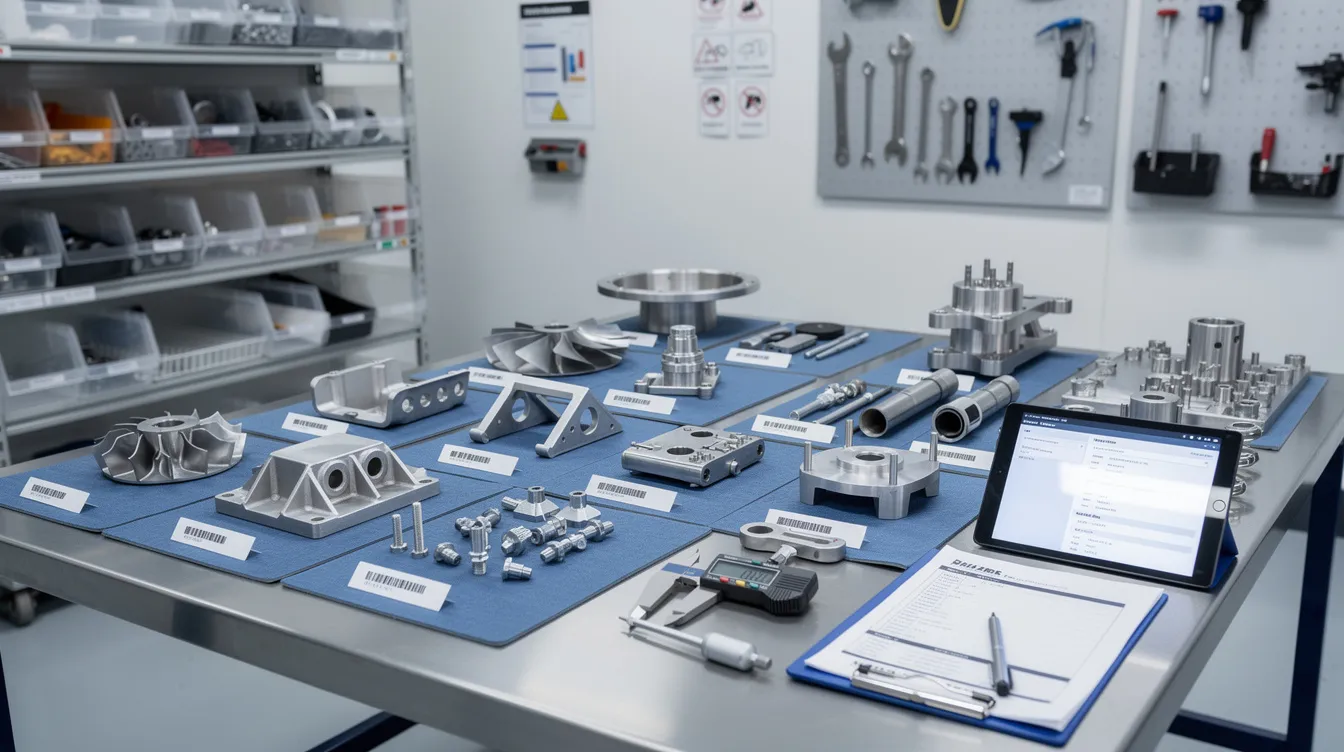
    The image depicts aerospace parts meticulously arranged in a clean industrial workspace, ready for receiving inspection to ensure compliance with quality standards. This setup emphasizes the importance of quality management systems and the need for relevant documentation to verify the acceptance criteria and prevent nonconformance.

    Audit Trail and Revision History Fields

    An audit trail should capture who created, edited, reviewed, dispositioned, verified, and closed the NCR. It should include timestamps for raised, contained, dispositioned, corrective actions completed, verified, and closed.

    Regulated aerospace environments should prevent silent overwrites. Updates need a reason for change, prior value, new value, and user identity. In Connect981, these events are system-generated and exportable for AS9100, customer, FAA, or EASA audit review.

    If the audit history is unreliable, the technical content may still be questioned.

    Internal vs Supplier NCR Templates (What Changes?)

    Internal NCRs apply to shopfloor processes, in-house MRO work, tooling issues, documentation errors, and internal production quality problems. Supplier NCRs apply to incoming material, outsourced special processes, external repair stations, or supplier documentation gaps.

    Both share a common core. Supplier templates add supplier code, PO, contract, delivery note, certificate of conformity, supplier NCR number, 8D reference, and response due date.

    Supplier NCRs may link to SCARs, scorecards, and sourcing decisions. The fields can vary depending on customer requirements, product criticality, and regulatory compliance impact.

    Coordinating Supplier Corrective Actions and Internal Records

    Supplier response fields should include supplier root cause, corrective actions, preventive actions, completion dates, and supplier verification evidence. Internal quality should accept, reject, or return the response with comments.

    Add fields for multi-program impact and impact on other customers when shared suppliers are involved. Keeping supplier answers in the same system reduces email-driven data loss and improves supplier collaboration.

    What Makes an NCR Weak vs Audit-Ready?

    Weak NCRs usually have the same pattern:

    • Vague description such as “dimension wrong.”
    • No requirement reference or acceptance criteria.
    • Missing severity, risk, or scope.
    • No containment record.
    • Disposition not approved.
    • “use as is” without engineering justification.
    • Root cause listed as human error without systemic analysis.
    • No closure evidence or verification.
    • Attachments missing or stored outside the record.

    Strong NCRs include measurable facts, named approvers, linked specifications, objective evidence, complete audit trail, and closure verification that can verify effectiveness.

    Weak example: “Paint peeling on A320 flap track. Repainted.”Audit-ready example: “Paint finish on A320 LT flap track PN FT-23-195, SN 14579, per PS-105 Rev C, found 15 Mar 2026 during final inspection. Delta E measured 4.5 versus required ≤3. Supplier batch 002345 quarantined. Disposition: rework per WP-05. Verification: next 10 parts measured within limit. Closed with QA sign off.”

    The effective use of NCRs can lead to improved product quality, reduced operational costs, and enhanced compliance with regulatory requirements, ultimately preventing customer complaints and operational inefficiencies. NCRs serve as critical inputs for continuous improvement programs, allowing organizations to analyze trends and implement preventive measures that enhance overall quality and compliance.

    Checklist: Quick Review Before Closing an NCR

    Before closure, confirm:

    • Is the unique NCR number, location, date, part, serial, lot, and configuration complete?
    • Is the description factual and measurable?
    • Is the requirement reference documented?
    • Is severity set and justified?
    • Is scope bracketed across affected units and shipped product?
    • Is containment documented with owner and date?
    • Is disposition approved by the authorized role?
    • Are corrective actions assigned with target dates?
    • Is preventive action defined where needed?
    • Are photos, reports, certificates, and process records attached?
    • Did re inspection or test data verify effectiveness?
    • Is closure evidence complete and sign off recorded?

    This checklist should be part of daily quality review, not just audit preparation.

    Designing and Using an NCR Template in Connect981

    A digital NCR template in Connect981 differs from static forms because required fields, routing, approvals, supplier access, and role-based visibility are built into the workflow. Teams can configure internal, supplier, and MRO templates with zero or low-code tools.

    Connect981 links NCRs to work orders, serial numbers, digital work instructions, supplier records, CAPA workflows, and dashboards. Results feed management review, recurrence metrics, time-to-containment, supplier performance, and minor versus major non conformance trends.

    The outcome is practical: better quality, stronger compliance, less manual reporting, and clearer decisions at the point of work. Request a Demo of Connect981 to see NCR templates, supplier workflows, and audit-ready traceability in a live aerospace context.

  • design authority

    A design authority is the organization or formally appointed role that has legal, technical, and procedural responsibility for a product’s design. It controls the approved design definition, decides what constitutes a conforming or nonconforming condition, and authorizes any changes or deviations from the baseline design.

    Scope and responsibilities

    In industrial and regulated manufacturing environments, the design authority commonly:

    • Owns the baseline design, including drawings, models, specifications, and bills of material
    • Defines acceptance criteria and tolerances that production and quality must apply
    • Reviews and approves design changes through formal change control processes
    • Assesses nonconformances and determines whether rework, repair, or use-as-is is acceptable
    • Issues and approves deviations, waivers, and concessions to allow controlled departure from the design
    • Maintains configuration control and traceability of design revisions

    The design authority may be an internal engineering organization, a specific engineering role, or an external customer or type certificate holder, depending on contracts and regulatory frameworks.

    Operational meaning in manufacturing systems

    Within MES, PLM, ERP, and quality systems, the design authority is the reference owner of:

    • Released design data linked to routings, work instructions, and inspection plans
    • Approval steps for engineering change notices and configuration updates
    • Dispositions for nonconforming material that require design approval, such as repairs or concessions

    Workflow configurations often model the design authority as an approver or sign-off step for changes affecting form, fit, function, safety, or regulatory compliance.

    Use in aerospace and other regulated sectors

    In aerospace and similar highly regulated industries, the design authority commonly:

    • Holds design approval from the aviation or relevant regulatory body
    • Determines whether proposed repairs or rework restore full conformity to the approved design
    • Approves concessions or deviations when a part does not fully meet the design but may still be accepted under controlled conditions

    Production, maintenance, and quality functions typically cannot independently change or override design requirements without documented approval from the design authority.

    Common confusion

    The term “design authority” is sometimes confused with:

    • Manufacturing authority: responsible for how the product is built, not for the design definition itself.
    • Regulatory authority: the external agency that grants approvals; it may recognize a design authority but is not the same entity.

    In many organizations, the design authority collaborates with manufacturing and quality but retains final say on what the official design is and which deviations are technically acceptable.

    Link to the source context

    In the context of scrap, rework, repair, and concession, the design authority is the body that decides whether a nonconformance can be corrected to meet the original design, repaired under an approved method, or accepted via a concession or deviation, and ensures that these decisions are documented and traceable.

  • How does Connect 981 differ from a traditional QMS for managing NCRs?

    Usually, the difference is this: a traditional QMS is centered on controlled quality records, formal workflows, and documentable evidence, while Connect 981 is typically used to improve how NCR work is executed on the shop floor and across connected operations.

    That does not mean Connect 981 automatically replaces a QMS. In regulated manufacturing, it often coexists with the QMS, MES, ERP, and sometimes PLM. Which system owns the NCR record, approvals, disposition steps, attachments, and downstream actions depends on your process design, integration quality, and validation approach.

    In practice, this connects to non-conformance management when teams need to turn the answer into repeatable execution habits.

    Practical difference

    • Traditional QMS: Usually focused on governance, controlled workflows, approvals, CAPA linkage, audit trails, and quality records management.

    • Connect 981: Usually focused on operational execution, contextual data capture, routing, role-based work coordination, and connecting NCR activity to production, inspection, materials, and operator workflows.

    So if your question is whether Connect 981 is “the same thing” as a QMS for NCRs, the answer is no.

    It is better understood as an execution-oriented layer that can make NCR handling faster, more traceable, and more connected to real plant activity, assuming the implementation is done well. A traditional QMS, by contrast, is usually where organizations anchor formal quality governance and retained evidence.

    What changes in practice

    Compared with a conventional QMS-only NCR process, Connect 981 may help with:

    • capturing nonconformance details closer to the point of occurrence

    • linking NCRs to work orders, travelers, parts, operations, or inspection events

    • routing actions across production, quality, engineering, and supplier workflows

    • improving visibility into rework, hold status, bottlenecks, and aging NCRs

    • reducing manual re-entry between paper, spreadsheets, email, and disconnected enterprise systems

    Those are operational advantages, not compliance guarantees. If the underlying data is incomplete, the process is inconsistent, or integrations are weak, a connected workflow can still produce bad records faster.

    Where the boundary matters

    The important question is not whether Connect 981 or the QMS is “better” in the abstract. It is which system should own each part of the NCR lifecycle.

    For example, some organizations keep:

    • initial capture and shop floor containment in Connect 981

    • formal quality review, disposition approval, and CAPA linkage in the QMS

    • inventory and cost effects in ERP

    • drawing or specification references in PLM or document control systems

    Others may consolidate more steps into a single platform, but that is harder in brownfield environments. Full replacement strategies often fail where equipment, workflows, and quality systems have been qualified over many years. The burden is not just software migration. It includes validation effort, retraining, integration rewrites, downtime risk, record continuity, and change control across regulated processes.

    Tradeoffs and limits

    Using Connect 981 for NCR management can improve execution, but it also introduces design decisions and risks:

    • Integration dependency: If ERP, MES, QMS, and supplier systems are not well connected, users may still duplicate data or work from conflicting statuses.

    • Ownership ambiguity: If system-of-record rules are unclear, audit trails and decision accountability can become fragmented.

    • Validation burden: Any workflow that affects controlled records, approvals, or traceability may require formal validation and disciplined change control.

    • Process maturity limits: Software will not fix weak disposition rules, inconsistent MRB practices, or poor root cause discipline.

    • Adoption risk: If operators and quality staff find the workflow slower than current practice, workarounds will appear quickly.

    So the real difference is not only feature-level. It is architectural and operational. A traditional QMS manages formal quality control structures. Connect 981 is more useful when the problem is delayed capture, disconnected plant execution, poor handoffs, or weak visibility around NCR flow.

    In many regulated operations, the strongest approach is coexistence: keep the QMS where it is already entrenched as the controlled quality backbone, and use Connect 981 to close execution gaps around NCR creation, triage, traceability, and follow-through. Whether that is viable depends on your interfaces, master data quality, workflow governance, and willingness to define clear system boundaries.

  • How does Connect 981 handle defect logging, root cause analysis, and corrective action tracking?

    Connect 981 commonly refers to a connected manufacturing or operations platform that supports closed-loop quality management on the shop floor. In that context, it typically handles defect logging, root cause analysis, and corrective action tracking as integrated workflows rather than isolated activities.

    Defect logging

    Defect logging in Connect 981 generally includes:

    • Electronic capture of nonconformances and defects at the workstation, inspection point, or test bench
    • Structured defect records with fields such as part, batch/lot, operation, station, operator, defect type, and severity
    • Attachment of supporting evidence, such as images, measurements, or test results
    • Linking the defect to related production orders, travelers, or serial numbers for traceability

    Root cause analysis

    For root cause analysis, Connect 981 typically provides:

    • Workflows to assign and track investigations for each logged defect or group of defects
    • Structured analysis fields, for example to capture probable cause, confirmed root cause, contributing factors, and verification steps
    • Support for common problem-solving methods (such as 5-Whys or fishbone-style categorization) using configurable forms or templates
    • Links between the analysis record and process data, equipment status, or parameter histories when those are available from connected systems

    Corrective action tracking

    Corrective and related preventive actions are usually managed as trackable tasks within Connect 981 that:

    • Are directly tied to a defect or root cause record, so each action has clear context
    • Include owners, due dates, priorities, and status (for example, open, in progress, implemented, verified, closed)
    • Allow attachment or reference to updated work instructions, parameter limits, or training records maintained in other systems
    • Capture verification and effectiveness checks to confirm the corrective action addressed the underlying cause

    How this supports regulated manufacturing

    In regulated environments, the combined handling of defect logging, root cause analysis, and corrective actions in Connect 981 helps create a consistent, timestamped record of quality events. This can support internal reviews, audits, and continuous improvement by showing what went wrong, why it happened, what was changed, and how effectiveness was evaluated, all within a single connected data set.