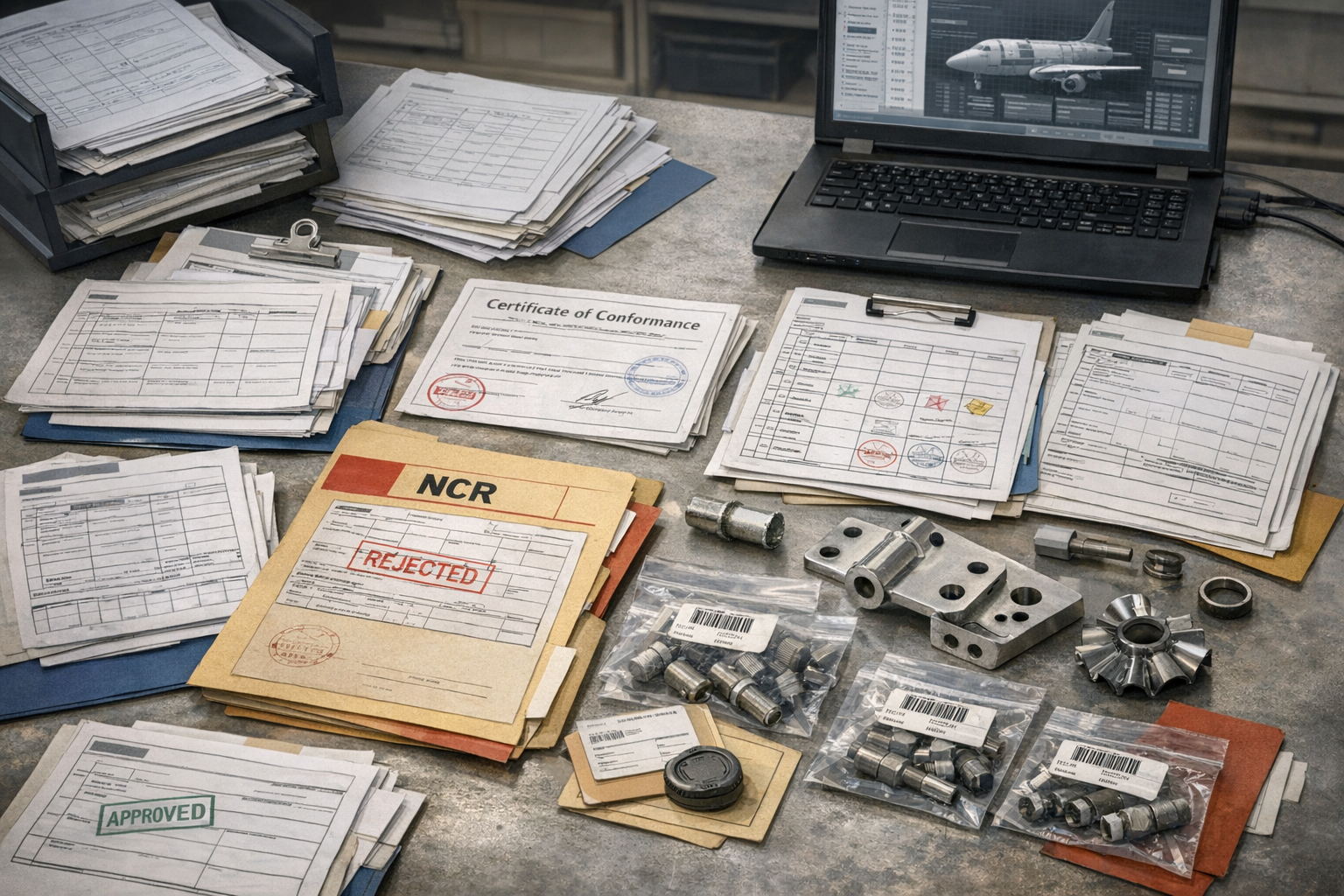
Aerospace supply chain resilience is usually discussed in terms of contracts, dual-sourcing, and inventory buffers. Those levers matter, but they ignore where many disruptions actually start: inside supplier factories, in the invisible gap between the production plan and what is really happening on the line. In a network built on complex, regulated work, resilience is fundamentally an execution problem.
This is the same pattern explored in the broader pattern behind OEM scoreboard narratives: top-level KPIs and scorecards hide the operational reality that determines whether programs stay stable under stress. In the supply base, that reality lives in how work is sequenced, controlled, and recovered when something goes wrong.
For teams putting this topic into daily operation, Connect 981’s aerospace execution solutions help connect the concept to traceability, work-order reality, and audit-ready evidence.
For teams putting this topic into daily operation, execution systems for aerospace manufacturing, supply chain and supplier execution help connect the concept to traceability, work-order reality, and audit-ready evidence.
The same operating model also depends on shop floor execution control, a connected execution platform, Connect 981’s aerospace operations guidance, practical aerospace operations FAQs, especially when decisions have to move across quality, production, suppliers, and program leadership without losing context.
Looking at aerospace supply chain resilience through an execution lens changes the conversation. Instead of asking, “Do we have a second source?” the better questions are, “Can we see what is really happening at critical suppliers?” and “Can we coordinate response before problems become surprises?” This article unpacks how execution gaps at tier-1 and tier-2 suppliers drive risk, and how a shared execution layer can turn fragile networks into collaborative, predictable systems.
Why Traditional Views of Aerospace Supply Chain Resilience Are Incomplete
Focus on contracts, capacity, and inventory buffers
Most resilience discussions start with three themes: long-term contracts, nominal capacity, and inventory. OEMs negotiate volume and price for years ahead, ask suppliers to demonstrate capacity, and create safety stocks of long-lead items or critical assemblies. Risk registers and mitigation plans often sit at this level.
Those tools help with strategic risk, but they operate at a coarse resolution. A supplier might show a nameplate capacity of 20 shipsets per month, yet struggle to produce more than 14 without chronic overtime, rework, and schedule churn. A contract may secure capacity on paper but says nothing about whether the supplier’s day-to-day execution system can handle a surge, a configuration change, or a new surveillance requirement.
Inventory buffers can buy time, but in aerospace they are expensive, regulated, and often constrained by configuration and effectivity. When the underlying execution system is unstable, inventory becomes a band-aid that slowly erodes under variability, leaving OEMs surprised when the buffer runs out precisely when it is needed most.
Underestimating the impact of execution quality at suppliers
Execution quality is not just product quality; it is the quality of how work is planned, sequenced, controlled, and recorded. In many aerospace plants, especially smaller tier-2s, the formal systems—ERP, scheduling modules, quality databases—tell a clean story. The real system lives in paper travelers, local spreadsheets, and tribal knowledge on the shop floor.
When execution quality is weak, risk accumulates silently:
- Work-in-process (WIP) is misaligned with actual constraint resources.
- Process deviations and concessions are tracked unevenly across cells.
- Configuration changes are communicated late or implemented inconsistently.
- Quality issues surface at test or inspection instead of at the point of work.
On the OEM’s dashboard, on-time delivery (OTD) may look acceptable until these latent issues line up with a surge request, a certification change, or a new non-conformance trend. By the time OTD moves, the underlying execution problem has existed for months or years.
Examples of how late-stage surprises propagate upstream
Late visibility on execution failures at suppliers turns local problems into network-wide shocks. Typical patterns include:
- Hidden yield problems on critical special processes. A tier-2 specializing in complex machining and surface treatments begins seeing higher scrap and rework on a new alloy. Travelers and rework logs are paper-based, so no one notices the trend until the finished-goods buffer drains and multiple late lots converge in inspection. The tier-1 is forced into emergency reprioritization, consuming capacity for other programs.
- Configuration or drawing effectivity misapplied. A design update changes hole patterns, fastener types, or coatings across multiple part numbers. The supplier updates work instructions for new jobs but misses reactivated legacy orders still in WIP. When assemblies reach integration, mismatches appear, driving rework, concessions, and schedule slips back through the chain.
- Unseen resource constraints around key people or assets. A small group of qualified special-process operators, or a single certified CMM, becomes the true bottleneck during a ramp. Local supervisors know this, but the OEM sees only aggregate capacity. When demand spikes, lead times stretch in unexpected ways and expedite requests simply move the queue without improving actual throughput.
In each case, the resilience failure is not lack of contracts or theoretical capacity—it is the absence of shared, timely execution visibility.
Execution Realities in Tier-1 and Tier-2 Aerospace Suppliers
Manual scheduling and paper-based control in critical processes
Even among sophisticated tier-1s, a surprising amount of critical work is still coordinated with manual tools. High-level schedules are generated from ERP or APS, but detailed sequencing often lives on whiteboards, printed dispatch lists, and the experience of a few planners and supervisors.
Paper travelers remain common for routing, inspection checkpoints, and signoffs. For regulated processes—heat treat, NDT, weld, bond, special coatings—this can technically satisfy compliance but makes it hard to understand real-time status. If a line stoppage occurs due to a furnace outage or failed coupon, the impact on specific customer orders is not obvious without manual triage.
The result is a fragile link between planning systems and the shop floor. Schedulers can publish a perfect plan at the start of the week, but by mid-week the true sequence diverges as operators adjust to machine issues, missing tooling, or late components. OEMs see the original plan; they do not see the divergence.
Limited real-time visibility into WIP and quality status
Most suppliers can answer “Where is my part?”—but not without work. Customer service teams send emails to production, planners walk the floor, supervisors check racks and travelers. The answer is often a snapshot rather than a continuous view.
Quality status is even harder to see in real time. Non-conformances might be logged in a QMS, but linkage to specific WIP orders and their impact on customer commitments is rarely automatic. An NC that stops a small batch can quietly hold up a critical assembly, while the top-level schedule still assumes the original promise date.
This opacity forces OEMs to operate on lagging indicators—OTD, aging past-due orders, and concession trends—rather than leading indicators like WIP aging, queue build-up at constraints, or first-pass yield on critical operations.
Strain from variable OEM demand and expedited requests
Demand from aircraft and defense programs is rarely smooth. Retrofits, post-certification changes, out-of-sequence work, and campaign-based upgrades mean order books for suppliers can swing significantly month to month. Those swings are often amplified by blanket POs, release patterns, and late-breaking field priorities.
Without a strong execution layer, suppliers respond with ad hoc expediting: pulling jobs forward, swapping setups, running overtime, and reassigning operators. Each local decision might make sense, but taken together they erode schedule stability. Lead times stretch unpredictably, WIP piles up in the wrong places, and quality risk increases as teams operate in permanent surge mode.
From the OEM’s perspective, the supplier looks unresponsive or disorganized. From the supplier’s perspective, they are doing everything possible with the tools they have. The missing piece is a shared, data-driven way to prioritize and manage work across customers and programs.
Signals That Indicate Supplier Fragility
Chronic expedites and short-notice replanning
Occasional expedites are normal in complex programs. Chronic expedites are a warning sign. When every critical delivery requires special attention—phone calls, executive escalations, daily status meetings—it indicates that the standard execution system is not robust enough to keep commitments without heroics.
Similarly, frequent short-notice schedule changes coming from the supplier—”we need to move this out two weeks,” “we can swap these lots,” “we had to hold that batch”—are clues that the internal plan is repeatedly invalidated by issues that should be visible earlier. In stable systems, plans fail gracefully; in fragile ones, they fail suddenly and repeatedly.
High rates of concessions and escape incidents
Concessions, use-as-is dispositions, and escape incidents are classic quality signals, but they are also execution signals. A rising concession rate often reflects stressed processes, training gaps, or overloaded inspection capacity. Escapes—non-conformances that reach the OEM or final assembly—usually point to weak integration between quality and execution on the shop floor.
When concessions become the de facto way to keep schedule, resilience is already compromised. The system is using future risk—potential rework, field findings, or certification scrutiny—to pay for present throughput. That trade rarely works out over the long term.
Inconsistent or delayed status reporting
Suppliers that struggle to provide timely, consistent status are typically struggling to see their own system. Weekly spreadsheets compiled by hand, status decks that change format every quarter, and large discrepancies between what is reported and what is observed during on-site visits all suggest weak execution visibility.
For OEMs, these are not just communication issues; they are early indicators of fragility. If a supplier cannot reliably say where work stands today, it is unlikely they can reliably absorb a design change, ramp, or new compliance requirement tomorrow.
What Shared Execution Visibility Enables
Early warning for capacity and quality constraints
A shared execution layer between OEMs and critical suppliers does not mean exposing every internal detail. It means creating a narrow but accurate window into real production status, WIP, and quality conditions that affect customer commitments.
With that window, OEMs can see emerging constraints long before they hit OTD: queue growth at a specific special process, extended cycle times on a new configuration, rising NCs tied to a particular tool, work center, or supplier lot. Instead of learning about problems when due dates are missed, OEMs receive early warning signals that enable proactive replanning, alternate sourcing, or engineering support.
Joint prioritization of orders across programs and customers
Suppliers often serve multiple OEMs and multiple programs. Without a shared execution view, prioritization becomes a negotiation driven by whoever is loudest or most urgent on a given day. That dynamic increases risk for all parties.
When OEMs can see, at least in summarized form, how their orders sit in the supplier’s real queue and what constraints are binding, prioritization becomes a joint decision. Programs can align on which units truly protect downstream integration schedules, test campaigns, or field commitments. Suppliers can propose realistic trade-offs grounded in constraint capacity rather than guesses.
Collaborative root-cause analysis grounded in real data
Traditional root-cause analysis between OEMs and suppliers is often forensic and slow. Teams reconstruct timelines from travelers, emails, and memory. Data is static and incomplete, and blame dynamics can overshadow learning.
A shared execution layer changes that dynamic. When both parties can see the same history of WIP movement, machine states, NC events, rework loops, and signoffs, the conversation shifts from speculation to evidence. It becomes easier to distinguish between systemic issues (e.g., under-capacity at a special process, unclear work instructions) and true one-off events. Corrective actions can then focus on changing the execution system, not just closing paperwork.
Architectures for Multi-Enterprise Execution Layers
Connecting OEM systems to supplier execution environments
Most OEMs already exchange data with suppliers through portals, EDI, and PLM integrations: purchase orders, forecasts, drawings, specifications. What is usually missing is a live connection to execution signals on the supplier’s side—order status by operation, WIP location, quality holds, and key timestamps.
A multi-enterprise execution layer sits between planning systems (ERP, APS, PLM) and shop-floor reality (MES, travelers, machines). It federates data from supplier environments—whether from existing MES, homegrown systems, or lightweight digital work instructions—and normalizes a small set of status signals that OEMs can consume. Platforms like Connect 981 are designed to operate in this space, without replacing ERP or QMS systems that already exist.
Data scope and access models that respect IP and export controls
Aerospace suppliers rightly worry about exposing too much internal data. Intellectual property, commercial terms, and export-controlled technical information all impose real constraints on data-sharing architectures. The goal of a shared execution layer is not to copy entire databases to the OEM, but to expose a minimal set of operational facts necessary for resilience.
Typical patterns include:
- Order-level status (e.g., not started / in work / at special process / in inspection / ready to ship).
- Operation-level milestones and cycle times for agreed critical routes.
- Aggregated WIP and capacity utilization for key resources, without revealing full routings.
- Quality event indicators tied to orders (e.g., on quality hold, under engineering review) without disclosing proprietary process details.
Access can be scoped by program, part family, or contract, and strictly limited to what is needed to manage risk. Export-controlled data remains governed by existing regulatory frameworks and technical safeguards; the execution layer should be designed to operate within those constraints, not bypass them.
Standardizing core status and traceability signals
Every supplier has its own internal codes, routing structures, and naming conventions. For OEMs trying to manage hundreds or thousands of suppliers, consuming this diversity directly is impossible. A practical multi-enterprise execution layer therefore relies on standardizing a small vocabulary of status and traceability signals.
Examples include:
- Common order lifecycle states (planned, released, in process, at external process, in final inspection, ready to ship, shipped).
- Key timestamps (release, start, finish by work center family, quality release).
- Serialized or lot-based identifiers that support downstream traceability.
- High-level quality flags (NC present, concession requested, deviation approved).
Internally, suppliers can continue to operate with detailed MES or paper systems. The execution layer acts as a translator, projecting just enough structured information outward to support network-level visibility without forcing every plant to adopt identical tools.
Resilience Metrics Beyond On-Time Delivery
Variability in lead time and schedule adherence
On-time delivery is a lagging, binary signal. Two suppliers with 95% OTD can behave very differently under stress. One may have tight lead-time distributions and stable adherence to start dates; the other may achieve OTD through constant firefighting and large swings in actual cycle times.
Execution-aware resilience metrics focus on variability as much as averages. Key views include distribution of actual lead times vs. planned, adherence to operation start/finish windows, and sensitivity of those metrics to demand changes. High variability is a direct indicator of fragility, even when OTD is still formally acceptable.
Quality stability and reoccurrence of issues
Quality metrics like defect rates and DPPM are standard, but resilience requires looking at how issues behave over time. Are similar NCs recurring across lots and configurations? Do corrective actions lead to stable improvements, or do problems resurface after a short period?
With execution-layer data, OEMs and suppliers can track NC rates by operation, shift, and configuration, and correlate them with process conditions (e.g., machine, tooling set, supplier lot). Persistent or migrating patterns signal where the system is absorbing risk rather than eliminating it. A resilient network shows decreasing recurrence and faster convergence of corrective actions.
Recovery performance after disruptions
No aerospace network can avoid disruptions: machine failures, late material, regulatory changes, or field-driven engineering orders will always occur. Resilience is therefore measured at least as much by recovery performance as by baseline performance.
Execution-aware metrics include time-to-detect issues, time-to-contain (e.g., isolate affected WIP and inventory), and time-to-recover committed schedules. These are difficult to measure with traditional reporting but become natural outputs of a connected execution environment where events and response actions are captured in context.
Practical Steps Toward a More Resilient Aerospace Network
Prioritizing critical suppliers and parts for deeper integration
Building a shared execution layer across an entire supply base is a multi-year journey. The starting point is to prioritize. OEMs should identify a small set of suppliers and part families where execution risk is most consequential: long-lead structural components, critical systems, single-source special processes, or assemblies that frequently drive line stoppages.
For those suppliers, the goal is to move beyond quarterly business reviews and spreadsheet-based tracking toward a more direct connection to their execution environment. That may begin with simple, structured status feeds and progress over time to richer WIP, constraint, and quality visibility as trust and capability grow.
Pilots using platforms like Connect 981 for shared visibility
Early pilots should be scoped narrowly but designed to exercise the full concept of connected execution. A typical pattern is to select one program, one or two suppliers, and a handful of part families, then instrument the full order flow from OEM release through supplier execution to final delivery using a shared platform such as Connect981.
The pilot’s purpose is not to implement every feature but to learn how real execution data changes decision-making: how earlier detection of WIP bottlenecks affects replanning, how transparent queues influence expedite behavior, and how embedded traceability simplifies audits and concessions. These insights then guide broader rollout.
Embedding execution expectations into new contracts and SOWs
Finally, resilience must be designed into commercial and technical relationships, not added as an afterthought. As OEMs renew contracts and statements of work, they can explicitly define expectations for execution visibility and data-sharing, alongside traditional quality and delivery requirements.
Examples include requirements for order-level status updates through designated digital channels, participation in defined multi-enterprise execution platforms, timely capture of traceability data at critical operations, and support for joint root-cause investigations using shared data. The goal is not to impose a single system everywhere, but to make connected execution a standard part of what it means to be a strategic aerospace supplier.
In a regulated, high-consequence industry, resilience cannot be purchased solely through second sources and inventory. It has to be built into how work is executed and seen across organizations. By investing in a shared execution layer—where OEMs and suppliers operate from the same real-time understanding of production, constraints, and quality—networks become less reactive, less fragile, and better prepared for the next wave of program and regulatory pressures.