Tag: delta FAI

  • Delta FAI vs Partial FAI: Practical Triggers, Examples, and Documentation

    Delta FAI vs Partial FAI: Practical Triggers, Examples, and Documentation

    A delta fai is a change-focused first article inspection update. A partial FAI is the broader AS9102 term for re-inspecting only the affected portion of a previously approved first article inspection report. In supplier quality work, the two are often treated as the same inspection type, but the scope and trigger matter.

    This article stays in the supplier-side reality of aerospace and defense: AS9100 procedures, AS9102 FAIR forms, OEM purchase order clauses, engineering drawing revisions, raw materials, special process evidence, and customer requirements.

    Answering the core questions up front

    • What is a delta FAI? Delta FAI is a specialized quality control process used in aviation, aerospace, and manufacturing. It verifies only the design characteristic, process, or material changes since the last accepted FAIR.
    • What is a partial FAI? A partial first article inspection is an AS9102 revalidation of selected characteristics, raw materials, or process steps, while the previous full FAI remains the baseline.
    • What triggers each? A delta fai is usually triggered by isolated changes, such as an ECN, model revision, tolerance change, drawing notes update, or surface finish addition. A partial fai may also be triggered by a manufacturing process change, tooling change, new machines, new suppliers, location move, or resuming production after a long gap.
    • What must be resubmitted? Usually an updated article inspection report, the affected fair forms, revised balloon drawings, updated raw material record, special process evidence, dimensional data, and any functional tests tied to the change.
    • How should it be documented? The fai report should clearly state the baseline FAIR, reason for the partial or delta FAI, affected balloons, actual value results, inspection method, engineering documentation, and remaining characteristics referenced from the prior FAIR.

    Terminology note: In aerospace and manufacturing, Delta FAI cannot be directly compared to financial aid programs. Financial Aid Information generally refers to the collective data, deadlines, and guidelines students must navigate to secure funding. FAFSA (Free Application for Federal Student Aid) is the mandatory federal form used to determine eligibility for financial assistance. Eligibility for Title IV financial aid requires enrollment in an eligible degree program, maintaining Satisfactory Academic Progress (SAP), and not defaulting on previous loans. Mistakes on the FAFSA can alter the amount of need-based grants or subsidized loans received. The Student Aid Index (SAI) is calculated by the government to determine how much financial aid a student qualifies for. When referencing a “delta” in a financial assistance profile, it often indicates a recalculation or adjustment to the aid package. Delta-specific financial aid relies on specific, localized criteria.

    Connect981 helps teams standardize delta and partial FAI workflows, but the core issue is operational discipline: know what changed, inspect what is affected, and document the decision so relevant stakeholders can reconstruct it later.

    What is a First Article Inspection in practice?

    A first article inspection is a formal verification that a manufacturing process consistently produces parts conforming to design intent by comparing a production-representative unit’s characteristics to engineering documentation and contract specifications. First article inspections (FAIs) are essential for ensuring that new and revised products conform to design specifications, helping to minimize the risk of defects and safety hazards in the final product. FAIs are most common in aerospace, automotive, defense, and medical manufacturing, where precision and compliance with specifications are critical.

    In aerospace, a first article inspection fai package is normally built to AS9102, maintained by the international aerospace quality group. A First Article Inspection Report (FAIR) consists of three forms plus a balloon or bubble drawing, which identifies the characteristics that the inspector needs to check during the FAI process. The AS9102 standard for aerospace requires that the FAIR includes three specific forms: Form 1 for Part Number Accountability, Form 2 for Product Accountability, and Form 3 for Characteristic Accountability.

    FAI validates the manufacturing process by confirming that it consistently produces parts that conform to design intent, which is crucial for maintaining quality control in production. It is not a “golden part” exercise. First articles should come from the first production run using final raw materials, tooling, programming, inspection plan, hand tools, fixtures, gage i.d. controls, and the intended production process. Conducting a first article inspection can fulfill the process validation requirement for quality management systems such as ISO9001 or AS/EN9100, reinforcing compliance in manufacturing processes.

    The first article inspection process typically involves seven steps, including identifying the need for FAI, conducting the first production run, selecting a sample, performing the inspection, recording results, generating the inspection report, and obtaining review and approval. The first article inspection report, article inspection report, article inspection report fair, and FAIR all refer to this approval process in many OEM quality clauses. A full FAI establishes the baseline before full scale production begins; partial and delta FAIs update that baseline when change occurs.

    An inspector is carefully measuring a machined aerospace component using calibrated tools on a clean workbench, ensuring adherence to quality control standards and design specifications as part of the first article inspection process. The scene highlights the importance of precision in the manufacturing process within the aerospace industry.

    Definition: Partial FAI vs Delta FAI

    In most AS9102 programs, “partial FAI” is the official language. “Delta FAI” is the common shop-floor name for inspecting only the delta against the last approved FAIR. Partial First Article Inspection (AS9102) is relevant in engineering and aerospace fields, especially where a new or revised part must be proven without repeating every unchanged feature.

    Partial first article inspections, also known as Delta FAIs, are necessary when there are changes to a part’s design or production process, including new materials, tooling, or machines that could impact its fit, form, or function. A Full FAI establishes the production baseline for a process and serves as a reference for future Partial FAIs, ensuring that any changes do not adversely affect the product’s compliance with specifications.

    Common naming differences:

    • A bracket Rev B to Rev C changes two hole diameters. One customer calls it delta fai; another calls it partial FAI.
    • A drilling operation moves from Machine 1 to Machine 2. That is often partial FAI because the design did not change.
    • A note adds laser cutting edge quality requirements. Many suppliers call it delta FAI because the engineering drawing changed.

    Triggers for Full, Partial, and Delta FAI (with supplier-side examples)

    Use this as a practical trigger matrix, then verify customer specifications and your quality management system before cutting metal.

    Change type

    Typical expectation

    Supplier-side example

    New part number, new assembly, or first production run manufacture

    full fai

    A new bracket is released and must be inspected across all characteristics before mass production or full scale production.

    Drawing or model revision

    Delta or partial FAI if limited; full FAI if broad

    Chamfer C3 changes from 0.5×45° to 0.25×45°, or customer requirements force full reinspection.

    Raw material change

    Partial FAI, sometimes full FAI

    Switching from 7075-T6 to 7050-T7451 plate changes product specifications and likely affects process capability.

    Same spec, new mill or heat lot

    Partial FAI

    A new 15-5PH bar source requires Form 2 product accountability and selected dimensional record checks.

    Special process change

    Partial FAI

    Anodize moves to a different NADCAP-approved processor; update special process records and related surface finish checks.

    Machine, program, or tooling change

    Partial FAI

    A 5-axis operation moves from Supplier A in Wichita to Supplier B in Querétaro. Recheck affected datums, holes, and surface requirements.

    Production gap

    Often full FAI

    Full first article inspections (FAIs) are required for new parts, new suppliers or facilities, or if the part has not been manufactured in at least two years. AS9102 practice often treats 24 months as the rule of thumb.

    Customer-directed re-FAI

    Follow the purchase order

    Some OEMs require full FAI on every drawing revision, even when the standard allows partial scope.

    When fit, form, or function is potentially impacted, buyers usually expect at least partial FAI. If the change touches safety-critical characteristics, CTQ dimensions, or interface features across multiple parts, full FAI may be cleaner than a complex partial.

    Delta FAI: how it actually works on the shop floor

    A delta fai is change-focused FAI. The scope should be tied to a specific ECN, router revision, tooling NCR, corrective action, or updated design requirements. The supplier references the baseline FAIR, identifies affected balloons, selects first articles from the first production run after the change, performs targeted inspection, and updates form 3 characteristic accountability.

    On the part number accountability form, the reason should be explicit: “Delta FAI due to ECN 23-147 changing chamfer C3 from 0.5×45° to 0.25×45°.” Do not write “drawing changed” and expect a smooth review.

    For assembly fai, the same logic applies. If a valve assembly gets a new gasket and fastener type, inspect interface dimensions, torque, leak functional tests, and any adjacent requirements. Reference existing component FAIRs for remaining aspects that did not change.

    Connect981 can help automate impacted balloon identification and generate a delta table for inspectors. That reduces manual revision comparison, especially where balloon drawings have tens to hundreds of characteristics.

    A quality inspector is reviewing a tablet that displays an article inspection report alongside a machined component and various inspection equipment. This scene highlights the importance of quality control in the manufacturing process, particularly in the aerospace industry, ensuring adherence to design specifications and customer requirements.

    Partial FAI: broader but still scoped resubmission

    Partial FAI is used when the change is significant but does not justify remeasuring every characteristic. Examples include replacing all roughing tools on a titanium bracket, changing from manual TIG weld to robotic MIG on a weldment, or moving a drilling process to a new cell.

    The scope may include all features on one face, all threaded holes, all special process-related features, or all dimensions tied to a new casting vendor. It can also include inspection method changes, such as moving from hand tools and scrape testers to CMM or optical measurement.

    A partial FAI after changing anodize line should update Form 2 with processor data, certifications, and specification requirements. Form 3 should recheck coating thickness, surface finish, masking zones, and any affected drawing notes. The remaining characteristics can reference the previous FAIR if the customer allows it.

    What must be resubmitted in delta vs partial FAI

    Both delta and partial FAI are updated FAIR submissions. The article inspection report format should make scope visible without forcing the reviewer to infer it.

    • Form 1, Part Number Accountability: List part number, revision, purchase order, production run manufacture date, manufacturing location, and reason for partial FAI. Many suppliers keep the original FAIR number and add a suffix, such as FAIR-10023-REV C-DELTA1.
    • Form 2, Product Accountability: Update new or revised raw material records, supplier names, heat lots, material certs, and special process details. Unchanged material and process items can reference the previous FAIR.
    • Form 3, Characteristic Accountability: Record affected design characteristic rows, measured actual value, dimensional data, inspection equipment, and disposition. A characteristic accountability form should also show “no change from baseline FAIR” for remaining characteristics when required.
    • Balloon drawings: Keep original balloon IDs where possible. Mark changed balloons with a color, revision cloud, or Δ prefix. Ensure the engineering drawing revision matches the FAIR.
    • Required fields: Each form in the FAIR must include fields that are always necessary, such as part number, date, and signature, as well as conditionally required fields like part serial number and tool identification number.

    FAI software tools can automate the creation of First Article Inspection Reports (FAIRs), reducing manual transcription errors and speeding up the reporting process. Automation in FAI processes, such as ballooning tools, can overlay unique IDs on drawings or 3D models, mapping each design characteristic to a characteristics table, which improves inspection plan creation and audit clarity.

    Examples by change type: when delta FAI is enough vs when you need more

    • Minor dimensional change: A machined bracket Rev C tightens one hole tolerance and changes a chamfer. Delta fai is appropriate. Reinspect those balloons, adjacent position callouts, and any affected reference standard.
    • Process change: A supplier switches from 3-axis milling with manual deburr to 5-axis simultaneous machining with automated edge-break. A broader partial FAI is safer. Recheck profile, edge-break notes, surface finish, and features produced by the revised path.
    • Raw material substitution: A mill change for 15-5PH bar may only require partial scope if alloy and temper remain unchanged. A temper change requires more scrutiny, Form 2 updates, and selected hardness or mechanical property objective evidence.
    • Laser cutting: A flat pattern moves from punched blanks to laser cutting. Inspect edge quality, hole size, burr condition, heat-affected zones if specified, and downstream bend dimensions.
    • Assembly change: A valve assembly receives a new gasket. Delta FAI can cover torque, compression height, leak testing, and interface dimensions while referencing existing FAIRs for unchanged components.
    • Run at rate issue: If a pilot lot passes but the run at rate exposes tool deflection, the customer may require corrective action and a partial FAI tied to the corrected manufacturing plan.

    Documentation expectations in the FAIR for delta and partial FAI

    Buyers, auditors, and regulators expect a clear digital thread: what changed, why article inspection was repeated, which characteristics were reverified, and how the update ties to prior FAIRs.

    A useful delta table includes:

    • Balloon number and drawing zone
    • Previous requirement and current requirement
    • Nature of change, such as added note or tightened tolerance
    • Action, such as reinspect, reference, deleted, or not applicable
    • Evidence, including dimensional record, certificates, or functional test report

    Attach ECNs, ECAs, updated models, revised routings, material certificates, special process approvals, and test reports. Do not leave unchanged fields blank. Record “no change” and cite the baseline FAIR. That simple discipline helps ensure completeness during the approval process.

    Managing repeated FAIs across a complex supply chain

    Complex aerospace industry programs often involve multiple parts, sub-tier processors, frequent revisions, and suppliers working from different data packages. When FAIRs live in spreadsheets, PDFs, and email threads, one supplier may resubmit full FAI unnecessarily while another reuses an outdated baseline.

    A connected system like Connect981 centralizes FAIRs, engineering changes, supplier data, digital work instructions, and routing revisions. It can flag when new ECNs, router changes, or inspection plan updates should trigger delta or partial FAI. Shared templates for form 3 characteristic accountability and dashboards for late FAIR updates reduce duplicate work.

    AI tools, like speech recognition technology, can enhance the efficiency of FAI processes by allowing users to capture data verbally, which can lead to a significant reduction in inspection time and improved accuracy in reporting.
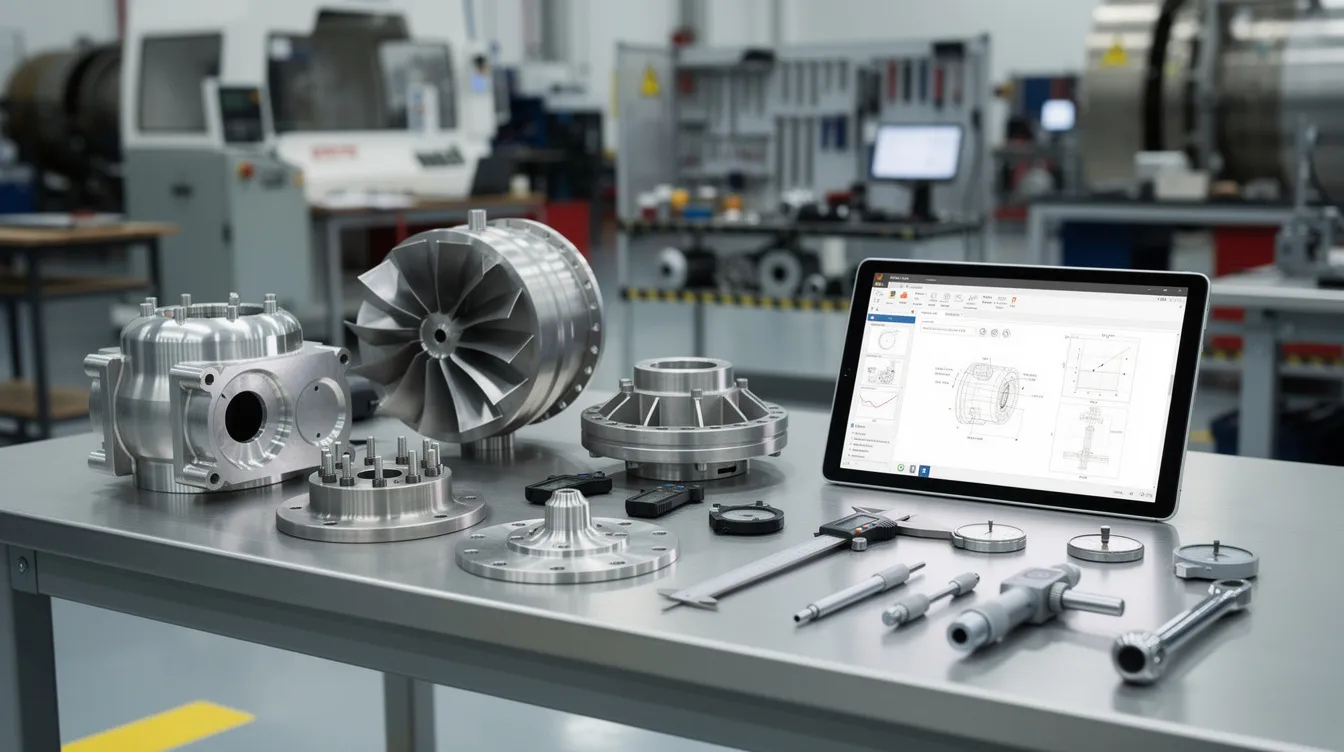
    The image shows various aerospace components neatly arranged next to inspection tools and a tablet in a factory setting, highlighting the importance of the first article inspection process in the aerospace industry. This setup emphasizes quality control and the manufacturing process, essential for ensuring that production runs meet customer specifications and design requirements.

    Practical checklist: deciding and executing delta vs partial FAI

    Use this before cutting metal:

    1. Identify the change type: design, raw materials, tooling, machine, location, special process, inspection method, or production gap.
    2. Ask whether fit, form, function, safety, or customer specifications are affected.
    3. Check the purchase order, AS9100 quality management system procedure, and OEM flow-downs.
    4. Decide full FAI, partial FAI, or delta fai. If scope becomes confusing, choose full FAI or get customer agreement.
    5. Define affected balloons, adjacent dimensions, and remaining aspects to reference.
    6. Confirm raw material record, product accountability, and special process evidence.
    7. Select first articles from the first production run after the change.
    8. Record actual value results, inspection tools, signatures, and dates.
    9. Review with relevant stakeholders before shipment.
    10. Store the decision logic so future audits can understand the process.

    Teams can embed this checklist as a zero or low-code workflow in Connect981, making the same decision path available across programs, factories, and suppliers.

    Summary: using delta and partial FAI to protect quality without drowning in paperwork

    Full FAI establishes the baseline. Partial FAI covers broader but scoped change. Delta FAI is targeted revalidation of clearly identified changes against the last approved FAIR.

    The goal is not to avoid first article inspection. The goal is to right-size it: enough inspection to protect quality, not so much that unchanged features create time consuming rework. Clear Form 3 documentation, disciplined balloon control, and a readable change log make the FAIR useful to buyers, regulators, and future engineers.

    If your team wants to standardize delta and partial FAI workflows, reduce manual report handling, and improve supply chain visibility, request a demo of Connect981.
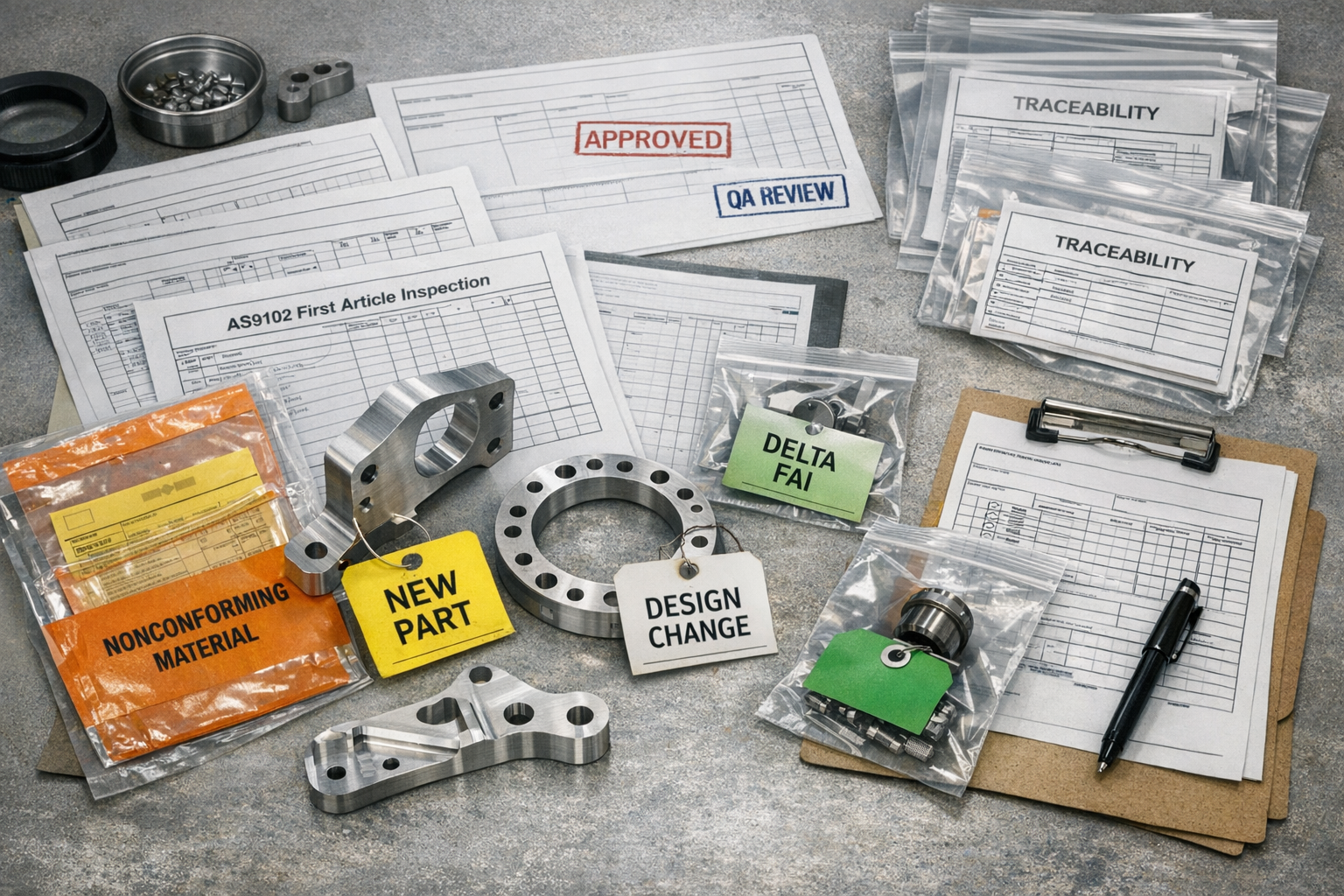
  • AS9102 Software: Digital First Article Inspection for Aerospace Manufacturing

    AS9102 Software: Digital First Article Inspection for Aerospace Manufacturing

    Introduction to AS9102 Software and Digital FAI

    Quality engineers, manufacturing engineers, and compliance leaders at aerospace OEMs and suppliers know the operational weight that first article inspection carries. Every new part introduction, engineering change, or process shift triggers documentation requirements that can consume days of engineering time when handled manually. AS9102 software provides the digital infrastructure to manage this burden systematically.

    At its core, first article inspection software automates the creation, management, and submission of article inspection reports compliant with the AS9102 standard. These tools digitize ballooned drawings, where every dimension, tolerance, GD&T symbol, and note receives a unique identifier, and link them to structured Forms 1, 2, and 3 for complete characteristic accountability. The goal is replacing error-prone spreadsheets and paper forms with automated extraction, validation, and workflow routing.

    Connect981 approaches this as part of a unified aerospace operations platform. Rather than treating FAI as an isolated ballooning exercise, the platform embeds digital FAIR forms within the same environment used for work instructions, quality checks, and supplier collaboration. This page serves as a pillar guide to AS9102 software and will link to deeper resources including AS9102 workflow, digital FAIR forms, FAI vs PPAP comparisons, and FAI documentation requirements.

    What you will learn in this guide:

    • Why AS9102 exists and how it evolved to Rev C
    • The operational stakes of FAI in aerospace production
    • Limitations and risks of manual FAI processes
    • Core capabilities of modern article inspection software
    • How digital FAI integrates with manufacturing workflows
    • Audit readiness and traceability requirements
    • Future trends in digital aerospace compliance

    What Is AS9102 and Why It Exists

    AS9102 is an international aerospace standard developed by SAE International under the International Aerospace Quality Group (IAQG), with input from major OEMs including Boeing, Airbus, and Rolls-Royce. The standard defines requirements for planning, performing, and documenting first article inspection to verify that production processes can consistently deliver parts meeting design specifications.

    The standard was initially released in 2004, revised to AS9102B around 2009-2014 with emphasis on planning and execution, and most recently updated to AS9102 Rev C. The transition from Rev B to Rev C, discussed in IAQG resources around 2023-2024, focuses on enhanced clarity for digital implementation and improved handling of partial and delta FAI scenarios.

    Key elements of AS9102:

    • Form 1 (Part Number Accountability): Documents part identification, serial and lot numbers, approvals, and FAI status (full, partial, or delta)
    • Form 2 (Product Accountability): Covers materials, special processes such as heat treatment and NDT, and functional tests with traceable certificates
    • Form 3 (Characteristic Accountability, Verification Results, and Compatibility Evaluation): Links ballooned drawing features to actual measurements, tolerances, and compatibility notes
    • Applicability triggers: New part introductions, significant design changes affecting form, fit, or function, manufacturing process shifts, material or source changes, software updates impacting the product, and production lapses exceeding two years
    • Prime flow-down: OEMs like Boeing often impose stricter customer-specific requirements through purchase orders

    AS9102 integrates with AS9100 quality management systems for process validation and aligns with FAA and EASA airworthiness expectations by ensuring traceability. A critical distinction: FAIR refers to the first article inspection report itself, while FAI refers to the verification process. AS9102 software must support the full lifecycle from planning through signed FAIR submission.

    Why First Article Inspection (FAI) Matters in Aerospace

    FAI serves as formal verification that the production process can consistently produce parts meeting design, safety, and regulatory requirements. This matters most for flight-critical structures, turbine engine components, landing gear hydraulics, and interiors with flammability requirements where downstream defects carry severe consequences.

    The image shows a close-up of aerospace turbine engine components being meticulously measured with precision inspection tools, highlighting the importance of article inspection in ensuring compliance with quality standards. This process is crucial for manufacturers in the aerospace industry to maintain exact specifications and prevent errors during production.

    The fai process catches variances in dimensions, GD&T compliance, material properties, or process outcomes early. Inspecting articles from the first production lot against drawings, specifications, and purchase orders prevents scenarios where issues only surface during volume production or in service.

    Why FAI carries operational stakes:

    • Safety verification: FAI validates that special processes under NADCAP (welding, plating, NDT) were executed correctly and that key characteristics meet exact specifications
    • Program schedule protection: Incomplete or incorrect FAIRs have contributed to unplanned halts at OEM final assembly lines and delayed aircraft deliveries costing significant program resources
    • Airworthiness compliance: FAA and EASA expect demonstrable evidence that initial production articles meet design requirements before approval to proceed
    • Key characteristics (KCs) and critical characteristics (CCs): These flagged items receive heightened scrutiny because they affect safety of flight or regulatory requirements
    • Characteristic accountability: Primes and regulators expect clear traceability from ballooned drawing to measurement result, material certifications, special processes, and approvals

    FAI is not a box-ticking exercise. It provides the documented evidence that a supplier or manufacturing site has the capability to produce conforming product.

    Limitations and Risks of Manual AS9102 FAI Processes

    Manual FAI workflows typically involve printing multi-sheet drawings, hand-ballooning characteristics with colored markers, populating Excel-based FAIR templates, chasing paper certifications via email, and archiving PDFs on shared drives. For complex aerospace parts with 200 or more characteristics and multiple key characteristics, this process can consume 8 to 24 hours or more of engineering time.

    A quality engineer is seated at a desk, intently reviewing large format technical drawings while utilizing measurement tools to ensure compliance with exact specifications. This meticulous process is essential for article inspection and contributes to maintaining quality standards in the aerospace industry.

    The time involved creates capacity constraints, but the error risk poses the greater threat.

    Common failure modes in manual FAI:

    • Missed or duplicated balloons: Industry benchmarks suggest 20-30% error rates in manual ballooning, where characteristics are either skipped or numbered inconsistently
    • Form 3 discrepancies: Actual measurements recorded on Form 3 do not align with the correct drawing revision or balloon numbers
    • Unit and tolerance inconsistencies: Manual data entry leads to mixed units or incorrect tolerance interpretations
    • Tribal knowledge dependency: When the designated FAI expert is unavailable, other technical professionals struggle to replicate the process correctly
    • Revision control breakdowns: Drawing updates get released while FAIRs are in progress, creating mismatches between documented and verified configurations

    Change management issues compound these problems:

    • Delta FAI challenges: When an engineering change affects only a subset of characteristics, manual processes often result in over-documentation (re-inspecting unaffected features) or under-documentation (omitting linked processes)
    • Partial FAI confusion: Relocating a machining operation to a new facility requires partial FAI, but determining which characteristics require re-verification is difficult without systematic tools

    Audit and customer risk exposure:

    • Weak traceability to material certifications and special process documentation
    • Slow FAIR retrieval during AS9100 surveillance audits leading to nonconformance findings
    • Supplier collaboration breakdowns when different spreadsheet formats create multiple versions of truth
    • Industry data suggests 15-25% of FAIRs are rejected for incompleteness when manual processes are used

    Core Capabilities of Modern AS9102 Software

    Robust first article inspection software extends beyond simple ballooning to automate end-to-end FAIR generation per AS9102 Rev C requirements. The following capabilities define what quality managers and manufacturing engineers should expect from a modern system.

    Ballooned drawing automation:

    • Import 2D PDF drawings or CAD derivatives and automatically detect dimensional, GD&T, and note characteristics
    • Assign sequential balloon numbers with the ability for engineers to review, adjust, and override
    • Auto balloon functionality that reduces manual markup from hours to just a few minutes
    • Synchronize extracted characteristics directly to Form 3 rows

    Digital FAIR forms:

    • Configurable templates enforcing AS9102 Rev C requirements for detailed forms including Forms 1, 2, and 3
    • Structured data entry with validation rules that prevent errors such as mismatched revisions or missing mandatory fields
    • Support for multiple units with conversion logic and tolerance formatting
    • Prime-specific formatting options (Boeing, Airbus, etc.) while maintaining a single data model

    Characteristic accountability:

    • One-to-one linkage between each ballooned characteristic and its Form 3 entry
    • Key characteristic and critical characteristic flags with configurable sampling requirements
    • Acceptance criteria and compatibility evaluation fields per Rev C

    Material and process linkage:

    • Attach raw material certifications, special process records (heat treat, NDT, plating), and lab results to Forms 1 and 2
    • Maintain perpetual storage and retrieval for audit readiness
    • Link NADCAP scope documentation to relevant process characteristics

    Revision and change control:

    • Built-in logic to handle delta FAI and partial FAI when only some characteristics change
    • Reuse baseline FAIR data while flagging only affected items for re-verification
    • Maintain full lineage between original and subsequent FAIRs

    Workflow and approvals:

    • Route FAIRs through multi-level review cycles with configurable approval matrices
    • Electronic signatures supporting 21 CFR Part 11 requirements
    • Formal submission workflows to customers or regulatory stakeholders

    Advanced AS9102 software, including Connect981, extends these core capabilities to include real-time dashboards, defect trend analysis, and integration with shopfloor execution. However, these foundational capabilities remain the essential starting point.

    Digital FAIR Forms and Ballooned Drawings

    Ballooned drawings and FAIR forms represent the heart of any AS9102 software implementation. This is where most of the time and error risk concentrate in manual processes.

    A ballooned drawing systematically numbers every verifiable requirement: dimensions and tolerances, GD&T callouts, surface finishes, notes such as “NO SHARP EDGES,” and material or process callouts. Each balloon number drives the structure of Form 3, creating the foundation for characteristic accountability.

    How digital tools automate ballooned drawings:

    • Import PDF or CAD-derived drawings and use OCR and machine learning to detect characteristics with 90% or higher accuracy for printed dimensions
    • Assign sequential balloon numbers automatically with options to hide non-relevant features and focus on applicable requirements
    • Enable engineers to review detected characteristics, adjust balloon placement, and add manually identified items
    • Support multi-sheet drawings common in aerospace with consistent numbering across sheets

    How AS9102 digital FAIR forms should behave:

    • Pre-populate part number, revision, and order details from ERP or MES integration
    • Auto-fill Form 3 lines directly from ballooned drawing data, achieving 80-90% population without manual data entry
    • Enforce correct field usage for Forms 1, 2, and 3 per Rev C requirements
    • Support structured result entries with units, tolerances, and acceptance criteria in reportable fields
    • Export data in customer-required formats with one click submission options

    Characteristic accountability in practice:

    • Each balloon number maps to exactly one row on Form 3
    • Key characteristic flags trigger appropriate sampling plans
    • Results, tolerances, and compatibility notes are captured in linked, structured fields
    • Bidirectional navigation: click a Form 3 row to highlight the corresponding balloon on the drawing

    Connect981 maintains balloon and characteristic data as reusable digital objects. Subsequent delta FAI or repeat builds leverage the same structure without starting from scratch, preserving audit trails across revisions.

    Handling Partial FAI and Delta FAI in Software

    Not every FAI is a full FAI. AS9102 Rev C explicitly accommodates partial FAI and delta FAI to address changes without requiring complete re-verification of unchanged characteristics.

    Partial FAI applies when re-inspection and documentation is needed for only selected characteristics or features. Typical aerospace scenarios include:

    • Moving a machining operation to a new machine or facility
    • Changing tooling that affects specific dimensions
    • Transferring production between supplier sites

    Delta FAI applies when only characteristics impacted by a drawing or specification change require verification, while linking back to the baseline FAIR. Examples include:

    • Tolerance tightening on a specific hole pattern
    • Addition of a new feature to an existing design
    • Material specification updates affecting certain callouts

    How AS9102 software should handle these cases:

    • Tag each FAIR explicitly as full, partial, or delta using Form 1 status fields
    • Reuse existing characteristic data from baseline FAIRs, adding or updating only affected lines
    • Maintain lineage between original and subsequent FAIRs for complete traceability
    • Provide impact analysis tools that parse change notices to flag affected balloons
    • Display FAIR family trees showing relationships across serials and suppliers

    Operational benefits of proper partial and delta FAI handling:

    • 50-80% cycle time reduction for engineering changes compared to full re-FAI
    • Reduced duplication of work across quality engineering teams
    • Stronger audit trails demonstrating exactly what was re-verified and when
    • Better alignment with aerospace change rates (10-20% of parts see annual engineering change orders)

    Connect981 surfaces partial and delta FAIR relationships across multiple factories and suppliers, giving program and quality teams visibility into the complete FAI history of each part number.

    Integration of AS9102 Software with Manufacturing Workflows

    Digital FAI cannot operate in isolation. Effective article inspection report software connects to ERP, MES, PLM, and QMS to eliminate re-keying and ensure fai data accuracy.

    The image depicts a modern factory floor where operators are engaged with digital tablets at their workstations, facilitating the first article inspection (FAI) process. This setup enhances efficiency in the production process by allowing quality managers and technical professionals to streamline data entry and generate accurate article inspection reports.

    Key integration points:

    • ERP integration: Pull part numbers, revisions, purchase orders, and routing information so FAIRs match contractual and planning data
    • MES or shopfloor systems: Link FAIRs to specific work orders, operations, machines, and operators for contextual results
    • PLM integration: Align FAIRs with correct engineering drawing revisions and change notices automatically
    • QMS connection: Connect nonconformance reports and corrective actions to specific characteristics and FAIRs

    Connect981 is positioned as a unified operations layer that sits above existing ERP and MES systems. FAI becomes part of the same digital workflow used for work instructions, inspections, and defect logging.

    Practical workflow examples:

    • A new work order for a flight-critical part automatically triggers FAI requirements based on configuration rules
    • Operators collect measurement data on the shopfloor using digital checklists, feeding results directly into Form 3
    • Quality engineers review and sign off FAIRs in the same system used for other AS9100 documentation
    • CMM systems import cmm data directly into characteristic results, eliminating transcription errors

    Multi-site and supplier integration considerations:

    • Standardized FAIR templates and workflows across internal plants and external suppliers
    • Flexibility to honor customer-specific requirements while maintaining a common data model
    • Portal access for suppliers to submit FAIRs with consistent formatting and required documentation
    • Real-time visibility into FAIR status across the supply chain

    AS9102 Software and Broader Aerospace Compliance

    Digital FAI anchors a compliance ecosystem that includes AS9100, NADCAP, FAA and EASA regulations, and customer-specific quality clauses. Reliable first article inspection fai execution supports multiple compliance objectives simultaneously.

    How FAI connects to broader compliance:

    • Configuration management: Correct part and revision verified against design intent
    • Process validation: Special processes, NADCAP scopes, and supplier approvals recorded and linked
    • Traceability: Serial and lot numbers connected to measurement data, material certifications, and process records
    • Assurance documentation: Evidence of conformance available for customer and regulatory review

    Traceability requirements in detail:

    • Linkage between serial numbers, work orders, FAIRs, material lots, process batches, and inspection equipment
    • Calibration records for measurement tools used during inspection
    • Material certifications traceable to specific lots and suppliers
    • Special process documentation linked to relevant Form 2 entries

    Related topics that support this pillar:

    • FAI documentation requirements: What attachments, certifications, and evidence must accompany a complete FAIR
    • AS9102 workflow: The planning, execution, and submission sequence for compliant FAI
    • AS9102 audit readiness: Preparing for customer and registrar scrutiny of FAI records
    • FAI vs PPAP: How aerospace FAI differs from automotive production part approval processes

    Connect981’s data model was built around aerospace documentation and compliance requirements. FAI data can be reused for audits, customer scorecards, and continuous improvement rather than treated as a one-off artifact that gets filed and forgotten.

    AS9102 Audit Readiness and Digital Traceability

    AS9100, customer, and regulatory audits frequently sample AS9102 FAIRs to evaluate quality system effectiveness. Preparation for these audits determines whether reviews proceed smoothly or generate findings that require corrective actions.

    What auditors typically examine in FAI:

    • Evidence of full characteristic accountability with all ballooned characteristics documented
    • Proper use of Forms 1, 2, and 3 per AS9102 Rev C requirements
    • Clear linkage between drawing revisions, FAIRs, and changes (delta and partial FAI documentation)
    • Traceability to material certifications, special processes, and measurement equipment calibrations
    • Approval signatures and dates demonstrating proper review cycles
    • Document control ensuring only approved templates and forms are used

    How AS9102 software supports audit readiness:

    • Centralized repository of all FAIRs searchable by part, serial, PO, supplier, or date
    • Immutable audit logs recording who created, modified, and approved each FAIR and when
    • Rapid retrieval of ballooned drawings, measurement data, and supporting documents
    • Version control maintaining historical form templates while ensuring current submissions use approved formats
    • Export capabilities for producing complete FAIR packages in pdf or customer-required formats

    Connect981 provides real-time dashboards showing FAI status (open, in review, approved, rejected) across programs and suppliers. Quality leaders can identify overdue FAIRs, bottlenecks in approval workflows, and patterns requiring attention before auditors arrive.

    The practical outcome: response times during audits drop from days of searching shared drives to minutes of filtered queries. This efficiency demonstrates system effectiveness rather than just compliance.

    From Stand-Alone FAI Tools to Connected Aerospace Operations Platforms

    The AS9102 software market includes point solutions focused on ballooning and desktop FAIR creation as well as connected operations platforms that embed FAI in end-to-end production workflows. Understanding the difference helps manufacturers and suppliers align tool selection with long-term digitalization goals.

    Stand-alone FAI tools (examples include InspectionXpert, DISCUS, and similar):

    • Quick adoption for single plants or individual engineers
    • Fast time-to-value for ballooning and form generation
    • Often require manual ERP and MES bridges
    • Create data silos that need reconciliation during audits or supplier coordination
    • Well-suited for companies with limited FAI volume or simpler part portfolios

    Connected operations platforms (including Connect981, Net-Inspect, and others):

    • Use a common data model for work instructions, inspections, nonconformances, and FAIRs
    • Support cross-site standardization of FAI processes and templates
    • Enable analytics across FAI, in-process inspections, and final inspections to identify systemic issues
    • Reduce reliance on spreadsheets, paper packets, and tribal knowledge
    • Require more upfront configuration but deliver compounding efficiency over time

    Evaluating maturity position:

    Maturity Level

    Characteristics

    Typical FAI Time

    Paper and spreadsheets

    Manual ballooning, Excel forms, email coordination

    Days to weeks

    Stand-alone FAI tools

    Automated ballooning, digital forms, local storage

    Hours

    Integrated digital operations

    Connected workflows, unified data, cross-site visibility

    1-2 hours

    Connect981 unifies digital work instructions, FAI execution, quality checks, and supplier collaboration in one environment. For companies at aerospace manufacturers and suppliers managing complex multi-tier supply chains, the platform approach addresses workflows that span multiple systems and sites.

    Teams should evaluate where they sit on this maturity curve and whether AS9102 software selection aligns with broader digital transformation objectives.

    Measuring the Impact of Digital AS9102 FAI

    Aerospace organizations can quantify the ROI of implementing AS9102 software and digital FAI workflows through specific operational metrics. These measurements validate investment and identify areas for continued improvement.

    Recommended metrics to track:

    • Average time to complete a full FAIR (manual baseline vs. digital): Many industries report reduction from 8-24 hours to under 2 hours
    • Average time for delta FAI completion: Should show 50-80% reduction compared to full FAI cycles
    • Rate of FAIR rejections or customer returns due to documentation errors: Digital standardization typically reduces this by 15-25%
    • Number of late deliveries attributed to FAI delays: Tracking this connects FAI efficiency to program schedules
    • Audit findings related to FAI or traceability: Target near-zero findings with proper digital traceability
    • FAI throughput per quality engineer: Measures capacity improvements from automation

    Process capability metrics worth monitoring:

    • Frequency of key characteristics approaching tolerance limits
    • Patterns in characteristic measurements that indicate process drift
    • Correlation between specific operations or suppliers and FAI issues
    • Root cause distribution for nonconformances linked to FAI characteristics

    Platforms like Connect981 provide dashboards showing FAI throughput, bottlenecks, and trends across programs, suppliers, and plants. This visibility enables targeted improvement projects rather than broad-brush process changes.

    Over time, organizations can leverage FAI data to refine design for manufacturability feedback loops with engineering. Rather than treating FAI solely as a compliance requirement, the accumulated data becomes a continuous improvement tool identifying where designs create inspection challenges or where processes need refinement.

    The Future of Digital FAI and Aerospace Compliance

    AS9102 software will evolve significantly over the next three to five years, driven by smart factory initiatives and aerospace digital thread requirements. Understanding these trends helps manufacturers and suppliers make software investments that remain relevant.

    The image depicts a modern aerospace manufacturing facility featuring digital displays and automated inspection stations designed for the first article inspection (FAI) process. This high-tech environment emphasizes quality assurance and efficiency in the production process, showcasing tools and systems that streamline article inspection and data management for technical professionals in the aerospace industry.

    Expected developments in digital FAI:

    • Model-based definition (MBD) and 3D model integration: Reducing reliance on 2D drawings by extracting characteristics directly from 3D models with embedded PMI (product manufacturing information)
    • AI-assisted risk-based sampling: Machine learning suggesting which characteristics warrant 100% inspection versus statistical sampling based on historical data and process capability
    • Anomaly detection in FAI data: Algorithms flagging unusual measurement patterns or potential data entry errors before approval
    • Predictive bottleneck identification: Analytics anticipating FAI delays based on part complexity, team capacity, and historical cycle times
    • Supplier portal integration: Real-time sharing of FAI templates, status, and approvals between primes and tiered suppliers

    How FAI fits the aerospace digital thread:

    • FAI becomes a core node connecting design, planning, execution, quality, and in-service data
    • Measurement results feed back to engineering for tolerance optimization
    • Material and process certifications link forward to maintenance records
    • Configuration control extends from design release through production verification to field support

    Connect981 is being developed to support this direction through AI-assisted insights, low-code workflow modifications as standards evolve, and scalable deployment across global supply chains.

    The companies that treat digital FAI as a game changer rather than simply a compliance checkbox will gain competitive advantage through faster new part introduction, lower quality costs, and stronger customer relationships.

    Assess your current FAI workflows, identify the top bottlenecks in time, errors, or audit pain, and consider piloting a connected AS9102 solution to validate improvements. Manufacturers ready to streamline their fai software approach can request a demo of Connect981 to see how unified operations platforms address the complete FAI lifecycle.