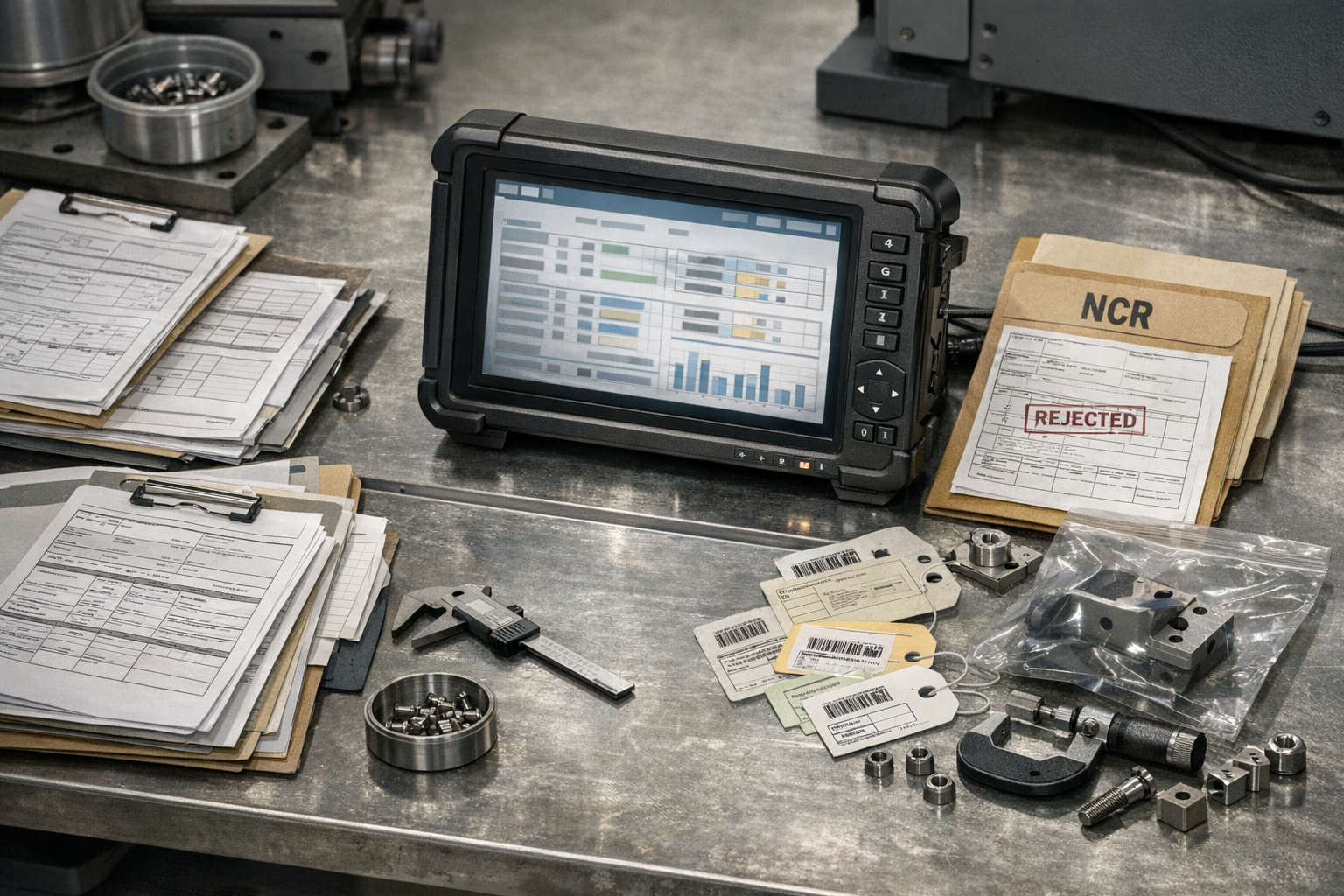
Tag: ISA-95

  • ISA-95 in Aerospace: Defining What ERP, MES, QMS, and PLM Should Own

    Aerospace teams rarely fail audits because nobody collected data. They fail because nobody can prove which system owned the data, which revision was current, or which decision blocked release.

    ISA-95, also known as ANSI/ISA-95 or IEC 62264, is an international standard for enterprise control system integration and for integrating enterprise office systems with factory floor control systems. In aerospace and MRO, isa 95 matters because AS9100, NADCAP, FAA, EASA, ITAR, CoCs, FAI packages, serial genealogy, and supplier evidence all depend on clean boundaries.

    Connect981 applies this boundary thinking as a unified operations layer between ERP, MES, PLM, QMS, suppliers, and the connected shopfloor.

    Quick overview: ISA-95 levels and aerospace system roles

    The ISA-95 model consists of five levels that describe the flow of information and activities within an organization, from the plant floor up to the enterprise level. ISA-95 defines a five-level model that describes the flow of information and activities within an organization, from the physical production processes at Level 0 to business planning and logistics at Level 4.

    • Level 0 describes physical production processes, machinery, raw materials, and physical assets on the floor.
    • Level 1 focuses on sensing and manipulating the production process through control devices, sensors, actuators, intelligent devices, and basic control functions.
    • Level 2 involves monitoring and supervisory control using programmable logic controllers, distributed control systems, SCADA, batch control, control module logic, and industrial control systems.
    • Level 3 is the manufacturing operations management level. It includes manufacturing execution systems, manufacturing execution systems mes, manufacturing operations management systems, manufacturing operations systems, quality control, maintenance activities, production scheduling, inventory control, and operational control.
    • Level 4 covers business planning and logistics. This includes enterprise resource planning, enterprise resource planning erp, erp systems, logistics systems, business systems, enterprise systems, business operations, and business processes.

    ISA-95 provides standard terminology and models to bridge the gap between information technology and operational technology. The common data model established by ISA-95 ensures consistent information exchange between enterprise and control systems. The framework is based on the Purdue Reference Model, also called the purdue enterprise reference architecture, with hierarchy models and a hierarchical structure for industrial automation.

    What belongs in ERP at ISA‑95 Level 4

    Level 4 owns the commercial plan, not the detailed build method. Enterprise resource planning ERP should own:

    • Customer contracts, demand, shipsets, sales orders, project accounting, and earned value.
    • Item master basics: part number, description, UOM, make/buy, cost category, high-level revision.
    • Inventory management: on-hand stock, warehouse balances, batch or lot quantities.
    • Purchase orders, approved supplier commercial records, delivery schedules, and raw materials commitments.
    • High-level routings and work centers for capacity and costing, not operator instructions.

    ERP decisions include MPS, MRP, material allocation, make-vs-buy, PO expedite logic, and release of production orders. ISA-95 Part 1 and Part 2 define object models, object model attributes, production capability, inventory, and schedule objects that support those decisions.

    Avoid using ERP for torque readings, inspection signoffs, NC program tracking, NADCAP parameters, or quality gate enforcement. That creates static PDFs, duplicate entry, and weak traceability.

    What belongs in MES / MOM at ISA‑95 Level 3

    Level 3 turns plans into executable manufacturing activities. Manufacturing operations management covers production operations, quality operations, maintenance operations, and inventory operations through operations activity models and production segments.

    MES, MOM, or Connect981 should own:

    • Detailed routing, operation sequence, dependencies, and station instructions.
    • Digital work instructions tied to PLM drawings, models, and revision control.
    • WIP status by serial, lot, tail number, station, operator, and timestamp.
    • Data acquisition from tools, equipment, and manufacturing systems.
    • Operator signatures, time-on-task, resource usage, and inspection evidence.
    • Local dispatching based on tooling, skills, machine status, shortages, and holds.

    In practice, MES is the execution truth for an engine MRO visit, a composite layup, a wing panel, or a heat treat load. It captures historical data, furnace curves, NDT results, serialized genealogy, and links to calibrated equipment.

    MES should not own long-term forecasting, engineering authority, or final MRB policy.

    What belongs in QMS: quality planning, records, and decisions

    QMS spans Level 3 and Level 4. It defines quality policy, while execution systems capture evidence.

    QMS should own:

    • AS9100, NADCAP, FAA/EASA, ITAR, and customer procedure requirements.
    • Inspection plans, control plans, sampling rules, acceptance criteria, and FAI requirements.
    • Nonconformance, MRB, CAPA, concessions, deviations, escapes, and customer returns.
    • Supplier approval, audit findings, calibration evidence, and supplier quality metrics.

    AS9100 traceability requires documented identification, status, acceptance authority, and unique identification where required. QMS defines conforming versus nonconforming product. MES or Connect981 presents the checks, captures measurements, blocks progression, and returns structured evidence.

    Avoid scanned forms buried in ERP attachments. They slow audits and weaken regulatory compliance.

    What belongs in PLM: product definition and engineering authority

    PLM owns product definition outside the ISA-95 pyramid but tightly feeds it.

    PLM should own:

    • eBOM, design intent, tolerances, specifications, MBD, drawings, and 3D models.
    • Configuration rules for aircraft, engines, structures, repair schemes, and modification kits.
    • ECR, ECO, revision effectivity by serial number, block number, or tail number.
    • Engineering requirements, verification, and validation data.

    PLM decides how the part is designed and when a revision becomes effective. ERP consumes released commercial attributes. MES consumes released work content. QMS aligns inspection characteristics and special process rules. Connect981 helps keep data flows synchronized so operators do not build from obsolete instructions.

    Control level (ISA‑95 Levels 0–2): what stays on the machines

    The isa 95 standard keeps the control level focused on physical processes and control processes. Level 0 of the ISA-95 model describes the physical production processes, including machinery and other assets in the field or on the floor. Level 1 focuses on sensing and manipulating the production process, which includes devices like sensors and actuators that collect data and affect production. Level 2 involves monitoring and supervising control, which refers to systems like programmable logic controllers and distributed control systems that manage physical processes.

    Typical aerospace assets include CNC machines, CMMs, autoclaves, test cells, torque tools, shot peen machines, NDT stations, and automated riveting systems.

    Control level systems own immediate safety, interlocks, recipes, NC code, PLC logic, and local cycle data. They should not own part revision, quality policy, supplier status, or full traceability chains. Critical results must flow upward through standardized data exchange.

    Ownership by data type: who is the system of record?

    • Product definition and design intent: PLM, read by ERP, MES, QMS.
    • Item master and commercial attributes: ERP, referenced by other systems.
    • Detailed routing and work instructions: MES or Connect981, linked to PLM.
    • Production orders: ERP owns order creation; MES owns execution status.
    • WIP and operation completions: MES, summarized back to ERP.
    • Quality plans and criteria: QMS, enforced in the execution layer.
    • Inspection evidence: MES or Connect981 captures it; QMS governs it.
    • NCR, MRB, CAPA: QMS owns decisions; MES supplies context.
    • Serial genealogy: MES or execution layer, with rollups to ERP and QMS.
    • Equipment capability: CMMS/EAM, integrated with MES and QMS.
    • Supplier approval: QMS owns qualification; ERP implements purchasing controls.

    ISA-95 prevents redundant work and reduces costly custom integrations by clearly defining software system responsibilities.

    Ownership by decision type: planning, execution, and quality calls

    ISA-95 is also a decision model.

    • Long-term capacity, site moves, and investment: ERP and program governance.
    • Master scheduling and MRP: ERP at the enterprise level.
    • Finite scheduling and short-interval control: Level 3 execution system.
    • Work instruction content: PLM defines design intent; manufacturing engineering authors executable steps in MES or Connect981.
    • Rework, concessions, alternate methods: QMS and PLM define rules; execution applies them.
    • Product acceptance and release: QMS owns release; ERP ships only after release.
    • Supplier changes: QMS and supply chain governance decide; ERP enforces purchasing status.

    Example: a new NADCAP rule changes a heat treat requirement. QMS updates the procedure, PLM confirms affected specs, Connect981 updates instructions and blocks noncompliant work, and ERP reflects schedule impact.

    Common overlaps, gaps, and failure modes in aerospace ISA‑95 implementations

    Most failures are boundary failures.

    Common overlaps:

    • ERP and MES both owning routings.
    • QMS and MES duplicating inspection results.
    • PLM and QMS holding different inspection characteristics.

    Common gaps:

    • No real-time WIP view across plants and suppliers.
    • Serial genealogy trapped in spreadsheets, HMIs, or PDFs.
    • ECOs not propagated to work instructions or supplier packets.
    • ERP showing “released” while MES has a quality hold.

    Failure modes include missed FAI updates, wrong-revision builds, incomplete CoC links, inconsistent special process coverage, and MRO return-to-service delays. A clear isa 95 model reduces these risks.

    How Connect981 applies ISA‑95 to unify aerospace operations

    Connect981 is not a monolithic ERP or MES replacement. It is an aerospace operations platform that uses isa 95 principles for seamless integration across ERP, PLM, QMS, suppliers, and shopfloor systems.

    It supports:

    • Level 3 execution: digital work instructions, WIP tracking, serial traceability, operator guidance, and audit evidence.
    • Enterprise and supplier workflows: PO collaboration, contract review, supplier visibility, and shared documentation.
    • Better information exchange across complex systems without forcing replacement of existing manufacturing systems.

    Properly implemented, ISA-95 eliminates data silos between IT and OT, reducing integration costs and enhancing data visibility. Reduced integration costs are achieved by eliminating the need for custom, expensive, point-to-point software code between different vendor systems.

    Next steps: applying ISA‑95 boundaries in your aerospace plant

    ISA-95 is an international set of standards aimed at integrating logistics systems with manufacturing control systems, facilitating communication among various manufacturing layers. The primary goal of ISA-95 is to ensure that different systems and software can communicate effectively, enabling real-time visibility into production, assets, and workforce activity, which is crucial for scaling operations consistently across plants and regions.

    More than 90% of manufacturers use ISA-95 to improve automation, ensuring that different systems and software can communicate effectively, which is crucial for real-time visibility into production and workforce activity. ISA-95 is widely used in modern manufacturing, with over 90% of manufacturers adopting it to improve automation and ensure that different systems and software can communicate effectively, which is crucial for Industry 4.0 initiatives.

    Use this action plan:

    • Map current systems to ISA-95 Levels 0 through 4.
    • Assign each data type and decision type to one system of record.
    • Identify overlaps that create rework, delays, audit exposure, or custom code.
    • Pilot Connect981 on one value stream, such as a nacelle line or engine MRO program.

    Real-time shop floor visibility reduces safety stock and raw material waste, optimizing inventory management. Implementing ISA-95 can help manufacturers navigate evolving regulatory expectations and drive better business outcomes, including improved efficiency and reduced operational costs. ISA-95 enhances scalability by allowing for the addition of new production lines or software modules without disrupting the existing architecture.

    Challenges in implementing ISA-95 often include legacy infrastructure complexity, data cleansing and classification issues, and the need for workforce training and change management to ensure successful deployment. Standardizing data exchange is key to ensuring that critical information flows between business systems and plant operations.

    The ISA-95 standards framework is designed to facilitate the integration of logistics systems with manufacturing control systems, which is essential for the implementation of Industry 4.0 and the Internet of Things. ISA-95 provides a tech-agnostic communication model that remains relevant in the era of Industry 4.0, allowing global manufacturers to define, develop, and integrate complex systems and processes effectively.

    To map your ERP, MES, QMS, PLM, and supplier landscape to practical desired outcomes, request a demo of Connect981 or ask for an ISA-95 boundary workshop.

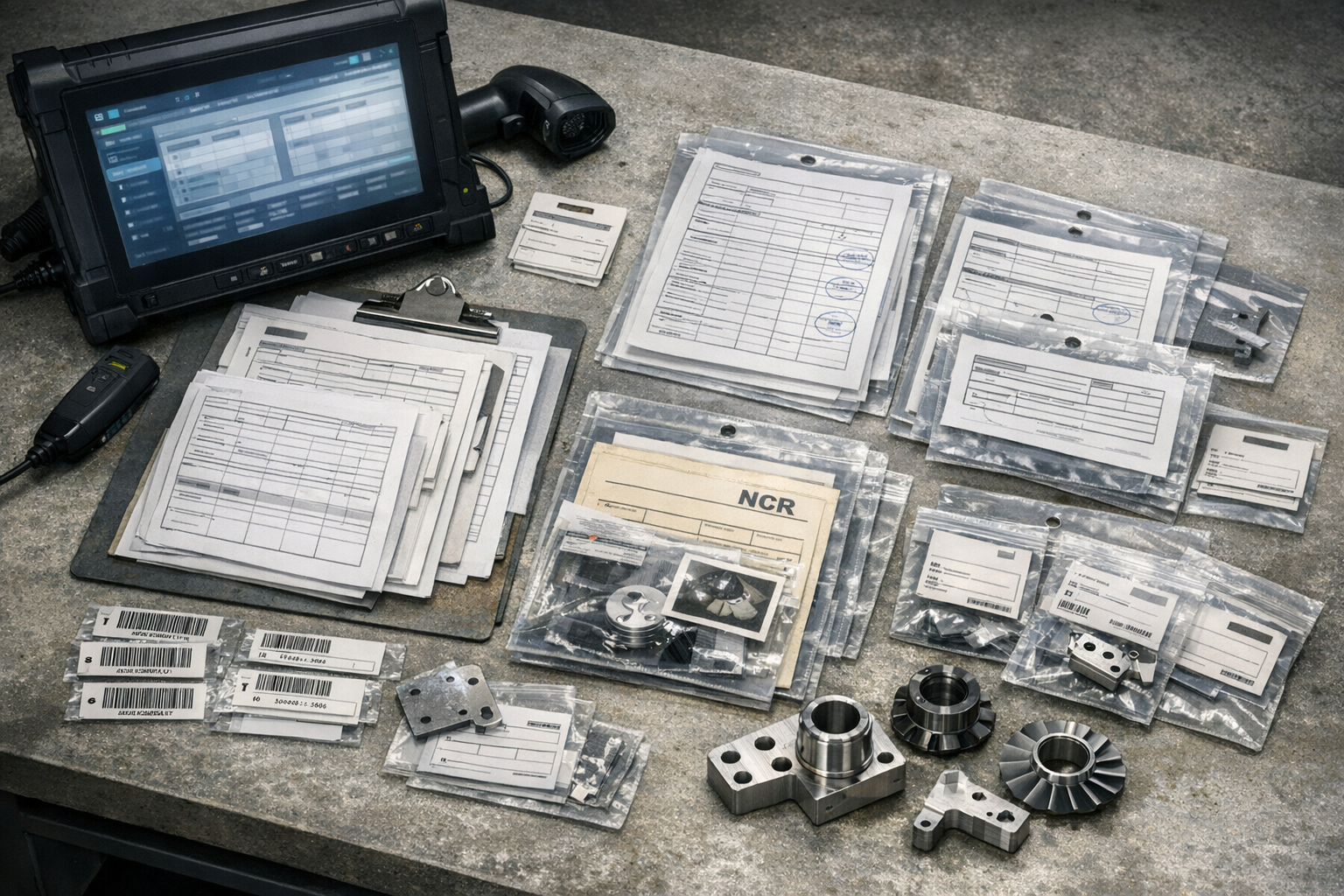
  • Manufacturing Operations Management Standards in Aerospace: ISA-95, IEC 62264, and ISO 22400

    Manufacturing Operations Management Standards in Aerospace: ISA-95, IEC 62264, and ISO 22400

    Manufacturing operations management, usually shortened to MOM, sits in the layer between enterprise planning and machine-level control. It is the operational space where production orders become real work, quality checks happen in context, materials are tracked through execution, maintenance activities are coordinated, and actual performance data is captured for review.

    That middle layer matters in every manufacturing sector, but it matters especially in aerospace. Aerospace operations do not just need efficiency. They need traceability, configuration control, documented execution, supplier visibility, and audit-ready records. That makes MOM more than a scheduling concept. In a regulated environment, it becomes part of the control structure that connects engineering intent, shopfloor execution, and quality evidence.

    For aerospace manufacturers and MRO teams, MOM standards provide a shared way to define how this layer should work. Standards such as ISA-95, IEC 62264, and ISO 22400 help organizations describe the operational model, clarify how information should move between business systems and the floor, and measure whether execution is actually performing as intended.

    Connect 981 sits directly in this layer. It helps aerospace organizations connect work instructions, quality evidence, traceability records, supplier context, and execution visibility so the operational system is not split across disconnected tools. That is where MOM standards become practical. They are not just reference models. They describe the structure that modern aerospace operations need in order to run cleanly and prove control.

    What Manufacturing Operations Management Means in Aerospace

    At a high level, manufacturing operations management covers the activities used to manage, coordinate, monitor, and improve operations between planning and control. It is where high-level business intent gets translated into executable work and where execution results get pushed upward as usable operational data.

    In aerospace, that includes more than production dispatching. MOM typically touches four operational domains:

    • Production operations such as work order execution, sequencing, dispatching, and status tracking
    • Quality operations such as inspections, holds, nonconformance logging, acceptance evidence, and in-process verification
    • Maintenance operations such as equipment reliability, repair coordination, and service planning
    • Inventory operations such as raw material movement, WIP control, serialized parts tracking, and floor-level inventory visibility

    In aerospace manufacturing, these domains are tightly tied to compliance and product integrity. A work order is not just a job ticket. It may carry configuration requirements, revision-controlled instructions, part traceability, tooling requirements, inspection gates, and signoff expectations. That is one reason generic factory coordination language is usually not enough in aerospace. Teams need models that define these functions with much more precision.

    Where MOM Sits in the Manufacturing Stack

    The most widely used conceptual model for this comes from ISA-95, later aligned internationally as IEC 62264 and ISO 62264. These standards place MOM at Level 3 in the manufacturing hierarchy.

    Level Role Typical Scope
    Level 4 Business planning and logistics ERP, forecasting, master scheduling, enterprise resource allocation, planning
    Level 3 Manufacturing operations management Scheduling, dispatching, quality operations, maintenance coordination, inventory execution, work instructions, production visibility
    Level 2 Supervisory control SCADA, HMI, supervisory logic, machine status visibility
    Level 1 Direct control PLCs, controllers, equipment logic, feedback loops
    Level 0 Physical process Machines, tooling, materials, operators, physical production activity

    This model is useful because it makes the boundary clear. MOM is not long-range planning, and it is not direct machine control. It is the execution coordination layer in between.

    In aerospace, that is often the most operationally painful layer because it is where planning meets the reality of revision changes, shortages, supplier delays, inspection failures, operator signoffs, serialized components, and controlled deviations. It is also where most organizations feel the cost of fragmented systems most sharply.

    ISA-95 and IEC 62264 as the Core MOM Reference Model

    ISA-95 is the foundational standard family for defining manufacturing operations management functions and enterprise-control integration. It gives organizations a shared language for how manufacturing activities are structured, what kinds of information objects are exchanged, and where the operational layer begins and ends.

    Its international counterpart, IEC 62264, carries the same core conceptual role. In practice, many teams refer to ISA-95 and IEC 62264 together because they describe the same underlying model.

    What these standards define

    ISA-95 and IEC 62264 help define:

    • functional hierarchies across Levels 0 through 4
    • activity models for production, quality, maintenance, and inventory operations
    • information models for exchanging data between business systems and operational systems
    • clear boundaries between planning, operations coordination, and control

    That may sound abstract, but it matters in practice. If an aerospace organization cannot clearly describe what the operations layer is responsible for, it usually ends up with overlap, gaps, or disconnected systems. Work instructions may live in one place, inspection results in another, serialized material data somewhere else, and supplier visibility nowhere useful at all.

    The four MOM domains from ISA-95

    ISA-95 breaks manufacturing operations management into four main domains:

    1. Production operations management
      Covers scheduling, dispatching, work execution, resource allocation, and production status tracking.
    2. Maintenance operations management
      Covers maintenance planning, maintenance execution, equipment reliability, and upkeep coordination.
    3. Quality operations management
      Covers inspections, process verification, holds, nonconformance control, and quality reporting.
    4. Inventory operations management
      Covers material tracking, WIP control, movement visibility, and execution-level inventory status.

    Those categories map directly to aerospace pain points. A production team may be trying to dispatch work in sequence while quality is holding a serialized subassembly, maintenance is working around a machine issue, and inventory is waiting on controlled material release. That is not four separate realities. It is one operational system, and ISA-95 gives it structure.

    Why MOM Standards Matter More in Aerospace

    Many factories can tolerate operational ambiguity for a while. Aerospace usually cannot. The moment you add configuration control, special process traceability, regulated documentation, supplier flowdown, and audit expectations, the Level 3 operating layer becomes much more important.

    In aerospace, MOM-aligned operations help coordinate things like:

    • revision-controlled work instructions
    • serialized part installation records
    • inspection gates tied to product definition
    • nonconformance handling in production context
    • material traceability through execution
    • production and maintenance data needed for compliance evidence

    This is where Connect 981 becomes especially relevant. It supports the operational layer where those controls actually live. Instead of leaving quality evidence, execution records, supplier inputs, and floor-level status scattered across multiple tools, Connect 981 helps bring them into one connected operating view.

    ISO 22400 and the Measurement Side of MOM

    If ISA-95 and IEC 62264 tell you what the operational layer is, ISO 22400 tells you how to measure its performance more consistently.

    ISO 22400 focuses on key performance indicators for manufacturing operations management. The goal is to standardize how organizations define and calculate operational metrics so results can be interpreted more clearly across teams, sites, and time periods.

    What ISO 22400 contributes

    • standardized MOM-related terminology
    • defined KPI concepts and formulas
    • measurement logic tied to operational activities
    • more consistent interpretation of production performance

    This matters in aerospace because organizations often operate across multiple plants, suppliers, and programs. If one site calculates throughput one way and another site uses a different logic, leadership gets noise instead of insight.

    Common KPI categories linked to MOM

    Category Example Metrics
    Production and time Cycle time, throughput rate, schedule adherence, execution time
    Quality First-pass yield, defect rate, scrap ratio, rework rate
    Equipment and utilization Availability, performance rate, overall equipment effectiveness
    Maintenance Mean time between failures, mean time to repair, planned vs unplanned maintenance
    Inventory Inventory accuracy, stock turns, WIP visibility, material availability

    In aerospace, some of these metrics need nuance. OEE may still be useful, but it rarely tells the whole story in a low-volume, high-complexity, high-documentation environment. First-pass yield, schedule adherence on constrained programs, inspection queue time, hold duration, and traceability-related delays may matter just as much.

    Connect 981 helps make these metrics more meaningful because it ties them to the execution context behind them. A performance number becomes much more useful when teams can see which work order, part family, station, supplier input, or quality event shaped it.

    How ISO 22400 Relates Back to ISA-95

    The relationship is straightforward. ISA-95 and IEC 62264 describe the functional operating model. ISO 22400 describes how to quantify the performance of that operating model.

    • ISA-95 / IEC 62264 define the structure of production, quality, maintenance, and inventory operations
    • ISO 22400 defines how to measure those operations consistently

    That pairing is useful because it gives aerospace organizations both the language for the workflow and the language for the scorecard. One defines how the operational system is structured. The other defines how its performance can be evaluated in a more consistent, comparable way.

    Other Standards That Shape the MOM Layer

    Manufacturing operations management does not live in isolation. In aerospace, the MOM layer is shaped by other standards and regulatory expectations even when those standards are not MOM frameworks themselves.

    AS9100

    AS9100 is the aerospace quality management system standard. It does not define MOM architecture, but it strongly shapes what the operations layer must support. If the quality system requires traceability, documented process control, nonconformance management, and audit-ready evidence, the MOM environment has to help deliver that.

    AS9102

    First article inspection workflows often sit at or near the MOM layer because they connect production execution, inspection activity, drawing accountability, and evidence generation. A disconnected FAI process usually creates friction because it is detached from the operational execution model around it.

    NADCAP and special process oversight

    Special process traceability and supplier approvals also push requirements into the operations layer. The shopfloor or execution system needs to know not just what job is being run, but what approved source, process route, or certification scope applies.

    ISA-88

    ISA-88 is more closely tied to batch control, so it is not the primary MOM standard for most aerospace discrete manufacturing environments. Still, the concept matters in operations where structured procedural execution, recipe-like controls, or tightly sequenced process logic are relevant.

    Planning, MOM, and Control: The Practical Boundary

    One of the most useful things MOM standards do is force clarity about where one layer ends and another begins.

    Planning layer

    The planning layer decides what should be made, in what quantity, and in what overall timeframe. This is where ERP, demand planning, financial planning, master scheduling, and aggregate resource logic usually live.

    MOM layer

    The MOM layer translates that intent into executable work. It handles detailed scheduling, order dispatching, operator-facing instructions, execution visibility, floor-level quality coordination, maintenance coordination, and actual-versus-plan feedback.

    Control layer

    The control layer runs the machines and equipment. It is responsible for setpoints, sequencing, machine logic, supervisory control, and physical process execution.

    Why does this boundary matter? Because in aerospace operations, confusion at the boundaries creates real pain:

    • ERP tries to own details it cannot see in real time
    • machine systems expose data with no operational context
    • quality records sit outside production execution
    • operators get instructions that are current in one system and outdated in another

    A MOM-aligned operating model helps keep those responsibilities clearer. Connect 981 supports that model by sitting in the execution and coordination layer rather than trying to replace planning systems or machine controls. It helps bridge the gap between what the business planned and what the floor can actually prove happened.

    How MOM Standards Apply in Aerospace Manufacturing

    For aerospace manufacturers, MOM standards become valuable when translated into practical workflows.

    Production operations

    • controlled release of work instructions
    • routing visibility tied to revision status
    • sequencing and dispatching around constrained equipment or approvals
    • as-built execution data connected to the production order

    Quality operations

    • in-process inspection capture
    • hold points before critical operations continue
    • defect logging with production context
    • FAI, verification, and acceptance evidence connected to execution history

    Inventory operations

    • lot and serial traceability through the floor
    • WIP visibility by job, operation, or configuration state
    • controlled material issue and consumption records
    • supplier-linked material status where approvals matter

    Maintenance operations

    • equipment readiness visibility
    • maintenance coordination that affects execution schedules
    • machine reliability metrics that matter for constrained processes
    • better distinction between planned and disruptive downtime

    These are not just smart factory nice-to-haves. In aerospace, they support schedule integrity, compliance confidence, and product traceability. Connect 981 supports these workflows by helping organizations connect execution status, instructions, quality records, supplier context, and evidence in one environment.

    How MOM Standards Apply in Aerospace MRO

    MRO environments introduce a different version of the same problem. In maintenance operations, the execution layer must coordinate inspections, findings, repair routing, serialized component history, replacement decisions, and airworthiness-related documentation. That makes MOM concepts just as useful, even if the environment looks different from new production.

    In MRO, MOM-aligned thinking helps structure:

    • task execution against controlled maintenance instructions
    • findings capture with traceable evidence
    • component and serialized asset history
    • repair cycle coordination across stations or vendors
    • maintenance KPIs such as turnaround time, repeat findings, and reliability trends

    That is especially relevant because aerospace operations often span both production and support environments. Connect 981 supports both by helping teams keep instructions, findings, records, and coordination activity linked instead of split across departmental tools.

    What a Connected MOM Layer Looks Like in Practice

    In older environments, ISA-95 might map cleanly to a classic MES that sat between ERP and shopfloor control. In modern aerospace operations, the reality is often much more fragmented. One tool may handle instructions, another inspections, another defects, another supplier coordination, and another production status. The result is not a coherent MOM layer. It is a patchwork.

    A connected platform approach restores that missing operational layer by unifying:

    • digital work instructions
    • execution status tracking
    • quality checks and evidence capture
    • nonconformance workflows
    • supplier and material context
    • traceability across the job lifecycle

    That is where Connect 981 fits. It strengthens the operational zone that MOM standards describe. It helps aerospace organizations make the Level 3 layer more real, more connected, and more useful by tying execution, quality, supplier input, and traceability together in ways that support both compliance and day-to-day control.

    Final Takeaway

    ISA-95 and IEC 62264 define the operational structure. ISO 22400 defines how performance is measured. Aerospace standards such as AS9100 shape what that operating layer must support. Together, they form a practical framework for understanding how aerospace manufacturing and MRO operations should connect planning, execution, quality, maintenance, and measurement.

    For aerospace organizations, MOM is not an abstract standards topic. It is the structure behind cleaner execution, stronger traceability, better evidence, and more disciplined control across the operational layer. Connect 981 supports that structure by helping manufacturers and MRO teams bring work instructions, quality events, traceability, supplier context, and execution visibility into one connected operating model.

    For teams putting data mapping and system interoperability into daily operation, data mapping and system interoperability, ERP, MES, and PLM integration paths, a connected execution platform help connect the concept to traceability, work-order reality, and audit-ready evidence.

    The same operating model also depends on Connect 981’s aerospace execution solutions, real aerospace execution examples, Connect 981’s aerospace operations guidance, practical aerospace operations FAQs, especially when decisions have to move across quality, production, suppliers, and program leadership without losing context.