Tag: Manufacturing Compliance

  • AS9102 FAI Triggers: New Parts, Changes, Lapses, and Delta Requirements

    AS9102 FAI Triggers: New Parts, Changes, Lapses, and Delta Requirements

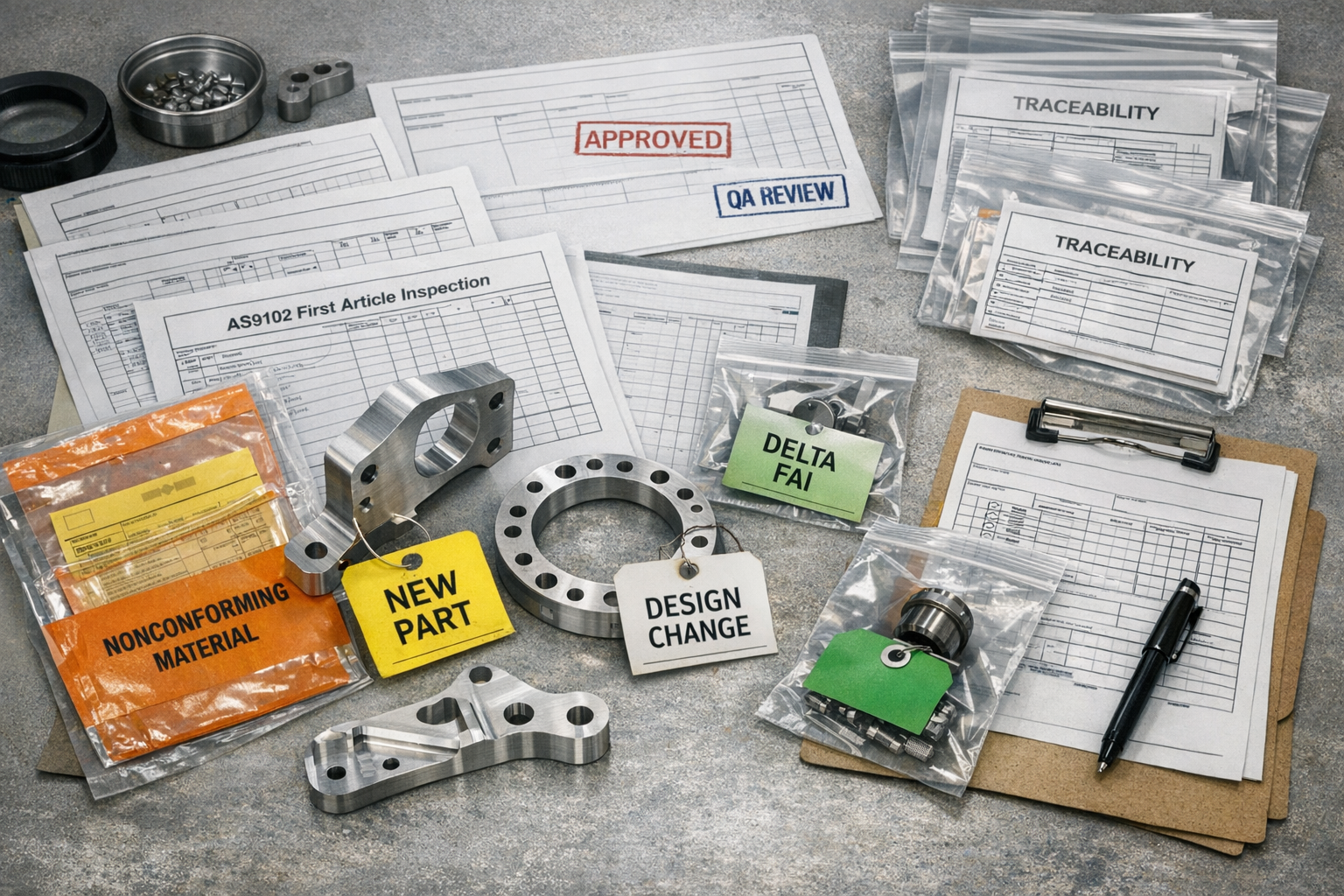
    In aerospace manufacturing, one of the most common quality questions is not what AS9102 first article inspection is, but when it is actually required. Teams know first article inspection matters. They know customers expect a compliant FAIR. What causes real friction is deciding whether a situation calls for a full FAI, a partial FAI, or no new FAI at all.

    That decision matters because unnecessary first article work slows production, ties up quality resources, and adds documentation overhead. On the other hand, missing a valid trigger can create customer escapes, audit findings, approval delays, and serious traceability problems. In aerospace, where configuration control and product conformity carry real operational and regulatory weight, getting this right is not optional.

    For teams putting this topic into daily operation, digital AS9102 FAI help connect the concept to traceability, work-order reality, and audit-ready evidence.

    For teams putting this topic into daily operation, digital AS9102 FAI, a connected execution platform, Connect 981’s aerospace execution solutions help connect the concept to traceability, work-order reality, and audit-ready evidence.

    The same operating model also depends on real aerospace execution examples, Connect 981’s aerospace operations guidance, practical aerospace operations FAQs, especially when decisions have to move across quality, production, suppliers, and program leadership without losing context.

    This article explains the most important AS9102 FAI triggers, including new part introduction, engineering changes, process changes, production lapses, and the circumstances that justify a partial or delta FAI rather than a full reset. It also looks at how aerospace manufacturers can manage these triggers more consistently using connected digital workflows.

    If you want the broader foundation first, review AS9102 Software: Digital First Article Inspection for Aerospace Manufacturing.

    What AS9102 FAI Is Designed to Prove

    AS9102 first article inspection is a structured method for verifying that a production process can manufacture a part or assembly that fully conforms to engineering, specification, and purchase order requirements at the released configuration. It is not just a sample inspection. It is not a one-time paperwork exercise. It is a formal record that shows the part definition was interpreted correctly, the process was executed properly, and the evidence of conformity is complete and traceable.

    In practice, an FAI helps answer a straightforward but high-stakes question:

    Can this exact aerospace production process, at this exact released configuration, produce conforming hardware with full documented accountability?

    That is why FAI sits so close to configuration control, traceability, launch readiness, supplier quality, and customer approval. It creates a documented baseline that can later support change management, resubmissions, investigations, and audits.

    Why Knowing the Right Trigger Matters

    Plenty of aerospace organizations understand how to complete Form 1, Form 2, and Form 3. Fewer have a disciplined internal method for deciding when a new or updated FAI is required. That is where problems begin.

    If the trigger logic is weak, teams end up doing one of two things. They either over-trigger, which creates waste and slows down manufacturing, or they under-trigger, which creates risk. Neither outcome is good. The first hurts efficiency. The second hurts compliance, customer trust, and sometimes product integrity.

    A clear trigger model helps quality and manufacturing teams:

    • Apply AS9102 consistently across programs and part families
    • Reduce unnecessary full FAIR rebuilds
    • Identify when partial or delta FAI is appropriate
    • Align change control with customer and contract expectations
    • Protect traceability when production conditions shift

    Here’s the thing. The cost of poor trigger discipline is rarely visible all at once. It shows up as late package corrections, missing evidence, confused resubmissions, duplicated work, and uncomfortable customer conversations.

    New Part Introduction Is the Most Obvious FAI Trigger

    The clearest AS9102 trigger is the first production run of a new part number or assembly. When an aerospace organization introduces a part into production for the first time, it needs objective evidence that the released design can be built and verified correctly using the intended production process.

    This usually calls for a full FAI because there is no prior approved baseline to rely on.

    What counts as a new part introduction

    New part introduction typically includes:

    • A newly released part number entering production for the first time
    • A new assembly requiring first-time product accountability
    • A part transferred from development or prototype status into controlled production
    • A customer program launch where the released configuration has not yet been formally validated

    In these cases, the FAIR establishes the first documented baseline for the product. That baseline matters later when changes occur, because it gives the organization something traceable to compare against.

    Why aerospace treats this carefully

    In aerospace, new part introduction is not just about proving that one part measured correctly on one day. It is about proving that the released configuration, manufacturing route, inspection method, material traceability, and special process chain all support conformity. That is why the first baseline FAIR often becomes an anchor record for the life of the part.

    Design Changes Often Trigger Full or Partial FAI Activity

    Engineering changes are one of the most common reasons organizations revisit FAI. Not every revision change means the entire FAIR must be rebuilt, but changes that affect requirements, form, fit, function, interfaces, or inspection criteria often require at least a partial or delta FAI.

    Examples of design changes that may trigger FAI

    • Dimensional changes to a feature on the drawing
    • Tolerance changes on an existing characteristic
    • Material specification changes
    • Updated notes affecting finish, marking, or identification
    • Changes to critical, key, or safety-related characteristics
    • Revision changes affecting mating or installation conditions

    The real question is not simply whether the drawing revision changed. The better question is whether the released product definition changed in a way that affects conformity or verification. If it did, the FAI baseline likely needs to be updated.

    When a design change justifies a partial or delta FAI

    If the change affects only certain characteristics rather than the entire part, a partial or delta FAI is often the right choice. That allows the organization to revalidate only the impacted features while preserving the unaffected baseline from the original FAIR.

    This approach is especially valuable in aerospace because programs often evolve slowly through controlled revisions, and rebuilding a full FAIR every time can become needlessly expensive. Still, that efficiency only works if the company has strong revision control and can clearly identify which characteristics were affected.

    Process Changes Can Trigger FAI Even When the Drawing Stays the Same

    One of the biggest mistakes organizations make is assuming that if the drawing did not change, the FAIR does not need attention. In aerospace manufacturing, process changes matter because the product may be the same on paper while the route used to build it has changed in a meaningful way.

    If the process changes in a way that could affect part conformity, a new or updated FAI may be required.

    Common process-related FAI triggers

    • New manufacturing equipment or machine replacement
    • New tooling, fixtures, or program changes
    • Method changes in machining, forming, assembly, or inspection
    • Changes to sequence of operations that affect product outcome
    • Transfer of work between facilities or production cells
    • Changes in outside processing sources for controlled operations

    What this really means is that aerospace FAI is not only about the part definition. It is also about the process definition behind that part. If the way the part is made changes enough to alter risk, the FAIR logic needs to catch up.

    Why process changes matter so much in aerospace

    Aerospace production often involves tight tolerances, special processes, controlled materials, complex routings, and customer-specific source requirements. A machine swap, tooling update, supplier change, or move to a different facility can alter process behavior even if the part number and drawing revision remain identical. That is why smart trigger discipline looks at more than engineering release history.

    Material and Special Process Changes Require Careful Review

    In aerospace, traceability to material and special process evidence is central to FAI integrity. Form 2 exists for a reason. If the source or nature of the controlled inputs changes, organizations need to evaluate whether a new or updated FAI is required.

    Typical material and source changes that may trigger FAI

    • A new supplier for a controlled alloy or raw material
    • A change in material specification or condition
    • A new special process source for plating, heat treatment, NDT, coating, or similar operations
    • A change in approval status or scope of a special process provider
    • A change in process parameters that affects product characteristics

    Some of these may require only partial FAI activity. Others may justify a broader review, depending on the criticality of the change and the customer’s expectations. Either way, they should never be treated as invisible background changes. In aerospace, they are often part of the conformity story.

    Production Lapses Are a Real Aerospace Trigger

    Aerospace manufacturing does not always run at a steady cadence. Many parts are made intermittently. Some programs have long pauses. Some part numbers may go quiet for months or years before restarting. That makes production lapse one of the most important and most overlooked FAI triggers.

    If production has been dormant long enough, organizations may need to review whether the baseline process can still be trusted without refreshed validation.

    Why lapse-based triggers exist

    A long production gap can introduce risk even when the part and process documentation appear unchanged. During the lapse, a lot may have shifted:

    • Operators may have changed
    • Tooling may have worn or been replaced
    • Programs may have been updated
    • Equipment may have been serviced or relocated
    • Suppliers may have changed
    • Inspection methods may have evolved

    That is why production lapse should be treated as a process risk issue, not just a scheduling detail.

    How lapse thresholds are handled

    Many organizations use internal thresholds, customer requirements, or contract-specific rules to define what counts as a significant lapse. A common reference point is two years, but the right answer always depends on the customer, the product, and the organization’s quality system. The main point is that lapse-based trigger logic should be defined clearly and applied consistently.

    Full FAI vs Partial FAI vs Delta FAI

    One reason AS9102 remains practical in real aerospace operations is that it does not force a full restart every time something changes. Instead, it allows manufacturers to scale the response to the actual scope of impact.

    When a full FAI is usually appropriate

    • First production of a new part number or assembly
    • Major design change affecting broad portions of the part definition
    • Major process change with wide conformity impact
    • No reliable baseline FAIR exists
    • Customer or contract explicitly requires a complete new FAIR

    When a partial or delta FAI is often the better choice

    • Only selected characteristics changed
    • A limited process change affected a defined subset of features
    • Material or source changes affected traceability but not the full configuration
    • The baseline FAIR remains valid for unaffected requirements

    The discipline here is simple to say but harder to execute: revalidate what changed, preserve what did not, and document the logic clearly.

    Why organizations struggle with delta FAI

    Delta FAI sounds efficient, and it is, but only when the underlying data is structured well enough to support it. If characteristics are trapped in static spreadsheets, traceability is fragmented, or revision history is unclear, teams often end up redoing far more than necessary. In those environments, delta FAI becomes confusing because nobody can cleanly separate affected from unaffected requirements.

    Customer-Specific Requirements Still Matter

    AS9102 gives aerospace manufacturers a standard framework, but it does not erase customer-specific expectations. Many primes and upper-tier suppliers apply additional rules around when FAI is required, what counts as a significant change, how lapse thresholds are handled, and what submission format is acceptable.

    That means the right internal question is never only:

    What does the standard allow?

    It also needs to be:

    What did the customer contract, purchase order, or program requirement actually ask for?

    This matters because a technically defensible partial FAI may still be rejected if the customer expects a full resubmission package, specific portal workflow, or extra supporting documentation.

    Common Mistakes Aerospace Teams Make with FAI Triggers

    Most FAI trigger failures come from poor process visibility rather than bad intent. Teams are busy, systems are disconnected, and changes are sometimes managed in silos.

    Typical mistakes include

    • Treating revision changes as administrative without checking affected characteristics
    • Ignoring process changes because the drawing stayed the same
    • Missing lapse-based triggers on low-volume or intermittent parts
    • Failing to assess source changes for material or special processes
    • Overusing full FAI because delta logic is too hard to manage manually
    • Assuming one customer’s interpretation applies to every program

    The result is usually one of two ugly outcomes. Either the organization creates a lot of unnecessary quality work, or it ships with weaker evidence than the customer expects. Neither is a good place to be.

    How Digital Systems Make FAI Trigger Decisions Easier

    Digital FAI platforms are at their best when they do more than produce forms. They should help aerospace manufacturers manage trigger logic as part of a connected quality and manufacturing workflow.

    What a strong digital workflow can do

    • Maintain a traceable baseline FAIR by part number and revision
    • Track changes to characteristics, materials, and process routes
    • Highlight which features were affected by a revision or process update
    • Support partial or delta FAI generation without recreating everything
    • Connect Form 1, Form 2, Form 3, ballooned drawings, and certifications in one record set
    • Preserve audit history around why a given trigger decision was made

    That last point matters more than people think. In aerospace, it is not enough to make the right trigger decision. You often need to show later why that decision was reasonable.

    Why this matters for Connect 981-style operations

    Connected platforms are especially useful in regulated manufacturing because they reduce the gap between engineering changes, manufacturing process shifts, and quality documentation. Instead of waiting for someone to notice a trigger manually, the system can support earlier visibility into what changed and what evidence may need to be refreshed.

    That does not replace engineering judgment. It makes that judgment more consistent, more traceable, and less dependent on memory.

    How to Build a Better Internal FAI Trigger Policy

    Every aerospace manufacturer should define a practical internal trigger policy that aligns with AS9102, customer requirements, and real production conditions. The best policies are not vague. They are specific enough that quality, manufacturing, and engineering teams can use them without guesswork.

    A strong internal policy should define

    • What counts as a new part or first production run
    • What kinds of design changes trigger full, partial, or delta FAI
    • What kinds of process changes require review
    • How material and special process source changes are evaluated
    • What lapse threshold applies by default
    • How customer-specific rules override standard internal logic
    • Who has authority to approve the trigger decision
    • How that decision is documented for future audit or customer review

    Without this, organizations tend to rely too heavily on tribal knowledge. That works until the key person is out, the program changes hands, or the customer starts asking harder questions.

    Final Takeaway

    AS9102 FAI triggers are not just a compliance detail. They are part of how aerospace manufacturers control change, preserve traceability, and protect confidence in the production process. New parts, engineering changes, process shifts, material source changes, and production lapses can all justify a new or updated FAIR. The real challenge is knowing when a full FAI is necessary and when a partial or delta FAI is the smarter, defensible path.

    The organizations that handle this well do not treat FAI as a last-minute quality document. They treat it as part of a connected operational system that links engineering, production, inspection, and customer requirements. That is where the real efficiency shows up, and it is also where the strongest compliance posture comes from.

    To go deeper into digital workflows, FAIR structure, and connected aerospace quality execution, read AS9102 Software: Digital First Article Inspection for Aerospace Manufacturing.

  • Leveraging MES Traceability to Reduce Waste and Support Aerospace Compliance

    Leveraging MES Traceability to Reduce Waste and Support Aerospace Compliance

    Leveraging MES Traceability to Reduce Waste and Support Aerospace Compliance

    In aerospace manufacturing, scrap is not just a quality metric. It is a financial and contractual event. Losing a single high-value machined forging or composite structure can ripple through schedules, margins, and customer commitments. Robust traceability in a Manufacturing Execution System (MES) is one of the most effective ways to contain that impact when problems do occur.

    This article explains how aerospace MES traceability structures data so that, when defects are discovered, you can precisely identify affected parts, lots, and operations. That precision allows you to avoid over-scrapping, limit re-inspection, and respond to regulators and customers with confidence.

    For a broader discussion of waste reduction practices, see MES-supported waste reduction and traceability in aerospace.

    Regulatory and Customer Expectations for Aerospace Traceability

    Aerospace OEMs and regulatory bodies expect manufacturers to demonstrate where every critical part came from, how it was processed, and whether it met requirements at each key step. MES is a primary tool for capturing and organizing this information, but expectations vary by part criticality and contractual context.

    Typical traceability requirements by part criticality

    Traceability depth is closely tied to the risk posed by a part or assembly:

    • Flight-critical and safety-critical parts typically require full serial-level genealogy. You must be able to trace every individual item from incoming material, through each operation, to final assembly and test.
    • Mission-critical or performance-critical parts may require serial or small-lot traceability, including key process parameters and inspection results, but with some aggregation where risk is lower.
    • Standard or non-critical parts are often managed at lot or batch level, with enough traceability to support quality management and basic containment without excessive burden.

    OEM flow-downs, airworthiness authority guidance, and internal engineering risk assessments typically define which level applies. An MES should be configurable enough to reflect those distinctions without forcing a single model on all parts.

    Differences between lot, batch, and serial tracking

    The way you structure traceability strongly influences your exposure when a defect appears:

    • Lot tracking associates groups of items with a common identifier (e.g., a barstock heat lot or fastener lot). If a defect is traced to a lot, you may have to contain or scrap everything produced from that lot, across time and work orders.
    • Batch tracking is similar, but often tied to a manufacturing event (e.g., a batch of parts heat-treated together). A defect in the batch process generally drives containment of all batch members.
    • Serial tracking assigns a unique identity to each specific part or assembly. If a problem is linked to a particular process or material exposure, you can typically narrow the impact to just the serials that passed through that exact condition.

    An aerospace MES needs to manage all three simultaneously. The finer the traceability granularity, the more precisely you can limit the scope of scrap and rework, though this comes at a cost of data volume and operational discipline.

    Implications for scrap and rework decisions

    When a nonconformance is discovered—whether through inspection, in-service feedback, or supplier notification—the traceability model determines your options:

    • With coarse traceability (e.g., only lot-level), you may be forced to treat an entire lot as suspect, even if only a fraction of parts actually experienced the adverse condition.
    • With robust serial-level genealogy, you can identify exactly which part serials saw which tool, fixture, program version, operator, or material batch at the time of deviation.

    The result is a more defensible decision about what to scrap, what to re-inspect, and what can continue to ship, reducing both direct waste and schedule disruption.

    How MES Structures Traceability Data

    To achieve useful traceability, an aerospace MES must connect multiple dimensions of manufacturing data into a coherent genealogy: materials, processes, inspections, tooling, and people.

    Linking materials, processes, and inspections

    A mature traceability model in MES constructs a chain of evidence that ties together:

    • Incoming material: supplier lot, heat number, certificates of conformity, receiving inspections, and release status.
    • Process execution: which operation was run, on which machine or cell, using which work instructions and parameters at the time.
    • In-process and final inspections: measured values, pass/fail results, sampling plans, and any nonconformance reports raised.

    Each produced unit or lot carries these links throughout its lifecycle. When an anomaly emerges, engineers can quickly traverse this data from any direction: from part back to process, from process to tooling, or from material lot forward to all affected assemblies.

    As-built records and operation history

    An as-built record is essentially the factual history of how a given unit was manufactured, as opposed to how it was planned. In aerospace MES, this typically includes:

    • All operations actually executed, including deviations from the routing.
    • Start/finish timestamps and elapsed time per step.
    • Configuration identifiers (program revision, work instruction version, NC file version).
    • Key process parameters as recorded (temperatures, pressures, torque values, cure cycles, etc.).
    • Inspection points, measurements, and dispositions.

    This operation history turns investigations from guesswork into data-driven analysis. It is also crucial evidence for regulators and OEMs if a field issue triggers a broader fleet review.

    Tooling, program, and operator associations

    Many systemic defects are not about the part itself, but the conditions under which it was made. Effective aerospace MES traceability therefore links each produced item to:

    • Tools and fixtures: serial numbers, calibration status, and maintenance records.
    • NC programs and work instructions: which revision was used, and whether any temporary instructions or concessions were active.
    • Operators and inspectors: who performed which step, and what qualifications or certifications they held at the time.

    When a programming error, tool wear, or training gap is discovered, you can immediately map that condition to the exact set of affected parts or batches, rather than applying broad assumptions.

    Using Traceability to Contain Defects Efficiently

    Even in highly controlled environments, nonconformances will occur. The key is to prevent them from propagating into large quantities of scrap or widespread rework. MES-based traceability is a core enabler of fast, precise containment.

    Quickly bounding affected populations

    When an issue is flagged—by a failed inspection, supplier alert, or monitoring alarm—engineers need to answer two questions quickly: What exactly went wrong? and Which units were exposed?

    With a well-designed MES genealogy model, you can:

    • Query all parts produced on a specific machine, with a particular tool or program revision, during a defined time window.
    • Identify all assemblies containing material from a suspect lot or batch, across multiple levels of the bill of material.
    • Trace forward from a suspect subassembly to finished units already in stock, in shipment, or at the customer.

    This allows you to set precise holds and shipping stops, rather than blanket freezes that paralyze production.

    Avoiding unnecessary scrap and re-inspection

    When data is incomplete, organizations often err on the side of caution by scrapping broadly or re-inspecting large populations of parts. This is costly and, in many cases, avoidable.

    Robust aerospace MES traceability reduces this waste by providing evidence that:

    • Only parts processed within a defined timeframe or parameter window were at risk.
    • Specific serials did not pass through the suspect condition and can be safely released.
    • Previously executed inspections already verified the relevant characteristics, eliminating the need to repeat them.

    The combination of genealogy and recorded measurements supports risk-based decisions that stand up to internal and external scrutiny.

    Coordinating with customers on disposition

    When potential escapes or in-service findings occur, OEMs and regulators expect clear, data-backed responses. MES traceability enables you to:

    • Provide trace reports showing how many units are affected, where they are, and what their exact as-built configuration is.
    • Support engineering disposition (use-as-is, repair, or scrap) with detailed parameter histories and inspection evidence.
    • Collaborate on risk assessments by simulating worst-case combinations of variables based on actual production data.

    This often leads to more targeted repair or rework actions, rather than defaulting to scrapping complete batches or assemblies.

    Reducing Rework Risk with Better Genealogy

    Rework may appear to save scrap but can introduce new defects, consume capacity, and complicate traceability if not tightly controlled. A strong genealogy model reduces both the need for rework and the risk it introduces.

    Ensuring correct rework paths are followed

    When a nonconformance is found, MES can enforce approved rework routings and capture all steps taken. Proper genealogy ensures that:

    • Only parts with specific nonconformance codes are eligible for certain rework paths.
    • Rework steps are linked to engineering-authorized instructions and concessions.
    • Additional inspections or tests required after rework are completed before release.

    This prevents ad-hoc fixes that might resolve the immediate defect but violate design intent or introduce hidden risks.

    Tracking multiple rework cycles and concessions

    Some aerospace parts may legitimately go through multiple repair or rework cycles, especially on long-life assets. Without clear genealogy, it becomes difficult to understand the cumulative impact of concessions and deviations.

    An aerospace MES should record:

    • Each rework cycle as a distinct but linked set of operations.
    • All concessions, waivers, or deviations applied, with references to approvals.
    • Resulting configurations, especially if they differ from the nominal design.

    This history supports future maintenance decisions, fleet management, and life-limited part analysis, while also protecting against unapproved work that could invalidate airworthiness assumptions.

    Avoiding double-handling and undocumented fixes

    Undocumented touch labor is a hidden source of waste and risk. It consumes time, may invalidate prior inspections, and can break the traceability chain.

    By tightly integrating rework processes into MES:

    • All work, including unplanned fixes, must be logged against the part or lot.
    • Operators receive clear instructions on whether to rework, scrap, or route parts to MRB (Material Review Board).
    • Supervisors can see the total rework burden and target process improvements at the root cause.

    This reduces double-handling and ensures that every action performed on a part is captured in its genealogy.

    Traceability-Driven Continuous Improvement

    Traceability is not only about compliance and containment. When used effectively, MES genealogy becomes a continuous improvement engine that exposes systemic waste drivers and validates corrective actions.

    Identifying systemic issues across programs

    Aggregated genealogy data helps you spot patterns that individual nonconformance reports may not reveal, such as:

    • Higher defect rates associated with specific machines, tools, or shifts.
    • Increased rework on parts produced from certain material lots or suppliers.
    • Recurring issues tied to specific process windows (e.g., temperature, humidity, or cure times).

    By analyzing these patterns, quality and manufacturing engineers can prioritize improvement projects that deliver the greatest reduction in scrap and rework.

    Feeding genealogy insights into design and process changes

    When MES is integrated with engineering systems, genealogy data can inform both product and process design:

    • Feedback on which features or tolerances drive most defects can trigger design simplification or tolerance relaxation (subject to regulatory and performance constraints).
    • Evidence of robust performance under certain process ranges can be used to widen allowable windows, reducing false alarms and unnecessary rework.
    • Changes in tooling, fixtures, or methods can be evaluated by comparing before/after defect rates at a granular level.

    This closes the loop between production reality and engineering assumptions, making waste reduction an ongoing capability rather than a one-time initiative.

    Audit trails that support lessons learned

    Aerospace organizations are frequently audited by customers, regulators, and internal compliance teams. MES traceability provides an objective audit trail that:

    • Documents exactly how a process was run at a given point in time.
    • Shows how nonconformances were detected, contained, and corrected.
    • Records changes and their approvals, supporting robust configuration control.

    These audit trails not only reinforce compliance but also serve as a knowledge base for future programs, helping new projects avoid repeating past causes of scrap and rework.

    Designing a Traceability Model in MES

    Achieving the right level of traceability requires deliberate design. Overly coarse models drive excessive waste; overly detailed models can be costly to maintain and slow operations. The goal is a risk-based balance.

    Deciding what to track at serial vs lot level

    Key considerations when deciding traceability granularity include:

    • Risk and criticality: Flight-critical and safety-critical parts typically demand serial-level tracking, whereas standard hardware may be adequately managed at lot level.
    • Defect detection opportunities: If issues are likely to be caught at or near the point of origin, coarser traceability may be acceptable. If detection tends to occur late (e.g., final test, in service), finer granularity can dramatically reduce exposure.
    • Volume and handling: High-volume, low-risk parts may become impractical to track individually. In these cases, a hybrid approach (e.g., serial tracking only after a certain assembly stage) can be effective.

    The chosen model should be formally risk-assessed and aligned with engineering, quality, and customer requirements.

    Balancing detail with practicality and performance

    More data is not always better. Aerospace MES implementations must balance:

    • Data capture burden: Manual data entry slows operators and increases the risk of errors. Use automation (e.g., barcode/RFID scans, equipment integration) wherever feasible.
    • System performance: Excessive granularity can create large datasets that are hard to query quickly during investigations. Data architecture and indexing must support fast genealogy queries.
    • Human factors: Traceability processes should fit naturally into the workflow. If they are seen as overhead, workarounds and data gaps are likely to emerge.

    Continuous feedback from production teams helps refine the model over time, ensuring it stays both effective and usable.

    Integrating MES with PLM, ERP, and QMS

    Traceability does not live in MES alone. Its effectiveness depends on connections to surrounding systems:

    • PLM (Product Lifecycle Management) provides the authoritative design intent, bills of material, and approved processes that MES must execute and track against.
    • ERP (Enterprise Resource Planning) manages material purchasing, inventory, and financials; linking MES genealogy to ERP lots and orders closes the loop from cost to cause.
    • QMS (Quality Management System) handles nonconformance records, corrective actions, and audits; integrating MES data enriches investigations and supports more effective corrective actions.

    These integrations ensure that traceability is not an isolated data silo, but a shared resource for engineering, operations, quality, and supply chain teams.

    Case Examples: Limiting Scrap via Precise Traceability

    To illustrate how aerospace MES traceability limits waste, consider several typical scenarios. Details will vary by organization and program, and specific configurations must be tailored to applicable requirements.

    Narrowing a suspected material defect to a small batch

    A material supplier notifies your organization of a potential anomaly in a specific heat lot of alloy used for machined brackets. Without robust traceability, you might have to treat all brackets of that type as suspect.

    With MES genealogy in place, you can instead:

    • Identify exactly which internal lots and serials used that heat.
    • Trace forward to all assemblies containing those brackets.
    • Apply targeted holds and inspections to only the affected units.

    This can reduce the number of impacted parts from thousands to a much smaller, well-defined population, saving material and avoiding unnecessary line disruptions.

    Isolating parts exposed to out-of-spec process conditions

    Suppose a heat treatment furnace is later found to have operated slightly out of specification for a period of time. The question becomes: which parts were actually in the furnace during that window?

    An MES with detailed equipment and time-based genealogy can:

    • List all loads processed in that furnace while it was out of spec.
    • Identify every part serial or batch included in those loads.
    • Trace those parts into higher-level assemblies and current locations.

    Instead of scrapping every part ever processed in that furnace, you focus on a time-bounded subset. In many cases, additional testing or engineering analysis may clear some of these parts for use, based on the exact conditions experienced.

    Providing evidence for customer waivers or repairs

    In some situations, an OEM or regulator may consider a waiver, concession, or defined repair in lieu of scrapping suspect hardware. The decision depends heavily on confidence in the underlying data.

    MES traceability supports these discussions by:

    • Demonstrating that only certain features, loads, or parameters deviated, with all other conditions meeting requirements.
    • Providing detailed histories that support engineering analyses of structural or performance impact.
    • Documenting any rework or repair performed, tying it to approved instructions and validated results.

    This evidence can convert potential scrap into accepted, safe hardware, while maintaining trust with customers and oversight bodies.

    Making Traceability a Strategic Waste-Reduction Lever

    Traceability is often pursued first as a compliance obligation in aerospace, but its value goes far beyond regulatory checklists. With a well-designed genealogy model in MES, manufacturers can:

    • Respond faster and more precisely to defects and supplier alerts.
    • Limit the scope of scrap, rework, and re-inspection when issues arise.
    • Feed rich operational data into continuous improvement and design decisions.

    Requirements differ by program, customer, and jurisdiction, so no single MES configuration can guarantee compliance in all contexts. However, investing in thoughtful traceability design—and integrating it with broader MES-supported waste reduction and traceability in aerospace practices—consistently pays dividends in reduced waste, stronger margins, and more resilient customer relationships.