Tag: non-conformance management

  • Corrective and Preventive Action (CAPA) Best Practices for Aerospace Non-Conformances

    In aerospace manufacturing, a single non-conformance can ground an aircraft program, trigger regulatory attention, or disrupt delivery schedules for weeks. Corrective and preventive action (CAPA) is the mechanism that turns these events into structured, traceable improvement. When CAPA is weak, repeat issues proliferate, audit exposure grows, and non-conformance cycles drag on. When it is designed well—supported by data, clear ownership, and digital workflows—CAPA becomes a core engine of continuous improvement.

    This article is for aerospace operations, quality, and compliance teams who need to understand Corrective and Preventive Action (CAPA) Best Practices for Aerospace Non-Conformances. It explains the practical question this topic answers in a manufacturing execution context.

    This article outlines aerospace CAPA best practices: when to escalate from an NCR, how to structure the process, what effective actions look like, how to verify results, and how digital tools support non-conformance management across aerospace operations at scale.

    For teams putting this topic into daily operation, non-conformance management, quality management workflows, a connected execution platform help connect the concept to traceability, work-order reality, and audit-ready evidence.

    The same operating model also depends on Connect 981’s aerospace execution solutions, real aerospace execution examples, Connect 981’s aerospace operations guidance, practical aerospace operations FAQs, especially when decisions have to move across quality, production, suppliers, and program leadership without losing context.

    The Role of CAPA in Aerospace Quality Systems

    How CAPA Relates to Non-Conformance Management

    Non-conformance reports (NCRs) capture discrete deviations from requirements—dimensional out-of-tolerance conditions, missing process records, unapproved configuration, or test failures. CAPA sits on top of this workflow as the formal problem-solving layer that asks: why did this issue occur, and how do we prevent it from happening again, either here or elsewhere?

    In a mature aerospace quality system, every NCR does not automatically generate a CAPA. Instead, NCRs are triaged and analyzed for patterns. CAPA is reserved for significant, recurring, or high-risk problems that warrant a structured investigation, cross-functional involvement, and documented long-term actions. The CAPA record then references the underlying NCRs, audit findings, or customer complaints that triggered it, providing full traceability.

    Regulatory, AS9100, and Customer Expectations

    AS9100 requires organizations to investigate causes of nonconformities, implement actions to prevent recurrence, and review the effectiveness of those actions. Regulators and major OEM customers expect that significant findings—especially those with potential safety, airworthiness, or configuration impact—are handled through a disciplined CAPA process, not informal fixes.

    Practically, this means aerospace manufacturers must be able to show auditors:

    • Clear linkage between a problem (NCR, audit, customer escape) and the associated CAPA.
    • Documented root cause analysis that goes beyond operator error.
    • Defined corrective and preventive actions with owners and due dates.
    • Evidence that changes were implemented and their effectiveness verified.

    Customer-specific clauses often tighten expectations, such as maximum response times for containment, mandatory use of structured methods like 8D, or specific reporting formats for safety-critical issues.

    When an NCR Should Escalate to a Formal CAPA

    Not every non-conformance needs a CAPA. Over-escalation clogs the system and delays truly critical work; under-escalation leads to repeat incidents and audit risk. Effective aerospace organizations apply simple, explicit criteria to determine when a CAPA is required. Typical triggers include:

    • Safety or airworthiness impact, or potential to affect flight-critical functions.
    • Customer escapes—issues detected at the customer or in the field.
    • Regulatory findings (authority audits, oversight inspections).
    • Repeat occurrences of similar NCRs across lines, shifts, or sites.
    • Systemic signals: multiple NCRs pointing to common processes, tooling, or suppliers.

    A risk-based escalation matrix that considers severity, occurrence, and detectability helps teams decide when a non-conformance stays at the NCR level and when it requires a formal CAPA project with cross-functional involvement.

    Structuring an Effective CAPA Process

    Standard Stages: Containment, Root Cause, Action, Verification

    Most effective aerospace CAPA workflows share a common structure, even if terminology varies by site or system. A clear stage model avoids confusion and supports consistent execution across programs and suppliers. A typical structure includes:

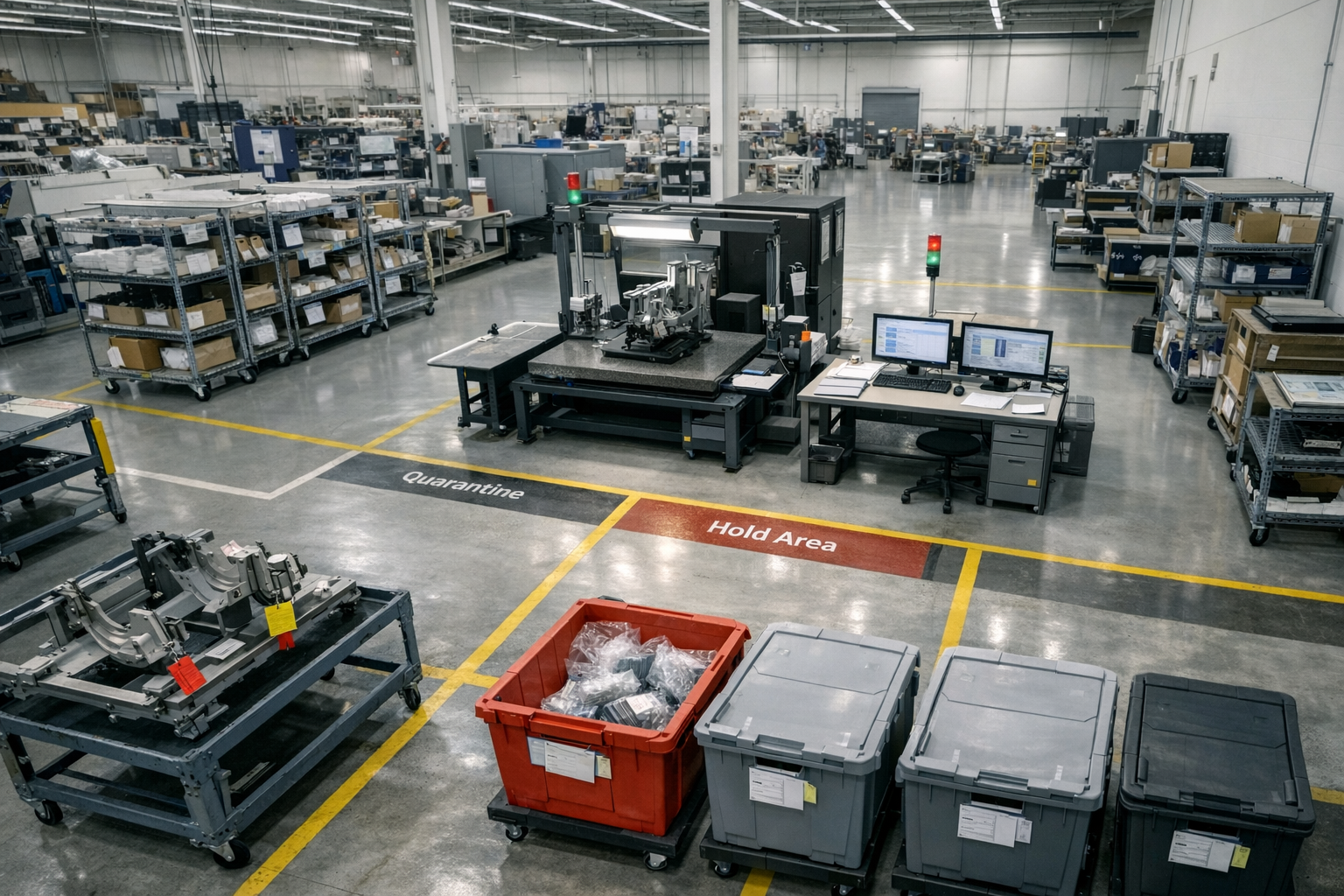
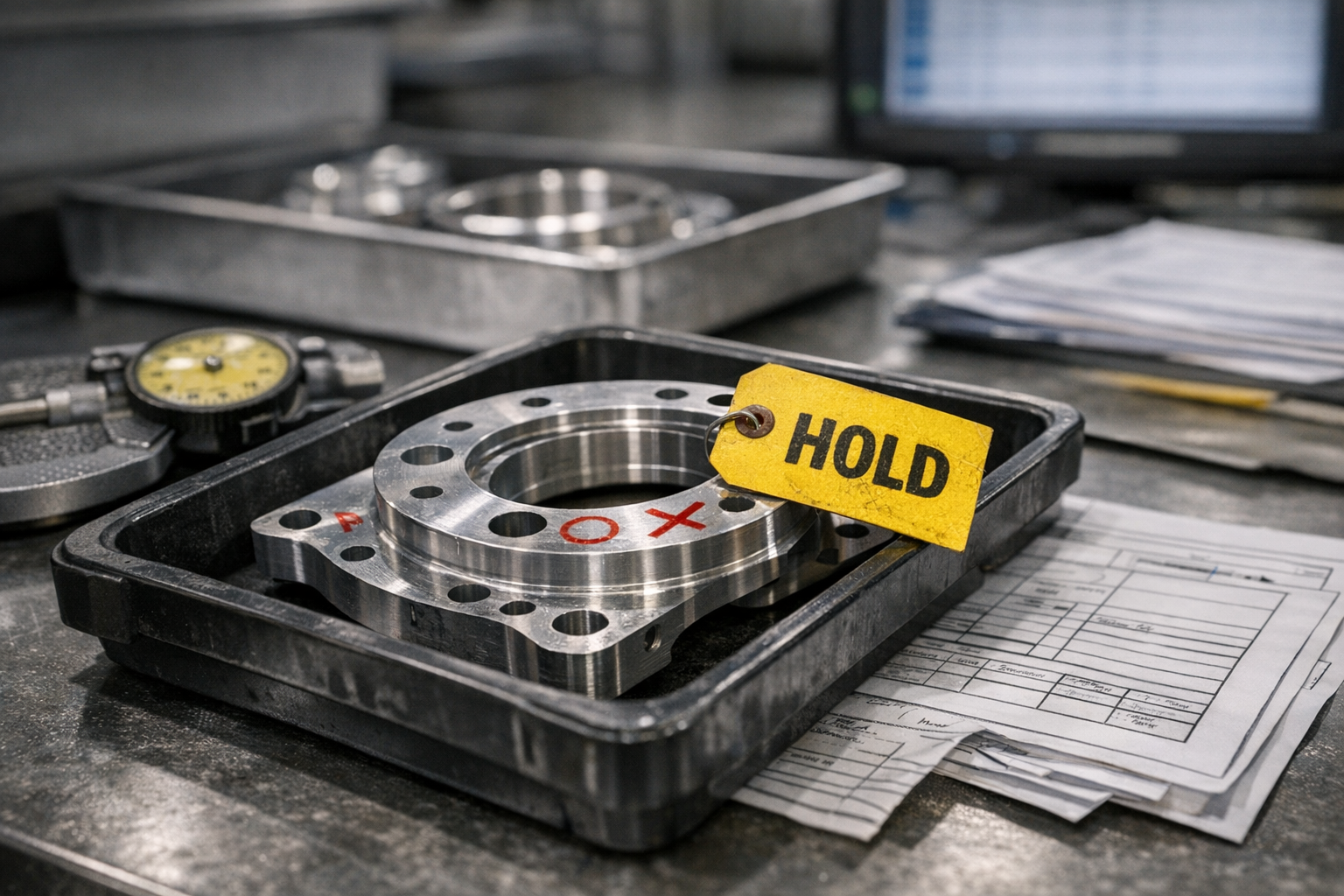
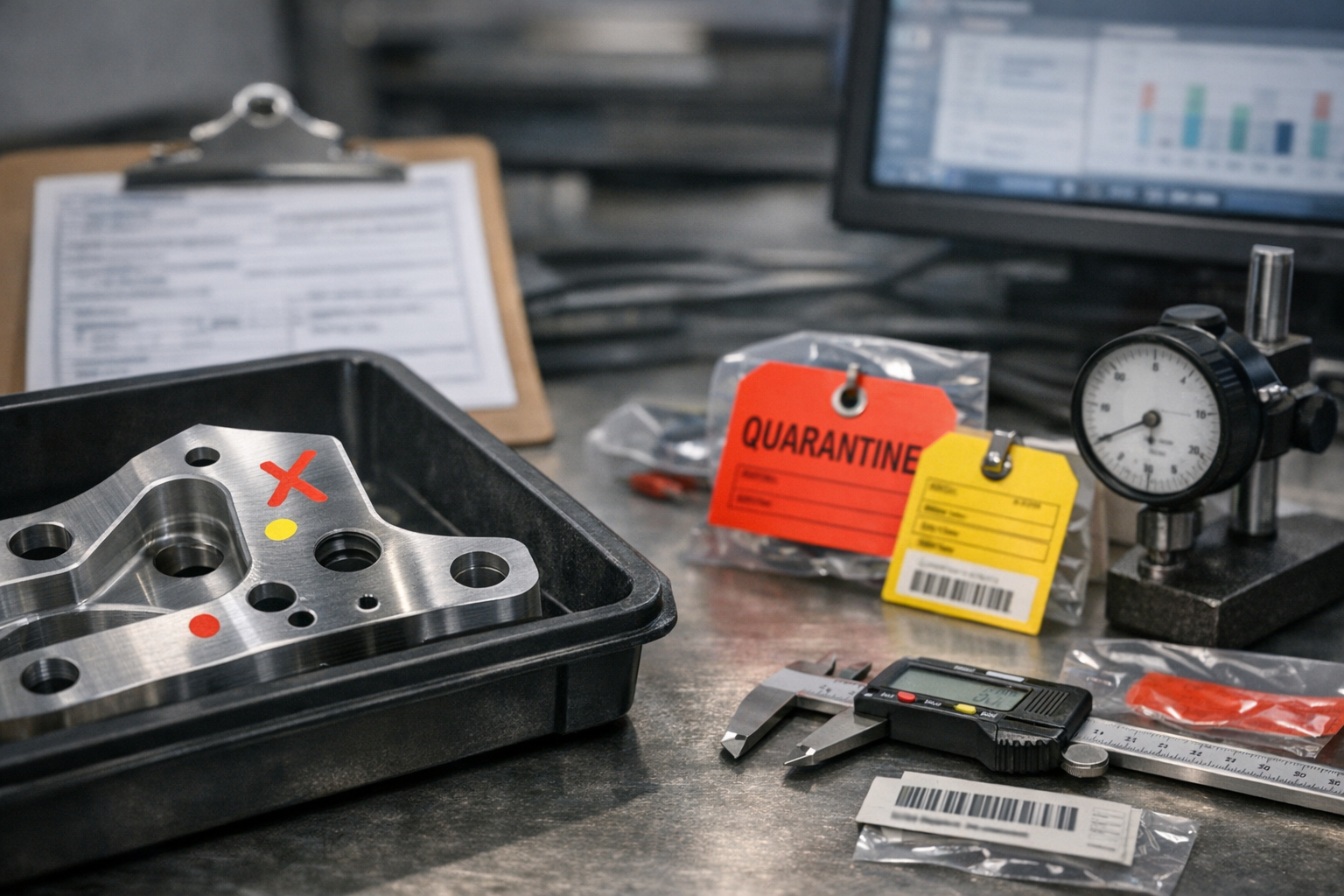
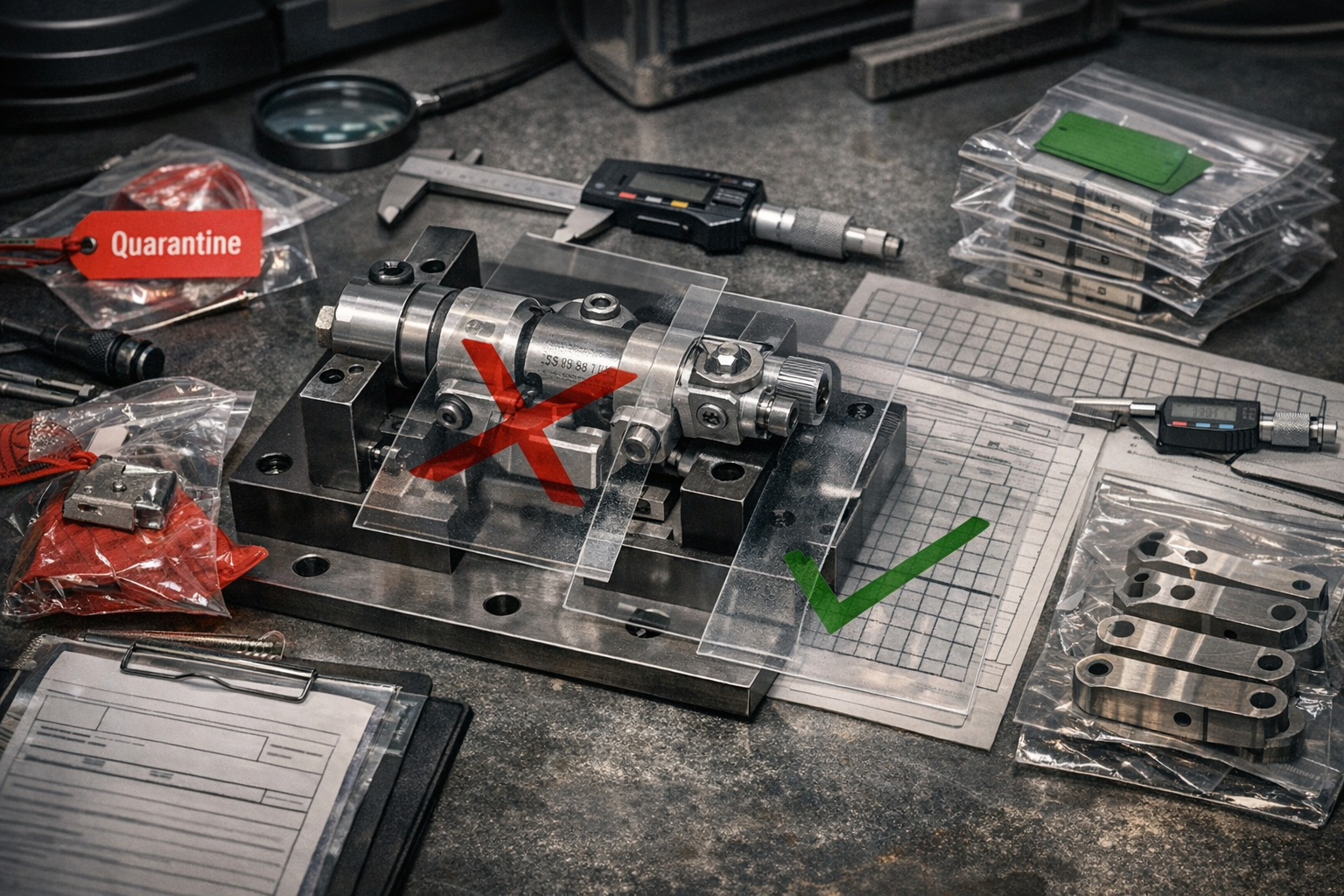
    • 1. Containment: Immediate actions to protect the customer and production flow—segregating suspect material, placing work orders on hold, issuing stop work for affected operations, and defining inspection or test expansions.
    • 2. Problem Definition: Precise, data-backed description of the issue. This includes affected part numbers, serials or lot IDs, processes, documents, and detection points.
    • 3. Root Cause Analysis: Structured analysis of the true causes (technical and systemic), not just the symptoms observed on the floor.
    • 4. Corrective Actions: Measures to eliminate the root cause and prevent recurrence for the same process, part, or configuration.
    • 5. Preventive Actions: Measures to extend the learning—e.g., applying controls to similar processes, related programs, or sister facilities.
    • 6. Effectiveness Verification: Planned checks and metrics to confirm the problem does not reappear and that the system change is sustained.

    A digital workflow that enforces these stages, with required fields and approvals, reduces variability and gives leaders consistent visibility into CAPA progress.

    Defining Roles and Responsibilities

    Aerospace CAPA typically involves multiple functions: quality engineering, manufacturing engineering, design engineering, production, supply chain, and sometimes field support. Without clear ownership, actions stall, investigations remain superficial, and audit readiness suffers. A RACI-style assignment for each CAPA stage is particularly useful:

    • CAPA owner: Usually a quality or manufacturing engineer responsible for coordination, schedule, and documentation.
    • Investigators: Functional experts (e.g., design engineers for configuration or stress issues, process engineers for manufacturing defects, supplier quality for vendor-related non-conformances).
    • Approvers: Quality leadership, program management, and, where needed, design authority or delegated signatories.
    • Implementers: Line supervisors, trainers, document control, and IT/automation teams who execute process, training, tooling, or system changes.

    Defining these roles in the CAPA procedure and embedding them in workflow rules (e.g., routing based on part family, process, or customer) prevents ambiguity and improves response times.

    Risk-Based Prioritization of CAPA Projects

    Most aerospace organizations have more potential CAPAs than resources to execute them simultaneously. Risk-based prioritization avoids a first-in-first-out queue that ignores criticality. Criteria typically include:

    • Impact on safety, airworthiness, or regulatory compliance.
    • Impact on key customers, strategic programs, or fielded fleet.
    • Frequency of occurrence and trend across lines or suppliers.
    • Cost and schedule impact—scrap, rework, AOG events, delayed deliveries.

    Prioritization should be visible in CAPA dashboards so management can reallocate engineering and quality resources as risks shift. Digital systems that score CAPAs based on configured rules help ensure critical work is not buried under low-impact items.

    Writing Strong Corrective and Preventive Actions

    Avoiding Vague or Person-Dependent Actions

    One of the most common weaknesses in aerospace CAPA is actions that depend on individuals rather than systems: “retrain operator,” “remind inspector,” or “be more careful.” These may be necessary in the short term but rarely change underlying conditions. Effective actions are specific, observable, and verifiable. For example:

    Clarify the operational risk

    When the work behind Corrective and Preventive Action (CAPA) affects quality, delivery, or compliance, teams need one place to connect evidence, decisions, and shop-floor follow-through.

    Map the risk in Corrective and Preventive Action (CAPA)

    • Instead of “retrain inspectors,” specify “update inspection work instruction WI-123 to include gage set-up checklist and require sign-off; train all inspectors on revision C by [date].”
    • Instead of “tighten documentation discipline,” specify “modify MES routing to block operation close-out until torque value field is completed and verified by barcode scan.”

    Action descriptions should clearly state what will change, where it applies, who owns it, and how completion will be evidenced in the digital record.

    Addressing Process, Design, Training, and Supplier Factors

    Root causes in aerospace rarely belong to a single category. A robust CAPA portfolio covers multiple levers:

    • Process: Changes to routings, parameter limits, inspection plans, process FMEAs, tooling, or fixtures.
    • Design: Drawing clarifications, tolerance adjustments (with rigorous justification), interface definitions, and configuration baselines.
    • Training and Competence: Updating curricula, qualification requirements, or recurring assessments for sensitive operations (e.g., special processes, NDT).
    • Supplier and External: Flow-down of requirements, updated specifications or quality clauses, supplier process audits, or dual sourcing strategies.

    During CAPA review, leaders should ask whether actions address only local symptoms or also the system-level contributors: planning, tooling standardization, data visibility, or supplier controls.

    Ensuring Feasibility and Clear Ownership

    Actions that look good on paper but are impractical in the plant or supply chain will either never be implemented or will be quietly bypassed. Feasibility checks should consider:

    • Required downtime for implementation and validation.
    • Impact on takt time and station cycle times.
    • Availability of required skills, test equipment, or IT changes.
    • Change management for planning, tooling, and configuration documentation.

    Each action must have a named owner and a realistic due date aligned with program schedules. In digital CAPA systems, owners should receive automated tasks and reminders, and management dashboards should highlight late or at-risk actions for escalation.

    Verifying and Sustaining CAPA Effectiveness

    Verification Plans and Success Criteria

    Verification is where many CAPAs fail. Closure is granted based on completion of tasks, not on demonstrated reduction of risk. To avoid this, define verification plans and success criteria when creating the CAPA, not at the end. A good plan answers:

    • What metrics or signals will show that the issue has not recurred?
    • Over what period or volume of production will we observe?
    • What specific records, inspections, or test results will we review?

    Examples include zero recurrence of a defect over a defined number of units or hours, stable yield above a target level, audit results confirming proper use of new work instructions, or process data demonstrating control within revised limits.

    Monitoring Over Time for Recurrence

    Complex aerospace products often have long cycle times, and some failure modes may only surface in downstream tests or in the field. Short verification windows are rarely sufficient. Instead, organizations should:

    • Tag NCRs, test records, and field events with relevant CAPA identifiers.
    • Use dashboards and trend charts to watch for re-emergence of similar issues across lines and sites.
    • Require periodic CAPA reviews for high-criticality issues, even after formal closure, especially during ramp-ups or configuration changes.

    Data integration between MES, QMS, test systems, and field support improves the ability to detect weak signals early and re-open or extend CAPAs when necessary.

    Closing CAPAs with Documented Evidence

    CAPA closure should be a deliberate decision, supported by objective evidence rather than elapsed time. Typical closure evidence includes:

    • Records of implemented process or document changes (revised routings, work instructions, or control plans).
    • Training completion logs and competence assessments for affected roles.
    • Before/after metrics showing improved yield, reduced scrap, or absence of specific defects.
    • Results of targeted audits or inspections confirming adherence to new standards.

    Auditors and customers often sample closed CAPAs during assessments. A well-structured digital record—linking underlying NCRs, design changes, supplier responses, and verification data—demonstrates control and maturity.

    Digitizing CAPA Workflows in Aerospace

    Linking CAPAs to NCRs, Audits, and Risks

    Effective aerospace CAPA requires a unified view across quality events. This is difficult when NCRs live in spreadsheets, audit findings in separate tools, and risk registers in static documents. A digital manufacturing quality platform should allow CAPAs to be:

    • Initiated directly from NCRs, internal audits, customer findings, or FMEA outputs.
    • Linked to specific part numbers, serial numbers, work orders, and configurations.
    • Associated with risk assessments so that controls are updated consistently.

    This connectivity supports traceability: when a regulator or OEM asks how you mitigated a particular risk, you can show the related CAPA, its implementation status, and resulting performance trends.

    Dashboards to Monitor CAPA Status and Backlog

    Without real-time visibility, CAPA portfolios quickly become unmanageable. Leaders need dashboards that provide:

    Connect decisions to execution

    Connect 981 helps turn this kind of operational detail into traceable action, so the context behind each decision does not get lost.

    Discuss the workflow for Corrective and Preventive Action (CAPA)

    • Counts and aging of open CAPAs by criticality, program, and site.
    • Stage distribution (containment, analysis, implementation, verification) to identify bottlenecks.
    • On-time completion rates for actions and verification activities.
    • Heat maps of repeat issues by process or supplier.

    These insights enable proactive management instead of end-of-quarter firefighting. In environments with multiple sites or complex supply chains, standardized KPIs across locations support consistent governance.

    Cross-Site Sharing of Lessons Learned

    Many aerospace manufacturers build similar components across multiple sites or suppliers. When a CAPA at one facility identifies an effective control, the benefit multiplies if the lesson is shared and applied elsewhere. Digital systems can support this by:

    • Tagging CAPAs with technology, process, and product families.
    • Providing search and reporting on resolved CAPAs for use in design reviews, PFMEAs, and new line launches.
    • Allowing controlled replication of actions—e.g., copying a proven inspection enhancement into routings for comparable parts at other sites.

    This turns CAPA from a purely local problem-solving tool into an enterprise knowledge asset that strengthens the overall aerospace production network.

    Common CAPA Pitfalls and How to Avoid Them

    Superficial Root Cause Statements

    “Operator error” and “did not follow procedure” are red flags in aerospace CAPA. They rarely satisfy auditors or prevent recurrence. To avoid superficiality:

    • Require structured analysis methods (e.g., 5 Whys, cause-and-effect diagrams, fault tree analysis) for significant CAPAs.
    • Challenge teams to identify systemic contributors—unclear instructions, poor ergonomics, missing error-proofing, insufficient training criteria, or inadequate system validations.
    • Use cross-functional reviews to test whether the stated root cause would reasonably lead to the observed pattern of non-conformances.

    Over time, organizations can build libraries of common root cause categories aligned with aerospace realities—special process controls, configuration errors, tooling variation, data integration gaps—to prompt more rigorous analysis.

    Actions That Fail to Address System Causes

    Even when the root cause analysis is sound, actions often remain focused at the local level. For example, a torque miss might lead only to local training, when the deeper issue is that the MES does not enforce data entry or gage calibration tracking. To counter this, CAPA reviews should explicitly ask:

    • Have we addressed the process or system feature that allowed the error?
    • Could similar failures occur in other cells, lines, or suppliers using the same tools or documents?
    • Have we updated relevant risk assessments (e.g., PFMEA) and control plans to reflect the learning?

    Embedding these questions into digital approval workflows helps drive actions that strengthen the underlying aerospace production system, not just the point of failure.

    Premature Closure Without Adequate Verification

    Closing CAPAs purely based on task completion is risky in aerospace. Pressure to reduce backlogs can lead to early closure before meaningful data is collected. To avoid this pitfall:

    • Make verification criteria mandatory fields when creating the CAPA, not optional at closure.
    • Link CAPA verification to live data sources where possible—NCR trends, test yields, escape rates—rather than anecdotal reports.
    • Require independent review (e.g., quality management) to confirm that verification evidence matches predefined criteria.

    For high-severity issues, consider staged closure: provisional closure after initial verification, followed by scheduled reviews during program milestones or configuration changes.

    Integrating CAPA with Digital Non-Conformance Management

    CAPA effectiveness is heavily influenced by how well it is connected to day-to-day non-conformance handling. When NCR creation, disposition, and CAPA initiation all occur in a unified digital environment, organizations gain:

    • End-to-end traceability from detection through resolution and verification.
    • Consistent data structures for part IDs, serials, work orders, and configurations.
    • Faster pattern recognition across plants and suppliers, enabling earlier CAPA triggers.

    Platforms that integrate NCRs, CAPAs, engineering changes, and supplier responses into a single digital thread align well with AS9100 expectations and reduce the burden of audit preparation. They also provide a foundation for analytics that identify where additional CAPAs—or preventive design and process changes—will yield the greatest risk reduction.

    For aerospace manufacturers looking to move beyond reactive firefighting, strengthening CAPA within a unified non-conformance management and quality workflow is a high-leverage step toward more predictable, compliant, and efficient operations.
  • How to Roll Out Connect 981 for Aerospace Non-Conformance Management

    How to Roll Out Connect 981 for Aerospace Non-Conformance Management

    In aerospace manufacturing, moving non-conformance reporting (NCR) from spreadsheets and email into a digital platform such as Connect 981 changes more than where data lives. It reshapes how quality, engineering, production, and suppliers collaborate under AS9100 and regulatory expectations. A disciplined implementation roadmap is essential to avoid disruption on the shop floor and to realize measurable improvements in cycle time, traceability, and audit readiness.

    This article is for aerospace operations, quality, and compliance teams who need to understand How to Roll Out Connect 981 for Aerospace Non-Conformance Management. It explains the practical question this topic answers in a manufacturing execution context.

    This guide outlines a practical, phased roadmap for implementing a digital non-conformance platform in regulated aerospace environments. It assumes an AS9100 context, integration with ERP/MES/PLM, and the need for complete traceability across the non-conformance management workflow in aerospace operations.

    For teams putting this topic into daily operation, non-conformance management, quality management workflows, a connected execution platform help connect the concept to traceability, work-order reality, and audit-ready evidence.

    The same operating model also depends on Connect 981’s aerospace execution solutions, real aerospace execution examples, Connect 981’s aerospace operations guidance, practical aerospace operations FAQs, especially when decisions have to move across quality, production, suppliers, and program leadership without losing context.

    Clarifying Objectives and Scope

    Defining business goals and success criteria

    Before configuring a single form in Connect 981, aerospace organizations need clear business objectives. Common goals include reducing NCR cycle time, improving on-time closure against customer or regulatory targets, strengthening part and configuration traceability, and simplifying audit preparation. Each objective should translate into measurable success criteria, such as percentage reduction in average closure time or improvement in first-pass containment rates.

    In an aerospace plant, these criteria should be directly linked to operational realities: aircraft-on-ground (AOG) exposure, impact on critical work orders, scrap and rework costs, and customer scorecards. Defining these targets early guides configuration decisions later, such as which data fields are mandatory, which escalations are required, and what KPIs must be available in dashboards.

    Prioritizing plants, programs, and supplier involvement

    Few organizations can move the entire enterprise onto a new non-conformance platform in a single step without risk. A practical approach is to prioritize by a combination of volume, criticality, and readiness. Examples include selecting:

    • A flagship final-assembly line with high NCR volume and strong local leadership.
    • A development or low-rate initial production program where teams are accustomed to process change.
    • A subset of strategic suppliers that already collaborate closely on quality topics.

    For each selected area, define whether suppliers will be onboarded in the first phase or in a later wave. Some aerospace organizations begin with internal NCRs only, then add external supplier access to Connect 981 once internal workflows are stable and data ownership is clear.

    Aligning quality, IT, and operations stakeholders

    Successful deployment of a digital NCR platform requires tight alignment between quality, IT, operations, and engineering. Quality typically owns process definitions and compliance; IT owns infrastructure, identity management, and integration; operations own daily use on the shop floor; and engineering controls dispositions and technical decisions.

    Establishing a cross-functional implementation team early helps manage competing constraints. For example, quality may insist on additional mandatory data for investigations, while operations may be concerned about inspection takt time. Connect 981 configuration choices—such as conditional fields or role-based layouts—rely on resolving these trade-offs in design workshops rather than during go-live firefighting.

    Assessing Current Non-Conformance Processes

    Mapping as-is workflows and systems

    A realistic roadmap starts from a clear understanding of how NCRs work today. This means documenting detection points, data capture methods, routing paths, and approval steps across the full lifecycle: initial report, containment, investigation, disposition, corrective action, and verification of effectiveness.

    In aerospace environments, this often reveals parallel processes: one for internal findings in production, another for supplier-related issues, and yet another for customer or regulatory escapes. It also exposes system handoffs—for example, an MES used for work orders, an ERP for material, separate quality databases, and spreadsheet trackers for investigations. These handoffs are precisely where a platform like Connect 981 can remove friction, but only if they are clearly understood in advance.

    Identifying pain points and quick wins

    Process mapping should explicitly capture pain points rather than just the nominal workflow. Typical issues include NCRs stalled waiting for engineering disposition, limited visibility across shifts, non-standard defect coding, and fragmented supplier communications. For each pain point, determine whether it can be addressed by configuration (such as mandatory fields, routing rules, or notifications) or requires deeper process change.

    Quick wins often come from simple changes: standardizing non-conformance categories, automating notifications when NCRs sit beyond target timelines, or giving production supervisors real-time dashboards. Highlighting these early wins in the roadmap helps sustain support from plant leadership and frontline teams during later phases.

    Gathering baseline metrics for later comparison

    Without baseline data, it is difficult to quantify the value of digital transformation. Before rolling out Connect 981, capture basic metrics from legacy systems, even if this requires manual sampling. Examples include:

    Clarify the operational risk

    When the work behind How to Roll Out Connect affects quality, delivery, or compliance, teams need one place to connect evidence, decisions, and shop-floor follow-through.

    Map the risk in How to Roll Out Connect

    • Average and median NCR closure time by severity.
    • Percentage of NCRs closed within customer or internal targets.
    • Reopen rates due to incomplete root cause or corrective actions.
    • Proportion of NCRs with missing or incomplete traceability attributes (e.g., serial numbers, lot, work order).

    These metrics serve two purposes: they shape configuration priorities (for example, focusing on bottlenecks in disposition) and later allow objective comparison to demonstrate improvements after Connect 981 is in production. Actual results will depend on scope, complexity, and governance discipline.

    Designing the Future-State Digital Workflow

    Standardizing core NCR steps across the enterprise

    Connect 981 is most effective when the underlying process is consistent across sites and programs, with clear variations only where justified by customer or regulatory requirements. Start by agreeing on an enterprise-level, end-to-end workflow: detection, containment, analysis, disposition, corrective/preventive action, verification, and closure.

    Within aerospace manufacturers, this standardization supports clearer training, simpler audits, and more meaningful enterprise-wide analytics. It also underpins a digital thread for quality—linking NCRs to work orders, parts, and configurations regardless of production site. Local differences (for example, specialized repair stations or space-flight hardware lines) can then be handled through configurable routing or additional steps rather than completely separate processes.

    Configuring forms, fields, and approval paths

    The heart of a digital non-conformance platform is the form structure and associated workflows. From an aerospace standpoint, certain data elements are non-negotiable: part and serial numbers, work order or operation, defect classification, detection point, configuration identifiers, and operator or inspector details. Connect 981 forms should enforce consistent capture of these elements, with validation where appropriate (for example, verifying part numbers against master data).

    Approval paths must reflect real technical authority. This usually means separating quality review, technical disposition (often engineering), and any approvals required by design authority or airworthiness representatives. Conditional routing can ensure that safety-critical parts, customer-specified features, or regulatory findings receive additional scrutiny. The intent is not to add bureaucracy but to ensure that the right experts are engaged automatically, without relying on informal email chains.

    Handling customer-specific and regulatory variations

    Aerospace organizations frequently face customer-specific requirements for notification, categorization, and response time, as well as regulatory expectations tied to authorities such as FAA or EASA. In Connect 981, these variations can be expressed through attributes such as program, customer, or type of hardware and then used to adjust routing, required fields, and timelines.

    Examples include requiring additional sign-off for customer-owned tooling, different categories for in-service events versus production findings, or dedicated workflows for export-controlled hardware. The aim is to encode these rules directly in the system so that compliance does not depend on each inspector remembering which template to use for each contract.

    Integration and Data Strategy

    Planning interfaces with ERP, MES, and PLM

    For aerospace manufacturers, a non-conformance platform cannot operate as a standalone silo. Connect 981 should exchange data with ERP for material, customers, and suppliers; MES or shop-floor systems for work orders and operations; and PLM or configuration management systems for product structure and design authority references.

    A practical roadmap identifies minimum viable integrations for initial phases, then deeper connections over time. Early on, read-only reference to work orders and part structures may be sufficient; later, write-back of holds, scrap decisions, or rework instructions can be added. Interface design should respect existing validation rules, change-control processes, and regulatory logging requirements.

    Managing master data and access rights

    A digital NCR process is only as reliable as the master data it consumes. Part numbers, serial number rules, supplier codes, and user roles must be consistent across platforms. Decide which system is the source of truth for each data domain and how Connect 981 will consume updates, whether via batch synchronization or real-time APIs.

    Access rights are particularly sensitive in aerospace due to export controls, proprietary designs, and customer confidentiality. Role-based access in Connect 981 should align with existing identity and access management policies. For example, a supplier might see only their own NCRs and related corrective actions, while internal engineering has broader visibility. Segmented visibility also reduces noise for users, improving adoption.

    Migrating or referencing historical NCR records

    Most organizations have years of non-conformance history spread across multiple systems. A decision is needed on whether to migrate legacy data into Connect 981, maintain it read-only in prior systems, or selectively import high-value records (for example, safety-related or recurring issues).

    A common pattern is to migrate a limited history window and key attributes while retaining original documents in existing repositories. The goal is to enable trending over time without delaying go-live with an extensive data-conversion project. Where full migration is not undertaken, ensure that NCR numbers, part identifiers, and tail or serial numbers are mapped in a way that allows investigators to find relevant historical context efficiently.

    Pilot, Training, and Change Management

    Running pilots in representative environments

    Aerospace production lines differ significantly—by product complexity, level of automation, and degree of customer oversight. Pilots for Connect 981 should be run in environments that collectively represent these differences: for instance, a high-volume machining cell, a complex assembly line, and a repair or MRO station.

    Each pilot should have clear entry and exit criteria: which NCR types are in scope, which legacy tools are being replaced, and what metrics will be tracked. During pilots, it is normal to discover gaps in routing rules, missing fields, or unclear responsibilities; the key is to capture these systematically and feed them into a controlled iteration cycle rather than making ad-hoc changes during production use.

    Connect decisions to execution

    Connect 981 helps turn this kind of operational detail into traceable action, so the context behind each decision does not get lost.

    Discuss the workflow for How to Roll Out Connect

    Training inspectors, engineers, and suppliers

    Digital tooling only improves outcomes if the people who detect, investigate, and disposition non-conformances understand how to use it in context. Training plans should be role-based: inspectors focus on creating and updating NCRs at the point of detection, engineers on investigations and dispositions, supervisors on monitoring backlogs, and suppliers on participating in corrective actions.

    Hands-on exercises using realistic aerospace scenarios are more effective than generic system demos. For example, simulate a non-conformance on a serialized flight-critical component, complete with traceability requirements, or a supplier escape requiring containment across multiple lots. Recording short, role-specific reference videos or job aids helps reinforce training after initial sessions.

    Collecting feedback and iterating configurations

    Within regulated manufacturing, changing quality workflows must remain controlled, but that does not mean Connect 981 configuration is static. During and after pilots, establish a structured feedback process: regular touchpoints with frontline users, a channel for raising issues, and a review board to decide on configuration changes.

    Feedback often highlights opportunities to streamline screens, refine defect codes, or adjust notifications to reduce alert fatigue. Each approved change should follow a documented change-control process, including impact assessment and communication, to maintain auditability and avoid confusion on the shop floor.

    Scaling, Governing, and Improving Over Time

    Rolling out to additional sites and programs

    Once pilot configurations have stabilized, Connect 981 can be rolled out progressively to additional plants and programs. A repeatable deployment playbook is useful here: pre-deployment readiness checks, data validation, training steps, cutover plans, and post-go-live support arrangements.

    Each site should adopt the enterprise-standard process and configuration by default, with controlled exceptions for genuinely unique requirements. This discipline is what enables cross-site analytics, common KPI definitions, and consistent experience for engineers and suppliers who work across multiple facilities.

    Establishing governance and ownership

    A digital non-conformance platform must be actively governed, not simply maintained. Define clear ownership for both the process and the system. Typically, quality leadership owns the standard process and defect taxonomy, while IT or a digital operations team owns the platform, integrations, and technical performance.

    A governance board can review requested changes, ensure alignment with AS9100 and customer requirements, and prioritize enhancements. This group should also define policies for data retention, electronic signatures, and audit access, ensuring that Connect 981 remains aligned with evolving regulatory interpretations and customer contracts.

    Using KPIs and audits to refine the system

    Over time, Connect 981 becomes a rich source of information about how non-conformance management actually works in your aerospace operations. Use this data to track core KPIs such as mean time to closure, containment timeliness, recurrence rates, and backlog by functional owner. Where performance diverges between sites or programs, investigate whether configuration, training, or local practices differ.

    Internal audits can also use Connect 981 as a primary evidence source, reviewing samples of NCRs from detection through closure. Findings from these audits should lead not only to corrective actions on the shop floor but also to refinements in workflow rules, mandatory fields, and reporting structures within the platform.

    Positioning Connect 981 Within the Digital Manufacturing Landscape

    Implementing a digital non-conformance platform is not an isolated project; it is part of a broader digital manufacturing and quality strategy. In aerospace, Connect 981 should connect naturally into the digital thread linking requirements, design, production, and in-service performance. NCRs then become structured events along this thread, tied to part genealogy, configuration states, and process conditions.

    Over time, this enables more advanced use cases: predictive quality based on patterns in defect data, supplier performance management grounded in precise metrics, and faster response to regulatory or customer inquiries. Achieving these benefits depends less on any single feature and more on disciplined implementation, realistic scoping, and strong cross-functional governance. With a structured roadmap, aerospace manufacturers can move from fragmented, reactive non-conformance handling to an integrated, data-driven system anchored by Connect981.