Tag: supplier quality

  • Managing Supplier Non-Conformances in Aerospace: From SCARs to Scorecards

    Managing Supplier Non-Conformances in Aerospace: From SCARs to Scorecards

    Managing Supplier Non-Conformances in Aerospace: From SCARs to Scorecards

    In aerospace, a single defective lot from a supplier can halt production, trigger aircraft-on-ground (AOG) situations, or invite intense regulatory scrutiny. That is why aerospace supplier non conformance management is not just a purchasing or quality activity—it is a core risk-control and business performance process.

    This article focuses specifically on non conformances originating from suppliers: how they are detected, communicated, corrected, and ultimately used to drive long-term performance improvement. When done well, supplier NCR (non-conformance report) data becomes a strategic asset for managing risk and making sourcing decisions. When done poorly, it leads to recurring problems, strained relationships, and cost overruns.

    For teams putting non-conformance and capa into daily operation, non-conformance management, supply chain and supplier execution, quality management workflows help connect the concept to traceability, work-order reality, and audit-ready evidence.

    The same operating model also depends on a connected execution platform, Connect 981’s aerospace execution solutions, real aerospace execution examples, Connect 981’s aerospace operations guidance, especially when decisions have to move across quality, production, suppliers, and program leadership without losing context.

    If you are looking for a broader, end-to-end view of non-conformance handling across your operation, including in-house manufacturing and MRO, see our guide on enterprise-wide non conformance visibility.

    Why Supplier Non-Conformances Are Critical in Aerospace

    Impact on production schedules and AOG risk

    Purchased material typically represents a large portion of cost and risk in aerospace programs. When supplier parts arrive out of specification:

    • Production lines stall while engineering determines disposition and buyers scramble for replacement parts.
    • Aircraft-on-ground (AOG) situations may occur if replacement parts are not available to support final assembly or maintenance.
    • Buffers and safety stock are consumed more quickly, driving up inventory requirements and working capital if supplier quality is unstable.

    Because many aerospace parts have long lead times and tight qualification requirements, switching suppliers or re-sourcing is rarely a quick option. Effective supplier non-conformance management is therefore a critical lever for protecting delivery schedules.

    Regulatory and customer traceability expectations

    Regulators and aerospace customers expect full traceability for supplier-related non conformances:

    • Which lots, serial numbers, and work orders are affected?
    • What containment was applied and when?
    • What root cause was identified at the supplier and at your own facility?
    • What corrective and preventive actions (CAPA) were implemented, and how was effectiveness verified?

    Standards like AS9100, along with customer clauses, require documented, auditable processes for handling supplier-caused non conformances. Incomplete or inconsistent records can surface during audits, customer reviews, or incident investigations, with significant reputational and commercial consequences.

    Cost and relationship implications of poor supplier quality

    Supplier non conformances carry direct and indirect costs:

    • Direct costs: additional inspection, rework, scrap, expedited freight, and premium overtime.
    • Indirect costs: missed delivery commitments, line downtime, engineering support, and customer penalties.

    At the same time, suppliers are long-term partners. Overly punitive responses can damage relationships and limit collaboration, while overly lenient responses encourage recurrence. The goal is a fair, documented, and consistent process that:

    • Protects safety and compliance.
    • Allocates costs appropriately when justified by facts.
    • Supports genuine joint improvement with strategic suppliers.

    Typical Supplier Non-Conformance Workflow

    Although every organization has its own terminology and systems, most aerospace supplier non-conformance workflows follow a similar pattern.

    Detection at incoming inspection or in-process

    Supplier issues can be detected at multiple points:

    • Incoming inspection – dimensional checks, functional tests, documentation review, and visual inspection.
    • In-process – machining, assembly, or test operations reveal defects traceable back to supplier material.
    • Final inspection or test – failures linked to upstream supplier deviations.
    • Field or MRO feedback – service issues ultimately traced to a supplier component or process.

    When a deviation is found, the inspector or operator should immediately:

    1. Quarantine the suspect material (physical segregation and clear identification).
    2. Document the non conformance in the QMS or NCR system, including part numbers, lot/serials, supplier details, and defect description.
    3. Flag potential impact on work-in-process and delivered products using the same lot or configuration.

    Documentation and issuing supplier corrective action requests (SCARs)

    Not every minor defect warrants a formal Supplier Corrective Action Request (SCAR). Many organizations use thresholds based on:

    • Severity (safety or flight-critical impacts).
    • Frequency (repeat issues over a defined period).
    • Volume (defect rate across a lot or program).

    For issues that cross those thresholds, the quality or supplier management team issues a SCAR that typically includes:

    • Clear description of the non conformance and supporting evidence (photos, test results, measurements).
    • Traceability information (purchase order, lot, serial, manufacturing date, applicable specs and revisions).
    • Required containment actions at the supplier and your site.
    • Timelines for initial response, root cause analysis, and corrective action completion.

    Well-structured SCARs set expectations up front and avoid rework cycles where suppliers ask for missing information or clarification.

    Joint root cause analysis and corrective action planning

    Effective supplier non-conformance management is collaborative. After the SCAR is issued:

    • The supplier performs an initial assessment and confirms or updates containment scope.
    • Both parties may participate in a structured problem-solving method such as 8D or 5 Whys.
    • Root causes are identified not only at the supplier but also, if applicable, in your own processes (e.g., inadequate incoming inspection, unclear specifications).
    • Corrective and preventive actions are defined, including process changes, training, documentation updates, and verification plans.

    The aim is not merely to close the SCAR, but to implement actions that demonstrably prevent recurrence.

    Defining Clear Expectations for Suppliers

    Clarity upfront reduces friction and delays during non-conformance handling. Expectations should be documented in supplier quality requirements, purchase order terms, and, where appropriate, contracts.

    Response time targets and containment requirements

    Many aerospace organizations define tiered response expectations, such as:

    • Immediate (within 24 hours): Acknowledgement of the SCAR and confirmation of short-term containment actions and affected scope.
    • Interim report (3–5 business days): Initial root cause hypotheses, risk assessment, and additional containment if needed.
    • Final 8D / root cause and corrective action (10–30 days): Verified root cause, implemented corrective actions, and effectiveness plan.

    Containment expectations should specify:

    • How the supplier will identify and segregate potentially affected material (on-site and at your facility).
    • How they will prevent shipment of suspect product until risk is understood.
    • When and how they will perform 100% inspection or additional testing, if required.

    Data and evidence required with supplier responses

    To avoid low-quality responses, define minimum requirements for SCAR closure, such as:

    • Documented root cause analysis method used and why the cause is believed to be valid.
    • Objective evidence of process changes (updated work instructions, control plans, training records, equipment maintenance or calibration records).
    • Verification data, such as capability studies, inspection results, or pilot runs showing the issue is resolved.
    • Assessment of similar products, processes, and customers potentially affected by the same cause.

    Making these expectations visible to suppliers upfront improves the quality and consistency of their responses.

    Alignment with AS9100 and customer clauses

    Supplier expectations should be aligned with:

    • AS9100 requirements for control of externally provided processes, products, and services.
    • Specific customer quality requirements (e.g., mandatory notification timelines, approval of concessions, mandated use of particular 8D templates).
    • Any applicable design authority or regulatory requirements for concessions or deviations.

    Providing suppliers with a concise summary of these expectations—rather than assuming they will interpret long standards documents—reduces ambiguity and audit risk.

    Using Digital Tools to Manage Supplier Non Conformances

    Managing supplier SCARs through email, spreadsheets, and ad hoc trackers quickly becomes unmanageable, especially across multiple sites and high part counts. Digital solutions make the process more reliable and transparent.

    Supplier portals and shared NCR visibility

    A secure supplier portal within your quality management or non-conformance system allows suppliers to:

    • View all open and historical non conformances assigned to them.
    • Access relevant documentation (NCR forms, photos, drawings where authorized).
    • Submit SCAR responses, attach evidence, and update status directly.

    This eliminates version confusion from multiple spreadsheets and enables a single, auditable record for each issue. Suppliers see precisely what is expected and by when, and your teams see responses as soon as they are posted.

    Automated notifications and reminders

    Digital workflows can automatically:

    • Notify the appropriate supplier contacts when a new SCAR is issued or updated.
    • Send reminders ahead of due dates for containment, interim reports, and final actions.
    • Escalate overdue responses to supplier management or your internal supplier quality leaders.

    This reduces administrative follow-up burden and prevents SCARs from silently aging in inboxes.

    Integrating supplier data into scorecards and dashboards

    When supplier-related NCR and SCAR data is stored in structured, centralized systems, it becomes straightforward to:

    • Calculate defect rates by part family, program, or supplier.
    • Monitor response time and closure time performance.
    • Track repeat issues by root cause category.
    • Feed this information into supplier scorecards and executive dashboards.

    This connection between day-to-day non-conformance handling and periodic business reviews is a key element of mature supplier management.

    Building Supplier Scorecards From Non-Conformance Data

    Supplier scorecards are most effective when they combine objective defect data with a balanced view of responsiveness and collaboration.

    Key metrics: defect rates, response times, effectiveness

    Common quality and non-conformance related metrics include:

    • Defect rate: parts per million (PPM), percentage of lots rejected, or NCRs per million dollars of spend.
    • SCAR response time: average days from issuance to initial containment, interim report, and final closure.
    • Corrective action effectiveness: percentage of SCARs with no recurrence within a defined monitoring window.
    • Documentation quality: completeness and clarity of responses, frequency of returns for rework.

    These metrics should be trended over time to identify improvement or deterioration rather than viewed as one-off snapshots.

    Combining qualitative and quantitative assessments

    Numbers alone do not tell the full story. Leading organizations also consider qualitative factors, such as:

    • Collaboration: willingness to share data, engage in joint problem-solving, and attend technical reviews.
    • Engineering support: ability to respond to technical questions, support qualification, and manage changes.
    • Process maturity: evidence of robust internal quality systems (e.g., AS9100 certification, robust FMEA/control plans).

    Scorecards that mix hard data with structured qualitative input support better sourcing and development decisions.

    Using scorecards in reviews and sourcing decisions

    Supplier scorecards should not be a once-a-year exercise with little follow-through. They can be used to:

    • Guide quarterly business reviews (QBRs) with key suppliers.
    • Identify candidates for development plans or additional oversight.
    • Support sourcing decisions when awarding new business or consolidating volumes.
    • Recognize and reinforce high performers through preferred status or longer-term agreements.

    The key is consistency: suppliers should know how their performance is assessed and how scorecard results influence future opportunities.

    Collaborative Improvement With Strategic Suppliers

    Not all suppliers are equal. For strategic, high-impact suppliers, non-conformance management should feed a broader, collaborative improvement agenda.

    Sharing trends and lessons learned

    Instead of addressing each SCAR in isolation, analyze and share:

    • Trends in defect types (e.g., surface defects, documentation errors, process escapes).
    • Common root cause categories (e.g., operator training, programming errors, supplier sub-tier issues).
    • Lessons learned that could apply across part families or programs.

    Regularly reviewing this information with strategic suppliers helps both sides prioritize improvement projects that deliver the greatest risk reduction.

    Joint improvement projects and training

    Where recurring or high-risk issues are identified, consider:

    • Joint Kaizen or problem-solving events at the supplier facility.
    • Technical training on print interpretation, special process controls, or regulatory requirements.
    • Support for the supplier to improve their own NCR and CAPA systems, including how they manage their sub-tiers.

    These collaboration efforts should be targeted based on data from your non-conformance and scorecard systems, ensuring resources go where they have the most impact.

    Recognizing and rewarding strong performance

    Non-conformance data can also be used positively. For suppliers that consistently demonstrate:

    • Low defect rates,
    • Fast and effective SCAR responses,
    • Strong support during audits and customer visits,

    you can consider:

    • Reduced incoming inspection levels in accordance with risk and regulation.
    • Preferred-supplier status or opportunities for new programs.
    • Public recognition in supplier conferences or awards.

    Positive reinforcement, anchored in objective non-conformance data, helps build durable, high-performance supplier partnerships.

    Bringing It All Together

    Supplier non-conformance management in aerospace is about more than closing NCRs and SCARs. It is a structured way to protect safety, maintain regulatory compliance, safeguard production schedules, and strengthen your supply base.

    Organizations that move from fragmented spreadsheets and email to integrated, digital workflows gain:

    • Faster, more reliable detection and containment across sites.
    • Traceable, auditable records that stand up to regulatory and customer scrutiny.
    • Rich data to power supplier scorecards, risk assessments, and improvement plans.
    • Stronger collaboration with strategic suppliers built on clear expectations and shared visibility.

    By treating supplier non conformances as a high-value feedback loop rather than a necessary administrative burden, aerospace organizations can turn everyday quality problems into a driver of long-term performance and strategic advantage.
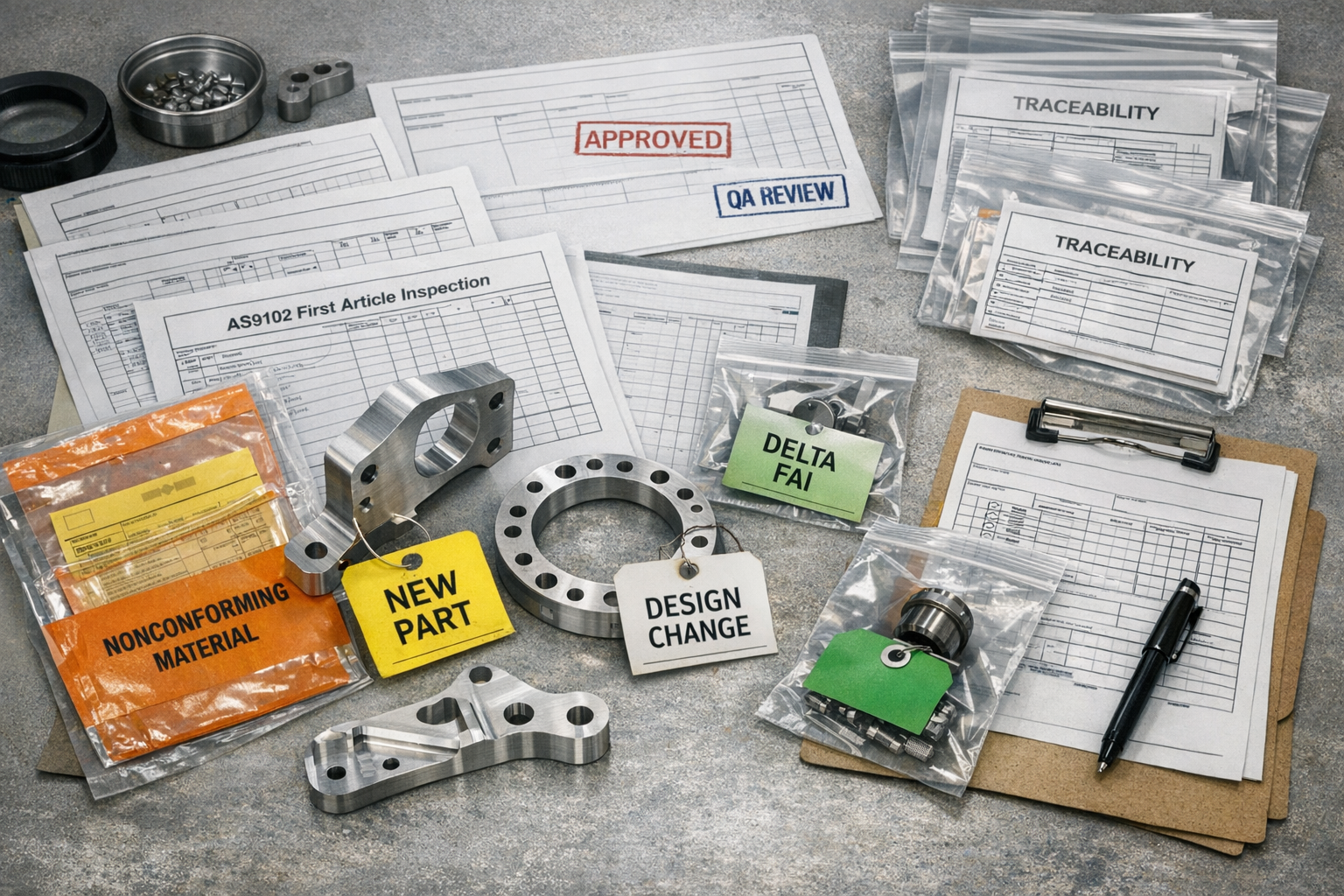
  • AS9102 FAI Triggers: New Parts, Changes, Lapses, and Delta Requirements

    AS9102 FAI Triggers: New Parts, Changes, Lapses, and Delta Requirements

    In aerospace manufacturing, one of the most common quality questions is not what AS9102 first article inspection is, but when it is actually required. Teams know first article inspection matters. They know customers expect a compliant FAIR. What causes real friction is deciding whether a situation calls for a full FAI, a partial FAI, or no new FAI at all.

    That decision matters because unnecessary first article work slows production, ties up quality resources, and adds documentation overhead. On the other hand, missing a valid trigger can create customer escapes, audit findings, approval delays, and serious traceability problems. In aerospace, where configuration control and product conformity carry real operational and regulatory weight, getting this right is not optional.

    For teams putting this topic into daily operation, digital AS9102 FAI help connect the concept to traceability, work-order reality, and audit-ready evidence.

    For teams putting this topic into daily operation, digital AS9102 FAI, a connected execution platform, Connect 981’s aerospace execution solutions help connect the concept to traceability, work-order reality, and audit-ready evidence.

    The same operating model also depends on real aerospace execution examples, Connect 981’s aerospace operations guidance, practical aerospace operations FAQs, especially when decisions have to move across quality, production, suppliers, and program leadership without losing context.

    This article explains the most important AS9102 FAI triggers, including new part introduction, engineering changes, process changes, production lapses, and the circumstances that justify a partial or delta FAI rather than a full reset. It also looks at how aerospace manufacturers can manage these triggers more consistently using connected digital workflows.

    If you want the broader foundation first, review AS9102 Software: Digital First Article Inspection for Aerospace Manufacturing.

    What AS9102 FAI Is Designed to Prove

    AS9102 first article inspection is a structured method for verifying that a production process can manufacture a part or assembly that fully conforms to engineering, specification, and purchase order requirements at the released configuration. It is not just a sample inspection. It is not a one-time paperwork exercise. It is a formal record that shows the part definition was interpreted correctly, the process was executed properly, and the evidence of conformity is complete and traceable.

    In practice, an FAI helps answer a straightforward but high-stakes question:

    Can this exact aerospace production process, at this exact released configuration, produce conforming hardware with full documented accountability?

    That is why FAI sits so close to configuration control, traceability, launch readiness, supplier quality, and customer approval. It creates a documented baseline that can later support change management, resubmissions, investigations, and audits.

    Why Knowing the Right Trigger Matters

    Plenty of aerospace organizations understand how to complete Form 1, Form 2, and Form 3. Fewer have a disciplined internal method for deciding when a new or updated FAI is required. That is where problems begin.

    If the trigger logic is weak, teams end up doing one of two things. They either over-trigger, which creates waste and slows down manufacturing, or they under-trigger, which creates risk. Neither outcome is good. The first hurts efficiency. The second hurts compliance, customer trust, and sometimes product integrity.

    A clear trigger model helps quality and manufacturing teams:

    • Apply AS9102 consistently across programs and part families
    • Reduce unnecessary full FAIR rebuilds
    • Identify when partial or delta FAI is appropriate
    • Align change control with customer and contract expectations
    • Protect traceability when production conditions shift

    Here’s the thing. The cost of poor trigger discipline is rarely visible all at once. It shows up as late package corrections, missing evidence, confused resubmissions, duplicated work, and uncomfortable customer conversations.

    New Part Introduction Is the Most Obvious FAI Trigger

    The clearest AS9102 trigger is the first production run of a new part number or assembly. When an aerospace organization introduces a part into production for the first time, it needs objective evidence that the released design can be built and verified correctly using the intended production process.

    This usually calls for a full FAI because there is no prior approved baseline to rely on.

    What counts as a new part introduction

    New part introduction typically includes:

    • A newly released part number entering production for the first time
    • A new assembly requiring first-time product accountability
    • A part transferred from development or prototype status into controlled production
    • A customer program launch where the released configuration has not yet been formally validated

    In these cases, the FAIR establishes the first documented baseline for the product. That baseline matters later when changes occur, because it gives the organization something traceable to compare against.

    Why aerospace treats this carefully

    In aerospace, new part introduction is not just about proving that one part measured correctly on one day. It is about proving that the released configuration, manufacturing route, inspection method, material traceability, and special process chain all support conformity. That is why the first baseline FAIR often becomes an anchor record for the life of the part.

    Design Changes Often Trigger Full or Partial FAI Activity

    Engineering changes are one of the most common reasons organizations revisit FAI. Not every revision change means the entire FAIR must be rebuilt, but changes that affect requirements, form, fit, function, interfaces, or inspection criteria often require at least a partial or delta FAI.

    Examples of design changes that may trigger FAI

    • Dimensional changes to a feature on the drawing
    • Tolerance changes on an existing characteristic
    • Material specification changes
    • Updated notes affecting finish, marking, or identification
    • Changes to critical, key, or safety-related characteristics
    • Revision changes affecting mating or installation conditions

    The real question is not simply whether the drawing revision changed. The better question is whether the released product definition changed in a way that affects conformity or verification. If it did, the FAI baseline likely needs to be updated.

    When a design change justifies a partial or delta FAI

    If the change affects only certain characteristics rather than the entire part, a partial or delta FAI is often the right choice. That allows the organization to revalidate only the impacted features while preserving the unaffected baseline from the original FAIR.

    This approach is especially valuable in aerospace because programs often evolve slowly through controlled revisions, and rebuilding a full FAIR every time can become needlessly expensive. Still, that efficiency only works if the company has strong revision control and can clearly identify which characteristics were affected.

    Process Changes Can Trigger FAI Even When the Drawing Stays the Same

    One of the biggest mistakes organizations make is assuming that if the drawing did not change, the FAIR does not need attention. In aerospace manufacturing, process changes matter because the product may be the same on paper while the route used to build it has changed in a meaningful way.

    If the process changes in a way that could affect part conformity, a new or updated FAI may be required.

    Common process-related FAI triggers

    • New manufacturing equipment or machine replacement
    • New tooling, fixtures, or program changes
    • Method changes in machining, forming, assembly, or inspection
    • Changes to sequence of operations that affect product outcome
    • Transfer of work between facilities or production cells
    • Changes in outside processing sources for controlled operations

    What this really means is that aerospace FAI is not only about the part definition. It is also about the process definition behind that part. If the way the part is made changes enough to alter risk, the FAIR logic needs to catch up.

    Why process changes matter so much in aerospace

    Aerospace production often involves tight tolerances, special processes, controlled materials, complex routings, and customer-specific source requirements. A machine swap, tooling update, supplier change, or move to a different facility can alter process behavior even if the part number and drawing revision remain identical. That is why smart trigger discipline looks at more than engineering release history.

    Material and Special Process Changes Require Careful Review

    In aerospace, traceability to material and special process evidence is central to FAI integrity. Form 2 exists for a reason. If the source or nature of the controlled inputs changes, organizations need to evaluate whether a new or updated FAI is required.

    Typical material and source changes that may trigger FAI

    • A new supplier for a controlled alloy or raw material
    • A change in material specification or condition
    • A new special process source for plating, heat treatment, NDT, coating, or similar operations
    • A change in approval status or scope of a special process provider
    • A change in process parameters that affects product characteristics

    Some of these may require only partial FAI activity. Others may justify a broader review, depending on the criticality of the change and the customer’s expectations. Either way, they should never be treated as invisible background changes. In aerospace, they are often part of the conformity story.

    Production Lapses Are a Real Aerospace Trigger

    Aerospace manufacturing does not always run at a steady cadence. Many parts are made intermittently. Some programs have long pauses. Some part numbers may go quiet for months or years before restarting. That makes production lapse one of the most important and most overlooked FAI triggers.

    If production has been dormant long enough, organizations may need to review whether the baseline process can still be trusted without refreshed validation.

    Why lapse-based triggers exist

    A long production gap can introduce risk even when the part and process documentation appear unchanged. During the lapse, a lot may have shifted:

    • Operators may have changed
    • Tooling may have worn or been replaced
    • Programs may have been updated
    • Equipment may have been serviced or relocated
    • Suppliers may have changed
    • Inspection methods may have evolved

    That is why production lapse should be treated as a process risk issue, not just a scheduling detail.

    How lapse thresholds are handled

    Many organizations use internal thresholds, customer requirements, or contract-specific rules to define what counts as a significant lapse. A common reference point is two years, but the right answer always depends on the customer, the product, and the organization’s quality system. The main point is that lapse-based trigger logic should be defined clearly and applied consistently.

    Full FAI vs Partial FAI vs Delta FAI

    One reason AS9102 remains practical in real aerospace operations is that it does not force a full restart every time something changes. Instead, it allows manufacturers to scale the response to the actual scope of impact.

    When a full FAI is usually appropriate

    • First production of a new part number or assembly
    • Major design change affecting broad portions of the part definition
    • Major process change with wide conformity impact
    • No reliable baseline FAIR exists
    • Customer or contract explicitly requires a complete new FAIR

    When a partial or delta FAI is often the better choice

    • Only selected characteristics changed
    • A limited process change affected a defined subset of features
    • Material or source changes affected traceability but not the full configuration
    • The baseline FAIR remains valid for unaffected requirements

    The discipline here is simple to say but harder to execute: revalidate what changed, preserve what did not, and document the logic clearly.

    Why organizations struggle with delta FAI

    Delta FAI sounds efficient, and it is, but only when the underlying data is structured well enough to support it. If characteristics are trapped in static spreadsheets, traceability is fragmented, or revision history is unclear, teams often end up redoing far more than necessary. In those environments, delta FAI becomes confusing because nobody can cleanly separate affected from unaffected requirements.

    Customer-Specific Requirements Still Matter

    AS9102 gives aerospace manufacturers a standard framework, but it does not erase customer-specific expectations. Many primes and upper-tier suppliers apply additional rules around when FAI is required, what counts as a significant change, how lapse thresholds are handled, and what submission format is acceptable.

    That means the right internal question is never only:

    What does the standard allow?

    It also needs to be:

    What did the customer contract, purchase order, or program requirement actually ask for?

    This matters because a technically defensible partial FAI may still be rejected if the customer expects a full resubmission package, specific portal workflow, or extra supporting documentation.

    Common Mistakes Aerospace Teams Make with FAI Triggers

    Most FAI trigger failures come from poor process visibility rather than bad intent. Teams are busy, systems are disconnected, and changes are sometimes managed in silos.

    Typical mistakes include

    • Treating revision changes as administrative without checking affected characteristics
    • Ignoring process changes because the drawing stayed the same
    • Missing lapse-based triggers on low-volume or intermittent parts
    • Failing to assess source changes for material or special processes
    • Overusing full FAI because delta logic is too hard to manage manually
    • Assuming one customer’s interpretation applies to every program

    The result is usually one of two ugly outcomes. Either the organization creates a lot of unnecessary quality work, or it ships with weaker evidence than the customer expects. Neither is a good place to be.

    How Digital Systems Make FAI Trigger Decisions Easier

    Digital FAI platforms are at their best when they do more than produce forms. They should help aerospace manufacturers manage trigger logic as part of a connected quality and manufacturing workflow.

    What a strong digital workflow can do

    • Maintain a traceable baseline FAIR by part number and revision
    • Track changes to characteristics, materials, and process routes
    • Highlight which features were affected by a revision or process update
    • Support partial or delta FAI generation without recreating everything
    • Connect Form 1, Form 2, Form 3, ballooned drawings, and certifications in one record set
    • Preserve audit history around why a given trigger decision was made

    That last point matters more than people think. In aerospace, it is not enough to make the right trigger decision. You often need to show later why that decision was reasonable.

    Why this matters for Connect 981-style operations

    Connected platforms are especially useful in regulated manufacturing because they reduce the gap between engineering changes, manufacturing process shifts, and quality documentation. Instead of waiting for someone to notice a trigger manually, the system can support earlier visibility into what changed and what evidence may need to be refreshed.

    That does not replace engineering judgment. It makes that judgment more consistent, more traceable, and less dependent on memory.

    How to Build a Better Internal FAI Trigger Policy

    Every aerospace manufacturer should define a practical internal trigger policy that aligns with AS9102, customer requirements, and real production conditions. The best policies are not vague. They are specific enough that quality, manufacturing, and engineering teams can use them without guesswork.

    A strong internal policy should define

    • What counts as a new part or first production run
    • What kinds of design changes trigger full, partial, or delta FAI
    • What kinds of process changes require review
    • How material and special process source changes are evaluated
    • What lapse threshold applies by default
    • How customer-specific rules override standard internal logic
    • Who has authority to approve the trigger decision
    • How that decision is documented for future audit or customer review

    Without this, organizations tend to rely too heavily on tribal knowledge. That works until the key person is out, the program changes hands, or the customer starts asking harder questions.

    Final Takeaway

    AS9102 FAI triggers are not just a compliance detail. They are part of how aerospace manufacturers control change, preserve traceability, and protect confidence in the production process. New parts, engineering changes, process shifts, material source changes, and production lapses can all justify a new or updated FAIR. The real challenge is knowing when a full FAI is necessary and when a partial or delta FAI is the smarter, defensible path.

    The organizations that handle this well do not treat FAI as a last-minute quality document. They treat it as part of a connected operational system that links engineering, production, inspection, and customer requirements. That is where the real efficiency shows up, and it is also where the strongest compliance posture comes from.

    To go deeper into digital workflows, FAIR structure, and connected aerospace quality execution, read AS9102 Software: Digital First Article Inspection for Aerospace Manufacturing.