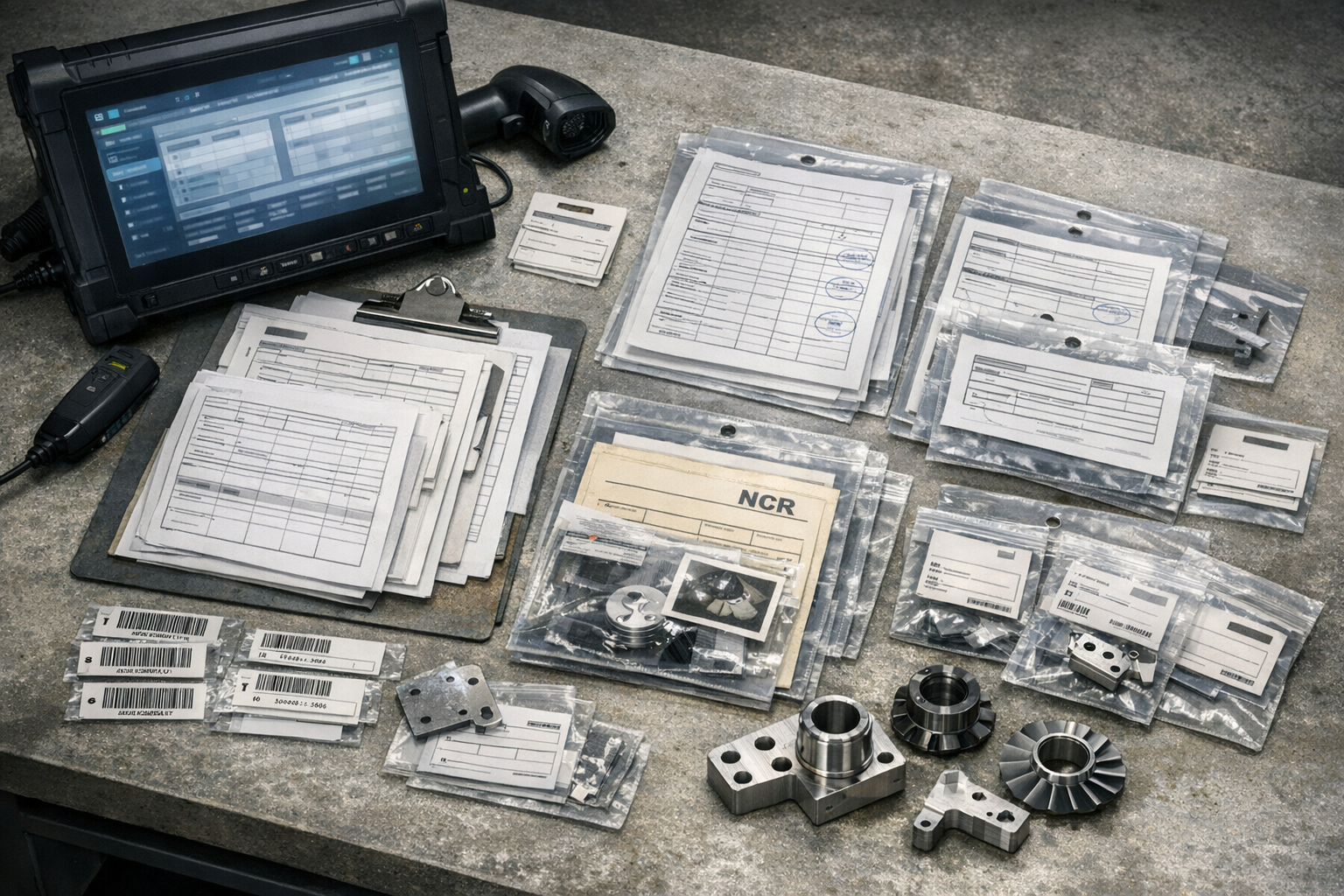
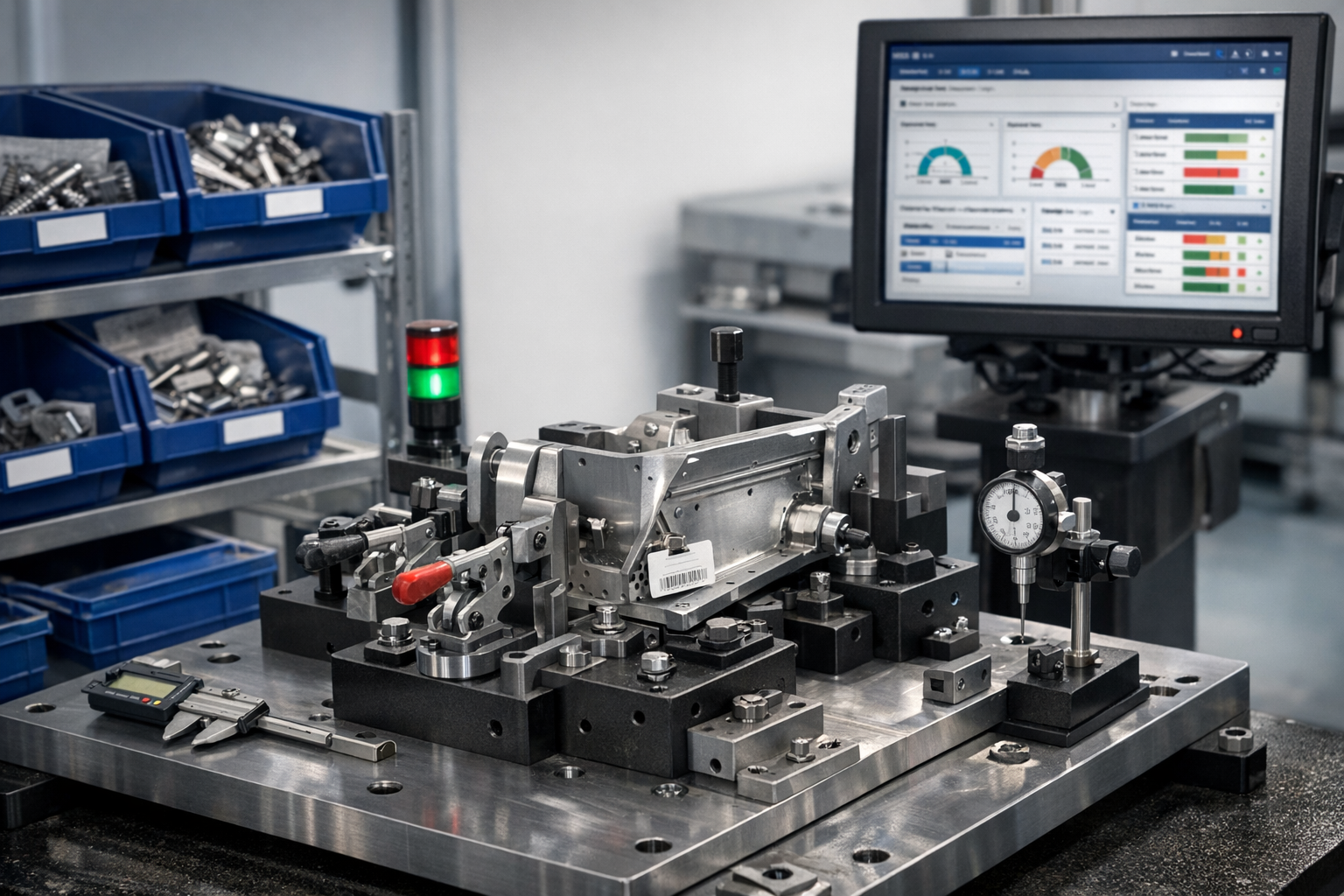
ISO 9000:2015, titled “Quality management systems — Fundamentals and vocabulary,” is the foundational standard in the iso 9000 family. It defines the terms, concepts, and the seven quality management principles that underpin ISO 9001:2015 and related quality management standards across industries.
This article is a reference guide to the quality management principles and standardized terminology found in ISO 9000. It is not an implementation handbook, maturity model, or prescriptive guide. The purpose here is definitional clarity.
Shared definitions matter in cross-functional and multi-site contexts. In aerospace manufacturing and MRO supply chain operations, ambiguity in terminology creates real problems during audits, contract negotiations, and technical documentation reviews. When one team defines “nonconformity” differently than another, or when “corrective action” gets conflated with simple rework, the result is inconsistent records and audit findings that could have been avoided.
Connect981 works with aerospace and MRO organizations that rely on ISO 9000 terminology to coordinate ERP, MES, QMS, and supplier workflows. Precise language directly affects how digital operations function. When a quality management system maps shopfloor events to ISO-aligned terms, audit readiness improves and data consistency across sites becomes achievable.
This article covers:
- The role and history of ISO 9000 in the ISO 9000 family
- The relationship between ISO 9000 and ISO 9001
- The seven quality management principles as conceptual foundations
- Standardized terminology and why it matters
- Examples of commonly misunderstood terms
- ISO 9000 vocabulary in aerospace and MRO contexts
ISO 9000 in the ISO 9000 Family: Role and History
The iso 9000 family is a set of international standards for quality management first released in 1987 by the international organization for standardization. These standards provide frameworks for organizations to establish, implement, and improve a quality management system qms. The family includes multiple documents, each with a distinct purpose: ISO 9000 defines fundamentals and vocabulary, ISO 9001 specifies requirements for certification, and ISO 9004 provides guidance on achieving sustained success.
ISO 9000 itself carries the full title “Quality management systems — Fundamentals and vocabulary.” It is not a certification standard. ISO 9001:2015 is the standard that specifies requirements for a QMS that can be audited and certified by accredited certification bodies.
The revision history of ISO 9000 reflects the evolution of quality management thinking:
Year
Milestone
1987
Original publication of the ISO 9000 family
2000
Major revision introducing process-focused structure
2008
Minor update for clarification
2015
Alignment with Annex SL high-level structure; seven updated QMPs
ISO 9000 provides the conceptual baseline that the iso technical committee ISO/TC 176 uses when developing ISO 9001 and sector-specific derivatives. AS9100D for aerospace, published in 2016, aligns with ISO 9001:2015 and therefore inherits ISO 9000’s terminology and principles. The international automotive task force similarly developed IATF 16949:2016 with ISO 9001 as its core, which means ISO 9000 definitions apply there as well.
ISO 9000 is a normative reference in ISO 9001:2015. This means its definitions and fundamentals are formally invoked by ISO 9001 requirements. When ISO 9001 uses a term like “process,” “documented information,” or “nonconformity,” the precise meaning comes from ISO 9000.

Relationship Between ISO 9000 and ISO 9001
ISO 9000 and ISO 9001 are distinct but interdependent documents within the iso 9000 family. Understanding their relationship is essential for anyone working with quality standards.
ISO 9000 is the source of agreed vocabulary, key concepts, and the statement of the seven quality management principles. It provides the definitional foundation. ISO 9001:2015 is the standard that specifies auditable QMS requirements used by certification bodies worldwide. Over one million organizations held ISO 9001 certificates in the early 2020s, making it the most widely adopted management system standard globally.
The structural relationship works as follows:
Document
Function
ISO 9000:2015
Defines terms, fundamentals, and principles
ISO 9001:2015
Specifies requirements for a certifiable QMS
Sector standards (AS9100, IATF 16949)
Add sector-specific requirements to ISO 9001
ISO 9001 clauses—covering context of the organization, leadership, operation, performance evaluation, and improvement—rely on terms defined precisely in ISO 9000. Terms such as “process,” “monitoring,” “nonconformity,” “correction,” and “corrective action” carry specific meanings that auditors and organizations must interpret consistently.
Sector-specific standards like AS9100D for aerospace and IATF 16949:2016 for automotive adopt ISO 9001 requirements wholesale, then add additional requirements relevant to their industries. Because these sector standards build on ISO 9001, they inherit ISO 9000’s terminology and principles.
The iso certification process for any of these standards depends on shared understanding of ISO 9000 vocabulary. An external audit conducted against ISO 9001 or AS9100 uses ISO 9000 definitions as the interpretive baseline.
ISO 9000 Quality Management Principles (QMPs)
ISO 9000:2015 identifies seven quality management principles that provide the conceptual basis for the iso 9000 family, including ISO 9001. These principles are not listed in priority order; their relative importance varies by organization and context.
The seven quality management principles are:
- Customer focus
- Leadership
- Engagement of people
- Process approach
- Improvement
- Evidence-based decision making
- Relationship management
Each principle is described below in definitional terms, explaining its role in the structure of ISO 9001.
Customer Focus
The customer focus principle recognizes that the primary purpose of a quality management system is to meet customer requirements and strive to exceed customer expectations. Customer satisfaction is the central measure of QMS performance.
In ISO 9001, this principle is reflected in requirements for determining customer needs, enhancing customer satisfaction through conforming products and services, and monitoring customer perception. Clauses addressing customer requirements, customer communication, and post-delivery activities trace directly to this principle.
The term “customer” in ISO 9000 encompasses anyone who receives a product or service, including internal customers within an organization. Customer demand and customer expectations shape how organizations define quality objectives.
Leadership
The leadership principle is concerned with establishing unity of purpose and direction within an organization. Leaders at all levels create conditions in which people can become fully engaged in achieving the organization’s objectives.
ISO 9001 clauses on management responsibility, quality policy, and organizational roles reflect this principle. Leadership is not limited to top management; it includes anyone who establishes direction, provides resources related to quality, and maintains accountability for QMS outcomes.
Engagement of People
This principle recognizes that competent, empowered, and engaged people at all levels throughout the entire organization are essential to enhance an organization’s ability to create and deliver value.
ISO 9001 requirements for competence, awareness, and communication reflect engagement of people. The principle aligns with total quality management concepts that emphasize participation across functions and levels.
Process Approach
The process approach principle states that consistent and predictable results are achieved more effectively and efficiently when activities are understood and managed as interrelated processes that function as a coherent system.
This principle shapes the definitions of “process,” “input,” “output,” and “sequence and interaction of processes” in ISO 9000. ISO 9001’s structure—with requirements for process identification, process inputs and outputs, process criteria and controls, and process monitoring—is built on the process approach.
Manufacturing processes, production processes, and service delivery processes are all understood through this lens. The process approach treats the quality system as an interconnected set of activities rather than isolated functions.
Improvement
The improvement principle recognizes that successful organizations have an ongoing focus on improvement. This encompasses continuous improvement of products, services, and processes, as well as continuous quality improvement in the QMS itself.
ISO 9001 addresses this through requirements for corrective action, continual improvement, and management review. The principle distinguishes between improvement as a permanent organizational objective and specific improvement projects.
ISO 9000 uses “continual improvement” rather than “continuous improvement” to indicate that improvement occurs in recurring cycles rather than as an unbroken stream. Both terms appear in quality literature, but ISO 9000 formalizes “continual.”
Evidence-Based Decision Making
The evidence based decision making principle states that decisions based on the analysis and evaluation of data and information are more likely to produce desired results.
ISO 9001 reflects this in requirements for monitoring, measurement, analysis, and evaluation. Internal audits, performance indicators, and data analysis requirements all stem from this principle. The expectation is that decisions about quality objectives, process changes, and resource allocation are grounded in evidence rather than assumption.
Relationship Management
The relationship management principle recognizes that managing relationships with interested parties—including suppliers, partners, and others in the supply chain—sustains organizational performance.
ISO 9001 requirements for external providers, supplier evaluation, and stakeholder consideration reflect this principle. In complex manufacturing environments, relationship management affects how organizations coordinate with suppliers, share quality data, and address nonconformities that span organizational boundaries.

Standardized ISO 9000 Terminology and Why It Matters
ISO 9000:2015 defines nearly 200 terms related to quality management. These include foundational concepts, QMS-specific vocabulary, and management system terminology aligned with other ISO management system standards.
Consistent use of ISO 9000 terms supports coherent interpretation of ISO 9001 clauses by:
- Organizations implementing a QMS
- Auditors conducting conformity assessment
- Regulators reviewing compliance
- Customers evaluating suppliers
- National standards bodies developing guidance
In complex environments such as aerospace manufacturing, where Connect981 customers coordinate work packages, MRO events, and supplier data across multiple physical locations and jurisdictions, shared vocabulary reduces ambiguity in contracts, quality agreements, audit reports, and digital records.
The practical effect of standardized terminology appears when ERP, MES, and QMS systems exchange data using the same terms. If one system logs a “correction” and another system expects a “corrective action,” the mismatch creates confusion and potential audit findings. Standardized definitions prevent this.
ISO 9000 aligns terminology with other management system standards, including ISO 14001 for environmental management and ISO 45001 for occupational health and safety. This alignment supports integrated management systems and enables organizations to manage quality, environmental, and safety requirements using consistent language.
Key categories of ISO 9000 terms include:
Category
Examples
Quality concepts
Quality, requirement, grade, capability
QMS terms
Quality management system, quality policy, quality objective
Process terms
Process, procedure, input, output, product, service
Conformity terms
Conformity, nonconformity, defect, correction, corrective action
Documentation terms
Documented information, specification, quality manual, record
Audit terms
Audit, audit criteria, audit evidence, audit finding
Commonly Misunderstood ISO 9000 Terms
Several ISO 9000 terms are frequently interpreted differently across organizations and industries. Inconsistent interpretation leads to inconsistent application of ISO 9001 requirements, audit findings, and contractual disputes.
Quality
ISO 9000 defines “quality” as the degree to which a set of inherent characteristics of an object fulfills requirements. This definition differs from colloquial usage, where “quality” often implies premium grade or superior performance.
A product with basic specifications that fully meets its stated requirements has quality according to ISO 9000. A premium product that fails to meet requirements does not. Quality managers often encounter confusion when stakeholders equate “quality” with “high-end” rather than “conforming to requirements.”
Requirement
A “requirement” in ISO 9000 is a need or expectation that is stated, generally implied, or obligatory. Requirements include customer requirements, statutory and regulatory requirements, and organization-determined requirements.
The misunderstanding arises when organizations treat only written specifications as requirements. ISO 9000 recognizes that requirements can be implied by custom or practice, even when not explicitly documented.
Nonconformity
A “nonconformity” is the non-fulfillment of a requirement. This term is distinct from “defect,” which ISO 9000 defines as non-fulfillment of a requirement related to an intended or specified use.
In practice, organizations sometimes use these terms interchangeably, which creates problems during audits and when categorizing quality records. Not every nonconformity is a defect, and the distinction affects how issues are logged and addressed.
Correction vs. Corrective Action
This distinction causes significant confusion in aerospace and MRO operations.
A “correction” is an action to eliminate a detected nonconformity. Reworking a turbine blade to bring it into specification is a correction.
A “corrective action” is an action to eliminate the cause of a nonconformity and to prevent recurrence. Modifying a fixture or revising a work instruction to prevent the same error from happening again is a corrective action.
Mislabeling a one-off rework as a “corrective action” when ISO 9000 would classify it as a “correction” creates inaccurate quality records and may obscure systemic issues that require root cause analysis.
Preventive Action
ISO 9001:2015 removed explicit requirements for “preventive action” as a separate concept, folding it into risk-based thinking. However, ISO 9000 still defines “preventive action” as action to eliminate the cause of a potential nonconformity or other potential undesirable situation.
Some organizations still reference preventive action in their documented procedures, which can create confusion during audits against current ISO 9001 requirements.
Monitoring vs. Measurement
“Monitoring” is determining the status of a system, a process, a product, a service, or an activity. “Measurement” is the process of determining a value.
Monitoring does not necessarily involve measurement. Visual inspection to confirm that a process step occurred is monitoring. Recording a dimensional value is measurement. The distinction affects how organizations document control activities.
Documented Information
ISO 9000:2015 introduced “documented information” to replace the older terms “documents” and “records.” Documented information encompasses both documents (information and the medium on which it is contained) and records (documents stating results achieved or providing evidence of activities performed).
Organizations transitioning from earlier ISO 9001 versions sometimes struggle with this terminology shift, particularly when updating document control and record-keeping procedures to align with current standards. Quality manuals, while no longer explicitly required by ISO 9001:2015, remain common as documented information.
Traceability
“Traceability” is the ability to trace the history, application, or location of an object. In aerospace contexts, traceability requirements extend to materials, components, and production processes.
Some organizations interpret traceability as simply maintaining records. ISO 9000’s definition emphasizes the ability to trace—meaning the records must be organized and accessible in a way that enables reconstruction of an object’s history when needed.
ISO 9000 as a Foundational Document for Modern QMS
ISO 9000 functions as the foundational reference for all iso 9000 family QMS standards and many sector-specific documents. Since the 2015 revisions aligned ISO 9000 with the Annex SL high-level structure used across ISO management system standards, its role as a common vocabulary has become even more significant.
Technical committees—including ISO/TC 176 for quality management, aerospace standards committees, and industry-specific groups—use ISO 9000’s fundamentals and vocabulary when drafting consistent, interoperable requirements. This consistency enables organizations to integrate multiple management systems without conflicting terminology.
The structured definitions in ISO 9000 support digitalization of quality data. Platforms like Connect981 map shopfloor events, nonconformities, and traceability records to ISO-aligned terms for audit-ready reporting. When the terminology in digital systems matches ISO 9000 definitions, gap analysis during audits becomes straightforward.
ISO 9000’s principle-based vocabulary enables organizations, certification bodies, and regulators to discuss QMS performance using a common, globally recognized language. Whether the conversation involves a supplier in one country and a customer in another, or an internal team and an external audit body, ISO 9000 provides the reference point.
Future revisions of ISO 9000 are expected to preserve its role as a core reference while refining terminology to reflect evolving concepts like risk management and data-driven decision making. The standard’s function as a living vocabulary ensures it remains relevant as quality management practices develop.
Understanding ISO 9000 is primarily about understanding the language and principles that frame how ISO 9001 and related standards are interpreted. Without this foundation, consistent quality across an organization’s operations and supply chain becomes difficult to achieve.

ISO 9000 Vocabulary in Aerospace and MRO Contexts
Aerospace manufacturing and MRO operations rely heavily on ISO 9000 vocabulary to maintain clear communication across OEMs, Tier 1–3 suppliers, and maintenance organizations. The complexity of aerospace supply chains, combined with stringent regulatory requirements from FAA, EASA, and other bodies, makes precise terminology essential.
Terms from ISO 9000 take on specific interpretations in aerospace standards like AS9100D:
ISO 9000 Term
Aerospace Application
Traceability
Serial number management, batch tracking, material certifications
Configuration management
Revision control of engineering data and as-built records
Release of product and service
First article inspection, airworthiness certification
External provider
Qualified supplier list, supplier quality agreements
Nonconformity
Material review board dispositions, deviation requests
These terms appear in digital work instructions, inspection points, and defect logging across real-world environments. In airframe assembly or engine overhaul facilities, the distinction between ISO 9000 terms affects how quality events are categorized, reported, and resolved.
Connect981 uses standardized ISO 9000 definitions when structuring quality checks, nonconformity categories, and audit trails across multiple plants and MRO facilities. When a shopfloor system classifies a discrepancy using the same terminology that appears in AS9100 audit checklists, the path from event detection to audit response becomes direct.
The alignment of digital systems with ISO 9000 vocabulary also affects how organizations document quality data for customers and regulators. Build packages, routing sheets, and inspection records that use ISO-standard terminology integrate more easily with customer quality systems and reduce rework during contract review.
Shared definitions influence operational efficiency in specific ways:
- Work order systems that distinguish “correction” from “corrective action” enable accurate root cause tracking
- Traceability records structured around ISO 9000 definitions support faster response to customer demand for documentation
- Nonconformity logs aligned with ISO terminology simplify reporting to certification bodies
The result is improved customer satisfaction through consistent quality documentation and reduced friction during conformity assessment.
Summary: ISO 9000 as a Language for Quality Management
ISO 9000:2015 defines the fundamentals, vocabulary, and quality management principles that underpin ISO 9001 and related international standards. Its primary contribution is a shared language—defining key terms, clarifying the seven quality management principles, and aligning concepts across sectors and geographies.
The distinction between commonly confused terms like “correction” and “corrective action” matters in practice. When organizations, auditors, and technology providers use these terms consistently, clarity in audits, contracts, and digital records follows.
The relationship between ISO 9000 and ISO 9001 is foundational:
- ISO 9000 supplies the definitions and principles
- ISO 9001 transforms them into specific requirements
- Sector standards like AS9100 add industry-specific requirements while inheriting ISO 9000’s vocabulary
For aerospace manufacturing and MRO operations, where compliance with statutory and regulatory requirements intersects with complex supply chain coordination, ISO 9000’s standardized terminology enables an effective quality management system that spans organizational boundaries.
Organizations that achieve certification to ISO 9001 or AS9100 do so using the vocabulary ISO 9000 defines. Platforms that support quality operations—including Connect981—structure data and workflows around these same terms. The key benefits of grounding quality discussions, documentation, and data models in ISO 9000 terminology include reduced ambiguity, improved operational efficiency, and business opportunities enabled by consistent quality across the enterprise.
When quality managers, engineers, and operations leaders share a common vocabulary, product quality and process performance become measurable against agreed definitions rather than competing interpretations.