Blog

  • ISO 9000 Quality Management Principles: Fundamentals and Vocabulary Reference

    ISO 9000 Quality Management Principles: Fundamentals and Vocabulary Reference

    ISO 9000:2015, titled “Quality management systems — Fundamentals and vocabulary,” is the foundational standard in the iso 9000 family. It defines the terms, concepts, and the seven quality management principles that underpin ISO 9001:2015 and related quality management standards across industries.

    This article is a reference guide to the quality management principles and standardized terminology found in ISO 9000. It is not an implementation handbook, maturity model, or prescriptive guide. The purpose here is definitional clarity.

    Shared definitions matter in cross-functional and multi-site contexts. In aerospace manufacturing and MRO supply chain operations, ambiguity in terminology creates real problems during audits, contract negotiations, and technical documentation reviews. When one team defines “nonconformity” differently than another, or when “corrective action” gets conflated with simple rework, the result is inconsistent records and audit findings that could have been avoided.

    Connect981 works with aerospace and MRO organizations that rely on ISO 9000 terminology to coordinate ERP, MES, QMS, and supplier workflows. Precise language directly affects how digital operations function. When a quality management system maps shopfloor events to ISO-aligned terms, audit readiness improves and data consistency across sites becomes achievable.

    This article covers:

    • The role and history of ISO 9000 in the ISO 9000 family
    • The relationship between ISO 9000 and ISO 9001
    • The seven quality management principles as conceptual foundations
    • Standardized terminology and why it matters
    • Examples of commonly misunderstood terms
    • ISO 9000 vocabulary in aerospace and MRO contexts

    ISO 9000 in the ISO 9000 Family: Role and History

    The iso 9000 family is a set of international standards for quality management first released in 1987 by the international organization for standardization. These standards provide frameworks for organizations to establish, implement, and improve a quality management system qms. The family includes multiple documents, each with a distinct purpose: ISO 9000 defines fundamentals and vocabulary, ISO 9001 specifies requirements for certification, and ISO 9004 provides guidance on achieving sustained success.

    ISO 9000 itself carries the full title “Quality management systems — Fundamentals and vocabulary.” It is not a certification standard. ISO 9001:2015 is the standard that specifies requirements for a QMS that can be audited and certified by accredited certification bodies.

    The revision history of ISO 9000 reflects the evolution of quality management thinking:

    Year

    Milestone

    1987

    Original publication of the ISO 9000 family

    2000

    Major revision introducing process-focused structure

    2008

    Minor update for clarification

    2015

    Alignment with Annex SL high-level structure; seven updated QMPs

    ISO 9000 provides the conceptual baseline that the iso technical committee ISO/TC 176 uses when developing ISO 9001 and sector-specific derivatives. AS9100D for aerospace, published in 2016, aligns with ISO 9001:2015 and therefore inherits ISO 9000’s terminology and principles. The international automotive task force similarly developed IATF 16949:2016 with ISO 9001 as its core, which means ISO 9000 definitions apply there as well.

    ISO 9000 is a normative reference in ISO 9001:2015. This means its definitions and fundamentals are formally invoked by ISO 9001 requirements. When ISO 9001 uses a term like “process,” “documented information,” or “nonconformity,” the precise meaning comes from ISO 9000.

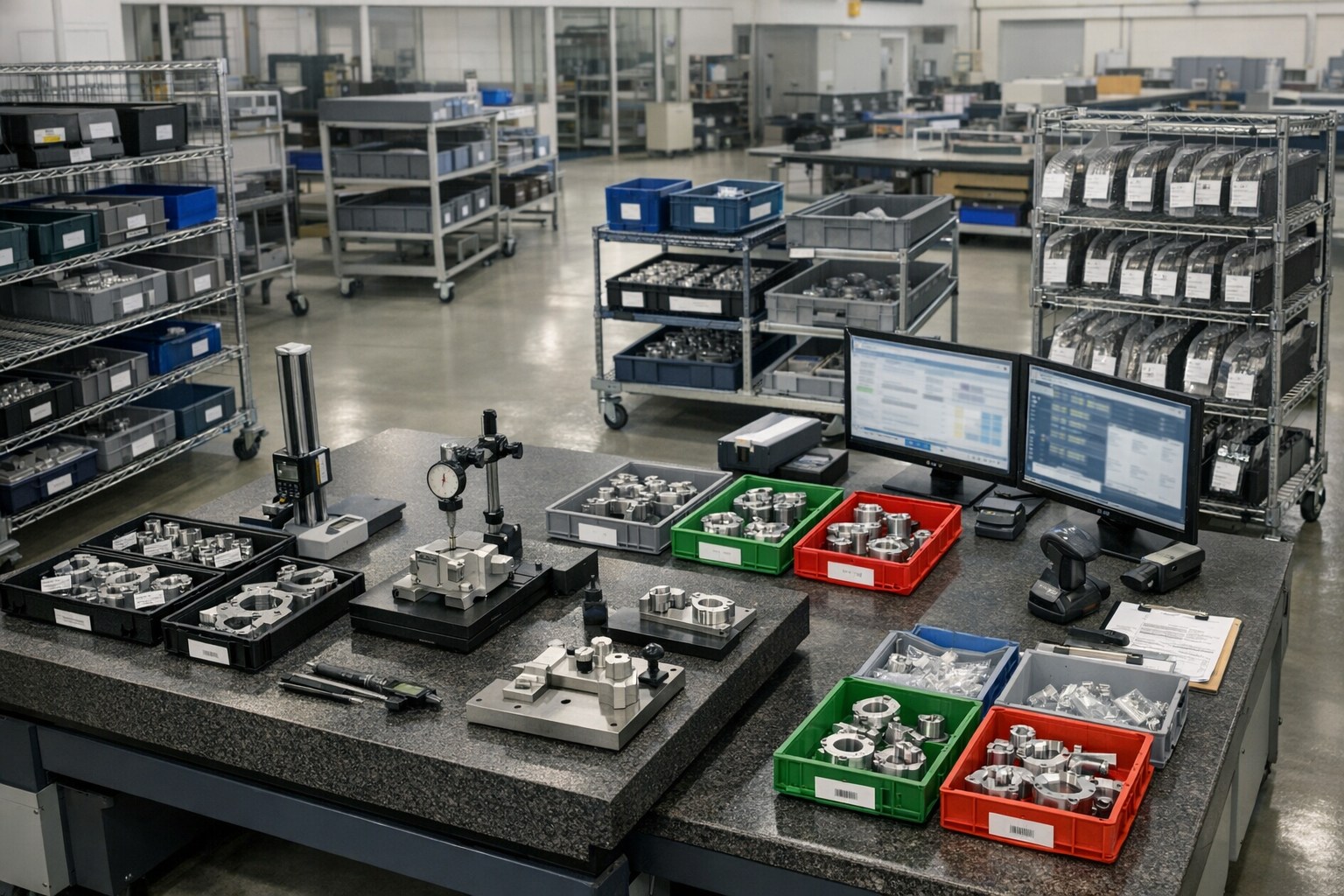
    A technician is performing a quality control inspection on various components in a manufacturing setting, ensuring they meet the quality management standards outlined by ISO 9000. This process is essential for achieving customer satisfaction and maintaining consistent product quality through effective quality management systems.

    Relationship Between ISO 9000 and ISO 9001

    ISO 9000 and ISO 9001 are distinct but interdependent documents within the iso 9000 family. Understanding their relationship is essential for anyone working with quality standards.

    ISO 9000 is the source of agreed vocabulary, key concepts, and the statement of the seven quality management principles. It provides the definitional foundation. ISO 9001:2015 is the standard that specifies auditable QMS requirements used by certification bodies worldwide. Over one million organizations held ISO 9001 certificates in the early 2020s, making it the most widely adopted management system standard globally.

    The structural relationship works as follows:

    Document

    Function

    ISO 9000:2015

    Defines terms, fundamentals, and principles

    ISO 9001:2015

    Specifies requirements for a certifiable QMS

    Sector standards (AS9100, IATF 16949)

    Add sector-specific requirements to ISO 9001

    ISO 9001 clauses—covering context of the organization, leadership, operation, performance evaluation, and improvement—rely on terms defined precisely in ISO 9000. Terms such as “process,” “monitoring,” “nonconformity,” “correction,” and “corrective action” carry specific meanings that auditors and organizations must interpret consistently.

    Sector-specific standards like AS9100D for aerospace and IATF 16949:2016 for automotive adopt ISO 9001 requirements wholesale, then add additional requirements relevant to their industries. Because these sector standards build on ISO 9001, they inherit ISO 9000’s terminology and principles.

    The iso certification process for any of these standards depends on shared understanding of ISO 9000 vocabulary. An external audit conducted against ISO 9001 or AS9100 uses ISO 9000 definitions as the interpretive baseline.

    ISO 9000 Quality Management Principles (QMPs)

    ISO 9000:2015 identifies seven quality management principles that provide the conceptual basis for the iso 9000 family, including ISO 9001. These principles are not listed in priority order; their relative importance varies by organization and context.

    The seven quality management principles are:

    1. Customer focus
    2. Leadership
    3. Engagement of people
    4. Process approach
    5. Improvement
    6. Evidence-based decision making
    7. Relationship management

    Each principle is described below in definitional terms, explaining its role in the structure of ISO 9001.

    Customer Focus

    The customer focus principle recognizes that the primary purpose of a quality management system is to meet customer requirements and strive to exceed customer expectations. Customer satisfaction is the central measure of QMS performance.

    In ISO 9001, this principle is reflected in requirements for determining customer needs, enhancing customer satisfaction through conforming products and services, and monitoring customer perception. Clauses addressing customer requirements, customer communication, and post-delivery activities trace directly to this principle.

    The term “customer” in ISO 9000 encompasses anyone who receives a product or service, including internal customers within an organization. Customer demand and customer expectations shape how organizations define quality objectives.

    Leadership

    The leadership principle is concerned with establishing unity of purpose and direction within an organization. Leaders at all levels create conditions in which people can become fully engaged in achieving the organization’s objectives.

    ISO 9001 clauses on management responsibility, quality policy, and organizational roles reflect this principle. Leadership is not limited to top management; it includes anyone who establishes direction, provides resources related to quality, and maintains accountability for QMS outcomes.

    Engagement of People

    This principle recognizes that competent, empowered, and engaged people at all levels throughout the entire organization are essential to enhance an organization’s ability to create and deliver value.

    ISO 9001 requirements for competence, awareness, and communication reflect engagement of people. The principle aligns with total quality management concepts that emphasize participation across functions and levels.

    Process Approach

    The process approach principle states that consistent and predictable results are achieved more effectively and efficiently when activities are understood and managed as interrelated processes that function as a coherent system.

    This principle shapes the definitions of “process,” “input,” “output,” and “sequence and interaction of processes” in ISO 9000. ISO 9001’s structure—with requirements for process identification, process inputs and outputs, process criteria and controls, and process monitoring—is built on the process approach.

    Manufacturing processes, production processes, and service delivery processes are all understood through this lens. The process approach treats the quality system as an interconnected set of activities rather than isolated functions.

    Improvement

    The improvement principle recognizes that successful organizations have an ongoing focus on improvement. This encompasses continuous improvement of products, services, and processes, as well as continuous quality improvement in the QMS itself.

    ISO 9001 addresses this through requirements for corrective action, continual improvement, and management review. The principle distinguishes between improvement as a permanent organizational objective and specific improvement projects.

    ISO 9000 uses “continual improvement” rather than “continuous improvement” to indicate that improvement occurs in recurring cycles rather than as an unbroken stream. Both terms appear in quality literature, but ISO 9000 formalizes “continual.”

    Evidence-Based Decision Making

    The evidence based decision making principle states that decisions based on the analysis and evaluation of data and information are more likely to produce desired results.

    ISO 9001 reflects this in requirements for monitoring, measurement, analysis, and evaluation. Internal audits, performance indicators, and data analysis requirements all stem from this principle. The expectation is that decisions about quality objectives, process changes, and resource allocation are grounded in evidence rather than assumption.

    Relationship Management

    The relationship management principle recognizes that managing relationships with interested parties—including suppliers, partners, and others in the supply chain—sustains organizational performance.

    ISO 9001 requirements for external providers, supplier evaluation, and stakeholder consideration reflect this principle. In complex manufacturing environments, relationship management affects how organizations coordinate with suppliers, share quality data, and address nonconformities that span organizational boundaries.

    A diverse aerospace manufacturing team is gathered around a table, collaboratively reviewing engineering documentation to ensure compliance with quality management standards and enhance customer satisfaction. Their focus on effective quality management principles reflects a commitment to continuous improvement and meeting customer expectations in their production processes.

    Standardized ISO 9000 Terminology and Why It Matters

    ISO 9000:2015 defines nearly 200 terms related to quality management. These include foundational concepts, QMS-specific vocabulary, and management system terminology aligned with other ISO management system standards.

    Consistent use of ISO 9000 terms supports coherent interpretation of ISO 9001 clauses by:

    • Organizations implementing a QMS
    • Auditors conducting conformity assessment
    • Regulators reviewing compliance
    • Customers evaluating suppliers
    • National standards bodies developing guidance

    In complex environments such as aerospace manufacturing, where Connect981 customers coordinate work packages, MRO events, and supplier data across multiple physical locations and jurisdictions, shared vocabulary reduces ambiguity in contracts, quality agreements, audit reports, and digital records.

    The practical effect of standardized terminology appears when ERP, MES, and QMS systems exchange data using the same terms. If one system logs a “correction” and another system expects a “corrective action,” the mismatch creates confusion and potential audit findings. Standardized definitions prevent this.

    ISO 9000 aligns terminology with other management system standards, including ISO 14001 for environmental management and ISO 45001 for occupational health and safety. This alignment supports integrated management systems and enables organizations to manage quality, environmental, and safety requirements using consistent language.

    Key categories of ISO 9000 terms include:

    Category

    Examples

    Quality concepts

    Quality, requirement, grade, capability

    QMS terms

    Quality management system, quality policy, quality objective

    Process terms

    Process, procedure, input, output, product, service

    Conformity terms

    Conformity, nonconformity, defect, correction, corrective action

    Documentation terms

    Documented information, specification, quality manual, record

    Audit terms

    Audit, audit criteria, audit evidence, audit finding

    Commonly Misunderstood ISO 9000 Terms

    Several ISO 9000 terms are frequently interpreted differently across organizations and industries. Inconsistent interpretation leads to inconsistent application of ISO 9001 requirements, audit findings, and contractual disputes.

    Quality

    ISO 9000 defines “quality” as the degree to which a set of inherent characteristics of an object fulfills requirements. This definition differs from colloquial usage, where “quality” often implies premium grade or superior performance.

    A product with basic specifications that fully meets its stated requirements has quality according to ISO 9000. A premium product that fails to meet requirements does not. Quality managers often encounter confusion when stakeholders equate “quality” with “high-end” rather than “conforming to requirements.”

    Requirement

    A “requirement” in ISO 9000 is a need or expectation that is stated, generally implied, or obligatory. Requirements include customer requirements, statutory and regulatory requirements, and organization-determined requirements.

    The misunderstanding arises when organizations treat only written specifications as requirements. ISO 9000 recognizes that requirements can be implied by custom or practice, even when not explicitly documented.

    Nonconformity

    A “nonconformity” is the non-fulfillment of a requirement. This term is distinct from “defect,” which ISO 9000 defines as non-fulfillment of a requirement related to an intended or specified use.

    In practice, organizations sometimes use these terms interchangeably, which creates problems during audits and when categorizing quality records. Not every nonconformity is a defect, and the distinction affects how issues are logged and addressed.

    Correction vs. Corrective Action

    This distinction causes significant confusion in aerospace and MRO operations.

    A “correction” is an action to eliminate a detected nonconformity. Reworking a turbine blade to bring it into specification is a correction.

    A “corrective action” is an action to eliminate the cause of a nonconformity and to prevent recurrence. Modifying a fixture or revising a work instruction to prevent the same error from happening again is a corrective action.

    Mislabeling a one-off rework as a “corrective action” when ISO 9000 would classify it as a “correction” creates inaccurate quality records and may obscure systemic issues that require root cause analysis.

    Preventive Action

    ISO 9001:2015 removed explicit requirements for “preventive action” as a separate concept, folding it into risk-based thinking. However, ISO 9000 still defines “preventive action” as action to eliminate the cause of a potential nonconformity or other potential undesirable situation.

    Some organizations still reference preventive action in their documented procedures, which can create confusion during audits against current ISO 9001 requirements.

    Monitoring vs. Measurement

    “Monitoring” is determining the status of a system, a process, a product, a service, or an activity. “Measurement” is the process of determining a value.

    Monitoring does not necessarily involve measurement. Visual inspection to confirm that a process step occurred is monitoring. Recording a dimensional value is measurement. The distinction affects how organizations document control activities.

    Documented Information

    ISO 9000:2015 introduced “documented information” to replace the older terms “documents” and “records.” Documented information encompasses both documents (information and the medium on which it is contained) and records (documents stating results achieved or providing evidence of activities performed).

    Organizations transitioning from earlier ISO 9001 versions sometimes struggle with this terminology shift, particularly when updating document control and record-keeping procedures to align with current standards. Quality manuals, while no longer explicitly required by ISO 9001:2015, remain common as documented information.

    Traceability

    “Traceability” is the ability to trace the history, application, or location of an object. In aerospace contexts, traceability requirements extend to materials, components, and production processes.

    Some organizations interpret traceability as simply maintaining records. ISO 9000’s definition emphasizes the ability to trace—meaning the records must be organized and accessible in a way that enables reconstruction of an object’s history when needed.

    ISO 9000 as a Foundational Document for Modern QMS

    ISO 9000 functions as the foundational reference for all iso 9000 family QMS standards and many sector-specific documents. Since the 2015 revisions aligned ISO 9000 with the Annex SL high-level structure used across ISO management system standards, its role as a common vocabulary has become even more significant.

    Technical committees—including ISO/TC 176 for quality management, aerospace standards committees, and industry-specific groups—use ISO 9000’s fundamentals and vocabulary when drafting consistent, interoperable requirements. This consistency enables organizations to integrate multiple management systems without conflicting terminology.

    The structured definitions in ISO 9000 support digitalization of quality data. Platforms like Connect981 map shopfloor events, nonconformities, and traceability records to ISO-aligned terms for audit-ready reporting. When the terminology in digital systems matches ISO 9000 definitions, gap analysis during audits becomes straightforward.

    ISO 9000’s principle-based vocabulary enables organizations, certification bodies, and regulators to discuss QMS performance using a common, globally recognized language. Whether the conversation involves a supplier in one country and a customer in another, or an internal team and an external audit body, ISO 9000 provides the reference point.

    Future revisions of ISO 9000 are expected to preserve its role as a core reference while refining terminology to reflect evolving concepts like risk management and data-driven decision making. The standard’s function as a living vocabulary ensures it remains relevant as quality management practices develop.

    Understanding ISO 9000 is primarily about understanding the language and principles that frame how ISO 9001 and related standards are interpreted. Without this foundation, consistent quality across an organization’s operations and supply chain becomes difficult to achieve.

    The image depicts an aircraft maintenance hangar where technicians are diligently working on a commercial airplane, ensuring adherence to quality management principles and standards. This environment emphasizes customer satisfaction and operational efficiency, reflecting the organization's commitment to continuous improvement and regulatory requirements within the aviation industry.

    ISO 9000 Vocabulary in Aerospace and MRO Contexts

    Aerospace manufacturing and MRO operations rely heavily on ISO 9000 vocabulary to maintain clear communication across OEMs, Tier 1–3 suppliers, and maintenance organizations. The complexity of aerospace supply chains, combined with stringent regulatory requirements from FAA, EASA, and other bodies, makes precise terminology essential.

    Terms from ISO 9000 take on specific interpretations in aerospace standards like AS9100D:

    ISO 9000 Term

    Aerospace Application

    Traceability

    Serial number management, batch tracking, material certifications

    Configuration management

    Revision control of engineering data and as-built records

    Release of product and service

    First article inspection, airworthiness certification

    External provider

    Qualified supplier list, supplier quality agreements

    Nonconformity

    Material review board dispositions, deviation requests

    These terms appear in digital work instructions, inspection points, and defect logging across real-world environments. In airframe assembly or engine overhaul facilities, the distinction between ISO 9000 terms affects how quality events are categorized, reported, and resolved.

    Connect981 uses standardized ISO 9000 definitions when structuring quality checks, nonconformity categories, and audit trails across multiple plants and MRO facilities. When a shopfloor system classifies a discrepancy using the same terminology that appears in AS9100 audit checklists, the path from event detection to audit response becomes direct.

    The alignment of digital systems with ISO 9000 vocabulary also affects how organizations document quality data for customers and regulators. Build packages, routing sheets, and inspection records that use ISO-standard terminology integrate more easily with customer quality systems and reduce rework during contract review.

    Shared definitions influence operational efficiency in specific ways:

    • Work order systems that distinguish “correction” from “corrective action” enable accurate root cause tracking
    • Traceability records structured around ISO 9000 definitions support faster response to customer demand for documentation
    • Nonconformity logs aligned with ISO terminology simplify reporting to certification bodies

    The result is improved customer satisfaction through consistent quality documentation and reduced friction during conformity assessment.

    Summary: ISO 9000 as a Language for Quality Management

    ISO 9000:2015 defines the fundamentals, vocabulary, and quality management principles that underpin ISO 9001 and related international standards. Its primary contribution is a shared language—defining key terms, clarifying the seven quality management principles, and aligning concepts across sectors and geographies.

    The distinction between commonly confused terms like “correction” and “corrective action” matters in practice. When organizations, auditors, and technology providers use these terms consistently, clarity in audits, contracts, and digital records follows.

    The relationship between ISO 9000 and ISO 9001 is foundational:

    • ISO 9000 supplies the definitions and principles
    • ISO 9001 transforms them into specific requirements
    • Sector standards like AS9100 add industry-specific requirements while inheriting ISO 9000’s vocabulary

    For aerospace manufacturing and MRO operations, where compliance with statutory and regulatory requirements intersects with complex supply chain coordination, ISO 9000’s standardized terminology enables an effective quality management system that spans organizational boundaries.

    Organizations that achieve certification to ISO 9001 or AS9100 do so using the vocabulary ISO 9000 defines. Platforms that support quality operations—including Connect981—structure data and workflows around these same terms. The key benefits of grounding quality discussions, documentation, and data models in ISO 9000 terminology include reduced ambiguity, improved operational efficiency, and business opportunities enabled by consistent quality across the enterprise.

    When quality managers, engineers, and operations leaders share a common vocabulary, product quality and process performance become measurable against agreed definitions rather than competing interpretations.

  • ISO 22400 Explained: A Practical Guide to Standardized Manufacturing KPIs

    ISO 22400 Explained: A Practical Guide to Standardized Manufacturing KPIs

    Answer first: ISO 22400 is an international standard that defines how manufacturing key performance indicators (KPIs) are described, structured, and named so that plants, suppliers, and systems can talk about performance in the same language. It does not tell you which KPIs to use, what targets to set, or how to run improvement programs. Its job is to define what the metrics mean, not how you manage with them.

    This overview explains the basics of ISO 22400 in plain language for operations, IT, and quality leaders. By the end, you should understand why the standard exists, what it covers (and doesn’t), and how its KPI concepts differ from homegrown definitions you may use today. If you later decide to build a standardized ISO 22400 KPI framework, you will know what role the standard can realistically play.

    Why ISO 22400 Exists in Modern Manufacturing

    The problem of inconsistent KPI definitions across plants

    Many manufacturers grow through acquisitions, greenfield sites, and long supplier networks. Over time, each plant develops its own metrics and naming conventions. Common situations include:

    • One site tracks “availability” while another tracks “uptime,” but they include different kinds of downtime.
    • OEE is calculated differently between plants, making comparisons misleading.
    • Corporate dashboards aggregate numbers that were never defined in the same way.

    The result is confusion. Leaders spend time debating what the numbers mean instead of discussing how to improve them. ISO 22400 exists to reduce this definitional noise.

    How global supply chains and heterogeneous systems increase confusion

    Modern operations rely on a mix of systems: ERP for planning, MES for execution, SCADA and PLCs for control, historians for time-series data, and various reporting tools. Each system may:

    • Use its own KPI names and abbreviations
    • Define equipment states in different ways
    • Aggregate time and quantity data according to its own rules

    When you connect multiple sites and suppliers, these inconsistencies multiply. A KPI that looks identical on a dashboard may be based on very different underlying logic. ISO 22400 addresses this by defining a shared conceptual framework for KPIs used in manufacturing operations management.

    Standards as a common language for performance data

    ISO 22400 belongs to the family of automation and integration standards. Its purpose is to provide a common language for performance data so that:

    • Plants can compare performance on consistent terms
    • Suppliers and customers can refer to the same KPI definitions in contracts and reports
    • Software vendors can design interfaces that exchange KPI information without custom translations for every project

    This language is intentionally industry neutral, so discrete, batch, and continuous operations can all use the same conceptual building blocks.

    What ISO 22400 Covers—and What It Does Not

    Conceptual KPI definitions and terminology

    ISO 22400 focuses on the conceptual side of performance measurement. It defines:

    • Core terms such as performance indicator, key performance indicator (KPI), work unit, production order, and equipment state
    • Attributes that describe KPIs, for example:
      • What object is being measured (equipment, order, plant, etc.)
      • Which time behavior applies (real time, shift, order lifecycle)
      • Which units of measure and trend directions make sense
    • Families of KPIs for production, maintenance, quality, logistics, and energy-related operations

    The standard separates indicators into a broader set of performance indicators and a more selective set of key performance indicators. The key indicators are those considered particularly relevant for monitoring manufacturing operations.

    Relationship to enterprise-control integration standards (IEC 62264)

    ISO 22400 is closely aligned with IEC 62264, the reference standard for enterprise-control system integration. IEC 62264 defines hierarchical levels such as:

    • Level 4 – Business planning and logistics (ERP layer)
    • Level 3 – Manufacturing operations management (MOM)
    • Levels 0–2 – Basic control and equipment

    ISO 22400 positions its KPIs mainly at Level 3, the manufacturing operations layer. This is where production, quality, inventory, and maintenance are executed and monitored. Metrics that combine detailed operational data with financial results at Level 4 typically fall outside the scope of ISO 22400.

    Boundaries: no targets, formulas, or improvement methods

    Understanding what ISO 22400 does not do is as important as understanding what it covers. The standard deliberately avoids:

    • Prescribing KPI formulas: It may describe the time and quantity elements involved in a KPI, but it does not dictate a single calculation method.
    • Setting targets or thresholds: No “good” or “bad” values are defined. Targets depend on your industry, equipment, and strategy.
    • Describing improvement techniques: Lean, TPM, Six Sigma, and other methods are outside its remit.

    If you adopt ISO 22400, you still decide which KPIs to track, what levels to report them at, and how to use them in decision-making. The standard provides vocabulary and structure, not a performance playbook.

    Key Concepts in ISO 22400

    Performance indicators vs. key performance indicators

    ISO 22400 separates the universe of possible measures into:

    • Performance indicators: Any quantified measure that describes how a resource, process, or system behaves. Example: total time a machine spent in RUN state during a shift.
    • Key performance indicators (KPIs): A selected subset of indicators that are considered especially important for managing manufacturing operations. Example: equipment utilization for a bottleneck work center.

    The standard provides a structured description for KPIs, including their intended users (operator, supervisor, manager), applicable time horizons, and typical use cases. This helps organizations distinguish between raw data, general metrics, and the smaller group of measures that truly drive decisions.

    Manufacturing operations management (MOM) and Level 3 focus

    In the ISO 22400 context, Manufacturing Operations Management (MOM) refers to the activities that plan, dispatch, execute, track, and report manufacturing and maintenance operations. MOM sits between enterprise planning systems and the shop-floor control layer.

    ISO 22400 focuses on KPIs relevant to this MOM layer, such as:

    • Production order execution and adherence to plan
    • Equipment availability and utilization
    • Quality-related outcomes linked to production
    • Maintenance-related states and their impact on production

    By concentrating on Level 3, the standard builds a bridge between high-level business goals and detailed control-system data.

    Objects of measurement: equipment, orders, plants, and more

    Another core concept in ISO 22400 is the object of measurement. KPIs are always tied to something being measured, for example:

    • Equipment and work units: Individual machines, workstations, or cells
    • Lines and areas: Production lines, work centers, or plant areas
    • Production orders and lots: Specific orders, batches, or serial ranges
    • Entire sites: Plant-level aggregates

    The same conceptual KPI—such as equipment utilization—can be applied at different levels. ISO 22400 clarifies how these KPIs relate to time, quantity, and state concepts so that aggregation across levels is meaningful.

    How ISO 22400 Helps Multi-Site and Multi-Supplier Operations

    Comparability across plants and suppliers

    For organizations operating multiple plants or collaborating with external manufacturers, comparability is a key challenge. Without standard definitions, numbers for “availability,” “throughput,” or “scrap rate” may not be genuinely comparable.

    By adopting ISO 22400 definitions:

    • Corporate dashboards can present KPIs that are consistent across locations.
    • Benchmarking between plants becomes more robust.
    • Supplier scorecards can reference the same KPI terms with clear, shared meanings.

    Instead of spending time reconciling definitions, teams can focus on understanding performance differences and root causes.

    Interoperability across ERP, MES, SCADA, and reporting tools

    Most manufacturers do not have a single monolithic system. Instead, they integrate ERP, MES, SCADA, historians, and specialized reporting tools. ISO 22400 supports this heterogeneous reality by providing:

    • Standard terminology for equipment states and time categories
    • Consistent KPI names and attributes
    • A conceptual structure that data models can reference

    When multiple systems use ISO 22400-aligned definitions, data exchange and aggregation become easier. Interfaces can be designed around shared KPI concepts rather than custom mappings for each integration.

    Using standardized KPI definitions in contracts and SLAs

    Another practical benefit appears in commercial relationships. When performance reporting is part of a contract or service-level agreement (SLA), unclear metric definitions can lead to disputes.

    By referencing ISO 22400 concepts in contracts—for example, defining “equipment utilization” or “order execution reliability” according to the standard—both parties can verify they are using the same language. This reduces ambiguity and supports more transparent, data-driven collaboration.

    Deciding Whether ISO 22400 Is Right for Your Organization

    Typical adopters: discrete, batch, and process industries

    ISO 22400 is intentionally industry neutral and can be applied in:

    • Discrete manufacturing: Aerospace, electronics, industrial machinery, and precision component manufacturing
    • Batch processes: Chemicals, pharmaceuticals, food and beverage
    • Continuous processes: Oil and gas, utilities, large-scale chemical plants

    Organizations with complex multi-site operations, regulated environments, or extensive supplier networks often benefit most from a standard KPI language.

    Signs your KPI landscape needs standardization

    Consider ISO 22400 if you recognize several of the following symptoms:

    • Different plants use the same KPI names but calculate them in incompatible ways.
    • Corporate reports are built through manual reconciliation of spreadsheets from each site.
    • Discussions about performance frequently turn into debates about “what the numbers mean.”
    • New system implementations require bespoke KPI definitions every time.
    • Supplier performance reviews spend more time clarifying definitions than discussing outcomes.

    In such environments, a standardized conceptual framework can simplify reporting and improve the quality of performance discussions.

    Combining ISO 22400 with domain-specific KPIs

    Even if you adopt ISO 22400, you will likely need additional, domain-specific measures. Examples include:

    • Aerospace traceability indicators tied to serial numbers and life-limited parts
    • MRO turnaround-time breakdowns specific to overhaul workflows
    • Regulatory compliance metrics unique to pharmaceuticals or medical devices

    The key is to distinguish clearly between KPIs that follow ISO 22400 definitions and those that are custom to your organization. Many platforms and data models allow you to label metrics accordingly, so users know which indicators are standardized and which are local extensions.

    Next Steps: Moving From Awareness to Adoption

    Assessing your current KPI definitions

    Before changing tools or rolling out new dashboards, start with a structured assessment of your existing KPIs:

    • Compile your current KPI catalog across plants and systems.
    • Document how each metric is defined, including included and excluded time or quantity elements.
    • Identify where different sites use the same names for different concepts—or different names for the same concept.

    This inventory will show where ISO 22400 can bring the most immediate clarity.

    Prioritizing which domains to standardize first

    You do not need to implement every ISO 22400 concept at once. Many organizations begin by focusing on a subset of domains, such as:

    • Equipment-related KPIs for critical work centers or bottlenecks
    • Order execution KPIs for key value streams or product families
    • Quality-related KPIs tied to high-risk or high-cost defects

    Starting small and expanding over time reduces disruption and helps teams build confidence in the standardized definitions.

    How ISO 22400 concepts support platforms like the hub

    Modern digital operations platforms can use ISO 22400 concepts as a semantic layer between shop-floor events and business reporting. For example, a platform aligned with the ISO 22400 Manufacturing KPIs: Standardized Performance Measurement for Modern Plants hub can:

    • Map raw signals and equipment states to ISO 22400-aligned time categories.
    • Expose standardized KPI definitions across ERP, MES, PLM, QMS, and analytics tools.
    • Allow additional, non-standard KPIs to coexist without being mislabeled as ISO 22400 measures.

    In this way, the standard becomes an enabler of consistent reporting rather than a constraint on how you design your operations.

    Summary: What ISO 22400 Means for Manufacturing KPIs

    ISO 22400 is a definitional standard for manufacturing KPIs. It offers:

    • A clear distinction between performance indicators and key performance indicators
    • A focus on manufacturing operations management (Level 3)
    • Standard terminology for equipment, orders, and plant-level KPIs
    • Alignment with IEC 62264 for enterprise-control integration

    Equally important, it does not dictate which KPIs you must use, how to calculate them in detail, what targets to set, or how to run improvement programs. Those remain business decisions.

    If your organization struggles with inconsistent KPI definitions across plants, systems, or suppliers, ISO 22400 can provide a solid foundation for a more coherent performance measurement framework. From there, you can build dashboards, analytics, and contracts on top of a shared understanding of what the numbers mean—while retaining the flexibility to add domain-specific metrics where needed.

  • Aerospace Non-Conformance Reports (NCRs): Step-by-Step Process and Best Practices

    Aerospace Non-Conformance Reports (NCRs): Step-by-Step Process and Best Practices

    Aerospace Non-Conformance Reports (NCRs): Step-by-Step Process and Best Practices

    In aerospace, a single non conformance can ground an aircraft, trigger regulatory scrutiny, or delay a key delivery. That is why the aerospace non conformance report process must be structured, repeatable, and fully traceable from first detection through final closure.

    This article explains the aerospace non conformance report (NCR) lifecycle in practical terms. You will see what information belongs in an NCR, how work should flow between quality, engineering, production, and suppliers, and where digital tools can eliminate delays and blind spots. For a broader view of how NCRs fit into the wider quality ecosystem, see our hub article on aerospace non conformance management.

    What Is an Aerospace Non-Conformance Report (NCR)?

    Definition of an NCR in Aerospace Manufacturing and MRO

    An aerospace non-conformance report (NCR) is a formal record used to document any deviation from approved requirements in design, manufacturing, maintenance, repair, or overhaul activities. It captures the details of the discrepancy, its impact, and the actions taken to contain, investigate, and disposition the issue.

    In AS9100-based quality systems, NCRs are a primary mechanism for demonstrating control of nonconforming product and for feeding issues into corrective action and continuous improvement processes.

    Common Triggers for Raising an NCR

    Typical triggers for issuing an NCR in aerospace include:

    • Dimensional out-of-tolerance conditions identified during inspection
    • Incorrect material, heat treatment, or special process certification
    • Surface defects such as scratches, pits, corrosion, or coating damage
    • Assembly errors (wrong part installed, incorrect torque, missing hardware)
    • Software or configuration mismatches relative to the approved baseline
    • Deviations from approved work instructions or process parameters
    • Equipment used past calibration or outside specified limits
    • Field or in-service performance issues reported by operators or customers

    Any time product, documentation, or process execution does not conform to the approved specification or procedure, an NCR should be raised to preserve traceability and ensure structured follow-up.

    Minor vs. Major Non Conformances and Risk Categorization

    Aerospace organizations typically categorize non conformances according to risk. Terminology and criteria may be defined by internal procedures, AS9100-compliant QMS documents, customer contracts, or regulatory expectations, so each organization must follow its own approved definitions. A common pattern is:

    • Minor non conformance: A deviation that does not affect safety, airworthiness, form/fit/function, or regulatory compliance. Examples include cosmetic blemishes within agreed limits or certain documentation errors that can be corrected without product impact.
    • Major non conformance: A deviation that may affect safety, airworthiness, performance, reliability, or compliance. Examples include dimensional issues on critical features, missing inspections, process escapes on special processes, or unapproved design changes.

    Risk categorization helps determine priorities, containment urgency, who must approve dispositions, and which NCRs must be reported to customers or authorities.

    Core Stages of the Aerospace NCR Process

    While each organization’s procedures differ, most aerospace NCR workflows contain the same core stages.

    1. Detection and Initial Documentation

    The process starts when someone detects a deviation. This might be an inspector, production technician, engineer, supplier quality representative, or field service technician. Key steps include:

    • Recognize the non conformance: Confirm that an actual requirement is violated (drawing, specification, procedure, or contract).
    • Open the NCR: Create an NCR record in the approved system with a unique identifier.
    • Capture basic details: Part number, serial/lot, work order, operation, discrepancy description, and who found it.
    • Record immediate risk notes: Is product already delivered? Is there potential impact to in-service aircraft?

    Fast, accurate initial documentation is essential. Incomplete information at this stage often causes rework and investigation delays later.

    2. Containment and Segregation of Nonconforming Product

    Containment prevents the nonconformance from spreading or reaching the customer. Typical actions:

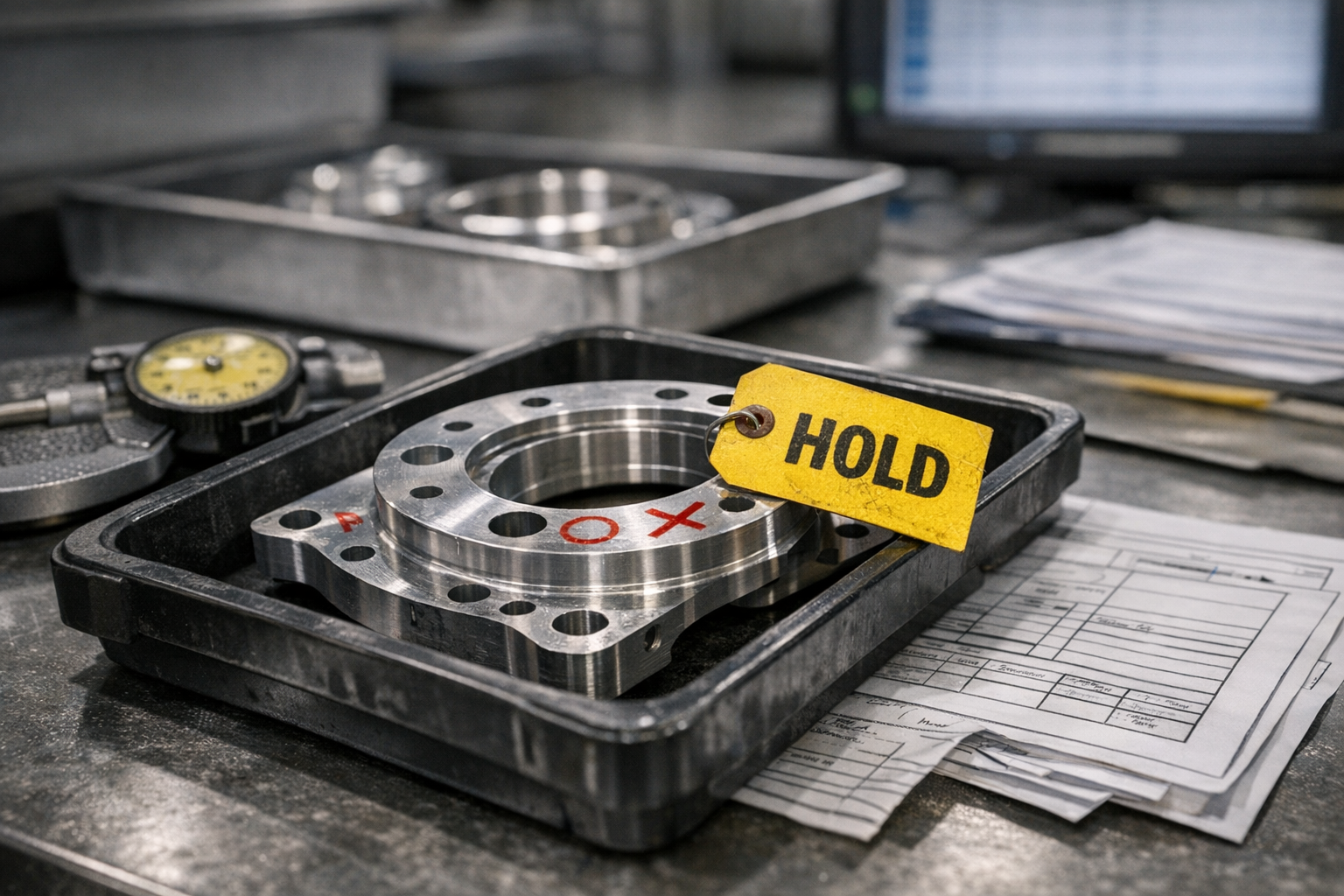
    • Physically segregate affected parts or assemblies in a clearly marked hold area.
    • Place electronic or physical hold tags on related work orders or lots.
    • Stop or limit production steps that could worsen the issue.
    • Assess potential impact on delivered product or fielded aircraft and initiate additional containment if required.

    The objective is to protect flight safety and customer operations while the investigation proceeds. The effectiveness and timeliness of containment are key metrics for a healthy NCR process.

    3. Root Cause Investigation and Analysis

    Once the situation is stable, a structured investigation begins. Common practices include:

    • Assign an owner: Typically a quality or manufacturing engineer responsible for coordinating the investigation.
    • Use a formal method: 5-Why, Ishikawa/fishbone, 8D, or similar approaches suitable for aerospace applications.
    • Consider multiple cause categories: Human (training, workload), method (procedure), machine (equipment), material, measurement, and environment.
    • Review historical data: Previous NCRs, process capability data, maintenance logs, and supplier history to determine if the issue is isolated or systemic.

    In aerospace, superficial root cause analysis is a recurring audit finding. Investigations must go beyond operator error and identify underlying system or process contributors.

    4. Disposition, Corrective, and Preventive Actions

    Disposition is the formal decision on what to do with the affected product. Common aerospace dispositions are:

    • Use-as-is: The product is acceptable in its current state, and engineering analysis confirms no negative impact to form, fit, function, or safety.
    • Rework: The product will be processed to bring it fully back into conformance with the original specification.
    • Repair: A controlled deviation from the original design is accepted according to an approved repair scheme, often documented in a repair order or engineering deviation.
    • Scrap: The product is not recoverable or is not economical to rework or repair and is permanently removed from use.

    Around the disposition decision, the team defines:

    • Immediate corrective actions: What must be done now to fix the specific occurrence.
    • Systemic corrective actions: Changes to procedures, tooling, training, or controls to address the root cause.
    • Preventive actions: Proactive measures to prevent similar issues in adjacent processes or products, even if they have not yet failed.

    Who can approve which disposition is usually defined by internal procedures and may depend on part criticality, regulatory requirements, and customer contracts.

    5. Verification and Formal Closure

    An NCR should only be closed when:

    • The disposition has been implemented and documented.
    • All required inspections, tests, or verifications are completed.
    • Corrective and preventive actions are implemented and verified for effectiveness according to internal criteria.
    • All required approvals and signatures are captured in the record.

    Verification might include follow-up audits, review of process performance data, or sampling inspections after the corrective action is in place. Only then is the NCR closed in the system. The data should still be accessible for trend analysis, audits, and continuous improvement.

    Standardizing NCR Data Capture

    Standardizing the information captured in each non conformance report is one of the fastest ways to improve investigation quality and reduce cycle time.

    Mandatory Fields: Part, Serial, Work Order, References

    At minimum, an aerospace NCR should consistently record:

    • Identification: Part number, nomenclature, revision level, and configuration baseline.
    • Traceability: Serial number, lot/batch number, heat number (if applicable), and work order or routing.
    • Location: Station, process step, or facility where the non conformance was found.
    • References: Drawing or model ID, specification, procedure, or customer requirement that was violated.
    • Detection method: Incoming inspection, in-process inspection, final inspection, test, or field report.
    • Discrepancy description: Clear, objective description including what was expected vs. what was actually observed.

    Many organizations define checklists or electronic forms to ensure these data elements cannot be skipped.

    Capturing Visual Evidence and Measurement Data

    High-quality NCRs include objective evidence, such as:

    • Photographs of the condition with clear context and scale
    • Dimensional measurements compared to tolerance bands
    • Screen captures or logs from test systems and automated equipment
    • Copies or links to relevant certifications, travelers, or process records

    Digital systems make it easier to attach this evidence directly to the NCR, improving communication between inspectors, engineers, and suppliers.

    Ensuring Completeness at the Point of Entry

    Data gaps at the start of the process are a major cause of NCR delays. To minimize this:

    • Use mandatory fields with validation rules in electronic forms.
    • Provide clear guidance and training for personnel who open NCRs.
    • Leverage dropdown lists for common defect codes and locations to standardize terminology.
    • Integrate with ERP/MES to auto-populate part, work order, and customer data where possible.

    Doing the hard work upfront enables faster, more accurate root cause work later on.

    Roles and Responsibilities Across the NCR Workflow

    Quality Engineering Ownership

    Quality often owns the overall NCR process. Typical responsibilities include:

    • Ensuring NCRs are opened when required and contain sufficient detail.
    • Coordinating containment and verifying that affected product is controlled.
    • Driving root cause analysis and ensuring use of structured methods.
    • Monitoring timelines, escalations, and adherence to procedures.
    • Maintaining the integrity of the NCR database and reporting.

    Production, Design Engineering, and Supplier Roles

    Beyond quality, other functions play key roles:

    • Production / Operations: Implement containment and rework, provide process knowledge, and support root cause investigations.
    • Manufacturing / Industrial Engineering: Analyze process capability, tooling, and workflow; propose process changes.
    • Design Engineering: Evaluate impact to form/fit/function and safety, approve use-as-is or repair dispositions, and initiate design changes when required.
    • Supplier Quality and Suppliers: Investigate and correct issues originating at the supplier, provide supporting data, and implement corrective actions in their own processes.

    Escalation Paths for Safety-Critical Issues

    For safety-critical parts, systems, or in-service events, escalation paths must be clear and documented. These may include:

    • Immediate notification of engineering leadership and airworthiness authorities within the organization.
    • Triggers for reporting to customers according to contract or quality agreement clauses.
    • Internal safety review boards or material review boards (MRBs) for high-risk dispositions.

    Timelines, communication channels, and decision-making authority should be defined in approved procedures rather than improvised after a serious event occurs.

    Common Bottlenecks in Manual NCR Processes

    Email-Based Approvals and Spreadsheet Tracking

    Many aerospace facilities still manage NCRs via email, shared folders, and spreadsheets. Typical consequences include:

    • Approvals that sit in inboxes for days with no visibility to quality or management.
    • Conflicting versions of NCR forms across various shared drives.
    • Manual copying of data between systems, leading to errors and omissions.

    These delays directly impact mean time to closure, on-time delivery, and audit readiness.

    Lost Context and Incomplete Audit Trails

    When conversations occur in email threads and hallway discussions, critical context is easily lost:

    • Decisions are not fully documented in the NCR record.
    • Investigations are difficult to reconstruct during audits.
    • Lessons learned cannot be effectively reused across the organization.

    Aerospace regulators and customers expect complete and retrievable records, not scattered files and partial histories.

    Missed Deadlines for Customer and Regulatory Commitments

    Some customers and authorities specify response times for acknowledging and resolving non conformances. Manual monitoring makes it easy to miss these commitments. Consequences can include:

    • Formal audit findings or certification risk.
    • Customer dissatisfaction and increased oversight.
    • Pressure on internal teams as due dates slip without early visibility.

    Without real-time dashboards and automated reminders, quality managers often spend significant time just chasing status updates.

    Digitizing the NCR Workflow

    Digital tools do not change the fundamental steps of the NCR process, but they dramatically improve speed, visibility, and consistency.

    Configurable Electronic NCR Forms

    Electronic forms allow organizations to:

    • Standardize mandatory data fields for all NCRs.
    • Configure specialized forms for different categories (e.g., design, supplier, in-service).
    • Embed guidance, checklists, and drop-down codes to improve data quality.
    • Attach supporting documents and multimedia evidence directly to the record.

    This reduces errors and rework compared with handwritten or static PDF forms.

    Automated Routing and Notification Rules

    Workflow engines can route NCRs automatically based on criteria such as product line, customer, risk level, or part criticality. Typical capabilities include:

    • Automatic assignment of NCRs to the responsible quality or engineering group.
    • Parallel routing for approvals when multiple sign-offs are required.
    • Escalation emails or alerts when tasks remain open beyond defined thresholds.

    This reduces dependency on manual coordination and helps ensure issues progress steadily toward closure.

    Dashboards for Tracking Open NCRs and Cycle Time

    Digital dashboards give real-time visibility into:

    • Total open NCRs by status, product line, or facility.
    • Average and median cycle times.
    • Backlogs at key workflow steps (e.g., pending engineering disposition).
    • Top recurring defect codes, suppliers, or processes.

    With this information, leaders can allocate resources, remove bottlenecks, and prioritize high-risk items proactively.

    KPIs for Measuring NCR Process Performance

    To continuously improve the aerospace non conformance report process, organizations track key performance indicators (KPIs) and use them in regular reviews.

    Mean Time to Closure (MTTC)

    Mean time to closure is the average time between NCR creation and final closure. It is often broken down by category, product family, or facility. Trends in MTTC help identify:

    • Whether the process is becoming more efficient over time.
    • Where specific groups or steps are causing delays.
    • How process changes or digital tools are affecting responsiveness.

    Some organizations also track time by phase (e.g., from detection to containment, from containment to disposition) for finer analysis.

    First-Pass Containment and Investigation Effectiveness

    It is not enough to close NCRs quickly; actions must be effective. Two useful concepts are:

    • First-pass containment effectiveness: Percentage of non conformances where the initial containment fully prevents further escapes or rework.
    • Investigation and corrective action effectiveness: Measured by repeat non conformance rates on the same part, process, or defect code over a defined period.

    Low effectiveness often indicates that root causes were not correctly identified or that corrective actions were too narrow or insufficiently verified.

    Rework, Scrap, and Cost of Poor Quality (COPQ) Impact

    The NCR process should feed into cost analysis to support data-driven decision-making. Common metrics include:

    • Rework hours and cost associated with NCRs.
    • Scrap quantities and value by part family or process.
    • Cost of Poor Quality (COPQ): A holistic measure including internal failure costs (rework, scrap), external failure costs (returns, concessions), appraisal costs, and prevention costs.

    Linking technical NCR data with financial metrics helps prioritize improvement projects with the highest return on investment.

    Connecting NCRs to Broader Non-Conformance Management

    NCRs are a central building block of broader aerospace non conformance management. A mature approach:

    • Integrates NCRs with CAPA, risk management, and configuration management processes.
    • Supports trend analysis across multiple sites, programs, and suppliers.
    • Ensures that lessons learned are shared and embedded into standards, training, and design rules.

    By standardizing and digitizing the NCR process, aerospace organizations improve traceability, reduce cycle time, and protect safety and compliance, while building a stronger foundation for continuous improvement across their entire operation.

  • ISO 22400 Basics: Core Definitions, KPI Concepts, and Terminology

    ISO 22400 Basics: Core Definitions, KPI Concepts, and Terminology

    ISO 22400 gives aerospace manufacturers a shared language for talking about performance. Instead of each plant defining its own version of “availability” or “equipment utilization,” the standard describes how key performance indicators (KPIs) should be structured and interpreted for manufacturing operations management (MOM). It does not tell you which KPIs to use or what “good” looks like; it defines what those KPIs mean.

    For aerospace and defense programs running across multiple sites, partners, and tiers of the supply chain, this common vocabulary matters. It makes it possible to compare the performance of a nacelle line in one region with a composite structures cell in another using consistent terms. Platforms like Connect 981 use these ISO 22400 manufacturing KPI concepts as a neutral layer so MES, ERP, QMS, and engineering systems can exchange performance data without semantic confusion.

    What ISO 22400 Tries to Standardize (and Why It Matters)

    ISO 22400 focuses on the conceptual side of manufacturing KPIs. It defines the building blocks, categories, and relationships behind performance indicators used in MOM environments. For aerospace plants, that means the terms used in OEE dashboards, turnaround-time reports, and shop-floor status boards can be interpreted consistently from program to program and site to site.

    The role of common KPI language in multi-site manufacturing

    In a typical aerospace enterprise, different facilities may have grown up with local KPI dialects. One final assembly line might report “uptime,” a composites facility reports “machine availability,” and an MRO shop tracks “bay occupancy.” Without shared definitions, leadership cannot be sure whether numbers are directly comparable, even when they use similar words.

    ISO 22400 addresses this by standardizing:

    • How performance indicators and KPIs are defined conceptually
    • How time, quantity, and state concepts relate to each other
    • Which attributes a KPI description should include (purpose, unit, time behavior, users, trend direction, and so on)

    For aerospace programs with stringent regulatory and contractual obligations, this consistency underpins reliable reporting to airframers, defense agencies, and aviation authorities. When contracts reference KPIs that align with ISO 22400 terminology, disputes about “what was actually measured” become less likely.

    How ISO 22400 fits into the standards landscape (IEC 62264, etc.)

    ISO 22400 sits alongside other standards that describe how an aerospace factory’s digital infrastructure is organized. IEC 62264 (and its ISA-95 lineage) defines integration between enterprise systems (planning, finance) and control systems (equipment, cells, lines). It introduces levels such as enterprise, site, area, work center, and work unit.

    ISO 22400 aligns its KPI concepts with these levels, focusing primarily on what IEC 62264 calls Level 3: manufacturing operations management. That is where MES, dispatching, detailed scheduling, and WIP tracking live. In practice, this means:

    • KPIs are defined at the same structural levels you use for routing, work centers, and work units in MES
    • Performance data exchanges between MES, ERP, QMS, and data historians can reference a common hierarchy
    • Plant-level reports and program-level summaries can be tied back to standard, named KPI concepts

    For regulated aerospace environments, this alignment simplifies building traceable, auditable flows of performance information across planning, execution, and reporting systems.

    Core Performance Measurement Concepts in ISO 22400

    ISO 22400 starts by clarifying the basic elements of performance measurement in manufacturing. If your teams use these terms consistently, integration projects and cross-plant benchmarking become far simpler.

    Performance indicators vs. key performance indicators

    The standard makes a clear distinction between “performance indicators” and “key performance indicators”:

    • Performance indicator: any measurable quantity or relationship that characterizes how a process, resource, or order behaves. Examples in aerospace include time an autoclave spends in RUN state, number of accepted parts after inspection, or hours spent on unplanned rework.
    • Key performance indicator (KPI): a selected subset of those indicators judged critical for understanding performance and steering operations. KPIs are not just raw numbers; they are indicators that have been named, described, and contextualized.

    In ISO 22400 terms, a KPI comes with a conceptual description: what object it applies to (equipment, line, order), which time horizon it covers (shift, day, campaign), its intended users (operators, supervisors, management), and the expected trend direction (higher is better, lower is better, target band, and so on).

    For an aerospace composite layup cell, “time in oven RUN state” is a performance indicator. “Oven utilization for autoclave A23 during the last shift,” normalized against planned time and described per ISO 22400, can be treated as a KPI.

    From raw signals to derived indicators to KPIs

    ISO 22400 also introduces a layered view of how performance data is built:

    • Raw signals: direct outputs from control systems or sensors, such as machine ON/OFF, RUN/STOP state codes, part count increments, or temperature readings.
    • Derived indicators: values computed from raw signals, like time in a given state, quantities produced per period, or counts of changeovers for a work unit.
    • KPIs: standardized constructs created from one or more derived indicators, aligned with ISO 22400 terminology and attributes.

    Consider an aerospace drilling cell producing wing skins. PLC data shows RUN, IDLE, and STOP states plus part counters. The MES aggregates these signals into derived indicators: total RUN time during a shift, number of completed skins, scrap count. ISO 22400 then provides a conceptual pattern for defining a KPI like “equipment utilization for drilling cell 4,” based on those derived indicators, with a clear description of what time buckets and quantities it uses.

    This separation is important in aerospace programs with mixed equipment vintages and multiple MES instances. Different equipment can produce different raw signals, yet you can still converge on common KPIs as long as the derived indicators and definitions follow ISO 22400 patterns.

    Defining Manufacturing Operations Management (MOM)

    Manufacturing operations management (MOM) is central to ISO 22400. The standard uses MOM as the context in which KPIs are defined and interpreted.

    MOM in relation to ERP and control systems

    In an aerospace factory, enterprise resource planning (ERP) handles contracts, customer orders, high-level capacity planning, and financials. At the other end of the stack, control systems operate equipment, collect signals, and enforce process parameters on machines, cells, and test stands.

    MOM sits between these layers and includes functions typically associated with MES and related systems:

    • Dispatching work orders and operations to the shop floor
    • Tracking WIP status for assemblies, subassemblies, and components
    • Recording execution data such as start/stop times, scrap counts, and test results
    • Coordinating maintenance, tool availability, and material readiness

    ISO 22400 KPIs are designed primarily for this MOM layer, where execution decisions are made and where aerospace-specific constraints—such as serialized component tracking, configuration control, and inspection holds—are applied.

    Typical MOM activities covered by ISO 22400

    The standard spans several functional areas that matter for regulated aerospace production:

    • Production operations: order execution, sequencing, changeovers, resource allocation to work units and lines.
    • Maintenance operations: planned and unplanned maintenance, equipment readiness, impact of downtime on critical production assets.
    • Quality operations: inspection, test, containment, and disposition activities that affect throughput and scrap/rework.
    • Inventory and logistics operations: internal material flows, staging, and WIP movement that influence lead time and work center loading.

    In each area, ISO 22400 emphasizes that performance indicators should be defined against a clear object (equipment, order, resource) and time context. For example, a KPI that measures the execution reliability of a batch of flight-critical actuators must explicitly state whether it is computed per production order, per work center, or per plant, and over what time base.

    Key ISO 22400 Terms Manufacturers Should Know

    Adopting ISO 22400 terminology starts with a few core concepts that show up repeatedly in MOM KPIs. For aerospace teams, these terms form the backbone of performance conversations between operations, engineering, and program leadership.

    Availability, utilization, and equipment effectiveness

    ISO 22400 devotes significant attention to equipment-focused measures because they underpin many shop-floor dashboards:

    • Availability: conceptually, how much of the planned time a resource is actually in a state where it can produce. Downtime—both planned (e.g., scheduled maintenance) and unplanned—reduces availability.
    • Utilization: how much of the available capacity is actually used. A machining center might be available but idle because material is missing or an operator is reassigned to another line.
    • Equipment effectiveness: an aggregate concept capturing availability, performance (speed or throughput against a reference), and quality (proportion of good output). ISO 22400 describes several OEE-related models using standardized time and quantity elements.

    On a composite layup line, availability might be constrained by autoclave maintenance, while utilization is limited by tooling readiness or cure cycle sequencing. Using ISO 22400 definitions helps isolate which aspect of performance is actually being affected and avoids conflating downtime with underutilization.

    Work unit, production order, and state definitions

    The standard also formalizes several structural and state-related terms that are particularly relevant when harmonizing KPIs across an aerospace digital thread:

    • Work unit: the smallest functional production entity considered for MOM KPIs. In aerospace, this might be a specific machine (5-axis mill), a cell (drilling and fastening station), or even a test rig.
    • Production order: an instruction to produce a defined quantity of a given configuration—such as a set of serialized landing gear components or a batch of engine brackets—often linked back to ERP or program planning.
    • Equipment state: the abstracted condition of a work unit, such as RUN, STOP, IDLE, or SLOW. ISO 22400 uses these states as the basis for time categorizations that feed many KPIs.

    State definitions matter because they determine how time is allocated across availability, utilization, and other indicators. For example, if an aircraft structure assembly station is IDLE because an engineering change is being evaluated, ISO 22400-based time models need a consistent way to classify that state—so that program reports differentiate engineering holds from pure equipment downtime.

    How Clear Terminology Enables Better KPI Governance

    Once terminology is aligned, aerospace organizations can treat KPIs as governed data assets rather than ad hoc report outputs. Governance is critical in environments where regulators, customers, and internal stakeholders all depend on consistent, traceable performance information.

    Reducing ambiguity in internal and supplier reporting

    Without standardized terminology, the same label can hide different calculation methods. One site might exclude quality holds from availability; another might include them. Over time, such inconsistencies undermine confidence in enterprise dashboards and supplier scorecards.

    By adopting ISO 22400 terminology, you can:

    • Specify unambiguous definitions for KPIs in internal reporting standards
    • Clarify which time categories and states are included in each indicator
    • Ensure that plant-level and supplier-level reports are structurally comparable

    For example, a supplier delivering composite subassemblies can be required to report “equipment utilization for autoclaves” following an ISO 22400-aligned definition. This lets the prime contractor compare utilization patterns across multiple suppliers and internal sites without interpreting each data set from scratch.

    Using ISO 22400 terms in contracts and SLAs

    In aerospace contracts, words like “on-time completion,” “turnaround time,” and “line availability” often appear in service-level agreements (SLAs). If each party interprets these differently, disagreements multiply when performance is questioned.

    ISO 22400 provides a neutral vocabulary that can be referenced in:

    • Long-term agreements with tier-1 and tier-2 suppliers
    • Maintenance and MRO contracts defining hangar or test stand performance
    • Internal service agreements between central functions (e.g., shared coating facilities) and individual programs

    By citing standard-aligned KPI definitions in these documents, aerospace organizations can make performance clauses more objective and auditable, while still tailoring thresholds and targets to the specific program or asset class.

    Practical Next Steps for Adopting ISO 22400 Vocabulary

    Adopting ISO 22400 terminology does not require redesigning every dashboard. It typically starts with clarifying language, then incrementally mapping existing indicators into standard-aligned structures.

    Creating internal KPI glossaries and data dictionaries

    A practical first move is to build an internal KPI glossary and data dictionary aligned with ISO 22400 concepts. For each KPI already in use—such as “autoclave availability,” “test stand OEE,” or “order execution reliability for flight control actuators”—document:

    • The object of measurement (work unit, work center, order, plant)
    • The time horizon (shift, day, rolling week, campaign)
    • The underlying time buckets and quantities used in the calculation
    • How state codes from control systems map to ISO 22400 states

    This documentation helps engineering, production, and IT teams understand where definitions diverge from the standard and where they already align. In an AS9100 environment, such a dictionary can be treated as a controlled document, supporting auditability and change control for performance metrics themselves.

    Aligning existing KPI names to ISO 22400 concepts

    Most aerospace manufacturers already track a rich set of metrics in MES, QMS, and reporting tools. The challenge is not inventing new KPIs but realigning names and definitions with ISO 22400 so performance data becomes interoperable across systems and sites.

    Typical steps include:

    • Grouping existing metrics into ISO 22400 categories (equipment-oriented, order-related, resource-related)
    • Identifying where multiple names refer to the same concept and consolidating them under a standard term
    • Flagging metrics that mix conceptual dimensions (e.g., combining availability and quality into a single opaque index) and breaking them into clearer indicators
    • Updating integration specifications so data exchanges use ISO 22400-aligned identifiers and descriptions

    A platform like Connect 981 can help by providing a common data model that maps plant-specific tags and labels into ISO 22400 concepts. This lets existing systems retain local naming conventions, while enterprise-level analytics and cross-program dashboards work with a standardized vocabulary.

    How ISO 22400 Relates to Other Levels and Standards

    ISO 22400 does not operate in isolation. It is designed to slot into the layered model of manufacturing systems defined by IEC 62264 and related standards, particularly around MOM (Level 3) activities.

    Hierarchy levels and KPI focus

    Within the IEC 62264 hierarchy, ISO 22400 focuses on KPIs that live primarily at the MOM level:

    • Level 4 (enterprise planning): business KPIs tied to financial results, customer service, and long-term capacity are largely out of scope.
    • Level 3 (MOM): the core scope for ISO 22400 KPIs, where production, quality, maintenance, and inventory operations are planned and executed.
    • Levels 0–2 (control and equipment): raw signals and control logic are not standardized by ISO 22400, but they feed the derived indicators and KPIs defined at Level 3.

    In practice, this means aerospace organizations can use ISO 22400 to harmonize the KPI layer of their digital manufacturing infrastructure, even when they use different vendors, architectures, or deployment models at the control or enterprise levels.

    Limits of KPI standardization in regulated environments

    ISO 22400 deliberately avoids prescribing calculation formulas, performance targets, or improvement methods. This is especially important in regulated aerospace contexts, where organizations must tailor KPIs to program-specific requirements, regulatory frameworks, and risk profiles.

    The standard does not decide:

    • Which KPIs are mandatory for a given aircraft program or defense platform
    • What thresholds define acceptable performance or trigger escalation
    • How KPIs feed into incentive schemes or continuous improvement initiatives

    Instead, ISO 22400 defines terminology and structures. Aerospace manufacturers, MRO organizations, and system integrators then layer their own domain-specific metrics—such as turnaround time breakdowns, concession rates, or first-pass yield for flight-critical assemblies—on top of that vocabulary. Where those metrics overlap with ISO 22400 concepts, the standard provides a clean way to describe them; where they are unique, they can coexist without being misrepresented as ISO 22400 KPIs.

    ISO 22400 in a Connected Aerospace Manufacturing Environment

    Aerospace production and MRO facilities rely on a complex ecosystem of digital systems: ERP for contracts and orders, PLM for product definitions and configurations, MES for execution, QMS for nonconformance and corrective actions, and historians or data lakes for time-series data. ISO 22400 offers a neutral KPI layer that can bind these systems together.

    In this environment, a standard-aligned KPI model helps ensure that when a program manager views a dashboard combining OEE data from machining, yield data from inspection, and schedule adherence from planning, every number is grounded in consistent meaning.

    Data integration and interoperability benefits

    From an integration perspective, ISO 22400 supports:

    • Common naming: interface specifications can use standardized KPI identifiers, reducing ambiguity when systems are integrated or replaced.
    • Stable semantics: as plants modernize equipment, underlying raw signals can change without forcing a redefinition of KPIs, as long as the derived indicators still align with ISO 22400 concepts.
    • Traceability of performance data: KPI definitions can be treated like other controlled data artifacts in the digital thread, supporting audits and investigations.

    For example, when a new MES is rolled out to a wing assembly plant, the integration team can map its event codes and counters to existing ISO 22400-aligned KPIs, maintaining continuity for enterprise reports and supplier scorecards.

    Connect 981’s role in applying ISO 22400 concepts

    As a digital manufacturing platform focused on aerospace and regulated production, Connect 981 can implement ISO 22400 terminology as a shared reference layer. While each organization retains its own KPI choices and targets, the platform can:

    • Map equipment states, order events, and inspection results into ISO 22400-aligned indicators
    • Link KPIs to serialized components and configurations, preserving part genealogy and performance context
    • Expose standard-aligned KPI definitions to downstream analytics and reporting tools

    This approach supports cross-program visibility without forcing every plant or supplier to abandon their existing systems. The key is that wherever KPIs appear—in shop-floor dashboards, supplier portals, or executive summaries—their underlying terminology is consistent with ISO 22400.

    Summary: Using ISO 22400 Terminology to Strengthen KPI Foundations

    ISO 22400 gives aerospace manufacturers a rigorous language for describing manufacturing KPIs. It clarifies the distinction between raw signals, derived indicators, and KPIs; defines core terms like work unit, equipment state, availability, and utilization; and aligns MOM-level metrics with the broader enterprise-control hierarchy.

    The standard does not replace organizational strategy or sector-specific metrics. Instead, it offers a common foundation so that performance data from diverse plants, partners, and systems can be interpreted consistently. For aerospace organizations operating in AS9100 and similar regulated environments, adopting ISO 22400 terminology supports clearer contracts, more reliable cross-site comparisons, and stronger data governance across the digital thread. Platforms such as Connect 981 can then apply this vocabulary across MES, QMS, ERP, and engineering systems, turning performance measurement into a coherent, standards-aligned capability rather than a collection of disconnected local practices.

    Note: This article is an educational overview of ISO 22400 concepts in the aerospace manufacturing context. It does not reproduce the standard text or replace the need to consult the official ISO 22400 documents.

  • Leveraging MES Traceability to Reduce Waste and Support Aerospace Compliance

    Leveraging MES Traceability to Reduce Waste and Support Aerospace Compliance

    Leveraging MES Traceability to Reduce Waste and Support Aerospace Compliance

    In aerospace manufacturing, scrap is not just a quality metric. It is a financial and contractual event. Losing a single high-value machined forging or composite structure can ripple through schedules, margins, and customer commitments. Robust traceability in a Manufacturing Execution System (MES) is one of the most effective ways to contain that impact when problems do occur.

    This article explains how aerospace MES traceability structures data so that, when defects are discovered, you can precisely identify affected parts, lots, and operations. That precision allows you to avoid over-scrapping, limit re-inspection, and respond to regulators and customers with confidence.

    For a broader discussion of waste reduction practices, see MES-supported waste reduction and traceability in aerospace.

    Regulatory and Customer Expectations for Aerospace Traceability

    Aerospace OEMs and regulatory bodies expect manufacturers to demonstrate where every critical part came from, how it was processed, and whether it met requirements at each key step. MES is a primary tool for capturing and organizing this information, but expectations vary by part criticality and contractual context.

    Typical traceability requirements by part criticality

    Traceability depth is closely tied to the risk posed by a part or assembly:

    • Flight-critical and safety-critical parts typically require full serial-level genealogy. You must be able to trace every individual item from incoming material, through each operation, to final assembly and test.
    • Mission-critical or performance-critical parts may require serial or small-lot traceability, including key process parameters and inspection results, but with some aggregation where risk is lower.
    • Standard or non-critical parts are often managed at lot or batch level, with enough traceability to support quality management and basic containment without excessive burden.

    OEM flow-downs, airworthiness authority guidance, and internal engineering risk assessments typically define which level applies. An MES should be configurable enough to reflect those distinctions without forcing a single model on all parts.

    Differences between lot, batch, and serial tracking

    The way you structure traceability strongly influences your exposure when a defect appears:

    • Lot tracking associates groups of items with a common identifier (e.g., a barstock heat lot or fastener lot). If a defect is traced to a lot, you may have to contain or scrap everything produced from that lot, across time and work orders.
    • Batch tracking is similar, but often tied to a manufacturing event (e.g., a batch of parts heat-treated together). A defect in the batch process generally drives containment of all batch members.
    • Serial tracking assigns a unique identity to each specific part or assembly. If a problem is linked to a particular process or material exposure, you can typically narrow the impact to just the serials that passed through that exact condition.

    An aerospace MES needs to manage all three simultaneously. The finer the traceability granularity, the more precisely you can limit the scope of scrap and rework, though this comes at a cost of data volume and operational discipline.

    Implications for scrap and rework decisions

    When a nonconformance is discovered—whether through inspection, in-service feedback, or supplier notification—the traceability model determines your options:

    • With coarse traceability (e.g., only lot-level), you may be forced to treat an entire lot as suspect, even if only a fraction of parts actually experienced the adverse condition.
    • With robust serial-level genealogy, you can identify exactly which part serials saw which tool, fixture, program version, operator, or material batch at the time of deviation.

    The result is a more defensible decision about what to scrap, what to re-inspect, and what can continue to ship, reducing both direct waste and schedule disruption.

    How MES Structures Traceability Data

    To achieve useful traceability, an aerospace MES must connect multiple dimensions of manufacturing data into a coherent genealogy: materials, processes, inspections, tooling, and people.

    Linking materials, processes, and inspections

    A mature traceability model in MES constructs a chain of evidence that ties together:

    • Incoming material: supplier lot, heat number, certificates of conformity, receiving inspections, and release status.
    • Process execution: which operation was run, on which machine or cell, using which work instructions and parameters at the time.
    • In-process and final inspections: measured values, pass/fail results, sampling plans, and any nonconformance reports raised.

    Each produced unit or lot carries these links throughout its lifecycle. When an anomaly emerges, engineers can quickly traverse this data from any direction: from part back to process, from process to tooling, or from material lot forward to all affected assemblies.

    As-built records and operation history

    An as-built record is essentially the factual history of how a given unit was manufactured, as opposed to how it was planned. In aerospace MES, this typically includes:

    • All operations actually executed, including deviations from the routing.
    • Start/finish timestamps and elapsed time per step.
    • Configuration identifiers (program revision, work instruction version, NC file version).
    • Key process parameters as recorded (temperatures, pressures, torque values, cure cycles, etc.).
    • Inspection points, measurements, and dispositions.

    This operation history turns investigations from guesswork into data-driven analysis. It is also crucial evidence for regulators and OEMs if a field issue triggers a broader fleet review.

    Tooling, program, and operator associations

    Many systemic defects are not about the part itself, but the conditions under which it was made. Effective aerospace MES traceability therefore links each produced item to:

    • Tools and fixtures: serial numbers, calibration status, and maintenance records.
    • NC programs and work instructions: which revision was used, and whether any temporary instructions or concessions were active.
    • Operators and inspectors: who performed which step, and what qualifications or certifications they held at the time.

    When a programming error, tool wear, or training gap is discovered, you can immediately map that condition to the exact set of affected parts or batches, rather than applying broad assumptions.

    Using Traceability to Contain Defects Efficiently

    Even in highly controlled environments, nonconformances will occur. The key is to prevent them from propagating into large quantities of scrap or widespread rework. MES-based traceability is a core enabler of fast, precise containment.

    Quickly bounding affected populations

    When an issue is flagged—by a failed inspection, supplier alert, or monitoring alarm—engineers need to answer two questions quickly: What exactly went wrong? and Which units were exposed?

    With a well-designed MES genealogy model, you can:

    • Query all parts produced on a specific machine, with a particular tool or program revision, during a defined time window.
    • Identify all assemblies containing material from a suspect lot or batch, across multiple levels of the bill of material.
    • Trace forward from a suspect subassembly to finished units already in stock, in shipment, or at the customer.

    This allows you to set precise holds and shipping stops, rather than blanket freezes that paralyze production.

    Avoiding unnecessary scrap and re-inspection

    When data is incomplete, organizations often err on the side of caution by scrapping broadly or re-inspecting large populations of parts. This is costly and, in many cases, avoidable.

    Robust aerospace MES traceability reduces this waste by providing evidence that:

    • Only parts processed within a defined timeframe or parameter window were at risk.
    • Specific serials did not pass through the suspect condition and can be safely released.
    • Previously executed inspections already verified the relevant characteristics, eliminating the need to repeat them.

    The combination of genealogy and recorded measurements supports risk-based decisions that stand up to internal and external scrutiny.

    Coordinating with customers on disposition

    When potential escapes or in-service findings occur, OEMs and regulators expect clear, data-backed responses. MES traceability enables you to:

    • Provide trace reports showing how many units are affected, where they are, and what their exact as-built configuration is.
    • Support engineering disposition (use-as-is, repair, or scrap) with detailed parameter histories and inspection evidence.
    • Collaborate on risk assessments by simulating worst-case combinations of variables based on actual production data.

    This often leads to more targeted repair or rework actions, rather than defaulting to scrapping complete batches or assemblies.

    Reducing Rework Risk with Better Genealogy

    Rework may appear to save scrap but can introduce new defects, consume capacity, and complicate traceability if not tightly controlled. A strong genealogy model reduces both the need for rework and the risk it introduces.

    Ensuring correct rework paths are followed

    When a nonconformance is found, MES can enforce approved rework routings and capture all steps taken. Proper genealogy ensures that:

    • Only parts with specific nonconformance codes are eligible for certain rework paths.
    • Rework steps are linked to engineering-authorized instructions and concessions.
    • Additional inspections or tests required after rework are completed before release.

    This prevents ad-hoc fixes that might resolve the immediate defect but violate design intent or introduce hidden risks.

    Tracking multiple rework cycles and concessions

    Some aerospace parts may legitimately go through multiple repair or rework cycles, especially on long-life assets. Without clear genealogy, it becomes difficult to understand the cumulative impact of concessions and deviations.

    An aerospace MES should record:

    • Each rework cycle as a distinct but linked set of operations.
    • All concessions, waivers, or deviations applied, with references to approvals.
    • Resulting configurations, especially if they differ from the nominal design.

    This history supports future maintenance decisions, fleet management, and life-limited part analysis, while also protecting against unapproved work that could invalidate airworthiness assumptions.

    Avoiding double-handling and undocumented fixes

    Undocumented touch labor is a hidden source of waste and risk. It consumes time, may invalidate prior inspections, and can break the traceability chain.

    By tightly integrating rework processes into MES:

    • All work, including unplanned fixes, must be logged against the part or lot.
    • Operators receive clear instructions on whether to rework, scrap, or route parts to MRB (Material Review Board).
    • Supervisors can see the total rework burden and target process improvements at the root cause.

    This reduces double-handling and ensures that every action performed on a part is captured in its genealogy.

    Traceability-Driven Continuous Improvement

    Traceability is not only about compliance and containment. When used effectively, MES genealogy becomes a continuous improvement engine that exposes systemic waste drivers and validates corrective actions.

    Identifying systemic issues across programs

    Aggregated genealogy data helps you spot patterns that individual nonconformance reports may not reveal, such as:

    • Higher defect rates associated with specific machines, tools, or shifts.
    • Increased rework on parts produced from certain material lots or suppliers.
    • Recurring issues tied to specific process windows (e.g., temperature, humidity, or cure times).

    By analyzing these patterns, quality and manufacturing engineers can prioritize improvement projects that deliver the greatest reduction in scrap and rework.

    Feeding genealogy insights into design and process changes

    When MES is integrated with engineering systems, genealogy data can inform both product and process design:

    • Feedback on which features or tolerances drive most defects can trigger design simplification or tolerance relaxation (subject to regulatory and performance constraints).
    • Evidence of robust performance under certain process ranges can be used to widen allowable windows, reducing false alarms and unnecessary rework.
    • Changes in tooling, fixtures, or methods can be evaluated by comparing before/after defect rates at a granular level.

    This closes the loop between production reality and engineering assumptions, making waste reduction an ongoing capability rather than a one-time initiative.

    Audit trails that support lessons learned

    Aerospace organizations are frequently audited by customers, regulators, and internal compliance teams. MES traceability provides an objective audit trail that:

    • Documents exactly how a process was run at a given point in time.
    • Shows how nonconformances were detected, contained, and corrected.
    • Records changes and their approvals, supporting robust configuration control.

    These audit trails not only reinforce compliance but also serve as a knowledge base for future programs, helping new projects avoid repeating past causes of scrap and rework.

    Designing a Traceability Model in MES

    Achieving the right level of traceability requires deliberate design. Overly coarse models drive excessive waste; overly detailed models can be costly to maintain and slow operations. The goal is a risk-based balance.

    Deciding what to track at serial vs lot level

    Key considerations when deciding traceability granularity include:

    • Risk and criticality: Flight-critical and safety-critical parts typically demand serial-level tracking, whereas standard hardware may be adequately managed at lot level.
    • Defect detection opportunities: If issues are likely to be caught at or near the point of origin, coarser traceability may be acceptable. If detection tends to occur late (e.g., final test, in service), finer granularity can dramatically reduce exposure.
    • Volume and handling: High-volume, low-risk parts may become impractical to track individually. In these cases, a hybrid approach (e.g., serial tracking only after a certain assembly stage) can be effective.

    The chosen model should be formally risk-assessed and aligned with engineering, quality, and customer requirements.

    Balancing detail with practicality and performance

    More data is not always better. Aerospace MES implementations must balance:

    • Data capture burden: Manual data entry slows operators and increases the risk of errors. Use automation (e.g., barcode/RFID scans, equipment integration) wherever feasible.
    • System performance: Excessive granularity can create large datasets that are hard to query quickly during investigations. Data architecture and indexing must support fast genealogy queries.
    • Human factors: Traceability processes should fit naturally into the workflow. If they are seen as overhead, workarounds and data gaps are likely to emerge.

    Continuous feedback from production teams helps refine the model over time, ensuring it stays both effective and usable.

    Integrating MES with PLM, ERP, and QMS

    Traceability does not live in MES alone. Its effectiveness depends on connections to surrounding systems:

    • PLM (Product Lifecycle Management) provides the authoritative design intent, bills of material, and approved processes that MES must execute and track against.
    • ERP (Enterprise Resource Planning) manages material purchasing, inventory, and financials; linking MES genealogy to ERP lots and orders closes the loop from cost to cause.
    • QMS (Quality Management System) handles nonconformance records, corrective actions, and audits; integrating MES data enriches investigations and supports more effective corrective actions.

    These integrations ensure that traceability is not an isolated data silo, but a shared resource for engineering, operations, quality, and supply chain teams.

    Case Examples: Limiting Scrap via Precise Traceability

    To illustrate how aerospace MES traceability limits waste, consider several typical scenarios. Details will vary by organization and program, and specific configurations must be tailored to applicable requirements.

    Narrowing a suspected material defect to a small batch

    A material supplier notifies your organization of a potential anomaly in a specific heat lot of alloy used for machined brackets. Without robust traceability, you might have to treat all brackets of that type as suspect.

    With MES genealogy in place, you can instead:

    • Identify exactly which internal lots and serials used that heat.
    • Trace forward to all assemblies containing those brackets.
    • Apply targeted holds and inspections to only the affected units.

    This can reduce the number of impacted parts from thousands to a much smaller, well-defined population, saving material and avoiding unnecessary line disruptions.

    Isolating parts exposed to out-of-spec process conditions

    Suppose a heat treatment furnace is later found to have operated slightly out of specification for a period of time. The question becomes: which parts were actually in the furnace during that window?

    An MES with detailed equipment and time-based genealogy can:

    • List all loads processed in that furnace while it was out of spec.
    • Identify every part serial or batch included in those loads.
    • Trace those parts into higher-level assemblies and current locations.

    Instead of scrapping every part ever processed in that furnace, you focus on a time-bounded subset. In many cases, additional testing or engineering analysis may clear some of these parts for use, based on the exact conditions experienced.

    Providing evidence for customer waivers or repairs

    In some situations, an OEM or regulator may consider a waiver, concession, or defined repair in lieu of scrapping suspect hardware. The decision depends heavily on confidence in the underlying data.

    MES traceability supports these discussions by:

    • Demonstrating that only certain features, loads, or parameters deviated, with all other conditions meeting requirements.
    • Providing detailed histories that support engineering analyses of structural or performance impact.
    • Documenting any rework or repair performed, tying it to approved instructions and validated results.

    This evidence can convert potential scrap into accepted, safe hardware, while maintaining trust with customers and oversight bodies.

    Making Traceability a Strategic Waste-Reduction Lever

    Traceability is often pursued first as a compliance obligation in aerospace, but its value goes far beyond regulatory checklists. With a well-designed genealogy model in MES, manufacturers can:

    • Respond faster and more precisely to defects and supplier alerts.
    • Limit the scope of scrap, rework, and re-inspection when issues arise.
    • Feed rich operational data into continuous improvement and design decisions.

    Requirements differ by program, customer, and jurisdiction, so no single MES configuration can guarantee compliance in all contexts. However, investing in thoughtful traceability design—and integrating it with broader MES-supported waste reduction and traceability in aerospace practices—consistently pays dividends in reduced waste, stronger margins, and more resilient customer relationships.

  • Protecting Margins on Fixed-Price Aerospace Contracts with MES

    Protecting Margins on Fixed-Price Aerospace Contracts with MES

    Protecting Margins on Fixed-Price Aerospace Contracts with MES

    In aerospace manufacturing, scrap is not just a quality problem. It is a financial event. Under fixed-price and long-term contracts, every lost part, extra hour of rework, and unplanned material withdrawal directly erodes program margin. A well-implemented Manufacturing Execution System (MES) gives aerospace manufacturers the visibility and control needed to keep waste from silently eating into profitability.

    This article explains how MES-driven scrap, rework, and material waste reduction supports margin protection in fixed-price aerospace contracts. It also shows how plant-floor data can feed program-level financial decisions, improve risk management, and strengthen contract negotiations.

    For a broader view of waste reduction strategies, see how MES supports reducing scrap, rework, and material waste in aerospace manufacturing as a foundation for margin protection.

    Why Waste is So Dangerous in Fixed-Price Aerospace Programs

    Fixed-price and long-duration aerospace contracts lock in revenue while leaving most cost risk with the supplier. That structure amplifies the impact of scrap, rework, and material waste.

    Limited Ability to Pass Costs to Customers

    In many aerospace programs, contracts are structured as firm fixed-price, fixed-price with incentive, or long-term pricing agreements. Once the price per unit or per block of deliveries is agreed, your room to recover unplanned costs is limited.

    • Unplanned scrap of high-value materials (e.g., nickel alloys, titanium, composites) must usually be absorbed internally.
    • Extra rework hours consume capacity and increase overtime without a corresponding price increase.
    • Expedited materials and logistics to protect delivery dates often hit your P&L, not the customer’s.

    Without detailed, timely waste data, these costs accumulate gradually and only become visible when program margins are already compromised.

    Tight Margins and Long Production Horizons

    Aerospace programs often run for years or even decades, with cost curves expected to improve over time. In this environment:

    • Initial learning curve assumptions are built into bid models.
    • Planned rate increases depend on predictable cycle times and yields.
    • Suppliers commit to price reductions or productivity targets over the life of the contract.

    If scrap and rework rates stay higher than planned—even by a few percentage points—the impact on lifetime program margin can be substantial. MES helps teams detect when real-world waste performance diverges from the cost model early enough to intervene.

    Forecasting Challenges for Emerging Programs

    On new or ramping programs, forecasts are inherently uncertain. Engineering changes, immature processes, and supplier variability all introduce risk. Traditional quality systems that rely on sampling and end-of-line checks often miss small process deviations until multiple parts are affected.

    MES addresses this by:

    • Capturing real-time process data (machine parameters, operator inputs, environmental conditions).
    • Flagging out-of-tolerance trends before they produce large batches of non-conforming parts.
    • Enforcing standardized work instructions so new processes are executed consistently.

    The result is a faster feedback loop between the shop floor and program finance teams, reducing the gap between estimated and actual costs.

    Linking MES Waste Data to Program Financials

    To protect margins, waste metrics must be connected directly to program and contract financials. MES is the system of record for what actually happened during manufacturing; when integrated properly with ERP and program controls, it becomes a powerful financial lens.

    Attributing Scrap and Rework Costs to Specific Contracts

    Under fixed-price arrangements, the critical question is not just how much scrap or rework occurred, but which contract or customer it affected. MES enables this by:

    • Tracking every unit and lot by work order, contract number, and customer.
    • Recording scrap events with coded reasons (e.g., process deviation, supplier defect, programming error).
    • Logging rework operations, including additional labor, machine time, and consumables.

    When MES data is linked to cost rates from ERP, you can calculate:

    • Scrap cost per contract, part number, and configuration.
    • Rework labor and overhead by program.
    • Trends in waste by customer or major assembly group.

    This enables more accurate program margin analysis and targeted corrective actions.

    Understanding Cost per Good Piece by Configuration

    Aerospace products often have multiple configurations, options, or block points. The real cost per good piece can vary significantly depending on:

    • Configuration-specific processing sequences.
    • Different inspection requirements or special processes.
    • Distinct yield profiles for early versus mature designs.

    MES provides the necessary granularity by:

    • Tying each operation and inspection to a specific configuration or effectivity.
    • Capturing actual cycle times, scrap, and rework at the operation level.
    • Supporting traceability across serial numbers and lots.

    When combined with cost data, this gives program managers a clear view of cost per good piece by configuration, helping them understand where margin is being gained or lost.

    Supporting Earned Value and Program Reporting

    Many aerospace programs use Earned Value Management (EVM) or similar frameworks. MES can feed more accurate actuals into these models by providing:

    • Real-time actual hours consumed versus planned.
    • Visibility into rework hours that might not be obvious in high-level reports.
    • Accurate counts of accepted units versus scrapped or reworked quantities.

    With this data, cost performance index (CPI) and schedule performance index (SPI) reflect true execution performance rather than optimistic assumptions. Program teams can course-correct earlier and defend their forecasts with objective evidence.

    Reducing Cost Volatility with MES-Controlled Processes

    Margin protection on fixed-price contracts is not only about lowering average cost; it is about reducing cost volatility. MES-controlled processes make outcomes more predictable.

    Stabilizing Scrap and Rework Rates Over Time

    Most waste does not come from dramatic failures. It comes from small process deviations—a worn tool, a drifting fixture, a subtle setup mistake—that accumulate over time. MES helps stabilize performance by:

    • Monitoring key process parameters continuously instead of relying on periodic checks.
    • Issuing immediate alerts when parameters exceed tolerance.
    • Automatically placing holds on affected work orders to prevent further nonconforming production.

    By catching issues early, MES reduces the number of parts involved in each incident, smoothing waste rates and avoiding spikes that can wipe out a period’s margin.

    Reducing Schedule Risk from Unexpected Rework

    Rework can sometimes save expensive hardware, but it also:

    • Consumes finite capacity on critical machines and skilled labor.
    • Introduces additional risk of further nonconformances.
    • Threatens on-time delivery when discovered late in the process.

    MES mitigates these risks by:

    • Enforcing correct execution the first time with validated data entry and digital work instructions.
    • Routing nonconforming parts through controlled disposition and rework workflows.
    • Providing visibility into rework queues and cycle times for scheduling and capacity planning.

    Reduced surprise rework directly supports schedule adherence and avoids the expensive expediting often required to protect customer commitments.

    Improving Confidence in Rate Readiness

    As aerospace programs ramp from development to rate production, customers scrutinize suppliers’ ability to meet volume and quality targets. MES strengthens your case by providing:

    • Historical trends on scrap and rework rates by process and part family.
    • Evidence of process stability under increasing load.
    • Data-supported projections of first-pass yield at higher rates.

    This gives both your internal leadership and your customers greater confidence that quoted rates and costs are achievable, reducing the risk of margin-damaging surprises during ramp-up.

    Using MES Insights in Contract Negotiations and Change Management

    While MES cannot change the basic commercial structure of a fixed-price contract, it can materially improve your negotiating position and change management outcomes by supplying objective, detailed data. This data does not guarantee customer acceptance, but it provides a credible foundation for discussions.

    Providing Data-Backed Justification for Pricing and Surcharges

    When new proposals or re-pricing events arise, MES helps build more accurate cost models by:

    • Supplying actual cycle times by operation and configuration.
    • Quantifying scrap and rework rates for similar parts or processes.
    • Highlighting special process steps or inspections that drive cost.

    This allows commercial teams to justify pricing with concrete operational evidence rather than historical averages alone. In some cases, MES data may support discussions about surcharges or price adjustments when customer-driven changes clearly increase cost.

    Demonstrating Process Capability to Customers

    Aerospace OEMs and Tier 1s increasingly expect suppliers to demonstrate capability, not just quote a price. MES can support this by providing:

    • Capability summaries (e.g., yield, defect rates, process stability) for key operations.
    • Evidence of closed-loop corrective actions and sustained improvements.
    • Traceable histories showing how the plant responded to prior disruptions.

    These insights can improve your position in competitive bids and support conversations about risk-sharing and scheduling flexibility.

    Managing the Impact of Design and Scope Changes

    Design changes, new customer requirements, and scope expansions are facts of life in aerospace programs. MES helps quantify their impact by:

    • Simulating revised routing and operation sequences.
    • Estimating incremental cycle time and inspection effort based on similar past changes.
    • Tracking post-change scrap and rework trends to validate cost assumptions.

    This supports structured change management, helping both sides understand how new requirements affect cost and schedule. While MES data alone does not guarantee contractual relief, it makes your case more transparent and defensible.

    Metrics for Executives: From Plant Data to Program Health

    Executives need a concise set of metrics that connect MES data to program performance. The goal is to translate detailed shop-floor information into indicators that signal margin risk early.

    Scrap Cost as a Percentage of Contract Value

    One powerful metric is scrap cost as a percentage of contract or program value. To compute it, combine MES scrap quantities with material and processing costs from finance, and compare the result to total revenue on the contract.

    This view helps executives:

    • Identify programs where waste is reaching materiality thresholds.
    • Prioritize improvement projects where margin is most at risk.
    • Track the return on MES and process improvement investments.

    Rework Hours vs Planned Labor

    Another key indicator is the ratio of rework hours to planned production labor. MES can distinguish between planned operations and rework steps, allowing for:

    • Visibility into how much capacity is absorbed by non-value-added recovery work.
    • Comparison of actual rework effort to what was assumed in bids or budgets.
    • Trend analysis to see whether corrective actions are sustainable.

    High or rising rework ratios are early warning signs that program margins may be under pressure even if shipments and revenue appear on track.

    On-Time Delivery Performance Under Waste Control

    Fixed-price contracts often include delivery penalties or incentives. Waste and rework can quietly jeopardize on-time performance. MES supports more reliable delivery by:

    • Flagging potential schedule slips when scrap or rework events affect critical path components.
    • Providing accurate work-in-progress (WIP) status and queue times.
    • Helping planners and program managers re-sequence work to protect contractual dates.

    Tracking on-time delivery alongside waste metrics lets executives see whether improvements in scrap and rework are translating into reliable customer performance and preserved margin.

    Implementing MES for Financial Visibility

    To realize the margin-protection potential of MES, implementation must be designed with financial and contractual outcomes in mind—not just manufacturing efficiency.

    Aligning Finance, Operations, and IT Requirements

    Successful MES programs in aerospace bring together finance, operations, and IT to define:

    • Which waste categories matter most for margin (scrap, rework, consumables, overtime triggers).
    • How contracts and programs will be identified within MES and related systems.
    • What reporting granularity is required for program reviews and customer discussions.

    This alignment ensures that MES data structures support both operational control and program-level financial analysis from day one.

    Ensuring Accurate Cost Allocation in MES and ERP

    MES captures what happened; ERP and finance determine how costs are allocated. To link them effectively:

    • Use common keys and identifiers (work orders, WBS elements, contract numbers) across systems.
    • Define clear rules for how scrap and rework costs flow to programs and cost centers.
    • Regularly reconcile MES quantities with inventory and financial records.

    The tighter the integration, the more reliably you can translate execution data into meaningful financial insight without manual workarounds.

    Phasing Deployment by Highest-Risk Programs

    Not every program needs the same level of MES sophistication immediately. A pragmatic approach is to:

    • Identify high-value or low-margin contracts where waste poses the greatest financial risk.
    • Prioritize complex parts and special processes with historically higher scrap and rework.
    • Roll out MES capabilities in phases, starting with traceability, scrap capture, and rework control, then extending to advanced analytics.

    This sequencing accelerates financial impact and builds internal support using results from the most exposed programs.

    Communicating Value to Internal and External Stakeholders

    MES only protects margins if people understand and use the information it provides. Communicating value clearly is essential for sustaining investment and adoption.

    Framing MES Investments as Margin Protection

    Internally, MES is often viewed as an operations or IT project. To gain executive sponsorship, frame it as a margin protection initiative for fixed-price programs:

    • Quantify current scrap and rework cost exposures using available data.
    • Estimate potential savings from even modest yield improvements.
    • Highlight the role of MES in supporting accurate bids and avoiding surprises after contract award.

    This shifts the conversation from system features to financial outcomes.

    Reporting Improvements to OEMs and Regulators

    Aerospace customers and regulators care deeply about process control and traceability. MES can strengthen your external position by enabling:

    • Structured reports on defect reduction and process capability.
    • Transparent documentation of corrective and preventive actions.
    • Evidence of consistent compliance with approved processes.

    While this may not directly change pricing, it builds trust, supports supplier ratings, and can influence future sourcing decisions.

    Using Success Stories to Scale Across Programs

    Once MES has delivered measurable benefits on one or two programs, capture those results and use them to build momentum:

    • Document before-and-after metrics for scrap, rework, on-time delivery, and margin where possible.
    • Share case studies internally to show how data-driven decisions improved outcomes.
    • Incorporate lessons learned into standard deployment templates for new areas.

    Over time, this creates a culture where MES is viewed as an essential tool for managing the financial health of fixed-price aerospace contracts, not just a manufacturing system.

    By tightly linking MES waste data to program financials, aerospace manufacturers can move from reacting to margin erosion to proactively managing it—protecting profitability while delivering reliable performance to their customers.

  • Work Order Integration Playbook for Aerospace Traceability

    Work Order Integration Playbook for Aerospace Traceability

    Work orders in aerospace manufacturing live at the seam between planning and execution: the ERP (enterprise resource planning) system releases the order, but the shop floor and suppliers determine what actually happens. When ERP, MES (manufacturing execution system), quality tools, and spreadsheets tell different stories, you do not just lose visibility—you lose traceability, and you start rebuilding audit evidence after the fact.

    The fix is rarely “replace the ERP.” In regulated plants, ERP is the contractual and financial system of record. The practical problem is boundary control: which system owns work-order state at each stage, which events must cross that boundary, and what minimum record set must be retained so an auditor can reconstruct intent, execution, and disposition.

    This playbook shows a disciplined way to integrate work orders across ERP and execution (MES/MOM) using ISA-95 / IEC 62264 thinking, with an evidence model aligned to AS9100-style expectations for documented information and traceability.

    When you need this playbook

    • Status looks on track in ERP but work is blocked on the floor (inspection disposition, MRB, missing material/tooling, missing certs).
    • Execution proof is fragmented across paper travelers, spreadsheets, and point tools that do not share identifiers or revision context.
    • Quality events are “after the fact”—nonconformances and holds exist, but they do not reliably stop downstream execution.
    • Closeout requires manual reconciliation to assemble a ship-ready package (inspections, dispositions, certs, and revision-correct records).

    Key Takeaways

    • Keep ERP stable for order release, part masters, and financial commitments; treat execution as a separate system-of-action layer.
    • Use ISA-95 / IEC 62264 boundaries to decide what belongs in Level 4 (enterprise) vs Level 3 (manufacturing operations).
    • Integrate milestones, not micro-events: ERP needs planning-relevant states; the execution layer owns detailed steps, checks, and signatures.
    • Make quality change execution by linking holds and dispositions to the exact operation, routing, and revision context.
    • Define a minimum evidence pack per work order so audits are reviewable, not reconstructive.

    Scope and system boundary: ERP vs MES/MOM

    ISA-95 (also published as IEC 62264) separates enterprise planning from manufacturing operations management and describes the interface between Level 4 (enterprise) and Level 3 (manufacturing operations). Treat that interface as a contract: only information that changes enterprise decisions should flow back to ERP.

    • ERP owns order release/close, part masters, top-level routing references, commitments, costing, and shipment/billing triggers.
    • Execution (MES/MOM) owns dispatch, operator guidance, confirmations, in-process inspections, quality events, and revision enforcement.
    • Both must share stable identifiers and revision context (WO, operation IDs, routing revision, instruction revision, lot/serial anchors).

    A common anti-pattern is trying to make ERP “know everything” that happens during execution. You create noisy integrations and still cannot answer the only questions that matter: what is blocked, what revision was built, and what evidence proves ship readiness.

    Evidence model: the minimum work-order record set that survives an audit

    “Complete” must mean routing complete + inspections complete + dispositions resolved + required documents present. The evidence model below is intentionally minimal: it is the smallest record set that lets you answer an auditor in one sitting.

    Identifiers and revision context:

    • Work order ID, part number, quantity, and program/sales reference (when applicable).
    • Routing ID + routing revision; operation IDs; planned work center/cell.
    • Work instruction/document ID + instruction revision (the version actually presented at the station).
    • Traceability anchors: issued material lot/batch IDs and produced serial numbers with parent/child links.

    Execution and quality records:

    • Operation confirmations (start/complete) with operator ID and timestamp (or equivalent approval evidence).
    • Inspection results tied to operation ID and revision context (including re-inspection after rework).
    • Nonconformance record ID, disposition, and approval evidence; hold applied/released with reason and owner.
    • Ship-ready documents tracked as requirements (e.g., test report, CofC/CoC, special process certs where applicable).

    Minimum “audit navigation” expectation: someone should be able to start at the WO and reach, in two to three clicks, the effective revision context, the inspection results, and the disposition trail for any open/closed defect. If the only way to do that is a shared drive and tribal knowledge, you will keep paying the reconciliation tax.

    ERP should receive the subset that drives enterprise action: milestone state, material consumption with traceability anchors, and completion readiness. The execution layer retains the detailed “how.”

    Step-by-step workflow for integrating work orders

    1. Standardize identifiers. WO and operation IDs must be identical across systems; do not translate identifiers in interfaces.
    2. Declare system roles. ERP is system of record for release/close; execution is system of action for in-process state and evidence.
    3. Define milestone events. Limit ERP updates to planning-relevant transitions (released, in-process, blocked, rework, complete, doc-complete, closed).
    4. Make routings executable. Convert ERP routing references into station-level steps with checks and required attachments, without silently changing the baseline.
    5. Enforce revision effectiveness. The execution layer must present the correct instruction/routing revision for that WO and log what was used.
    6. Capture genealogy at source. Record lot/serial relationships during issue, assembly, test—not at closeout.
    7. Wire quality into state. Holds and dispositions must immediately change executable state so work cannot “flow around” quality.
    8. Close on ship readiness. Require routing completion and document completeness before sending the ERP close/ship-ready signal.

    Integration points to implement first (these cover most aerospace pain without boiling the ocean):

    • Order release: ERP → execution (WO identity, part, quantity, due date, routing reference).
    • Work-in-process status: execution → ERP (milestone state + blocker reason/owner when blocked).
    • Material and genealogy anchors: execution → ERP (issues/consumption plus lot/serial identifiers needed for inventory and traceability).
    • Quality holds: execution ↔ ERP (hold applied/released so enterprise planning stops assuming flow).
    • Completion readiness: execution → ERP (physically complete and documentation complete as separate milestones).

    If you implement only identity standardization and milestone events, you will already reduce “different truths” because every system will be talking about the same work order using the same states.

    Failure mode vs good practice

    Failure mode: Integrations move fields, not meaning. ERP receives many updates, but none reliably indicate blockers, effective revision, or ship-ready evidence. Teams still run the business in meetings and spreadsheets.

    Good practice: Integrate state transitions with evidence. “Complete” and “ship-ready” are gated by recorded inspections, dispositions, and required documents tied to the WO’s effective revision context.

    Failure mode: Quality is parallel. NCRs exist, but dispatching continues because holds are not execution states.

    Good practice: Holds stop the next operation by workflow design, and ERP receives the planning-relevant signal (blocked/unblocked plus reason and owner).

    Generalized example and controls that survive margin pressure

    Example: one work order from release to closeout

    Scenario: WO-104882 builds 6 assemblies (PN-55210). ERP releases the WO with a routing reference and due date. The execution layer expands it into operation IDs, presents the effective instruction revision, and captures confirmations and inspections at the station.

    • Material lots are issued and linked to the WO; serials S55210-001 through S55210-006 are created and tied back to those lots.
    • An NCR is opened for one serial; the unit is placed on hold, preventing downstream operations until a disposition is approved.
    • After rework and re-inspection, the execution layer verifies that routing steps and required documents are complete, then sends ERP two milestones: physically complete and documentation complete.
    • ERP closes the WO only when both milestones are true, avoiding the common “built but not shippable” failure mode.

    Clarify the operational risk

    When the work behind Work Order Integration Playbook for affects quality, delivery, or compliance, teams need one place to connect evidence, decisions, and shop-floor follow-through.

    Map the risk in Work Order Integration Playbook for

    Controls that survive margin pressure

    • Scan-based identity capture for WO, operation, lot, and serial to prevent transcription drift.
    • Revision gating at the station: the operator can only execute the effective revision, or must log an approved deviation.
    • Hold stops flow by workflow, not by memory.
    • Ship-ready requirements are structured (machine-checkable), not “attachments someone hopes are there.”
    • Exception queues are owned: every missing cert, open hold, or late serial capture has an owner and an escalation path.

    Talk to an engineer at Connect 981 if you want to map your current integrations to an ISA-95 boundary, define milestone events, and design an evidence pack that eliminates spreadsheet reconciliation at closeout.

    Sources

    For teams putting this topic into daily operation, qms integration and evidence trails, part traceability and as-built evidence, shop floor execution control help connect the concept to traceability, work-order reality, and audit-ready evidence.

    This article is for aerospace operations, quality, and compliance teams who need to understand Work Order Integration Playbook for Aerospace Traceability. It explains the practical question this topic answers in a manufacturing execution context.

    The same operating model also depends on ERP, MES, and PLM integration paths, a connected execution platform, Connect 981’s aerospace execution solutions, real aerospace execution examples, especially when decisions have to move across quality, production, suppliers, and program leadership without losing context.

  • Faster Decision-Making in Aerospace Manufacturing Through MES Data Integration

    Faster Decision-Making in Aerospace Manufacturing Through MES Data Integration

    Aerospace manufacturing decisions often stall for one simple reason. The data needed to make them lives in too many places.

    Supervisors chase status updates. Planners reconcile reports. Quality teams wait for confirmation. By the time clarity arrives, the window to act has already closed.

    Why decision-making slows down in complex operations

    Traditional manufacturing environments rely on disconnected systems and delayed reporting. Production data arrives after the fact. Quality metrics lag behind execution. Resource availability is inferred rather than confirmed.

    Common decision delays include:

    • Waiting for manual status updates
    • Reconciling conflicting reports
    • Chasing missing information across teams
    • Making decisions based on yesterday’s data

    In aerospace, those delays translate directly into missed delivery commitments and reactive firefighting.

    How MES creates a single operational view

    Manufacturing Execution Systems integrate execution data at the point of work. Production status, quality holds, material availability, and equipment usage are captured in real time.

    Instead of assembling information manually, decision-makers access a unified, current view of operations.

    From reporting to situational awareness

    MES dashboards are not historical reports. They provide live situational awareness.

    This includes:

    • Which jobs are at risk right now
    • Where bottlenecks are forming
    • Which resources are constrained
    • What actions will have the greatest impact

    Decisions move from reactive to proactive.

    Responding to change without disruption

    Customer change requests, late material deliveries, and equipment issues are inevitable. MES allows teams to respond quickly because the consequences of each option are visible immediately.

    Schedules can be adjusted, priorities rebalanced, and customers informed before problems escalate.

    Decision speed as a competitive advantage

    In high-compliance industries, speed must coexist with control. MES delivers both by grounding decisions in verified execution data.

    Organizations that decide faster without sacrificing accuracy consistently outperform those still managing by spreadsheets and status meetings.

  • PNAA’s Quality Cohort Is a Signal: The Region Is Done Treating Quality Like Paperwork

    PNAA’s Quality Cohort Is a Signal: The Region Is Done Treating Quality Like Paperwork

    From Compliance to Intelligence: Why the PNAA Quality Cohort and Connect 981 Belong Together

    The aerospace industry does not have a quality awareness problem.

    It has an execution problem.

    With the launch of the new Quality Cohort initiative led by Pacific Northwest Aerospace Alliance and supported by Boeing and Impact Washington, we are seeing something shift.

    This is not another audit checklist.

    This is not another AS9100 slide deck.

    It is a recognition that compliance alone is not delivering the quality outcomes aerospace needs.

    And that is exactly where Connect 981 can step in.

    The Real Cost of Poor Quality

    Let’s talk numbers. Not theoretical ones.

    • In some aerospace machining environments, scrap and rework at early processing stages can reach 30 to 40 percent depending on material class, tolerance stack up, and operator variability.
    • Every time a high grade titanium or aluminum billet is scrapped at a low value stage, the material often gets sold off at commodity rates. That is a catastrophic value loss.
    • Rework cycles can add days or weeks to a production schedule.
    • Inventory can expire. Paint systems age. Coatings degrade. Adhesives exceed shelf life.
    • QA holds can stall shipments.
    • Contract penalties in aerospace and defense programs can reach into the hundreds of thousands of dollars per day for schedule slippage.
    • And in the worst cases, missed quality events cost more than money. They cost lives.

    The industry knows this. The cohort acknowledges it.

    But acknowledgment does not equal prevention.

    What the PNAA Quality Cohort Represents

    The cohort model is important because it reframes quality as collaborative and operational, not purely regulatory.

    It signals:

    • Peer level transparency
    • Shared best practices
    • Process maturity conversations
    • Cross supplier learning

    That is healthy.

    But conversation without instrumentation stalls.

    This is where Connect 981 can change the game.

    Where Connect 981 Fits

    If PNAA convenes the network, Connect 981 can provide the intelligence layer.

    Not a dashboard for vanity metrics.

    A decision engine embedded in the execution layer.

    Here is what that means in practice.

    1. Rifle Inspection Optimization

    Inspection bottlenecks drive rebuild loops.

    AI models trained on historical NCR patterns can:

    • Predict high risk part features
    • Prioritize inspection focus areas
    • Reduce over inspection while catching true risk
    • Identify systemic drift before it becomes scrap

    The result is fewer surprise escapes and shorter rework cycles.

    2. FOD Detection Intelligence

    Foreign Object Debris is one of the most persistent and preventable quality risks in aerospace.

    AI vision systems integrated with shop floor cameras can:

    • Detect debris in near real time
    • Flag process discipline breakdowns
    • Create trend analysis across work cells
    • Correlate FOD events with staffing, shift timing, or environmental conditions

    That turns FOD from a compliance checkbox into an actionable signal.

    3. NCR Pattern Analysis

    Non Conformance Reports are usually treated as paperwork.

    They should be treated as training data.

    AI models can:

    • Cluster root cause themes
    • Detect repetitive drift masked by reclassification
    • Quantify rework vs repair cost trends
    • Identify suppliers trending toward cohort level risk before escalation

    This lowers the cost of poor quality by preventing recurrence, not documenting it.

    4. MRB Acceleration

    Material Review Boards are often reactive and slow.

    Intelligent triage tools can:

    • Recommend probable dispositions based on historical outcomes
    • Estimate cost impact of repair vs scrap
    • Predict downstream schedule impact
    • Surface precedent cases instantly

    That compresses rebuild time and improves repair decision quality.

    Rework vs Repair: The Hidden Drain

    Many organizations blur the difference between rework and repair.

    Rework returns the product to original specification.

    Repair alters it within approved limits.

    Both carry cost.

    But unmanaged rework loops quietly destroy margin.

    AI backed traceability can:

    • Track rework frequency per feature
    • Quantify repeat repair rates
    • Tie disposition outcomes to field performance
    • Measure scrap percentage by process stage

    When lower tier scrap is reaching up to 40 percent, that is not a shop floor problem. That is a system visibility failure.

    Inventory Decay and Compliance Drag

    Quality delays create aging inventory.

    • Sealants expire.
    • Paint systems harden.
    • Coatings oxidize.
    • Stored assemblies exceed shelf life.

    AI integrated with ERP and MES layers can:

    • Flag at risk inventory before expiration
    • Predict QA induced bottlenecks
    • Identify process stages with disproportionate delay exposure
    • Quantify daily cost of compliance friction

    When penalties can reach six figures per day, preventing a three day delay is not optimization. It is survival.

    Lowering the Cost of Poor Quality

    The Quality Cohort is about improving culture and shared learning.

    Connect 981 can convert that culture into measurable impact.

    Lower scrap rates

    Reduced rebuild cycles

    Faster MRB resolution

    Shorter QA holds

    Improved first pass yield

    Reduced material waste

    And critically:

    Earlier detection of systemic risk before it escalates to OEM level scrutiny.

    The Strategic Opportunity

    The partnership between PNAA and Connect 981 is not about selling software.

    It is about shifting aerospace from reactive quality compliance to predictive execution intelligence.

    If Boeing and regional suppliers are serious about strengthening the production system, the next evolution is clear.

    • Compliance frameworks set expectations.
    • Peer cohorts share knowledge.
    • AI driven execution platforms prevent failure.

    The aerospace supply chain does not need more reporting.

    It needs earlier signals.

    And if Connect 981 becomes the AI quality partner within the PNAA ecosystem, it can help move the industry from fixing defects to preventing them.

    That is not incremental improvement.

    That is structural change.

  • Boeing’s 737 Ramp is a Warning: Rate Readiness is an Evidence Program

    Boeing’s 737 Ramp is a Warning: Rate Readiness is an Evidence Program

    Our team has been through enough production ramps to know this: the hard part isn’t hiring faster or buying more machines. It’s proving, day after day, that you built each unit under control.

    AS9100 and IA9101 audits care about objective evidence. Travelers. Controlled work instructions. Training records. Nonconformance decisions. A coherent, defensible build story for a specific serial number.

    If you can’t reconstruct that story without chasing people down the hallway, you’re not rate-ready.

    And this isn’t happening in isolation.

    Industry-wide deliveries are suddenly almost back to peak levels in real-dollar terms. Jetliner output is forecast to rise more than 30% year over year. Single-aisle production is accelerating north of 20%. Twin-aisle is rebounding even faster. Defense is growing simultaneously.

    The entire system is ramping at once.

    That’s why Boeing’s 737 ramp matters right now.

    Boeing reported the 737 production rate increased to 42 aircraft per month. Reuters has reported plans for a fourth 737 line in Everett in mid-summer 2026, with a path toward roughly 47 per month in 2027 and a longer-term goal of 63 per month over several years.

    Those are big numbers.

    And when numbers get big, small cracks get loud.

    Especially in an industry that is, by its own admission, “at the whim of the supply gods.”

    The stance

    Rate readiness is an evidence program first, and a capacity program second.

    Speed multiplies variation. It stresses handoffs. It exposes weak revision control. It turns “we’ll fix that later” into a systemic habit.

    When the execution system can’t keep up, good people fill the gaps with email threads, spreadsheets, and verbal updates. I don’t blame them. They’re trying to protect schedule.

    But those tools move parts. They do not reliably move evidence.

    And evidence is what survives audits, escapes, regulator scrutiny, and customer escalations.

    As rates climb across the industry: not just at Boeing, but Airbus, widebody programs, and defense platforms. The tolerance for undocumented variability shrinks.

    Because at 42 a month, variation scales.

    At 63 a month, it compounds.

    What people get wrong about ramps

    Most ramp conversations center on staffing, machine hours, and supplier capacity.

    Those matter.

    But the fragile part is the record chain.

    The FAA has been clear that production expansion must follow demonstrated quality control. That is not a PR statement. It is a structural truth about regulated manufacturing. If your quality system cannot keep up with your production rate, your production rate is theoretical.

    The broader market context makes this sharper.

    Jetliners are projected to grow more than 30% next year. Military output nearly 25%. Forgings, engines, and interiors are already identified as constrained nodes. The industry is simultaneously attempting to recover margin, expand output, and repair regulatory trust.

    Under margin pressure, the first things to bend are documentation discipline and nonconformance rigor.

    Jobs get completed “in spirit.”
    Sign-offs happen after the fact.
    Deviations get handled informally.
    Engineering cut-ins propagate unevenly.

    And suddenly, your traceability depends on memory.

    Memory is not objective evidence.

    What auditors actually test at higher rates

    At higher rates, auditors and customers don’t just sample product.

    They sample coherence.

    They pick a serial number and ask:

    • What revision governed the work at the time of execution?
    • Who performed it, and were they qualified on that date?
    • What inspection results proved acceptance?
    • Were there any nonconformances, and how were they dispositioned?
    • Can you prove cut-in boundaries when specifications changed mid-stream?

    That chain has to hold together without interpretation.

    If any link requires “go ask someone,” you don’t have scalable control.

    And when the entire industry is accelerating on single aisle, widebody, defense fighters, ISR platforms; regulators know where to look: the seams.

    Where ramps quietly fail

    Here’s a scenario we’ve seen more than once.

    • A work order includes a torque-and-mark operation on a critical fastener. Mid-shift, engineering releases a revised torque value. The change is technically correct and safety-driven.

    • In a weak system, someone walks the line and tells the team. They adjust. The traveler gets a handwritten note. Everyone feels responsible. Everyone means well.

    • Six months later, you can’t prove which serial numbers were built under which torque spec without recreating history.

    Now layer that scenario onto a production rate increase from 31 to 42 per month with plans for 47 and eventually 63.

    Multiply that revision drift across:

    • Forgings with long lead times
    • Engine hardware
    • Supplier-delivered assemblies
    • Interior installations

    In a strong system, the revision is formally released under change control. Point-of-use instructions update in a controlled way. Work in process is clearly segregated by cut-in. Operator qualification for the revised step is verified. Torque results are recorded against the correct revision for each serial number.

    It feels slower in the moment.

    It is dramatically faster over the quarter because you are not re-auditing your own work.

    The honest tradeoff

    The objection I hear from operations leaders is real:

    “If we tighten all this up during a ramp, we’ll slow the line.”

    Yes. You might, at first.

    But the real tradeoff is not records versus throughput.

    It’s discipline now versus containment later.

    Containment multiplies.

    It spreads across shipped product.
    Across suppliers.
    Across customer confidence.
    Across regulators.
    Across global fleets.

    It consumes leadership time.
    It erodes trust internally and externally.
    It freezes future rate approvals.

    Borrowing risk at compound interest is not a growth strategy.

    And in today’s environment, where deliveries are nearly back to historical peaks, regulators have no incentive to accept “growth first, control later.”

    What can Boeing suppliers do in the coming weeks

    Plant managers can focus on a few practical moves:

    • Create a simple, one-page build story checklist for every serialized unit. Traveler, governing revision, qualification proof, inspection results, MRB linkage. No interpretation required.

    • Measure revision propagation. Not just “engineering released it,” but how long it takes for point-of-use instructions to reflect it everywhere they must across shifts, lines, and suppliers.

    • Gate critical operations by current qualification status. If an exception is made, record who authorized it and why.

    • Standardize the nonconformance and rework record set so it reads clearly across tiers and survives a customer audit without translation.

    • Treat spikes in traveled work and after-the-fact corrections as process-control signals, not scheduling inconveniences.

    • Monitor constrained nodes (forgings, engine components, interiors) for documentation drift when parts arrive late or under deviation.

    None of this is glamorous. It will not make headlines.

    But when the entire aerospace industry is trying to grow at once (civil up more than 20%, military up nearly 25%, widebody rebounding 50%) the system stress is cumulative.

    Evidence discipline is what prevents systemic fatigue.

    Why This Matters to Us

    This is precisely why we built Connect 981 the way we did — as infrastructure for maintaining AS9100-compliant execution and audit-ready evidence at production rate.

    The goal is straightforward: preserve configuration control and complete, objective traceability at the serial-number level — even as production accelerates across lines, shifts, and supplier tiers. Especially when constrained hardware, supplier-delivered assemblies, late engineering releases, or deviation activity introduce risk into the record chain.

    In practice, that means:

    • The drawing and work instruction revision in effect at the time of execution — not after-the-fact reconciliation.
    • Clear effectivity and cut-in control when engineering changes release midstream.
    • Operator certification and authorization verified at time-of-work for critical processes.
    • Inspection, verification, and acceptance records captured against the governing configuration.
    • Nonconformance, MRB disposition, and rework activity traceable into a complete as-built history.

    Because at higher rates, audits don’t just test product — they test the integrity of the evidence.

    And if the record set cannot withstand scrutiny without interpretation, the rate will not hold.

    The larger lesson

    Capacity is visible.

    Evidence is structural.

    Right now, aerospace output is almost back to peak levels. The demand side looks strong. The backlog is real.

    But supply chains remain tight. Forgings, engines, interiors, and certification bandwidth are constrained.

    Which means the only sustainable way to increase rate is to increase control.

    In regulated aerospace manufacturing, structure wins every time.

    And if rate increases are going to be real and durable. The evidence has to scale with the metal.

    Sources