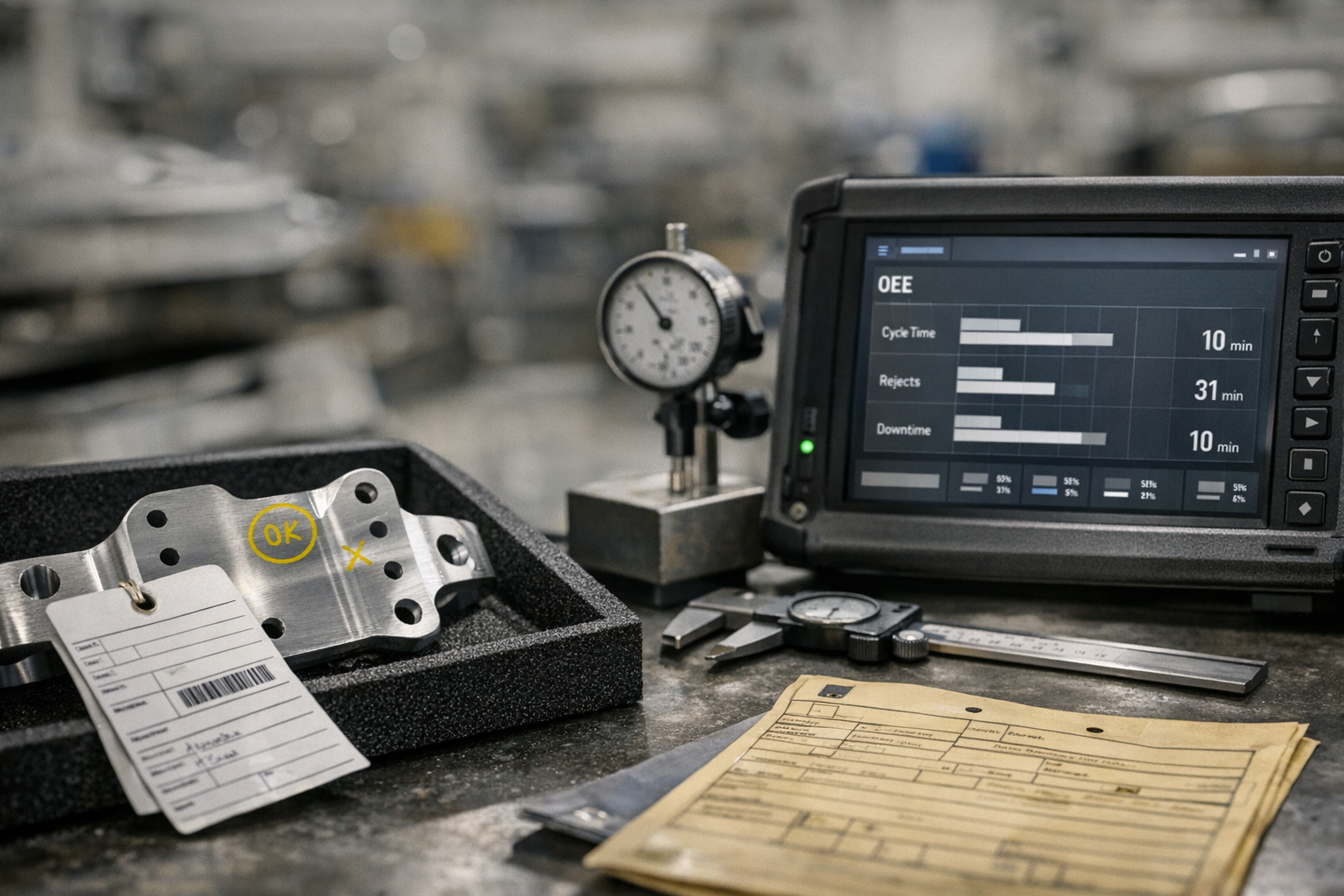
In aerospace manufacturing and MRO, non-conformance reports (NCRs) do not live in a vacuum. Every quality decision affects production schedules, inventory availability, cost accounting, and—ultimately—flight safety. When NCR workflows are disconnected from enterprise resource planning (ERP) and manufacturing execution systems (MES), organizations end up with blind spots, double entry, and conflicting data that erode both efficiency and compliance.
Integrating non-conformance management with ERP and MES creates a single coherent story across work orders, inventory, and quality records. Done well, it lets teams see—within minutes—what material is affected, which operations are blocked, what the cost impact is, and when a line can restart. Done poorly, it introduces new failure modes, data inconsistencies, and audit risks.
For teams putting erp / mes / plm interoperability into daily operation, data mapping and system interoperability, MES execution control, shop floor execution control help connect the concept to traceability, work-order reality, and audit-ready evidence.
The same operating model also depends on ERP, MES, and PLM integration paths, quality management workflows, a connected execution platform, Connect 981’s aerospace execution solutions, especially when decisions have to move across quality, production, suppliers, and program leadership without losing context.
This article explains how to integrate non-conformance management with ERP and MES in aerospace environments. It focuses on key data flows, typical integration scenarios, and design considerations that support reliability, traceability, and regulatory compliance.
For a broader view of process design before you tackle integration, see our guide on integrated aerospace quality workflows.
Why NCR Integration With ERP and MES Matters
Aerospace organizations often start with quality-managed NCRs in a standalone system or spreadsheet. Over time, they discover that almost every disposition decision requires data held elsewhere: work order status in MES, inventory balances in ERP, contract requirements in a customer portal, and so on. Integration closes these gaps.
Linking quality events to work orders and routings
When an inspector raises an NCR, they usually do it in the context of a specific job: a work order, operation, or task. If your NCR system is not tied to ERP and MES, you immediately face problems:
- Ambiguous context: NCRs reference work orders or operations via free-text fields, increasing the risk of mis-typed IDs and mislinked records.
- Lost history: Planners and engineers viewing work orders in ERP or MES cannot see associated NCRs without separate searches.
- Inconsistent status: A work order may look released and executable in MES even though a critical NCR is still open in the quality system.
Integration solves this by ensuring each NCR is anchored to authoritative production data:
- The NCR record references the exact work order, operation, operation sequence, and resource from MES/ERP.
- Work order screens show links or badges indicating open NCRs and their dispositions.
- Routings and travelers reflect holds or additional steps (e.g., rework operations) derived from NCR decisions.
Accurate inventory, WIP, and cost accounting
Every NCR disposition—rework, scrap, or use-as-is—affects quantities and costs. Without integration, these updates depend on manual re-keying into ERP, which is slow and error-prone.
Key impacts that should be automated via integration include:
- Inventory balances: Moving parts to quality hold, returning them to stock, scrapping them, or issuing replacements.
- WIP (work in process): Adjusting WIP quantities when assemblies are partially scrapped or reworked.
- Cost allocation: Capturing labor, material, and overhead associated with rework or scrap to the right cost centers, work orders, or projects.
- Customer or contract impacts: Flagging costs that must be charged to a specific program, contract line item, or warranty account.
With integrated systems, an approved disposition in the NCR workflow can automatically trigger the right ERP transactions—such as inventory adjustments, additional operations, or cost postings—removing the need for duplicate data entry.
Real-time impact assessment for production planning
Production planners, schedulers, and program managers need to answer questions such as:
- How many assemblies are blocked by quality holds?
- Which lines are at risk if this NCR leads to scrap instead of rework?
- Do we have enough conforming material to meet this week’s ship dates?
When NCR, ERP, and MES data are synchronized, planning tools can show the impact of quality events in real time:
- Work orders and operations affected by open NCRs are clearly visible in planning boards.
- Inventory availability calculations reflect parts under quality hold.
- Scenario planning can incorporate potential scrap rates or extended lead times driven by rework.
Core Data Elements Shared Across Systems
Successful integration starts with a precise understanding of which data elements are owned by which system—and how they should be referenced in NCR workflows.
Parts, serial numbers, and configuration baselines
Aerospace quality decisions hinge on precise identification of parts and configurations. Typical shared elements include:
- Part and assembly identifiers: Part numbers, revisions, and descriptions managed in ERP/PLM.
- Serial/lot/batch numbers: Unique identifiers needed for traceability to specific aircraft, engines, or line-replaceable units.
- Configuration baselines: Which drawing revision, bill of material (BOM), and process specification applied when the unit was built or serviced.
From an integration standpoint, your NCR system should never maintain its own “shadow” master list of parts or serials. Instead, it should reference authoritative master data from ERP and, where applicable, PLM or configuration management systems.
Work orders, operations, and resources
Most NCRs relate to an execution context, which lives primarily in MES and/or ERP:
- Work orders / shop orders: Job identifiers, quantities, due dates, and related projects or contracts.
- Operations / tasks: Routing steps, standard work instructions, and inspection operations.
- Resources: Machines, tools, and cells, plus the operators or technicians executing the work.
Integrating non-conformance management with ERP and MES means NCR records can:
- Automatically pull in the correct work order and operation when raised from an MES screen.
- Associate resource usage (machine, fixture, tool) with the deviation to support root cause analysis.
- Feed back rework operations or additional inspections into routings as part of approved dispositions.
Suppliers, customers, and contracts
External stakeholders are a critical part of aerospace non-conformance management:
- Suppliers: Vendor IDs, purchase orders, delivery notes, and certificates of conformity.
- Customers: Contract references, customer-specific quality clauses, and deviation permit processes.
- Regulatory and contractual constraints: Requirements for notification, approval workflows, and retention periods.
Quality systems must use supplier and customer master data from ERP/CRM to ensure that notifications, charge-backs, and reporting align with commercial agreements. For example, an NCR against incoming material should be directly linked to the originating PO and supplier record, not just recorded via free text.
Typical Integration Scenarios
Most aerospace organizations converge on a handful of common NCR–ERP–MES integration patterns. The specifics vary, but the underlying scenarios are remarkably consistent.
Creating NCRs from ERP/MES context
The most visible integration requirement is the ability to launch an NCR from within ERP or MES while preserving context:
- Inspector in MES identifies a defect during an in-process check and raises an NCR against the current operation.
- Receiver in ERP identifies a discrepancy at incoming inspection and triggers an NCR from the purchase order or receipt line.
- Planner finds a documentation error on a work order and opens an NCR tied to that job.
Key design choices include:
- Single sign-on and deep links: Users click a button in MES/ERP and are taken directly to a pre-populated NCR form.
- Pre-filled data: Work order IDs, part numbers, operations, and supplier/customer data are automatically copied from ERP/MES into the NCR.
- Bidirectional references: The NCR stores the originating ERP/MES keys, and the ERP/MES record stores a link or reference back to the NCR.
Applying holds and releases in inventory and WIP
Once an NCR is raised, the organization must prevent suspect material from advancing. Integration enables this without manual phone calls or emails:
- Inventory holds: An NCR on incoming material automatically sets the relevant lots or serials to a quality-hold status in ERP.
- WIP holds: Open NCRs against certain work orders or operations can block movement to the next operation in MES.
- Release logic: When an NCR is dispositioned and containment is verified, the integration can remove holds or redirect units to rework operations.
Design considerations:
- Define which system is the system of record for hold/release status (often ERP for stock, MES for WIP).
- Ensure that NCR workflows cannot close without confirming that physical inventory/WIP status has been updated.
- Provide clear visibility in ERP/MES screens when a part or job is on hold because of an NCR.
Posting rework, scrap, and use-as-is decisions
Disposition drives financial and operational outcomes. Integration should translate quality decisions into concrete ERP and MES transactions:
- Rework: Create or modify operations in MES, issue additional materials, and capture labor hours against rework tasks.
- Scrap: Post scrap transactions in ERP to remove inventory/WIP and book the cost to the appropriate account or project.
- Use as-is / deviation: Record engineering approvals in the NCR system and, where required, update configuration or as-built records in ERP/MES.
These postings should be as automated as practical, based on pre-defined mapping between disposition codes and ERP/MES transactions. At the same time, aerospace organizations must ensure that IT and compliance teams review any automation to verify it meets internal control requirements.
Technical Integration Approaches
No single integration pattern is universally correct. The right design depends on your existing architecture, vendor capabilities, regulatory expectations, and internal IT standards. Most aerospace companies mix several of the approaches below.
APIs, middleware, and event-driven workflows
Modern NCR, ERP, and MES platforms often expose REST or SOAP APIs and can publish or consume events. Typical choices include:
- Direct API integrations: NCR application calls ERP/MES APIs (or vice versa) to retrieve master data and post transactions.
- Middleware / ESB: An integration layer orchestrates data flows, transforms payloads, and centralizes error handling.
- Event-driven architecture: Systems publish business events (e.g., “NCRCreated”, “NCRDispositioned”) to a message bus, and subscribers react by updating their own data stores.
Event-driven designs can reduce coupling and improve scalability but require robust monitoring and governance to avoid silent failures.
Data mapping and master data management
Technical plumbing alone is not enough. You must define consistent semantics across systems:
- Standardized codes for dispositions, defect types, causes, and corrective actions.
- Common identifiers for parts, customers, suppliers, and resources.
- Clear ownership rules for who can create or change master data and how those changes propagate.
Master data management (MDM) practices help here. Whether you use a dedicated MDM tool or governance processes around ERP, the goal is to ensure that all systems refer to the same business objects in the same way.
Handling offline and multi-site environments
Aerospace operations often span multiple plants, test facilities, and field locations—some with intermittent connectivity. Integration designs should account for:
- Local capture: Ability to record NCRs offline on tablets or local systems, then synchronize when connectivity is restored.
- Latency-aware behavior: Clear rules about what actions can proceed without immediate confirmation from ERP/MES (e.g., temporary local holds vs. enterprise-wide stock status changes).
- Site-specific variations: Different ERPs or MES instances at different plants, with a central quality system or vice versa.
For multi-site environments, consider patterns such as hub-and-spoke integration, regional middleware instances, or phased rollouts that allow each site to stabilize before expanding the footprint.
Designing for Reliability and Traceability
In aerospace, an integration that “usually” works is not good enough. Systems must support rigorous traceability, predictable behavior under failure, and clear audit trails.
Error handling and reconciliation
Integration errors will occur: network timeouts, data validation failures, or mismatched identifiers. Designing for reliability means:
- Idempotent operations: Replaying integration messages without creating duplicate transactions.
- Queued retries: Automatic retries for transient failures with backoff policies.
- Dead-letter handling: A controlled queue or worklist for messages that cannot be processed automatically.
- Reconciliation reports: Periodic checks comparing key fields (e.g., hold statuses, scrap quantities) across systems to detect drifts.
Audit trails across system boundaries
Regulators and customers expect you to prove not only what decisions were made, but also how those decisions flowed through your systems. Practical measures include:
- Storing correlation IDs that link NCR records to ERP/MES transactions.
- Logging which integration process invoked which API, with timestamps and outcomes.
- Ensuring that any automated changes (e.g., inventory status updates from an NCR decision) are traceable to the originating NCR and user.
These capabilities simplify audits by showing a clear, end-to-end chain from defect discovery through disposition, execution, and financial posting.
Change management and regression testing
As processes, systems, and regulations evolve, integrations must change. Before deploying modifications:
- Use representative test data that includes critical cases (serialized parts, safety-critical items, customer-specific rules).
- Run end-to-end regression tests that validate not just data movement but also business outcomes (e.g., holds applied, costs posted correctly).
- Involve quality, production, finance, and compliance stakeholders in sign-off.
IT and compliance teams should jointly agree on the level of validation required for each type of integration change, especially where it may impact regulatory evidence or financial postings.
Governance and Continuous Improvement
NCR–ERP–MES integration is not a one-time project. As product lines, suppliers, customers, and regulations change, so do integration requirements. Governance keeps the solution aligned with the business.
Defining ownership for integrated processes
Clarify who owns what:
- Process ownership: Quality leaders define how NCR workflows should behave and what data they require.
- System ownership: IT or application owners manage the configuration and technical integrity of ERP, MES, and quality systems.
- Integration ownership: An integration architect or team maintains the contracts, data mappings, and monitoring around cross-system flows.
Having named owners makes it easier to resolve issues, prioritize enhancement requests, and manage change.
Monitoring data quality and integration KPIs
Beyond technical uptime, monitor indicators that reveal whether integrated processes actually work for the business. Examples include:
- Percentage of NCRs created from ERP/MES context versus manual entry.
- Frequency of mismatches between NCR dispositions and ERP inventory or cost data.
- Number of integration-related incidents discovered during audits.
- Mean time to apply holds in ERP/MES after NCR creation.
These metrics help you identify where integrations need refinement or additional training.
Iterating integration as business needs evolve
As you mature, you may:
- Extend integration to new plants or maintenance depots.
- Incorporate additional systems (e.g., PLM, supplier portals, or field service tools).
- Automate more of the NCR lifecycle where risk and internal controls allow.
Approach this as a continuous improvement program, not a one-time rollout. Regularly revisit your integration design in light of new customer requirements, regulatory interpretations, and internal lessons learned.
Putting It All Together
Integrating non-conformance management with ERP and MES is a cornerstone of modern aerospace quality operations. By anchoring NCRs to production, inventory, and financial data, organizations can:
- Reduce manual data entry and associated errors.
- Provide real-time visibility into the impact of quality issues.
- Strengthen traceability from defect detection through disposition and execution.
- Improve readiness for regulatory and customer audits.
There is no single blueprint that fits every aerospace organization. The right integration architecture depends on your current systems, regulatory posture, and risk tolerance. What matters most is that IT, quality, production, and finance jointly define how data should flow, validate the design against compliance requirements, and treat integration as a living capability that evolves with the business.