RSC Topic: Inventory Accuracy and Material Control

  • How do you handle kit changes after production has started?

    Why kit changes in-flight are risky

    Changing a kit once production has started is inherently high risk because it disrupts a configuration that has already been planned, documented, and often partially built. At that point, bills of material, routings, travelers, and quality plans may already be instantiated, and operators may be following printed or cached instructions. Uncontrolled changes can create mixed configurations on the line, undocumented rework, and gaps in traceability. In regulated environments, this quickly turns into a documentation and audit exposure, not just an efficiency issue. For that reason, in-flight kit changes need to be treated as controlled configuration changes, not quick fixes.

    Start with clear triggers and decision gates

    You need defined triggers for when a kit change is even allowed after production start, such as formally logged nonconformances, customer-driven configuration changes, or safety-critical design updates. Each trigger should route through a decision gate involving at least engineering and quality, and often production planning. At that gate, the team decides whether to stop the order, scrap or rework parts, or proceed under controlled change with updated kits. In many brownfield plants this decision process is partly manual, but it still needs documented criteria and accountable approvers. Without clear gates, production staff will improvise, leading to uncontrolled divergence between the physical build and the documented configuration.

    Perform a structured impact assessment first

    Before changing any kits, perform an impact assessment covering technical, quality, and schedule implications. From a technical standpoint, identify which assemblies and serial numbers are already at which build step and whether the new kit content is forward- and backward-compatible. From a quality and regulatory angle, clarify whether this is a design change, a deviation, or a concession, and what level of documentation and validation evidence is required. Operationally, check capacity to rework affected units, material availability for revised kits, and any knock-on effects on downstream test or inspection. In older MES/ERP environments this analysis often relies on a mix of system queries and manual line walks; pretending it is fully automated when it is not is a source of errors.

    Control work in progress and separate configurations

    Once you commit to a kit change, you must prevent uncontrolled mixing of old and new configurations on the floor. A pragmatic pattern is to clearly separate work-in-progress into: units that will finish under the old kit, units that will be reworked to the new kit, and units not yet started that will begin with the new kit. Physical segregation, clear traveler markings, and line-side signage are often as important as system flags, especially in plants that still rely on paper travelers. If you attempt to drive everything purely through system statuses without physical controls, you increase the risk of operators following obsolete instructions or pulling the wrong components.

    Update BOMs, routings, and travelers under change control

    Any in-flight kit change should flow through your existing change control process, even if you need an expedited path. That typically means updating the BOM and relevant routings or work instructions, with clear effective dates or effectivity by serial/lot. Travelers or electronic work orders must reflect which configuration applies to which unit, and which additional steps (e.g., removal and replacement) are required. In brownfield stacks, aligning ERP BOMs, MES work instructions, and line documentation is often the hardest part and the main source of mismatch. If these systems cannot be synchronized quickly, you may need temporary controlled workarounds, like controlled rework sheets tied to specific serials, while formal master data updates catch up.

    Handle physical material and kitting logistics explicitly

    Changing a kit is not just a data change; it is a physical materials problem. Old components already issued to the order may need to be quarantined, returned to stock, or scrapped with proper disposition records. New components must be picked, verified, and staged, ideally with barcode or RFID checks where available, but often still supported by manual counts. Point-of-use storage labels and kanban bins may need to be updated to avoid operators grabbing superseded parts. If warehouse and production systems are weakly integrated, expect manual reconciliations between inventory records, kitting lists, and what operators actually have at the station, and plan for that overhead in the process.

    Maintain full traceability and documentation of the change

    For regulated work, traceability of what changed, when, for which units, and under whose approval is non-negotiable. Every affected serial or lot should be linked to the specific change record, deviation, or concession identifier. Inspection records, test results, and certificates of conformity must reflect the final as-built kit, not just the original plan. In older or fragmented IT environments, this often means supplemental documentation such as annotated travelers, controlled rework forms, or configuration summary sheets. The key is that an auditor can reconstruct, without guesswork, how the final configuration for each unit relates to the change and when the new kit content became effective.

    Plan for validation, qualification, and re-verification where required

    If the kit change alters form, fit, function, or process parameters in a regulated product, you may trigger the need for additional validation or qualification steps. That might include targeted re-qualification runs, additional first-article inspections, or temporary 100% inspection versus sampling. The burden depends heavily on your sector, customer contracts, and change classification, so the process must call this out explicitly. Attempting to shortcut these steps to avoid downtime can create bigger issues later when nonconformances surface in the field or during customer audits. Because full revalidation is costly, plants often use risk-based approaches, but those need to be documented and consistently applied, not improvised.

    Brownfield coexistence: accept partial automation and manual controls

    In most existing plants, the systems landscape cannot fully automate or perfectly synchronize in-flight kit changes. ERP, MES, PLM, and QMS often use different identifiers, update cycles, and ownership, making real-time effectivity control difficult. Effective handling usually combines: minimal but clear system changes (like status flags and revised BOMs), structured but manual communication (like focused line briefings), and simple physical controls (segregation, labels, and traveler annotations). Attempts to replace or heavily re-platform systems just to handle rare kit changes often fail under the weight of validation, integration complexity, and downtime risk. It is usually more realistic to strengthen procedures, training, and simple integration points than to chase a fully automated, zero-manual-touch solution.

    Connecting this to your environment

    If your current process for mid-build kit changes consists mainly of emails and verbal instructions, you likely already carry hidden risk in traceability and configuration control. A practical first step is to formalize triggers, decision gates, and minimum documentation requirements, even if your systems remain unchanged. From there, you can incrementally improve by tying change records to work orders in your existing MES/ERP, and by using simple physical controls on the line to separate configurations. Over time, you can target the highest-risk gaps—such as unsynchronized BOMs or poor serial-level tracking—rather than trying to redesign the entire stack around this one class of event.

  • How does better traceability directly reduce scrap and rework costs?

    Direct ways traceability reduces scrap and rework

    Better traceability reduces scrap and rework primarily by shrinking the *scope* and *duration* of quality events, not by magically preventing all defects. When you can precisely identify which lots, serials, or units are exposed to a specific risk, you avoid blanket quarantine or mass disposition of otherwise good product. This translates into fewer units scrapped “just in case” and less unnecessary rework driven by uncertainty. The effect is most visible when something goes wrong and you need to act quickly under incomplete information.

    When traceability links materials, process steps, equipment, and operators at the batch/serial level, you can isolate suspected product more surgically. Instead of scrapping a full shift’s production, you may restrict action to a few pallets, travelers, or serial numbers with a specific combination of inputs and process parameters. This works only if the trace data is accurate, complete, and reliably time-aligned; partial or inconsistent data can force you back to conservative, high-scrap decisions. In well-configured environments, this containment precision is one of the largest direct cost levers.

    Faster and more accurate root cause analysis

    Scrap and rework costs stay high when root cause analysis is slow or inconclusive and temporary fixes drag on. Good traceability provides a structured data backbone for root cause work by connecting nonconformances to specific materials, process conditions, tools, and changes. Investigators can quickly compare good vs. bad units along the actual process history instead of relying on anecdote and memory. This typically reduces time spent on broad, trial-and-error rework campaigns while the team searches for the cause.

    When you can reliably correlate defects to a particular supplier lot, equipment state, program revision, or operator training status, you can stop producing more defective units sooner. This early stop limits downstream scrap and rework accumulation, especially in multi-step, high-value processes where defects are discovered late. However, this depends on appropriate data granularity and on cross-system visibility between QMS, MES, and ERP. If key links are missing (for example, NC records not tied to specific work orders or serials), the theoretical benefit of traceability will not materialize in lower rework costs.

    Narrower quarantines and more confident dispositions

    In many regulated plants, the most expensive scrap events arise not from known-bad product but from *uncertainty* about what might be affected. Better traceability allows quality and operations to define the actual exposure window and affected configurations, so quarantine and hold decisions can be narrowly targeted. This reduces the volume of product sitting idle, aging, or ultimately scrapped because risk cannot be bounded. In aerospace-grade or pharma environments, this can mean the difference between scrapping weeks of output vs. a handful of lots.

    The same trace data underpins more confident disposition decisions. When you can demonstrate that certain units never saw the suspect material, parameter drift, or out-of-tolerance tool, you may justify release or reduced rework scope under your quality procedures. This must be done within your documented risk and validation framework; traceability does not override specification or regulatory requirements. In weakly governed environments, there is a real risk that better data is misused to rationalize marginal releases, so strong quality oversight and clear criteria remain essential.

    Earlier defect detection and prevention of cascading rework

    High-resolution traceability often surfaces patterns and weak signals earlier, before they generate large rework backlogs. By linking in-process inspections, SPC results, and equipment events to individual units or batches, you can catch emerging issues before they propagate through additional value-adding steps. Stopping a problem at operation 20 instead of operation 80 can prevent significant scrap of expensive assemblies and reduce rework complexity. This is particularly important in long routing, high-mix, or special-process environments.

    However, traceability only enables earlier detection if people and systems actively use the data for monitoring and alerts. Without clear thresholds, workflows, and responsibilities, richer trace data simply accumulates in databases while scrap and rework patterns continue unchanged. Integration with existing MES, QMS, and equipment data historians is critical; if operators and engineers cannot easily see and act on linked data in their normal tools, practical impact on scrap will be limited. The improvement is as much about process discipline as it is about technology.

    Improved supplier and material control

    Scrap and rework often originate in variable or marginal incoming materials that only show issues later in the process. With robust lot-level and sometimes characteristic-level traceability, you can connect downstream defects back to particular suppliers, lots, or certificates of conformance. This supports data-backed supplier corrective actions, tighter acceptance criteria, or alternate sourcing decisions. Over time, this reduces the recurrence of material-driven rework and scrap.

    Better traceability also allows you to segment material risk instead of treating all supply from a vendor as equivalent. You may choose to route higher-risk lots to more robust processes, additional inspections, or less critical product while preserving lower-risk material for demanding applications. These strategies depend on stable supplier relationships and careful change control; abrupt, undocumented routing changes can create new failure modes. In regulated environments, you must ensure that any differential controls remain traceable and justifiable during audits.

    Practical constraints in brownfield and regulated environments

    In brownfield plants with mixed MES/ERP/QMS and long-qualified equipment, traceability improvements are usually incremental and uneven across lines. You may get strong unit-level traceability on some new assets while older stations remain paper-based or partially digitized. As a result, scrap and rework reductions may be localized to flows where end-to-end trace links are actually reliable. Full replacement of legacy systems just to improve traceability often fails in aerospace-grade contexts due to validation cost, downtime risk, integration complexity, and the need to preserve historical records.

    To realize cost benefits without destabilizing operations, many sites layer new traceability capabilities on top of existing systems (for example, barcodes or RFID tied into the current MES, or a traceability service that links QMS NCs to legacy ERP work orders). This coexistence approach brings its own risks: mapping errors, duplicate master data, and confusion about the “system of record” can all undermine confidence in trace data. Without rigorous change control, validation of interfaces, and clear data ownership, improved traceability can be perceived as untrustworthy, driving conservative decisions and negating the intended scrap and rework reductions.

    Why better traceability is not a guarantee of lower scrap

    Better traceability is an enabler, not a guarantee. If the underlying processes are unstable, work instructions are unclear, or training is weak, you will still generate defects—just with better records of how they happened. In such cases, initial implementation of traceability may even *reveal* more issues, causing a temporary increase in recorded scrap or rework as hidden problems become visible. Leadership needs to treat this as diagnostic information rather than a failure of the traceability effort.

    Sustained scrap and rework reduction requires that engineering and quality actually use traceability data in continuous improvement and problem-solving routines. If trace data is captured only to satisfy regulatory requirements and never analyzed, the impact on cost will be marginal. Conversely, over-reliance on traceability without adequate process controls can encourage a “fix it later” mindset that drives up rework. The most effective sites pair robust traceability with disciplined root cause analysis, preventive actions, and careful evaluation of changes before they are rolled into validated production.

  • How does MES help reduce the need for high safety stock levels?

    How MES changes the drivers behind safety stock

    Safety stock is usually a response to uncertainty: unreliable lead times, poor schedule adherence, quality variation, and weak visibility of work-in-progress. MES can help by reducing some of this uncertainty and exposing it earlier, which makes lead times more predictable and safety stock calculations less conservative. In practice, MES does not eliminate the need for safety stock, but it can justify lowering buffers where performance, data, and integration are proven and validated. Any reduction should be based on measured improvements, not assumptions about what the software “should” do. Plants in highly regulated environments typically move in small steps to avoid jeopardizing service levels or compliance.

    Lead time stability and schedule adherence

    One of the most direct ways MES helps is by tightening the link between the schedule and real-time execution, so planned lead times are closer to actuals. Detailed dispatching, constraint-aware sequencing, and visibility into resource status can reduce unplanned waiting, changeover delays, and priority conflicts. As schedule adherence improves and variability narrows, planning teams can recalculate safety stocks with shorter and more stable lead times. However, this only holds if the MES is properly configured, operators actually use the dispatching logic, and maintenance, materials, and quality processes are aligned. In brownfield environments with multiple legacy schedulers and informal workarounds, these gains are often partial and uneven across lines or value streams.

    Visibility of WIP and true inventory position

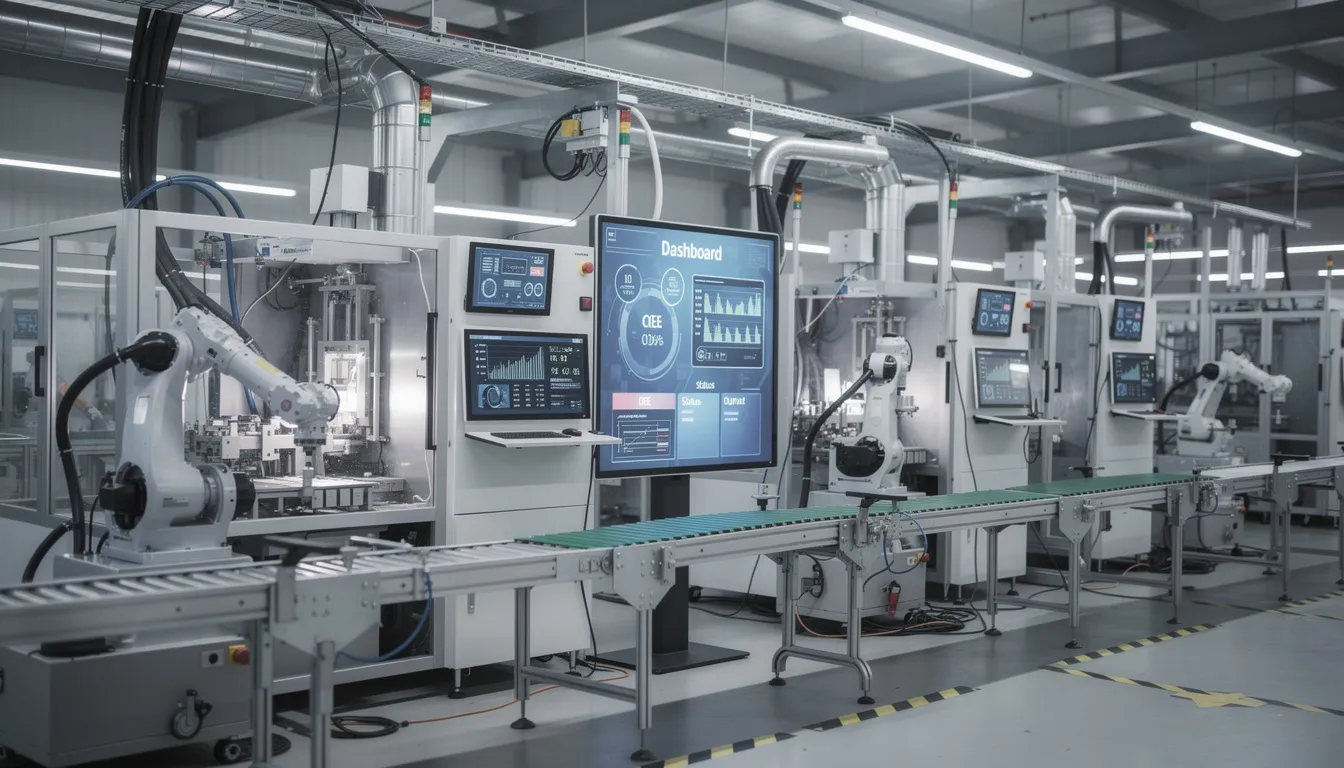
    MES typically exposes real-time WIP location, status, and quantity, which reduces the need to carry extra finished goods just to compensate for poor visibility. When planners and customer service can see what is in-process, waiting for test, or in rework, they can rely less on conservative safety stock and more on the actual pipeline. This is only effective if the MES is consistently updated at the point of work and integrated with ERP so on-hand, WIP, and planned orders form a coherent picture. Barcode or RFID scanning gaps, offline work centers, and parallel shadow spreadsheets will quickly erode trust in the data. In regulated plants, traceability requirements often mean that manual or semi-automated data capture persists, which can limit how much you can tighten stocks.

    Quality yield, rework, and scrap predictability

    High or unpredictable scrap and rework rates are a major driver of inflated safety stock, especially in complex assemblies or special processes. MES can help by enforcing electronic work instructions, capturing process parameters, and linking nonconformances to specific operations and materials. Over time, this can improve first-pass yield and make residual defects more predictable, allowing planners to reduce the extra inventory held to buffer quality risk. The benefit depends heavily on the maturity of your quality processes, the integration between MES, QMS, and LIMS (if applicable), and whether corrective actions actually change behavior on the floor. In regulated industries, additional inspections or mandatory holds can offset some of the gains and keep effective lead times longer.

    Changeover, batch size, and response flexibility

    MES can support smaller, more frequent runs by improving setup coordination, material availability, and line readiness, which in turn allows you to respond faster to demand changes and hold less finished goods. Electronic checklists, staged kitting, and better alignment between maintenance windows and production plans can reduce changeover variability. However, if your equipment is inherently slow to change over or requalification is required after certain changes, MES alone will not make small batch scheduling economical. Safety stock targets should reflect these physical and regulatory constraints, not just software capabilities. In many brownfield plants, a hybrid model emerges where some families move toward leaner buffers while others remain tied to large, validated campaign runs.

    Integration with ERP and planning processes

    MES only influences safety stock meaningfully when it is tightly integrated with ERP and planning tools so that improved execution data flows into planning parameters. Without this, planners continue to use legacy lead times, yields, and lot sizes, and safety stocks remain inflated regardless of execution improvements. Robust interfaces, consistent master data, and validated data flows are all prerequisites, and they are often non-trivial to achieve in mixed-vendor landscapes. You also need governance so that when measured lead time performance improves, the planning team systematically updates safety stock and related settings. In aerospace-grade and similar environments, any change to planning logic or parameters may require documented risk assessment and change control, which slows down how fast you can capture MES-derived benefits.

    Constraints, tradeoffs, and realistic expectations

    MES is an enabler, not a guarantee, of lower safety stock. If upstream suppliers are unreliable, qualification cycles are long, or regulatory release steps add fixed time, you will still need buffers even with excellent shop-floor execution. Aggressively cutting safety stock based solely on an MES rollout is risky; reductions should follow demonstrated improvements in schedule adherence, yield, and response time, confirmed over sufficient history. There is also a tradeoff between inventory and other costs: tighter stocks may expose issues faster but can increase expediting, overtime, and customer risk if performance backslides. In long-lifecycle, validated environments, many sites choose targeted reductions on stable, high-volume products while retaining traditional buffers on critical, low-volume, or highly regulated items.

    Applying this in brownfield, regulated plants

    In existing regulated facilities with legacy MES/ERP/QMS stacks, the most practical approach is to pick a specific value stream and baseline current variability and service levels. Use MES to improve data capture, stabilize the schedule, and tighten execution, then re-estimate safety stocks for that scope based on observed performance, not theoretical gains. Expect integration and behavioral issues to surface: operators bypassing terminals, mismatched master data, and parallel planning spreadsheets. Treat any safety stock reduction as a controlled change with clear monitoring metrics and rollback criteria. Over time, this disciplined, incremental approach can reduce safety stocks where justified, without compromising traceability, qualification status, or customer commitments.

  • How long does it typically take to implement MES for inventory control in aerospace?

    Typical timelines and why they vary so much

    For aerospace environments, an MES implementation focused on inventory control is usually measured in months and years, not weeks. A narrowly scoped pilot in a single area, with limited integrations and pragmatic requirements, might reach production use in 4–6 months, but 6–12 months is more realistic for a plant-level deployment. Multi-site rollouts, or cases where MES inventory control is deeply tied into ERP, PLM, QMS, and warehouse systems, often stretch to 18–36 months. The main drivers are integration complexity, validation burden, the need to preserve traceability, and constrained windows for downtime. Any vendor estimate that ignores these factors is unlikely to hold up once you start detailed design.

    Scope, ambition, and the trap of “just inventory control”

    On paper, “MES for inventory control” sounds like a small, contained use case, but in aerospace it quickly touches traceability, quality holds, configuration control, and regulatory records. If you limit scope to basic material visibility within one facility and keep existing ERP as the system of record for quantities and value, you can usually keep the project closer to the 6–12 month range. As soon as you add serialized tracking across multiple sites, alternate part usage rules, repair/overhaul flows, or complex kitting and staging logic, timelines extend significantly. Trying to redesign all inventory-related processes at once (receiving, stockroom, WIP, kitting, shipping) tends to turn an inventory project into an enterprise transformation, which is why many programs overrun. Practically, you get faster, more stable outcomes by starting with a constrained subset of flows and expanding once those are proven.

    Brownfield reality: coexistence with ERP, WMS, and legacy MES

    In most aerospace plants, inventory data already lives in multiple systems: ERP, WMS, legacy MES, spreadsheets, and sometimes homegrown tools. An MES project that assumes you can simply turn those off and move inventory into a single new system typically runs into qualification and downtime barriers. More realistic programs treat MES as an operational control and visibility layer, while ERP remains the financial and legal system of record for inventory. This means you have to design and validate interfaces, reconciliation processes, and exception handling for data mismatches. Building and testing robust coexistence usually adds several months, but skipping it creates chronic discrepancies and audit risks that are much harder to fix after go-live.

    Validation, qualification, and change control overhead

    In aerospace, any system that affects product configuration, material genealogy, or records used for regulatory or customer evidence will attract validation and qualification expectations. Even if you limit MES to operational inventory control, you still need documented requirements, risk analysis, test protocols, and traceability between them. Creating this documentation, executing tests, capturing evidence, and resolving findings often consumes as much calendar time as the technical build itself. On top of that, formal change control—design reviews, approvals, and configuration management of workflows and master data—adds latency to every decision. This overhead is necessary for long-term credibility, but it means that an otherwise quick configuration change can take weeks to move from idea to production, and this directly affects implementation timelines.

    Data quality, master data, and process readiness

    MES inventory control depends heavily on clean and consistent master data: part numbers, units of measure, storage locations, BOMs, alternates, and effectivity rules. In practice, many aerospace plants discover data gaps (e.g., incomplete serialization rules, inconsistent location coding, or undocumented kitting practices) only once they start detailed MES design. Cleansing and reconciling this data, and aligning it across ERP, PLM, QMS, and MES, often takes longer than expected and becomes a critical path activity. Similarly, if current processes are undocumented, highly tribal, or vary by shift or cell, the team must stabilize and standardize them before they can be automated. When data and processes are mature and well-documented, timelines compress; when they are not, months can be added purely for preparation and rework.

    Downtime constraints and phased rollout strategies

    Aerospace operations typically cannot afford long, full-plant outages to switch over inventory systems. As a result, MES implementations for inventory control are usually phased: start with a pilot line or stockroom, run MES and legacy processes in parallel, reconcile discrepancies, and then expand scope. Each phase requires cutover planning, operator training, temporary workarounds, and careful monitoring to prevent disruption to production schedules. This reduces risk but adds calendar time because you are effectively executing multiple small go-lives instead of one big bang. Plants with more flexible schedules and buffer stock can implement faster; high-utilization, low-buffer operations tend to choose more cautious, slower rollouts.

    Why full replacement strategies usually extend or fail

    Attempts to replace all existing inventory capabilities across MES, ERP, WMS, and custom tools in one step often stall in aerospace environments. The combined qualification and validation workload becomes very large, since every interface and business rule must be demonstrated and documented. Integration complexity multiplies because inventory is tied to planning, finance, quality, maintenance, and logistics, and each of those domains has its own constraints and legacy integrations. Long asset and system lifecycles mean you must coexist with older equipment and software that cannot easily be retired or changed. As a result, full replacement strategies tend to produce multi-year programs with repeated deferrals, scope cuts, and partial rollbacks. Incremental replacement—targeted MES capabilities layered onto existing systems, then gradually expanded—is slower in any single area but more likely to succeed overall.

    Practical expectations and planning assumptions

    If you are planning MES for inventory control in an aerospace plant with typical brownfield constraints, a reasonable baseline is 6–12 months for a well-scoped, single-site initial deployment, assuming existing ERP, WMS, and PLM stay in place. Expect another 6–18 months for stabilization, incremental scope expansion, and additional sites, depending on how aggressively you push integration and standardization. Shorter timelines are possible if processes and data are already clean, integrations are simple, and validation expectations are lighter, but these conditions are uncommon. When building your plan, treat vendor configuration estimates as only one part of the picture; add explicit time for integration, data work, validation, training, and change control. It is safer to plan conservatively and deliver earlier in limited scope than to promise a rapid, full replacement that later has to be scaled back under operational and regulatory pressure.

  • stock-keeping unit

    Meaning in industrial and regulated environments

    A **stock-keeping unit** is a unique identifier assigned to a distinct, countable item in inventory so that it can be tracked, stored, moved, and reconciled consistently across systems such as ERP, WMS, and MES.

    In practice, a stock-keeping unit (often shortened to SKU) represents a specific combination of characteristics that the organization chooses to manage as a separate inventory item. Typical characteristics include:

    – Material or product code
    – Version or revision (where applicable)
    – Packaging form (e.g., bulk, case, kit, palletized unit)
    – Unit of measure used for stock (e.g., each, bag, drum)
    – Sometimes grade, potency band, or other commercially distinct attributes

    A SKU is the level at which inventory is usually counted, valued, and transacted (receipts, issues, moves, adjustments), and against which planning and replenishment are performed.

    How SKUs are used in manufacturing workflows

    In industrial and regulated manufacturing, SKUs commonly serve to:

    – **Align physical inventory with business systems**: Each SKU maps to a material or item master record in ERP and often to a corresponding material or item definition in MES or LIMS.
    – **Support material flow and traceability**: SKUs define the item that is received, stored, picked, issued to production, and shipped. Batch/lot numbers, serial numbers, and other identifiers are then tracked within each SKU.
    – **Enable planning and scheduling**: MRP/MPS and capacity planning typically operate at the SKU level (e.g., plan to produce 1000 units of a specific finished-good SKU).
    – **Structure warehousing operations**: Locations, bin assignments, and picking strategies are often defined per SKU.

    In regulated environments, the combination of **SKU + batch/lot + other identifiers** (such as container IDs, serial numbers, or MES material lots) forms the basis for detailed material genealogy and electronic records.

    Boundaries: what a stock-keeping unit is and is not

    A stock-keeping unit **is**:

    – A business and operational construct for uniquely identifying and managing an inventory item.
    – Tied to how materials are bought, stored, produced, and sold.
    – The level at which standard cost and valuation are typically maintained in ERP.

    A stock-keeping unit **is not**:

    – A batch, lot, or serial number (those are identifiers for specific instances within a SKU).
    – A regulatory classification (though it may embed attributes relevant to compliance, such as strength or packaging type).
    – Necessarily universal: SKU structures and codes are usually company-specific, even if they reference external identifiers (like GTINs or part numbers from suppliers).

    Common confusion and terminology

    – **SKU vs. part number**: In some organizations these are equivalent. In others, a part number describes the design, while a SKU represents a specific stocked variant (e.g., different pack sizes or labels for different markets).
    – **SKU vs. item master/material master**: The item or material master record in ERP defines the attributes and rules for a SKU. The SKU is the specific stocked item instance of that definition.
    – **SKU vs. batch/lot**: The SKU is the product definition (e.g., 500 mL vial, 10-pack). The batch/lot identifies a specific production run of that SKU.

    Clarity on how a company defines SKUs is important when integrating MES, ERP, WMS, and quality systems, as each system may use slightly different terminology for similar concepts.

    Application to kits and MES (site context)

    When dealing with **kits** in MES and ERP:

    – A kit may be modeled as its **own SKU** (a distinct inventory item) if it is pre-assembled, stored, and transacted as a single unit.
    – Alternatively, a kit may be treated as a **logical grouping** of underlying component SKUs, without defining a separate kit SKU, if it is assembled on demand and not stored as a finished stock item.

    The decision to create a kit as a separate SKU affects:

    – How inventory is counted and reserved in ERP and WMS
    – How materials are issued and reconciled in MES
    – How traceability and genealogy are represented (e.g., whether the kit itself is a tracked inventory object or just a set of component consumptions)

    In all cases, the stock-keeping unit remains the core concept for defining what is being stocked, moved, and consumed in the manufacturing and supply chain systems.

  • What are best practices for scanning and labeling serialized parts on the shop floor?

    Start from the data model, not the label format

    For serialized parts, the primary risk is not the label technology but ambiguous data ownership and weak data models. Before specifying labels or scanners, define which system is the system of record for serial numbers, what attributes are tied to each serial (lot, revision, configuration, test status), and which events must be captured at scan time. In brownfield environments, this often means reconciling MES, ERP, and test systems that each already “think” they own serialization. Aligning on a single serialization scheme and reference data set avoids duplicate serials, conflicting statuses, and broken traceability during audits. Once the data model is clear, you can map exactly what needs to be human-readable, encoded in barcodes/RFID, and stored in back-end systems, instead of letting label space or scanner limitations drive critical design decisions.

    Use proven, unambiguous identifiers and symbologies

    Best practice is to use a globally unique, machine-readable identifier per serialized part and stick with it consistently across the plant. In regulated environments, that usually means a 1D barcode (Code 128, Code 39 where legacy demands it) or a 2D code (Data Matrix, QR) plus a human-readable serial number printed nearby. 2D Data Matrix is typically preferred for small parts or harsh environments because it is denser and often more robust to damage. Avoid encoding unnecessary data in the code itself (like full routings); instead, store that data in MES/ERP and use the scanned serial as a key, which reduces label changes and revalidation when processes evolve. Where multiple identifier schemes already exist, maintain a clear mapping table and transition plan, and document which symbology is authoritative for new production to avoid long-term confusion.

    Design labels for the environment and lifecycle

    Label design must account for temperature, chemicals, abrasion, and the full equipment or part lifecycle, not just the next station. In aerospace-grade contexts, parts can see decades of service, so label materials, adhesives, and marking methods (label vs laser mark vs nameplate) need to match that reality. Clearly separate safety markings, regulatory information, and production serialization to avoid operators covering critical markings when adding rework labels. Test label legibility and adhesion through realistic cleaning, curing, and handling conditions before rolling out plant-wide. Treat label templates as controlled documents: any layout, content, or symbology change should go through change control and, where required, revalidation of both printing and scanning.

    Place labels for reliable scanning and realistic handling

    Label placement is as important as label design in determining scan reliability and operator compliance. Best practice is to standardize preferred label zones per part family or tooling, so operators do not improvise locations that end up hidden, curved, or blocked by fixtures. Place labels so they are scannable without unsafe body positions, excessive reach, or disassembly of clamps and tooling, or operators will bypass the process. For assemblies, plan label location early in design so downstream wiring, hoses, or covers do not permanently obscure the serialized ID. In dense work areas, ensure that a scanner’s field of view will not pick up adjacent parts inadvertently and cause mis-scans. Validate placement at pilot stations and get direct operator feedback, then document the finalized locations in work instructions and visual standards.

    Standardize scanning workflows to avoid bypasses and workarounds

    Scanning must be embedded into the work sequence, not added as an afterthought that competes with takt time. Define explicit triggers for scans: at material receipt, WIP start, critical process steps, test completion, and final pack-out, based on your traceability requirements. Configure MES or station software so operators cannot complete key steps without scanning the correct serial, while still providing controlled overrides with justification for edge cases. Avoid workflows that require multiple system logins or duplicate scans into parallel applications; such friction creates pressure for manual workarounds and back-dated entries. Where legacy systems require separate entries, design a single front-end workflow that posts to both via integration or controlled background jobs, and document any remaining manual transfers clearly.

    Select scanners and readers based on real-world conditions

    Scanner selection should be driven by actual lighting, distance, label size, contrast, and part movement, not by lab specs or vendor demos. Fixed-mount scanners work well for automated stations or conveyorized flows, while handheld scanners are more flexible for manual assembly cells but easier to misuse. In noisy RF environments, or with metal-intensive assemblies, RFID performance can be inconsistent and requires specific tag types and careful antenna placement; treat RFID as a specialized solution requiring thorough piloting, not a default. Validate that scanners can reliably read all relevant symbologies and damaged labels at the speed required, and that error rates are acceptable under realistic shift conditions. Ensure firmware, configuration files, and any custom scripts on scanners are under change control, with versioning and rollback paths, to avoid untraceable behavior changes on the line.

    Integrate scanning with MES/ERP/QMS rather than standalone islands

    Scanning should feed directly into the systems that own work orders, routings, and quality records, not into disconnected spreadsheets or local databases. In most brownfield plants, that means integrating with existing MES and ERP systems that may have limited or aging APIs. Where real-time integration is not feasible, design robust batch data flows with clear reconciliation reports so missing scans or failed transfers are visible quickly. Avoid creating parallel “shadow” serialization databases just to work around integration delays, as they almost always diverge and cause major issues during investigations or audits. For regulated contexts, maintain clear traceability from each scanned event back to the originating system, user, and timestamp, and ensure any transformation or aggregation logic is documented and validated.

    Plan explicitly for rework, relabeling, and scrap scenarios

    Rework and relabeling are common failure points for serialized control on the shop floor. Procedures should specify exactly when a new label is applied, whether the serial changes or not, and how old labels are cancelled, covered, or removed to avoid dual identities. When parts move off the main route for repair or investigation, scanning workflows must still capture all critical steps and maintain linkage to the original work order and history. Scrapping procedures should ensure the serial number is clearly flagged as non-conforming in the system of record, so it cannot accidentally be reassigned or shipped. Audit trails must show, for any serialized part, all label changes and rework histories, including who performed the actions and under what authority.

    Validate and maintain the end-to-end serialization and scanning process

    In regulated environments, the serialization and scanning process is a system that must be validated as a whole, not just its components. This includes label printing software, templates, scanners, integration logic, and MES/ERP configurations that interpret scanned data. Define test cases that cover normal operations, error conditions (mis-scans, unreadable labels, duplicate serials), and edge scenarios like partial system outages or offline operation. Periodically re-verify performance as labels, materials, equipment, or software versions change, recognizing that long equipment lifecycles mean old and new components will coexist for years. Use periodic sampling, internal audits, and investigation of data anomalies to catch drift in scanning discipline or accuracy before they show up in customer escapes or formal audits.

    Recognize why “rip and replace” serialization projects often fail

    Attempting to replace all existing serialization, scanning, and labeling systems in one step is risky in aerospace-grade and similar regulated settings. The qualification and validation burden for a new, unified solution can be substantial, especially when it touches MES, ERP, QMS, and test data flows simultaneously. Downtime to retrofit labels, reconfigure scanners, and rewire integration points across many lines is often underestimated and may be incompatible with business demand. Legacy assets and long-lived parts may be locked into older serialization schemes that cannot be retroactively changed without jeopardizing field traceability. A more realistic approach is incremental: stabilize and document current practices, pilot improved labeling and scanning on targeted product families, and gradually harmonize standards while maintaining clear cross-references and traceability during the transition.

  • stockist/distributor

    A stockist/distributor is an organization that purchases goods from manufacturers or upstream suppliers, holds those goods in inventory, and then resells and ships them to downstream customers. In industrial and regulated manufacturing supply chains, this role often focuses on managing availability, traceability, and correct documentation rather than performing design or complex production activities.

    Core characteristics

    In manufacturing and aerospace contexts, a stockist/distributor commonly:

    • Buys finished goods or standard parts (for example, fasteners, electronic components, raw material stock) from approved manufacturers or master distributors.
    • Holds inventory in warehouses or stocking locations to support customer lead-time and availability needs.
    • Resells and ships items to OEMs, MRO providers, or other users, often according to framework agreements or long-term contracts.
    • Maintains product identification, certificates, and records (such as certificates of conformity, batch/lot information, and country-of-origin data).
    • May perform limited value-added services, such as breaking bulk, repackaging, basic inspection, barcoding, or kitting, without changing the product design.

    In aerospace and defense, the term is often used in connection with quality management standards such as AS9120, which commonly applies to organizations that procure, store, and distribute parts and materials but do not design or produce them.

    Operational meaning in regulated environments

    For regulated industries, a stockist/distributor typically needs controls around:

    • Traceability: Maintaining linkage between received lots/batches and customer shipments, including part numbers, serial or lot numbers, and supplier details.
    • Document control: Managing and transmitting correct revision levels, certificates, and regulatory documents with each shipment.
    • Supplier and customer requirements: Ensuring purchased items and distribution practices meet contractual, regulatory, and quality-management expectations.
    • Storage and handling: Preserving product integrity through appropriate environmental controls, shelf-life management, and segregation of conforming and nonconforming stock.

    What it is not

    A stockist/distributor, in this sense, typically does not:

    • Design products or manage product engineering changes.
    • Perform full manufacturing or complex special processes on the items (such as machining to drawing or full assembly build).
    • Act as a maintenance/repair/overhaul (MRO) organization performing functional repairs on equipment or aircraft.

    Common confusion

    • Distributor vs. manufacturer: A manufacturer transforms raw materials or components into finished products to a design. A stockist/distributor primarily manages the flow and availability of existing products.
    • Stockist/distributor vs. broker: A broker may arrange transactions without taking physical possession or ownership of the goods. A stockist/distributor typically owns and physically holds inventory.
    • Stockist/distributor vs. MRO provider: An MRO provider repairs or overhauls equipment; a stockist/distributor supplies parts and materials that MROs or operators may use.

    Link to aerospace standards context

    In the aerospace quality standard family, organizations acting mainly as stockist/distributors for aerospace parts and materials are commonly associated with AS9120, whereas organizations that design and manufacture products are more commonly associated with AS9100, and those focused on maintenance/repair/overhaul (MRO) with AS9110.