Introduction: Why Aerospace Manufacturing Operations Must Change Now
The period from 2024 through 2026 marks an inflection point for aerospace manufacturing operations. Post-COVID production backlogs have reached unprecedented levels. Airbus and Boeing collectively hold orders for over 15,000 commercial aircraft, representing more than 11 years of production at current rates. Defense spending accelerates on hypersonics, unmanned systems, and engine MRO. Meanwhile, experienced machinists and inspectors retire faster than replacements can be trained. The operational model that carried the aerospace industry through the last two decades cannot scale to meet these demands.
This guide is written for COOs, plant managers, and operations leaders who are responsible for scaling aerospace programs while maintaining compliance and profitability. The challenge you face is not a lack of data or tools. It is fragmentation. ERP systems manage orders. MES controls machines. PLM holds engineering data. QMS tracks nonconformances. Spreadsheets bridge the gaps. Emails coordinate suppliers. None of these systems speak the same language, and none provide the real-time operational visibility that ramp conditions demand.
Traditional siloed processes cannot keep pace with AS9100D certification mandates, AS9102 First Article Inspection requirements, ITAR export controls, or the turnaround times your MRO customers expect. The volume of documentation, the velocity of engineering changes, and the complexity of multi-tier supply chains have outpaced what paper-based or spreadsheet-driven processes can handle reliably.
The solution is a digital execution layer that connects ERP, MES, quality systems, and suppliers into one operational view. This layer does not replace existing investments. It orchestrates them. It provides the single source of truth that executives need to see program status, quality trends, and supplier performance in real time.
Connect981 is an aerospace and MRO-focused operations platform built for this purpose. It unifies shopfloor execution, quality workflows, and supply chain collaboration without requiring a disruptive rebuild of your existing systems. The following guide explains how to build this connected operations backbone across four core pillars: operational visibility, scaling programs, workforce productivity, and digital execution layers.
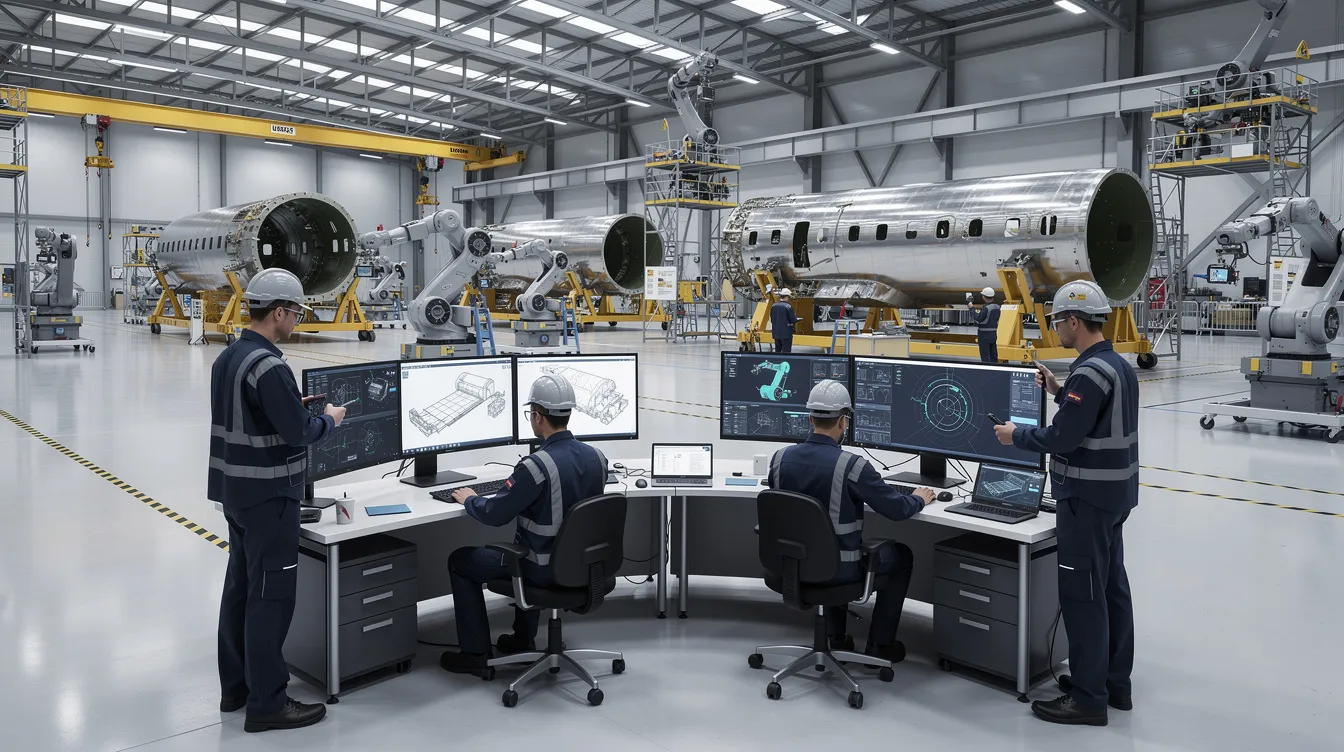
Current State vs. Target State:
Disconnected Systems
Unified Operations Layer
ERP for orders, MES for machines, separate QMS
Single view of work status across all systems
Spreadsheets for WIP tracking
Real-time serial and lot traceability
Email for supplier coordination
Supplier portals with shared workflows
Paper travelers and build books
Digital work instructions with audit trails
Manual audit preparation
Instant record retrieval by part, lot, or tail number
What Are Aerospace Manufacturing Operations Today?
Aerospace manufacturing operations encompass the end-to-end activities from contract award and design release through production, inspection, delivery, and aftermarket support. These operations are executed by original equipment manufacturers, Tier 1 through Tier 3 suppliers, and specialized MRO providers. The scope includes aircraft structures, engines, avionics, interiors, and space hardware. Every step is governed by regulatory frameworks that demand precision, traceability, and documentation that other industries rarely encounter.
Commercial Operations
The commercial aerospace sector faces sustained pressure from multi-year backlogs. CFM International’s LEAP engine deliveries rose 21% year-over-year through nine months of 2025, comprising nearly three-fourths of narrowbody engines. Pratt & Whitney’s Geared Turbofan backlog surpassed 12,000 units by mid-2025. For operations leaders, this translates into relentless pressure on production rates, supplier capacity, and quality systems. Airlines extending fleet lifespans due to delivery delays create parallel demand for engine MRO and component repair.
Defense and Space Operations
Defense spending continues to grow on hypersonics, autonomous systems, and next-generation platforms. These programs present different operational challenges: low-volume, high-complexity builds with frequent engineering change notices and strict ITAR controls. Space hardware adds another dimension, with new constellations driving demand for specialized components that must meet exact specifications under extreme conditions.
High-Volume vs. Engineering-to-Order
Operations differ significantly between high-volume standard parts production and low-volume engineering-to-order assemblies. High-volume production uses repetitive routings with automated WIP controls and predictable cycle times. Engineering-to-order work demands bespoke documentation, multi-wave FAIs, and tight coordination with customers on configuration changes. Both require the same underlying traceability and compliance infrastructure, but the workflow complexity and documentation volume differ substantially.
Regulatory and Certification Anchors
Key regulatory frameworks shape daily operations:
- AS9100D: Quality management system requirements for aviation, space, and defense
- AS9102: First Article Inspection requirements validating manufacturing processes
- NADCAP: Accreditation for special processes including welding, heat treating, and NDT
- FAA/EASA: Airworthiness approvals and production certificates
- ITAR/EAR: Export controls requiring serialized part traceability and access restrictions
These are not abstract compliance boxes. They define how work is planned, executed, inspected, and documented every day on the factory floor.
The Current State of Aerospace Manufacturing: Pressures and Trends
The global aerospace and defense market is projected to grow from $373.61 billion in 2024 to $791.78 billion by 2034, a 7.8% CAGR that reflects sustained demand across commercial aviation, defense systems, and space. The aerospace parts manufacturing market alone, valued at $1.48 billion in 2025, continues expanding. North America commands 52% market share, driven by Boeing, Lockheed Martin, robust defense budgets, and advanced R&D ecosystems. Asia-Pacific surges through “Made in China 2025” initiatives, lower labor costs, and partnerships fostering local production.
These numbers translate directly into operational load. Ramp-ups in single-aisle aircraft mean more work orders, more complex routings, and exponentially more documentation. Engine shop visits increase as airlines push existing fleets harder. New space constellations require production methods that blend aerospace precision with faster development cycles.
Primary Operational Pressures
- Schedule slippage: Supply chain resilience issues cascade across programs, pushing delivery dates and straining customer relationships
- Materials and semiconductor shortages: Long lead times for raw materials like titanium, forgings, and electronic components constrain capacity planning
- Workforce gaps: Skilled machinists, inspectors, and technicians retire faster than new talent enters, creating knowledge loss and training bottlenecks
- Audit and compliance risk: Manual systems increase the likelihood of documentation gaps, escapes, and failed audits during ramps or staff turnover
- Multi-site coordination: Expanding production across plants and suppliers without standardized processes creates variability and rework
Shifting Investment Patterns
Digitalization spending in aerospace is projected to rise from $33.6 billion in 2024 to $53.8 billion by 2034. The shift is notable: organizations are moving from pilot projects and proof-of-concepts to targeted deployments that address specific operational constraints. Predictive maintenance, process optimization, and AI-assisted analytics are entering production environments rather than remaining isolated experiments.
Leading aerospace companies are also moving from point solutions to integrated operational visibility. OEMs like Boeing and Airbus are in-sourcing aerostructures from Spirit AeroSystems to mitigate supply chain headwinds, signaling a broader trend toward vertically integrated operations that demand unified execution platforms.
Traditional vs. Digitally Enabled Operations KPIs:
Metric
Traditional Operations
Digitally Enabled Operations
On-time delivery
75-85%
90-95%
Scrap and rework rate
3-5%
<1-2%
MRO turnaround time
Variable, often extended
20-30% reduction
Audit preparation time
Days to weeks
Hours to minutes
FAI completion cycle
Weeks, with coordination delays
Days, with orchestrated workflows
Core Pillars of Modern Aerospace Manufacturing Operations
This guide addresses four core pillars that define modern aerospace manufacturing and MRO operations. Each pillar addresses specific executive concerns and connects directly to delivery, cost, risk, and compliance outcomes.
Pillar 1: Operational Visibility
Real-time visibility into work status, bottlenecks, quality risk, and material readiness across lines, plants, and suppliers. In aerospace, this includes serial-level traceability and the ability to link any part back to its full genealogy. Without visibility, executives make decisions based on outdated snapshots rather than current reality.
Pillar 2: Scaling Programs
The ability to move from prototype builds through low-rate initial production to full-rate production without losing control of configuration, quality, or delivery. Aerospace programs require orchestrated ramps that coordinate engineering releases, supplier readiness, and multi-site capacity.
Pillar 3: Workforce Productivity
Guiding technicians and inspectors through complex tasks with digital work instructions, embedded quality checks, and access to current revisions. As experienced workers retire, the knowledge they carry must be captured and transferred through systems rather than tribal knowledge alone.
Pillar 4: Digital Execution Layers
The software layer that orchestrates work execution, quality, and collaboration on top of existing ERP, MES, PLM, and QMS systems. This layer integrates without replacing, providing the operational backbone that connects people, processes, and systems.
These pillars apply equally to new production in greenfield and brownfield plants, and to MRO operations in hangars, engine shops, and component repair centers.
Operational Visibility: From Siloed Data to a Single Source of Truth
Operational visibility means the real-time ability to see work status, bottlenecks, quality risk, and material readiness across lines, plants, and suppliers. It is the foundation for informed decision-making in aerospace manufacturing processes where serialized traceability and regulatory compliance are non-negotiable.
Current State Fragmentation
Most aerospace manufacturers operate with fragmented data across multiple systems:
- ERP: Work orders, purchase orders, and financial data
- MES: Machine-level control and routing execution
- PLM: Engineering designs, BOMs, and change notices
- QMS: Nonconformance reports, CAPA tracking, and audit findings
- Spreadsheets: WIP tracking, readiness checks, and capacity planning
- Email: Supplier coordination, technical clarifications, and status updates
Each system serves a purpose, but none provides the integrated view that aerospace operations leaders need. Pulling together program status for an executive review requires manual consolidation from multiple sources, often with data that is already hours or days old.
Target State
Executives need program-by-program status showing constraint-aware schedules, defect trends, and supplier performance dashboards. They need to see which work orders are at risk, which suppliers are lagging, and where quality issues are clustering. This visibility must extend from raw material receipt through final delivery and into MRO operations.
How to Get There
A unified operations layer sits on top of existing systems, synchronizing work orders, serial numbers, and quality records without replacing ERP, MES, or PLM investments. Connect981 provides this layer by integrating via APIs and file-based interfaces, pulling high-value data flows into a single operational view.
Concrete examples of visibility in action:
- Tracking the full genealogy of a critical rotating part from forging through machining, heat treatment, inspection, and final assembly into an engine module
- Seeing hangar-level MRO turnaround time by tail number, with drill-down into which task cards are delaying redelivery
- Identifying that a specific supplier consistently delivers 4-5 days late on a critical forging, enabling proactive schedule adjustments
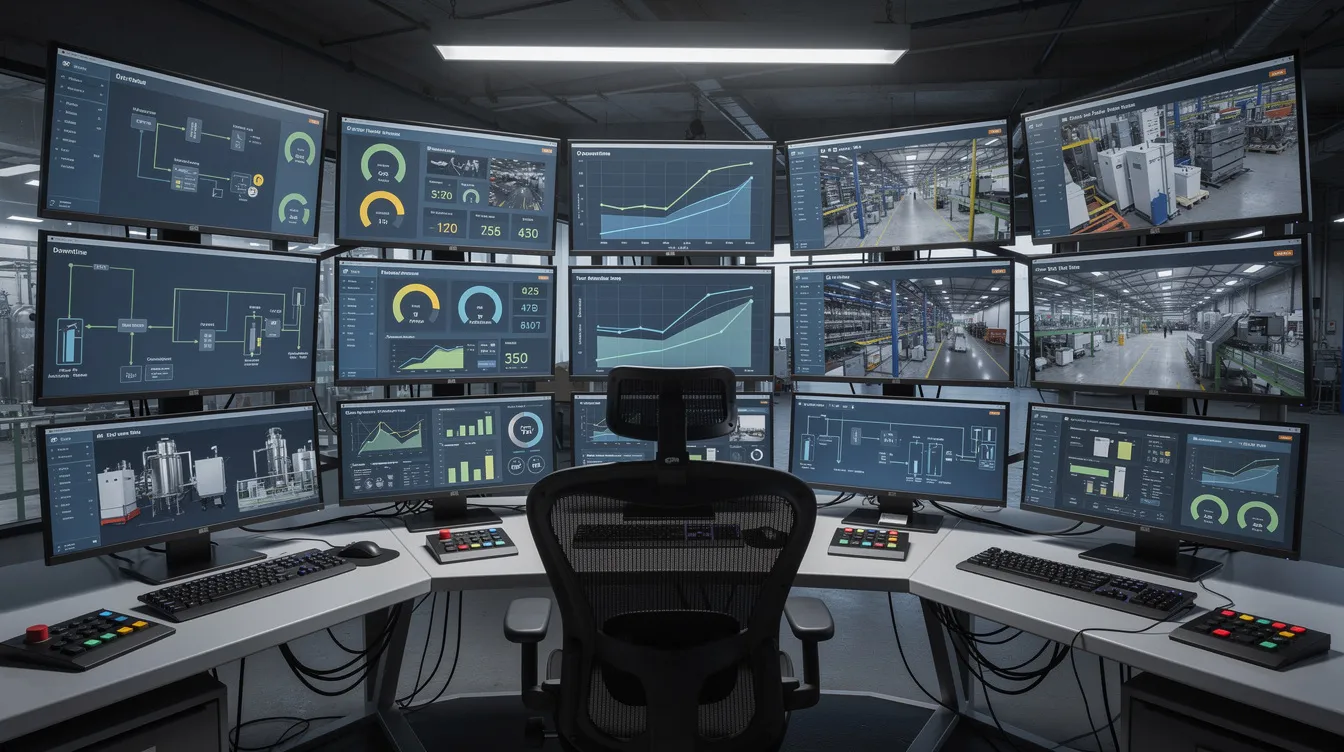
Key Visibility Metrics for Aerospace Operations Leaders
The following KPIs should appear on an aerospace operations executive dashboard:
KPI
Calculation
Why It Matters
On-time delivery
Shipped orders meeting customer dates / total orders, by program and supplier
Direct customer satisfaction and contract performance metric
Schedule adherence
Actual vs. planned start and completion dates, by work order and cell
Early warning for delivery risk
WIP aging
Average days in each production stage, flagging delays beyond thresholds
Identifies bottlenecks and stalled work
Scrap and rework rate
Defective units per 1,000, linked to operators and processes
Cost driver and quality indicator
FAI completion status
Percentage complete per wave, with measured vs. nominal dimensions
Program launch readiness
NCR volume
Incidents per million opportunities, by root cause
Quality trend indicator
Supplier OTD
Percentage of POs received on time, by supplier and commodity
Supply chain health
MRO TAT
Days from induction to redelivery, by workscope and tail number
Customer commitment and capacity utilization
Audit findings
Open CAPAs by category and age
Compliance risk exposure
These metrics gain urgency during ramp conditions. Connect981 embeds AI-powered analytics that surface anomalies before they impact delivery or safety metrics. For example, the system can detect a spike in NCRs on a specific composite layup cell or flag risk of FAI delays on a new program based on historical patterns.
Serial and lot traceability links every KPI back to specific work orders, operators, and process steps. When an issue arises, you can trace it to root cause in minutes rather than days.
Scaling Aerospace Programs: From Prototype to Rate Production
Aerospace programs progress through distinct phases: development builds including prototypes and test articles, low-rate initial production focused on FAI validation and supplier readiness, and full-rate production. Each transition presents operational challenges that disconnected systems struggle to address.
Operational Challenges During Scale-Up
- Configuration changes: Engineering change notices must propagate consistently across all production sites and suppliers
- FAI waves: Multiple first article inspection cycles validate processes as production ramps
- Supplier readiness: PPAP and APQP milestones must be tracked and coordinated across the supply chain
- Capacity balancing: Work must shift between sites based on capacity, capability, and customer requirements
Without coordinated workflows, these transitions create delays. Spreadsheet-based readiness checks miss dependencies. Email-based supplier gates lack accountability. Work instructions exist in multiple versions across different plants. The result is 20-30% higher rework in brownfield expansions and extended time-to-rate.
Digital Orchestration for Program Ramps
A digital execution layer orchestrates program launch checklists, supplier PPAP/APQP status, and FAI completion with real-time dashboards for program leadership. Connect981 provides this orchestration through:
- Shared routing templates that synchronize across sites
- Digital work instructions tied to specific configuration baselines
- FAI workflows that coordinate data collection, approvals, and documentation packages
- Supplier portals that provide visibility into readiness milestones
Example Scenario: Nacelle Assembly Line Scale-Up
A 2025 nacelle assembly line scaling across two plants illustrates the approach. Both plants share the same routing templates in Connect981, ensuring process consistency. Digital work instructions reference the same engineering baseline, with revision control ensuring both sites execute to current specifications. FAI data collection follows the same workflow, with results visible to program leadership in real time. When engineering releases an ECN, both plants see the change simultaneously, with mandatory acknowledgment before execution continues.
The outcome is 15-25% faster ramps compared to traditional approaches, with first-pass yield variance below 5% across sites.
Program Ramp-Up Workflow:
- Contract Award: Program setup, initial planning, supplier identification
- Design Release: Engineering baseline established, routing templates created
- Development Builds: Prototype execution, process validation, initial FAI
- LRIP: Supplier PPAP/APQP completion, FAI waves, capacity ramp
- Full-Rate Production: Stable rate execution with continuous improvement
Standardization Across Sites and Suppliers
Multi-site and multi-supplier standardization challenges every aerospace organization. Legacy ERP systems differ between plants. Local practices evolve independently. Customer-specific requirements create variations that compound over time. The operational risk is significant: inconsistent routings, inspection plans, and documentation formats amplify audit failures and delivery variability.
Where to Start Standardization:
- FAI workflows: Standardize data collection formats and approval sequences
- Inspection plans: Use common templates for dimensional, visual, and NDT inspections
- Routers: Implement shared routing templates with configurable parameters
- Deviation handling: Establish consistent concession and NCR processes
Connect981’s zero and low-code workflow templates support standardized routing, inspection, and deviation processes that can be reused across plants and external suppliers. Manufacturing engineers can configure workflows without coding, adapting to local requirements while maintaining core process consistency.
Example: Wing Rib Machining Workflow
A successful wing rib machining and inspection workflow at a European plant can be replicated to a North American facility in months instead of years. The routing template, inspection checkpoints, and quality signoffs transfer directly. Local adaptations for equipment differences are configured without custom development. The result is measurable: reduced first-pass yield variance and fewer concession requests during initial production.
How to Measure Standardization Impact:
- First-pass yield variance across sites (target: <5%)
- Concession volume by site and program
- FAI cycle time consistency
- Audit finding rates by location
Workforce Productivity and Skills: Guiding People Through Complexity
The aerospace labor environment presents structural challenges. Experienced technicians retire at rates that outpace replacement. Competition from technology sectors draws skilled machinists and inspectors to other industries. New hires require months of training through shadowing and tribal knowledge transfer, correlating to 10-15% higher rework during onboarding periods.
Onboarding Acceleration
Digital work instructions fundamentally change how new technicians learn and execute complex tasks. Instead of shadowing experienced workers for weeks, new hires follow step-by-step digital guides with embedded media, 3D models, and explicit quality checkpoints. Connect981 reduces onboarding time by 40-50% compared to traditional paper-based training methods.
Error-Proofing Execution
Error-proofing goes beyond instructions. Mandatory signoffs at critical steps ensure operators acknowledge completion before proceeding. Go/no-go checks for dimensions, torque values, and visual criteria catch errors at the point of execution rather than downstream inspection. The system flags when steps are skipped or executed out of sequence.
Knowledge Capture
When experienced technicians leave, their knowledge often leaves with them. Digital work instructions capture this knowledge in structured, version-controlled formats. Manufacturing engineers can update workflows based on shopfloor feedback, embedding the lessons learned into the system for future operators.
Change Management
Engineering changes propagate instantly across all stations. When a torque specification changes, every work instruction referencing that specification updates automatically. Revision history maintains the audit trail, and operators always access the current version.
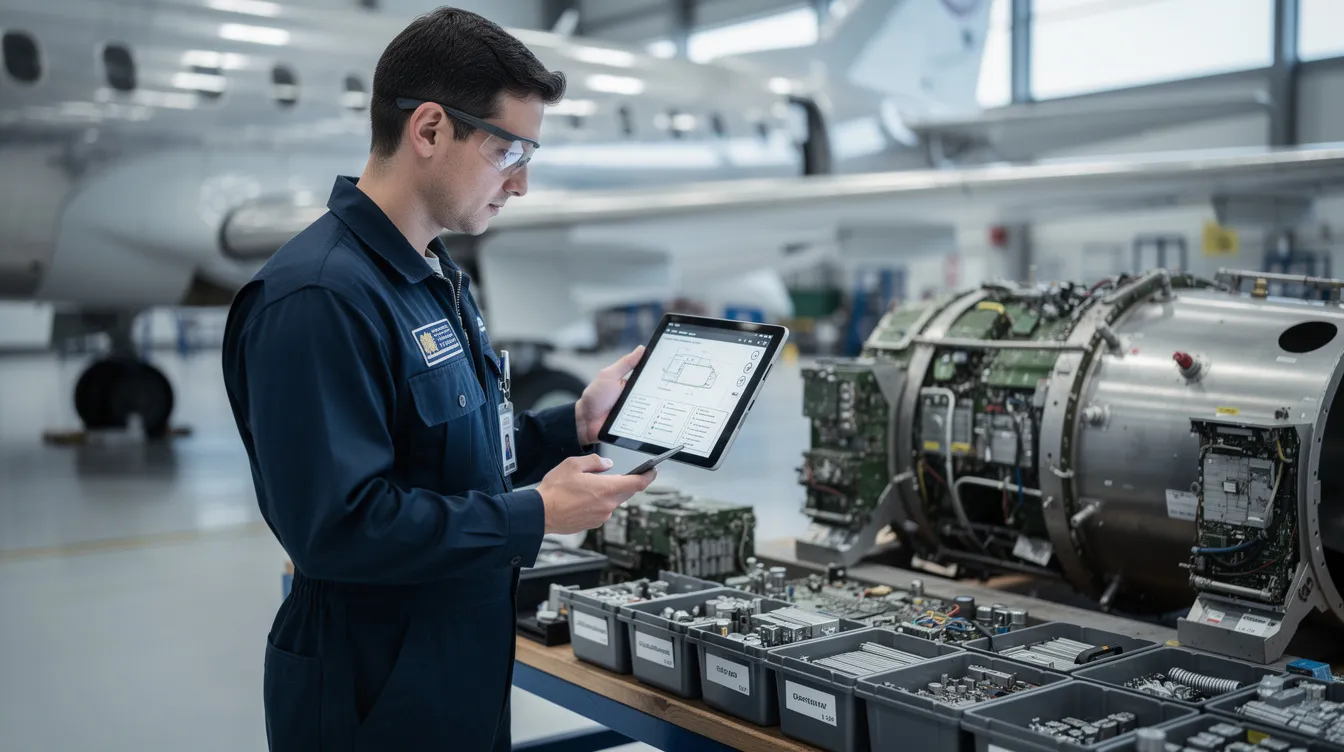
Closing the Skills Gap with Digital Work Instructions
High-quality aerospace digital work instructions include:
- 3D models: Interactive views showing assembly orientation and component placement
- Annotated photos: Real-world images with callouts identifying features and hazards
- Torque specifications: Explicit values with sequence requirements
- Inspection checkpoints: Inline quality gates with measurement criteria
- Hazard notes: Safety warnings aligned to regulatory requirements
These instructions must be tightly version-controlled and linked to specific configuration baselines. When engineering releases a new revision, instructions update accordingly, maintaining the link between design intent and shopfloor execution.
Example: Composite Fairing Build
Converting a 40-page paper build book for a composite fairing into an interactive digital workflow demonstrates the transformation. The digital version includes:
- Step-by-step layup sequences with orientation photos
- Inline signoffs for ply placement verification
- Automatic data capture for cure cycle parameters
- Links to material certifications and shelf-life tracking
- Quality checkpoints with accept/reject criteria
The result is 30% reduction in turnaround time and significantly lower variability between operators.
Connect981 provides templates for standard jobs including drilling, riveting, NDT, and disassembly/reassembly. These templates accelerate authoring and ensure consistency across products and programs.
Digital Execution Layers: Connecting ERP, MES, Quality, and Suppliers
A digital execution layer is the software layer that orchestrates work execution, quality, and collaboration on top of existing ERP, MES, PLM, and QMS systems. It is not a replacement for these investments. It is the connective tissue that makes them work together.
Heavy monolithic MES replacements require years of implementation and significant customization for aerospace requirements. A digital execution layer takes a different approach: lightweight, aerospace-specific workflows that integrate with existing systems rather than replacing them.
How It Works
Work orders flow from ERP through the digital execution layer to operators on the shopfloor. Operators execute tasks via tablets or terminals, with each step recorded and linked to serial numbers. Inspection results feed back to QMS. Engineering changes from PLM trigger work instruction updates. Supplier tasks are visible through connected portals.
The digital execution layer becomes the single pane of glass for regulators and customers. Serial number and lot tracking provides full genealogy. Audit trails capture every signoff, measurement, and disposition decision. When an auditor requests records for a specific part, the system retrieves them in minutes.
Connect981 serves as this unified operations layer, with capabilities including:
- Digital work instructions with version control
- Nonconformance and CAPA workflows
- Supplier portals for document exchange and collaboration
- AI-assisted analytics for anomaly detection and root cause analysis
- Real-time dashboards for operational visibility
Architecture Overview:
The integration architecture connects:
- ERP (SAP, Oracle): Work orders, BOMs, purchase orders
- PLM: Engineering designs, ECNs, configuration data
- MES: Machine routings, cycle data, equipment status
- QMS: NCRs, CAPAs, audit findings
Bidirectional data flows through Connect981, which provides the operational view for shopfloor execution, quality management, and supplier collaboration.
Integrating MES, ERP, PLM, and QMS Without Rebuilding Everything
The typical system landscape at an aerospace OEM or Tier 1 includes SAP or Oracle ERP, legacy MES implementations, multiple PLM instances, and point QMS tools. Full replacement is neither practical nor necessary.
Integration Strategy:
Focus on high-value data flows:
- Work orders and BOMs from ERP
- Routings and process parameters from MES
- Engineering releases and ECNs from PLM
- NCs, inspection results, and CAPAs from QMS
- Supplier delivery data and quality performance
Connect981 uses APIs, file-based interfaces, and connectors to link into existing systems. This approach enables fast pilots and phased rollout rather than multi-year implementation programs.
Governance Considerations:
- Master data ownership: Define which system is authoritative for each data element
- Change control: Establish processes for configuration and workflow changes
- Roles and permissions: Implement ITAR-compliant access controls with restricted views
- Cybersecurity: Ensure data protection across system boundaries
The integration approach allows visible ROI within months. A 20% improvement in on-time delivery from a single-line pilot builds momentum for broader rollout.
AI and Analytics in Aerospace Manufacturing Operations
Realistic AI applications in aerospace operations today focus on practical value rather than speculative capabilities:
- Anomaly detection in quality data: Identifying patterns in NCRs that indicate systematic issues
- Predictive maintenance signals: Detecting cycle-time outliers that precede equipment failures
- Root cause analysis suggestions: Surfacing historical data relevant to current issues
Example Applications:
- AI surfaces that a coating line is causing repeat rejects on a specific part family, enabling targeted process investigation before the issue impacts delivery
- The system flags risk of FAI delays on a new program based on historical patterns of engineering change velocity and supplier response times
- Machine learning identifies correlations between operator shifts, equipment parameters, and quality outcomes
Connect981 embeds these insights within day-to-day workflows. They appear in context during execution rather than requiring separate data science investigation.
Regulatory and Safety Guardrails:
AI in aerospace operates under strict boundaries. Safety-critical decisions require human oversight. FAA guidelines emphasize that AI assists rather than replaces qualified personnel. Connect981 implements these guardrails, ensuring that AI recommendations are presented for human review and decision.
Quality, Traceability, and Compliance in Daily Operations
AS9100D, AS9102, NADCAP, FAA/EASA regulations, and ITAR shape every aspect of aerospace manufacturing operations. These are not compliance boxes to check annually. They define how work is planned, executed, inspected, and documented daily.
Operational Implications
- Serialized parts: Every safety-critical component carries unique identification linked to full production history
- 100% inspection on critical features: No sampling allowed for characteristics that affect airworthiness
- Controlled special processes: Welding, heat treating, and surface treatments require NADCAP accreditation
- Document retention: Records must be maintained for 10+ years, accessible for audit at any time
Risk of Manual Systems
Manual or semi-manual systems increase risk during ramps or staff turnover. Missing operator signoffs, incomplete inspection records, or undocumented deviations create audit findings or worse, quality escapes that reach customers. The cost of a single escaped defect in aerospace can exceed millions in warranty, rework, and regulatory consequences.
Digital Quality Capture
Connect981 captures operator signoffs, inspection data, torque readings, pressure measurements, and NCRs automatically. Every data point links to the specific serial number, work order, and operator. The system creates an audit-ready trail without requiring manual documentation compilation.
Example: Audit Preparation
Preparing for an AS9100 or NADCAP audit using Connect981 involves:
- Auditor requests records for a specific part, lot, or tail number
- Query returns complete production history within minutes
- All signoffs, inspection results, and deviations are linked and accessible
- Traceability extends through supply chain to raw material certifications
What previously required days of file retrieval and manual compilation becomes a straightforward system query.
First Article Inspection (FAI), NCR, and CAPA Workflows
FAI Workflow (AS9102):
FAI validates that manufacturing processes produce conforming parts. Without coordinated workflows, FAI becomes a bottleneck as data collection, approvals, and signatures stall at handoff points.
Digital FAI orchestration:
- Ballooned drawings with measured vs. nominal dimensions
- Coordinated data collection across engineering, quality, and suppliers
- Digital signature routing with escalation for delays
- Automated documentation package generation
NCR Process:
- Capture nonconformance on shopfloor via tablet
- Automatic routing to appropriate reviewer based on defect type
- Disposition decision: use-as-is, rework, or scrap
- Linkage to CAPA if systemic issue identified
- Closure with verification and audit trail
CAPA Integration:
NCRs feed into corrective action workflows. Connect981’s low-code builder allows configuration of program-specific or customer-specific variations while maintaining core process consistency.
Connected Supply Chain and MRO Operations
Aerospace supply chains involve thousands of tiered suppliers, long lead times for forgings and castings, and competition between OEM and MRO demand for the same parts. Operational success requires real-time visibility that extends beyond factory walls.
New Production Supply Chain
Supplier management in aerospace production requires visibility into:
- PO status: Where is each purchase order in the supplier’s production cycle?
- Supplier capacity: Can the supplier support rate increases?
- FAIR/PPAP progress: Has the supplier completed qualification milestones?
- Quality performance: What are the supplier’s reject rates and OTD trends?
Connect981 enables supplier portals for document exchange, digital work instructions for build-to-print partners, and collaborative management of deviations. Suppliers see their tasks and requirements in a controlled view. Quality feedback flows directly to supplier quality engineers. Performance dashboards highlight issues before they impact production schedules.
MRO and Aftermarket Operations
MRO operations present distinct challenges:
- Unscheduled events: Aircraft on ground situations require rapid response
- Variable workscopes: Initial findings often expand repair requirements
- Parts availability: Cannibalization decisions balance multiple aircraft needs
- TAT pressure: Customer commitments depend on efficient turnaround
Connect981 supports MRO routing, digital task cards, findings capture, and linkage of each repair to part history and regulatory documentation. Technicians execute repairs with access to the component’s full service history. Findings are captured digitally and linked to disposition decisions. Turnaround time metrics are visible in real time, enabling proactive management of customer commitments.

Supplier Collaboration and Multi-Tier Visibility
Email, spreadsheets, and static portals are insufficient for coordinating complex aerospace build packages across multiple tiers.
Practical Collaboration Mechanisms:
- Shared workflows for contract review: Eliminate version confusion and email chains
- Technical clarification requests: Structured submission and response with audit trail
- Change notifications: Automatic distribution with acknowledgment tracking
- Quality feedback: Direct communication between receiving inspection and supplier quality
- Performance dashboards: Shared metrics drive improvement conversations
Example: ITAR-Controlled Actuator Assembly
Coordinating an ITAR-controlled actuator assembly across a US Tier 1, European machining house, and surface treatment supplier requires:
- Role-based access controls restricting data by nationality and clearance
- Shared work instructions visible only to authorized personnel
- Quality feedback flowing to appropriate parties without ITAR violations
- Performance tracking across the supply chain
Connect981 provides these capabilities with configurable access controls that maintain compliance while enabling necessary collaboration.
Implementation Timeline:
Operations leaders can implement supplier collaboration mechanisms within 6-12 months:
- Month 1-2: Assess current supplier communication patterns and pain points
- Month 3-4: Pilot portal with strategic suppliers on critical programs
- Month 5-8: Expand to broader supplier base with standard workflows
- Month 9-12: Integrate performance dashboards and continuous improvement processes
Roadmap: How Aerospace Leaders Can Modernize Operations in 12-24 Months
Modernizing aerospace operations requires a phased approach that demonstrates value early while building toward comprehensive transformation.
Phase 1: Assessment (Weeks 1-6)
- Map current workflows and data flows across shopfloor, quality, and suppliers
- Identify pain points: where do delays occur, where is data lost, where do audits struggle?
- Document system landscape: ERP, MES, PLM, QMS, and their integration points
- Define success metrics for pilot deployment
Phase 2: Pilot Deployment (Months 2-5)
- Select a targeted line, cell, or MRO operation for initial implementation
- Recommended starting domains:
- Digital work instructions for a critical assembly
- FAI and NCR workflows for a high-visibility program
- MRO routing for a specific workscope
- Deploy Connect981 with integration to existing systems
- Train operators and supervisors
- Measure impact against baseline metrics
Phase 3: Multi-Site Scaling (Months 6-12)
- Expand to additional lines and programs based on pilot learnings
- Standardize workflows across sites using proven templates
- Extend supplier integration to strategic partners
- Implement advanced analytics and AI capabilities
Phase 4: Enterprise Extension (Months 12-24)
- Roll out across all production sites and MRO operations
- Full supplier network integration
- Continuous improvement based on operational data
- Integration with customer systems where applicable
Expected KPI Improvements by Phase:
Phase
On-Time Delivery
Rework Reduction
TAT Improvement
Pilot
+10%
-10%
-15%
Multi-Site
+15%
-20%
-25%
Enterprise
+20%
-25%
-30%
Change Management Levers
- Involve manufacturing engineers early: They build and maintain workflows
- Align with IT and security: Address integration and ITAR requirements upfront
- Use quick wins for momentum: Eliminating paper travelers or reducing rework builds organizational support
- Executive sponsorship: Visible leadership commitment accelerates adoption
Connect981 is designed for fast deployment and iterative expansion. Aerospace-specific templates reduce time-to-value. Zero and low-code configuration enables manufacturing engineers to adapt workflows without IT dependency.
Conclusion: Building a Connected Aerospace Operations Backbone
The four pillars covered in this guide—operational visibility, scaling programs, workforce productivity, and digital execution layers—address the core challenges facing aerospace manufacturing and MRO operations in 2024-2026 and beyond. Each pillar connects directly to executive priorities: delivery performance, cost control, risk reduction, and regulatory compliance.
The future of aerospace production depends not on new machines alone or isolated software tools, but on a connected operations backbone that unifies people, processes, and systems. This backbone provides the single source of truth that executives need for decision-making, the guided execution that operators need for consistency, and the traceability that regulators require for compliance.
Connect981 serves as this backbone for aerospace organizations. It bridges ERP, MES, PLM, QMS, and supplier workflows without requiring a disruptive rebuild. It deploys in months rather than years. It adapts to your specific programs and requirements through zero and low-code configuration.
The question for operations leaders is not whether to modernize, but where to start. Evaluate where your operations sit on the modernization curve. Identify one or two concrete pilot opportunities—a critical assembly line, an FAI workflow that consistently bottlenecks, or an MRO cell with TAT pressure.
Request a tailored Connect981 demo focused on one of your active programs or MRO lines. The demo will review your current workflows, integration landscape, and potential ROI specific to your operation. The path to connected aerospace operations starts with that first conversation.
Leave a Reply