Author: garethshaw

  • IEC 62264 Manufacturing Operations: Standards-Aligned Overview

    IEC 62264 Manufacturing Operations: Standards-Aligned Overview

    Manufacturing enterprises operating across multiple sites, suppliers, and jurisdictions face a persistent challenge: how to describe what happens between business planning and the physical processes on the factory floor. The answer, for many global organizations, lies in IEC 62264.

    This international standard series provides a common framework for enterprise control system integration, giving manufacturers a shared vocabulary for how enterprise systems and control systems exchange information. For aerospace organizations coordinating production, maintenance, and quality operations across complex supply chains, IEC 62264 offers a neutral reference that supports consistent communication regardless of geography or technology platform.

    This blog post examines the scope and purpose of IEC 62264, its relationship to ISA 95, and its role in global manufacturing operations.

    What Is IEC 62264 in Manufacturing Operations?

    IEC 62264 is the internationally adopted version of the ISA-95 enterprise and control system integration standard, focused specifically on manufacturing operations management at Level 3 in the hierarchical model. Published by the International Electrotechnical Commission, IEC 62264 provides a common reference model for how business planning and logistics systems (Level 4) interact with manufacturing operations and control functions (Levels 3 and 2).

    The standard exists to serve as a globally recognized counterpart to the ISA-95 series originally developed by the International Society of Automation. While ISA-95 carries ANSI/ISA designation, IEC 62264 enables organizations worldwide to reference the same technical content through their national or regional standards frameworks.

    IEC 62264 is widely applied in discrete, batch, and continuous manufacturing sectors. It holds particular relevance for aerospace and MRO operations that rely on interconnected systems including enterprise resource planning, manufacturing execution systems, product lifecycle management, and quality management systems. These environments require precise coordination of production orders, maintenance records, traceability data, and compliance documentation across multiple facilities and suppliers.

    Connect981 is a platform built for aerospace manufacturing and MRO teams that aligns to IEC 62264 and ISA-95 concepts. Its approach to organizing digital work instructions, traceability, and supplier workflows reflects the levels, information flows, and terminology established by these standards.

    Scope and Purpose of IEC 62264

    IEC 62264 defines models, terminology, and interfaces that describe how enterprise systems and manufacturing operations exchange information. It does not prescribe specific technologies or software products. Instead, it provides a conceptual framework that allows different stakeholders, vendors, and sites to interpret and design systems consistently.

    The core scope centers on control system integration, specifically the interactions between:

    Level

    Domain

    Examples

    Level 4

    Business planning and logistics

    ERP, supply chain planning, order management

    Level 3

    Manufacturing operations management

    MES, MOM, production scheduling, quality management

    Level 2

    Supervisory control

    SCADA, DCS, supervisory systems

    Level 1

    Sensing and manipulating

    Sensors, actuators, devices

    Level 0

    Physical processes

    Actual production equipment and physical assets

    The purpose of IEC 62264 is to standardize how manufacturing activities, information objects, and information flows are described. This standardization allows organizations to map their existing systems into a common reference architecture without requiring a complete technology overhaul.

    For aerospace and MRO organizations, this scope supports consistent handling of:

    • Production orders and work schedules
    • Maintenance orders and equipment states
    • Quality data and inspection records
    • Materials, lot tracking, and serialization
    • Resource allocation across plants and suppliers

    The standard’s purpose is informational and modeling-oriented. It defines activity models and object models. It does not mandate how those models should be implemented in any specific technology or business processes.

    Relationship Between IEC 62264 and ISA-95

    IEC 62264 and ISA 95 cover the same conceptual territory. They were developed in close coordination, with IEC 62264 effectively mirroring the content of ISA-95 for international use.

    ISA-95 was first developed and published by ISA in the mid-1990s and early 2000s. The standard addressed a critical functional gap: the interface between enterprise functions operating at Level 4 and process control functions operating at Level 2. When this content achieved sufficient technical maturity, it was adopted and published by the IEC as the IEC 62264 series to provide a global electrotechnical standard.

    The part structure aligns closely between the two series:

    ISA-95 Part

    IEC 62264 Part

    Focus Area

    ISA-95 Part 1

    IEC 62264-1

    Models and terminology, Level 3-4 interface

    ISA-95 Part 2

    IEC 62264-2

    Object model attributes

    ISA-95 Part 3

    IEC 62264-3

    Activity models of MOM

    ISA-95 Part 4

    IEC 62264-4

    Object models and attributes

    ISA-95 Part 5

    IEC 62264-5

    Business-to-manufacturing transactions

    Conceptually, both series share the same hierarchical model defined for organizing manufacturing levels, the same object models for entities like materials and equipment, and the same activity models for production, maintenance, quality, and inventory operations. Document layouts and editorial details may differ between ISA and IEC publications, but the technical substance remains equivalent.

    Connect981’s information model and workflows are designed to be understandable in both ISA-95 and IEC 62264 terms. This helps aerospace teams collaborate across global partners who may refer to either naming convention.

    Why IEC Versions Exist Alongside ISA Standards

    ISA is a professional society. IEC is a formal international standards body recognized by many national standards organizations and regulators. This distinction explains why both designations exist for the same technical content.

    IEC 62264 exists to provide the ISA-95 concepts in a format that can be adopted as national or regional electrotechnical standards. In Europe, for example, CENELEC can adopt IEC standards directly. Other national committees worldwide follow similar processes. When organizations reference IEC 62264, they reference a standard with formal international standing.

    Several practical factors drive this dual publication approach:

    • Procurement and contracts: Many countries and procurement frameworks reference IEC standards explicitly. Having IEC 62264 makes it easier for multinational manufacturers to align on a single international reference.
    • Regulatory alignment: Different jurisdictions have different standards bodies. IEC publication provides equal weight across multiple regulatory environments.
    • Community coordination: The coexistence of ISA-95 and IEC 62264 allows both automation professionals and national standards bodies to work from a harmonized conceptual base while following their own publication processes.

    This dual publication is especially important in global industries such as aerospace. OEMs, Tier-1 suppliers, and MRO providers must coordinate standards language across multiple jurisdictions. A supplier in Germany can reference IEC 62264 knowing that a customer in the United States recognizes the same technical content under the ISA-95 designation.
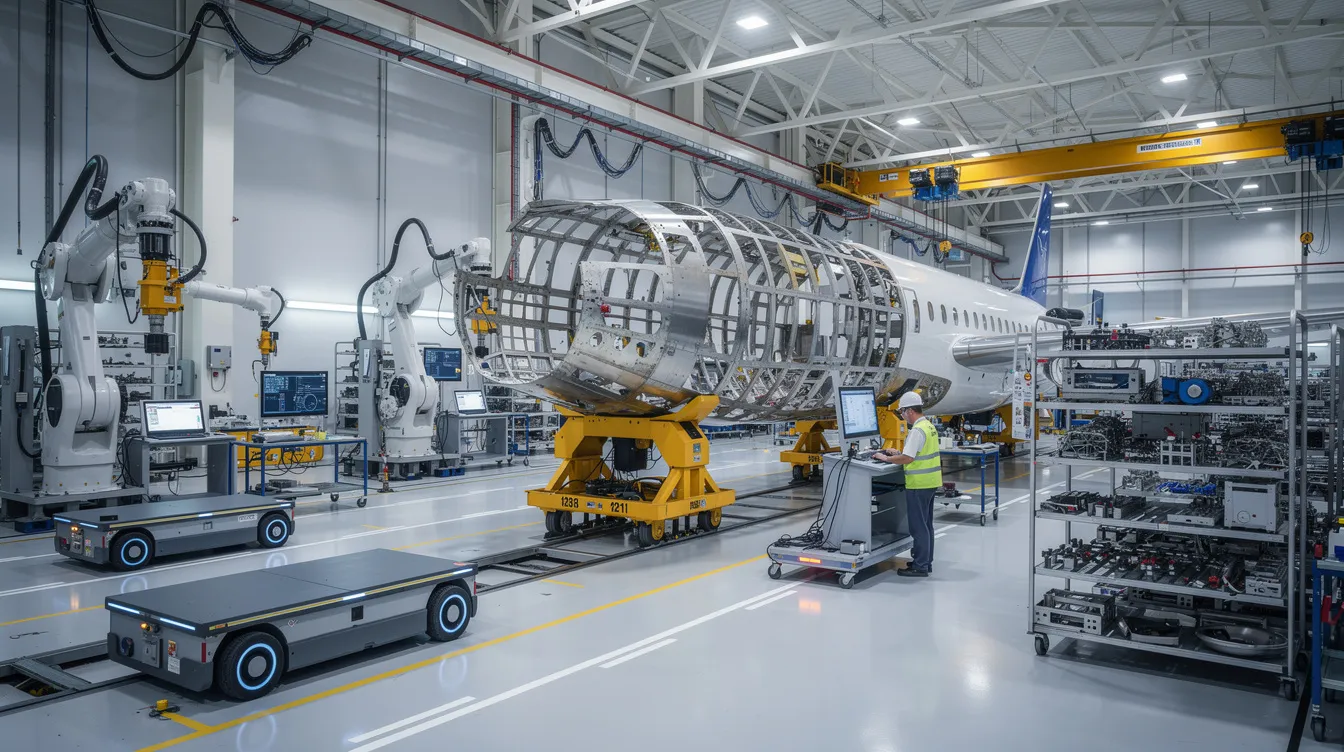
    The image depicts an industrial aerospace manufacturing floor bustling with workers collaborating alongside automated equipment, showcasing the integration of enterprise control systems and manufacturing operations. This environment highlights the synergy between technology and business processes, emphasizing the efficient management of manufacturing activities within the aerospace sector.

    How IEC 62264 Mirrors ISA-95 Conceptually

    The technical content of IEC 62264 is designed to be conceptually equivalent to ISA-95. Models, definitions, and terminology align across both series by design.

    Both standards use a hierarchical view of manufacturing based on the Purdue Reference Model. This layers defined structure organizes technology and business processes from physical production (Level 0) up through business planning (Level 4). The hierarchy provides a common reference for discussing where different systems and functions operate.

    In both ISA-95 and IEC 62264, Level 3 (Manufacturing Operations Management) breaks into four key activity areas:

    Activity Area

    Scope

    Production operations

    All the activities related to converting materials into products

    Maintenance operations

    Activities taking place to maintain equipment availability

    Quality operations

    Activities related to measuring and verifying product and process quality

    Inventory operations

    Activities for managing materials and storage

    Both series define similar object models for entities such as:

    • Material (material lots, sublots, serial numbers)
    • Equipment (work centers, production units, storage zones)
    • Personnel (qualifications, assignments)
    • Process segments (routing steps, operations)

    These object models enable consistent descriptions of what is being planned, executed, and recorded across manufacturing operations domain applications.

    Connect981 uses these same conceptual objects and levels. Work orders, routing, resources, and quality records map cleanly to IEC 62264 and ISA-95 aligned architectures. This alignment makes it easier to integrate enterprise system data with shopfloor execution.

    IEC 62264 Part Structure for Manufacturing Operations

    IEC 62264 is organized into multiple parts, each addressing a specific aspect of enterprise and control integration. Understanding this structure helps organizations locate the relevant models and terminology for their needs.

    IEC 62264-1: This part establishes the foundational framework, including the five-level hierarchy, the manufacturing operations management domain definition (Level 3), and the interfaces between Level 3 and Level 4. The latest edition includes extended functional and equipment hierarchies, a physical asset equipment model, and generic models of manufacturing operations management categories. The interface content describes what information flows between manufacturing operations and other enterprise functions.

    IEC 62264-2: Focuses on object model attributes for information exchanges between enterprise and control domain systems.

    IEC 62264-3:2016: The second edition defines activity models of manufacturing operations management. It covers production operations management, maintenance operations management, quality operations management, and inventory operations management. The 2016 update consolidated information and aligned terminology with other parts.

    IEC 62264-4: Covers object models and attributes used in manufacturing operations, specifying the precise data structures for data exchange between functions.

    IEC 62264-5: Addresses business-to-manufacturing transactions, defining how to enable enterprise system communication with manufacturing operations management systems.

    The updates across editions have focused on aligning terminology across parts and maintaining consistency with ISA-95 equivalents. Aerospace organizations often use Level-3 activity and object models as a reference for aligning ERP order management, MES systems, and shopfloor execution tools like Connect981.

    IEC 62264-3:2016 and Manufacturing Operations Management (MOM)

    IEC 62264-3:2016 is the second edition that defines activity models of Manufacturing Operations Management (MOM). It clarifies the role of Level 3 as the operational layer between business planning (Level 4) and control (Level 2).

    The activity models in IEC 62264-3:2016 provide a structured way to describe what Level 3 actually does. The models cover:

    • Production operations management: Detailed production scheduling, production dispatching, production execution management, and production data collection
    • Maintenance operations management: Maintenance scheduling, dispatching, execution, and tracking
    • Quality operations management: Quality test management, inspection coordination, and quality data collection
    • Inventory operations management: Material movement, storage management, and inventory tracking

    These models operate independently of any specific software or hardware. They can describe both traditional MES implementations and newer digital operations platforms. The purpose is to enable information collection and coordination across manufacturing activities regardless of the underlying technology.

    This edition updated terminology and cross-references to align with IEC 62264-1 and IEC 62264-4. Activity descriptions and object models use consistent naming across the entire standard series.

    Connect981 aligns its features with these MOM activity areas. Digital work instructions, traceability, quality checks, and supplier workflows map to the production, quality, and maintenance operations described in IEC 62264-3:2016. This mapping helps aerospace teams describe their processes using standards-aligned language.
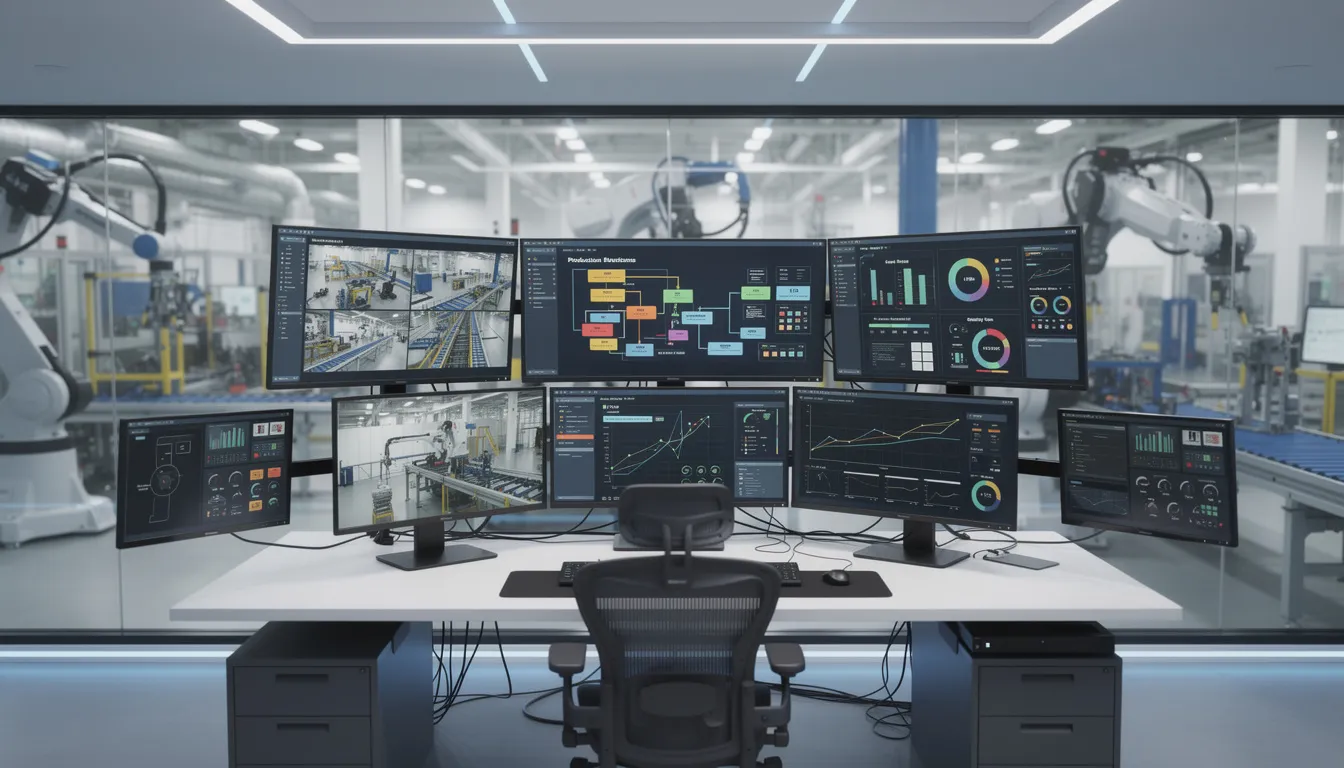
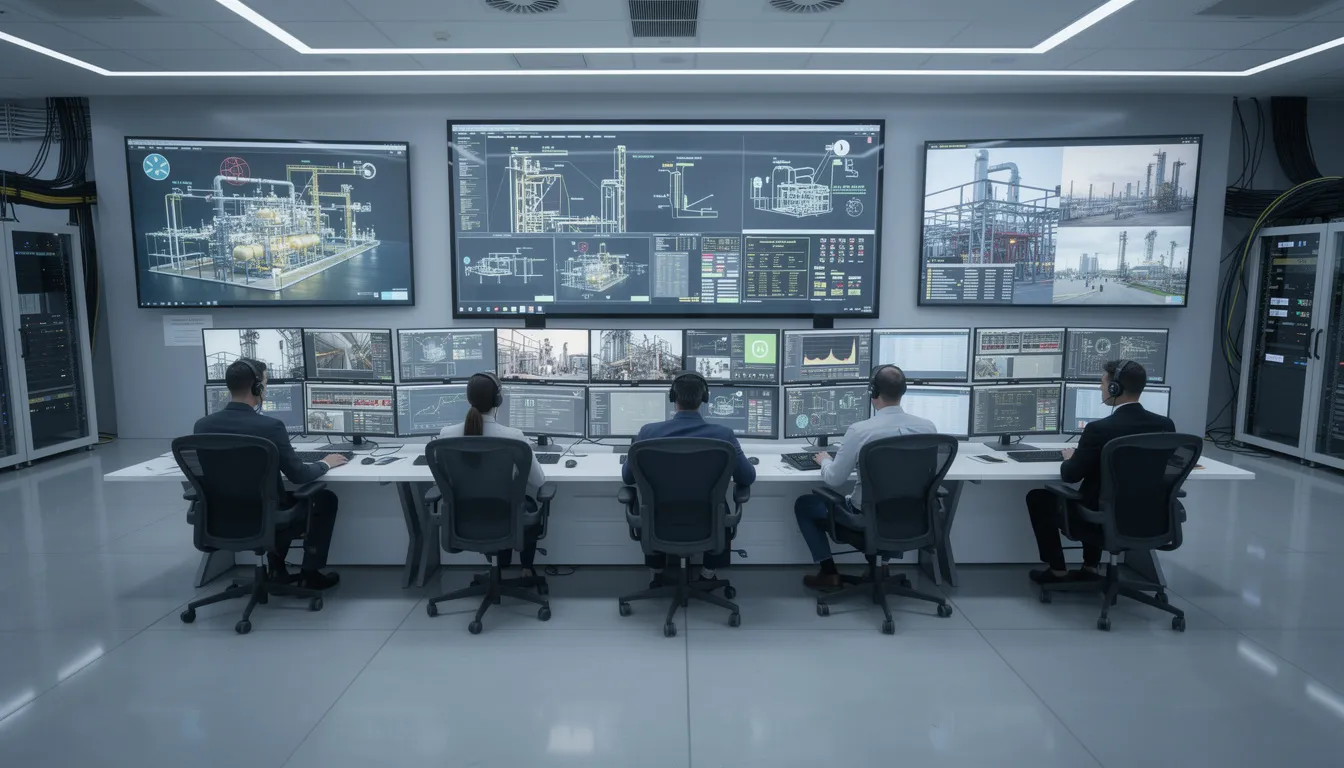
    The image depicts a modern control room filled with multiple monitors that display real-time data related to manufacturing operations management. This setup illustrates the integration of enterprise control systems, enabling efficient monitoring and management of business and manufacturing activities.

    Terminology and Consistency Between IEC 62264 and ISA-95

    One of the key aims of both IEC 62264 and ISA-95 is to provide a stable, shared vocabulary for enterprise-control system integration. This interface terminology allows different organizations to describe the same operations the same way.

    The two series coordinate on terminology for key concepts:

    Term

    Definition

    Manufacturing Operations Management

    Level 3 functions that manage manufacturing operations

    Process segment

    A logical grouping of manufacturing operations

    Material lot

    A specific quantity of material with common properties

    Equipment

    Physical assets used in manufacturing

    Work center

    A grouping of equipment for production purposes

    Production schedule

    A plan for production activities over time

    Revisions such as those in IEC 62264-3:2016 have explicitly updated terms to align with naming conventions in other parts (for example, IEC 62264-4) and with their ISA-95 counterparts. This deliberate alignment ensures models and terminology remain consistent across the entire standard family.

    This terminology consistency allows documentation, system specifications, and cross-site process descriptions to remain coherent whether a stakeholder references the ISA or IEC designation. When different parties in a supply chain use the same terms for the same concepts, integration becomes more straightforward.

    Connect981 uses this standards-aligned vocabulary in its data model and user interfaces where practical. This helps aerospace and MRO organizations describe the same operations the same way across OEMs, suppliers, and regulators.

    Role of International Standardization in Manufacturing Operations

    International standardization through bodies like the IEC enables manufacturers, technology providers, and regulators across different regions to share a common framework for describing manufacturing operations. This role is especially important for industries with global supply chains.

    IEC 62264 supports interoperability by giving different systems a shared reference for how information should be structured at the boundaries between business and manufacturing. When an ERP system needs to communicate with an MES, or when an MES needs to exchange data with a QMS, IEC 62264 provides the conceptual framework for describing what information should flow and how it should be structured.

    In global aerospace supply chains, this international alignment is crucial for coordinating:

    • Production schedules across multiple manufacturing sites
    • Quality data shared between OEMs and suppliers
    • Maintenance records for aircraft components across MRO providers
    • Compliance documentation required by different regulatory authorities

    International standards make it easier for software platforms to interoperate with existing systems. Because the information flows can be modeled using widely understood IEC 62264 and ISA-95 concepts, integration projects can proceed from a shared reference point rather than custom definitions.

    IEC 62264’s role is to provide a neutral, well-defined language for manufacturing operations. This supports long-term consistency even as specific technologies, architectures, and tools evolve. The standard organizes technology choices without mandating them.

    IEC 62264, Smart Manufacturing, and Aerospace Digital Operations

    IEC 62264’s models connect directly to current themes such as smart manufacturing, Industry 4.0, and connected aerospace operations. The standard’s technology-agnostic architecture remains valid as organizations adopt new capabilities.

    Similar to ISA-95, IEC 62264 offers an architecture that accommodates:

    • IoT devices and sensor networks at Levels 0-2
    • Cloud analytics and reporting systems
    • AI-driven insights and predictive analytics
    • Digital thread initiatives connecting design through production
    • Automation across manufacturing and quality processes

    Aerospace and MRO organizations can use IEC 62264 concepts to describe how information should move between:

    • Planning systems: Build plans, maintenance programs, production schedules
    • Operations systems: Work execution, inspections, resource allocation
    • Supporting systems: Configuration management, certification records, audit trails

    The hierarchical model and activity models provide a stable reference even as the underlying technology changes. An organization can modernize its industrial control systems, adopt new information technology platforms, or implement advanced automation while maintaining alignment with the same conceptual framework.

    Platforms like Connect981 implement digital work instructions, traceability, supplier collaboration, and real-time reporting in ways that fit naturally into the Level 3 Manufacturing Operations Management space described by IEC 62264-3. This alignment provides several advantages:

    • Clear boundaries between what enterprise systems manage and what shopfloor systems manage
    • Consistent terminology for describing product offerings and system capabilities
    • A reference for how information should flow between applications performing business functions and those managing physical production

    By aligning digital operations platforms with IEC 62264 and ISA-95 concepts, aerospace manufacturers and MRO providers can modernize their operations while keeping a clear, standards-aligned structure for information and responsibilities. The result is operations that increase uniformity across sites and suppliers without requiring all parties to use identical technology platforms.
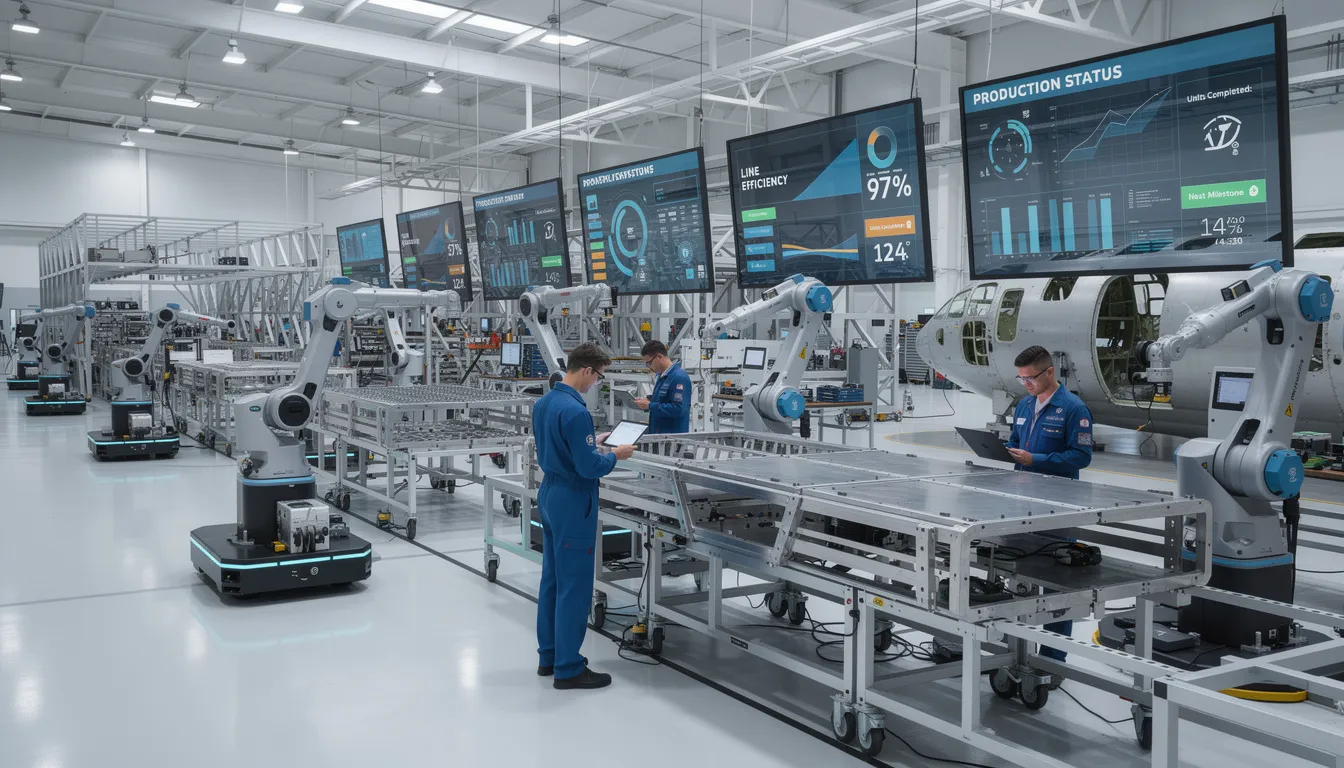
    The image depicts an aerospace manufacturing facility featuring digital displays that showcase real-time production information, reflecting the integration of control systems and manufacturing operations management systems. This environment emphasizes the importance of enterprise control system integration and efficient management of manufacturing activities.

    IEC 62264 provides the neutral, well-defined language that global aerospace manufacturing operations require. Its conceptual mirroring of ISA-95 ensures that organizations referencing either designation work from the same technical foundation. For aerospace teams coordinating production, maintenance, quality, and supply chain activities related to complex product offerings, this standards alignment supports consistent communication across other domains and systems.

    Connect981 is designed with these IEC 62264 and ISA-95 concepts in mind, organizing digital aerospace manufacturing and MRO workflows around the same levels, objects, and activities that the standards describe. To see how this standards-aligned approach works in practice, request a demo and explore how Connect981 fits into your operations architecture.

  • What is ISO 9001?

    What is ISO 9001?

    ISO 9001 is the international standard that specifies requirements for a quality management system (QMS). The current version, ISO 9001:2015, establishes what an organization’s QMS must achieve to demonstrate the ability to consistently provide products and services that meet customer and applicable statutory and regulatory requirements. Published by the International Organization for Standardization, ISO 9001 belongs to the ISO 9000 family of quality management standards—a set of international standards addressing different aspects of quality management.

    Within that family, ISO 9001 is the requirements standard. It defines what a QMS must accomplish, not how an organization must implement it. The standard does not prescribe specific methods, tools, or software. It sets outcome-oriented requirements across clauses 4 through 10, covering areas from organizational context and leadership to performance evaluation and improvement. These requirements are deliberately generic, making ISO 9001 applicable to organizations of all sizes and sectors, including aerospace manufacturing, maintenance, repair, and overhaul operations.

    This technology-neutral, sector-agnostic design means the same structure applies whether an organization relies on paper-based documentation or integrated digital platforms. ISO 9001 establishes the baseline; sector-specific standards and organizational processes determine how that baseline is met in practice.

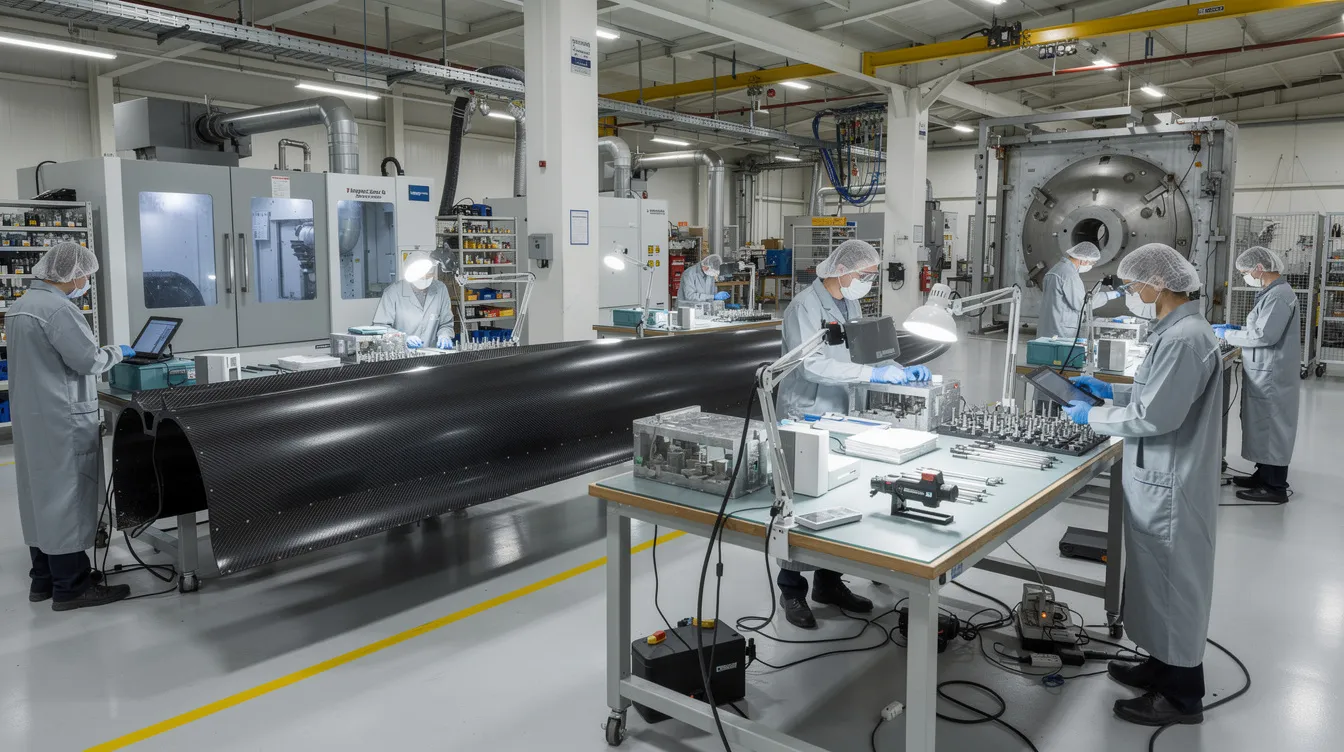
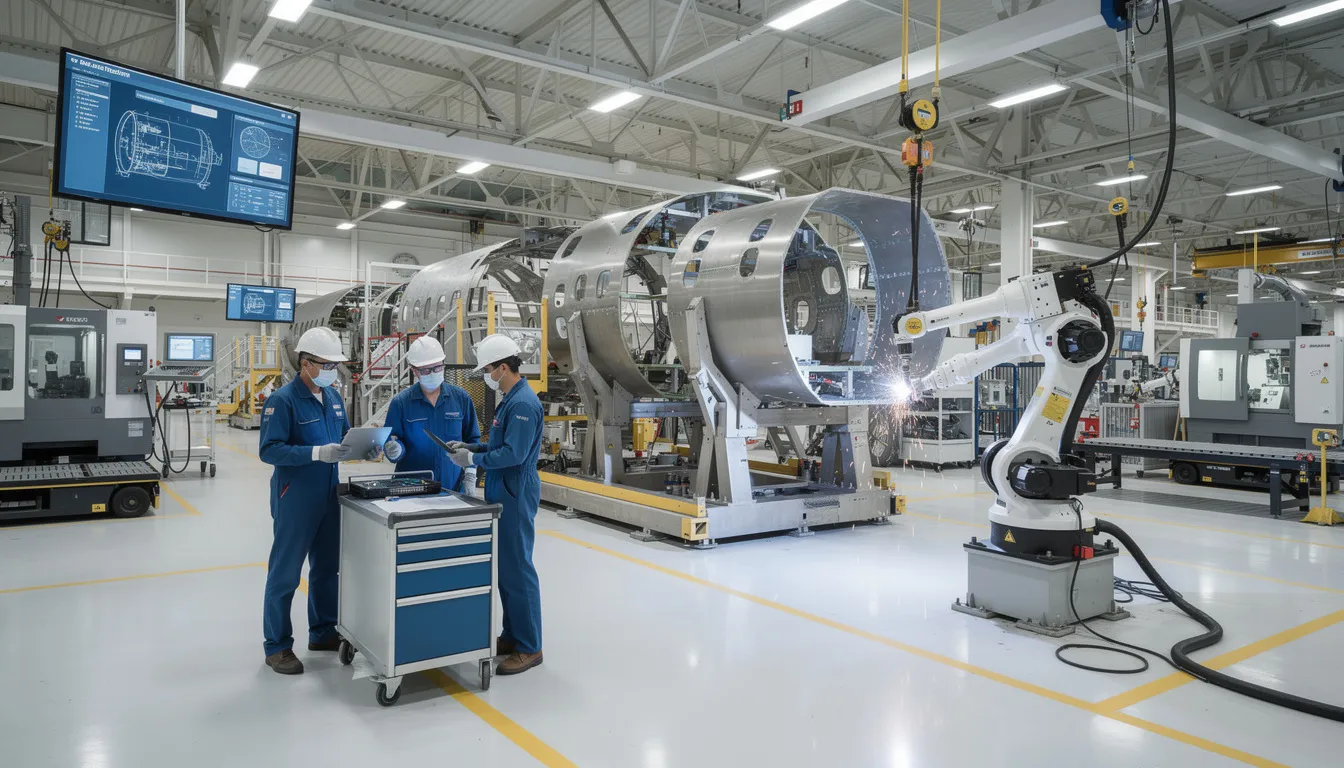
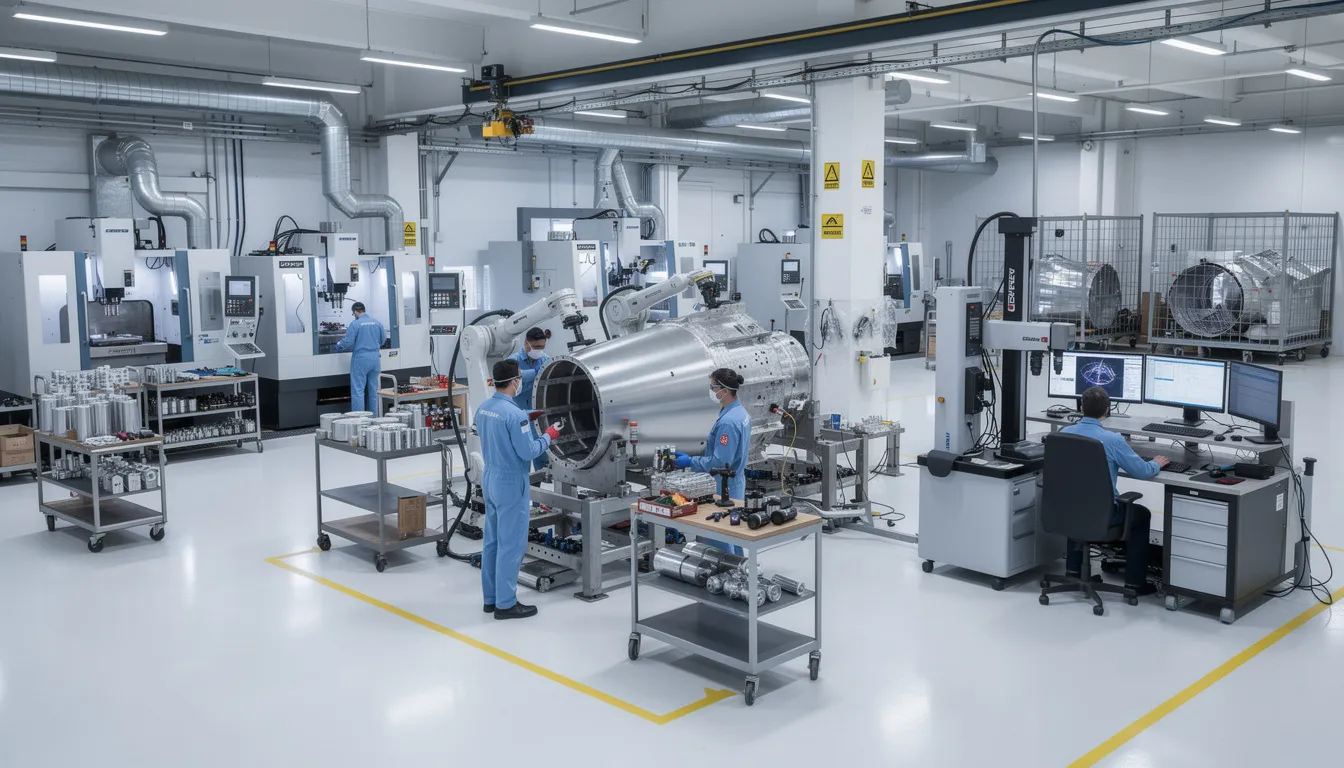
    The image depicts an aerospace manufacturing floor featuring precision assembly operations alongside quality inspection stations, emphasizing a quality management system that adheres to ISO 9001 standards. This environment showcases a commitment to customer satisfaction, continual improvement, and effective risk management through structured processes and internal audits.

    The ISO 9000 family and the role of ISO 9001

    The ISO 9000 family originated in 1987, drawing on earlier national standards such as the British Standard BS 5750. Maintained by ISO Technical Committee 176 (ISO/TC 176), these international standards address quality management from multiple angles. The family has evolved through several revisions, with the 2000 version consolidating previously separate standards into a unified process-based framework.

    Three standards define the core of the ISO 9000 family. ISO 9000 establishes fundamentals and vocabulary, providing definitions for terms such as “quality,” “conformity,” “risk,” and “interested parties” that underpin the other standards. ISO 9001 specifies the auditable requirements for a quality management system based on demonstrated capability to meet customer and regulatory requirements. ISO 9004 offers guidance for organizations seeking sustained success beyond basic compliance, addressing performance improvement and organizational maturity.

    ISO 9001 is the only standard in the ISO 9000 series that contains normative requirements suitable for third-party certification. When organizations certified to a quality management standard reference their certification, they are typically referring to ISO 9001. Third party certification bodies, accredited through national accreditation bodies affiliated with the International Accreditation Forum, conduct audits to verify conformity with ISO 9001 requirements. This certification process provides external validation that an organization’s QMS meets the standard’s requirements.

    Sector-specific standards build on ISO 9001 rather than replacing it. In aerospace, AS9100 incorporates all ISO 9001 requirements and adds sector-specific controls for configuration management, product safety, and other stakeholders’ expectations particular to aviation, space, and defense. The same structure applies across industries: IATF 16949 for automotive, ISO 13485 for medical devices, and similar frameworks all use ISO 9001 as their foundation.

    What ISO 9001 specifies at a high level

    ISO 9001:2015 is organized into 10 clauses. Clauses 0 through 3 provide introductory context, scope, normative references, and terms and definitions. Clauses 4 through 10 contain the normative QMS requirements—the sections against which organizations are audited.

    Clause 4 addresses the context of the organization. It requires determination of internal and external issues relevant to the organization’s purpose and strategic direction, identification of interested parties and their requirements, definition of QMS scope, and establishment of processes and their interactions. This includes understanding factors such as market conditions, regulatory environment, and organizational culture that affect the ability to achieve intended results.

    Clause 5 establishes leadership requirements. Top management must demonstrate leadership commitment to the QMS, establish quality policy aligned with organizational direction, assign roles and responsibilities, and promote customer focus throughout the organization. Leadership requirements in ISO 9001 place accountability at the executive level rather than delegating quality to a single department.

    Clause 6 covers planning. Organizations must address risks and opportunities relevant to achieving quality objectives, establish measurable quality objectives consistent with the quality policy, and plan actions to achieve those objectives. Risk based thinking, strengthened in the 2015 revision, replaces earlier prescriptive preventive action requirements with a systematic approach to identifying and addressing effects of uncertainty.

    Clause 7 specifies support requirements. This includes determining and providing necessary resources (people, infrastructure, environment, monitoring and measuring resources, organizational knowledge), ensuring competence through education, training, or experience, maintaining awareness of quality policy and objectives, establishing communication processes, and controlling documented information. The 2015 revision replaced mandatory documents and documented procedures with the more flexible concept of documented information, allowing organizations to determine appropriate formats and media.

    Clause 8 addresses operation—the actual realization of products and services. Requirements cover operational planning and control, requirements determination and review, design and development, control of external providers, production and service provision, release of products and services, and control of nonconforming outputs. For manufacturing organizations, this clause directly addresses production controls, supplier management, and nonconformity handling.

    Clause 9 covers performance evaluation. Organizations must monitor, measure, analyze, and evaluate QMS performance, including customer satisfaction. Internal audits and management reviews are required at planned intervals to assess QMS suitability, adequacy, and effectiveness.

    Clause 10 addresses improvement. Requirements include determining opportunities for improvement, responding to nonconformities through corrective actions, and pursuing continual improvement of QMS suitability, adequacy, and effectiveness.

    The process approach is central to ISO 9001:2015. Organizations must identify their processes, determine inputs and outputs, establish criteria and methods for effective operation and control, and manage process interactions. This approach, combined with the Plan-Do-Check-Act (PDCA) methodology embedded in the standard’s structure, provides a framework for systematic management rather than isolated controls.

    The intent of a Quality Management System under ISO 9001

    The stated purpose of a QMS under ISO 9001 is to enable organizations to consistently provide products and services that meet customer requirements and applicable statutory and regulatory requirements. The standard explicitly connects QMS effectiveness to the objective of enhancing customer satisfaction through system application, including processes for continual improvement and assurance of conformity.

    ISO 9001 frames quality management as a system of interrelated processes, not as a series of isolated inspections or end-of-line checks. Quality objectives link to organizational strategy. Resource allocation, competence development, and operational controls work together to achieve planned results. Customer expectations inform requirements determination, and customer satisfaction data feed back into improvement processes. Evidence based decision making grounds actions in data analysis rather than assumption.

    The seven quality management principles articulated in ISO 9000 inform this approach. Customer focus drives the system’s purpose. Leadership provides direction and creates conditions for achieving quality objectives. Engagement of people ensures competent, empowered personnel at all levels. The process approach enables consistent outcomes through systematic management of activities and resources. Continuous improvement addresses changing conditions and opportunities. Evidence-based decision making relies on data analysis. Relationship management addresses interactions with external providers and other stakeholders. These quality management principles underpin the requirements specified in ISO 9001, though the standard itself does not require formal adoption of each principle as a separate activity.

    The intent, in operational terms, is a management system that produces predictable outputs, responds systematically to deviations, and improves over time. For manufacturing operations, this translates to controlled processes, traceable records, defined authorities, and mechanisms for identifying and correcting problems before they propagate.

    Requirements versus implementation: what ISO 9001 does and does not dictate

    ISO 9001 specifies what an organization’s QMS must achieve. It does not prescribe how those outcomes are realized. This distinction between requirements and implementation is fundamental to understanding the standard’s design.

    The standard requires documented information to be maintained and retained for QMS operation and evidence of conformity. It does not specify document formats, software systems, or file structures. An organization may use paper-based records, electronic document management systems, or integrated digital platforms. The requirement is met when documented information is controlled, accessible, and adequate for its intended purpose.

    Nonconformity management provides another example. Clause 10 requires organizations to react to nonconformities, evaluate the need for action to eliminate root causes, implement corrective actions, and retain documented information of the nature of nonconformities and subsequent actions. The standard does not prescribe nonconformance tracking software, investigation methodologies, or specific forms. Organizations determine the methods appropriate to their operations and the nature of the nonconformities they encounter.

    Control of external providers illustrates the same principle. Clause 8.4 requires organizations to ensure that externally provided processes, products, and services conform to requirements. Organizations must determine and apply criteria for evaluation, selection, monitoring of performance, and re-evaluation of external providers. The standard does not mandate specific supplier audit frequencies, scoring systems, or supply chain visibility platforms. It requires that controls exist and are effective.

    This technology-neutral stance allows ISO 9001 to remain relevant across decades and technological shifts. Organizations in highly regulated sectors such as aerospace, medical devices, or automotive often implement controls that exceed ISO 9001’s basic requirements to meet additional regulatory expectations or customer specifications. In these contexts, ISO 9001 serves as the baseline quality system upon which sector-specific requirements are layered.

    The practical implication is that two organizations, both certified to ISO 9001, may operate very differently. One may rely on manual processes and physical records; another may use fully integrated digital systems with automated workflows. Both can meet the requirements if their respective approaches achieve the intended results: consistent products and services, conformity to requirements, and effective process control.

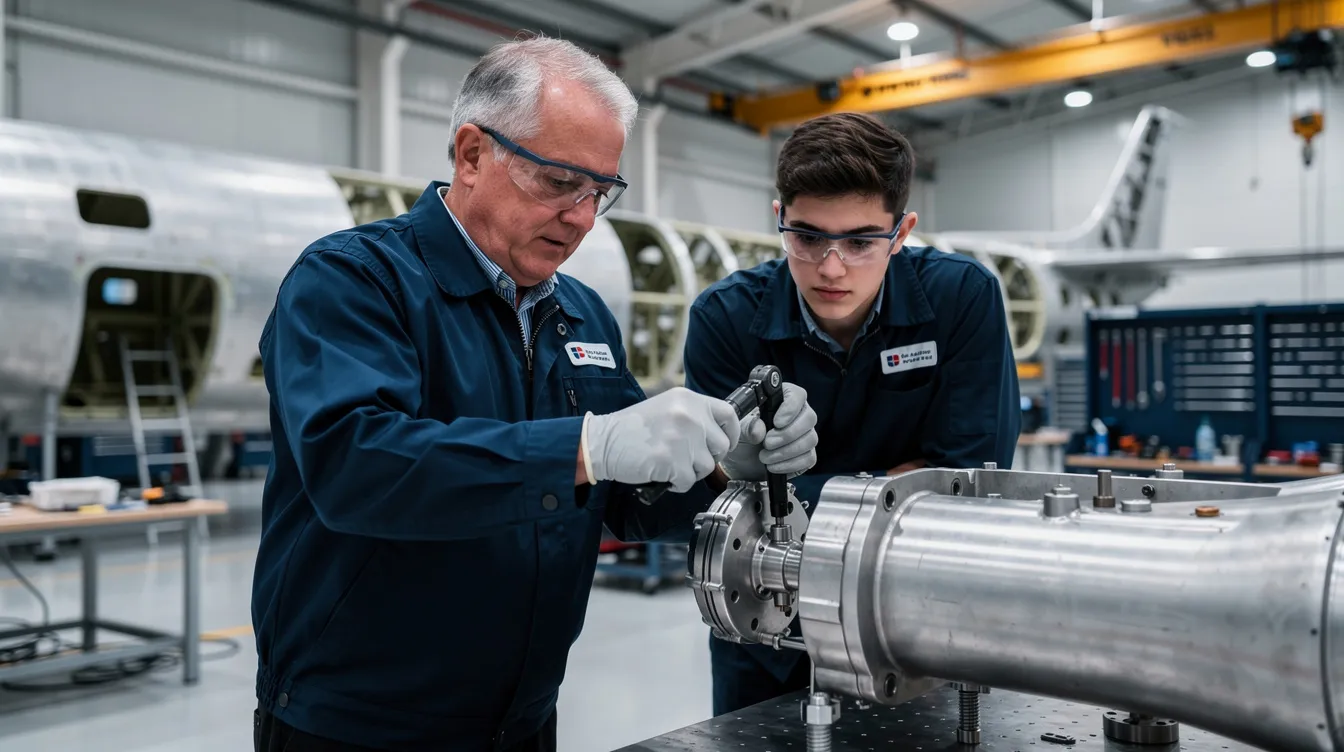
    An industrial quality control technician is carefully using precision measurement instruments to assess aerospace components, ensuring they meet customer requirements and comply with ISO 9001 quality management standards. This process reflects the commitment to continual improvement and risk management in the quality management system.

    Why ISO 9001 is widely referenced in manufacturing and aerospace

    ISO 9001 certification extends across more than one million organizations certified in over 180 countries. This global adoption reflects the standard’s function as a common baseline for quality expectations in business-to-business relationships.

    Manufacturing organizations work with complex supply chains where consistent quality directly affects production schedules, cost savings, and regulatory compliance. ISO 9001 provides a recognized reference point for supplier quality requirements. Purchasing agreements commonly reference ISO certification as a baseline qualification. Contract language often specifies that suppliers maintain ISO 9001 quality management or equivalent systems. This standardization reduces the burden of supplier qualification by establishing common expectations around documentation, traceability, and process control.

    Several factors contribute to this widespread adoption in manufacturing contexts:

    Factor

    Relevance to Manufacturing

    Process orientation

    Aligns with production systems that depend on repeatable, controlled operations

    Documentation requirements

    Supports traceability and configuration control essential to manufacturing

    Supplier control requirements

    Addresses multi-tier supply chain management common in manufacturing

    Performance evaluation

    Enables data-driven improvements in process efficiency and defect reduction

    Continual improvement focus

    Supports integration with methodologies such as lean manufacturing and Six Sigma

    Global recognition

    Facilitates international trade and supply chain relationships

    For aerospace manufacturing and MRO operations, ISO 9001 serves as the foundation for sector-specific standards. AS9100 incorporates all ISO 9001 requirements while adding controls for product safety, counterfeit part prevention, and configuration management. Regulatory bodies such as the FAA and EASA expect quality systems that address documentation accuracy, traceability, and nonconformance management—areas where ISO 9001’s structure provides an established framework.

    Many organizations in aerospace find that ISO 9001’s process approach aligns with modern production systems. Requirements for documented information, change control, and performance evaluation support integration across ERP, MES, and QMS platforms. The standard’s emphasis on determining and meeting customer requirements maps directly to contract review and requirements flowdown processes common in aerospace programs.

    Industry standards such as AS9100 add aerospace-specific requirements, but the underlying ISO 9001 structure remains. Organizations moving from general manufacturing into aerospace supply chains often find that their existing ISO 9001 certification provides a foundation for AS9100 implementation, though additional controls are invariably required to address sector-specific expectations.

    ISO 9001 in context: links to digital operations and aerospace workflows

    ISO 9001 requirements for documented information, process control, traceability, and change management intersect directly with digital shopfloor and supplier-integration tools in aerospace manufacturing. The standard does not reference specific software, but its requirements describe outcomes that digital operations platforms are designed to support.

    QMS processes for documented information control, for example, require that documents be available at points of use, protected from unintended alterations, and retained as evidence of conformity. Digital work instruction systems address these requirements by providing version-controlled, revision-tracked documents accessible at workstations. Nonconformity logging, corrective actions, and management reviews generate documented information that must be maintained and retained—functions supported by integrated quality management modules within digital platforms.

    Platforms like Connect981 are designed to help aerospace manufacturers and MROs operationalize these requirements within day-to-day workflows. Work instructions, traceability records, defect logs, and audit-ready documentation become part of connected data flows across ERP, MES, QMS, and supplier systems. This integration supports the evidence-based decision making that ISO 9001 requires by making quality data accessible, current, and linked to operational context.

    The standard’s technology-neutral design means ISO 9001 itself does not mandate digital systems. Paper-based approaches remain compliant if they meet requirements for control, accessibility, and retention. In practice, however, aerospace organizations increasingly find that digital operations layers make it easier to demonstrate consistent process control, maintain data integrity across production and supplier networks, and respond to audit inquiries with complete, traceable records.

    ISO 9001 provides a stable reference framework against which aerospace organizations can structure quality governance and digital transformation initiatives. The standard’s requirements define what must be achieved; organizational context, regulatory expectations, and operational complexity determine how those achievements are realized in integrated workflows across factories and suppliers.

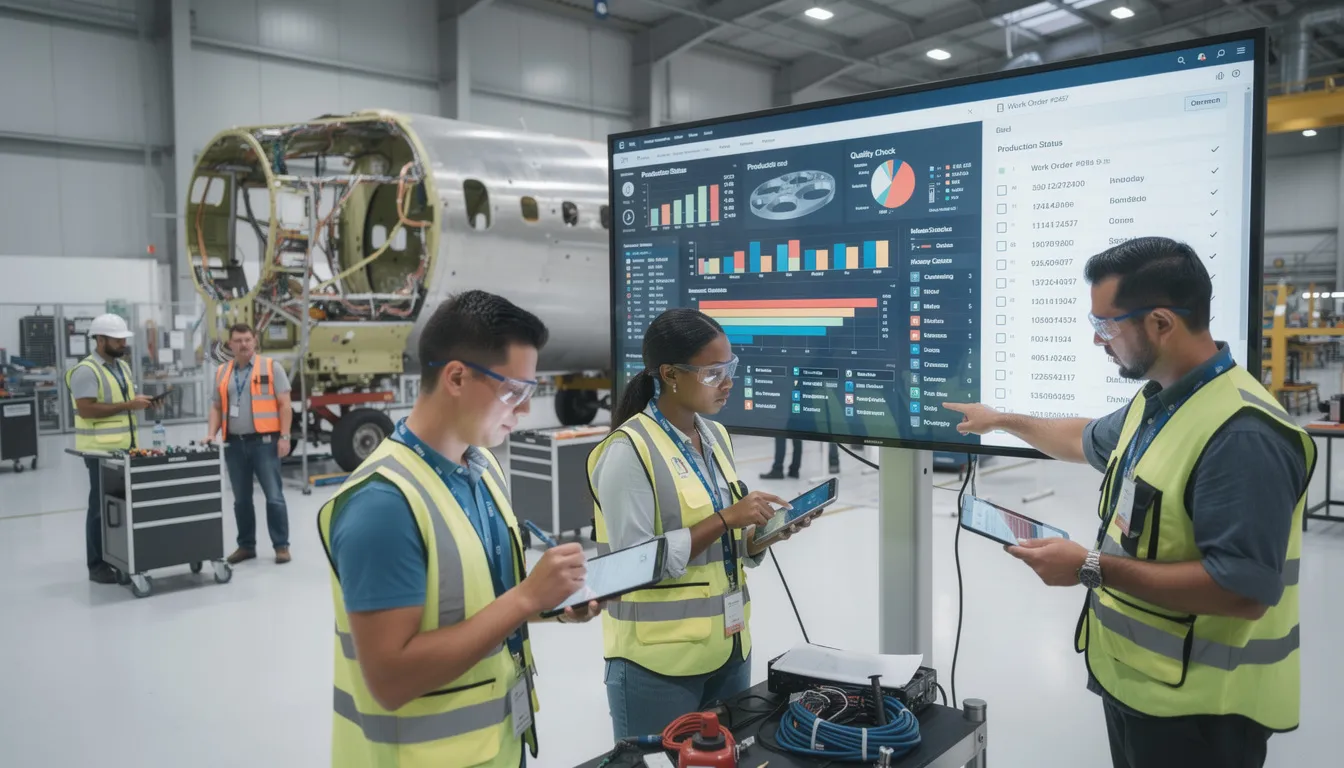
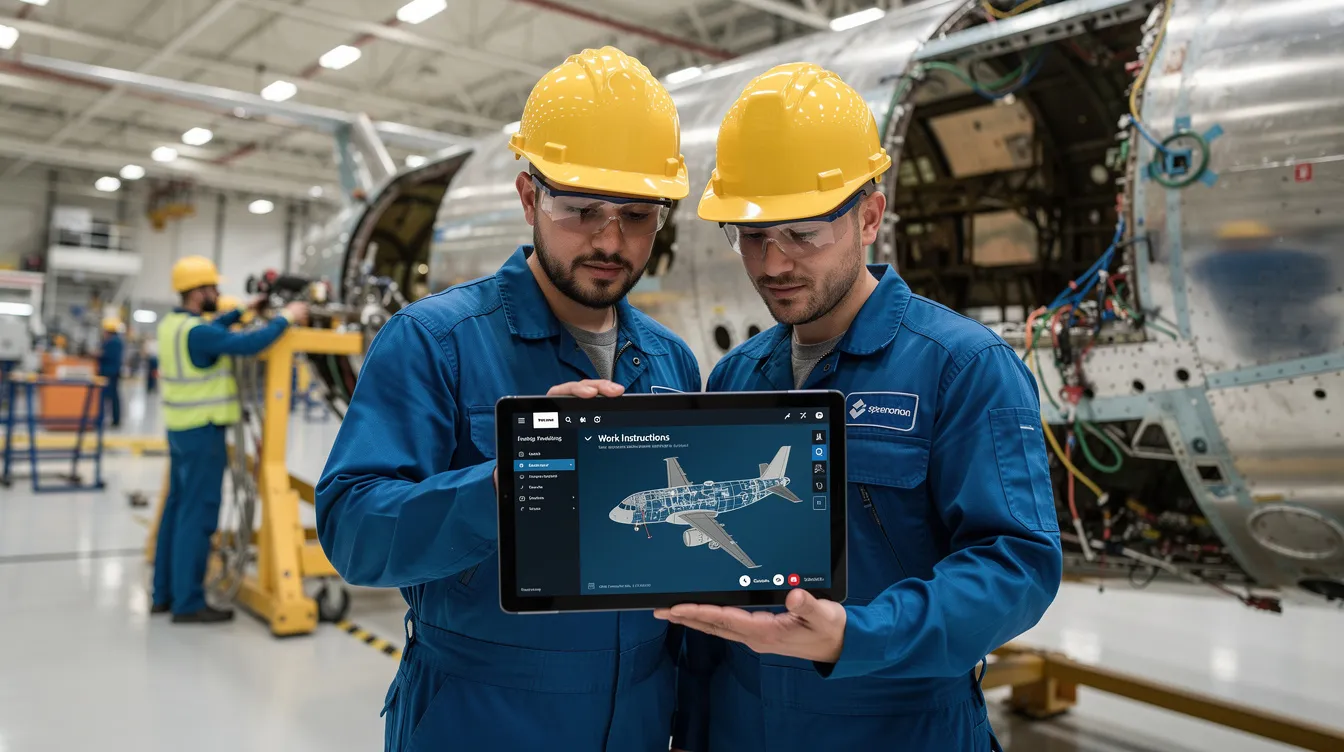
    A group of aerospace workers is actively using digital tablets and screens on the factory floor to track production processes, ensuring adherence to quality management principles and enhancing customer satisfaction. This use of technology supports the implementation of a quality management system aligned with ISO 9001 standards, promoting continual improvement and risk-based thinking in their operations.

    ISO 9001 establishes the baseline for quality management system requirements recognized globally across manufacturing and regulated industries. Understanding what the standard specifies—distinct from the methods organizations use to meet those specifications—enables more effective alignment between quality systems and operational realities. For aerospace manufacturers and MRO operations, ISO 9001 provides the foundation upon which sector-specific requirements, regulatory expectations, and digital transformation strategies are built.

  • ISO 22400 Manufacturing KPIs: Standardized Performance Measurement for Modern Plants

    ISO 22400 Manufacturing KPIs: Standardized Performance Measurement for Modern Plants

    Answer First: What ISO 22400 Means for Manufacturing KPIs

    ISO 22400 is an international standard that defines how key performance indicators should be structured, named, and conceptualized for manufacturing operations management. Published by the International Organization for Standardization beginning in 2014 and still current in 2025, the standard provides a common language for measuring manufacturing performance across plants, enterprises, and supply chains. It does not tell manufacturers what to improve or which metrics matter most for their business. It defines what those metrics mean.

    The standard exists because manufacturing companies operating across multiple sites, working with diverse suppliers, and integrating heterogeneous systems need consistent terminology. When one plant reports “availability” and another reports “uptime,” the numbers may not be comparable. ISO 22400 addresses this by providing unambiguous definitions for key performance indicators KPIs used in production, maintenance, quality, and related operations. The goal is interoperability and clarity, not performance coaching.

    This article focuses on conceptual definitions, KPI categories, and the limits of KPI standardization as framed by ISO 22400. It does not explain how to calculate KPIs, recommend which KPIs to use, or offer advice on performance improvement. Connect981 uses ISO 22400 concepts to keep aerospace and MRO reporting aligned with global terminology, while integrating with ERP, MES, PLM, and QMS. The platform applies standardized definitions where feasible without mandating any particular KPI set for its users.

    The image depicts an industrial factory floor filled with automated machinery and advanced control systems, showcasing the integration of manufacturing operations management and automation systems. This environment emphasizes production efficiency and overall equipment effectiveness, essential for achieving key performance indicators in the manufacturing industry.

    ISO 22400 in Context: Purpose, Scope, and Relationship to Other Standards

    ISO 22400 belongs to the automation systems and integration family of standards. Its primary focus is establishing an industry neutral framework for key performance indicators applied to manufacturing operations management. The standard addresses how KPIs should be defined, composed, exchanged, and utilized across different automation systems and software platforms.

    The standard consists of multiple parts:

    • ISO 22400-1:2014 provides the foundational concepts and terminology. It introduces a framework for KPIs that can apply across batch, continuous, and discrete industries without prescribing specific metrics for any sector.
    • ISO 22400-2:2014 defines a set of 34 KPIs drawn from current industry practices. Each KPI includes attributes such as its description, applicable time behavior, units of measure, logical ranges, and trend direction. The intent is conceptual clarity, not formula delivery.

    The standard aligns with IEC 62264-1, which addresses enterprise-control system integration. Both standards reference similar hierarchical levels: enterprise, site, area, work center, and work unit. ISO 22400 KPIs are primarily positioned at Level 3 of this hierarchy, focusing on production, quality, inventory, and maintenance operations. Level 4 metrics, which incorporate economic, logistic, and financial factors tied to business planning, fall outside the standard’s scope.

    ISO 22400 is designed to be applicable across the manufacturing industry broadly. Aerospace, automotive, electronics, and process industry operations can all reference the same KPI definitions. This neutrality supports organizations that operate across multiple sectors or collaborate with suppliers in different verticals.

    • The standard supports interoperability among heterogeneous systems (ERP, manufacturing execution systems, SCADA, historians, and reporting tools) by standardizing KPI names, definitions, and data relations. When two systems use the same ISO 22400 definition for a metric, their data can be compared or aggregated without manual translation.

    Conceptual Definitions: From Performance Measurement to Manufacturing KPIs

    Performance measurement in a manufacturing context refers to the systematic quantification of efficiency, effectiveness, and resource utilization using structured metrics. The purpose is to provide a comprehensive view of how production processes, equipment, and personnel behave over a specific period. ISO 22400 provides the conceptual foundation for this measurement activity.

    The standard works with several core definitions:

    • Performance indicator: A measurable representation of how a process, system, or resource behaves over time. Indicators provide quantifiable data points that describe operational states or outcomes.
    • Key performance indicator (KPI): A selected subset of performance indicators considered critical for understanding manufacturing operations. KPIs are framed in a standardized way, with explicit definitions of what they measure, how they relate to time and quantity elements, and who typically uses them (operators, supervisors, management).
    • Manufacturing operations management (MOM): The set of activities that plan, dispatch, execute, track, and report manufacturing and maintenance operations. MOM sits between enterprise planning (ERP) and basic control systems, managing manufacturing operations at the execution level.

    ISO 22400 emphasizes unambiguous terminology. Terms such as “availability,” “utilization,” “work unit,” “production order,” and “state” each have precise definitions. This precision keeps KPIs interpretable across plants and suppliers. When a contract references “equipment utilization” as defined in ISO 22400, both parties can verify they mean the same thing.

    The standard distinguishes between different levels of data abstraction:

    Level

    Description

    Example

    Raw signals

    Direct outputs from equipment or control systems

    Machine ON/OFF, cycle counters, timestamps

    Derived indicators

    Calculated values based on raw signals

    Time in a specific state, produced quantity

    KPIs

    Aggregated indicators mapped to defined concepts

    Equipment utilization, order execution reliability

    ISO 22400 deliberately separates conceptual definitions from implementation details. It defines what a KPI means without specifying which database, SCADA system, or reporting technology must be used. This separation allows manufacturing systems of varying architectures to implement the same conceptual framework.

    KPI Categorization in ISO 22400: How the Standard Structures Manufacturing Metrics

    ISO 22400 groups KPIs to reflect different viewpoints on manufacturing operations. The categorization addresses multiple dimensions: what is being measured, at what level of the organization, over what time horizon, and using what type of underlying data.

    The main categorization dimensions include:

    • Functional domain: KPIs oriented toward production operations, maintenance operations, quality operations, logistics, or energy usage. Each domain addresses a distinct aspect of manufacturing performance.
    • Object of measurement: KPIs can focus on industrial equipment and work units, production lines and areas, work centers, entire plants, or specific production orders and lots. The level of granularity depends on the decision context.
    • Time horizon: Indicators may reflect real time insights, shift-level summaries, daily aggregates, weekly or monthly trends, or the full lifecycle of a production order.
    • State-based vs. quantity-based: Some KPIs measure time in specific states (running, idle, scheduled downtime, unplanned downtime). Others measure volumes such as units produced, accepted units that meet quality standards, or scrap rate.

    Within these dimensions, ISO 22400 defines families of KPIs:

    • Equipment-oriented KPIs focus on machine or work unit behavior. These include concepts related to overall equipment effectiveness, availability indicators, and utilization indicators. The emphasis is on how equipment spends its planned time and actual time.
    • Order and production-related KPIs assess how executed operations compare to planned operations. Metrics in this family address production time structure, cycle time adherence, and throughput relative to production capacity.
    • Resource-related KPIs provide conceptual views on energy consumption, raw materials usage, or personnel involvement tied to specific operations.

    ISO 22400 often expresses KPIs as relationships among time categories, quantities, and events. The 34 KPIs defined in ISO 22400-2 are not isolated metrics. Research highlights their mutual interconnections, meaning changes in one indicator often affect others. This interdependence supports more nuanced analysis but also requires careful interpretation.

    • This categorization helps organizations and software platforms build consistent data models and dashboards. When “availability” or “resource utilization” has the same definition across multiple sites and suppliers, reporting becomes comparable without manual reconciliation.

    The image depicts an automated production line featuring advanced robotic assembly equipment, illustrating modern manufacturing operations management. This setup highlights key performance indicators related to production efficiency and overall equipment effectiveness within the manufacturing industry.

    Analytical View of OEE and Other Equipment-Oriented KPIs in ISO 22400

    ISO 22400 devotes significant attention to equipment-related KPIs because equipment behavior is central to manufacturing performance measurement. How machines spend their time, how much they produce, and whether output meets quality standards are fundamental concerns for any manufacturing plant.

    The standard addresses overall equipment effectiveness OEE at a conceptual level:

    • OEE is expressed through combinations of time-based and output-based indicators. These reflect availability, performance, and quality concepts without prescribing a single calculation method.
    • ISO 22400 introduces multiple OEE-related models, including variants referred to as OEEA and OEEB. These models are constructed from well-defined time elements (such as busy time, operating time, and downtime categories) and material-related quantities (good quantity, defect rate).

    Academic analyses since 2020 have evaluated these models for internal consistency and alignment with traditional TPM OEE concepts. The standard itself remains at the definitional level. It does not mandate how a plant should interpret or act on OEE figures.

    Equipment states serve as a conceptual bridge between control-system events and KPI definitions. ISO 22400 references states such as:

    State

    Description

    RUN

    Equipment actively producing

    STOP

    Equipment halted, not producing

    IDLE

    Equipment available but not currently running

    SLOW

    Equipment running below target speed

    Each state maps to specific time categories defined in the standard. This mapping allows different automation systems to classify equipment behavior consistently and feed that classification into equipment effectiveness indicators.

    The analytical intent of these definitions is threefold:

    1. Provide a consistent vocabulary of equipment states and derived times.
    2. Enable standard mapping from these times to equipment-focused KPIs.
    3. Support interoperability between automation systems and integration platforms when exchanging performance data.

    This section describes how OEE-related KPIs are framed conceptually in ISO 22400. It is not guidance on how to use OEE for continuous improvement or how to identify areas for operational excellence initiatives.

    Limits of KPI Standardization: What ISO 22400 Does Not Decide

    ISO 22400 standardizes definitions and structures. It intentionally avoids prescribing business strategy, objectives, or plant-specific KPI sets. Understanding these boundaries is essential for organizations adopting the standard.

    Key limits of KPI standardization include:

    • Context dependence: The relevance of any KPI depends on industry, process type, regulatory environment, and organizational goals. What constitutes an important KPI for a discrete industries manufacturer may differ from a process industry facility. The standard does not make those determinations.
    • Granularity choices: ISO 22400 defines KPIs across multiple levels (work unit, line, area, plant, production order). It does not state which level should be reported for any given decision process. A production engineering team may need work-unit-level data; a plant manager may need site-level summaries.
    • Weighting and thresholds: The standard defines what a KPI means. It does not set target values, good or bad thresholds, or scoring models. Strategic goals and acceptable performance ranges remain organizational decisions.

    The standard also does not specify:

    • Algorithms for data collection (sampling rates, filtering rules, data validation procedures)
    • Visualization techniques (dashboards, heatmaps, Pareto charts, trend displays)
    • How KPIs should be used in performance reviews, incentive systems, or lean manufacturing programs

    Organizations may combine ISO 22400 KPIs with additional, domain-specific indicators. Aerospace traceability measures, MRO turnaround-time breakdowns, or preventative maintenance scheduling metrics may lie outside the formal scope of the standard but can coexist with ISO 22400 terminology.

    • Connect981 maps plant data into ISO 22400-aligned structures where feasible, while allowing non-standard, aerospace-specific indicators to coexist. These additional indicators are not labeled as ISO 22400 KPIs, maintaining clarity about what is standardized and what is organization-specific.

    The boundaries of standardization are not deficiencies. They reflect a deliberate design choice. ISO 22400 provides vocabulary and structure; organizations fill in the content based on their operational realities.

    ISO 22400 in a Connected Manufacturing Environment: Data, Integration, and Interoperability

    Modern manufacturing plants operate with multiple systems exchanging data: ERP for business planning and order management, MES for production execution, QMS for quality operations, PLM for product definition, historians for time-series data, and various reporting tools for KPI data visualization. ISO 22400 provides a conceptual layer that helps these systems speak a common language when discussing manufacturing performance.

    The role of ISO 22400 in data modeling includes:

    • Providing standard names and definitions for common KPIs across production, maintenance, and quality domains.
    • Aligning time and state concepts so that different systems interpret equipment and order behavior consistently.
    • Supporting manufacturers, system integrators, and software vendors when they design interfaces and data exchanges.

    A platform like Connect981 leverages standardized KPIs in several ways:

    • Mapping incoming signals and events from existing MES and ERP systems to ISO 22400 concepts for managing manufacturing operations.
    • Supporting aerospace and MRO workflows (digital work instructions, parts traceability, quality checks) while keeping KPI semantics consistent with the standard.
    • Enabling multi-site reporting where a KPI such as “equipment utilization” or “production efficiency” is based on the same underlying definitions at every facility.

    ISO 22400 does not require any specific technology stack. No mandated databases, cloud platforms, or UI frameworks appear in the standard. It is designed to be compatible with web-based dashboards, SCADA-based reports, and third-party analytics tools alike. The end user can choose their preferred technology while maintaining definitional consistency.

    • Standardization helps when collaborating with suppliers. Contract reporting can reference ISO 22400 KPI concepts so that both parties interpret metrics the same way, even if they use different internal systems. This reduces disputes over what was measured and how.

    The image depicts an industrial control room filled with multiple monitoring displays, where operators are actively managing manufacturing operations. This environment focuses on key performance indicators (KPIs) related to production performance and overall equipment effectiveness, emphasizing the importance of real-time insights in optimizing manufacturing processes.

    While this connected environment can enable broad performance analysis, ISO 22400 itself remains focused on definitions and structures. It does not prescribe how organizations should improve their operations or which metrics deserve the most attention. Companies tend to adopt the vocabulary and then make their own decisions about application.

    Summary and Implications for Standards-Aligned KPI Frameworks

    ISO 22400 provides a standards-based framework for manufacturing KPIs. Aligned with IEC 62264-1 and applicable across discrete, batch, and continuous industries, the standard offers an industry neutral framework for defining, categorizing, and exchanging performance information. The 34 KPIs in ISO 22400-2 cover production, quality, and maintenance operations with explicit attributes including units of measure, applicable user groups, and trend directions.

    The standard’s value lies in conceptual definitions and KPI categorization. Equipment-oriented indicators, order-related metrics, and resource utilization concepts each have precise meanings that support interoperability across heterogeneous manufacturing systems. The limits of KPI standardization are equally clear: ISO 22400 defines meaning and structure, not targets, calculation algorithms, or management methods. Organizations retain full discretion over which KPIs to monitor, what thresholds to set, and how to act on the resulting KPI data.

    For aerospace manufacturing and MRO environments, mapping digital operations to ISO 22400 concepts helps maintain high standards of clarity and comparability. When multiple plants and suppliers reference the same definitions, performance information becomes actionable across organizational boundaries. Platforms like Connect981 can implement these standardized definitions as part of a broader digital operations layer, while leaving each organization free to decide which KPIs matter for their specific context and how to interpret results. The standard provides the vocabulary; the organization provides the strategy.

  • Aerospace Compliance Software: Digital Systems for AS9100, AS9102 & Audit-Ready Operations

    Aerospace Compliance Software: Digital Systems for AS9100, AS9102 & Audit-Ready Operations

    Aerospace manufacturing and MRO operations face a fundamental challenge that paper procedures and shared drives cannot solve. Regulatory requirements from AS9100, AS9102, FAA, EASA, ITAR, and NADCAP demand more than documented policies. They demand executable workflows that capture evidence at the point of work, maintain traceability across complex supply chains, and produce audit-ready records without weeks of preparation. This is where aerospace compliance software becomes essential.

    The aviation compliance monitoring software market grew from USD 10.1 billion in 2024 and is projected to reach USD 18.2 billion by 2032. That growth reflects a shift from manual, reactive compliance to digital systems that operationalize quality management at the shopfloor level. For aerospace manufacturers, MRO facilities, and their sub tier suppliers, the question is no longer whether to digitize compliance but how to do it without disrupting production.

    Connect981 addresses this challenge as a unified aerospace operations platform that connects ERP, MES, PLM, QMS, and supplier systems into a single compliance execution layer. Rather than adding another disconnected point tool, it replaces paper packets, spreadsheets, and tribal knowledge with digital work instructions, automated quality checks, and traceable documentation workflows. The result is reduced audit prep time, higher first-pass yield, and faster customer approvals.

    This article covers the key capabilities that quality managers and compliance leaders need to understand: digital audit trails that capture every action, layered process audits that maintain continuous compliance monitoring, CAPA traceability that links findings to root causes, and automated documentation workflows that keep pace with evolving standards. Each section provides practical context for aerospace and defense organizations evaluating software solutions for 2025 and beyond.

    The Aerospace Regulatory Environment: Standards Driving Compliance Software

    The aerospace industry operates under regulatory scrutiny that far exceeds most other discrete manufacturing sectors. A single component failure can endanger lives and aircraft. Liability exposure is substantial. Airworthiness certification requires meticulous documentation that traces every part, process, and decision. Export controls under ITAR and EAR add another layer of complexity, demanding that technical data access be controlled and auditable. These constraints make compliance execution fundamentally different from industries where quality issues result in warranty claims rather than safety incidents.

    AS9100 Revision D serves as the foundation for quality management in aerospace and defense industries. Built on ISO 9001:2015, it adds aerospace-specific requirements across critical clauses. Clause 7.5 governs documented information control, ensuring that work instructions and procedures remain current and accessible. Clause 8.5 addresses production and service provision, requiring controlled processes with defined inspection points. Clause 10.2 mandates structured approaches to nonconformity and corrective action. Aerospace compliance software operationalizes these clauses by automating record-keeping, workflow routing, and evidence capture at each step.

    AS9102 standardizes First Article Inspection processes that verify production capability against engineering drawings before full-rate production begins. The traditional approach involved manual forms, hand-entered measurements, and paper packages prone to transcription errors. Digital FAI tools replace this with automated data pulls from PLM and ERP systems, attaching CMM measurements, photos, and electronic signatures to ballooned drawings. In high-volume airframe component manufacturing, this approach has reduced FAI errors by up to 50%.

    Beyond AS9100 and AS9102, aerospace organizations must address multiple overlapping frameworks:

    • FAA Part 21 governs design and production approvals for civil aviation products in the United States
    • FAA Part 145 establishes requirements for repair station certification and MRO operations
    • EASA Part 21 and Part 145 provide equivalent European airworthiness and maintenance requirements
    • ITAR and EAR impose export restrictions on technical data, requiring role-based access controls and comprehensive audit logs
    • NADCAP accredits special processes like heat treating, welding, and non-destructive testing through rigorous audits

    An engine MRO facility might use aerospace compliance software to centralize NADCAP evidence, linking supplier certificates to serial-numbered parts across multiple overhaul cycles. An airframe structural component producer tracks ITAR-controlled drawings through production, ensuring that only authorized personnel access sensitive data while the system logs every interaction.

    Key terminology that appears throughout aerospace quality management system documentation:

    • Quality management system (QMS): The holistic framework encompassing policies, procedures, and processes that ensure consistent quality
    • Audit trail: An immutable, time-stamped log capturing who performed what action, when, and under which document revision
    • Nonconformance: Any deviation from specifications, drawings, procedures, or customer requirements
    • Corrective action: Root-cause remediation that addresses why a nonconformance occurred
    • CAPA (Corrective and Preventive Action): The structured process to fix issues and prevent their recurrence

    From Quality Manual to Digital Compliance Workflows

    Traditional aerospace organizations maintained compliance through paper procedures stored in binders, PDFs on shared drives, and institutional knowledge held by experienced personnel. This approach works tolerably well for a single facility with stable products and long-tenured staff. It breaks down when operations span multiple sites, when new programs ramp quickly, or when supplier networks must execute to the same industry standards.

    The constraint becomes clear during audits. Quality managers spend weeks gathering evidence. Revision control depends on manual processes that fail silently. Work instructions exist in document management systems but never reach the shopfloor in a format operators can execute. Compliance documentation exists, but the connection between the documented procedure and actual production practice requires human interpretation at every step.

    Compliance workflows represent the operationalization of AS9100 and customer requirements into executable digital sequences. Rather than procedures that describe what should happen, these workflows enforce what actually happens: routing approvals through designated reviewers, triggering inspection checkpoints at defined process steps, capturing electronic signatures from authorized personnel, and preventing work from proceeding until required evidence exists.

    Connect981 enables teams to design low-code workflows that mirror actual production and MRO steps without requiring IT projects. A contract review workflow routes incoming customer requirements through engineering, quality, and program management with automated checks against production capability. An in-process inspection workflow presents operators with the correct measurement criteria, captures their inputs, and routes failures to disposition. A final release workflow verifies that all FAI requirements, in-process inspections, and documentation exist before permitting shipment.

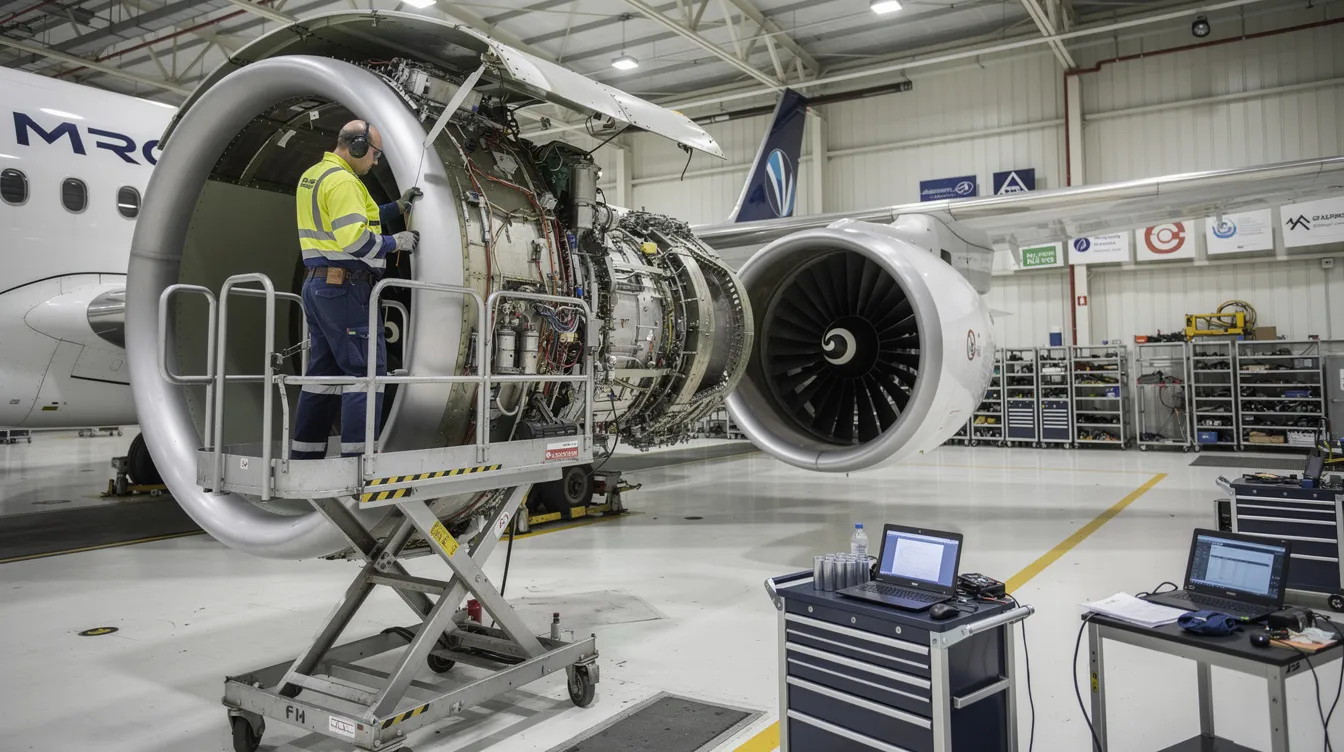
    The image depicts an aerospace manufacturing floor where technicians are actively engaged at digital workstations, surrounded by various aircraft components. This environment emphasizes the importance of regulatory compliance and quality management in the aerospace industry.

    AS9102 integration illustrates how digital compliance workflows replace manual processes. Digital FAI form templates automatically populate part numbers, revision levels, and ballooning data from PLM systems like Teamcenter or Windchill. Operators attach CMM measurements, photos, and comments directly within the workflow. Electronic signoffs route through layered approvals. The cycle time from first article completion to customer approval drops from days to hours.

    Layered process audits (LPAs) represent another structured workflow type essential for maintaining compliance between formal audits. These scheduled checks occur at operator, supervisor, and manager levels using standardized question sets that verify process adherence in real time. When an LPA identifies a finding, the system automatically creates a nonconformance record and initiates the appropriate escalation workflow.

    Concrete workflow examples from aerospace operations include:

    • A machining cell where a work order release from ERP triggers a digital traveler with inspection checkpoints linked to AS9100 Clause 8.5 requirements
    • An MRO bay where variable aircraft configurations pull tail-number-specific service bulletins from a centralized repository, ensuring mechanics follow the correct revision
    • A receiving inspection workflow that verifies supplier FAI packages and certificates of conformity before releasing material to stock

    Digital Documentation and Audit Trail Management

    An audit trail in aerospace terms means more than a log file. It represents a comprehensive, time-stamped, immutable record capturing who performed what action, on which document or part, under which revision, and at what location. These records are essential for demonstrating airworthiness, defending against liability claims, and satisfying regulatory requirements during internal and external audits.

    Aerospace compliance software centralizes diverse documentation into a single source of truth. This includes procedures and work instructions, FAI reports conforming to AS9102 forms, certificates of conformity, shop travelers, inspection logs, supplier 8130 tags, and teardown documentation for MRO operations. Version control ensures that every user accesses the current revision while maintaining complete revision history for audit purposes.

    Connect981 provides this document control capability with effectivity dates that determine when specific revisions become active across production. Role-based access addresses ITAR requirements for export-controlled information, partitioning sensitive data so that only authorized personnel can view or modify restricted content. The system automatically archives changes, creating the audit trails that regulators and customers expect.

    The linkage between documentation and physical assets enables end-to-end traceability. Each record connects to specific part numbers, serial numbers, lot numbers, work orders, and tail numbers. Reconstructing a turbine blade’s complete history from forging through installation becomes straightforward: every revision, approval, inspection result, and nonconformance appears in a connected view.

    Document types commonly digitized in aerospace manufacturing and MRO between 2024 and 2026 include:

    • Digital shop travelers: Build packages that capture every step of fabrication and assembly with electronic signoffs
    • Supplier FAI packages: First article documentation from sub tier suppliers with embedded metrology data and material certifications
    • Inspection records: In-process and final inspection results linked to specific serial numbers and work orders
    • MRO return-to-service documentation: 8130-3 tags with dual releases and complete maintenance histories
    • Certificates of conformity: Supplier and internal certifications linked to receiving records and production batches
    • Engineering changes: Revision-controlled drawings with approval workflows and effectivity tracking

    Automatic capture of e-signatures follows 21 CFR Part 11-style controls where required, ensuring that electronic records carry the same legal weight as paper signatures. The system maintains the integrity of these records through immutable logging, preventing modification without creating an auditable trail.

    Nonconformance, CAPA, and Traceability in Aerospace Operations

    Nonconformance management sits at the heart of any aerospace quality management system. Every machining defect, documentation error, or supplier discrepancy requires structured handling that captures the issue, prevents further processing of affected material, and initiates appropriate remediation. Without digital systems, these records scatter across forms, emails, and spreadsheets, making pattern detection nearly impossible.

    CAPA represents the structured response to nonconformance. In practical terms, this means:

    1. Issue capture: Documenting what went wrong with sufficient detail for analysis
    2. Containment: Quarantining affected parts or halting affected processes
    3. Root cause analysis: Using methods like 8D or fishbone diagrams to identify why the issue occurred
    4. Corrective action: Implementing fixes that address the root cause
    5. Verification: Confirming that corrections actually resolved the issue
    6. Preventive action: Deploying changes that prevent recurrence across similar processes

    Aerospace compliance software links each nonconformance record with associated contextual data: operator ID, machine, shift, work order, serial number, supplier lot, and process step. This preserves traceability so that root cause analysis can identify patterns that manual systems miss.

    Connect981 supports CAPA traceability by connecting findings from multiple sources into unified records. An LPA finding, a customer complaint, an in-process inspection failure, and a supplier quality escape can all link to the same underlying CAPA if they share a common root cause. Each CAPA record carries tasks, owners, due dates, and verification requirements, ensuring that corrective actions proceed to completion.

    A quality inspector is examining an aerospace component using precise measurement equipment, ensuring compliance with rigorous industry standards. This meticulous inspection process is crucial for maintaining regulatory compliance and quality assurance within the aerospace and defense industries.

    AI-assisted root cause analysis within modern platforms detects patterns across historical data. Repeated torque verification misses on a specific assembly line become visible as trends rather than isolated incidents. Supplier quality issues cluster by material lot or production date. These insights enable preventive action before nonconformances multiply.

    Consider two real-world scenarios that illustrate digital traceability in action:

    Scenario 1: Missed Torque Verification A landing gear overhaul facility discovers that a torque verification step was missed during assembly. The digital system traces the specific assembly, operator, shift, and tooling involved. Investigation reveals that the torque wrench had a lapsed calibration, which the paper-based calibration tracking failed to flag. The CAPA links to updated calibration tracking workflows and new system interlocks that prevent assembly progression without verified tool calibration.

    Scenario 2: Repeated Paint Adhesion Failures Composite panels from multiple production lots exhibit paint adhesion failures during final inspection. The compliance system aggregates nonconformance records and identifies that all failures share a common supplier material lot. Root cause analysis traces the issue to batch contamination at the supplier. The CAPA feeds outcomes back to ERP for vendor scorecard updates and triggers enhanced incoming inspection requirements for the supplier.

    Layered Process Audits and Continuous Compliance Monitoring

    Layered process audits have gained significant adoption among OEMs and Tier 1 suppliers from 2024 through 2026. These audits extend beyond annual AS9100 surveillance to create continuous improvement through daily or weekly verification at multiple organizational levels. The principle is straightforward: compliance is not a point-in-time event but an ongoing state that requires regular confirmation.

    LPAs involve cross-hierarchical checks where operators, supervisors, and managers each conduct audits using standardized question sets. Operators might verify daily setup parameters. Supervisors check that work instruction adherence matches requirements. Managers audit that safety protocols and FOD (foreign object debris) controls remain effective. This layered approach catches deviations early, before they become systemic issues.

    Aerospace compliance software automates the scheduling, assignment, and tracking of LPAs across multiple cells, lines, and sites. Connect981 assigns auditors via mobile access interfaces with geofenced checklists that guide them through each verification step. Results flow into a centralized repository where pass/fail outcomes, photos, and comments create trendable data.

    When an LPA identifies a failure, the system automatically generates a nonconformance record and initiates appropriate escalation. A missed calibration verification triggers a CAPA. A work instruction deviation creates a corrective action requirement. This automation ensures that findings receive appropriate attention rather than disappearing into email threads.

    Example LPA question sets for aerospace operations include:

    • Torque wrench calibration: Is the torque wrench within calibration date per NADCAP requirements?
    • Work instruction adherence: Is the operator using the correct revision of the work instruction for this operation?
    • FOD controls: Are FOD covers in place on all open aircraft areas per the posted procedure?
    • Measurement equipment: Are all gauges and instruments within calibration and properly stored?
    • Safety equipment: Is required personal protective equipment present and being used correctly?

    Dashboards and real-time reporting show audit completion rates, with targets typically exceeding 95%. Quality leaders see recurring findings by process step, shift, or location. Open corrective actions appear with aging indicators. This visibility transforms LPAs from administrative burden into actionable intelligence for continual improvement.

    Audit Readiness: Turning Audit Trails into Evidence

    The traditional approach to audit preparation involved quality teams spending weeks gathering documents from shared drives, tracking down paper records from archives, and assembling binders organized by audit criteria. This process consumed significant labor, created stress, and frequently revealed gaps that required frantic last-minute remediation.

    Digital aerospace compliance software inverts this paradigm. When audit trails capture evidence at the point of work, audit preparation becomes retrieval rather than assembly. Connect981 allows AS9100 surveillance auditors, FAA Part 145 inspectors, NADCAP assessors, and customer quality representatives to receive supporting evidence within minutes of requesting it.

    Typical auditor requests and how digital systems answer them:

    Auditor Request

    Digital Response

    Show the QMS procedure for Clause 10.2

    Versioned procedure document with usage log showing which operations reference it

    Show the work instruction revision used on a specific date

    Effectivity-linked traveler showing exact revision active during production

    Show NC/CAPA records for a part family

    Filtered view with full traceability graphs linking parts, work orders, and suppliers

    Show training records for operator performing this task

    Digital training matrix with completion dates and qualification evidence

    Show supplier FAI package for incoming material

    Embedded metrology data, certificates, and approval workflow history

    Features like saved auditor views and pre-configured evidence packages simplify managing audits across different audit types. Filters for date ranges, processes, suppliers, and nonconformance codes allow rapid response to specific queries. The system maintains these records in formats that auditors can navigate directly, reducing the interpretation burden on quality staff.

    One aerospace manufacturer reduced AS9100 surveillance audit preparation from three weeks to two days by implementing a connected compliance execution platform. Real-time auditor portals allowed external auditors to navigate relevant records with quality team guidance rather than waiting for document retrieval. Audit findings decreased by 40% because discrepancies were identified and corrected during normal operations rather than discovered during audits.

    Integrating Aerospace Compliance Software with ERP, MES, PLM, and Supplier Systems

    Compliance cannot function in isolation from production reality. When quality systems exist separately from ERP, engineering data resides in disconnected PLM, and supplier information lives in email attachments, the documentation burden multiplies and traceability breaks down.

    Connect981 bridges these systems without requiring full replacement of existing infrastructure. The platform integrates seamlessly with ERP systems like SAP, Oracle, and Epicor to pull work order data, bills of material, and routings into compliance workflows. It connects with PLM systems like CATIA/ENOVIA, Teamcenter, and Windchill to access revision-controlled drawings and engineering metadata. It feeds nonconformance and CAPA outcomes back into ERP for production planning adjustments.

    Practical integration flows include:

    ERP Integration: Work order release triggers digital traveler creation with correct BOM, routing, and inspection requirements. Material consumption updates inventory. Nonconformance dispositions update production scheduling.

    PLM Integration: Drawing revisions automatically update work instructions with current geometry and tolerance requirements. AS9102 FAI forms auto-populate with ballooned characteristics from PLM metadata. Engineering change effectivity synchronizes across production documentation.

    MES Integration: In-process measurements captured at CNC machines or CMMs feed directly into inspection records. Process parameters log against specific serial numbers. Machine status affects workflow routing for dependent operations.

    Supplier collaboration extends compliance execution beyond factory walls. Digital portals allow external suppliers to upload certificates, FAI packages, and inspection reports directly into the compliance system. Connect981 enables shared workflows where supplier quality data becomes immediately visible to receiving inspection, eliminating the delays of email-based document exchange.

    Security and access controls for ITAR and export-controlled data require careful integration design. Role-based permissions ensure that only authorized users access restricted information. Data partitioning separates export-controlled content from general quality records. The system logs every access attempt, creating audit trails that demonstrate compliance with arms regulations and international traffic restrictions.

    Operationalizing Compliance in MRO and Aftermarket Environments

    MRO operations face compliance challenges distinct from new production. Aircraft arrive with incomplete paperwork, unknown maintenance histories, and configuration variability that spans decades of modifications. Turnaround time pressures conflict with the meticulous documentation requirements of FAA Part 145 and EASA Part 145. Mechanics must execute complex tasks using the correct revision of maintenance manuals, service bulletins, and customer-specific procedures.

    Aerospace compliance software addresses these challenges by digitizing repair dispositions, task card execution, and return-to-service documentation through standardized workflows. Rather than paper forms that risk loss or illegibility, digital checklists capture each step with electronic signatures, timestamps, and linked evidence.

    Connect981 tracks component and assembly histories across multiple shop visits. Life-limited parts display time since overhaul, cycles remaining, and applicable service bulletin compliance. Airworthiness directives appear linked to specific tail numbers, ensuring that mechanics address required modifications during each visit.

    An MRO technician is focused on repairing an aircraft engine inside a maintenance facility, surrounded by tools and equipment essential for ensuring compliance with aerospace regulations. This scene highlights the importance of quality management and safety protocols in the aerospace industry.

    Digital work instructions ensure that mechanics use the correct procedure revision. When service bulletins update, the system reflects changes immediately in applicable task cards. Configuration control prevents the common MRO failure mode where outdated procedures cause rework or regulatory findings.

    Typical MRO compliance documents and steps that benefit from digitization:

    • Repair dispositions: Documented decisions on repair versus replace, with engineering authority approvals and supporting analysis
    • Task cards: Step-by-step maintenance instructions with inspection points, measurement requirements, and signoffs
    • Return-to-service tags: 8130-3 documentation with dual releases capturing both inspection and airworthiness authority
    • Life-limited part tracking: Time since overhaul, cycles, and calendar limits for components requiring scheduled replacement
    • Service bulletin compliance: Records of which SBs have been incorporated on specific aircraft or components
    • Teardown documentation: Detailed records of component condition at induction, supporting repair scope decisions

    An engine shop using digital audit trails demonstrates airworthiness and configuration control to regulators by producing complete component histories on demand. Studies on integrated tracking indicate that such facilities reduce turnaround delays by approximately 25% through elimination of documentation bottlenecks.

    Key Capabilities to Look for in Aerospace Compliance Software

    Quality managers and compliance leaders evaluating aerospace compliance software for 2025 and 2026 should prioritize capabilities that address aerospace-specific requirements rather than generic manufacturing features.

    Core Compliance Capabilities

    • Native AS9100 support with workflow templates aligned to key clauses
    • AS9102 FAI management with digital forms, auto-population from PLM/ERP, and layered approval routing
    • Nonconformance and CAPA management with full traceability to parts, serials, suppliers, and processes
    • LPA scheduling and execution with mobile interfaces and automatic finding escalation
    • Document control with version control, effectivity dating, and 21 CFR Part 11-compliant e-signatures

    Digital Factory Capabilities

    • Low-code workflow builder for rapid adaptation to new customer requirements or regulatory changes
    • Mobile-friendly shopfloor interfaces that work in manufacturing environments
    • Real-time dashboards showing compliance health, open actions, and trend data
    • Configurable analytics for predictive quality insights and pattern detection

    Integration Requirements

    • Connectors for existing ERP systems (SAP, Oracle, Epicor, and similar platforms)
    • PLM integration for revision-controlled drawing and BOM data
    • MES integration for capturing in-process measurements and machine data
    • Supplier portals for secure document exchange and collaborative workflows
    • ITAR-compliant data handling with role-based permissions and access logging

    Aerospace-Specific Data Models

    Generic manufacturing software treats parts as interchangeable items. Aerospace operations require data models that understand serial numbers, work orders, tail numbers, build packages, and travelers as first-class objects. The difference affects every workflow, query, and report.

    Connect981 bundles these capabilities into a unified operations layer purpose-built for aerospace and MRO environments. Rather than assembling point solutions for QMS, document management, and workflow execution, the platform provides comprehensive features across compliance domains.

    Connect981: A Unified Operations Layer for Aerospace Compliance Execution

    Connect981 operates as a B2B SaaS platform purpose-built for aerospace manufacturing and MRO compliance workflows. The platform addresses the fundamental problem that aerospace organizations face: disconnected systems, paper processes, and tribal knowledge that cannot scale across facilities and supplier networks.

    The unified platform replaces paper packets and spreadsheets by connecting work instructions, quality checks, supplier data, and documentation into a single execution layer. Zero and low-code workflow configuration allows teams to adapt quickly to new AS9100 revisions, customer requirements, and regulatory changes without extended IT projects. Drag and drop templates enable rapid deployment of repeatable processes.

    Core compliance-related features include:

    • Digital work instructions with revision control and shopfloor-ready presentation
    • First article inspection templates aligned with AS9102 requirements
    • Nonconformance and CAPA workflows with full traceability
    • Layered process audit scheduling and mobile execution
    • Audit-ready reporting with instant retrieval of evidence packages
    • Supplier workflow integration for sub tier suppliers visibility

    Organizations implementing Connect981 report measurable outcomes. Quality teams reduce audit prep time from weeks to days. Repeat nonconformances decrease as root cause analysis becomes data-driven. New programs ramp faster across multiple factories and suppliers because workflows deploy without site-specific customization.

    The platform integrates with existing ERP, MES, PLM, and QMS infrastructure rather than requiring wholesale system replacement. This approach protects existing investments while establishing the unified operations layer that aerospace compliance execution demands.

    Next Steps: Building a Digital Aerospace Compliance Execution Strategy

    Aerospace compliance in 2025 and beyond requires more than documented procedures in quality manuals. It requires integrated digital execution systems that capture evidence at the point of work, maintain traceability across complex supply chains, and produce audit-ready records without heroic manual effort.

    A practical roadmap starts with assessing current documentation and audit trail gaps. Where does paper still control critical processes? Where do spreadsheets bridge gaps between systems? Where does tribal knowledge create risk when experienced personnel leave? These assessments identify high-risk workflows for initial digitization.

    Prioritize FAI, nonconformance, and CAPA workflows first. These areas carry the highest regulatory and operational risk, and improvements create immediate visibility. Then expand to layered process audits and supplier collaboration, extending digital compliance execution across the operation and supply chain.

    Related topics that support this compliance execution strategy include AS9100 vs AS9102 requirements analysis, digital audit trail implementation, layered process audit design, CAPA traceability methods, and compliance workflow automation techniques. Each represents a deeper exploration of capabilities introduced in this overview.

    Quality leaders, compliance managers, and operations executives ready to move from reactive compliance to proactive digital execution should evaluate platforms like Connect981 that unify workflows across factories and suppliers. Request a Connect981 demo to see AS9100/AS9102 support, audit readiness, and CAPA traceability in a live environment built for aerospace operations.

  • Non Conformance in Aerospace: Managing NCRs, Compliance, and Digital Workflows

    Non Conformance in Aerospace: Managing NCRs, Compliance, and Digital Workflows

    Aerospace manufacturing operates under constraints that other industries rarely encounter. When an A320 wing rib arrives machined beyond tolerance limits or a Boeing 777 engine bracket is fabricated from an incorrect alloy, the consequences extend far beyond production delays. These nonconformances directly threaten structural integrity under flight loads, potentially leading to fatigue cracks, certification issues, or catastrophic failure during service.

    Non conformance in aerospace refers to any unplanned deviation where a product, process, or system fails to meet specifications, engineering drawings, regulatory mandates, or contractual obligations. Unlike consumer goods manufacturing, where a nonconforming part might only affect aesthetics or minor functionality, aerospace manufacturing demands absolute precision. Even subtle deviations can cascade into airworthiness certification problems, regulatory groundings, and financial losses measured in billions of dollars.

    Understanding the terminology matters for both operational clarity and audit readiness. Under AS9100D and FAA/EASA frameworks, a nonconformance is an unplanned spec breach, distinct from a defect (an inherent flaw in a part), a deviation (a pre-planned, approved temporary departure from specs), and a concession (formal customer approval to use or release a nonconforming item under controlled conditions). These distinctions shape how aerospace organizations document, disposition, and ultimately close quality issues.

    The Nonconformance Report, or NCR, serves as the primary mechanism for capturing and resolving these issues across aerospace shops, hangars, and supplier facilities. Detection points include First Article Inspection (FAI) under AS9102, in-process checks via coordinate measuring machines (CMM) or non-destructive testing (NDT) on turbine blades, incoming inspection of forgings, and line maintenance during C-checks. This article covers the regulatory framework (AS9100, FAA 14 CFR, EASA Part 21), NCR workflows, root cause analysis, CAPA integration, digital systems, and the cost impact of scrap and rework.

    Aerospace OEMs, Tier 1–3 suppliers, and MROs are increasingly investing in digital nonconformance management platforms like Connect981 to handle the growing complexity of global supply chains, multi-site operations, and regulatory scrutiny. Paper-based systems and fragmented spreadsheets simply cannot keep pace with programs like A350 or F-35, where just-in-time production and remote audits demand real-time visibility and structured documentation.

    The Importance of Non Conformance Management in Aerospace

    The 2018–2020 Boeing 737 MAX crises brought nonconformance management into sharp public focus. Production quality escapes, including nonconforming sensor installations and MCAS software deviations, contributed to two fatal crashes, a 20-month global grounding, over $20 billion in costs, and FAA findings of 178 production-related nonconformances. Similarly, Boeing 787 fuselage nonconformances from 2010–2022, such as shim gaps and fastener issues at Spirit AeroSystems, triggered inventory builds exceeding 500 aircraft and $15 billion in charges.

    Nonconformances occur across the entire product lifecycle:

    • Design phase: Model mismatches in CAD data leading to manufacturing errors
    • Fabrication: Composite porosity in layups, dimensional variations in machined parts
    • Assembly: Misdrilled holes in wing spars, incorrect torque on fasteners
    • Testing: Hydraulic actuator failures, pressure test anomalies
    • Flight line: Pylon fitting mismatches, wiring discrepancies
    • MRO: Corrosion exceeding allowable limits on landing gear during heavy checks

    The risk spectrum ranges from cosmetic issues like paint adhesion problems to critical structural nonconformances affecting airworthiness. A burr on a bracket interior might be classified as minor with no safety impact. A titanium bulkhead crack affecting load paths represents a critical, safety-of-flight issue requiring immediate regulatory notification.

    Operational consequences hit production schedules hard. Line stoppages occur when nonconforming parts cannot be cleared. Aircraft on Ground (AOG) events can cost $10,000–$50,000 per hour for widebody aircraft. Rework bays fill up, drawing resources from planned production. Customer penalties add up, as evidenced by Boeing’s $2.5 billion 737 MAX settlement, including a $243.6 million victim fund.

    Best-in-class aerospace organizations foster a no-blame reporting culture aligned with AS9100 clause 10.2.1. They recognize that every NCR represents an opportunity for continuous improvement. Organizations that encourage reporting every nonconformance, rather than hiding defects, consistently achieve lower defect rates over time. Some suppliers using NCR data for kaizen events have reduced defect rates by 30–50%.

    Effective nonconformance management requires tight integration across functions. Quality logs the NCR. Engineering evaluates disposition options. Production implements containment. Supply chain manages vendor SCARs. MRO provides in-service feedback loops. Siloed responses create gaps where issues recur or escalate.

    An aerospace technician is meticulously inspecting an aircraft wing component, ensuring compliance with quality management systems and safety standards in the aerospace industry. This detailed examination plays a critical role in identifying any non conformances to maintain high product quality and operational excellence.

    Regulatory and Standards Requirements for Aerospace Nonconformance

    Aerospace nonconformance control operates under multiple regulatory layers. International standards, aviation authorities, prime contractor specifications, and customer contracts all impose requirements that quality teams must satisfy simultaneously. Understanding these layers is essential for maintaining compliance across programs and customers.

    AS9100D Requirements

    AS9100D (2016 revision) provides the quality management system foundation for aerospace organizations. Clause 8.7 specifically addresses control of nonconforming outputs, requiring:

    • Identification through tags, labels, or electronic flags
    • Segregation in quarantine areas to prevent unintended use
    • Disposition evaluation with documented rationale
    • Approval authority for use-as-is, rework, or repair decisions
    • Records retention for double the part life or 20 years, whichever is longer

    Clause 10.2 links nonconformity management to corrective action, requiring organizations to react to nonconformances, evaluate the need for action to eliminate root causes, implement actions, review effectiveness, and update risks and opportunities as needed.

    FAA and EASA Expectations

    FAA requirements under 14 CFR Part 21 mandate that design and production organizations identify, document, and disposition nonconforming outputs to prevent unintended use. Part 145 repair stations must ensure airworthy releases via Form 8130-3, with clear processes for handling nonconforming material discovered during maintenance.

    EASA Part 21 Subpart G and Part 145 require equivalent controls, including segregation and Material Review Board (MRB) evaluation. Concessions affecting type design require DOA/DER approvals, adding complexity when dispositioning nonconformances on certified products.

    OEM-Specific Requirements

    Primes layer additional requirements through supplier quality documents:

    • Boeing D6-82479 requires NCRs within 24 hours for Tier 1 suppliers
    • Airbus GRAMS mandates FAI NCRs with 3D scan data
    • Rolls-Royce SABRe uses risk-based classification tied to engine health monitoring

    These requirements flow down through supply chain contracts, creating a web of obligations that suppliers must track and satisfy.

    Documentation and Traceability

    Regulatory compliance demands robust traceability. Serial and lot tracking per AS9100 clause 8.5.4 must connect parts to their manufacturing records. Digital signatures must meet standards equivalent to 21 CFR Part 11. Configuration baselines must align with Illustrated Parts Catalogs (IPCs). Critical structure records like engine disks require retention beyond 10 years.

    Post-2020 FAA and EASA audits flagged paper NCRs in 40% of findings across supply chains. This trend drives digital mandates, as reflected in FAA Order 8120.22 for production approval holders. Primes now audit for integrated QMS/MES/PLM linkages, rejecting siloed Excel tracking as insufficient for regulatory requirements.

    Core Aerospace NCR Workflow: From Detection to Disposition

    A clear, repeatable NCR workflow ensures that nonconformances are captured, evaluated, and resolved with full traceability. The process varies by organization but follows a consistent structure across aerospace manufacturing and MRO operations.

    Detection and Initiation

    Nonconformances surface at multiple points:

    • CMM inspection revealing turbine blade airfoil deviations during FAI
    • NDT ultrasonic testing identifying subsurface indications on landing gear struts
    • Borescope inspection finding erosion beyond limits during heavy maintenance
    • Receiving inspection detecting dimensional nonconformances on incoming forgings
    • Assembly line operators identifying fit issues during installation

    Certified inspectors, operators, or field service representatives can initiate NCRs. The key is ensuring that anyone who identifies a potential nonconformance has a clear path to document it without barriers.

    Documentation Requirements

    An aerospace NCR must capture sufficient detail for evaluation and future reference:

    • Part number, serial number, and lot number
    • Aircraft tail number (for MRO applications)
    • Drawing number and revision level
    • Specification limits and measured results (e.g., “0.005 inch oversize hole”)
    • Photos, NDT reports, and other objective evidence
    • Reference to traveler, route card, or work order step
    • Date, time, and initiator identification

    This structured documentation supports both immediate disposition decisions and long-term trend analysis.

    Containment and Segregation

    Once an NCR is opened, containment prevents the nonconforming item from progressing:

    • Physical red-tags placed on parts
    • Movement to quarantine cages or designated hold areas
    • Electronic holds in ERP blocking MES routing and shipment
    • Notification to downstream operations and MRB members
    • Work order holds preventing installation on other assemblies

    Electronic systems can auto-notify MRB members and trigger containment actions simultaneously, reducing response time compared to paper-based processes.

    Evaluation and Classification

    MRB evaluation classifies the nonconformance based on impact:

    • Minor: Cosmetic issues with no effect on fit, function, or safety
    • Major: Affects fit or function but manageable through disposition, no immediate safety impact
    • Critical: Safety of flight consideration, requires immediate regulatory notification

    Critical nonconformances involving airworthiness must be escalated to FAA or EASA within prescribed timeframes. Classification drives the rigor of the disposition process and the level of approval authority required.

    Disposition Options

    Aerospace MRBs typically select from these disposition categories:

    Disposition

    Description

    When Used

    Scrap

    Destroy and recycle material

    Uneconomic to repair or safety risk precludes rework

    Rework

    Bring part back to drawing requirements

    Feasible within process capability and cost constraints

    Repair

    Accept with approved engineering instruction

    Cannot achieve original spec but meets functional requirements

    Use-as-is

    Accept via concession or deviation

    Customer/DER approved, no safety impact

    Return to vendor

    Send back to supplier

    Supplier-caused defect, warranty claim

    Downgrade

    Use in non-flight application

    Part acceptable for ground support or spares

    Each disposition requires appropriate approval authority. Scrap decisions on critical components often require design authority concurrence. Use-as-is dispositions affecting type design need DER/DOA involvement.

    Verification and Closure

    Final steps ensure the nonconformance is fully resolved:

    • Re-inspection confirms rework or repair meets requirements
    • Updated routing reflects disposition actions
    • Configuration records updated for aircraft or assembly
    • Final digital sign-off with time/date stamps
    • Effectiveness check scheduled if linked to CAPA

    Complete closure creates an audit-ready record demonstrating that the nonconformance was effectively managed.

    Nonconformance vs Deviation, Concession, and Scrap in Aerospace

    Aerospace teams must clearly distinguish between related but distinct terms. Audit findings frequently cite improper classification, and operational confusion can lead to safety risks or regulatory violations.

    Nonconformance Defined

    A nonconformance is an unplanned failure to meet drawing, specification, or contract requirements. Examples include:

    • Holes drilled oversize in a 737 fuselage panel, risking corrosion propagation
    • Surface roughness exceeding callout on a hydraulic cylinder bore
    • Incorrect heat treatment on a landing gear component
    • Missing NDT inspection on a critical weld

    The defining characteristic is that the condition was not planned or anticipated. Something went wrong during production or maintenance.

    Deviation and Concession

    A deviation or concession represents a planned or accepted departure from requirements, approved before use or continued work. For example:

    • Substituting 7075 aluminum for 2024 on a test fixture with OEM waiver limiting cycles
    • Accepting a cosmetic surface condition outside normal limits for a prototype
    • Using an alternative fastener per engineering evaluation

    Concessions typically document the technical rationale, limitations on use, and any follow-up actions required. They represent controlled risk acceptance, not quality escapes.

    Scrap Criteria

    Scrap is the appropriate disposition when a part cannot be economically or safely reworked or repaired. Criteria often include:

    • Rotating engine parts with material inclusions per OEM specifications
    • Structural components with cracks exceeding blend limits
    • Parts where rework would compromise fatigue life or damage tolerance
    • Material contamination that cannot be removed

    Safety-critical components like titanium fan blades with inclusions typically mandate scrap and material recycling. The cost of scrap is significant, but the alternative risks far outweigh material losses.

    Relationship Between NCRs and Concessions

    An NCR typically captures the issue. A separate deviation or concession record documents the decision to use-as-is or repair under specific limits. The NCR remains part of the quality record, linked to the concession that authorized continued use.

    Mislabeling creates risks. Treating a nonconformance as a deviation after the fact bypasses proper root cause analysis and corrective action requirements under AS9100. Using concessions as shortcuts to avoid RCA leads to recurring issues. The Spirit AeroSystems 787 shim problems, which triggered FAA special audits, illustrate how such shortcuts compound over time.

    Root Cause Analysis and CAPA Integration for Aerospace NCRs

    NCR data becomes valuable when it drives improvement. Aerospace quality management systems under AS9100 require rigorous root cause analysis and linkage to corrective and preventive actions. This integration distinguishes mature organizations from those simply processing paperwork.

    Common RCA Tools

    Aerospace organizations deploy several root cause analysis methods depending on the complexity of the nonconformance:

    5 Whys: Sequential questioning to reach underlying factors. For example, peeling rivets trace to operator error, then to training gap, then to absence of refresher training program.

    Ishikawa Diagrams: Fishbone analysis examining man, method, machine, material, measurement, and environment factors for issues like rivet line misalignment.

    Fault Tree Analysis: Logical decomposition for complex failures like avionics intermittents or hydraulic system anomalies.

    FMEA: Failure Mode and Effects Analysis for recurring assembly defects on programs like A220 or Embraer E2, predicting risk priority numbers.

    Cross-Functional Investigation

    Effective RCA requires input beyond the quality control department:

    • Quality engineers lead documentation and process
    • Manufacturing engineering evaluates process capability
    • Design engineering assesses specification adequacy
    • Supply chain investigates vendor-related causes
    • MRO line leads provide in-service failure context
    • Customer representatives participate when required by contract

    This cross-functional approach prevents narrow conclusions that miss systemic issues.

    Translating RCA to CAPA

    RCA outcomes must drive concrete corrective and preventive actions:

    • Process FMEAs revised to reflect new risk understanding
    • Digital work instructions updated in MES with specific guidance
    • Poke-yoke tooling added to prevent recurrence
    • Supplier corrective action requests (SCARs) issued with 30-day closure targets
    • Training modules deployed addressing identified gaps

    The goal is eliminating the root cause, not just addressing the symptom.

    Traceability Requirements

    Auditors expect clear linkage between NCR, RCA, and CAPA records:

    • Unique IDs connecting related documents
    • Hyperlinks in digital systems enabling direct navigation
    • Evidence of effectiveness checks after 3–6 months
    • Closure verification demonstrating sustained improvement

    Example: Composite Layup CAPA

    In 2023, a supplier supporting A220 production experienced repeated nonconformances on composite plies. Using 8D methodology, the cross-functional team traced the issue to cure cycle variations. The CAPA introduced automated ply counters and temperature profiling during cure. The result was a 65% reduction in defect rates per internal metrics.

    Primes and authorities review this NCR-RCA-CAPA chain to assess quality management system maturity. Boeing’s QPM scoring, for instance, evaluates suppliers on their ability to demonstrate this closed-loop process.

    The image depicts a busy manufacturing floor in the aerospace industry, where workers are engaged in quality inspection of composite parts, ensuring adherence to quality management systems and regulatory compliance. The scene highlights the importance of operational excellence and continuous improvement initiatives in maintaining high-quality outcomes and addressing any non-conformance issues.

    Digital Nonconformance Systems and Connected Aerospace Operations

    The shift from paper travelers and email-based MRB logs to integrated digital NCR workflows accelerated dramatically after 2020. Remote audits, global supply disruptions, and increased regulatory scrutiny exposed the limitations of manual processes.

    Core Capabilities of Modern Systems

    Aerospace digital NCR systems must deliver:

    • Electronic forms with validation and required fields
    • Role-based approval workflows matching MRB authority structures
    • Attachment of CMM data, NDT reports, and photos
    • Automatic notifications to stakeholders
    • Integration with ERP for inventory holds
    • Integration with MES for work order routing
    • Integration with PLM for configuration management
    • Audit trail with digital signatures and timestamps

    These capabilities replace fragmented spreadsheets and email chains with structured, auditable workflows.

    Connect981 as a Unified Operations Layer

    Connect981 serves as an aerospace-native platform connecting NCRs to related operational data. The platform links nonconformance management to digital work instructions, supplier data, serial and lot traceability, and shopfloor execution records across OEM and MRO environments.

    This integration means that when an NCR is opened, relevant context is immediately available: the work instruction revision in use, the operator who performed the task, the incoming inspection results for materials, and the configuration baseline for the assembly.

    Multi-Site and Multi-Supplier Visibility

    Large aerospace programs require standardization across facilities and suppliers. Connect981 enables:

    • Standardized NCR templates used across different plants
    • Shared dashboards showing trends by program, part family, or supplier
    • Tier 2 and Tier 3 suppliers using consistent processes
    • Real-time visibility for program quality managers

    This visibility supports early detection of emerging issues before they propagate through the supply chain.

    Zero and Low-Code Workflow Configuration

    Traditional MES implementations require extensive IT involvement to model approval workflows. Connect981’s zero and low-code tools allow quality and manufacturing engineers to configure complex MRB and concession approval routes without heavy IT projects.

    This flexibility matters because NCR workflows vary by program, customer, and part criticality. A concession on a flight-critical structure requires different approvals than a cosmetic deviation on a ground support component.

    AI-Assisted Analytics

    Historical NCR and process data enable predictive capabilities:

    • Identifying likely root causes based on similar past nonconformances
    • Flagging high-risk work orders before issues reach final assembly
    • Suggesting investigation paths for manufacturing engineers
    • Detecting emerging supplier trends before they trigger production impacts

    These capabilities move quality management from reactive to proactive.

    MRO Deployment Example

    A 2025 MRO deployment illustrates the operational impact. The organization used Connect981 to cut NCR processing time from days to hours by automating routing between hangar technicians, engineering disposition, and customer representatives. This speed prevented AOG events on 787 engine maintenance and improved customer satisfaction through faster turnaround.

    Quest Global’s implementation of Connect981’s root cause and corrective action workflows yielded 3x build rates and $10 million in annual savings, demonstrating that digital transformation in quality management delivers measurable operational efficiency gains.

    Supplier NCR Management and Multi-Tier Aerospace Supply Chains

    Large aerospace programs depend on extensive supplier networks. The A320neo program involves over 2,000 vendors. A single supplier nonconformance can ground aircraft or stall final assembly lines. Managing supplier quality issues requires structured processes and clear information flow.

    OEM and Tier 1 Supplier NCR Management

    When nonconformances trace to supplier-provided material or components, OEMs and Tier 1s typically:

    • Raise a supplier NCR documenting the defect
    • Issue a Supplier Corrective Action Request (SCAR)
    • Require stock sweeps to contain suspect material
    • Demand root cause analysis with specified due dates
    • Track cost recovery through chargebacks

    Critical part nonconformances can trigger chargebacks exceeding $100,000, creating significant financial incentive for supplier quality performance.

    Information Flow Requirements

    Effective supplier NCR management requires clear data exchange:

    Information Element

    Direction

    Purpose

    Defect details and photos

    Buyer to supplier

    Define the issue clearly

    Suspected root cause

    Supplier to buyer

    Demonstrate investigation

    Containment actions

    Supplier to buyer

    Show immediate response

    Stock sweep results

    Supplier to buyer

    Confirm scope of problem

    Corrective action plan

    Supplier to buyer

    Define permanent fix

    Effectiveness evidence

    Supplier to buyer

    Prove sustained improvement

    Fragmented Systems Challenge

    The reality across aerospace supply chains is system fragmentation. OEMs use SAP or Oracle ERP with custom QMS modules. Tier 1 suppliers might use different ERP systems. Tier 2 and Tier 3 suppliers often rely on spreadsheets or basic quality databases.

    This fragmentation delays NCR resolution by 2–4x compared to integrated approaches. Data re-entry introduces errors. Audit trails become difficult to reconstruct.

    Connect981 Supplier Integration

    Connect981’s supplier integration capabilities create a shared layer where suppliers can receive, respond to, and close NCR-related actions without needing access to the OEM’s core ERP. This approach:

    • Standardizes NCR and SCAR templates across the supply chain
    • Provides suppliers with clear task lists and due dates
    • Captures responses and evidence in a single system of record
    • Generates audit-ready reports for AS9100 or customer reviews

    A 2024 case demonstrated the impact: a precision machining supplier’s recurring dimensional nonconformances dropped 50% after implementing standardized digital NCR and SCAR workflows. The key was visibility into trends and accountability for closure.

    Audit and Compliance Benefits

    Digital supplier NCR management provides clear trails showing:

    • When suppliers were notified of nonconformances
    • How suppliers responded and what actions they took
    • Evidence that effectiveness checks were completed
    • Trend data supporting supplier performance ratings

    Auditors reviewing the supply chain look for this documentation. Organizations that can demonstrate robust quality management systems for supplier oversight consistently achieve better audit results.

    Cost, Scrap, and Rework Impact of Aerospace Nonconformances

    Nonconformances carry significant financial consequences. Understanding these costs drives investment in prevention and enables informed disposition decisions.

    Direct Cost Categories

    Cost Element

    Typical Range

    Notes

    Scrap (titanium bulkhead)

    $50K–$200K

    Material cost plus machining investment

    Rework labor

    100–500 hours at $150/hr burdened

    Depends on complexity

    MRB evaluation

    20–40 hours per meeting

    Engineering and quality time

    Takt time disruption

    $1M+/day on programs like F-35

    Line stoppages cascade

    AOG events

    $20K/hr for widebodies

    Airline operational impact

    Customer penalties

    1–5% contract value

    Delivery delay liquidated damages

    Industry Examples

    The 2023–2024 fan case supply chain constraints illustrate systemic cost impact. Delivery delays on these critical engine components cost the aerospace industry an estimated $500 million industry-wide, with production rates constrained well below demand.

    Suppliers with high nonconformance rates experience cost of poor quality (COPQ) reaching 15–25% of revenue. This includes not just direct scrap and rework but also expediting costs, inspection overhead, and customer management burden.

    Using NCR Data for COPQ Analysis

    Digital NCR systems enable organizations to calculate COPQ by program and supplier:

    • Aggregate scrap and rework costs by part number
    • Identify suppliers driving disproportionate quality costs
    • Quantify the return on process improvement investments
    • Prioritize where to deploy automation or additional inspection

    Indirect Impacts

    Beyond direct costs, nonconformances create indirect financial exposure:

    • Missed slots on final assembly lines requiring schedule rework
    • Airline AOG events driving MRO nonconformances
    • Reputational damage leading to increased oversight and audit frequency
    • Loss of future contract opportunities

    Digital Platforms Reduce Costs

    Connect981 reduces nonconformance costs through several mechanisms:

    • Shortening NCR cycle time by 50–80%
    • Preventing repeat defects through better RCA visibility
    • Enabling early detection through real-time dashboards
    • Linking NCR trends to WIP data for predictive intervention

    A 2024 deployment demonstrated the impact: an aerospace manufacturer reduced scrap rates on composite panels by 35% after implementing standardized digital NCR workflows and visual dashboards. The visibility enabled manufacturing engineering to identify process drift before it generated scrap.

    The image depicts a modern aerospace manufacturing facility featuring digital displays that showcase production metrics, emphasizing operational efficiency and quality management systems. This environment reflects the aerospace industry's commitment to continuous improvement and regulatory compliance through innovative solutions and robust quality control measures.

    Future of Nonconformance Management in Aerospace

    Through 2030, nonconformance management will evolve significantly as digital transformation reshapes aerospace operations.

    Industry 4.0 Integration

    The “digital thread” connecting design, production, and MRO data will mature. Model-based definition (MBD) will enable simulation of tolerance stack-ups before manufacturing, predicting potential nonconformances during design. Digital twins will track actual versus designed configurations throughout product life. Digital product passports will provide lifecycle configuration visibility for major assemblies.

    Aviation Authority Expectations

    Regulators will continue tightening oversight of digital quality systems. FAA’s 2025+ digital mandates will require production approval holders to demonstrate integrated, auditable NCR workflows. Paper-based systems will increasingly fail to meet regulatory requirements for traceability and configuration control.

    AI and Predictive Analytics

    Machine learning applied to historical NCR, process, and sensor data will flag at-risk operations before visible nonconformances emerge. Early implementations show 80% accuracy in predicting certain defect types like alloy mix-ups. Complex assemblies and engines, where the cost of nonconformance is highest, will see the greatest investment in predictive capabilities.

    Space Technology and Defense Systems

    Emerging programs in space technology and defense systems will demand even more rigorous nonconformance management. These applications combine the quality standards of commercial aerospace with additional security and performance requirements, making integrated digital workflows essential.

    Connect981’s Role

    Connect981 positions aerospace organizations for this future as a configurable, aerospace-specific platform that links NCRs, CAPA, production data, and supplier information into a single operational view. The platform’s zero and low-code flexibility allows organizations to adapt workflows as requirements evolve without waiting for custom development.

    Organizations that invest now in digital nonconformance management build the foundation for continuous improvement and operational excellence as the industry advances toward fully connected operations.

    For quality leaders, operations managers, and MRO directors ready to transform their nonconformance management, Connect981 offers a practical path forward. The platform delivers aerospace-native NCR workflows, supplier integration, and analytics without the complexity of traditional MES replacements.

    Request a Connect981 demo to see digital NCR workflows in action and explore how your organization can reduce cycle time, prevent repeat defects, and satisfy regulatory requirements with a unified operations layer built for aerospace realities.

  • Digital Work Instructions in Aerospace Manufacturing

    Digital Work Instructions in Aerospace Manufacturing

    Aerospace manufacturing operates under constraints that most industries never face. A single missed fastener on a fuselage section can ground an entire fleet. A procedural gap discovered ten years into production might require retrofitting hundreds of aircraft already in service. When programs run for 20 to 40 years and every serial number must maintain traceable documentation for its entire operational life, the systems that guide shop floor execution become foundational to both safety and business viability.

    Digital work instructions in aerospace are structured, interactive procedures delivered to operators through tablets, workstations, or dedicated HMIs. Unlike static documents or paper build books, these instructions connect directly to ERP, MES, and quality systems, creating a continuous record of what happened, when, by whom, and with what result. This page focuses specifically on aerospace and defense manufacturing and MRO work, covering airframes, engines, structures, and avionics rather than generic factory use cases. The stakes in this environment make the difference between paper based instructions and connected digital systems a matter of compliance, safety, and program survival.

    Digital work instructions improve build consistency, reduce errors, and are central to AS9100, NADCAP, FAA, and EASA compliance. One aerospace manufacturer reduced work instruction creation time from four days to one hour, while another eliminated assembly errors entirely, dropping from a 0.12% error rate to zero. These results reflect what becomes possible when instructions are no longer static documents but active guides that enforce standard work and capture data at the point of execution. Connect981 is built specifically for aerospace and MRO teams, unifying instructions, travelers, ERP and MES data, and supplier workflows in one digital layer. This article serves as the pillar overview, with deeper content available on digital travelers, version control, operator guidance systems, and MES integration.

    From Traditional Paper Work Instructions to Digital Manufacturing Instructions

    Aerospace factories have traditionally relied on layered paper-based systems to control work. Engineering drawing sets filled large binders at each station. Printed work instructions defined sequences, tool requirements, and acceptance criteria. Paper travelers moved physically with work orders, collecting signatures and dates as assemblies progressed through production. This approach emerged when aerospace was built in smaller volumes with longer cycle times per unit, and it worked adequately for that environment.

    The physical artifacts are familiar to anyone who has spent time on an aerospace shop floor. Paper travelers clipped to work orders, printed CAD screenshots with handwritten annotations, binder-based process documentation updated by hand, and tribal knowledge passed during shift handovers. On a narrow-body final assembly line, a work order arrives with a multi-part traveler showing part numbers, serial numbers, work center routing, and space for operator sign-offs. Next to the workstation sits a binder with printed instructions covering fastener installation, torque values, and required tools.

    Concrete examples illustrate how this plays out across different aerospace environments. Final assembly of aircraft sections involves hundreds of fastener holes, with operators manually checking off each location on paper checklists. Composite layup procedures from programs launched in the 2010s still rely on printed ply orientation tables and manual cure cycle logs. Engine MRO shops manage teardown, inspection, reconditioning, and reassembly through stacks of paper travelers that must be manually reconciled before an engine can be released.

    The terminology in this space can be confusing because different organizations use overlapping terms:

    • Work instructions are detailed, step-by-step guides for specific operations, tied to part numbers and configurations
    • Manufacturing instructions often serve as engineering-owned baselines from which site-specific work instructions are derived
    • Digital travelers are the digital equivalent of route cards, tracking work order progress and collecting data at each step
    • Routing sheets define the sequence of work centers and operations
    • Process documentation is the broad category encompassing all technical instructions, drawings, and standards

    Digital work instructions represent the structured, current source of truth that replaces these fragmented paper artifacts with a single controlled system.

    Long certification cycles compound the challenges. Programs spanning 20 or more years accumulate complexity as work instructions undergo dozens of revisions. Supplier changes, design improvements, service bulletins, and lessons learned from in-service issues all drive updates. In paper systems, controlling which version is current across multiple sites and suppliers becomes nearly impossible.

    Limitations of Paper and File-Based Instructions in Aerospace Operations

    Paper-based instructions create concrete operational risks that aerospace and defense manufacturers know well. Rework on major assemblies when a procedural step is discovered missing during final inspection. Concessions to OEMs when deviations from approved instructions are found. Missed first article inspection requirements because documentation cannot demonstrate that procedures were followed correctly.

    The core limitations include:

    • Version confusion: When a revised instruction is issued, it must be printed, distributed to every relevant site and supplier, and old versions must be physically removed from circulation. This rarely happens uniformly. A technician in one MRO facility might work from a 2015 revision while the official current version dates from 2023. There is no enforcement mechanism in paper systems, and auditors cannot definitively answer which version was used for a specific serial number.
    • Disconnected systems: ERP holds work orders and part master data. PLM stores engineering drawings and BOMs. QMS manages nonconformances. Paper travelers exist outside all of these systems. When a defect is discovered, quality must manually transcribe findings. When engineering issues a change, travelers in the field do not automatically update. Data silos proliferate, and no single system knows the complete history of a serial number.
    • Slow change management: Engineering changes are frequent in aerospace, especially during early production. In paper systems, the change process takes days or weeks: engineering issues a notice, manufacturing engineering revises instructions, quality reviews, documents are printed and distributed, operators are briefed, and old versions are collected. For urgent safety issues, this gap is dangerous.
    • Limited traceability: A traveler might show that a part visited a machining center and was signed off, but there is no link to which specific instruction revision the operator used. If a torque value was recorded manually, there is no verification that it was within tolerance. When an FAA auditor requires evidence that a specific process step was performed correctly, paper systems force weeks of manual record searching.

    Compliance gaps are particularly acute. AS9100 clause 8.5.1 requires controlled conditions for work execution, but paper systems cannot prove every operator used the current revision. FAA and EASA require traceable maintenance sign-offs, which paper logs struggle to provide definitively. NADCAP special processes require real-time parameter capture that manual worksheets filled out after the fact cannot deliver. ITAR controls on defense programs demand role-based access that printed documents cannot enforce.

    File-share and PDF-based approaches that appear digital create similar problems. Static pdf documents can be printed, emailed, or edited locally. There is no audit trail showing which version was actually used. Virtual versions stored on shared drives perpetuate the same version confusion as paper. These pseudo-digital systems provide none of the traceability or control that aerospace compliance requires.

    Operational impacts are measurable. Engineering changes reach the line late, causing rework. High-value titanium parts are scrapped due to procedural errors caught too late. Engine MRO turnaround time extends because technicians must call engineering for clarification on unclear instructions.

    Digital Work Instructions: Core Capabilities for Aerospace and MRO

    Modern digital work instructions are structured, interactive procedures delivered to manufacturing workers through connected devices. Each instruction guides the operator through a sequence of steps where actions can be validated, data can be captured automatically, and progression can be blocked when requirements are not met. The system connects directly to ERP, MES, and quality systems, ensuring that every execution is tied to a specific work order and serial number.

    A properly designed aerospace digital work instruction includes step-by-step flow with mandatory checks, embedded images and 3D views showing component locations, torque values with automatic validation against spec limits, and certified tool requirements verified before progression. Operators see guided workflows rather than static documents. The system actively prevents advancement to the next step until the current step is completed correctly.

    An aerospace technician is using a tablet device to access digital work instructions while assembling an aircraft in a manufacturing facility. The digital transformation in aerospace and defense manufacturing enhances productivity and quality by providing real-time data and visual aids on the factory floor.

    Connect981 addresses these capabilities specifically for aerospace environments:

    • Embedded digital travelers showing routing and status, tied to each work order and serial number
    • Revision control and approval workflows ensuring only released instructions reach the shop floor
    • Part-level and serial-level traceability recording which operator performed which step, when, with what result
    • Integrated defect logging and nonconformance capture directly from the instruction screen
    • Support for final assembly lines, composite layup rooms, engine MRO cells, avionics repair benches, and supplier facilities
    • Connection to iot devices and torque tools for automatic data collection
    • Visual content including annotated drawings, 3D views, and photos from actual stations

    The glossary terms that recur throughout aerospace digital work instruction systems have specific meanings in practice. A digital traveler is the persistent record of a work order’s journey through manufacturing, holding routing information and collecting data at each operation. Revision control manages multiple versions of instructions, enforcing draft versus released states and documenting approvals. Manufacturing instructions are the procedural documents specifying how products should be manufactured. Process documentation is the broad category encompassing all technical guidance.

    How Digital Work Instructions Reduce Errors and Standardize Work

    Aerospace realities make error reduction essential. Escape defects can ground entire fleets. Concession costs run into millions. Flight safety incidents trigger regulatory scrutiny and program delays. Customer penalties for quality failures compound financial pressure on margins already stretched thin.

    Digital work instructions reduce errors through multiple mechanisms:

    • Guided step sequencing: Operators follow a defined sequence that prevents out-of-order execution. The system blocks progression until current steps are verified complete.
    • Required data entry: Certain fields cannot be left blank. Measurements, observations, and confirmations must be recorded before advancement.
    • Automatic validation: Tolerance checks compare recorded values against spec limits. Out-of-range entries are flagged immediately, before the operator moves on.
    • Tool verification: Connected torque tools, vision systems, and calibrated instruments auto-capture values and confirm correct tool usage.
    • Stop conditions: The system verifies prerequisites before allowing progression. If training records are missing or a previous step requires rework confirmation, execution is blocked.

    Results from aerospace implementations demonstrate the impact. Error rates dropped from 0.12% to zero. Scrap and rework reduced by 64%. Training time for new workers decreased by 50%. First time quality improved because defects were prevented rather than detected after the fact.

    Specific aerospace examples illustrate how this works in practice. Fuselage sections require hundreds of fasteners. Digital instructions can highlight each fastener location on a 3D model, require confirmation of each installation, and block completion until all positions are verified. Composite layup procedures demand precise fiber orientation. Digital systems track each ply, verify orientation, and log cure cycle parameters automatically from connected oven controllers. C-check and D-check MRO events involve hundreds of inspection steps. Digital instructions require evidence for each inspection, whether photos, measurements, or borescope images, ensuring nothing is marked complete without actual execution.

    Integration with inspection and measurement devices eliminates transcription errors. Real time data flows from torque wrenches, digital calipers, CMMs, and borescopes directly into the instruction system. Values are validated against tolerance bands instantly. This creates audit trails that prove not just what was recorded, but what actually happened.

    Standard work becomes enforceable across shifts and factories. Every operator at every site follows the same sequence, uses the same tools, and captures data in the same format. Multi-language and multi-unit variants operate under a single master revision. When instructions are updated, the update is instantly available everywhere. This standardization prevents the procedural drift that accumulates when frontline workers at different locations develop local variations.

    Supporting Compliance: AS9100, FAA/EASA, ITAR, and NADCAP

    Digital work instructions in aerospace are not primarily efficiency tools. They are compliance enablers that encode regulatory requirements and create audit ready records automatically. The documentation demands of aerospace and defense manufacturing make digital systems essential rather than optional.

    Core compliance themes addressed by digital work instructions:

    • AS9100: Clause 8.5.1 mandates controlled conditions for work execution. Digital systems prove control by maintaining revision history, tracking which instructions were used for which serial numbers, and linking execution to operator training and qualification records. Records retention becomes automatic rather than a manual archival project.
    • FAA/EASA: Maintenance documentation requirements demand traceable sign-offs tied to specific technicians and timestamps. Digital instructions capture exactly who performed each step, when, with what result. The complete maintenance history for an aircraft or engine becomes immediately accessible rather than scattered across filing cabinets.
    • NADCAP: Special processes like heat treat, non-destructive testing, and composite curing require parameter capture at the point of execution. Digital systems connected to oven controllers, NDT equipment, and cure monitoring systems log data in real time. The gap between process execution and parameter recording that exists in manual systems is eliminated.
    • ITAR: Defense programs require controlled access, data residency compliance, and role-based permissions that paper cannot provide. FedRAMP-ready cloud deployment or on-premises installation addresses these requirements. Access can be restricted to authorized personnel, with complete audit trails of who viewed or modified instructions.

    Connect981 maintains full audit trails covering who changed what instruction, when changes were approved, where instructions were executed, and which serial numbers were affected. Digital signatures tied to specific operators and timestamps replace handwritten initials that cannot be verified. Mandatory checklists ensure required steps are completed before progression. Automated escalation triggers when required approvals are skipped or when tolerance limits are exceeded.

    Maintaining compliance becomes an output of normal operations rather than a separate documentation exercise. Quality standards are encoded into the instruction workflow itself.

    Integration with ERP, MES, PLM, QMS, and Supplier Systems

    Digital work instructions function as the execution layer that sits on top of existing enterprise systems rather than replacing them. The goal is not to rip out ERP or MES but to create a connected layer that translates high-level work orders into guided shop floor execution and captures granular data for quality and compliance.

    Integration architecture for aerospace operations:

    • ERP sends work orders, part numbers, and due dates. As operators execute work, status updates flow back to ERP for accurate work-in-progress visibility.
    • PLM provides CAD drawings, BOMs, and engineering change data. Instructions reference the latest design, and when changes are issued, affected instructions are flagged for review.
    • MES or legacy systems track high-level routing while Connect981 manages detailed operator steps. The MES dispatches work to a work center; the digital instruction system guides what happens at that center.
    • QMS handles nonconformance workflows and CAPAs initiated directly from the instruction screen. When an operator discovers a defect, a nonconformance record is created automatically with all relevant context attached.

    Digital travelers pull and push data to these systems, creating a single consistent history per serial number. The digital thread connects design, manufacturing, and quality data into a traceable record that follows each part through its lifecycle.

    Multi-tier supplier integration extends visibility across the supply chain. Suppliers receive controlled access to work instructions, specifications, and change notifications through secure portals. As suppliers complete work, data returns to the OEM automatically. This visibility enables early defect detection and ensures supplier-manufactured parts meet the same quality standards as internal production.

    Real-time reporting becomes possible when manufacturing operations data flows from instruction execution. Production dashboards show WIP, bottlenecks, and quality trends without requiring manual data collection. Cycle time analysis, defect correlation, and operator performance tracking emerge from the same data captured during normal work.

    Digital Work Instructions Across Aerospace Use Cases

    Digital work instructions apply across the entire aerospace lifecycle, from prototype builds through rate production and into MRO and retrofit programs. The specific requirements vary, but the core need for controlled, traceable execution remains constant.

    Key aerospace scenarios:

    • New program industrialization: Early flight-test builds require rapid instruction updates as process issues are discovered. Digital systems enable same-day revisions with complete traceability of which serial numbers were built under which instruction version. A/B testing of different approaches becomes possible, with data showing which methods produce better outcomes.
    • Rate increases: Production ramps from 10 units per month to 40 units per month demand standardization across multiple assembly lines and sites. Digital instructions ensure every operator follows the same procedure regardless of location. New hires ramp faster because guided instructions reduce dependence on tribal knowledge and expert knowledge transfer.
    • Defense programs: Configuration control across multiple blocks (Block 1, Block 2, Block 3) requires instructions tied to specific configurations. Long service lives of 40 or more years demand documentation systems that can maintain records indefinitely. ITAR compliance requires controlled access that paper cannot enforce.
    • MRO and heavy checks: C-checks and D-checks involve hundreds of inspection and maintenance steps. Digital routing and instructions create complete maintenance histories tied to aircraft serial numbers. If a defect is discovered in service, the MRO work can be reviewed immediately to determine if the issue existed before maintenance or resulted from it.
    • Supplier manufacturing: Tier 1 and Tier 2 suppliers receive OEM-provided instructions to ensure consistency. Digital delivery with traceable completion data replaces paper packages sent via purchase order. The OEM gains visibility into supplier execution without requiring on-site audits for every operation.

    Connect981 adapts to mixed-model lines and complex options including customer-specific modifications, service bulletins, and retrofit kits. Instructions can be configured by variant, with the system automatically determining which version applies based on work order configuration.

    Designing Effective Aerospace Digital Work Instructions

    Manufacturing engineers and process owners responsible for authoring instructions need practical guidance for creating effective digital work instructions that operators can actually follow.

    Best practices for aerospace instruction design:

    • Start from validated templates tailored to aerospace tasks. Assembly, test, inspection, and rework operations each have common structures that can be standardized and then customized for specific applications.
    • Use clear, operator-focused language rather than pure engineering jargon. Reference spec IDs and drawing callouts accurately, but write for the person executing the work rather than the engineer who designed the process.
    • Include visual aids. Annotated drawings, 3D views, and photos from actual stations reduce ambiguity, especially for complex assemblies and harness routing. Videos demonstrating correct technique can accelerate training for new employees.
    • Build in checks and balances. Required data fields prevent progression without complete information. Automatic tolerance checks validate measurements against spec limits. Stop conditions block advancement when prerequisites are not met.
    • Consider training needs. Design instructions that can serve as on-the-job training content for new operators and cross-training programs. Include explanations of why steps matter, not just what to do.
    • Structure for multi-site deployment. Localizations for language, metric versus imperial units, and local tooling should be variants under one master process. When the master is updated, all variants update simultaneously.

    Connect981 offers drag-and-drop templates and zero-code workflow tools so process owners can design and deploy instructions without heavy IT involvement. This enables rapid iteration during early production when instructions change frequently and eliminates the bottleneck of waiting for IT resources to implement updates.

    Change Management, Revision Control, and Digital Travelers

    Unmanaged change is a primary source of defects in aerospace manufacturing. Engineering changes are frequent, especially during early production. When instructions change but operators use old versions, mixed lots and traceability gaps result. Paper systems cannot reliably control which version is current across distributed operations.

    Proper revision control in digital systems operates through defined states and workflows:

    • Draft vs. released states: Engineers work on draft revisions without affecting the shop floor. Only released revisions are visible to operators, preventing half-finished instructions from reaching production.
    • Approval workflows: Before release, revisions require approval from manufacturing engineering, quality, and sometimes customer representatives. Approval records are timestamped and archived.
    • Automatic archival and comparison: Every revision is stored with full metadata. Comparison tools show exactly what changed between versions.

    Digital travelers in Connect981 are always tied to the correct revision of work instructions for a given work order and serial number. The system enforces this binding automatically.

    Practical mechanisms for managing change:

    • Operators cannot access obsolete documents. The system presents only the current released revision for each work order.
    • Emergency deviations and temporary revisions can be implemented with controlled scope and automatic rollback when the deviation expires.
    • Complete records show which serial numbers were built under each revision. If a defect is traced to a procedural issue, affected units can be identified immediately for inspection or retrofit.
    • Version control prevents the scenario where an auditor asks which procedure was in effect for a specific build and no one can answer definitively.

    Data, Analytics, and Continuous Improvement from Instruction Execution

    Because every step of a digital work instruction is logged with timestamps, operator IDs, and measured values, the system generates granular data that powers continuous improvement and predictive quality. This data exists as a byproduct of normal work rather than requiring separate data collection efforts.

    Analytics capabilities from instruction execution data:

    • Step-level cycle times identify bottlenecks on assembly lines or MRO cells. If one step consistently takes longer than expected, investigation can reveal tooling issues, training gaps, or procedural inefficiencies.
    • Defect correlation connects quality issues to specific steps, tools, shifts, or operators. If a particular assembly step shows elevated defect rates, root cause analysis can focus there. If defects spike during a specific shift, workforce or supervision issues might be the cause.
    • Rework rate tracking by process, program, or supplier prioritizes improvement projects. Increasing rework rates signal growing problems before they become critical.
    • Operator performance monitoring compares execution across operators to identify training needs, skill certifications, and optimal task assignments. New hires can be tracked over time to measure ramp-up effectiveness and accelerate training programs.
    • Tool usage patterns reveal when equipment is drifting out of calibration or approaching end of life.

    Connect981 includes real-time dashboards and AI-assisted root cause analysis focused on aerospace operations data. Artificial intelligence can identify patterns that would take humans hours to spot, accelerating problem resolution.

    These insights directly support audit readiness. When an OEM auditor or FAA inspector asks for evidence that a specific procedure was followed correctly, reports can be generated in minutes rather than weeks. The execution history provides complete, timestamped documentation of every action.

    Analytics tie back to strategic initiatives like rate readiness and smart factory programs. The ability to continuously improve based on actual execution data rather than assumptions transforms digital work instructions from documentation tools into operational intelligence platforms.

    Implementing Digital Work Instructions in an Existing Aerospace Environment

    Implementing digital work instructions in established aerospace operations requires a practical approach that works alongside existing systems rather than forcing a complete infrastructure replacement.

    Phased adoption roadmap:

    • Assessment: Map current travelers, instructions, and compliance requirements across key programs and sites. Identify where paper processes create the most friction and where compliance gaps present the greatest risk.
    • Pilot: Choose a representative line or MRO cell to prove value and refine templates. A complex assembly operation or engine module works well because it exercises the full range of instruction capabilities without putting entire programs at risk.
    • Standardization: Define global templates for common process types and governance rules for authors. Establish who can create and approve instructions, what review processes are required, and how revisions flow to the shop floor.
    • Integration: Connect to ERP, PLM, MES, and QMS systems with focus on a few high-value data flows first. Work order dispatch and status updates typically provide immediate value. Broader integration can follow as the deployment matures.
    • Scale: Roll out to additional lines, sites, and suppliers using lessons learned and standardized training materials. The pilot team becomes champions who can support broader adoption.

    Involving manufacturing engineers, quality, IT, and frontline operators from the outset ensures the system is designed for actual use cases and builds buy-in for adoption. Operators who see the system reduce their daily frustrations become advocates rather than resistors.

    Connect981 is designed to run alongside existing ERP and MES with low IT overhead. The goal is deployment in months rather than the multi-year cycles associated with full system replacements. Digital transformation happens incrementally, proving value at each stage before expanding scope.

    A manufacturing team is collaborating around a digital display that showcases digital work instructions, enhancing their manufacturing operations. This setup emphasizes the importance of visual aids and real-time data in aerospace and defense manufacturing, promoting continuous improvement and reducing errors on the factory floor.

    How Connect981 Supports Digital Work Instructions for Aerospace Teams

    Connect981 acts as a unified operations layer specifically tuned for aerospace and MRO digital work instructions. The platform addresses the unique requirements of aerospace manufacturing, from serial number traceability to configuration control to the documentation structures required by AS9100 and FAA environments.

    Key capabilities that differentiate Connect981 for aerospace operations:

    • Aerospace-native data model: Serial number focus, configuration control, and documentation structures built for aerospace compliance rather than adapted from generic manufacturing systems.
    • Zero and low-code workflow builder: Manufacturing engineers can build and maintain instructions without heavy IT projects. Drag-and-drop templates and visual workflow builders eliminate paper and enable rapid deployment.
    • Cross-factory and cross-supplier visibility: One environment for OEM plants, MRO shops, and external suppliers with appropriate access controls.
    • Integrated quality and traceability: Defect capture, inspection checklists, and full audit trails tied to each instruction step create audit readiness as a byproduct of normal operations.
    • Fast deployment: Pilot to multi-line rollout in months rather than multi-year MES replacement cycles.
    • Mobile devices support: Operators access instructions on tablets and workstations appropriate for their work environment.
    • Connected tool integration: Torque tools, iot devices, and measurement equipment integrate directly for automatic data capture.

    The platform saves time by eliminating manual documentation, paper reconciliation, and the compliance scramble that precedes audits. Efficiency gains compound across operations as standardized processes replace scattered tribal knowledge.

    Next Steps and How to Get Started

    Conclusion digital work instructions: the shift from paper based work instructions to connected digital systems is foundational to consistent, compliant aerospace manufacturing. Error reduction, standardized work, and audit ready documentation emerge naturally when instructions guide operators through validated procedures and capture data at the point of execution. The technology exists today to eliminate paper and transform how aerospace and defense manufacturers control factory floor operations.

    For manufacturing engineers, operations leaders, and quality managers evaluating this transition, start by identifying one pilot area where digital work instructions would provide immediate value. Look for processes with high rework rates, compliance pressure, or reliance on tribal knowledge that does not scale.

    Related content for deeper exploration:

    • Digital travelers and routing management
    • Work instruction version control and approval workflows
    • Operator guidance systems and error proofing
    • MES integration and connected shopfloor architecture
    • Reducing human error through digital guidance

    Request a demo of the Connect981 platform to see how these capabilities apply to your specific programs. Demos can be tailored to commercial, defense, or MRO operations and your existing system landscape. The path from paper to connected digital work instructions is shorter than most organizations expect when the platform is designed specifically for aerospace realities.

  • Digital Thread in Aerospace: Connecting Traceability, Compliance, and Production Reality

    Digital Thread in Aerospace: Connecting Traceability, Compliance, and Production Reality

    Aerospace programs generate enormous volumes of data across design, manufacturing, suppliers, and maintenance. The challenge is not data creation but data connection. A digital thread in aerospace serves as the relational backbone that links requirements to design decisions, design decisions to production records, production records to certifications, and certifications to decades of in-service maintenance. Without this connected chain, traceability breaks down exactly where it matters most.

    Recent incidents have made the consequences of fragmented data painfully clear. The January 2024 Alaska Airlines Flight 1282 Boeing 737 MAX 9 door plug blowout, caused by missing bolts and improper installation during manufacturing, exposed gaps in assembly traceability between Spirit AeroSystems and Boeing’s Renton facility. That same year, the Boeing titanium quality documentation scandal revealed falsified records for titanium alloys affecting 787 and potentially 777 aircraft. Both cases illustrate what happens when production data remains siloed: the ability to trace what happened, when, and by whom disappears when it is needed most.

    This article is a pillar page focused on the aerospace digital thread as the backbone of traceability systems in aerospace manufacturing. It connects to supporting articles on part traceability, lot tracking, supplier traceability, audit trail systems, data normalization, and serial number traceability. Connect981 serves as a unified operations layer that turns fragmented data into a usable digital thread, linking ERP, PLM, MES, and QMS systems down to the shopfloor and across suppliers.

    • What a digital thread actually is and how it differs from digital twins and traditional PLM systems
    • How digital threads support regulatory compliance across FAA, EASA, AS9100, NADCAP, and ITAR
    • Building a digital thread across the full aerospace product lifecycle
    • Extending traceability to suppliers and MRO operations
    • Practical implementation approaches for existing operations

    What Is a Digital Thread in Aerospace Manufacturing?

    A digital thread in aerospace is a continuous, linked data record that flows from initial requirements and CAD/PLM through production, certification, operation, and MRO. Industry bodies like CIMdata and Eurostep define it as a communication framework that establishes a connected data flow and integrated view of product data from inception through maintenance, with automated linkages and traceability that enable reusable data flowing both downstream and upstream via feedback loops.

    The aerospace industry requires this level of connectivity because products like commercial airliners and defense systems span mechanical, electrical, software, and firmware domains. A digital thread creates the meaningful relationship connections between a product’s digital assets that INCOSE describes as essential for complex systems.

    • Digital thread vs. digital twin: A digital twin is a real-time virtual model simulating physical assets. A digital thread is the relational backbone connecting multiple twins and data sources without necessarily requiring simulation capabilities.
    • Digital thread vs. traditional PLM/MES: Legacy systems store data but lack the dynamic, cross-system relationships that a digital thread enforces. A digital thread links systems rather than replacing them.
    • Concrete example: Linking DO-178C software requirements (airborne software safety assurance) to DO-254 hardware design assurance, NC machining programs, AS9102 First Article Inspection records, and in-service maintenance logs ensures that changes in one domain propagate with full context.
    • Traceability underpinning: The digital thread supports part-level, lot-level, supplier-level, and serial number traceability concepts covered in supporting articles.

    The image depicts the interior of an aerospace manufacturing facility, showcasing various aircraft fuselage sections alongside advanced automated assembly equipment. This environment emphasizes operational efficiency and quality control, reflecting the rigorous standards and regulatory compliance essential in the aerospace industry.

    How the Digital Thread Supports Aerospace Traceability and Compliance

    The digital thread becomes the backbone of traceability required by FAA, EASA, AS9100D, EASA Part 21, NADCAP, ITAR, and defense regulations like MIL-STD-882. These regulatory requirements demand complete traceability from design intent through production execution to in-service maintenance. Manual approaches and disconnected systems cannot sustain this level of evidence.

    A properly implemented digital thread chains requirements to evidence across the entire manufacturing process: initial specifications in PLM flow to work orders in ERP/MES, connect to inspections via digital travelers, link to certifications like Certificates of Conformance, and tie into MRO logs. This chain enables audits in hours rather than weeks by providing time-stamped event histories of who performed what action with which revision.

    The 2024 Boeing titanium documentation review illustrates why this matters. Falsified records for titanium alloys from a supplier highlighted how fragmented supplier data, including missing heat lot certifications and process parameters, necessitates a digital thread to normalize identifiers like batch numbers and provide instant retrieval of full provenance chains. FAA Airworthiness Directives now mandate serial and batch identification for affected components, making this traceability critical for ensuring compliance.

    Connect981 can sit between PLM, ERP, MES, and QMS systems and the shopfloor to maintain a consistent traceability chain without forcing a full system replacement. The platform acts as a unified operations layer that preserves existing investments while ensuring seamless integration across data sources.

    • Instant retrieval of full build histories tied to specific serial numbers and lot numbers
    • Material certifications linked to process parameters and operator sign-offs
    • Nonconformance records with complete disposition trails
    • Audit-ready reports generated in minutes rather than weeks
    • Regulatory compliance evidence organized by program, part, or supplier
    • Defense regulations compliance through ITAR-segregated data handling

    Building a Digital Thread Across the Aerospace Product Lifecycle

    The digital thread captures and links specific artifacts phase by phase across the aerospace product lifecycle. Each phase produces data that must connect forward to downstream operations and backward to upstream design intent.

    Concept and Requirements

    DO-178C and DO-254 objectives form the baseline data. Requirements management systems capture initial specifications that will need to trace forward through design, production, and certification. This phase establishes the foundation for maintaining comprehensive records throughout the product’s life.

    Design and Certification Preparation

    CAD/PLM revisions embed model-based definitions for geometric dimensioning and tolerancing. PLM systems like Siemens Teamcenter or Dassault 3DEXPERIENCE maintain revision control while linking design data to certification requirements. Engineering teams establish the configuration baselines that production must execute against.

    Manufacturing and Assembly

    This phase integrates process plans, routing sheets, build travelers, torque logs, non-destructive testing reports, and Material Review Board dispositions. AS9102 FAI ballooning drawings are digitally signed and linked to serial numbers for part-level traceability. Production processes generate the evidence that proves design intent was executed correctly.

    • Routing sheets linked to specific work order numbers
    • Build travelers capturing real-time operator actions and inspections
    • Heat lot certifications tied to raw materials entering production
    • Torque logs with calibrated tool serial numbers
    • NDT reports linked to component serial numbers
    • MRB dispositions with full deviation approval chains

    Delivery and Operation

    Acceptance test procedure results transition to operations where configuration management tracks service bulletins and Airworthiness Directives. The digital thread maintains the link between as-built and as-delivered configurations.

    Maintenance, Repair, and Overhaul

    MRO closes the loop with disassembly findings, repair schemes, and life-limited part tracking over 20 to 30 year service lives. FAA continuing airworthiness mandates and component log cards demand back-to-birth traces. Connect981’s digital work instructions and shopfloor execution act as the on-the-floor segment of the thread, ensuring what actually happened matches design intent and regulatory requirements.

    Digital Thread vs Traditional Aerospace Traceability Systems

    Legacy systems in aerospace manufacturing rely on paper travelers, spreadsheets, siloed MES and QMS applications, and email-based supplier coordination. In multi-site, multi-supplier programs like the F-35 with over 1,500 suppliers, these approaches lead to estimated 20 to 30 percent data fidelity degradation per handoff and audit delays measured in months rather than days.

    Point solutions fail to address end-to-end needs. Standalone PLM lacks shopfloor execution visibility. Standalone MES lacks supplier integration. Neither provides the cross-system relationships required for complete visibility across aerospace operations.

    A modern digital thread architecture acts as a data fabric that normalizes identifiers and relationships across systems. This enables scenarios that would be impossible with legacy systems: identifying all aircraft and assemblies affected by a suspect titanium lot without halting the entire fleet, or tracing a misconfigured torque tool to every fastener it touched in the past 90 days.

    Dimension

    Legacy Approach

    Digital Thread Approach

    Speed

    Weeks for audit response

    Hours for complete trace

    Data completeness

    70-80% after handoffs

    Full chain preserved

    Audit readiness

    Manual compilation

    Automated evidence packages

    Supplier visibility

    Email and PDF exchange

    Shared traceability portal

    Recall containment

    Fleet-wide action

    Targeted serial/lot action

    Connect981 acts as a unified operations layer bridging ERP systems like SAP, PLM platforms like Siemens and Dassault, existing MES, and QMS with real-time shopfloor and supplier execution data. This approach preserves existing system investments while eliminating data silos that break traceability.

    Core Elements of an Aerospace Digital Thread Architecture

    A functional digital thread architecture requires specific technical elements designed for the aerospace sector’s unique demands around regulatory compliance, long product lifecycles, and multi-organization data sharing.

    Master Data Model

    The foundation is an ontology-based data model that defines relationships between entities: parts, assemblies, operations, inspections, certifications, and configurations. This model must handle the complexity of aerospace bills of materials while supporting relationships across mechanical, electrical, software, and firmware domains.

    Normalized Identifiers

    Serial numbers, lot numbers, batch numbers, and work order numbers must be harmonized across systems. The data normalization supporting article covers this in detail. Without unified identifiers, cross-system queries return incomplete results or fail entirely.

    Integration Interfaces

    Secure APIs connect PLM, ERP, MES, QMS, and supplier portals. These interfaces must handle bidirectional data flow, pushing work orders downstream and pulling execution data upstream. Information silos form when systems cannot exchange data in real time.

    Event Logs and Audit Trails

    Time-stamped event histories capture who did what, when, using which revision of instructions and which certifications. This supports audit trail systems requirements and provides the evidence chain regulators expect.

    • Multi-site deployments with consistent data models across locations
    • ITAR-segregated data handling for defense programs
    • Role-based access controlling visibility by program, site, or function
    • Long-term archival supporting 20 or more year retention requirements
    • Low-code workflow configuration for aerospace-specific compliance processes

    Connect981 fits into this architecture through its zero and low-code workflow builder, integration endpoints, and data model explicitly designed for aerospace documentation and traceability. The platform enables rapid deployment without requiring custom development for standard aerospace traceability processes.

    Digital Thread on the Shopfloor: From Work Instructions to Audit Trails

    The digital thread is realized at the point of execution where operators, inspectors, and supervisors follow digital work instructions. This is where theoretical traceability becomes operational reality through data collection at the source.

    Shopfloor execution captures real-time data that becomes part of the permanent audit trail: machine settings, torque values, inspection results, nonconformances, rework paths, and sign-offs tied to individual serial numbers and lots. Every data point links backward to requirements and forward to fielded assets.

    Digital work instructions in Connect981 maintain version control and ensure operators always see the correct revision for a given configuration and regulatory context. When a drawing revision changes, the platform ensures only current instructions are available for execution, reducing human error from outdated documentation.

    A technician is using a tablet device to inspect an aerospace component in a production environment, ensuring compliance with quality standards and enhancing traceability in the manufacturing process. This scene highlights the importance of digital transformation and operational efficiency within the aerospace industry.

    Consider an AS9102 FAI for a structural bracket on an Airbus A320neo or an F-35 subassembly. The digital thread captures:

    • Ballooned dimensions linked to CAD source data
    • Operator identification and timestamp for each measurement
    • Calibrated inspection equipment serial numbers
    • NDT results linked to heat lot certifications for raw materials
    • Any deviations triggering MRB workflow with disposition records
    • Final sign-offs creating the audit-ready FAI package

    Every operator action, deviation, and quality decision becomes part of comprehensive records automatically linked across the product lifecycle. Quality control data flows into analytics systems for continuous improvement without manual data entry or transcription.

    Extending the Digital Thread to Suppliers and Multi-Tier Networks

    The aerospace digital thread must cross organizational boundaries spanning OEMs, Tier 1 through Tier 3 suppliers, special processors, and repair stations. Supply chain management in aerospace involves complex multi-tier networks where traceability cannot stop at the factory gate.

    Typical issues in supplier traceability include mismatched part numbers, incomplete Certificates of Conformance, missing heat lot data, and unlogged process deviations at outside processors. These gaps create compliance risk and slow containment when quality issues emerge.

    Shared portals or integrated workflows allow secure exchange of build records, certifications, First Article Inspection Reports, and deviation approvals. Connect981’s supplier workflow integration enables this data sharing while maintaining appropriate access controls and ITAR compliance where required.

    Real-world scenarios illustrate the value:

    • Validating a NADCAP special process at a coating supplier across multiple regions
    • Responding to a material documentation inquiry affecting parts from a specific supplier lot
    • Tracing all assemblies that incorporated raw materials from a flagged heat lot
    • Coordinating deviation approvals across multiple sites and suppliers in real time

    The supplier traceability supporting article covers these concepts in greater depth. The digital thread serves as the mechanism for end-to-end visibility across the supply chain, ensuring that OEM traceability extends through every tier that touches the product.

    Digital Thread in MRO: Closing the Loop from Fleet to Factory

    MRO operations at airlines, MRO shops, and defense depots generate critical data that should feed back into the digital thread for design and manufacturing teams. This closed loop system enables learning from operational experience.

    Aircraft operate for 20 to 30 years, accumulating maintenance records, component replacements, and service history. Tracking serialized life-limited parts, repairs, and service bulletins over this timeframe requires a persistent digital thread that connects back to original production data. Regulatory requirements from FAA and EASA continuing airworthiness mandates demand back-to-birth traces for critical components.

    Integrating MRO workflows into platforms like Connect981 supports full lifecycle traceability:

    • Turnaround time optimization: Linking disassembly findings to prior production data accelerates diagnosis and reduces time to return aircraft to service
    • AD and SB traceability: Tracking Airworthiness Directive and Service Bulletin compliance status across the fleet with complete evidence packages
    • Repair approval chains: Maintaining full disposition records for non-standard repairs with links to engineering authority
    • Component swaps: Recording serialized part removals and installations with complete audit trails

    The benefits extend beyond compliance. Faster root cause analysis reduces downtime by 20 to 40 percent through predictive analytics. Data-driven design changes emerge from real-world failure modes captured in MRO operations. Manufacturing and engineering teams gain valuable insights into how their products perform over time, enabling continuous improvement in future designs.

    The image depicts technicians performing maintenance on an aircraft engine inside a maintenance hangar, highlighting the importance of quality control and regulatory compliance in the aerospace manufacturing process. The scene showcases the dedication of engineering teams to ensuring operational efficiency and maintaining high-quality standards in the aerospace industry.

    Using Digital Thread Data for Quality, Analytics, and Continuous Improvement

    A well-implemented digital thread produces high-quality, structured data suitable for advanced analytics and artificial intelligence insights. The connected data fabric enables analyses impossible with siloed systems.

    Practical use cases include:

    • Defect trend identification: Correlating defects across time, shift, station, and supplier to identify patterns before they become systemic
    • Supplier quality correlation: Linking supplier lots to scrap rates and DPPM metrics to inform supplier performance management
    • Early warning indicators: Detecting MRO findings that suggest emerging design or manufacturing issues
    • Virtual testing validation: Comparing simulation predictions to actual in-service performance data

    Connect981’s analytics capabilities include real-time dashboards, defect hotspot visualization, and AI-assisted root cause analysis leveraging tightly linked production and quality history. These traceability tools transform raw data into actionable intelligence.

    Key performance indicators enabled by digital thread data:

    Metric

    Description

    Target

    DPPM

    Defective parts per million by supplier, process, or station

    <100 for critical processes

    Rework rate

    Percentage of units requiring rework before acceptance

    <5%

    On-time FAI

    First Article Inspections completed within scheduled window

    >95%

    Audit response time

    Hours to compile complete evidence package

    <4 hours

    Containment scope

    Precision of affected unit identification

    100% accuracy

    This granular history enables targeted recalls and containment actions. When a quality issue emerges, the digital thread identifies exactly which serial numbers are affected, improving efficiency in response and minimizing disruption to unaffected production.

    Implementing a Digital Thread in Existing Aerospace Operations

    Most aerospace manufacturers operate in brownfield environments with existing ERP, PLM, some MES capabilities, and entrenched manual processes. Implementation must work within these constraints rather than requiring wholesale system replacement.

    First 90 Days: Foundation

    • Map current data sources across PLM, ERP, MES, QMS, and supplier systems
    • Define unified identifier strategy: harmonized part numbers, revision schemes, serial number formats
    • Identify critical programs or high-risk components for initial focus
    • Establish data governance policies for ownership and maintenance
    • Deploy initial Connect981 instance with core integrations

    6 to 12 Months: Expansion

    • Digitize work travelers for high-risk components like engine parts and structural assemblies
    • Implement serial number traceability on a flagship program
    • Automate FAI and AS9102 data capture with digital work instructions
    • Integrate key Tier 1 suppliers into traceability portal
    • Establish real time tracking for critical process parameters

    Full Rollout: Maturity

    • Extend site-by-site across manufacturing network
    • Integrate MRO data feeds for operational feedback
    • Deploy analytics dashboards for quality assurance and operational efficiency tracking
    • Expand supplier integration to Tier 2 and special processors
    • Implement predictive analytics for defect prevention

    Quick wins build momentum. Organizations typically achieve 50 percent audit time reduction within the first six months. Digitizing travelers for high-risk components demonstrates value while building organizational capability for broader deployment.

    Data normalization and governance remain critical throughout. Harmonized part numbers, revision schemes, and naming conventions across sites and suppliers prevent the fragmentation that undermines traceability. Change management addresses resistance by demonstrating how digital workflows reduce burden rather than adding complexity.

    Connect981 serves as a low-code, fast-deployment layer that can roll out line-by-line or site-by-site without a multi-year MES replacement. The platform integrates with existing systems rather than replacing them, accelerating time to value.

    How Connect981 Powers the Digital Thread for Aerospace and MRO

    Connect981 creates a connected shopfloor and supplier network that plugs into existing ERP, PLM, and QMS systems to realize a true digital thread. The platform bridges gaps between enterprise systems and point-of-execution data.

    Key capabilities in the context of digital thread:

    • Digital work instructions: Version-controlled instructions ensuring operators execute the right revision for each configuration
    • Work order execution: Real-time tracking of work order status and completion with automatic audit trail generation
    • Serial and lot traceability: Full chain from raw materials through final assembly to fielded asset
    • Supplier collaboration: Secure portals for CoC exchange, FAIR submission, and deviation coordination
    • Quality logging: Defect capture, nonconformance tracking, and MRB disposition management
    • Audit-ready histories: Complete evidence packages generated on demand for regulatory audits

    Aerospace use-case vignettes:

    A Tier 1 supplier used Connect981 to harmonize traceability across three plants producing assemblies for a major OEM program. Within 60 days, the organization eliminated discrepancies in serial number formats and established consistent build traveler data across all sites. Audit preparation time dropped from two weeks to two days.

    An MRO operation deployed Connect981 to link disassembly findings to prior production data. Technicians access component production history directly from digital work instructions, reducing diagnostic time and improving first-time fix rates. Turnaround time improved by 30 percent on heavy maintenance visits.

    Connect981 differentiates from generic MES and PLM through aerospace-specific data models designed for AS9100, ITAR, and FAA/EASA compliance. Rapid deployment in weeks rather than years enables organizations to close traceability gaps before the next audit or the next quality incident.

    Request a Demo to see how your existing systems can be connected into a working digital thread.

    Conclusion: Making Digital Thread the Backbone of Aerospace Traceability

    The digital thread is no longer optional. Recent safety incidents, supply chain scrutiny, and tightening aerospace regulations have made connected traceability an operational necessity. Organizations that cannot demonstrate complete evidence chains from requirements through production to maintenance face growing regulatory and customer expectations.

    A robust digital thread connects part traceability, lot tracking, supplier traceability, audit trails, and serial number traceability into one coherent system. This integration transforms data from a compliance burden into a strategic asset that enhances collaboration across engineering teams, production, quality assurance, suppliers, and MRO operations.

    Evaluate where your current traceability breaks. Paper travelers that lose information between stations. Missing supplier documentation that delays audits. Slow evidence compilation that extends audit response from hours to weeks. Each gap represents risk that a connected digital thread can eliminate.

    Supporting articles dive deeper into specific topics: part-level traceability, lot tracking, supplier traceability, audit trail systems, data normalization, and serial number traceability. Together, they provide a comprehensive view of modern aerospace traceability systems.

    • Assess current state: Map where traceability breaks across your production and supplier network
    • Prioritize high-risk gaps: Focus first on components and processes where regulatory exposure is highest
    • Connect existing systems: Deploy a unified operations layer like Connect981 that preserves existing investments
    • Request a Demo: See how your organization can move from fragmented data to a resilient, audit-ready digital thread within weeks
  • Aerospace Workforce Training: Capturing Knowledge and Powering a Connected Shopfloor

    Aerospace Workforce Training: Capturing Knowledge and Powering a Connected Shopfloor

    Aerospace manufacturing faces a production reality that demands urgent attention. Boeing and Airbus collectively hold a backlog exceeding 5,000 aircraft, while the global MRO market is forecasted to exceed $120 billion by 2030. Meeting these demands requires a workforce that simply does not exist in sufficient numbers today. By 2024, nearly 25% of U.S. manufacturing workers were aged 55 or older, and projections suggest that 27% of manufacturing workers will retire this decade. The knowledge these seasoned workers carry with them when they leave rarely exists in any documented form.

    Aerospace workforce training is no longer limited to classroom sessions or static PDF manuals. Modern training must capture institutional knowledge from experienced employees, standardize it into accessible formats, and deliver it in real time on the shop floor and in MRO hangars. The stakes are straightforward: legacy platforms will remain in service beyond 2040, complex processes require specialized knowledge that takes years to develop, and regulatory requirements demand full traceability of who did what, when, and with which revision of instructions.

    Connect981 serves as a unified aerospace operations platform that transforms tribal knowledge, documents, and work instructions into a connected training and execution layer across factories and suppliers. Rather than replacing existing ERP or MES systems, it bridges them with a practical layer that makes training status, qualifications, and work execution visible and auditable.

    This article serves as the pillar page for a broader content cluster addressing workforce knowledge capture in aerospace manufacturing. Supporting articles cover tribal knowledge loss and how to prevent it, training documentation best practices, operator onboarding strategies, cross-training for workforce flexibility, and workforce continuity planning for retirements and program transitions.

    The image depicts a busy aerospace manufacturing floor where skilled technicians are actively working on aircraft fuselage sections, showcasing their specialized knowledge and expertise in complex manufacturing processes. This environment emphasizes the importance of knowledge capture and sharing among experienced workers to ensure operational excellence and continuous improvement in the aerospace workforce training.

    What Is Aerospace Workforce Training Today?

    Aerospace workforce training operates as a closed-loop system that differs fundamentally from generic manufacturing training. It encompasses onboarding, certification, recurrent training, cross-training, and on-the-job guidance for production and maintenance roles. Each element feeds back into the others, with training status directly influencing work assignments, scheduling, and authorization levels.

    The distinction from other manufacturing sectors lies in regulatory oversight. FAA, EASA, and Transport Canada impose strict requirements around configuration control, safety of flight documentation, and serialized parts traceability. A technician’s training record is not merely an HR artifact. It is part of the audit trail that regulators and customers expect to see when tracing how a particular aircraft was built or maintained.

    Workforce training in aerospace spans a diverse range of roles. Structures and systems assemblers, avionics technicians, composite layup specialists, NDT inspectors, production planners, and MRO line and base maintenance teams all require role-specific competencies and authorizations. Each role intersects with different regulatory requirements and documentation standards.

    Typical training artifacts include digital work instructions, task cards, service bulletin and airworthiness directive compliance documentation, inspection checklists, and repair approvals. These artifacts must integrate with ERP, MES, and QMS systems so that training status and qualifications are visible in daily scheduling and work assignment decisions. The shift from static PDFs to auditable, digital formats linked to specific aircraft configurations, part revisions, and work orders reflects the operational demands of modern aerospace production.

    The Aerospace Knowledge Gap: Tribal Knowledge Loss and Skills Shortages

    Tribal knowledge refers to the unwritten expertise that experienced workers accumulate over years or decades on the job. In aerospace, this includes techniques for rigging flight controls to specification, understanding the nuances of composite repair heat cycles, applying precise torque sequences on critical fasteners, or troubleshooting hydraulic system anomalies that do not appear in any manual. This knowledge lives only in the heads of veteran employees.

    The demographic pressure is severe. By 2030, over 2 million manufacturing roles in the U.S. may remain unfilled. The aerospace manufacturing sector faces particular risk because its products demand decades of service life. Aircraft built today will fly into the 2060s, and the expertise required to maintain and modify them must somehow survive workforce turnover.

    Consider specific scenarios where knowledge loss becomes critical. Legacy platforms like the 737NG or A320ceo will remain in service well beyond 2040. Custom STC modifications often have sparse documentation, relying on the institutional knowledge of the engineers who developed them. MRO shops frequently depend on a single expert for complex structural repairs. When that person retires, the capability may be lost forever.

    Workforce churn, outsourcing to tier-2 and tier-3 suppliers, and program transitions from older fleets to next-generation aircraft all amplify the risk of losing critical knowledge. Each transition creates opportunities for knowledge drain if expertise is not systematically captured and transferred.

    Knowledge capture must be positioned as the foundation of sustainable aerospace workforce training, not a supplementary initiative. Training quality depends directly on the quality and availability of captured manufacturing expertise. Without a living repository of expert insights, new hires learn from incomplete documentation or inconsistent informal guidance.

    Core Building Blocks of an Aerospace Workforce Training Program

    Effective aerospace workforce training rests on several interconnected building blocks. Each element must be traceable, auditable, and integrated with operational systems to support both daily execution and regulatory compliance.

    Role-based skills matrices form the starting point. These matrices map roles to required competencies, licenses, and company-specific authorizations. For EASA Part-145 organizations, this means defining which personnel are authorized for which aircraft types, components, and inspection categories. For FAA Repair Stations, job functions must align with the capability list and individual training records. The skills matrix identifies where coverage exists and where single points of failure create risk.

    Standardized digital work instructions provide the procedural foundation. Unlike paper build books or tribal knowledge passed verbally between shifts, digital instructions offer version control, configuration management, and clear effectivity. Every worker receives the correct revision for the specific aircraft, part number, or work order.

    Competency-based training plans define the progression from novice to qualified operator. These plans specify what training content must be completed, what practical demonstrations are required, and what assessments verify competence. Certification tracking maintains the evidence needed for audits.

    Continuous feedback loops distinguish aerospace training from static curricula. Frontline workers encounter deviations, ambiguous steps, and process improvements every day. A systematic approach to capturing this feedback and updating training materials ensures the knowledge base evolves with actual production experience.

    The difference between procedural training and diagnostic training matters. Procedural training teaches workers to follow step by step guides accurately. Diagnostic training prepares them to troubleshoot and make safe decisions when conditions deviate from the norm. Both are essential skills for manufacturing environments where variability is inevitable.

    Capturing Aerospace Tribal Knowledge and Turning It Into Training Content

    Knowledge capture is the first pillar of aerospace workforce training, particularly as skilled workers retire in increasing numbers. The goal is to extract the essential information from experienced mechanics, inspectors, and manufacturing engineers before they leave, then normalize it into formats that current and future employees can use.

    Practical capture methods include recording expert walkthroughs of complex assembly steps, capturing NDT setup procedures that experienced operators perform instinctively, documenting the tactile feel required for proper composite layup, and interviewing senior planners about routing exceptions and decision making criteria that never made it into formal procedures.

    Connect981 can ingest videos, photos, markups on drawings, and notes on existing SOPs, then contextualize them to specific part numbers, work centers, or MRO tasks. This creates a centralized repository where pertinent information is linked directly to the operations where it applies, rather than buried in shared drives or personal notebooks.

    Concrete practices include scheduling knowledge capture sessions before major retirements, using structured templates for troubleshooting techniques and deviation logs, and treating rework and nonconformance data as learning content. When a veteran employee solves a problem that stumped others, that solution should become part of the documented knowledge base.

    Captured knowledge must be normalized into digital work instructions, inspection plans, and training modules. Left as standalone videos or documents, valuable knowledge remains difficult to find and apply. Integrated into the workflow, it becomes available at the moment of need.

    An experienced technician is demonstrating assembly techniques to a younger worker in an aerospace facility, highlighting the importance of knowledge sharing and capturing critical skills essential for operational excellence in the manufacturing sector. This interaction emphasizes the value of mentoring and collaboration in workforce development, ensuring that vital manufacturing expertise is passed on to future employees.

    From Expert Demonstrations to Digital Work Instructions

    Converting expert demonstrations into digital work instructions follows a practical workflow. A senior technician performs a complex operation while being recorded, explaining each step, highlighting cautions, and noting inspection points. This raw content is then structured into a step by step format with photos, diagrams, and clear acceptance criteria.

    Many aerospace manufacturers still rely on paper build books and routing sheets that accumulated tribal knowledge over decades in handwritten notes and margin annotations. These can be digitized and enriched with captured expertise inside Connect981, preserving the institutional memory while making it accessible and searchable.

    AI-assisted workflows can accelerate this process by extracting steps, tools, torque values, and inspection points from videos or legacy documentation. What previously took months of technical writing effort can be reduced to days, allowing organizations to capture more knowledge from retiring workers before they leave.

    A concrete example: converting a 737NG structural repair demonstration into a reusable, revision-controlled repair instruction. The captured content links to relevant Structural Repair Manual references and approval workflows, creating a complete package that any authorized MRO technician can follow. This eliminates dependence on a single go-to person and makes specialized knowledge available on any shift.

    Identifying Critical Knowledge Areas To Capture First

    Not all knowledge carries equal operational impact. Forward thinking manufacturers prioritize critical knowledge areas based on risk, complexity, and current documentation gaps.

    Priority domains include first article inspection for new programs, complex assembly stations with high defect rates, special process operations such as heat treat or plating, engine and APU overhauls, and structural repairs that require judgment and experience beyond what specifications capture.

    A practical audit process starts with reviewing nonconformance histories, rework hotspots, and delay codes. Operations that consistently require intervention from senior experts are prime candidates. These patterns reveal where tribal knowledge is already compensating for weak process documentation.

    Quality engineers, manufacturing engineers, and experienced operators should collaborate to select initial capture targets and define must-not-lose procedures. This collaborative approach ensures that the knowledge deemed most critical by those who use it daily receives priority attention.

    Connect981 dashboards can surface high-defect routes or long cycle time operations as candidates for knowledge capture and training content development. Rather than guessing where knowledge gaps exist, data-driven analysis points to the operations that would benefit most from systematic documentation.

    Designing Effective Digital Training Content for Aerospace and MRO

    Effective digital training content for aerospace reflects the unique constraints of the industry. Configuration control matters. Regulatory compliance matters. The content must work for frontline workers in manufacturing environments, not just look good in a presentation.

    The evolution from static PDFs and slideshows to interactive digital work instructions reflects how training integrates with actual work execution. Learning modules and microlearning content embedded inside the workflow reach workers at the moment they need guidance, not days before in a classroom.

    Mixing formats improves comprehension and retention. Text instructions work for simple operations. Annotated 3D models clarify complex geometries. Wiring diagrams support avionics work. Short video clips demonstrate techniques that are difficult to describe. Checklists with clear acceptance criteria tied to drawings and specifications ensure nothing is missed.

    Version control and configuration management are non-negotiable. Training content must match the correct aircraft configuration, part revision, or SB/AD status. When an engineering change updates a procedure, the associated training must update as well. Connect981 can manage revisions, approvals, and effectivity so training always reflects the right baseline for specific tail numbers, work orders, or serial numbers.

    On-the-Job, In-Context Training vs. Classroom-Only Learning

    Traditional multi-day classroom training served aerospace manufacturing for decades, but it has fundamental limitations. Workers learn procedures in isolation from actual execution, then must recall them days or weeks later when facing the real task. Details fade. Errors occur.

    Learning in the flow of work delivers guidance at the moment of execution. Operators receive the exact instruction, caution, or short video they need while performing the task, not as a remembered fragment from classroom training.

    Practical examples illustrate the approach. A mechanic scans a QR code on a composite repair fixture and sees a 90-second clip on correct vacuum bagging technique. An assembler receives an in-app reminder of the specific torque sequence for the fasteners they are about to install. An inspector reviews the acceptance criteria on a tablet while examining the part.

    Connect981 can present training prompts, verification checks, or knowledge snippets automatically based on work order context, operator skill level, or recent defect trends for that operation. The system adapts to what the worker needs, when they need it.

    In-context training accelerates time-to-competence while reducing errors that could affect airworthiness or compliance. New employees reach proficiency faster. Experienced operators receive reminders for infrequently performed tasks. Quality assurance improves because the right information appears at the right time.

    Structuring Content for Different Experience Levels

    Aerospace workforce training should be tiered to serve workers at different stages of competence. Novices need visual aids and detailed step by step guides. Intermediates benefit from condensed checkpoints and decision trees. Experts require advanced troubleshooting techniques and diagnostic guidance for non-standard conditions.

    Content structure guidelines follow this progression. New hires see detailed visual instructions with photos, callouts, and explicit cautions for each step. Experienced technicians see summarized checkpoints with branching logic for common variations. Experts access troubleshooting guides and one point lessons addressing rare but high-impact scenarios.

    Tagging content by complexity, certification requirements, and prerequisite skills allows platforms like Connect981 to serve appropriate instructions automatically. A worker new to a station receives full guidance. A worker with documented proficiency sees the abbreviated version.

    This structure supports cross-training programs by allowing workers to progress from basic tasks like hardware installation to higher-complexity jobs like systems integration with clear milestones. Each step builds on documented competencies.

    Differentiated content also helps when ramping temporary staff, contractors, or new suppliers into aerospace-grade processes. Rather than overwhelming them with expert-level procedures or leaving them without sufficient guidance, the system adapts to their current level.

    Operator Onboarding in Aerospace Manufacturing and MRO

    Aerospace onboarding differs from other industries because of the safety, documentation, and regulatory training expectations involved. New employees cannot simply shadow a colleague for a few days and start working independently. The regulatory framework demands documented competence before performing certain operations.

    A typical 90-day onboarding blueprint integrates three streams. Corporate safety training covers general facility requirements, emergency procedures, and organizational expectations. Regulatory training addresses human factors, FOD control, and compliance obligations specific to aerospace. Role-specific training introduces the actual digital work instructions and processes the new hire will execute.

    Linking onboarding modules directly to real operations accelerates learning. Connect981 can assign initial work orders with enhanced guidance and additional verification steps, allowing new hires to perform real work while receiving extra support. This builds practical skills faster than classroom simulations.

    Standardized onboarding reduces variation between sites and suppliers. A mechanic at a tier-2 machining supplier follows the same baseline practices as an OEM line worker when both operate under the same documented procedures. This consistency matters for operational excellence and regulatory compliance.

    Analytics from the platform reveal where new hires struggle. Time-on-step data, help requests, and error patterns identify specific procedures that need clarification or additional training support. This feedback enables continuous improvement of onboarding content rather than repeating the same gaps with each new cohort.

    Blending Compliance Training with Practical Skills

    Mandatory compliance topics like AS9100 awareness, ITAR handling, and human factors training are often delivered as detached courses disconnected from daily work. This approach produces employees who pass quizzes but fail to apply the concepts when they matter.

    Integrating compliance training with practical, job-relevant exercises improves retention and application. An ITAR module can include a scenario of properly handling a controlled drawing in Connect981. Human factors content can reference actual incident cases from the shop floor that illustrate why the principles matter.

    Completion records, quiz scores, and sign-offs must be stored in an auditable way and linked to each worker’s authorization matrix. When an auditor asks to see evidence that a specific employee was trained on a specific instruction revision before performing an operation, that evidence must be readily available.

    Connect981 serves as a single source of truth for training completion data tied to actual work execution history. This linkage simplifies compliance demonstration and reduces the administrative burden of preparing for audits.

    Cross-Training and Workforce Continuity in Aerospace Operations

    Cross-training serves as a strategic response to labor shortages, program ramps, and seasonal MRO demand spikes. Rather than being caught short when a single qualified worker is unavailable, organizations with robust cross-training programs maintain coverage across essential skills and critical knowledge areas.

    Aerospace cross-training requires careful control. Only properly trained and authorized personnel can perform safety-critical tasks. This constraint means cross-training programs must track progress through defined stages and enforce authorization checks before allowing independent work.

    Building a digital skill matrix in Connect981 maps workers to stations, processes, and certifications. The matrix flags single points of failure where only one person can perform a job, highlighting risks that require immediate attention. When experienced workers retire, the matrix shows exactly which capabilities are at risk.

    Structured cross-training plans rotate workers through compatible tasks with step-up training content. A technician might progress from simple wiring harness assembly to more complex avionics integration, with each stage requiring completion of specific training modules and demonstrated competence.

    Cross-training directly supports workforce continuity. When the plan accounts for vacations, medical leaves, and retirements, operations continue smoothly. Transitions between aircraft programs become less disruptive because workers have documented capabilities across multiple product lines.

    A group of skilled workers is collaborating on aerospace assembly, utilizing a digital tablet that displays step-by-step work instructions. This scene emphasizes the importance of knowledge sharing and capturing critical knowledge areas to ensure operational efficiency and support the continuous improvement of manufacturing processes.

    Using Data to Target Cross-Training Efforts

    Operational and HR data can guide cross-training investments toward the highest impact areas. Not all cross-training delivers equal value, so prioritization matters.

    Reviewing overtime patterns identifies operations where lack of qualified coverage forces excessive hours. Capacity bottlenecks and schedule delays often correlate with single-qualified positions. Connect981 dashboards can flag these operations as priority targets for cross-training investment.

    Mapping defect and rework rates to specific work centers ensures cross-trained workers learn from stronger experts. Deploying trainees to high-performing stations reinforces best practices rather than propagating errors.

    Cross-training progress should be tracked as workers move from shadowing to assisted execution to independent sign-off. Each stage is captured inside the platform, creating a clear record of who is qualified for what and how they achieved that qualification.

    Program managers can use these insights during risk reviews when planning production ramps, new line setups, or work offloads to suppliers. Knowing exactly where workforce capability exists and where gaps remain enables realistic planning.

    Integrating Training With ERP, MES, QMS, and Supplier Workflows

    Aerospace workforce training must be integrated with execution systems. Workers should not be able to perform work they are not trained or authorized to do. This integration transforms training from an HR function into an operational control.

    Connect981 sits as a unifying layer that pulls data from ERP for orders and parts, MES for operations and routing, PLM for BOM and CAD references, and QMS for nonconformances and audit findings. These data sources drive training requirements dynamically.

    When a new process, engineering change, or service bulletin is introduced, the platform triggers training updates and must-read acknowledgements before workers execute affected operations. This ensures that process documentation changes flow through to the people who execute the work.

    Supplier scenarios extend this integration. Tiered suppliers can receive digital instructions and training artifacts via Connect981, ensuring consistent execution and documentation across the extended enterprise. When a prime contractor updates a procedure, the supplier workforce receives the same update.

    This integration supports audit readiness in tangible ways. Organizations can trace a nonconformance back to training status, revision history, and specific work instructions used at the time. This traceability demonstrates operational continuity and regulatory compliance.

    Ensuring Only Qualified Workers Execute Safety-Critical Tasks

    Aerospace organizations must enforce competency and authorization checks before work assignment. This is especially critical for operations like NDT inspection, structural repairs, engine disassembly, and final buy-off inspections.

    Connect981 can enforce rules that prevent assignment of certain operation codes to workers missing required training, licenses, or internal approvals. The system checks qualifications automatically during scheduling and work assignment.

    A concrete example: blocking a technician without current borescope inspection training from being assigned to a C-check engine inspection task. The assignment simply cannot proceed until the required recurrent training is completed and documented.

    Such controls reduce regulatory findings, quality escapes, and costly rework while giving operations leaders confidence in their daily scheduling decisions. When the system enforces compliance automatically, supervisors can focus on execution rather than manual verification.

    These capabilities simplify audit demonstrations. Organizations can show FAA, EASA, or customer auditors clear evidence of who was authorized to do what, and when, with direct links to training completion records.

    Measuring the Impact of Aerospace Workforce Training

    Aerospace workforce training investments must be justified with measurable outcomes tied to safety, quality, delivery, and cost. Vague claims of improved capability do not satisfy leadership or support continued investment.

    A focused set of KPIs includes:

    KPI

    What It Measures

    Time-to-competence

    Days from hire to independent work authorization

    Rework and scrap reduction

    Percentage decrease in quality defects

    FAI defect rate

    First article inspection pass rate

    Training-related audit findings

    Regulatory and customer audit results

    MRO TAT

    Turnaround time improvement in maintenance operations

    Data from Connect981 enables correlation analysis. Usage of work instructions, help requests, deviation flags, and defect reports can be matched against training completion to assess which training interventions actually improve outcomes.

    Engagement metrics provide leading indicators. Frequency of access to instructions, completion of microlearning modules, and feedback submitted by operators reveal whether training content is being used and whether it meets frontline needs.

    Before and after case examples make the value concrete. A 20% reduction in rework on a wing assembly line after updating training and work instructions demonstrates ROI in terms leadership understands.

    Continuous Improvement of Training Content and Knowledge Base

    A governance loop ensures training materials evolve with operational experience. Feedback from operators, inspectors, and supervisors flows back into updates. This is not optional for aerospace, where products and regulations change continuously.

    Assigning owners for specific process instructions creates accountability. Manufacturing engineers and quality engineers responsible for particular processes are accountable for updates when nonconformances, engineering changes, or customer feedback indicate a need.

    Connect981 can flag outdated content, show which instructions are rarely accessed, and highlight operations with frequent deviations. These signals identify candidates for training improvement before problems escalate.

    Aerospace expertise is dynamic. New aircraft variants, new composite materials, and new repair schemes all require updates to the knowledge base and associated training. A cadence of quarterly reviews for high-risk operations ensures alignment with evolving products, regulations, and customer expectations.

    Building a Culture That Values Knowledge Sharing and Training

    Cultural challenges often pose greater obstacles than technical ones. Some technicians protect their expertise, viewing it as job security. Others are skeptical of digital tools after experiencing poorly designed systems. Training fatigue accumulates when programs feel disconnected from actual work.

    Leadership must position knowledge sharing and training as core to flight safety, program success, and professional pride. This is not administrative overhead. It is how aerospace organizations maintain their capability and reputation.

    Practical cultural levers include recognition programs for knowledge contributors, mentor and mentee pairings that formalize knowledge transfer, and involving frontline experts in designing digital instructions. When experienced operators help build the content in Connect981, adoption improves and quality increases.

    Addressing job security concerns directly matters. Documenting expertise increases an expert’s influence and legacy. It makes their knowledge available to future employees and demonstrates their contribution. This framing shifts the narrative from replacement to recognition.

    Digital tools gain adoption when they visibly make work easier. Fewer surprises, clearer instructions, less paperwork, and quick access to pertinent information all build positive reinforcement. Early pilots should target painful processes where improvement is immediately obvious.

    Change Management for Digital Training and Knowledge Capture

    Rolling out digital aerospace workforce training and knowledge capture across one or more sites follows established change management principles adapted to manufacturing environments.

    Starting with a pilot area limits risk and builds proof points. A critical assembly line or MRO check bay provides a contained scope with measurable outcomes. Selecting respected technicians as champions accelerates peer adoption.

    Clear communication about goals, timelines, and system interactions sets expectations. Emphasizing that Connect981 does not require a full ERP or MES replacement reduces resistance from IT and operations stakeholders.

    Hands-on support on the shop floor during early usage is essential. Workers who can ask questions and see quick fixes to issues with instructions or workflows build confidence in the system. Problems resolved immediately do not become entrenched objections.

    Scaling to multiple factories and suppliers requires standardized templates with local flexibility. Connect981’s low-code workflows enable manufacturing engineers to adapt procedures for site-specific equipment or supplier capabilities without central IT involvement.

    How Connect981 Supports Aerospace Workforce Training and Knowledge Capture

    Connect981 serves as a unified operations platform designed specifically for aerospace manufacturing and MRO realities. Unlike generic manufacturing software adapted from other industries, it addresses the configuration control, traceability, and documentation demands that aerospace requires.

    Key capabilities relevant to workforce training include:

    • Digital work instructions with version control and configuration management
    • Operator guidance delivered at the workstation via tablet or terminal
    • Integrated quality checks tied to instructions and part numbers
    • Supplier collaboration tools for extending training content to the extended enterprise
    • Training completion tracking linked to work execution history
    • Qualification enforcement that prevents unauthorized work assignment

    Zero and low-code workflow tools allow manufacturing engineers and quality leaders to build training-oriented workflows without large IT projects. Drag and drop templates accelerate deployment. The platform adapts to existing processes rather than forcing rigid standardization.

    AI-assisted analytics identify training gaps, recurring issues, and process variations. These insights feed targeted updates to instructions and onboarding content, supporting a continuous learning environment that evolves with operational experience.

    Organizations ready to unify their tribal knowledge, training documentation, and operator workflows into a single, audit-ready system can request a demo to see how Connect981 addresses their specific challenges.

    Conclusion: Turning Aerospace Workforce Training Into a Strategic Advantage

    Aerospace workforce training has evolved beyond classroom sessions and static manuals. Capturing tribal knowledge from retiring workers, digitizing and standardizing that expertise, and delivering it at the point of work across factories and MRO networks defines modern workforce development.

    The stakes are clear. An aging workforce creates knowledge drain that threatens operational efficiency and quality. Complex regulatory requirements demand traceability and audit readiness. Production backlogs and MRO demand require accelerated competence development for the next generation of manufacturing workers.

    A connected platform like Connect981 enables continuous learning, cross-training, and workforce continuity by linking training content to real operations and data. Knowledge management systems that integrate with execution systems transform training from administrative overhead into operational advantage.

    Aerospace leaders in operations, quality, MRO, and digital transformation should treat training and knowledge capture as core to their smart factory and connected shopfloor strategy. Organizations that invest now in digital workforce training foundations will be better prepared for new aircraft programs, advanced materials, and evolving regulatory demands through 2030 and beyond. The long term success of aerospace manufacturing depends on preserving today’s expertise for tomorrow’s workforce.

  • Corrective and Preventive Action (CAPA) Best Practices for Aerospace Non-Conformances

    In aerospace manufacturing, a single non-conformance can ground an aircraft program, trigger regulatory attention, or disrupt delivery schedules for weeks. Corrective and preventive action (CAPA) is the mechanism that turns these events into structured, traceable improvement. When CAPA is weak, repeat issues proliferate, audit exposure grows, and non-conformance cycles drag on. When it is designed well—supported by data, clear ownership, and digital workflows—CAPA becomes a core engine of continuous improvement.

    This article is for aerospace operations, quality, and compliance teams who need to understand Corrective and Preventive Action (CAPA) Best Practices for Aerospace Non-Conformances. It explains the practical question this topic answers in a manufacturing execution context.

    This article outlines aerospace CAPA best practices: when to escalate from an NCR, how to structure the process, what effective actions look like, how to verify results, and how digital tools support non-conformance management across aerospace operations at scale.

    For teams putting this topic into daily operation, non-conformance management, quality management workflows, a connected execution platform help connect the concept to traceability, work-order reality, and audit-ready evidence.

    The same operating model also depends on Connect 981’s aerospace execution solutions, real aerospace execution examples, Connect 981’s aerospace operations guidance, practical aerospace operations FAQs, especially when decisions have to move across quality, production, suppliers, and program leadership without losing context.

    The Role of CAPA in Aerospace Quality Systems

    How CAPA Relates to Non-Conformance Management

    Non-conformance reports (NCRs) capture discrete deviations from requirements—dimensional out-of-tolerance conditions, missing process records, unapproved configuration, or test failures. CAPA sits on top of this workflow as the formal problem-solving layer that asks: why did this issue occur, and how do we prevent it from happening again, either here or elsewhere?

    In a mature aerospace quality system, every NCR does not automatically generate a CAPA. Instead, NCRs are triaged and analyzed for patterns. CAPA is reserved for significant, recurring, or high-risk problems that warrant a structured investigation, cross-functional involvement, and documented long-term actions. The CAPA record then references the underlying NCRs, audit findings, or customer complaints that triggered it, providing full traceability.

    Regulatory, AS9100, and Customer Expectations

    AS9100 requires organizations to investigate causes of nonconformities, implement actions to prevent recurrence, and review the effectiveness of those actions. Regulators and major OEM customers expect that significant findings—especially those with potential safety, airworthiness, or configuration impact—are handled through a disciplined CAPA process, not informal fixes.

    Practically, this means aerospace manufacturers must be able to show auditors:

    • Clear linkage between a problem (NCR, audit, customer escape) and the associated CAPA.
    • Documented root cause analysis that goes beyond operator error.
    • Defined corrective and preventive actions with owners and due dates.
    • Evidence that changes were implemented and their effectiveness verified.

    Customer-specific clauses often tighten expectations, such as maximum response times for containment, mandatory use of structured methods like 8D, or specific reporting formats for safety-critical issues.

    When an NCR Should Escalate to a Formal CAPA

    Not every non-conformance needs a CAPA. Over-escalation clogs the system and delays truly critical work; under-escalation leads to repeat incidents and audit risk. Effective aerospace organizations apply simple, explicit criteria to determine when a CAPA is required. Typical triggers include:

    • Safety or airworthiness impact, or potential to affect flight-critical functions.
    • Customer escapes—issues detected at the customer or in the field.
    • Regulatory findings (authority audits, oversight inspections).
    • Repeat occurrences of similar NCRs across lines, shifts, or sites.
    • Systemic signals: multiple NCRs pointing to common processes, tooling, or suppliers.

    A risk-based escalation matrix that considers severity, occurrence, and detectability helps teams decide when a non-conformance stays at the NCR level and when it requires a formal CAPA project with cross-functional involvement.

    Structuring an Effective CAPA Process

    Standard Stages: Containment, Root Cause, Action, Verification

    Most effective aerospace CAPA workflows share a common structure, even if terminology varies by site or system. A clear stage model avoids confusion and supports consistent execution across programs and suppliers. A typical structure includes:

    • 1. Containment: Immediate actions to protect the customer and production flow—segregating suspect material, placing work orders on hold, issuing stop work for affected operations, and defining inspection or test expansions.
    • 2. Problem Definition: Precise, data-backed description of the issue. This includes affected part numbers, serials or lot IDs, processes, documents, and detection points.
    • 3. Root Cause Analysis: Structured analysis of the true causes (technical and systemic), not just the symptoms observed on the floor.
    • 4. Corrective Actions: Measures to eliminate the root cause and prevent recurrence for the same process, part, or configuration.
    • 5. Preventive Actions: Measures to extend the learning—e.g., applying controls to similar processes, related programs, or sister facilities.
    • 6. Effectiveness Verification: Planned checks and metrics to confirm the problem does not reappear and that the system change is sustained.

    A digital workflow that enforces these stages, with required fields and approvals, reduces variability and gives leaders consistent visibility into CAPA progress.

    Defining Roles and Responsibilities

    Aerospace CAPA typically involves multiple functions: quality engineering, manufacturing engineering, design engineering, production, supply chain, and sometimes field support. Without clear ownership, actions stall, investigations remain superficial, and audit readiness suffers. A RACI-style assignment for each CAPA stage is particularly useful:

    • CAPA owner: Usually a quality or manufacturing engineer responsible for coordination, schedule, and documentation.
    • Investigators: Functional experts (e.g., design engineers for configuration or stress issues, process engineers for manufacturing defects, supplier quality for vendor-related non-conformances).
    • Approvers: Quality leadership, program management, and, where needed, design authority or delegated signatories.
    • Implementers: Line supervisors, trainers, document control, and IT/automation teams who execute process, training, tooling, or system changes.

    Defining these roles in the CAPA procedure and embedding them in workflow rules (e.g., routing based on part family, process, or customer) prevents ambiguity and improves response times.

    Risk-Based Prioritization of CAPA Projects

    Most aerospace organizations have more potential CAPAs than resources to execute them simultaneously. Risk-based prioritization avoids a first-in-first-out queue that ignores criticality. Criteria typically include:

    • Impact on safety, airworthiness, or regulatory compliance.
    • Impact on key customers, strategic programs, or fielded fleet.
    • Frequency of occurrence and trend across lines or suppliers.
    • Cost and schedule impact—scrap, rework, AOG events, delayed deliveries.

    Prioritization should be visible in CAPA dashboards so management can reallocate engineering and quality resources as risks shift. Digital systems that score CAPAs based on configured rules help ensure critical work is not buried under low-impact items.

    Writing Strong Corrective and Preventive Actions

    Avoiding Vague or Person-Dependent Actions

    One of the most common weaknesses in aerospace CAPA is actions that depend on individuals rather than systems: “retrain operator,” “remind inspector,” or “be more careful.” These may be necessary in the short term but rarely change underlying conditions. Effective actions are specific, observable, and verifiable. For example:

    Clarify the operational risk

    When the work behind Corrective and Preventive Action (CAPA) affects quality, delivery, or compliance, teams need one place to connect evidence, decisions, and shop-floor follow-through.

    Map the risk in Corrective and Preventive Action (CAPA)

    • Instead of “retrain inspectors,” specify “update inspection work instruction WI-123 to include gage set-up checklist and require sign-off; train all inspectors on revision C by [date].”
    • Instead of “tighten documentation discipline,” specify “modify MES routing to block operation close-out until torque value field is completed and verified by barcode scan.”

    Action descriptions should clearly state what will change, where it applies, who owns it, and how completion will be evidenced in the digital record.

    Addressing Process, Design, Training, and Supplier Factors

    Root causes in aerospace rarely belong to a single category. A robust CAPA portfolio covers multiple levers:

    • Process: Changes to routings, parameter limits, inspection plans, process FMEAs, tooling, or fixtures.
    • Design: Drawing clarifications, tolerance adjustments (with rigorous justification), interface definitions, and configuration baselines.
    • Training and Competence: Updating curricula, qualification requirements, or recurring assessments for sensitive operations (e.g., special processes, NDT).
    • Supplier and External: Flow-down of requirements, updated specifications or quality clauses, supplier process audits, or dual sourcing strategies.

    During CAPA review, leaders should ask whether actions address only local symptoms or also the system-level contributors: planning, tooling standardization, data visibility, or supplier controls.

    Ensuring Feasibility and Clear Ownership

    Actions that look good on paper but are impractical in the plant or supply chain will either never be implemented or will be quietly bypassed. Feasibility checks should consider:

    • Required downtime for implementation and validation.
    • Impact on takt time and station cycle times.
    • Availability of required skills, test equipment, or IT changes.
    • Change management for planning, tooling, and configuration documentation.

    Each action must have a named owner and a realistic due date aligned with program schedules. In digital CAPA systems, owners should receive automated tasks and reminders, and management dashboards should highlight late or at-risk actions for escalation.

    Verifying and Sustaining CAPA Effectiveness

    Verification Plans and Success Criteria

    Verification is where many CAPAs fail. Closure is granted based on completion of tasks, not on demonstrated reduction of risk. To avoid this, define verification plans and success criteria when creating the CAPA, not at the end. A good plan answers:

    • What metrics or signals will show that the issue has not recurred?
    • Over what period or volume of production will we observe?
    • What specific records, inspections, or test results will we review?

    Examples include zero recurrence of a defect over a defined number of units or hours, stable yield above a target level, audit results confirming proper use of new work instructions, or process data demonstrating control within revised limits.

    Monitoring Over Time for Recurrence

    Complex aerospace products often have long cycle times, and some failure modes may only surface in downstream tests or in the field. Short verification windows are rarely sufficient. Instead, organizations should:

    • Tag NCRs, test records, and field events with relevant CAPA identifiers.
    • Use dashboards and trend charts to watch for re-emergence of similar issues across lines and sites.
    • Require periodic CAPA reviews for high-criticality issues, even after formal closure, especially during ramp-ups or configuration changes.

    Data integration between MES, QMS, test systems, and field support improves the ability to detect weak signals early and re-open or extend CAPAs when necessary.

    Closing CAPAs with Documented Evidence

    CAPA closure should be a deliberate decision, supported by objective evidence rather than elapsed time. Typical closure evidence includes:

    • Records of implemented process or document changes (revised routings, work instructions, or control plans).
    • Training completion logs and competence assessments for affected roles.
    • Before/after metrics showing improved yield, reduced scrap, or absence of specific defects.
    • Results of targeted audits or inspections confirming adherence to new standards.

    Auditors and customers often sample closed CAPAs during assessments. A well-structured digital record—linking underlying NCRs, design changes, supplier responses, and verification data—demonstrates control and maturity.

    Digitizing CAPA Workflows in Aerospace

    Linking CAPAs to NCRs, Audits, and Risks

    Effective aerospace CAPA requires a unified view across quality events. This is difficult when NCRs live in spreadsheets, audit findings in separate tools, and risk registers in static documents. A digital manufacturing quality platform should allow CAPAs to be:

    • Initiated directly from NCRs, internal audits, customer findings, or FMEA outputs.
    • Linked to specific part numbers, serial numbers, work orders, and configurations.
    • Associated with risk assessments so that controls are updated consistently.

    This connectivity supports traceability: when a regulator or OEM asks how you mitigated a particular risk, you can show the related CAPA, its implementation status, and resulting performance trends.

    Dashboards to Monitor CAPA Status and Backlog

    Without real-time visibility, CAPA portfolios quickly become unmanageable. Leaders need dashboards that provide:

    Connect decisions to execution

    Connect 981 helps turn this kind of operational detail into traceable action, so the context behind each decision does not get lost.

    Discuss the workflow for Corrective and Preventive Action (CAPA)

    • Counts and aging of open CAPAs by criticality, program, and site.
    • Stage distribution (containment, analysis, implementation, verification) to identify bottlenecks.
    • On-time completion rates for actions and verification activities.
    • Heat maps of repeat issues by process or supplier.

    These insights enable proactive management instead of end-of-quarter firefighting. In environments with multiple sites or complex supply chains, standardized KPIs across locations support consistent governance.

    Cross-Site Sharing of Lessons Learned

    Many aerospace manufacturers build similar components across multiple sites or suppliers. When a CAPA at one facility identifies an effective control, the benefit multiplies if the lesson is shared and applied elsewhere. Digital systems can support this by:

    • Tagging CAPAs with technology, process, and product families.
    • Providing search and reporting on resolved CAPAs for use in design reviews, PFMEAs, and new line launches.
    • Allowing controlled replication of actions—e.g., copying a proven inspection enhancement into routings for comparable parts at other sites.

    This turns CAPA from a purely local problem-solving tool into an enterprise knowledge asset that strengthens the overall aerospace production network.

    Common CAPA Pitfalls and How to Avoid Them

    Superficial Root Cause Statements

    “Operator error” and “did not follow procedure” are red flags in aerospace CAPA. They rarely satisfy auditors or prevent recurrence. To avoid superficiality:

    • Require structured analysis methods (e.g., 5 Whys, cause-and-effect diagrams, fault tree analysis) for significant CAPAs.
    • Challenge teams to identify systemic contributors—unclear instructions, poor ergonomics, missing error-proofing, insufficient training criteria, or inadequate system validations.
    • Use cross-functional reviews to test whether the stated root cause would reasonably lead to the observed pattern of non-conformances.

    Over time, organizations can build libraries of common root cause categories aligned with aerospace realities—special process controls, configuration errors, tooling variation, data integration gaps—to prompt more rigorous analysis.

    Actions That Fail to Address System Causes

    Even when the root cause analysis is sound, actions often remain focused at the local level. For example, a torque miss might lead only to local training, when the deeper issue is that the MES does not enforce data entry or gage calibration tracking. To counter this, CAPA reviews should explicitly ask:

    • Have we addressed the process or system feature that allowed the error?
    • Could similar failures occur in other cells, lines, or suppliers using the same tools or documents?
    • Have we updated relevant risk assessments (e.g., PFMEA) and control plans to reflect the learning?

    Embedding these questions into digital approval workflows helps drive actions that strengthen the underlying aerospace production system, not just the point of failure.

    Premature Closure Without Adequate Verification

    Closing CAPAs purely based on task completion is risky in aerospace. Pressure to reduce backlogs can lead to early closure before meaningful data is collected. To avoid this pitfall:

    • Make verification criteria mandatory fields when creating the CAPA, not optional at closure.
    • Link CAPA verification to live data sources where possible—NCR trends, test yields, escape rates—rather than anecdotal reports.
    • Require independent review (e.g., quality management) to confirm that verification evidence matches predefined criteria.

    For high-severity issues, consider staged closure: provisional closure after initial verification, followed by scheduled reviews during program milestones or configuration changes.

    Integrating CAPA with Digital Non-Conformance Management

    CAPA effectiveness is heavily influenced by how well it is connected to day-to-day non-conformance handling. When NCR creation, disposition, and CAPA initiation all occur in a unified digital environment, organizations gain:

    • End-to-end traceability from detection through resolution and verification.
    • Consistent data structures for part IDs, serials, work orders, and configurations.
    • Faster pattern recognition across plants and suppliers, enabling earlier CAPA triggers.

    Platforms that integrate NCRs, CAPAs, engineering changes, and supplier responses into a single digital thread align well with AS9100 expectations and reduce the burden of audit preparation. They also provide a foundation for analytics that identify where additional CAPAs—or preventive design and process changes—will yield the greatest risk reduction.

    For aerospace manufacturers looking to move beyond reactive firefighting, strengthening CAPA within a unified non-conformance management and quality workflow is a high-leverage step toward more predictable, compliant, and efficient operations.

  • Designing Dashboards with ISO 22400 KPIs: Role-Based Examples and Patterns

    Designing Dashboards with ISO 22400 KPIs: Role-Based Examples and Patterns

    Designing Dashboards with ISO 22400 KPIs: Role-Based Examples and Patterns

    ISO 22400 defines a common language for manufacturing KPIs. It explains what concepts like availability, utilization, and order execution mean, without prescribing particular tools or visualizations. This makes the standard an excellent foundation for designing role-based KPI dashboards that are understandable and comparable across lines, plants, and even suppliers.

    This article focuses on how to turn ISO 22400 concepts into practical dashboards for operators, engineers, and managers. It does not redefine the standard or provide calculation formulas. Instead, it shows how to group KPIs, choose time horizons, and label metrics clearly so every user knows exactly what they are looking at.

    For a broader overview of standardized KPI terminology, see ISO 22400 manufacturing KPI definitions used in dashboards.

    Why Standardized KPI Definitions Matter for Dashboards

    Many dashboards fail not because they lack data, but because users interpret metrics differently. ISO 22400 helps mitigate this by providing unambiguous KPI concepts that dashboards can build on.

    Reducing confusion over similar-looking metrics

    Manufacturing dashboards often contain terms like uptime, availability, and utilization side by side. Without standard definitions, people may:

    • Assume two metrics are identical when they are not, or
    • Treat different KPIs as separate when they are actually related views of the same time or quantity structure.

    ISO 22400 addresses this by defining KPI concepts using structured time and quantity elements. When dashboards reference those concepts explicitly in labels and documentation, a user in one plant can interpret a KPI the same way as a user in another plant.

    Making cross-plant dashboards reliable and comparable

    Standardized definitions are critical when you aggregate KPIs across multiple areas, sites, or suppliers. If one site reports availability based on scheduled time and another based on calendar time, an enterprise dashboard will be misleading.

    By aligning dashboards with ISO 22400 concepts, organizations can:

    • Ensure that each KPI’s meaning is consistent at every site
    • Simplify integration among MES, historians, and BI tools
    • Reduce time spent reconciling differences during audits or performance reviews

    Using ISO 22400 as a reference for labels and descriptions

    ISO 22400 is especially useful as a naming and documentation reference. While the standard does not define how a chart should look, it does define:

    • What a KPI measures (concept description)
    • Applicable units of measure and valid ranges
    • Intended trend direction (higher is better, lower is better)
    • Typical user groups and decision contexts

    Dashboards can embed this information directly into:

    • Metric names and subtitles
    • Tooltips and help popovers
    • Data dictionaries linked from the UI

    Design Principles for ISO 2240 0-Aligned Dashboards

    The goal is not to replicate the text of ISO 22400 in your UI, but to translate its concepts into clear, usable visualizations. The following principles apply regardless of which BI or operations tool you use.

    Clear naming and tooltips with standardized definitions

    Every KPI on a dashboard should be easy to interpret without guessing. When the KPI is aligned with ISO 22400, you can use the standard as the canonical definition.

    • Use explicit names: Prefer Equipment availability (ISO 22400) over just Availability when introducing the metric, especially on cross-plant views.
    • Provide structured subtitles: For example, “Availability – proportion of planned production time when the equipment is in an operating state, ISO 22400 concept”.
    • Add KPI tooltips: Tooltips can summarize the definition, intended trend direction, and a link to internal documentation. This reduces training effort and supports new users.

    Because ISO 22400 is conceptual, your tooltip should explain the meaning in plain language, without claiming the standard prescribes that specific visualization or formula.

    Consistent units, ranges, and trend directions

    Dashboards should reflect ISO 22400’s guidance on units and trend directions wherever applicable:

    • Units: Stick to one unit per KPI (e.g., %, hours, pieces). Do not mix minutes and hours for the same metric across different charts.
    • Ranges: Configure axes to reflect logical ranges (for instance, 0–100% for rate-based KPIs).
    • Trend direction: When ISO 22400 indicates that “higher is better” or “lower is better,” align your color coding and arrows with that direction.

    For example, if a scrap rate concept is defined as a proportion of defective quantity, the dashboard should use red for higher values and green for lower values, matching the expectation that lower scrap is better.

    Separating real-time views from aggregated performance views

    ISO 22400 considers different time horizons and data aggregation levels. Dashboards should reflect these distinctions clearly instead of mixing real-time and summary views on the same panel without context.

    • Real-time dashboards focus on current equipment states and near-term behavior (e.g., current shift). They help operators respond quickly.
    • Aggregated dashboards focus on shifts, days, weeks, or order lifecycles. They help engineers and managers analyze trends and variability.

    Labeling sections such as “Real-time states (current line)” and “Shift summary (ISO 22400-aligned KPIs)” reduces misinterpretation. It also aligns with the standard’s distinction between raw signals, derived indicators, and aggregated KPIs.

    Dashboards for Operators and Shift Supervisors

    Operator-facing dashboards should prioritize immediacy and clarity. ISO 22400’s equipment states and time categories provide a useful backbone for these views.

    Focusing on equipment states and immediate KPIs

    Operators need to know what equipment is doing right now and whether the current shift is on track. Practical design elements include:

    • State tiles per work unit or machine: Each tile shows the state (e.g., RUN, STOP, IDLE, SLOW) with color coding and minimal text.
    • Shift progress bar: Indicates progress against planned production quantity or planned busy time.
    • Key ISO 22400-oriented KPIs for the shift: For example, an availability-like indicator, an effectiveness or utilization indicator, and a simple quality indicator.

    These metrics should be narrow in scope, relating to the current line or work center only, to reduce cognitive load.

    Visual cues for downtime, speed loss, and quality issues

    ISO 22400 distinguishes among different time categories and quantity categories. Dashboards can turn those structures into visual cues:

    • Downtime: A timeline bar per machine that segments time into categories aligned with equipment states (planned stop, unplanned stop, idle, running). Each segment uses consistent colors across the plant.
    • Speed loss: A simple gauge that compares current output rate with a reference rate, clearly labeled as a performance concept.
    • Quality issues: A compact card summarizing accepted quantity vs. defective quantity, with a clear ratio and trend arrow.

    The intent is not to introduce complex analytics but to give operators fast, standardized signals about where problems are occurring.

    Using state-based indicators aligned with ISO 22400

    ISO 22400 describes equipment states such as RUN, STOP, IDLE, and SLOW as foundations for time-based KPIs. Dashboards can reflect this model without implying that the standard mandates any specific UI:

    • State distribution charts: Pie or stacked bar charts showing the share of the shift spent in each state.
    • Current state panel: A card per machine showing the current state, time in that state, and the last state change time.
    • Simple alarms: Rules such as “more than X minutes in UNPLANNED STOP” highlighted visually, derived from standardized state categories.

    By anchoring these visuals in defined state concepts, operators and supervisors can talk about performance using a shared vocabulary.

    Dashboards for Engineers and Continuous Improvement Teams

    Engineering and continuous improvement teams require deeper analysis than operators. They work with breakdowns of time, quantities, and orders across longer periods, while still relying on the same ISO 22400 concepts.

    Deeper breakdowns of time and quantity categories

    ISO 22400 expresses equipment-related KPIs as combinations of time elements (busy time, operating time, downtime categories) and quantity elements (good quantity, defective quantity). Dashboards for engineers can surface these components explicitly:

    • Time structure views: Charts that decompose a week of operation into planned time, unplanned stops, speed losses, and other structured categories.
    • Quantity structure views: Plots showing produced quantity, accepted quantity, and defective quantity by product or order, with ratios derived from ISO 22400 concepts.
    • Order lifecycle views: For each production order, display start time, execution time, waiting time, and completion time in alignment with the standard’s order-related definitions.

    Correlations among related ISO 22400 KPIs

    ISO 22400 KPIs are conceptually interrelated. For example, changes in one equipment-related indicator can propagate to order performance or resource utilization. Dashboards can emphasize these relationships without overcomplicating the UI:

    • Scatter plots: Compare two KPIs (e.g., a utilization concept vs. a quality-related ratio) across lines or orders.
    • Matrix views: Show a grid of related KPIs for each work center, helping engineers spot patterns and trade-offs.
    • Drill-down paths: Allow users to move from a summary KPI to underlying time and quantity components.

    These patterns respect the standard’s intention: KPIs are built from shared time and quantity structures, not isolated figures.

    Identifying patterns across lines and work centers

    Engineers frequently compare performance among lines, areas, or work units. Because ISO 22400 describes KPIs at multiple levels (work unit, line, area, site), dashboards can support these comparisons more reliably:

    • Benchmark tables: A table of key standardized KPIs for each line or work center, sorted by best or worst performance.
    • Heatmaps: Color-coded grids where each cell represents a line/KPI combination for a given time period, highlighting outliers.
    • Multi-line trend charts: Show how a chosen KPI evolves over time across several work centers, assuming all use the same definition.

    Because the underlying definitions are standardized, engineers can have greater confidence that differences in values reflect real performance, not inconsistent calculation methods.

    Dashboards for Plant and Enterprise Management

    Management dashboards aggregate information across activities and locations. ISO 22400’s role here is to ensure that when a KPI is compared across plants, everyone knows it means the same thing.

    Aggregated ISO 22400 KPIs across areas and sites

    Typical design elements for management-level views include:

    • Site comparison panels: Cards for each site showing a small set of ISO 22400-aligned KPIs with trend arrows and values relative to targets.
    • Area-level roll-ups: Summaries by area or line family that combine local KPIs into site-level metrics while preserving the same conceptual definitions.
    • Exception lists: Automatically generated lists of lines or areas whose KPIs deviate beyond configured thresholds.

    Because managers often do not work with the raw data, clarity in naming and consistent units become even more important.

    Benchmarking plants and suppliers on common definitions

    When plants or suppliers report using ISO 22400-aligned KPIs, dashboards can use those values for fair benchmarking:

    • Ranked views: Rank sites or suppliers by a selected standardized KPI.
    • Quartile charts: Show the distribution of a KPI across all sites to highlight top and bottom performers.
    • Stability vs. performance: Compare average KPI values with variability measures, emphasizing consistency as well as level.

    These views rely on the fact that everyone is using the same conceptual KPI definition, even if local systems and data sources differ.

    Blending standardized KPIs with financial indicators

    ISO 22400 focuses on manufacturing operations, not financial accounting. Nevertheless, dashboards often need to show both operational and financial metrics together. A practical approach is:

    • Keep labels explicit: Clearly distinguish ISO 22400-aligned KPIs (e.g., utilization, availability, quality rate) from financial KPIs (e.g., cost per unit, margin).
    • Link, don’t merge: Show relationships (such as a trend where improved equipment-related KPIs correlate with lower cost per unit) without relabeling financial metrics as ISO 22400 KPIs.
    • Use shared dimensions: Aggregate both operational and financial metrics by the same site, line, or product hierarchy, so users can view them side by side.

    This preserves the integrity of the standard while still supporting business decisions that span operations and finance.

    Implementation Tips Across BI and Operations Tools

    ISO 22400 is technology-neutral. It does not mandate specific dashboards, databases, or architectures. Nonetheless, its concepts can guide how you implement KPIs in BI platforms, MES dashboards, or custom operations portals.

    Using a central platform as a single KPI source

    Many organizations reduce complexity by designating a central platform as the single source of standardized KPI definitions and calculations. That platform maps raw data from ERP, MES, historians, or other systems into ISO 22400 concepts, then distributes KPIs to various dashboards.

    Dashboards in BI tools, shop-floor UIs, and management portals all consume the same KPI objects, which improves consistency when metrics are updated or extended.

    Maintaining definition consistency across tools

    Even with a central KPI model, inconsistencies can appear when teams implement local dashboards. To reduce this risk:

    • Maintain a data dictionary: For each ISO 22400-aligned KPI, capture its name, description, unit, trend direction, and calculation method (where applicable) in a shared catalog.
    • Expose metadata in the UI: Allow dashboard users to see the KPI definition via tooltips or info panels, so they can verify that a metric is standardized.
    • Control KPI creation: Establish a review process for new or modified KPIs to prevent overlapping or conflicting definitions.

    Periodic reviews to prevent KPI drift and clutter

    Over time, dashboards can accumulate too many metrics, or KPIs can drift away from their original ISO 22400-aligned meaning. Periodic reviews help keep dashboards clean and trustworthy:

    • Check alignment: Confirm that each KPI that claims ISO 22400 alignment still matches the underlying concept and attributes.
    • Retire unused metrics: Remove or archive KPIs and visualizations that are rarely used, replacing them with clearer views when needed.
    • Update documentation: When KPI definitions change, update tooltips and data dictionaries promptly so dashboards do not lag behind.

    These practices respect the boundary of the standard: ISO 22400 defines concepts, while each organization governs how those concepts are applied and maintained in its own dashboards.

    Clarifying What ISO 22400 Does and Does Not Specify for Dashboards

    It is important to emphasize that ISO 22400 does not prescribe particular dashboard designs, colors, chart types, or software tools. The examples in this article are illustrative only. They show how ISO 22400 concepts can inform dashboard structure and labeling, not how dashboards must look to be compliant with the standard.

    In practice, organizations adapt the concepts to their own environments:

    • Visualizations can be implemented in any BI, MES, or custom tool.
    • Additional, non-standard KPIs may appear alongside ISO 22400-aligned metrics.
    • Layout choices (cards, tables, heatmaps, timelines) are design decisions, not matters of standardization.

    The strength of ISO 22400 in dashboard design lies in its consistent vocabulary for time, quantity, and KPI concepts. Dashboards that adopt this vocabulary become easier to interpret, compare, and automate across the manufacturing network.

    Summary

    ISO 22400 provides conceptual definitions for manufacturing KPIs, not fixed dashboards. By using its standardized terminology and KPI attributes, you can design operator, engineer, and management dashboards that share the same underlying meanings even when they differ in layout or tool.

    Clear naming, robust tooltips, consistent units, and the separation of real-time and aggregated views all contribute to trustworthy dashboards. Role-based designs aligned with ISO 22400 help operators act quickly, engineers analyze deeply, and managers compare plants fairly, without forcing everyone into the same visual template.

    Organizations remain free to decide which KPIs matter for their strategy, how to calculate them in detail, and how to respond to changes over time. ISO 22400 supplies the language; good dashboard design turns that language into everyday decisions on the shop floor and in the boardroom.

    For teams putting lean manufacturing and process optimization into daily operation, lean manufacturing and process optimization, a connected execution platform, Connect 981’s aerospace execution solutions help connect the concept to traceability, work-order reality, and audit-ready evidence.

    The same operating model also depends on real aerospace execution examples, Connect 981’s aerospace operations guidance, practical aerospace operations FAQs, ISO 22400 KPI governance, especially when decisions have to move across quality, production, suppliers, and program leadership without losing context.