Blog

  • AS9102 Software: Digital First Article Inspection for Aerospace Manufacturing

    AS9102 Software: Digital First Article Inspection for Aerospace Manufacturing

    Introduction to AS9102 Software and Digital FAI

    Quality engineers, manufacturing engineers, and compliance leaders at aerospace OEMs and suppliers know the operational weight that first article inspection carries. Every new part introduction, engineering change, or process shift triggers documentation requirements that can consume days of engineering time when handled manually. AS9102 software provides the digital infrastructure to manage this burden systematically.

    At its core, first article inspection software automates the creation, management, and submission of article inspection reports compliant with the AS9102 standard. These tools digitize ballooned drawings, where every dimension, tolerance, GD&T symbol, and note receives a unique identifier, and link them to structured Forms 1, 2, and 3 for complete characteristic accountability. The goal is replacing error-prone spreadsheets and paper forms with automated extraction, validation, and workflow routing.

    Connect981 approaches this as part of a unified aerospace operations platform. Rather than treating FAI as an isolated ballooning exercise, the platform embeds digital FAIR forms within the same environment used for work instructions, quality checks, and supplier collaboration. This page serves as a pillar guide to AS9102 software and will link to deeper resources including AS9102 workflow, digital FAIR forms, and FAI documentation requirements.

    What you will learn in this guide:

    • Why AS9102 exists and how it evolved to Rev C
    • The operational stakes of FAI in aerospace production
    • Limitations and risks of manual FAI processes
    • Core capabilities of modern article inspection software
    • How digital FAI integrates with manufacturing workflows
    • Audit readiness and traceability requirements
    • Future trends in digital aerospace compliance

    What Is AS9102 and Why It Exists

    AS9102 is an international aerospace standard developed by SAE International under the International Aerospace Quality Group (IAQG), with input from major OEMs including Boeing, Airbus, and Rolls-Royce. The standard defines requirements for planning, performing, and documenting first article inspection to verify that production processes can consistently deliver parts meeting design specifications.

    The standard was initially released in 2004, revised to AS9102B around 2009-2014 with emphasis on planning and execution, and most recently updated to AS9102 Rev C. The transition from Rev B to Rev C, discussed in IAQG resources around 2023-2024, focuses on enhanced clarity for digital implementation and improved handling of partial and delta FAI scenarios.

    Key elements of AS9102:

    • Form 1 (Part Number Accountability): Documents part identification, serial and lot numbers, approvals, and FAI status (full, partial, or delta)
    • Form 2 (Product Accountability): Covers materials, special processes such as heat treatment and NDT, and functional tests with traceable certificates
    • Form 3 (Characteristic Accountability, Verification Results, and Compatibility Evaluation): Links ballooned drawing features to actual measurements, tolerances, and compatibility notes
    • Applicability triggers: New part introductions, significant design changes affecting form, fit, or function, manufacturing process shifts, material or source changes, software updates impacting the product, and production lapses exceeding two years
    • Prime flow-down: OEMs like Boeing often impose stricter customer-specific requirements through purchase orders

    AS9102 integrates with AS9100 quality management systems for process validation and aligns with FAA and EASA airworthiness expectations by ensuring traceability. A critical distinction: FAIR refers to the first article inspection report itself, while FAI refers to the verification process. AS9102 software must support the full lifecycle from planning through signed FAIR submission.

    Why First Article Inspection (FAI) Matters in Aerospace

    FAI serves as formal verification that the production process can consistently produce parts meeting design, safety, and regulatory requirements. This matters most for flight-critical structures, turbine engine components, landing gear hydraulics, and interiors with flammability requirements where downstream defects carry severe consequences.

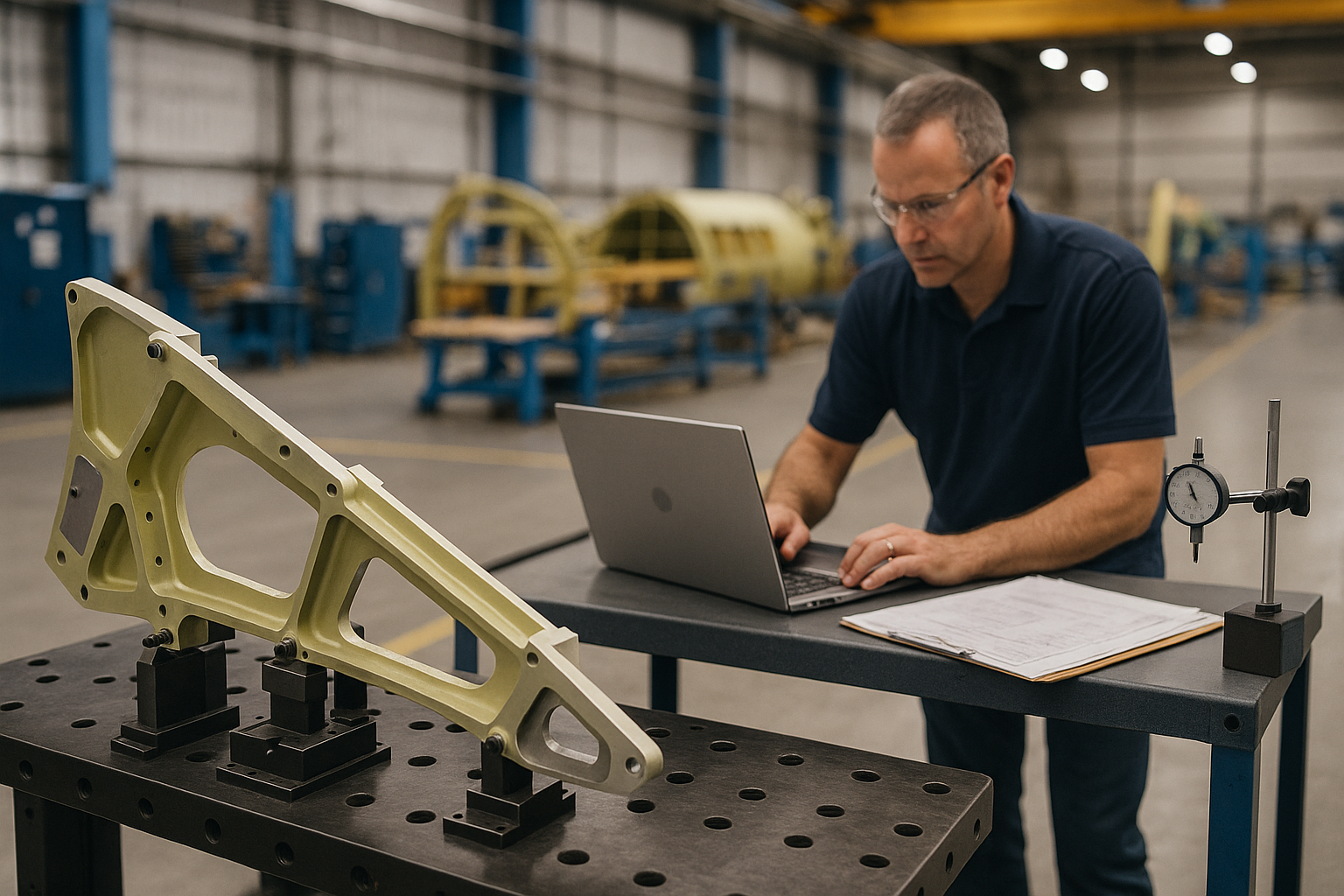
    The image shows a close-up of aerospace turbine engine components being meticulously measured with precision inspection tools, highlighting the importance of article inspection in ensuring compliance with quality standards. This process is crucial for manufacturers in the aerospace industry to maintain exact specifications and prevent errors during production.

    The fai process catches variances in dimensions, GD&T compliance, material properties, or process outcomes early. Inspecting articles from the first production lot against drawings, specifications, and purchase orders prevents scenarios where issues only surface during volume production or in service.

    Why FAI carries operational stakes:

    • Safety verification: FAI validates that special processes under NADCAP (welding, plating, NDT) were executed correctly and that key characteristics meet exact specifications
    • Program schedule protection: Incomplete or incorrect FAIRs have contributed to unplanned halts at OEM final assembly lines and delayed aircraft deliveries costing significant program resources
    • Airworthiness compliance: FAA and EASA expect demonstrable evidence that initial production articles meet design requirements before approval to proceed
    • Key characteristics (KCs) and critical characteristics (CCs): These flagged items receive heightened scrutiny because they affect safety of flight or regulatory requirements
    • Characteristic accountability: Primes and regulators expect clear traceability from ballooned drawing to measurement result, material certifications, special processes, and approvals

    FAI is not a box-ticking exercise. It provides the documented evidence that a supplier or manufacturing site has the capability to produce conforming product.

    Limitations and Risks of Manual AS9102 FAI Processes

    Manual FAI workflows typically involve printing multi-sheet drawings, hand-ballooning characteristics with colored markers, populating Excel-based FAIR templates, chasing paper certifications via email, and archiving PDFs on shared drives. For complex aerospace parts with 200 or more characteristics and multiple key characteristics, this process can consume 8 to 24 hours or more of engineering time.

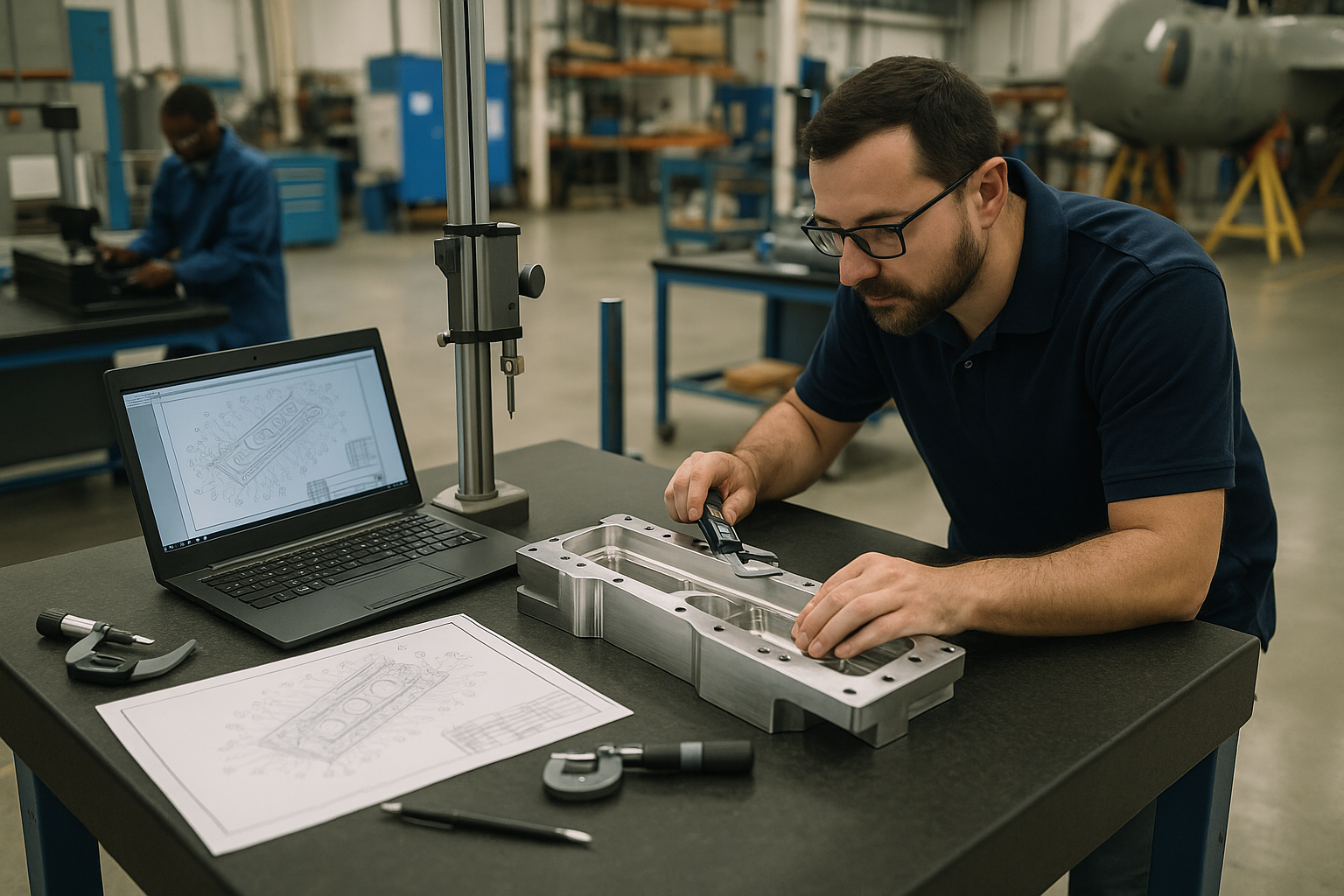
    A quality engineer is seated at a desk, intently reviewing large format technical drawings while utilizing measurement tools to ensure compliance with exact specifications. This meticulous process is essential for article inspection and contributes to maintaining quality standards in the aerospace industry.

    The time involved creates capacity constraints, but the error risk poses the greater threat.

    Common failure modes in manual FAI:

    • Missed or duplicated balloons: Industry benchmarks suggest 20-30% error rates in manual ballooning, where characteristics are either skipped or numbered inconsistently
    • Form 3 discrepancies: Actual measurements recorded on Form 3 do not align with the correct drawing revision or balloon numbers
    • Unit and tolerance inconsistencies: Manual data entry leads to mixed units or incorrect tolerance interpretations
    • Tribal knowledge dependency: When the designated FAI expert is unavailable, other technical professionals struggle to replicate the process correctly
    • Revision control breakdowns: Drawing updates get released while FAIRs are in progress, creating mismatches between documented and verified configurations

    Change management issues compound these problems:

    • Delta FAI challenges: When an engineering change affects only a subset of characteristics, manual processes often result in over-documentation (re-inspecting unaffected features) or under-documentation (omitting linked processes)
    • Partial FAI confusion: Relocating a machining operation to a new facility requires partial FAI, but determining which characteristics require re-verification is difficult without systematic tools

    Audit and customer risk exposure:

    • Weak traceability to material certifications and special process documentation
    • Slow FAIR retrieval during AS9100 surveillance audits leading to nonconformance findings
    • Supplier collaboration breakdowns when different spreadsheet formats create multiple versions of truth
    • Industry data suggests 15-25% of FAIRs are rejected for incompleteness when manual processes are used

    Core Capabilities of Modern AS9102 Software

    Robust first article inspection software extends beyond simple ballooning to automate end-to-end FAIR generation per AS9102 Rev C requirements. The following capabilities define what quality managers and manufacturing engineers should expect from a modern system.

    Ballooned drawing automation:

    • Import 2D PDF drawings or CAD derivatives and automatically detect dimensional, GD&T, and note characteristics
    • Assign sequential balloon numbers with the ability for engineers to review, adjust, and override
    • Auto balloon functionality that reduces manual markup from hours to just a few minutes
    • Synchronize extracted characteristics directly to Form 3 rows

    Digital FAIR forms:

    • Configurable templates enforcing AS9102 Rev C requirements for detailed forms including Forms 1, 2, and 3
    • Structured data entry with validation rules that prevent errors such as mismatched revisions or missing mandatory fields
    • Support for multiple units with conversion logic and tolerance formatting
    • Prime-specific formatting options (Boeing, Airbus, etc.) while maintaining a single data model

    Characteristic accountability:

    • One-to-one linkage between each ballooned characteristic and its Form 3 entry
    • Key characteristic and critical characteristic flags with configurable sampling requirements
    • Acceptance criteria and compatibility evaluation fields per Rev C

    Material and process linkage:

    • Attach raw material certifications, special process records (heat treat, NDT, plating), and lab results to Forms 1 and 2
    • Maintain perpetual storage and retrieval for audit readiness
    • Link NADCAP scope documentation to relevant process characteristics

    Revision and change control:

    • Built-in logic to handle delta FAI and partial FAI when only some characteristics change
    • Reuse baseline FAIR data while flagging only affected items for re-verification
    • Maintain full lineage between original and subsequent FAIRs

    Workflow and approvals:

    • Route FAIRs through multi-level review cycles with configurable approval matrices
    • Electronic signatures supporting 21 CFR Part 11 requirements
    • Formal submission workflows to customers or regulatory stakeholders

    Advanced AS9102 software, including Connect981, extends these core capabilities to include real-time dashboards, defect trend analysis, and integration with shopfloor execution. However, these foundational capabilities remain the essential starting point.

    Digital FAIR Forms and Ballooned Drawings

    Ballooned drawings and FAIR forms represent the heart of any AS9102 software implementation. This is where most of the time and error risk concentrate in manual processes.

    A ballooned drawing systematically numbers every verifiable requirement: dimensions and tolerances, GD&T callouts, surface finishes, notes such as “NO SHARP EDGES,” and material or process callouts. Each balloon number drives the structure of Form 3, creating the foundation for characteristic accountability.

    How digital tools automate ballooned drawings:

    • Import PDF or CAD-derived drawings and use OCR and machine learning to detect characteristics with 90% or higher accuracy for printed dimensions
    • Assign sequential balloon numbers automatically with options to hide non-relevant features and focus on applicable requirements
    • Enable engineers to review detected characteristics, adjust balloon placement, and add manually identified items
    • Support multi-sheet drawings common in aerospace with consistent numbering across sheets

    How AS9102 digital FAIR forms should behave:

    • Pre-populate part number, revision, and order details from ERP or MES integration
    • Auto-fill Form 3 lines directly from ballooned drawing data, achieving 80-90% population without manual data entry
    • Enforce correct field usage for Forms 1, 2, and 3 per Rev C requirements
    • Support structured result entries with units, tolerances, and acceptance criteria in reportable fields
    • Export data in customer-required formats with one click submission options

    Characteristic accountability in practice:

    • Each balloon number maps to exactly one row on Form 3
    • Key characteristic flags trigger appropriate sampling plans
    • Results, tolerances, and compatibility notes are captured in linked, structured fields
    • Bidirectional navigation: click a Form 3 row to highlight the corresponding balloon on the drawing

    Connect981 maintains balloon and characteristic data as reusable digital objects. Subsequent delta FAI or repeat builds leverage the same structure without starting from scratch, preserving audit trails across revisions.

    Handling Partial FAI and Delta FAI in Software

    Not every FAI is a full FAI. AS9102 Rev C explicitly accommodates partial FAI and delta FAI to address changes without requiring complete re-verification of unchanged characteristics.

    Partial FAI applies when re-inspection and documentation is needed for only selected characteristics or features. Typical aerospace scenarios include:

    • Moving a machining operation to a new machine or facility
    • Changing tooling that affects specific dimensions
    • Transferring production between supplier sites

    Delta FAI applies when only characteristics impacted by a drawing or specification change require verification, while linking back to the baseline FAIR. Examples include:

    • Tolerance tightening on a specific hole pattern
    • Addition of a new feature to an existing design
    • Material specification updates affecting certain callouts

    How AS9102 software should handle these cases:

    • Tag each FAIR explicitly as full, partial, or delta using Form 1 status fields
    • Reuse existing characteristic data from baseline FAIRs, adding or updating only affected lines
    • Maintain lineage between original and subsequent FAIRs for complete traceability
    • Provide impact analysis tools that parse change notices to flag affected balloons
    • Display FAIR family trees showing relationships across serials and suppliers

    Operational benefits of proper partial and delta FAI handling:

    • 50-80% cycle time reduction for engineering changes compared to full re-FAI
    • Reduced duplication of work across quality engineering teams
    • Stronger audit trails demonstrating exactly what was re-verified and when
    • Better alignment with aerospace change rates (10-20% of parts see annual engineering change orders)

    Connect981 surfaces partial and delta FAIR relationships across multiple factories and suppliers, giving program and quality teams visibility into the complete FAI history of each part number.

    Integration of AS9102 Software with Manufacturing Workflows

    Digital FAI cannot operate in isolation. Effective article inspection report software connects to ERP, MES, PLM, and QMS to eliminate re-keying and ensure fai data accuracy.

    The image depicts a modern factory floor where operators are engaged with digital tablets at their workstations, facilitating the first article inspection (FAI) process. This setup enhances efficiency in the production process by allowing quality managers and technical professionals to streamline data entry and generate accurate article inspection reports.

    Key integration points:

    • ERP integration: Pull part numbers, revisions, purchase orders, and routing information so FAIRs match contractual and planning data
    • MES or shopfloor systems: Link FAIRs to specific work orders, operations, machines, and operators for contextual results
    • PLM integration: Align FAIRs with correct engineering drawing revisions and change notices automatically
    • QMS connection: Connect nonconformance reports and corrective actions to specific characteristics and FAIRs

    Connect981 is positioned as a unified operations layer that sits above existing ERP and MES systems. FAI becomes part of the same digital workflow used for work instructions, inspections, and defect logging.

    Practical workflow examples:

    • A new work order for a flight-critical part automatically triggers FAI requirements based on configuration rules
    • Operators collect measurement data on the shopfloor using digital checklists, feeding results directly into Form 3
    • Quality engineers review and sign off FAIRs in the same system used for other AS9100 documentation
    • CMM systems import cmm data directly into characteristic results, eliminating transcription errors

    Multi-site and supplier integration considerations:

    • Standardized FAIR templates and workflows across internal plants and external suppliers
    • Flexibility to honor customer-specific requirements while maintaining a common data model
    • Portal access for suppliers to submit FAIRs with consistent formatting and required documentation
    • Real-time visibility into FAIR status across the supply chain

    AS9102 Software and Broader Aerospace Compliance

    Digital FAI anchors a compliance ecosystem that includes AS9100, NADCAP, FAA and EASA regulations, and customer-specific quality clauses. Reliable first article inspection fai execution supports multiple compliance objectives simultaneously.

    How FAI connects to broader compliance:

    • Configuration management: Correct part and revision verified against design intent
    • Process validation: Special processes, NADCAP scopes, and supplier approvals recorded and linked
    • Traceability: Serial and lot numbers connected to measurement data, material certifications, and process records
    • Assurance documentation: Evidence of conformance available for customer and regulatory review

    Traceability requirements in detail:

    • Linkage between serial numbers, work orders, FAIRs, material lots, process batches, and inspection equipment
    • Calibration records for measurement tools used during inspection
    • Material certifications traceable to specific lots and suppliers
    • Special process documentation linked to relevant Form 2 entries

    Related topics that support this pillar:

    • FAI documentation requirements: What attachments, certifications, and evidence must accompany a complete FAIR
    • AS9102 workflow: The planning, execution, and submission sequence for compliant FAI
    • AS9102 audit readiness: Preparing for customer and registrar scrutiny of FAI records

    Connect981’s data model was built around aerospace documentation and compliance requirements. FAI data can be reused for audits, customer scorecards, and continuous improvement rather than treated as a one-off artifact that gets filed and forgotten.

    AS9102 Audit Readiness and Digital Traceability

    AS9100, customer, and regulatory audits frequently sample AS9102 FAIRs to evaluate quality system effectiveness. Preparation for these audits determines whether reviews proceed smoothly or generate findings that require corrective actions.

    What auditors typically examine in FAI:

    • Evidence of full characteristic accountability with all ballooned characteristics documented
    • Proper use of Forms 1, 2, and 3 per AS9102 Rev C requirements
    • Clear linkage between drawing revisions, FAIRs, and changes (delta and partial FAI documentation)
    • Traceability to material certifications, special processes, and measurement equipment calibrations
    • Approval signatures and dates demonstrating proper review cycles
    • Document control ensuring only approved templates and forms are used

    How AS9102 software supports audit readiness:

    • Centralized repository of all FAIRs searchable by part, serial, PO, supplier, or date
    • Immutable audit logs recording who created, modified, and approved each FAIR and when
    • Rapid retrieval of ballooned drawings, measurement data, and supporting documents
    • Version control maintaining historical form templates while ensuring current submissions use approved formats
    • Export capabilities for producing complete FAIR packages in pdf or customer-required formats

    Connect981 provides real-time dashboards showing FAI status (open, in review, approved, rejected) across programs and suppliers. Quality leaders can identify overdue FAIRs, bottlenecks in approval workflows, and patterns requiring attention before auditors arrive.

    The practical outcome: response times during audits drop from days of searching shared drives to minutes of filtered queries. This efficiency demonstrates system effectiveness rather than just compliance.

    From Stand-Alone FAI Tools to Connected Aerospace Operations Platforms

    The AS9102 software market includes point solutions focused on ballooning and desktop FAIR creation as well as connected operations platforms that embed FAI in end-to-end production workflows. Understanding the difference helps manufacturers and suppliers align tool selection with long-term digitalization goals.

    Stand-alone FAI tools (examples include InspectionXpert, DISCUS, and similar):

    • Quick adoption for single plants or individual engineers
    • Fast time-to-value for ballooning and form generation
    • Often require manual ERP and MES bridges
    • Create data silos that need reconciliation during audits or supplier coordination
    • Well-suited for companies with limited FAI volume or simpler part portfolios

    Connected operations platforms (including Connect981, Net-Inspect, and others):

    • Use a common data model for work instructions, inspections, nonconformances, and FAIRs
    • Support cross-site standardization of FAI processes and templates
    • Enable analytics across FAI, in-process inspections, and final inspections to identify systemic issues
    • Reduce reliance on spreadsheets, paper packets, and tribal knowledge
    • Require more upfront configuration but deliver compounding efficiency over time

    Evaluating maturity position:

    Maturity Level Characteristics Typical FAI Time
    Paper and spreadsheets Manual ballooning, Excel forms, email coordination Days to weeks
    Stand-alone FAI tools Automated ballooning, digital forms, local storage Hours
    Integrated digital operations Connected workflows, unified data, cross-site visibility 1-2 hours

    Connect981 unifies digital work instructions, FAI execution, quality checks, and supplier collaboration in one environment. For companies at aerospace manufacturers and suppliers managing complex multi-tier supply chains, the platform approach addresses workflows that span multiple systems and sites.

    Teams should evaluate where they sit on this maturity curve and whether AS9102 software selection aligns with broader digital transformation objectives.

    Measuring the Impact of Digital AS9102 FAI

    Aerospace organizations can quantify the ROI of implementing AS9102 software and digital FAI workflows through specific operational metrics. These measurements validate investment and identify areas for continued improvement.

    Recommended metrics to track:

    • Average time to complete a full FAIR (manual baseline vs. digital): Many industries report reduction from 8-24 hours to under 2 hours
    • Average time for delta FAI completion: Should show 50-80% reduction compared to full FAI cycles
    • Rate of FAIR rejections or customer returns due to documentation errors: Digital standardization typically reduces this by 15-25%
    • Number of late deliveries attributed to FAI delays: Tracking this connects FAI efficiency to program schedules
    • Audit findings related to FAI or traceability: Target near-zero findings with proper digital traceability
    • FAI throughput per quality engineer: Measures capacity improvements from automation

    Process capability metrics worth monitoring:

    • Frequency of key characteristics approaching tolerance limits
    • Patterns in characteristic measurements that indicate process drift
    • Correlation between specific operations or suppliers and FAI issues
    • Root cause distribution for nonconformances linked to FAI characteristics

    Platforms like Connect981 provide dashboards showing FAI throughput, bottlenecks, and trends across programs, suppliers, and plants. This visibility enables targeted improvement projects rather than broad-brush process changes.

    Over time, organizations can leverage FAI data to refine design for manufacturability feedback loops with engineering. Rather than treating FAI solely as a compliance requirement, the accumulated data becomes a continuous improvement tool identifying where designs create inspection challenges or where processes need refinement.

    The Future of Digital FAI and Aerospace Compliance

    AS9102 software will evolve significantly over the next three to five years, driven by smart factory initiatives and aerospace digital thread requirements. Understanding these trends helps manufacturers and suppliers make software investments that remain relevant.

    The image depicts a modern aerospace manufacturing facility featuring digital displays and automated inspection stations designed for the first article inspection (FAI) process. This high-tech environment emphasizes quality assurance and efficiency in the production process, showcasing tools and systems that streamline article inspection and data management for technical professionals in the aerospace industry.

    Expected developments in digital FAI:

    • Model-based definition (MBD) and 3D model integration: Reducing reliance on 2D drawings by extracting characteristics directly from 3D models with embedded PMI (product manufacturing information)
    • AI-assisted risk-based sampling: Machine learning suggesting which characteristics warrant 100% inspection versus statistical sampling based on historical data and process capability
    • Anomaly detection in FAI data: Algorithms flagging unusual measurement patterns or potential data entry errors before approval
    • Predictive bottleneck identification: Analytics anticipating FAI delays based on part complexity, team capacity, and historical cycle times
    • Supplier portal integration: Real-time sharing of FAI templates, status, and approvals between primes and tiered suppliers

    How FAI fits the aerospace digital thread:

    • FAI becomes a core node connecting design, planning, execution, quality, and in-service data
    • Measurement results feed back to engineering for tolerance optimization
    • Material and process certifications link forward to maintenance records
    • Configuration control extends from design release through production verification to field support

    Connect981 is being developed to support this direction through AI-assisted insights, low-code workflow modifications as standards evolve, and scalable deployment across global supply chains.

    The companies that treat digital FAI as a game changer rather than simply a compliance checkbox will gain competitive advantage through faster new part introduction, lower quality costs, and stronger customer relationships.

    Assess your current FAI workflows, identify the top bottlenecks in time, errors, or audit pain, and consider piloting a connected AS9102 solution to validate improvements. Manufacturers ready to streamline their fai software approach can request a demo of Connect981 to see how unified operations platforms address the complete FAI lifecycle.

  • AS9100 Non-Conformance Requirements: Practical Implementation Guide

    AS9100 Non-Conformance Requirements: Practical Implementation Guide

    In aerospace operations, a single nonconformance can ground aircraft, trigger regulatory escalation, or stall a launch campaign. AS9100 sets the baseline expectations for how aerospace manufacturers and MROs identify, control, investigate, and correct these issues. The challenge is turning dense requirements language into clear workflows, roles, and digital records that work on a busy production floor and stand up in audits.

    This guide interprets AS9100 non conformance requirements in practical terms for aerospace production, maintenance, and supply-chain environments. It focuses on what auditors expect to see in your processes and data, and how to align your workflows with a broader aerospace non-conformance management framework without overcomplicating your system.

    Overview of AS9100 and Its Scope

    What AS9100 Covers Beyond ISO 9001

    AS9100 builds on ISO 9001 with aerospace-specific expectations around risk, configuration, and product safety. Beyond generic quality management principles, it addresses:

    • Product safety and airworthiness considerations throughout the lifecycle.
    • Configuration management for serialized and highly engineered hardware.
    • Enhanced requirements for traceability, counterfeit parts prevention, and supplier control.
    • More structured expectations for nonconforming outputs, corrective action, and process monitoring.

    For nonconformance control, this means your QMS cannot be a generic defect logging system. It must tie directly into engineering configuration, regulatory obligations, and customer-specific flowdowns.

    Why Non-Conformance Control Is Central in AS9100

    Nonconformance control is one of the primary ways an AS9100 auditor tests whether your QMS is effective in real operations. Nearly every serious quality issue eventually manifests as an NCR, deviation, or escape. If those are poorly handled, your entire system is called into question.

    In practice, AS9100 expects that when a nonconforming output is found:

    • The affected product is identified and contained quickly.
    • The impact and risk are evaluated, including fielded hardware when relevant.
    • An appropriate disposition is taken and properly authorized.
    • Where needed, a corrective action eliminates root causes and is verified for effectiveness.

    How AS9100 Ties Into Regulatory and Customer Demands

    AS9100 certification does not replace regulatory compliance; it provides the quality framework under which aviation and space work is performed. Regulators and primes typically rely on AS9100 mechanisms for:

    • Evidence that safety- and mission-critical issues are captured, assessed, and resolved.
    • Traceability from field findings back into production records, test data, and design baselines.
    • Assurance that suppliers follow similar discipline when they generate nonconformances.

    Because of this, AS9100 nonconformance processes must be compatible with FAA, EASA, defense agency, or space customer documentation expectations, even if those add additional timing or reporting requirements.

    AS9100 Clauses Related to Non-Conformance and Corrective Action

    Nonconforming Outputs Concepts

    AS9100 requires that you identify and control nonconforming outputs to prevent unintended use or delivery. While you must refer to the official standard for exact wording, the concepts typically include:

    • Clear identification and segregation of nonconforming items (physical or digital).
    • Defined dispositions such as rework, repair (if allowed), use-as-is, return to supplier, or scrap.
    • Formal authorization rules for each disposition type, especially use-as-is and repair.
    • Records that show who made decisions, based on what information, and when.

    Operationally, this means your NCR process must be able to demonstrate control at every step: from discovery on a shop floor tablet to final closure with engineering sign-off.

    Corrective Action and Risk-Based Thinking

    Not every nonconformance needs a full corrective action, but AS9100 expects you to apply risk-based thinking when deciding which ones do. In practice, organizations typically trigger corrective action when:

    • There is a safety or mission impact, or a significant customer escape.
    • Trends show recurring issues with the same part, process, or supplier.
    • Regulatory findings or customer contracts explicitly require a formal response.

    Your corrective action process should use structured methods (e.g., 8D, 5-Why, fault tree) and produce documented containment, root cause, corrective, and preventive actions, together with verification of effectiveness. Auditors will look for evidence that risk is actively considered, not just that a form is filled out.

    Configuration Management and Traceability Expectations

    Nonconformance control cannot be separated from configuration management (CM) and traceability in aerospace. When you discover a nonconforming output, you must be able to answer quickly:

    • Which serial numbers, lots, or tail numbers are affected.
    • Which design revision and process configuration were in effect.
    • Which suppliers, machines, and operators were involved.

    AS9100-driven CM expectations mean that dispositions and corrective actions must be aligned with design authority. If you decide to use a part as-is or apply a repair that deviates from baseline drawings, that decision must be properly analyzed, documented, and approved under your configuration control procedures.

    Documentation Expectations Under AS9100

    Required Records for Nonconforming Outputs

    AS9100 requires documented information demonstrating control of nonconforming outputs. While specific formats are flexible, auditors typically expect each NCR record to include at least:

    • Unique NCR identifier and date.
    • Part number, revision, serial/lot number, and related work order or router.
    • Process step or inspection point where discovered.
    • Clear, measurable description of the discrepancy (including reference to requirements).
    • Immediate containment actions taken and the scope of potentially affected product.

    Digital systems that enforce mandatory fields, controlled dropdowns, and standardized defect codes help ensure consistency and completeness across teams and sites.

    Evidence of Containment, Disposition, and Approvals

    Beyond basic identification, AS9100 auditors focus heavily on how you controlled risk once the issue was known. Your records should show:

    • Containment: when and how affected product was segregated or blocked in MES/ERP.
    • Disposition decisions: rework, use-as-is, repair, scrap, or return to supplier, with justifications.
    • Authorities: signatures or electronic approvals consistent with your procedures (e.g., design authority for use-as-is on critical parts).
    • Verification that rework or repair brought the item back into conformance, including re-inspection records.

    In a digital factory environment, this is typically demonstrated via NCR records linked to routing holds, nonconforming stock locations, e-signatures, and re-inspection logs.

    Linking Nonconformances to CAPAs and Design Changes

    AS9100 expects that your nonconformance and corrective action systems are connected, not standalone. That means:

    • NCRs that trigger a corrective action are clearly linked to a CAR/8D record.
    • Corrective actions that require design or process change are tied into your engineering change control workflow.
    • When a design change is implemented to address a recurring nonconformance, downstream NCRs reference the new configuration as part of effectiveness verification.

    In practice, this is best handled through a digital thread: NCR, CAR, change request, and change order are all connected objects, so an auditor can move end-to-end from field issue to engineering action in a few clicks.

    Aligning Your NCR Workflow With AS9100

    Ensuring Controlled Forms and Revision History

    Whether you use paper or electronic forms, AS9100 requires that they be controlled. For NCRs and CARs, this means:

    • A defined template with controlled fields and instructions.
    • Version and revision control, with changes authorized and communicated.
    • Obsolete versions withdrawn or blocked from use.

    In modern aerospace environments, this is usually implemented as controlled electronic forms within a QMS or MES. Every field change, workflow step, or routing rule is logged, providing a built-in audit trail of how the process evolved.

    Defining Authorities for Disposition and Use-as-Is

    AS9100 expects clear criteria for who may authorize each type of disposition. Operationally, you should define:

    • Which roles can initiate an NCR (often broad, including inspectors and supervisors).
    • Which engineering functions must approve use-as-is or repair dispositions for critical items.
    • When customer or regulatory approval is required for deviations.

    Your digital workflow should enforce this logic—e.g., preventing closure of an NCR involving a safety-critical part without signoff from the designated engineering authority and, where required, customer quality.

    Meeting Response Time and Closure Expectations

    AS9100 itself does not prescribe specific timelines, but customers and regulators often do. To remain compliant and competitive, aerospace organizations typically define internal targets such as:

    • Containment within hours for production findings on critical hardware.
    • Initial response to customer or regulatory findings within a set number of days.
    • Closure of standard NCRs and CARs within predefined lead times, with escalation rules.

    A well-configured system uses automated notifications, due dates, and escalations to keep issues moving, and dashboards to show quality and operations leaders where bottlenecks occur.

    Preparing for AS9100 Audits

    How Auditors Typically Sample NCR and CAPA Records

    During an AS9100 audit, nonconformance and corrective action records are a primary sampling area. Auditors typically:

    • Select NCRs tied to high-risk parts, key customers, or recent escapes.
    • Trace from an NCR to associated work orders, travelers, inspection records, and certificates.
    • Follow links from NCRs into CARs and any associated engineering changes.

    They are looking for consistency between your documented procedures and actual practice, as shown in the records.

    Common Nonconformities Found During AS9100 Audits

    Typical AS9100 audit findings around nonconformance and corrective action include:

    • Incomplete NCRs (missing traceability data, vague problem descriptions).
    • Evidence of product shipped before disposition or without required approvals.
    • Corrective actions closed without documented root cause analysis or effectiveness checks.
    • Inconsistent use of defect codes, leading to unreliable trending.

    Many of these issues arise from fragmented tools—spreadsheets, emails, and unconnected databases—where it is difficult to maintain discipline at scale.

    Using Audit Findings to Strengthen Your Process

    AS9100 expects that you treat audit results as inputs to continual improvement. Leading aerospace organizations:

    • Classify audit findings (internal, external, customer) and link them to specific process steps.
    • Feed systemic issues into the corrective action program, not just fix individual records.
    • Adjust digital workflows and forms to close the gaps that audits reveal.

    For example, if repeated findings show missing containment details, you might make containment actions a mandatory field in your NCR form and add automated prompts for affected lots and serials.

    Leveraging Digital Systems to Demonstrate Compliance

    Controlled Electronic Records and Signatures

    Aerospace organizations increasingly rely on digital quality systems to operationalize AS9100 requirements. Key capabilities that support nonconformance control include:

    • Unique, system-generated NCR and CAR IDs tied to part genealogy.
    • Role-based access and electronic signatures that meet your regulatory environment.
    • Immutable audit trails showing who changed what, when, and why.

    These capabilities not only simplify audit preparation but also reduce the risk of undocumented rework or informal dispositions that fall outside your QMS.

    Dashboards and Reports That Support Audit Readiness

    For AS9100 compliance, it is not enough to store records; you must be able to retrieve and analyze them quickly. Effective digital implementations provide:

    • Dashboards showing open NCRs and CARs by age, risk, part, and responsible function.
    • Trend reports on top defect codes, suppliers, and process steps.
    • Drill-down views that allow an auditor to move from KPIs to individual records in seconds.

    When auditors ask for “all nonconformances in the last year on this family of parts,” a well-structured system produces the list immediately, with links to associated work orders and configuration data.

    Maintaining Consistency Across Multiple Sites

    For aerospace groups operating multiple plants or MRO stations, AS9100 compliance depends on consistent execution, not just consistent documentation. A unified digital platform helps by:

    • Standardizing NCR/CAR templates and workflows while allowing site-level nuances.
    • Providing enterprise-wide visibility into trends, such as recurring issues across several suppliers or lines.
    • Enabling best-practice sharing when one site demonstrates superior performance on closure times or defect reduction.

    Multi-site consistency is especially important when major primes or agencies audit your global footprint, not just a single facility.

    Connecting AS9100 Requirements to Your Operational Reality

    AS9100 nonconformance and corrective action requirements are intentionally high-level. Each organization must interpret them in the context of its product risk, regulatory environment, and customer mix. For aerospace manufacturers and MROs, the practical implications are clear:

    • Your NCR process must be tightly connected to MES, ERP, and engineering configuration.
    • Digital traceability—from incoming inspection through final assembly and field service—must support rapid impact assessment.
    • Corrective actions must go beyond paperwork to drive measurable reductions in escapes, rework, and cycle time.

    Using integrated, aerospace-focused digital workflows makes it far easier to satisfy AS9100 expectations without building a heavy, manual system that slows your production or maintenance operation.

    Adapting Guidance to Your Scope and Registrar

    The implementation patterns described here are based on common aerospace practice, but each organization must adapt them to its certified scope, regulatory obligations, and registrar interpretations. Always refer to the current official AS9100 standard for precise requirements and align your approach with your certification body and key customers.