RSC Topic: Audit Readiness & Evidence Management

Ongoing audit-proof documentation, approvals, and revision histories.

  • Can MES traceability data support customer audits and investigations?

    Short answer and key constraints

    MES traceability data can support customer audits and investigations, but it rarely serves as a complete, stand‑alone evidence set. Its usefulness depends heavily on how well the system is configured, integrated, validated, and actually used on the shop floor. In many regulated plants, MES is one of several systems contributing to the total traceability picture, alongside ERP, QMS, PLM, LIMS, historian, and paper records. You should assume that customer auditors will expect consistent, reconciled data across these systems rather than trusting MES in isolation. MES data can make investigations faster and more structured, but it cannot compensate for poor master data, weak procedures, or undocumented workarounds. Treat MES as a powerful evidence source that still requires cross‑checks, context, and documented interpretation.

    What MES traceability can usually provide

    A reasonably implemented MES can typically provide genealogy between materials, intermediates, and finished goods, including batch/lot relationships and serial number links where used. It often captures which equipment, tools, and lines were used, which work instructions or recipes were followed, and who performed which steps and when. Many systems also store process parameters and alarms or deviations, or at least link to a historian or QMS record that does. For customer audits, this allows you to show how a specific delivered unit or batch was built, which materials fed into it, and which other batches or customers are potentially affected. This level of traceability can significantly reduce the time to define the scope of a complaint, recall, or field issue, provided the data is complete and reliably associated with the product identifier the customer cares about.

    Common gaps that limit audit readiness

    MES often does not cover the entire value stream, especially in brownfield environments with legacy equipment and partial rollout. Early process steps, external suppliers, contract manufacturers, or downstream packaging and distribution may sit outside MES, creating breaks in the traceability chain. Even inside MES, some data is frequently missing or unreliable due to optional data fields, operator shortcuts, poor user interface design, or insufficient training and oversight. Where manual records, spreadsheets, or local databases coexist with MES, reconciling the data can be time‑consuming and may expose inconsistencies during an audit. These gaps do not make MES useless, but they mean you cannot present it as the single, authoritative source of truth without qualification and supporting evidence.

    Role of configuration, master data, and procedures

    Whether MES traceability stands up in a customer audit depends less on the software brand and more on how your plant configures and governs it. Poorly structured master data for materials, routes, recipes, and product hierarchies leads directly to confusing or ambiguous traceability outputs. If operators can bypass steps, record work under the wrong order, or rework outside the prescribed electronic flow, the genealogy chain becomes unreliable. Clear procedures for order management, BOM changes, rework, holds, and scrap are essential so that the MES data matches what actually happens on the floor. Regular review of exceptions, missing scans, and overridden checks is needed to keep the dataset audit‑ready, rather than discovering systemic issues only when a customer is in the room.

    Integration with ERP, QMS, PLM, and historians

    In most regulated operations, the evidence set for a customer investigation spans multiple systems, not just MES. ERP is typically the commercial and logistics system of record for orders, shipping, and invoicing, so customer part numbers and delivery details often live there. QMS holds complaints, CAPAs, and deviations, while PLM or document control systems own the official product definition and approved work instructions. Process historians or equipment data loggers may be the authoritative record for critical parameters. For an investigation, MES needs to align with these sources: product codes and revisions must match, batch IDs must map cleanly across systems, and timestamps should be at least reasonably consistent. Weak or manual integrations increase the effort to present a coherent story to auditors and raise the risk of contradictions.

    Validation, data integrity, and evidence quality

    For MES data to be credible in regulated or aerospace‑grade customer audits, validation and data integrity controls must be demonstrable. This typically means documented requirements, test protocols, and change control for MES configurations that impact traceability and product quality. Auditors may ask how electronic records are protected from unauthorized change, how audit trails are captured, and how you ensure time synchronization and user identity integrity. If there are known limitations, such as specific fields that can be edited post‑fact or operations recorded offline and back‑entered, those must be clearly understood and risk‑assessed. MES can still support investigations under these conditions, but you need to be transparent about which data elements are strictly controlled and which rely more on procedural safeguards and review.

    Why MES is rarely a single system of record for audits

    Trying to make MES the sole system of record for traceability in aerospace‑grade or similar regulated environments usually runs into practical constraints. Replacing or fully centralizing ERP, QMS, PLM, and historians into MES would trigger a massive qualification and validation burden, prolonged downtime, and significant integration risk. Many key assets and processes have lifecycles measured in decades, with proprietary controls and validated interfaces that cannot be easily re‑platformed. As a result, MES must coexist with legacy and specialized systems, playing a central but not exclusive role in traceability. In customer audits, you are therefore presenting a federated evidence set where MES is one anchor among several, and the credibility comes from consistency and reconciliation, not single‑system dominance.

    Practical ways to strengthen MES support for customer investigations

    To make MES more effective in audits, many plants focus first on a handful of critical product families or customers and tighten traceability there. This may include enforcing mandatory data capture at key steps, hardening barcode or RFID practices, and closing obvious gaps in genealogy (such as linking rework or off‑line operations back to the main record). Periodic mock audits and sample investigations can reveal where MES views are confusing, slow to extract, or misaligned with how customers describe their parts and issues. Incrementally improving integrations with ERP, QMS, and historians around those high‑risk areas often delivers more value than attempting a wholesale systems overhaul. Over time, this approach builds a body of evidence that MES data is reliable for the scenarios that matter most, while making its limitations explicit and managed rather than hidden.

  • How should we prepare production and engineering staff for interviews?

    Preparing production and engineering staff for interviews in regulated, brownfield environments is less about “media training” and more about setting clear expectations, boundaries, and evidence standards.

    Clarify purpose and scope up front

    Before interviews, communicate:

    • Why the interviews are happening (e.g., process assessment, tool selection, root cause investigation, audit prep).
    • Scope of topics (e.g., only machining and inspection workflows, not HR or commercial topics).
    • What will be done with the information (e.g., used to map current state, inform requirements, support CAPA documentation).
    • Who will see the output (internal leadership only, external vendor, regulator, customer, etc.).

    The aim is transparency, so staff are not guessing whether they are in a performance review, an audit, or a design workshop.

    Define boundaries: confidentiality, safety, and compliance

    In regulated environments, staff must understand what they can and cannot share:

    • Export controls & technical data: Remind staff not to disclose controlled technical data, proprietary parameters, or customer-identifying details unless the interview arrangement explicitly allows it and NDAs are in place.
    • Safety and legal topics: Make clear that interviews are not a substitute for incident reporting. If safety or compliance issues surface, they should also go through established channels.
    • Confidential programs/customers: Instruct staff to use generic descriptions where needed (e.g., “military customer” instead of specific program names) unless cleared.

    Provide written guidance if external consultants or vendors are involved, so staff do not rely on memory in the moment.

    Ask for facts, not “right answers”

    A common failure mode is over-coaching people to say what management wishes were true. That undermines root cause analysis and system design. Instead, emphasize:

    • “Describe what you actually do, not what the procedure says.”
    • “If you use a workaround, say so, and explain why.”
    • “If you are unsure, say you are unsure.”

    Reassure staff that the goal is to understand the system and constraints, not to assign blame. This is especially important when discussing deviations, nonconformances, or CAPA history.

    Connect to traceability and evidence

    In regulated manufacturing, interviews should tie back to tangible evidence. Prepare staff to:

    • Reference actual records they work with (e.g., travelers, MES screens, QMS forms, logbooks, calibration certificates).
    • Explain where data lives (MES, ERP, QMS, spreadsheets, paper binders) and who updates it.
    • Describe how they prove work was done (signatures, electronic signoffs, scan events, device logs).

    Encouraging this mindset early limits vague discussion and helps external parties understand real traceability gaps, integration debt, and manual handoffs.

    Map roles across the brownfield stack

    Production and engineering staff often interact with a fragmented toolchain. Before interviews, help them outline:

    • The systems they actually touch: legacy MES screens, homegrown Access tools, PLM viewers, email-based workflows, shared drives, etc.
    • Where they feel friction: double entry between MES and ERP, manual report building, re-typing from paper into QMS, etc.
    • Dependencies on upstream/downstream functions: e.g., engineering change notices, supplier certs, inspection labs, outside processors.

    This is particularly important if interviews are part of a digital initiative, since full replacement is usually constrained by validation burden, downtime risk, and qualification of long-lived equipment. Interviewers need a realistic view of coexistence requirements, not an idealized “greenfield” picture.

    Align on known constraints and non-negotiables

    Help staff articulate the constraints that shape their choices:

    • Regulatory / customer requirements: retention periods, required signatures, inspection regimes, serialization rules.
    • Operational constraints: single qualified machine for a critical operation, limited calibration windows, batch sizes driven by furnace or autoclave capacity.
    • Change control: what it takes to change a work instruction, qualify a new software version, or adjust a process parameter.

    Interviewers should hear these explicitly. They drive why “simple” solutions or full system replacements are often not viable without extensive validation and planned downtime.

    Brief on interview logistics

    Operational realities matter. Before interviews:

    • Schedule around production: Avoid peak hours, changeovers, or critical builds when people cannot step away.
    • Clarify expected duration and whether participants should be in a control room, at a machine, or in a conference room.
    • Confirm coverage so operators or supervisors are not forced to choose between answering questions and meeting takt time or batch release.

    Where possible, communicate that candid feedback will not be held against individuals for productivity loss during the interview window.

    Give examples of the depth you expect

    To avoid shallow or overly high-level responses, provide concrete examples of the depth desired. For instance, ask staff to be ready to walk through:

    • End-to-end process for a representative part: from order release, through manufacturing steps, inspection, rework, and final acceptance.
    • Recent nonconformance or deviation: how it was detected, documented, investigated, and closed in the QMS or CAPA system.
    • Typical exception paths: rush orders, line-down events, or supplier quality issues.

    This helps interviewers uncover real root causes, manual work, and system interactions rather than an idealized process map.

    Set expectations for disagreements and gaps

    In many plants, procedures, QMS records, and actual practice do not fully align. Prepare staff by stating:

    • It is normal for engineering, quality, IT, and production to have different views of the “same” process.
    • They should flag inconsistencies (“the spec says X, but in reality we do Y because Z”).
    • Identified gaps may drive follow-up actions (e.g., procedure updates, training, system changes), but those will follow established change-control pathways.

    Making this explicit reduces the instinct to hide messy reality, which is exactly what interviewers need to see to design workable improvements.

    Explicitly avoid answer coaching

    For regulated environments, it is important not to train people to give “audit-proof” but inaccurate answers. Make clear:

    • Your role is to clarify context and boundaries, not to script answers.
    • Staff should not memorize talking points that differ from actual practice.
    • If they do not know the answer, the acceptable response is “I don’t know, but this is where we would check.”

    This is especially important if interviewers are customers, auditors, or regulators. Over-coaching can increase risk if inconsistencies are discovered.

    Link preparation to your specific initiative

    If the interviews are part of a specific project (e.g., MES replacement, new traceability solution, or CAPA effectiveness review), tailor the briefing to that context:

    • Explain which systems or processes are in scope, and which are not.
    • Clarify that any new tools must coexist with legacy systems for the foreseeable future, so participants should describe all integrations and manual touchpoints.
    • Ask staff to be explicit about validation or qualification constraints that could block or slow changes.

    This helps interviewers gather the information they need to design realistic roadmaps that respect long equipment lifecycles, change control, and limited downtime.

  • quality gate

    A quality gate is a defined checkpoint in a process where a product, batch, document, or workflow step is reviewed against predetermined acceptance criteria before it can move forward. In manufacturing and regulated operations, it commonly refers to a formal decision point tied to quality, completeness, traceability, or approval status.

    A quality gate is not the same as general in-process monitoring. Monitoring can happen continuously, while a quality gate is a specific hold, release, or review point. Depending on the process, the gate may be manual, system-enforced, or a combination of both.

    How it is used in operations

    Quality gates often appear at transitions between critical stages, such as:

    • incoming material receipt to production release
    • setup completion to first-piece approval
    • assembly to inspection
    • manufacturing completion to packaging or shipment
    • deviation review to disposition and release

    The gate criteria may include inspection results, document completion, required signatures or electronic approvals, training status, equipment readiness, or confirmation that nonconformances have been addressed. In MES, QMS, ERP-connected, or digital workflow environments, a quality gate may block the next transaction or operation until required conditions are met.

    What a quality gate includes and excludes

    A quality gate commonly includes:

    • defined entry or exit criteria
    • a review or verification activity
    • a pass, fail, hold, or conditional disposition
    • evidence of the decision, such as records, approvals, or inspection data

    It does not automatically mean 100% inspection, and it does not by itself define the full quality system. A quality gate is one control point within a larger process and may rely on sampling, automated checks, procedural review, or documented approvals.

    Common confusion

    Quality gate vs. inspection: an inspection is an activity that checks product or process characteristics. A quality gate is the decision point that may use inspection results as one of its inputs.

    Quality gate vs. stage gate: stage gate is often used for project, product development, or governance reviews. Quality gate is usually narrower and focused on process or product acceptance within execution.

    Quality gate vs. hold point: a hold point is a mandatory stop until authorization is given. A quality gate may function as a hold point, but some organizations use quality gate more broadly for any formal pass or fail checkpoint.

    Manufacturing example

    A shop may require first-article measurements, work instruction acknowledgment, and tooling verification before releasing a routed operation to full production. That release checkpoint is a quality gate.

  • What is the meaning of ISMS?

    ISMS stands for Information Security Management System.

    In industrial and regulated manufacturing environments, an ISMS is the structured management framework used to identify, assess, and control information security risks across people, processes, and technology. It typically covers production systems (for example MES, SCADA, DCS), business systems (for example ERP, PLM, QMS), networks, and the associated procedures and roles.

    An ISMS usually aligns with standards such as ISO/IEC 27001, but alignment on paper is not enough. Its effectiveness in a brownfield plant depends on:

    • Scope and boundaries: Which sites, systems, and data classes are actually covered, and which are explicitly out of scope.
    • Integration with existing controls: How it coexists with OT security practices, legacy system constraints, vendor-managed equipment, and existing quality and change-control processes.
    • Validation and evidence: Whether controls, monitoring, and procedures are documented, implemented, and periodically tested in a way that supports audit and regulatory expectations.
    • Change management: How security changes are introduced without disrupting validated processes, production schedules, or traceability.

    An ISMS is a governance and risk-management mechanism, not a product and not a guarantee of compliance or security outcomes. It provides the structure for deciding which controls are required, how they are implemented, and how their effectiveness is reviewed over time, given the realities of long equipment lifecycles and mixed-vendor environments.

  • How does MES help during regulatory or customer audits?

    What MES can realistically do for audits

    Manufacturing Execution Systems (MES) can significantly reduce the friction of regulatory and customer audits by centralizing production data and making it easier to retrieve evidence on demand. When configured and used consistently, MES provides structured records of what was made, when, on which equipment, using which materials, and under which conditions. This helps demonstrate control over critical parameters, adherence to approved instructions, and linkage between production events and quality decisions. However, MES only reflects what was actually captured; missing, inaccurate, or late data entry will surface just as clearly to an auditor as complete records.

    MES can also support the narrative you present to auditors about your control strategy and process discipline. Being able to pull up batch histories, operator actions, and equipment states in minutes rather than hours shows that the organization can access and interpret its own data. That said, MES does not replace documented procedures, training records, or quality system elements that typically reside in QMS, LMS, or document control systems. In practice, MES is one evidence source among several, and auditors will often cross-check it against other systems and paper records.

    Traceability, genealogy, and batch history

    One of the most concrete ways MES helps during audits is by providing forward and backward traceability across lots, batches, components, and intermediate steps. A well-implemented MES can show, for a given finished lot, which raw material lots went into it, which equipment and tools were used, which operators executed steps, and what the in-process test results were. This genealogy is central to answering auditor questions about impact analysis, potential recall scope, and the rigor of batch release decisions.

    Conversely, MES can also support backward impact analysis for suspect inputs by listing all finished goods that consumed a given component or process step. This is critical when responding to supplier notifications, deviations, or field feedback. The strength of this evidence depends heavily on consistent lot scanning, proper equipment and tooling mapping, and correct routing configuration. If operators can bypass scanning or if certain operations are still tracked on paper, your traceability will be incomplete, and auditors will notice the gaps during deeper probes.

    Demonstrating procedure adherence and process control

    MES can help demonstrate that production follows approved work instructions and that changes are controlled. Electronic work instructions, enforced process sequences, and electronic sign-offs show how the plant ensures operators cannot skip critical steps without some form of override or deviation. Time-stamped records of each step, including who performed it and when, are often powerful evidence when auditors ask how you know that a particular batch followed the intended process.

    At the same time, MES logic must be aligned with controlled procedures and change control processes. If the MES workflow differs from the officially approved SOPs, auditors may challenge which version is the “source of truth” and how discrepancies are managed. In regulated environments, updates to MES recipes, routes, or business rules generally must pass through formal change control and, where applicable, validation or qualification. Failure to align MES configuration with controlled documents can undermine, rather than strengthen, your audit position.

    Data integrity, audit trails, and electronic records

    From an audit perspective, MES is often evaluated for how it supports data integrity and traceability of changes. Properly designed MES audit trails record who created, modified, or invalidated records, when they did so, and sometimes why, including comments or deviation numbers. This can help answer auditor questions about late entries, corrections to data, and how unauthorized changes are prevented or detected. It also allows you to reconstruct the sequence of events when investigating deviations or customer complaints.

    However, these controls are only effective if they are implemented and used consistently. Weak access control, shared logins, and informal workarounds (such as notes on paper or post hoc data entry) can erode the value of MES audit trails. In some industries, electronic records and electronic signatures must meet specific regulatory requirements, and MES may need to be validated accordingly. If MES is not validated where required, you may need parallel paper records or additional controls, complicating the audit story and prolonging evidence gathering.

    Supporting deviation, nonconformance, and CAPA evidence

    Although formal CAPA and deviation management often reside in separate QMS tools, MES data is frequently used as source evidence in those investigations. During an audit, you may be asked to show how you identified issue scope, selected sample populations, or verified the effectiveness of corrective actions. MES records of process parameters, alarms, rework, and scrap can be instrumental in demonstrating that investigations considered sufficient data and that decisions were grounded in reality rather than anecdote.

    Limitations arise when deviations and nonconformances are not tightly linked to the specific batches or process steps in MES. If issue tracking is mostly manual or in siloed tools, you may struggle to show that lessons learned were systematically applied to similar products or lines. Integrations between MES and QMS, when present and well-implemented, can greatly speed up evidence retrieval for audit questions. Where such integrations are weak or absent, expect additional manual effort to bridge data between systems during audits.

    Coexistence with ERP, QMS, LIMS, and paper records

    In most brownfield environments, MES is only one part of the audit evidence landscape, coexisting with ERP, QMS, LIMS, historian, PLM, and often paper logbooks. Auditors may ask a question that spans multiple systems, such as how a change in specification in PLM propagated into MES instructions and then into released batches. MES can clarify the manufacturing portion of that story but usually cannot, on its own, explain commercial decisions, supplier status, or design authority.

    This fragmented reality also means that inconsistent master data or poor integration can create visible discrepancies that auditors will challenge. For example, if ERP shows a different material revision than MES, or if QMS references step numbers that do not match current MES workflows, your explanations will need to be precise and credible. MES can help if it is clearly positioned as the operational system of record for execution and if interfaces and reconciliations are managed under robust change control. Without that discipline, MES may expose integration weaknesses instead of simplifying your audits.

    Practical considerations and common failure modes in audits

    The value of MES in audits hinges on configuration quality, user discipline, and lifecycle governance rather than just the software’s feature set. Common failure modes include inconsistent use across shifts or plants, unconfigured edge cases that get handled off-system, and incomplete equipment or tooling mapping. Auditors will frequently probe abnormal scenarios—rework loops, hold releases, partial batches, or manual interventions—to see whether MES records remain reliable in non-happy paths.

    Another recurring issue is that plants sometimes treat MES data correction as a routine activity instead of an exception requiring justification and oversight. Excessive late entries, frequent manual overrides, or widespread use of generic user accounts raise doubts about data credibility. To avoid these problems, governance around role-based access, training, periodic review of audit trails, and configuration change control is critical. MES can help you pass audits more efficiently, but only if the organization treats it as part of the controlled quality system rather than just a production scheduling tool.

  • Supplier NCR: Managing Escaped Defects and Supplier Accountability

    Supplier NCR: Managing Escaped Defects and Supplier Accountability

    1. Introduction: What Is a Supplier NCR and Why It Matters in 2026

    A supplier NCR is not just another quality form. In aerospace manufacturing and MRO, it is the controlled record that links an external supplier’s defect to containment, investigation, disposition, and accountability across the supply chain.

    A Nonconformance Report (NCR) is a controlled quality record used to formally document, investigate, and resolve nonconformities identified during any phase of the product or service lifecycle. NCRs are important because they establish a controlled, auditable process for documenting and resolving deviations from specifications, procedures, or regulatory requirements, ensuring compliance with industry standards.

    In plain terms, non conformance is the condition. A non conformance report is the formal record. A supplier NCR is the supplier-quality version of that record, used when the identified non conformance originates with an external provider. For example, if turbine blades delivered in March 2026 arrive with blade tip thickness outside drawing tolerance by +0.005 inches, the issue is not only dimensional. It is a supplier non conformance that needs traceability, containment, supplier response, and disposition.

    Product non-conformance occurs when a product fails to meet specified requirements, standards, or expectations set by design, regulations, or customer needs. Common causes of product non-conformance include deviations from design specifications, quality standards, or customer requirements.

    This article answers the operational questions that matter: when to issue a supplier NCR, how it differs from an internal NCR, what evidence to require from the supplier, and when the issue becomes SCAR or CAPA-like escalation. Connect981 works with aerospace OEMs, Tier 1s, and MRO organizations, so the focus here is practical: escaped defects, supplier accountability, response windows, external traceability, and audit-ready execution.

    2. Supplier NCR vs Internal NCR: Key Differences

    Internal quality issues are usually contained inside one organization’s quality systems. A supplier NCR crosses company boundaries. That changes ownership, evidence, commercial exposure, and the way relevant stakeholders need to coordinate.

    • An internal NCR normally belongs to internal quality assurance, engineering, production, or maintenance teams. A supplier NCR shifts investigation and corrective measures to the external supplier, while the buyer still controls risk management and final disposition.
    • Internal NCRs usually reference internal procedures, travelers, routing records, and work instructions. Supplier NCRs must connect to purchase orders, contracts, supplier quality clauses, Certificates of Conformance, heat lots, inspection records, and sub-tier documentation.
    • Internal defects are often resolved within the factory. Supplier NCRs link quality control to procurement, warranty terms, replacement costs, approved supplier status, and supplier scorecards.
    • Supplier NCRs can affect sourcing decisions. Repeated major non conformance reports may move a supplier into development status, increase inspection requirements, or remove the supplier from the Approved Supplier List.
    • Legal consequences are different. A supplier NCR may support chargebacks, return to vendor decisions, replacement claims, or contract remedies if materials, parts, or services fail to meet agreed standards.
    • Audit readiness is broader. For AS9100 and customer requirements, especially in airline MRO contracts, external evidence must show that the organization controlled non conforming product from suppliers and protected downstream use.
    • Supplier NCRs require clearer record keeping because the traceability boundary sits outside the buyer’s facility. Lot genealogy, calibration records, raw materials history, special process evidence, and sub-tier flowdowns may all be required.
    • Regulatory compliance decreases the likelihood of defects and increases accountability in the supply chain. In practice, this means supplier NCR records must be suitable for customer audits, FAA or EASA review, and contractual documentation requirements.

    3. When to Issue a Supplier NCR: Triggers and Thresholds

    A supplier NCR should not be used for every minor blemish. It should be issued when supplier-origin non compliance meets defined procedures, acceptance criteria, or risk thresholds.

    Quality inspections typically catch flaws during incoming inspection, material handling, or on the production floor. An NCR may be issued when suppliers fail to provide materials, parts, or services that meet the agreed-upon standards, which can stem from various issues such as quality control failures or process deviations.

    Typical supplier NCR triggers include incoming inspection failures. A March 2025 batch of composite panels that fails ultrasonic inspection for delamination should open a supplier NCR if the panels do not meet specified requirements. The same applies to wrong alloy composition, missing material certification, incorrect coating, or heat treatment outside specification.

    A supplier NCR should also be opened for field-found escaped defects traced to a supplier lot. If a hydraulic actuator fails during service and the investigation points to supplier-provided seals from a defined batch, the response should not stop at replacing one unit. Addressing supplier non-conformance promptly is critical to mitigating the risk of product failure and safeguarding end-users, as it can directly cause final product non-conformances if left undetected.

    Repeated minor defects can justify a supplier NCR when they form a trend. For example, three consecutive months above 1,000 ppm for cosmetic damage, burrs, incomplete cure, or packaging damage may indicate process drift. The immediate defect may be minor, but the pattern is quality data that deserves formal review.

    Serious process non compliance found during supplier audits is another trigger. In 2024, an internal audits cycle might uncover undocumented process changes at a machining supplier, unapproved tooling, or use of a sub-tier special processor without approval. Those findings can require a supplier NCR even before defective hardware is found.

    Customer complaints should also feed the supplier NCR workflow. If a customer return, warranty claim, or in-service MRO finding maps back to a supplier part, the organization should address instances through a formal process rather than treat the complaint as an isolated fix.

    Qualitative triggers matter as much as numbers. Any safety hazards, regulatory non compliance, airworthiness concern, or critical characteristic failure should open a supplier NCR regardless of quantity. Quantitative triggers, such as three major supplier NCRs in 12 months, should be written into the QMS so authorized personnel apply them consistently.

    4. The Supplier NCR Process Step-by-Step

    The supplier ncr process follows the same core logic used in ISO 9001 and AS9100 quality management systems, but it adds supplier interaction, external evidence, and commercial accountability. Quality Management Systems (QMS) are essential for ensuring compliance with industry standards and regulations, such as ISO 9001, AS9100, and IATF 16949, which require organizations to manage nonconformities and take corrective actions.

    The nonconformance report process typically includes steps such as detection and reporting, evaluation and classification, root cause analysis, implementation of corrective actions, verification and closure, and follow-up and monitoring. A well-defined Non-Conformance Report (NCR) process is critical within quality management systems as it helps organizations track and manage issues that may arise during the production or implementation of products or services, ultimately supporting continuous improvement.

    1. Detect the issue at receiving, in-process inspection, first article inspection, MRO teardown, or post-delivery feedback. The identified non conformance must be described clearly enough for the supplier to reproduce the concern.
    2. Contain the affected material. Quarantine parts, prevent further use, apply hold tags, and bracket affected serial numbers, lot numbers, work orders, and shipments.
    3. Create the non conformance report ncr. Include supplier name, PO number, part number, serial or lot numbers, drawing revision, requirement violated, defect description, quantity affected, detection source, risk rating, and immediate containment.
    4. Notify relevant stakeholders. Supplier quality, the buyer, program manager, engineering, quality assurance, and sometimes the customer need timely visibility. Many aerospace supplier manuals require acknowledgement or containment response within 24 to 48 hours. Acro’s supplier quality manual, for example, calls for initial containment within 24 hours and longer-term actions within seven calendar days.
    5. Classify risk. Major, minor, and critical categories should reflect product quality, safety, regulatory requirements, customer requirements, and production impact.
    6. Require supplier investigation. Root cause analysis (RCA) is a structured investigation phase used to determine the underlying cause or combination of causes that led to a nonconformance, ensuring that corrective actions address the root cause to prevent recurrence.
    7. Review corrective actions and preventive actions. RCA may involve cross-functional input from various departments such as QA, engineering, production, maintenance, and regulatory affairs, and is performed using validated methodologies like the 5 Whys technique or Ishikawa diagram.
    8. Verify and close. The objective of root cause analysis is not only to resolve the immediate issue but also to identify additional preventive actions for similar processes or areas to prevent future occurrences.

    Quality Management System (QMS) software plays a crucial role in nonconformance management by standardizing workflows, automating routing and approval processes, ensuring version control, and maintaining full traceability of records, which is vital for compliance and quality assurance. In Connect981, this workflow can be digitized across work orders, suppliers, inspection records, and approval steps without replacing the existing ERP or MES.

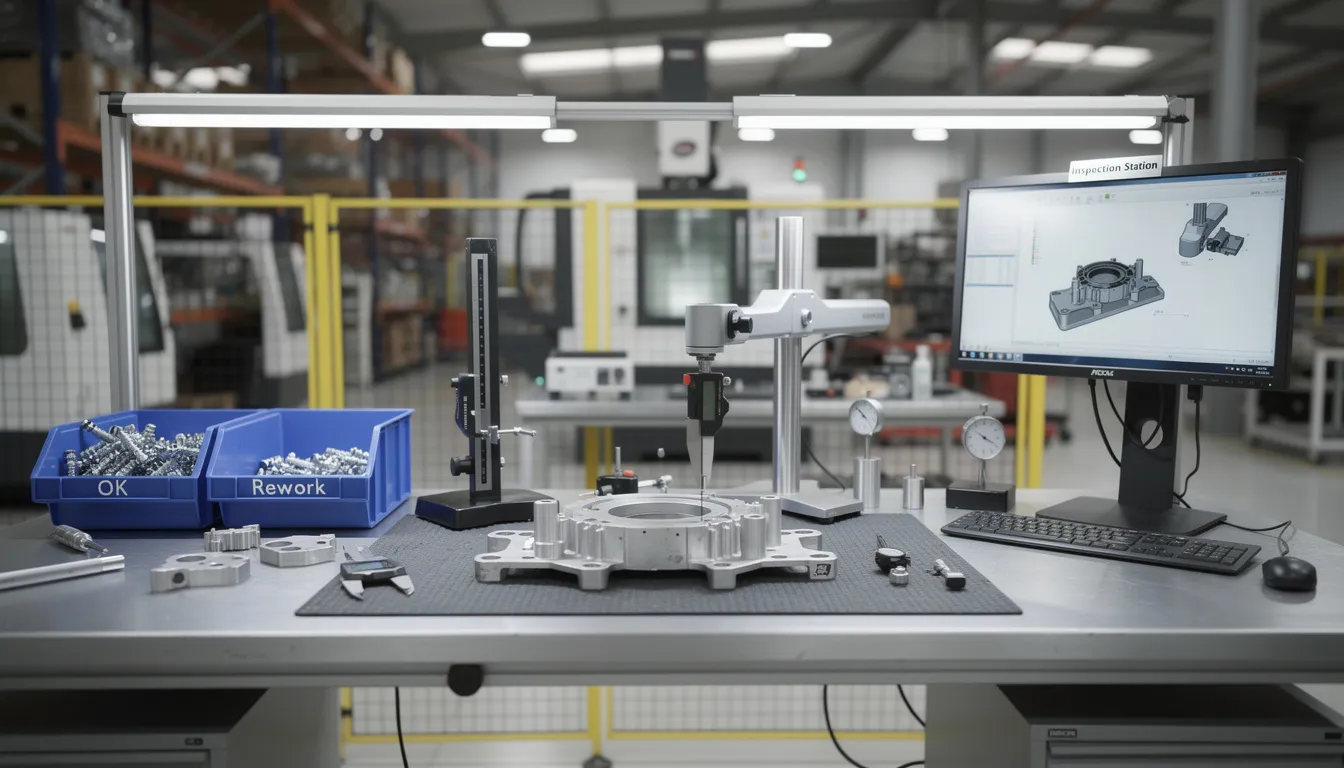
    An aerospace technician is meticulously inspecting a precision metal component on a clean shop floor, ensuring compliance with quality management systems and specified quality standards. This routine inspection is part of a structured process aimed at addressing quality issues and maintaining product quality in the aerospace industry.

    5. Containment: When It Must Happen at Supplier Level

    Containment in a supplier NCR means immediate action to stop further non conformances from reaching production, MRO, customers, or the field. Local containment at the buyer is necessary, but it is not always enough.

    Supplier-level containment is mandatory when parts have already moved across multiple sites, serialized aerospace hardware has shipped worldwide, the supplier still has work-in-progress in production, or the issue may affect adjacent lots. The purpose is risk mitigation before the defect becomes harder to find.

    Practical supplier containment requirements should include:

    • Require same-day acknowledgement when the issue affects safety, fit, function, or delivery to a customer.
    • Require a 24 to 48 hour interim containment plan, with named owners and affected lot numbers.
    • Stop production when the failure mode suggests the process is still producing suspect parts.
    • Quarantine work-in-progress, finished goods, and stock at the supplier site.
    • Expand inspection to adjacent lots and related part numbers when raw materials, tooling, fixtures, or operators overlap.
    • Temporarily increase inspection frequency, often to 100 percent screening until the process is stable.
    • Require supporting documentation that shows quantity inspected, quantity rejected, serial numbers affected, and disposition status.
    • Confirm whether sub-tier suppliers must also place material on hold.

    A practical example is a 2025 fastener supplier placing a line on hold, quarantining lots 24-031 through 24-037, and re-inspecting 100 percent of inventory within 72 hours. AMETEK supplier requirements similarly emphasize segregating suspect product and submitting containment plans quickly, which reflects how aerospace buyers expect suppliers to control risk.

    6. What Evidence to Require from Suppliers

    Robust quality assurance depends on objective evidence, not reassurance. A supplier response that says “operator error corrected” is not enough for aerospace, MRO, or other regulated industries such as medical device manufacturing.

    The supplier NCR response should require clear evidence categories:

    • Inspection data sets, including nominal values, actual values, tolerance limits, gage IDs, CMM output, and sampling basis.
    • Photos or video of the defect, packaging condition, tooling setup, fixture location, or marking issue.
    • Batch, lot, heat, and raw materials documentation showing traceability to Certificates of Conformance and purchase requirements.
    • Calibration records for inspection equipment and production equipment used to accept the affected product.
    • Traveler sheets, routing records, operator logs, and work instruction revisions that show what process was actually followed.
    • Control charts, capability data, and SPC history for critical or key characteristics.
    • Special process evidence, including NDT, heat treatment, coating, plating, welding, and sub-tier processor approvals.
    • Updated FMEAs, control plans, training records, effective dates, and revised work instructions when process improvement is required.
    • Verification of effectiveness, such as post-correction inspection data, internal audit results, field return monitoring, or stable SPC trends.

    A standard supplier response should follow a structured process: problem statement, containment, root cause analysis, corrective actions, verification of effectiveness, and corrective and preventive actions. For major or safety-related issues, attachments should be required, not optional.

    Digital traceability expectations are high in aerospace. The NCR record should link serial numbers, lot numbers, PO lines, inspection data, supplier documents, and relevant documentation in a document management system. VIRTEX supplier requirements, for example, call for retention of material and inspection records for 10 years unless otherwise specified, which reflects common aerospace documentation practice.

    Medical device manufacturers face similar expectations for medical devices, where evidence, traceability, and documented corrective and preventive activity are required to maintain product quality and ensure quality. The industries differ, but the record discipline is familiar.

    A quality engineer is reviewing precision inspection results next to aerospace components, focusing on quality management systems and ensuring compliance with specified quality standards. The engineer analyzes data to address quality issues and implement corrective actions, contributing to continuous improvement in the supply chain.

    7. Disposition, Escalation, and When a Supplier NCR Becomes a SCAR/CAPA

    Disposition is the formal decision on what happens to the nonconforming material. Common dispositions for non-conforming items include scrap, rework/repair, return to vendor, or use as-is with concessions.

    For supplier non conformances, disposition options usually include use-as-is with engineering justification, rework by supplier, rework by buyer with chargeback, scrap, repair, downgrade, or return to supplier. The decision should be made by authorized personnel, with engineering and quality approval where required.

    Addressing product non-conformance involves identifying and documenting issues, analyzing root causes, notifying stakeholders, and implementing corrective actions to prevent recurrence. The same discipline applies to supplier NCRs, but external accountability must be explicit.

    Escalation to SCAR or CAPA-like control is appropriate when:

    • The supplier has repeated non conformances in a 6 to 12 month period.
    • A defect has critical safety, airworthiness, regulatory compliance, or customer impact.
    • Customer complaints show the defect reached the field or an MRO customer.
    • The supplier misses response windows or provides weak root cause analysis.
    • The supplier cannot show process control, training, calibration, or special process approval.
    • The same underlying cause appears across multiple part numbers or sites.
    • The buyer’s risk assessments show unacceptable recurrence or severity.
    • The issue creates wasted resources, major schedule disruption, or exposure to non compliance.

    A supplier NCR becomes a SCAR when deeper supplier corrective actions are required. SCAR usually demands management review at the supplier, formal root cause, corrective measures, preventive actions, milestone tracking, and effectiveness verification. In many organizations, the SCAR behaves like an external capa process.

    The link to internal CAPA matters. Systemic supplier issues may require internal corrective and preventive review of supplier selection, incoming inspection strategy, contract review, design tolerances, or sourcing policy. A good QMS defines escalation logic, such as three major NCRs in 12 months automatically triggering SCAR, with approval roles and deadlines documented.

    8. Integrating Supplier NCRs with Internal Audits and Customer Feedback

    Supplier NCRs should not live in isolation. They should feed internal audits, supplier reviews, risk registers, customer complaints analysis, and management review.

    During an annual 2025 AS9100 internal audit cycle, auditors should verify that supplier NCRs are issued consistently, contain required evidence, follow response windows, and close only after verification. Internal audits should also test whether corrective actions were implemented and whether recurrence was monitored.

    Audit findings can themselves trigger supplier NCRs. Missing inspection records, undocumented process changes, unapproved sub-tier outsourcing, or weak calibration control all indicate supplier control problems. Even when no defective hardware has been found, the process weakness may justify formal supplier action.

    Customer feedback closes the loop. Field returns, in-service failures, warranty claims, and airline MRO findings should be mapped back to supplier lots when possible. If the supplier origin is confirmed or strongly suspected, the supplier NCR becomes the mechanism to address quality issues and prevent recurrence.

    Trend review is essential. Teams should identify trends by supplier, defect type, response time, containment quality, recurrence rate, and cost of poor quality. This data analysis supports continuous improvement because it shows where supplier development, inspection changes, or sourcing decisions will have the most effect.

    The key components are consistency and follow-through. A supplier NCR that closes without evidence, verification, or monitoring is only administrative closure. It does not improve quality.

    9. Using Supplier NCR Data for Quality Assurance and Competitive Advantage

    Well-structured supplier NCR data supports proactive quality assurance, cost reduction, supplier development, and better sourcing decisions. The NCR process can track vendor defect rates, enforce quality standards, and hold suppliers accountable for replacement costs.

    Useful metrics include the number of supplier NCRs by supplier, defect rate by part family, average response time, containment timeliness, closure cycle time, repeat defect percentage, escaped defects versus caught-at-receipt defects, and cost of poor quality. Mature teams also track whether corrective actions remained effective after 30, 60, or 90 days.

    Supplier scorecards should include both product quality and response behavior. A supplier with a low defect count but poor containment discipline may still be a risk. A supplier with recurring defects but strong root cause analysis and verified process improvement may be a better long-term candidate for development.

    Supplier non-conformance occurs when incoming raw materials or outsourced components fail to meet established design criteria or quality standards, which can lead to operational inefficiencies and increased costs. That data should feed quarterly business reviews, dual-sourcing decisions, preferred supplier status, and targeted supplier audits.

    From 2024 through 2026, aerospace companies have increasingly used AI-assisted analytics to find patterns across ncr data: defect types, tooling, operators, materials, sub-tier suppliers, and late response behavior. The goal is not to replace engineering judgment. The goal is to surface weak signals sooner.

    Digital platforms like Connect981 centralize quality data, integrate it with ERP and MES records, and give teams a shared view across factories and suppliers. The outcome is a practical competitive advantage: fewer disruptions, stronger compliance posture, better customer satisfaction, and stronger successful project execution.

    An aerospace production team is gathered in a factory setting, reviewing components and inspection records, focusing on quality management systems and ensuring compliance with specified quality standards. They are engaged in discussions about non conformance reports and corrective actions to address quality issues and improve product quality.

    10. How Connect981 Supports Supplier NCR Workflows

    Connect981 is a unified aerospace operations platform that helps teams digitize supplier NCR workflows without forcing a full ERP or MES replacement. It connects defect logging, work execution, supplier data, document control, and traceability in one operational layer.

    Teams can configure low-code workflows for supplier NCR initiation, review, approvals, supplier communication, MRB disposition, and escalation. Digital quality checks, defect logging, parts traceability, supplier collaboration, and automated alerts help enforce response windows instead of relying on email threads and spreadsheets.

    For audit readiness, Connect981 links supplier NCR records to work orders, serial numbers, PO data, inspection results, documents, and approval history. That traceability supports AS9100, FAA, EASA, ITAR, and customer audits because the record shows what happened, who approved it, and what evidence was used.

    A practical example: a Tier 1 aerospace supplier using Connect981 to manage more than 200 supplier NCRs in 2025 could reduce average closure time from 30 days to 12 days by standardizing templates, automating notifications, and making supplier evidence visible in one workflow.

    Request a demo to see how supplier NCR workflows run in Connect981.

    11. Practical Checklist: Designing a Robust Supplier NCR Procedure

    • Define when a supplier NCR is required and when a minor issue can be handled locally.
    • Specify thresholds for ppm, repeat defects, customer impact, and safety risk.
    • Map roles for supplier quality, procurement, engineering, quality management, MRB, and program leadership.
    • Require same-day acknowledgement for critical issues and 24 to 48 hour containment response.
    • Define required evidence for inspection, traceability, calibration, process controls, and training.
    • Include clear disposition paths: scrap, rework, repair, return to vendor, and use-as-is concession.
    • Document escalation logic to SCAR, CAPA, and management review.
    • Link supplier NCRs to internal audits, customer complaints, supplier scorecards, and risk reviews.
    • Require external traceability for serial numbers, lots, batches, raw materials, and sub-tier processors.
    • Control non compliance through documented approvals, version control, and closure verification.
    • Ensure documentation is suitable for regulatory and customer audits.
    • Use routine inspections, dashboards, and follow-up monitoring to confirm corrective actions remain effective.

    12. Conclusion

    A disciplined supplier NCR process improves quality control by making supplier-origin defects visible, traceable, and actionable. It protects production, MRO operations, and customers by forcing a clear sequence: containment, evidence, root cause analysis, disposition, corrective actions, verification, and monitoring.

    The distinction matters. Internal NCRs address problems inside the organization. Supplier NCRs manage external accountability across contracts, purchase orders, supplier scorecards, and regulatory expectations. Strong procedures define response windows, evidence requirements, escalation logic, and ownership before a high-risk escape occurs.

    As aerospace and MRO supply chains become more complex through 2030, supplier non conformance management will only become more important. Digitalization with platforms like Connect981 helps teams move beyond spreadsheets and email into a connected, audit-ready supplier NCR process that supports compliance, supplier collaboration, and reliable execution.

  • How do digital systems support ISO 9001 audit readiness?

    Digital systems support ISO 9001 audit readiness by making evidence easier to generate, find, and defend. They do not guarantee compliance or a positive audit outcome, but they can reduce scramble, ambiguity, and manual effort when they are correctly configured, validated, and embedded in disciplined processes.

    Key areas where digital systems help ISO 9001 audits

    ISO 9001 auditors are mainly looking for a functioning quality management system supported by objective evidence. Digital tools can help in several recurring evidence areas:

    • Document control and version governance
      QMS or document-control systems can manage controlled procedures, work instructions, forms, and templates with approvals, revision history, effective dates, and access control. This supports evidence for documented information being current and controlled, provided that obsolete content is actually removed from use at the plant.
    • Training records and competence
      Learning or training systems linked to roles and procedures can show who is trained on which revision, how often they are requalified, and when training is overdue. This only supports audits if the linkage between job roles, procedures, and training requirements is maintained and changes are managed under change control.
    • Process control and standard work
      MES, digital work instruction platforms, and shop-floor execution tools can demonstrate that operators follow defined steps in the correct sequence, capture required data, and record signoffs. This gives auditable records of process execution, but it depends on clear routing logic, maintained content, and appropriate user access rights.
    • Traceability and records management
      ERP, MES, PLM, LIMS, and maintenance systems can provide genealogy and device history information, including which materials, equipment, and revisions were used on each job. These records support requirements around product conformity and traceability, but only if master data, part numbers, and configuration rules are accurate and synchronized.
    • Nonconformance, CAPA, and improvement
      Digital NCR/CAPA systems can standardize how issues are logged, investigated, and closed. They can support ISO 9001 clauses around nonconforming output, corrective action, and continual improvement by providing an evidence trail of problem definition, root cause analysis, actions, verification of effectiveness, and management review. Their effectiveness depends on disciplined use, meaningful problem statements, and realistic action plans rather than superficial closures.
    • Risk-based thinking
      Risk registers, FMEA tools, and issue-tracking systems can capture identified risks, mitigation plans, and status. This can help show auditors how risk-based thinking is applied in planning and change management. It only works if risks are actually used in decisions and regularly reviewed, not just documented once.
    • Performance monitoring and management review inputs
      Reporting, BI, and dashboard tools can provide objective data on quality performance, on-time delivery, complaints, scrap, and process KPIs. These outputs are often used as evidence that performance is monitored and that there is input to management review. The value depends on data quality, definition of metrics, and documented use of the data in decision-making.

    Typical benefits during ISO 9001 audits

    When well implemented, digital systems can:

    • Shorten evidence retrieval time by making records searchable by part, batch, order, or date, instead of relying on paper binders and personal memory.
    • Improve data integrity through access control, time-stamped audit trails, and reduction of handwritten, ambiguous entries.
    • Clarify process ownership via electronic workflows, approvers, and role-based responsibilities that can be shown to auditors.
    • Make sampling easier by allowing an auditor to pick a job or customer complaint and quickly trace back through records, approvals, and changes.

    These advantages only appear if the underlying configuration reflects the real processes, operators use the systems as designed, and there is a defined approach to data retention and record completeness.

    Constraints, failure modes, and tradeoffs

    Digitalization does not remove ISO 9001 risk; it shifts where the risk sits. Common issues include:

    • Mismatch between system and actual process
      If the documented workflow in the system does not match what people actually do on the floor, auditors can raise findings on ineffective implementation, regardless of how sophisticated the software is.
    • Fragmented records across multiple systems
      In a brownfield environment, records may be spread across ERP, MES, PLM, QMS, maintenance, and file shares. If integration is weak, evidence chains (for example, from customer requirement to design to production to delivery) may be hard to reconstruct under time pressure.
    • Overreliance on dashboards and reports
      Auditors usually want underlying records, not just summarized metrics. If the system cannot quickly trace a KPI back to concrete records, the dashboard has limited audit value.
    • Configuration changes without change control
      Frequent, undocumented changes to workflows, fields, or permissions can create inconsistencies between procedures and system behavior. This can undermine confidence in the QMS and raise questions about validation and control of computerized systems.
    • Legacy systems and long equipment lifecycles
      Older test stands, data loggers, or homegrown databases often cannot easily provide standardized audit outputs. Replacing them outright is often impractical due to validation burden, downtime risk, and requalification costs. Instead, organizations typically implement wrappers, exports, or bridging tools and must be able to explain these workarounds to auditors.

    Coexistence with existing systems and brownfield realities

    Most ISO 9001 environments already have a stack of legacy systems and manual workarounds. Trying to replace everything with a single new platform before the next audit usually increases risk, not reduces it, because:

    • New systems require training, stabilization, and often revalidation before they become reliable sources of truth.
    • Data migration errors and incomplete historical records can make it harder, not easier, to answer auditor questions about the past.
    • Integration debt does not disappear; it is just re-created with different interfaces and must still be proven reliable.

    A more practical strategy is usually:

    • Identify the specific ISO 9001 clauses and evidence types where audits are currently painful (for example training, calibration, NCR/CAPA).
    • Stabilize and document how existing digital systems support those areas, including known gaps or manual bridges.
    • Implement targeted digital improvements that directly reduce audit effort, while keeping legacy systems in place where replacement would carry high risk or requalification cost.
    • Maintain clear mappings that show auditors which systems hold which records and how traceability is maintained across them.

    Validation, change control, and audit trails

    In regulated or customer-critical contexts, auditors will often probe how you ensure that computerized systems are fit for purpose and remain controlled. Digital systems can help if you:

    • Document basic system validation or user acceptance testing and keep records of what was verified.
    • Control configuration changes through a defined process with impact assessment, approvals, and updated procedures or work instructions.
    • Use system audit trails (where available) to support investigations into who changed what, when, and why.
    • Define and apply data retention rules so that required records are available for the full retention period.

    These practices do not guarantee a particular audit outcome, but they demonstrate that you treat digital systems as part of the QMS, not just IT tools.

    Practical ways to use digital systems before an ISO 9001 audit

    In preparation for an audit, digital systems can be used to:

    • Run internal process audits using the same systems that hold your production and quality data, to verify that records are complete and accessible.
    • Simulate common auditor traceability requests (for example, pick a random order and retrieve the associated training, inspection, and NCR records) to confirm that your evidence trail works end to end.
    • Identify data-quality issues and missing records early, then adjust processes, training, or system configuration.
    • Prepare clear navigation guides for the audit team, showing which systems will be used to answer which types of questions.

    Used this way, digital systems become part of a continual audit-readiness practice rather than an emergency tool during the audit week.

  • What’s the difference between ISO 9001 and AS9100?

    ISO 9001 and AS9100 are closely related, but they are not interchangeable. AS9100 is built on ISO 9001 and adds aerospace-specific requirements on top of the generic quality management system (QMS) framework.

    Core relationship

    • ISO 9001: A general QMS standard that applies to any industry. It focuses on customer satisfaction, process control, continual improvement, and risk-based thinking.
    • AS9100: An aerospace QMS standard that fully incorporates ISO 9001 and adds additional clauses and clarifications specific to aviation, space, and defense organizations and their supply chains.

    If you comply with AS9100, you are expected to meet ISO 9001 requirements, but not the other way around.

    Scope and intent differences

    • Industry scope
      • ISO 9001: Designed for any organization in any sector.
      • AS9100: Targeted at organizations that design, manufacture, maintain, or support aerospace products or services, including many critical suppliers.
    • Risk and safety emphasis
      • ISO 9001: Requires risk-based thinking, but at a relatively high level.
      • AS9100: Imposes detailed expectations for risk management, product safety, and prevention of counterfeit or suspect materials, reflecting aerospace safety and reliability demands.
    • Regulatory and customer expectations
      • ISO 9001: Often a generic customer requirement or internal standard of practice.
      • AS9100: Frequently required by aerospace primes and Tier 1s as a condition of doing business. It aligns with typical expectations of regulators and OEMs but does not guarantee regulatory compliance or any audit outcome.

    Key additional requirements in AS9100

    AS9100 contains all ISO 9001 clauses plus aerospace-specific additions and amplifications. Examples include:

    • Configuration management
      • More prescriptive control of configurations, baselines, and changes to design and process.
      • Stronger expectations on traceability from requirements through design, manufacturing, inspection, and delivery.
    • Product safety and reliability
      • Explicit requirements to manage product safety risks throughout the lifecycle.
      • Focus on reliability, including control of critical characteristics and key process parameters.
    • Risk management and operational planning
      • More detailed approaches to risk assessment, mitigation, and ongoing monitoring.
      • Requirements for formal risk management in project planning, special processes, and change control.
    • Counterfeit parts prevention
      • Controls to prevent, detect, and mitigate counterfeit or suspect parts in the supply chain.
      • Stronger supplier qualification and source verification practices.
    • Verification, validation, and first article inspection
      • Stricter expectations for verifying design and process changes.
      • Linkage to typical aerospace practices such as First Article Inspection (e.g., AS9102) and detailed documentation of conformity.
    • Nonconformity and corrective action
      • More emphasis on robust root cause analysis, systemic corrective actions, and escape management.
      • Higher scrutiny around nonconforming product control, rework, repair, and use-as-is dispositions.
    • Human factors and awareness
      • Additional focus on human factors in error prevention.
      • Awareness requirements around product safety, ethical behavior, and reporting of issues.

    Implications for systems and processes

    Implementing AS9100 in a regulated manufacturing environment almost always means extending an existing ISO 9001-style system rather than replacing it.

    • Brownfield reality
      • Most aerospace plants already have legacy QMS, MES, ERP, PLM, and document control systems in place.
      • Adopting AS9100 usually involves tightening and integrating those systems, not ripping them out.
    • Documentation and records
      • AS9100 drives more formalized procedures, documented risk assessments, configuration records, and traceability evidence.
      • Success depends heavily on document control, version governance, and reliable data capture on the shop floor.
    • Traceability and genealogy
      • Expect tighter part, batch, and process traceability requirements, sometimes down to individual serial numbers and special process parameters.
      • Existing MES/ERP often need configuration changes, interfaces, or add-ons to provide the necessary genealogy and audit trails.
    • Change control and validation
      • System and process changes that affect AS9100 controls usually require formal impact assessment, validation, and documented approval.
      • Large-scale system replacement can be risky due to downtime, requalification needs, and the effort to re-establish traceability and evidence.

    Choosing between ISO 9001 and AS9100

    • If you do not serve aerospace customers: ISO 9001 is often sufficient as a general QMS framework. Implementing AS9100 without aerospace drivers usually adds overhead with limited benefit.
    • If you are in the aerospace supply chain: AS9100 is typically expected by major customers, especially for design, manufacturing, special processes, or critical parts. Remaining at ISO 9001-only is often a commercial limitation.

    In both cases, the actual value depends less on the certificate and more on how well your processes, systems, and records support traceability, risk control, and reliable, repeatable operations.

  • How can software help enforce AS9102 Rev C requirements on Forms 1, 2, and 3?

    Software can help enforce AS9102 Rev C requirements on Forms 1 (Part Number Accountability), 2 (Product Accountability), and 3 (Characteristic Accountability) by constraining how data is created, linked, and approved. It does not make you compliant by itself, but it can make noncompliance harder and evidence generation easier, if it is configured and governed correctly.

    What software can realistically enforce for AS9102 Rev C

    Across Forms 1, 2, and 3, well-designed FAI or MES/QMS tooling can:

    • Use Rev C-compliant templates that mirror the latest standard layout for Forms 1–3, including all required fields and headings.
    • Configure mandatory fields and value rules so that key fields cannot be left blank, use invalid formats, or contain disallowed values (for example, FAI type, drawing revision, cert references).
    • Constrain selections by master data such as part numbers, customer names, PO numbers, and process codes pulled from ERP/MES/PLM instead of free text.
    • Enforce drawing and BOM linkage so the Forms are tied to specific drawing revisions, models, BOMs, and operation plans used to generate the characteristics list.
    • Require traceability to specific work orders and lots, including serial, heat/batch, and material certifications where applicable.
    • Drive Form 3 content from ballooned characteristics, preventing missing or duplicate characteristics and enforcing 100% coverage of the balloon set.
    • Link inspection results directly into Form 3, with automatic population of actual values, pass/fail status, and gage or method identifiers.
    • Enforce approval workflows and e-signatures so Forms 1–3 cannot be issued as final until defined roles (manufacturing, quality, MRB, etc.) approve them.
    • Record time-stamped audit trails for who created, modified, and approved each field or section of the forms.
    • Control versions and re-submittals for partial FAI, full FAI, and delta FAI, aligned with Rev C triggers when parts, processes, or suppliers change.

    Form 1: Part Number Accountability

    For Form 1, software can help by:

    • Pulling part and drawing data from ERP/PLM to prevent mismatches between part numbers, revisions, and descriptions.
    • Enforcing FAI type and reason for FAI (e.g., new part, design change, change in manufacturing source, process, or location) as required by Rev C.
    • Requiring linkage to the actual manufacturing order or batch used to produce the FAI part.
    • Validating customer-specific fields (e.g., PO number, contract number) where customer FAI requirements go beyond baseline AS9102.
    • Locking down revision alignment between Form 1, the drawing/model, and the associated Forms 2 and 3.

    To be effective, this depends on accurate and maintained master data in upstream systems and clear mapping between those systems and the FAI application.

    Form 2: Product Accountability (materials, processes, and functional tests)

    For Form 2, software can:

    • Link to routings and process plans from MES/ERP so special processes and key operations appear systematically instead of relying on manual recall.
    • Standardize process and material descriptions via controlled vocabularies (e.g., approved process codes, material specs, heat treat providers) instead of free text.
    • Enforce special-process evidence (e.g., NADCAP certs, supplier approvals, plating or heat treat certifications) being attached or referenced before the FAI can close.
    • Require documented functional and acceptance test results where applicable, with links to test procedures and test data.
    • Ensure supplier and lot traceability for critical materials and outsourced processes, aligning with Rev C traceability expectations and customer-specific adders.

    The quality of enforcement depends on good integration with supplier data, approved supplier lists, and special-process approval records, which often live in a QMS, ERP, or standalone spreadsheets in brownfield environments.

    Form 3: Characteristic Accountability, Verification, and Compatibility

    Form 3 is typically where software has the most impact, but also the highest integration and configuration burden.

    Software can help by:

    • Generating the characteristic list from a ballooned drawing or model, ensuring every ballooned feature appears once and only once on Form 3.
    • Enforcing characteristic numbering schemes and preventing “skipped” or reused characteristic numbers across revisions.
    • Linking each characteristic to its inspection method (e.g., CMM, visual, functional test) and required equipment, often drawing from an inspection plan library.
    • Importing or collecting measured data digitally (CMM outputs, hand gage entry, automated test results) directly into Form 3 fields.
    • Applying tolerance rules to automatically flag out-of-tolerance dimensions or incomplete measurements.
    • Enforcing resolution, rounding, and units consistent with drawing and gage capabilities, where configured.
    • Requiring NC handling (linking to NCR/MRB records) before allowing FAI completion when characteristics are nonconforming.
    • Driving delta FAI behavior so that only impacted characteristics are re-validated when revisions occur, while preserving full history.

    These capabilities rely on good ballooning practices, accurate CAD/drawing data, disciplined inspection-plan governance, and reliable integration with metrology and test systems.

    Traceability, re-use, and change control

    AS9102 Rev C expects clear traceability and disciplined handling of changes. Software can help by:

    • Providing a central repository of FAIs searchable by part, customer, revision, and FAI type.
    • Linking each FAI to underlying evidence (certs, NC records, inspection plans, process approvals) with immutable audit trails.
    • Controlling who can edit closed FAIs and requiring controlled revision workflows when forms must be updated.
    • Supporting reuse of prior FAI data where Rev C allows partial/delta FAI, while explicitly tracking what has and has not changed.
    • Making FAI content visible to internal stakeholders and customers while aligning with data security and export-control requirements where relevant.

    This is only robust if the system itself is under configuration control, with clear ownership, change procedures, and periodic reviews.

    Limits: what software cannot realistically enforce

    Even in a highly digitized environment, software cannot:

    • Guarantee technical correctness of the interpretation of the drawing, model-based definition, or specification requirements.
    • Guarantee that the “FAI part” was produced under production-representative conditions; this is a process and leadership responsibility.
    • Substitute for judgment in deciding when a full vs. partial/delta FAI is appropriate under Rev C and contractual flow-downs.
    • Resolve conflicting customer requirements where a customer-specific FAI checklist modifies or tightens baseline AS9102.
    • Eliminate the need for training on AS9102 Rev C itself; users must understand what the standard requires, not just how to click through screens.

    Also, software cannot promise audit outcomes or certification results. At best, it makes it easier to produce consistent, well-structured evidence when audits occur.

    Brownfield reality: coexistence with MES, ERP, PLM, and QMS

    In most aerospace plants, FAI software has to coexist with legacy MES, ERP, PLM, and QMS tools rather than replace them. This creates tradeoffs:

    • Full replacement of existing systems is rarely practical due to validation cost, downtime risk, qualification burdens, and the long lifecycle of production assets and processes.
    • Point FAI tools often start as overlays on top of existing systems, pulling data from ERP/PLM and pushing only key results back.
    • Integration quality drives enforcement quality: without reliable links to part masters, drawings, and routings, enforcement degrades to manual entry with some basic form checks.
    • Some plants rely on a mix of digital and paper, for example: Form 3 digital, but cert packages and NC evidence partly on paper or shared drives. Software can still help, but enforcement is weaker and more dependent on human discipline.
    • Validation of the FAI software itself (especially in defense or tightly regulated programs) is non-trivial and must be handled through formal change control and testing.

    A realistic strategy is often incremental: digitize Forms 2 and 3 first where data complexity is highest, integrate with one or two key systems (e.g., ERP for part data, PLM for drawings), validate that workflow, then gradually expand coverage.

    Practical steps to use software to enforce Rev C

    To make software meaningfully enforce AS9102 Rev C, most organizations need to:

    1. Define your AS9102 ground rules, including customer-specific variants and when full vs. partial/delta FAI is required.
    2. Standardize templates for Forms 1–3 aligned to Rev C, then configure those as system templates with mandatory fields.
    3. Map critical data sources (ERP, PLM, MES, QMS, metrology) and decide which fields must be system-of-record vs. local in the FAI tool.
    4. Implement and validate role-based workflows so only authorized users can create, modify, review, and approve FAIs.
    5. Train engineers, quality, and operators on both the standard and the digital workflow, and capture tribal knowledge about edge cases and customer adders.
    6. Monitor usage and audit trails to identify workarounds (e.g., dummy values to bypass required fields) and adjust configuration or training.

    With this approach, software becomes a structured enforcement and evidence tool for AS9102 Rev C, rather than just a digital version of the paper forms.

  • Which AS9102 documents do auditors usually sample?

    Auditors generally do not review every AS9102 First Article Inspection (FAI) package. They sample evidence to test how consistently you apply your FAI process, how well it is controlled, and whether records are complete and traceable.

    Typical AS9102 items auditors sample

    While approaches differ by auditor and certification body, you should expect sampling from at least these areas:

    • AS9102 Forms

      • Form 1 (Part Number Accountability): Part revision, FAI type (full/partial), relationship to drawing and model, and whether all associated sub-FAIs are referenced.
      • Form 2 (Product Accountability): List of materials, special processes, and functional tests, with cross-reference to certs and reports.
      • Form 3 (Characteristic Accountability, Verification and Compatibility Evaluation): Balloon-to-characteristic traceability, results, acceptance status, and disposition of any nonconformances.
    • Ballooned drawings or models

      • Evidence that every drawing characteristic has a unique balloon/identifier.
      • Clear linkage between balloon numbers and Form 3 line items.
      • Handling of reference dimensions, implied requirements, and notes.
    • Inspection and test records

      • Raw inspection results for sampled characteristics (CMM reports, gage sheets, test logs).
      • Confirmation that recorded values on Form 3 match the underlying data.
      • Evidence that measuring equipment was calibrated at time of use.
    • Material and special process certifications

      • Mill certs, heat treat and plating certs, NDT reports, weld records, and other special process evidence.
      • Verification that requirements and results on certs align with Form 2 entries and drawing notes.
      • Use of approved sources where required by the customer.
    • Change-control and configuration records

      • Evidence that the FAI reflects the correct drawing/model revision and applicable specs.
      • Partial/revised FAI logic: what changed, why a partial FAI was done, and how impact was assessed.
      • Linkage to engineering change orders, deviations, concessions, and waivers where applicable.
    • Process and routing evidence

      • Traveler/router or MES records for the FAI lot or piece.
      • Confirmation that the FAI part followed the released, approved process.
      • Proof that key process parameters and special characteristics were controlled and recorded where required.
    • Linkage to nonconformance and corrective action

      • NCRs raised during FAI, including MRB decisions and dispositions.
      • How FAI results are fed into corrective actions or process improvement when issues are found.
      • Evidence that escapes or repeated FAI failures are investigated and addressed.

    How auditors choose which FAIs and records to sample

    Sampling is risk-based and tied to the audit plan. Common selection patterns include:

    • Recent FAIs to see how your current process and tools work in practice.
    • High-risk parts (safety-critical, complex geometry, special processes, tight tolerances, or known field issues).
    • Key customers where additional flowdown requirements exist (customer-specific FAI forms, Net-Inspect, or portal workflows).
    • Mix of new and revised FAIs to test your handling of design changes and partial FAIs.
    • Supplied parts vs. in-house manufacture to evaluate supplier controls and incoming inspection when FAIs are done at the vendor.

    What they are really testing

    Across whatever packages they sample, auditors are less focused on the sheer volume of documents and more on the control of your FAI process:

    • Traceability: Can you trace from drawing/model to balloon to Form 3 line to actual inspection record and gage, and back to the specific part or lot?
    • Configuration control: Does each FAI correctly reflect the design baseline and any authorized deviations at that time?
    • Completeness and accuracy: Are there missing characteristics, mis-typed data, or unexplained blanks?
    • Consistency across sites and systems: Are AS9102 practices similar across different cells, plants, and systems (paper, spreadsheets, MES, FAI software)?
    • Integration with other QMS processes: How FAI connects to document control, calibration, training, NCR/MRB, and change control.

    Implications for brownfield and mixed-system environments

    In most aerospace operations, FAIs are scattered across paper files, shared drives, email, customer portals, and sometimes dedicated FAI or MES modules. Auditors will often sample across these different storage locations and systems to see whether:

    • You can reliably find the right FAI package for a given part, PO, or serial/lot number without long searches.
    • The same part family shows consistent ballooning, measurement methods, and documentation even if different tools or plants were used.
    • When systems change (for example, new MES, FAI software, or PLM), there is controlled migration and clear delineation between old and new processes, not a gap in evidence.

    Full replacement of legacy FAI records is rarely practical. Auditors typically accept mixed archives as long as you have controlled access, version control, and a repeatable way to retrieve and demonstrate complete AS9102 evidence across systems.

    Practical preparation

    To be ready for the kinds of AS9102 sampling auditors usually perform:

    • Maintain a simple index or register of FAIs (by part, customer, revision, FAI type, and location of records).
    • Standardize your ballooning and Form 3 practices as much as practical across programs and plants.
    • Verify that supporting evidence (inspection data, certs, routers, NCRs) is linked and retrievable for each FAI.
    • Periodically perform internal process audits that mimic auditor sampling, to catch gaps in traceability and completeness before external audits.