RSC Topic: Traceability & Genealogy

Lot, serial, and unit-level tracking from raw material through as-built record.

  • ballooning

    Ballooning in manufacturing and quality engineering commonly refers to the process of marking engineering or manufacturing drawings with numbered symbols (“balloons”) so that each requirement or characteristic can be uniquely identified and traced into inspection and quality records.

    Core meaning

    In regulated and aerospace environments, ballooning is typically applied to drawings, 3D models, or specifications used for First Article Inspection (FAI), in-process inspection, or final inspection. Each dimensional, geometric, material, or note-based requirement is assigned a balloon with a unique number. Those balloon numbers are then used as characteristic IDs in inspection reports, quality plans, or digital FAI forms.

    Ballooning includes:

    • Reviewing the drawing or model to identify all inspectable characteristics and notes
    • Assigning a unique balloon number to each characteristic
    • Placing balloons clearly near the relevant feature, dimension, or note
    • Maintaining a consistent mapping between balloon numbers and inspection line items
    • Managing revisions so that added, removed, or changed characteristics have traceable balloon references

    In digital workflows, ballooning may be performed using software that overlays balloons on PDF drawings or 3D models, automatically creates characteristic lists, and synchronizes those lists with FAI, inspection plans, MES, or PLM systems.

    Operational use in FAI and inspections

    Ballooning is a standard step in many aerospace and defense First Article Inspection (AS9102) processes. The ballooned drawing becomes the visual reference for:

    • Linking each balloon number to an AS9102 characteristic line item
    • Ensuring complete coverage of all applicable drawing requirements
    • Supporting traceability across multi-sheet drawings, zones, and configuration-controlled revisions
    • Clarifying which features have been inspected, waived, or not applicable

    Outside of formal FAI, ballooning is also used for incoming inspection, first-piece inspection, and complex part layouts where clear characteristic traceability is required.

    What ballooning is not

    Ballooning does not include the act of measuring the characteristics themselves or making pass/fail decisions. Those are inspection activities that use the ballooned drawing as a reference. Ballooning is also not the same as general mark-up or redlining of drawings; it is a structured, uniquely numbered identification of requirements intended for systematic inspection and traceability.

    Digital and multi-sheet considerations

    In digital environments, ballooning must account for:

    • Multi-sheet drawings where balloon numbers must remain unique and traceable across sheets
    • Sheet and zone references so each balloon can be located unambiguously
    • Integration with PLM, MES, or quality systems to keep ballooned characteristics aligned with the latest released revision
    • Change management when drawings or models are updated and characteristics are added, deleted, or renumbered

    Common confusion

    • Ballooning vs. characteristics: The balloons are the visual markers; the characteristics are the actual requirements (dimensions, notes, tolerances) referenced by those markers.
    • Ballooning vs. FAI report: Ballooning produces the numbered references used by an FAI or inspection report but is not, by itself, the report or the inspection record.
    • Ballooning vs. general annotations: Highlighting, comments, or informal marks on a drawing are not considered ballooning unless they follow a consistent, uniquely numbered scheme tied to inspection records.

    Context: aerospace and AS9102

    Within aerospace FAI processes following AS9102, ballooning supports characteristic identification and traceability between the engineering authority (drawing or model) and the FAI forms. Proper ballooning helps demonstrate that all drawing requirements have been accounted for in the inspection plan and that each measured result can be traced back to a specific, controlled requirement.

  • CofC/CoC

    Core meaning

    “CofC/CoC” commonly refers to a **Certificate of Conformance** or **Certificate of Compliance** in industrial and regulated manufacturing environments.

    It is a formal document, usually issued by a manufacturer or supplier, that attests in writing that a product, batch, component, material, or service:

    – Has been produced, tested, or inspected according to specified requirements, and
    – Meets the applicable standards, specifications, drawings, or regulations identified on the certificate.

    The specific phrase behind the abbreviation (“conformance” vs. “compliance”) often depends on company practice, industry, or customer contract language, but the operational role is similar: documented attestation that requirements have been met.

    Typical contents and use in operations

    In manufacturing workflows, a CofC/CoC commonly includes:

    – Identifying information: supplier name, customer name, part number, revision, description
    – Traceability data: lot/batch number, serial numbers, manufacturing date, purchase order
    – Reference requirements: drawings, specifications, standards, or contract clauses
    – Statement of conformance/compliance: text indicating that the item meets listed requirements
    – Sign-off: name, title, and signature (wet, electronic, or digital) of an authorized representative

    CofCs/CoCs are used to:

    – Accompany incoming materials or components from suppliers
    – Support quality release of finished goods or subassemblies
    – Provide evidence during audits and customer reviews
    – Link supplied parts into product genealogy and traceability records

    In regulated sectors (for example aerospace, defense, medical devices, or pharmaceuticals), CofC/CoC records are typically controlled, retained, and made retrievable through quality systems, ERP, MES, or document control solutions.

    Boundaries and distinctions

    In this site context, “CofC/CoC” **usually means the certificate document itself**, not the broader concepts below:

    – **Not the full quality record:** A CofC/CoC summarizes that requirements were met but does not always include all supporting inspection or test data. Detailed records may be held separately (e.g., certificates of analysis, test reports, inspection checklists).
    – **Not a regulatory approval:** A CofC/CoC is a supplier or manufacturer attestation, not an official certification or license from a regulator or standards body.
    – **Not a process capability statement:** It confirms that specific delivered units meet requirements, not that the process is statistically capable over time.

    Some organizations distinguish:

    – **Certificate of Conformance (CoC/CofC):** Emphasizes meeting internal or contractual specifications and drawings.
    – **Certificate of Compliance (CoC/CofC):** Emphasizes meeting external regulations, standards, or statutory requirements.

    In practice, many companies and suppliers use the abbreviations interchangeably. When precision matters (for example in contracts or quality agreements), parties may define the term explicitly.

    Relationship to digital manufacturing systems

    In integrated OT/IT and manufacturing information systems, CofC/CoC data may be:

    – Captured as part of supplier documentation in ERP or supplier portals
    – Linked to material masters, batch/lot records, and serial numbers in MES or LIMS
    – Managed under document control and revision governance procedures
    – Referenced during electronic batch record (EBR) review or product release decisions

    CofC/CoC records are frequently used as structured evidence for:

    – Internal and external audits
    – Customer source inspections
    – Traceability and genealogy investigations

    Common confusion and misuse

    Common points of confusion include:

    – **CofC vs. CoA (Certificate of Analysis):** A CofC/CoC usually states that requirements are met; a CoA typically lists specific measured values (e.g., chemical composition, test results). Some industries require both.
    – **CofC/CoC vs. regulatory certificates:** Documents such as a CE declaration, a product approval, or a notified body certificate are external attestations; a CofC/CoC is usually an internal or supplier-issued statement.
    – **CofC/CoC as a blanket guarantee:** It is an attestation, not a guarantee of future performance or suitability in all applications.

    When onboarding suppliers or setting up inspection plans, organizations often clarify what must be included in a CofC/CoC (e.g., lot-level vs. unit-level traceability, required references to standards, or digital signature requirements).

  • product lifecycle

    Product lifecycle commonly refers to the full span of time a product exists, from initial concept and design through production, use in the field, support, and eventual retirement or decommissioning. In industrial and regulated manufacturing, it is often used as a reference period for documentation, traceability, and configuration control requirements.

    Key stages of the product lifecycle

    While terminology varies by organization, the product lifecycle typically includes:

    • Concept and requirements: Market or customer needs are defined, and high-level requirements are captured.
    • Design and development: Engineering designs, simulations, prototypes, verification, and validation activities.
    • Industrialization and production: Process design, qualification, and routine manufacturing, including changes managed via formal change control.
    • Distribution and operation in the field: Shipment, installation, operation, maintenance, upgrades, and repairs of delivered units.
    • Support and sustainment: Long-term service, spares, modifications, and field retrofits, often under contract or regulatory oversight.
    • Retirement, disposal, or decommissioning: End-of-life activities, including removal from service, dismantling, recycling, or disposal.

    Operational use in manufacturing and regulated environments

    In manufacturing operations and quality systems, the product lifecycle is a reference frame for:

    • Document and record retention: For example, nonconformance reports, inspection records, and as-built configurations may be retained for the life of the product or program plus an additional period, as defined by contracts and regulations.
    • Configuration and change management: Ensuring that every delivered unit can be tied to the correct design baseline, process version, and changes applied across its lifecycle.
    • Traceability and genealogy: Maintaining links between a product and its materials, components, processes, and test results from build through field use.
    • Service and maintenance planning: Using lifecycle phase information to plan inspections, overhauls, upgrades, and spares provisioning.
    • Lifecycle status in systems: MES, PLM, and ERP systems often track product lifecycle states (such as prototype, released, in production, obsolete) to control what can be built, ordered, or modified.

    Common confusion

    • Product lifecycle vs. product life cycle (marketing usage): In marketing, the phrase may describe sales and market maturity stages (introduction, growth, maturity, decline). In industrial and regulated contexts, it more often refers to the technical and operational life of the product as an asset.
    • Product lifecycle vs. asset lifecycle: Asset lifecycle usually refers to a specific physical unit at a particular site (from installation to decommissioning). Product lifecycle normally refers to the design and product type across all units and customers, although some organizations use the terms interchangeably.
    • Product lifecycle vs. lifecycle of documentation: Documentation retention requirements may be defined as product lifecycle plus a specified number of years. The documentation lifecycle is therefore related but not the same as the product lifecycle itself.

    Relation to document retention and nonconformance records

    In sectors such as aerospace, defense, and other highly regulated industries, the product lifecycle is frequently used to define how long quality and compliance records must be retained. For example, organizations may retain nonconformance and corrective action records for the life of the product or program plus an additional period specified by contracts, customers, or authorities. The exact duration is determined by contractual, regulatory, and internal risk-based policies rather than by a single universal rule.

  • What traceability links are critical for AS9102 compliance?

    AS9102 focuses on evidence that the manufactured configuration matches the approved design, not on a specific software stack. The critical traceability links are the ones that prove that every requirement on the drawing has been inspected on the correct part, with controlled tooling, and with results that can be reproduced and re-verified.

    Core traceability links for AS9102 FAI

    At minimum, you should be able to demonstrate the following links in a consistent and auditable way. Where each link lives (PLM, ERP, MES, QMS, FAI software, spreadsheets) will vary by plant, but the relationships themselves are what matter.

    In practice, this connects to digital AS9102 FAI when teams need to turn the answer into repeatable execution habits.

    1. Design and ballooned characteristics to FAI report

    • Drawing / model to FAI part: Clear link from the controlled drawing number, revision, and model configuration to the specific part number and serial/lot inspected on AS9102 Form 1.
    • Ballooned characteristics to Form 3: Each ballooned characteristic ID (item/characteristic number) must tie directly to a line on Form 3 (or equivalent digital record) with requirement, tolerance, and result.
    • Change control link: Evidence that the FAI corresponds to the correct design revision and that any required partial or full FAI for design changes can be traced to the relevant engineering change or ECO.

    2. Part identity and manufacturing history

    • FAI part to lot/serial: The specific part used for FAI must be uniquely identifiable (serial number, lot/batch number, or other unique identifier) and linked to the FAI package.
    • Part to work order / router: Link between the FAI part/lot and the work order, router, or traveler that produced it.
    • Work order to process steps: Each process step that could affect form, fit, or function should be traceable (who did it, when, where, and on what resource), even if that detail is not fully repeated in the AS9102 forms.

    3. Materials and special processes

    • Part to material certificates: Link from the FAI part/lot to raw material heats, batches, and associated mill certs or COCs, with specification numbers and revisions traceable back to the design requirements.
    • Part to special process records: For special processes (heat treat, plating, welding, NDT, etc.), link from the FAI part/lot to the special process work order or batch record, including supplier or internal process ID.
    • Special process to approvals: Evidence that the processor (internal or external) was qualified/approved for the process and spec at the time (e.g., NADCAP or customer approval). This is usually indirect: your FAI package points to the process record, and the approval evidence is in your QMS.
    • Material and process specs to design requirements: Ability to show that the material and process specifications used align with those called out on the drawing and associated documents.

    4. Inspection equipment, methods, and results

    • Characteristic to inspection method: For each ballooned characteristic, link to the inspection method (gage, CMM program, functional test, visual method). Often this is a field on Form 3 or an associated inspection plan.
    • Characteristic to measured value(s): Recorded results for each characteristic, including pass/fail and, where required, the actual measurement values.
    • Inspection to gage ID and calibration: The instruments or CMM programs used for FAI should be traceable to equipment IDs with valid calibration status in your calibration system at the time of inspection.
    • Inspection to inspector identity: Ability to show who performed the inspection (name, ID, or stamp), when, and under which revision of the inspection plan.

    5. Configuration, revisions, and documentation

    • FAI to design data set: Link from the FAI to the complete set of design documents in effect: drawings, models, specifications, notes, and referenced standards.
    • FAI to manufacturing documentation: Link to the build records that define how the part was manufactured: routers/travelers, work instructions, NC programs, process plans, and special process instructions.
    • FAI to revisions and ECOs: Ability to show which revision of each document (drawing, router, work instruction, NC program) applied at the time of FAI, and how subsequent design or process changes triggered partial or full FAI as required.

    6. Supplier and customer linkage

    • FAI to purchase order or contract: Link to the customer PO, contract, or specification flowdown that triggered the FAI and defines which revision of AS9102 or customer-specific variant applies.
    • Supplier FAI to your internal records: For purchased parts or assemblies, link between the supplier’s FAI package and your receiving records, including lot/serial identity and any incoming inspection data.
    • Internal FAI to customer submission: Clear association of your internal FAI package to what was actually submitted to the customer or portal (e.g., Net-Inspect) and any subsequent customer approvals or rejections.

    7. Nonconformance, concessions, and rework

    • Characteristic to nonconformance record: Any FAI characteristic that does not meet requirements must be traceable to an NCR or deviation record, even if a concession was granted.
    • NCR to disposition / MRB: Link from the nonconformance to disposition (use as-is, repair, rework, scrap) and MRB decision records.
    • Concession to customer authorization: For use-as-is or repair dispositions that still ship, evidence of customer approval, and linkage back to the affected characteristics and FAI report.
    • Rework to revised inspection: If rework affects FAI characteristics, link to repeated inspections and updated FAI results or addenda.

    8. System and data integrity considerations

    In most regulated aerospace environments, these links span multiple legacy systems and paper records. The critical point is that they are:

    • Consistent: Part numbers, serials, lot IDs, and characteristic IDs are used consistently across PLM, ERP, MES, QMS, and FAI reports.
    • Auditable: You can reconstruct who changed what, when, and why (including design changes, router updates, and reissued FAI forms), with documented approvals.
    • Maintained under change control: When drawings, NC programs, work instructions, or special process methods change, your traceability model can support correct decisions on whether a new, partial, or delta FAI is required.
    • Survivable across lifecycles: Records remain accessible across long product lifetimes, even when systems are upgraded or replaced. This is a major reason why full, big-bang system replacements frequently stall in aerospace: migrating decades of FAI and genealogy data with intact traceability is high risk and costly to validate.

    Brownfield reality and integration tradeoffs

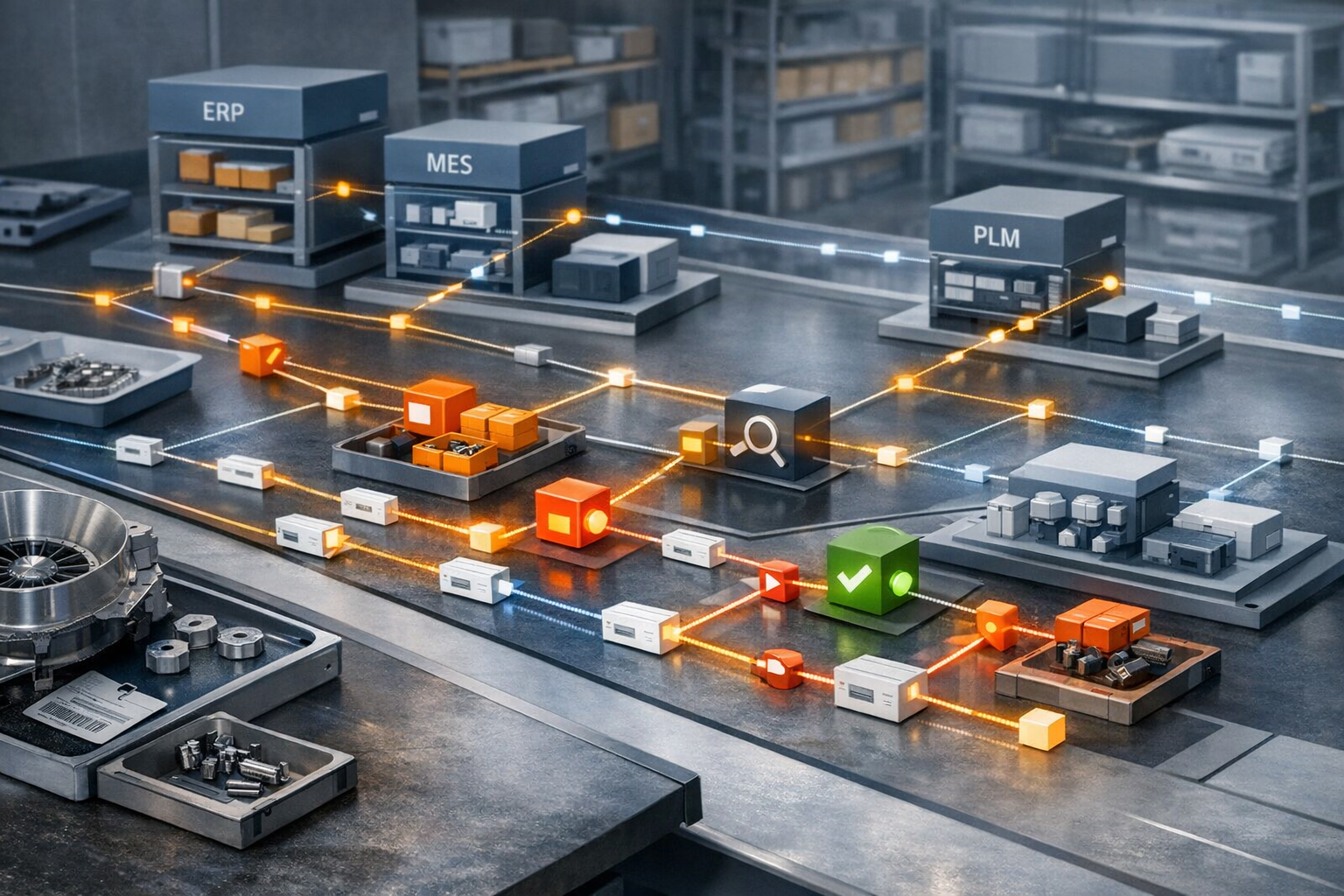
    Most plants meet AS9102 expectations using a combination of PLM for design control, ERP for part and PO identity, MES or travelers for routing, QMS for NCR and calibration, and dedicated or portal-based FAI tools. The critical decision is not whether you have one system or five, but whether the traceability links described above are:

    • Clearly defined and documented in procedures.
    • Implemented in a way that people can actually follow on the shop floor.
    • Verifiable during audits without manual data archaeology every time a customer asks a question.

    Where integration is weak, many organizations use controlled reference keys (e.g., always using the same work order number, part serial, and balloon IDs across systems) and standardized naming conventions as an intermediate step before deeper IT integration. These approaches do not remove the need for validation or change control, but they can improve AS9102 traceability without a risky full-system replacement.

  • What level of traceability is typically required for flight hardware versus non-flight aerospace parts?

    Traceability expectations in aerospace are usually driven by contract, program, and safety criticality, not just a simple “flight” vs “non-flight” label. That said, there are typical patterns.

    Typical traceability for flight hardware

    For parts that will be installed on aircraft or spacecraft (line-replaceable units, structural components, engine parts, flight controls, etc.), you should assume a need for:

    In practice, this connects to part genealogy and traceability when teams need to turn the answer into repeatable execution habits.

    • Full genealogy from raw material to installed configuration, including:
      • Heat/lot of raw material and test reports (mill certs)
      • All special processes (plating, heat treat, NDI, welding, bonding), with certs and process parameters as required by contract
      • Tooling, fixtures, and gages that affect key characteristics where required by customer or internal procedures
      • Operator, equipment, and date/time for critical operations where specified
    • Configuration traceability:
      • Which part revision was built, under which engineering change baseline
      • Which serial numbers are installed in which higher-level assemblies and final tail/ship/satellite numbers
    • Quality and inspection traceability:
      • AS9102 FAI records where applicable
      • Inspection results for key and critical characteristics, tied to specific parts or serial numbers
      • NCRs, concessions, and repair records linked to the affected serials and final disposition
    • Supply chain traceability:
      • Approved supplier status and certs for each procured item
      • Lot and serial number linkage from supplier into your work orders and on to the final product

    On many programs, flight hardware traceability is effectively “serial-level, end-to-end”: you can identify every material lot, process, inspection, and NCR that touched a given serialized unit, and you can trace each component into a particular aircraft or vehicle.

    Typical traceability for non-flight aerospace parts

    “Non-flight” parts span a wide range: ground support equipment, tooling, test rigs, training hardware, prototypes, shop aids, and internal spares. Traceability here is more variable and driven by risk and contracts.

    Common patterns include:

    • Lot-level rather than full serial-level genealogy:
      • Material certs and basic process traceability kept at heat/lot or batch level
      • Limited linkage between individual serials and specific process parameters unless the part is safety-related or can affect flight hardware
    • Configuration and change control still applied:
      • Version/revision tracking, controlled BOMs, and ECOs are usually still required
      • Traceability of major changes that can affect test results, interface dimensions, or handling of flight hardware
    • Targeted traceability for risk-sensitive non-flight assets:
      • Ground support equipment or tooling that interfaces with flight hardware may need near-flight-level traceability for calibration, maintenance, and configuration
      • Test equipment that generates certification data often requires traceability of calibration status, software versions, and as-run test conditions

    A non-flight label does not automatically mean “light” traceability. If a non-flight item can influence airworthiness (for example by handling or measuring flight parts), many OEMs expect traceability that is only slightly relaxed from flight hardware.

    Standards and contracts drive the real requirement

    In practice, the required level of traceability is set by:

    • Customer flowdowns and contracts (OEM, Tier 1, or government)
    • AS9100 and AS9102 requirements as interpreted by your QMS and auditors
    • Safety and criticality classification (primary structure, pressure-containing, flight control, engine, vs cosmetic or low-risk)
    • Regulatory program type (commercial transport, military, experimental, space, MRO vs new production)
    • Internal risk appetite and recall strategy (what you would need to know to surgically contain an issue)

    Two common patterns:

    • High-criticality flight parts: serial-level, end-to-end genealogy, including material, processes, inspections, NCRs, and installed configuration
    • Lower-risk and many non-flight parts: lot-level traceability plus full configuration control, with some serial-level tracking for tooling, test equipment, or parts that could compromise flight hardware

    Because interpretations differ by OEM, program, and auditor, it is risky to design systems around a generic rule. The safe approach is to map traceability expectations per part family or classification and tie them explicitly to requirements documents.

    System and process implications in brownfield environments

    Achieving these levels of traceability is usually constrained by existing ERP, MES, PLM, and QMS stacks and by limited downtime. Full system replacement to get “perfect” traceability often fails in aerospace because of:

    • Qualification and validation burden for new systems that influence airworthiness or quality records
    • Downtime risk for production and MRO lines that cannot be easily stopped and requalified
    • Integration complexity with legacy machines, paper travelers, and supplier portals
    • Long equipment and program lifecycles that make rip-and-replace expensive and disruptive

    Most plants instead extend what they have:

    • Overlay MES or digital traveler solutions on top of ERP to capture as-built data, operator, equipment, and process parameters for flight hardware
    • Enhance PLM/QMS integration to keep configuration and change control synchronized with shop-floor records
    • Digitize travelers and work instructions selectively for high-criticality flight parts first, then expand to non-flight areas where risk or rework is high
    • Define clear data ownership (which system owns serials, which owns NC records, which holds inspection data) to avoid gaps and double entry

    The traceability level you define on paper is only credible if your systems, integrations, and validation state can consistently produce audit-ready evidence for that level across the part lifecycle.

    Practical way to differentiate flight vs non-flight traceability

    Instead of relying solely on the “flight” label, many organizations use a classification scheme such as:

    • Class 1: Safety-critical flight hardware (highest traceability, serial-level genealogy, full AS9102, strict configuration linkage)
    • Class 2: Flight but lower criticality (serial-level on assemblies, lot-level allowed for some components where acceptable)
    • Class 3: Non-flight items that interface with flight hardware (tooling, GSE, test stands; strong configuration and calibration traceability)
    • Class 4: General non-flight (basic lot-level traceability, full configuration and change control, targeted serial tracking where justified)

    This allows you to align traceability depth, data capture, and system investment with actual risk and contractual expectations, rather than applying a single blanket rule.

  • Serial Number Control

    Serial Number Control commonly refers to the practice of assigning, recording, and governing a unique serial number for each individual unit of a product, component, asset, or assembly. It is used when items must be tracked at the unit level rather than only by part number, batch, or lot.

    In manufacturing and regulated operations, Serial Number Control typically includes the rules and system records that determine when a serial number is created, how it is linked to a specific item, and how that identifier follows the item through production, inspection, inventory, shipment, installation, service, or return. The serial number itself identifies one specific instance of an item, not the product design as a whole.

    This term does not usually mean general labeling alone. It refers more broadly to the control of the identifier and the associated records across business and shop floor systems such as ERP, MES, quality, and service systems.

    What it usually includes

    • Assignment of a unique serial number to an individual item

    • Rules for uniqueness, format, and reuse prevention

    • Status and history tied to that serial number, such as build, test, inspection, and shipment records

    • Links between the serial number and related data such as part number, revision, lot numbers, work order, and as-built configuration

    • Controls for scanning, lookup, reconciliation, and correction when exceptions occur

    How it appears in operations

    Operationally, Serial Number Control appears anywhere a process requires unit-level identity. Examples include assigning a serial number at assembly start, recording which serialized subcomponents were installed into a higher-level assembly, blocking shipment if a required inspection record is missing for a specific serial number, or retrieving the history of one returned unit during investigation.

    In integrated environments, serial number control often supports genealogy, electronic device history records, service history, warranty tracking, and targeted containment when a problem affects only certain units.

    Common confusion

    Serial Number Control is often confused with lot control or batch control. A serial number identifies one individual unit. A lot or batch identifies a group of units produced or handled together. Some operations use both at the same time, such as a serialized finished device made from lot-controlled raw materials.

    It can also be confused with an asset tag. An asset tag usually identifies an item for ownership or maintenance purposes after deployment. A serial number is typically tied to the product or component itself and may originate during manufacturing.

  • How do lot tracking requirements differ from serial number traceability?

    Lot tracking and serial number traceability serve different levels of control.

    Lot tracking identifies a batch or group of material, components, or finished goods that share a common production or receipt history. Serial number traceability identifies one specific unit and its individual history. In practice, lot tracking answers questions such as which material batch was used, while serial traceability answers which exact unit received which part, operation, inspection result, repair, or deviation.

    In practice, this connects to part genealogy and traceability when teams need to turn the answer into repeatable execution habits.

    What changes in the requirement

    • Granularity: Lot tracking is group-level. Serial traceability is unit-level.

    • Data volume: Serial traceability requires far more transactions, scans, and record links than lot tracking.

    • Genealogy depth: Lot control may stop at material consumption and batch disposition. Serial traceability often extends through assembly, test, packaging, shipment, maintenance, rework, and field history.

    • Containment scope: If a problem is found, lot traceability may force you to quarantine or investigate an entire batch. Serial traceability can sometimes narrow the impact to specific units, but only if the data capture is complete and trustworthy.

    • Operational burden: Serial traceability usually adds more operator steps, more exception handling, tighter label discipline, and more integration points with MES, ERP, QMS, test systems, and sometimes service systems.

    When lot tracking is usually sufficient

    Lot tracking is often used when materials or outputs are handled in homogeneous batches and individual unit identity does not materially change risk control, investigation quality, or downstream obligations. Typical examples include raw materials, chemicals, consumables, some bulk processes, and intermediate batches where units are not meaningfully distinguishable.

    That does not make lot tracking simple. You still need controlled lot creation rules, split and merge handling, disposition history, and clear links between received material lots, work orders, and finished output. If operators can substitute material, backflush consumption, or re-label containers outside the system, the recorded lot history may be incomplete even if the ERP says lot control is enabled.

    When serial traceability is usually required

    Serial traceability is generally used when each unit must carry its own identity because configuration, inspection evidence, repair history, service history, or risk exposure can differ unit by unit. This is common for high-value assemblies, safety-critical products, repairable assets, and products with long service lives.

    Serial traceability becomes more demanding if you need as-built genealogy across multiple levels, such as parent serial to child serial relationships, installed lot-controlled materials, process parameters, test results, nonconformance records, and approved deviations. Many organizations underestimate how much discipline is required to maintain that chain through rework, part replacement, split orders, subcontract processing, and returns.

    Key tradeoffs

    • Precision versus overhead: Serial traceability gives finer containment and investigation capability, but it increases scan burden, exception management, and data stewardship effort.

    • Recall efficiency versus implementation complexity: Lot control may be easier to deploy, but it can widen the population affected by a defect or supplier issue.

    • System fit versus process reality: Some ERP systems can store lot and serial data, but they do not reliably enforce the shop floor transactions needed for real genealogy without MES, scanning, test integration, or custom workflows.

    • Validation burden: In regulated environments, adding or changing traceability logic can require controlled rollout, documented testing, and updates to procedures and training. The burden rises with automation depth and record criticality.

    Brownfield reality

    Most plants do not start with a clean architecture. Lot and serial data are often split across ERP, MES, QMS, warehouse systems, label software, spreadsheets, and supplier paperwork. As a result, the real requirement is not just whether you want lot or serial traceability. It is whether your current process and system landscape can maintain an accurate, auditable chain without creating production delays or uncontrolled workarounds.

    That is why full replacement strategies often fail. Replacing ERP, MES, QMS, and plant integrations at once can create qualification burden, validation cost, downtime risk, interface breakage, and loss of historical continuity. In long lifecycle environments, a phased coexistence model is usually more realistic: preserve the system of record where needed, add controlled data capture where gaps matter most, and tighten genealogy incrementally.

    Practical rule

    If the business or quality question is about a batch, use lot control. If the question is about one specific unit and its exact as-built, as-tested, or as-maintained history, lot control alone is not enough. You need serial traceability, and you need the surrounding process discipline to support it.

    In many operations, the answer is not either-or. A finished serialized unit often contains lot-controlled materials and, in some cases, serialized subcomponents. The hard part is maintaining the parent-child relationships consistently across production, inspection, nonconformance, rework, and downstream service events.