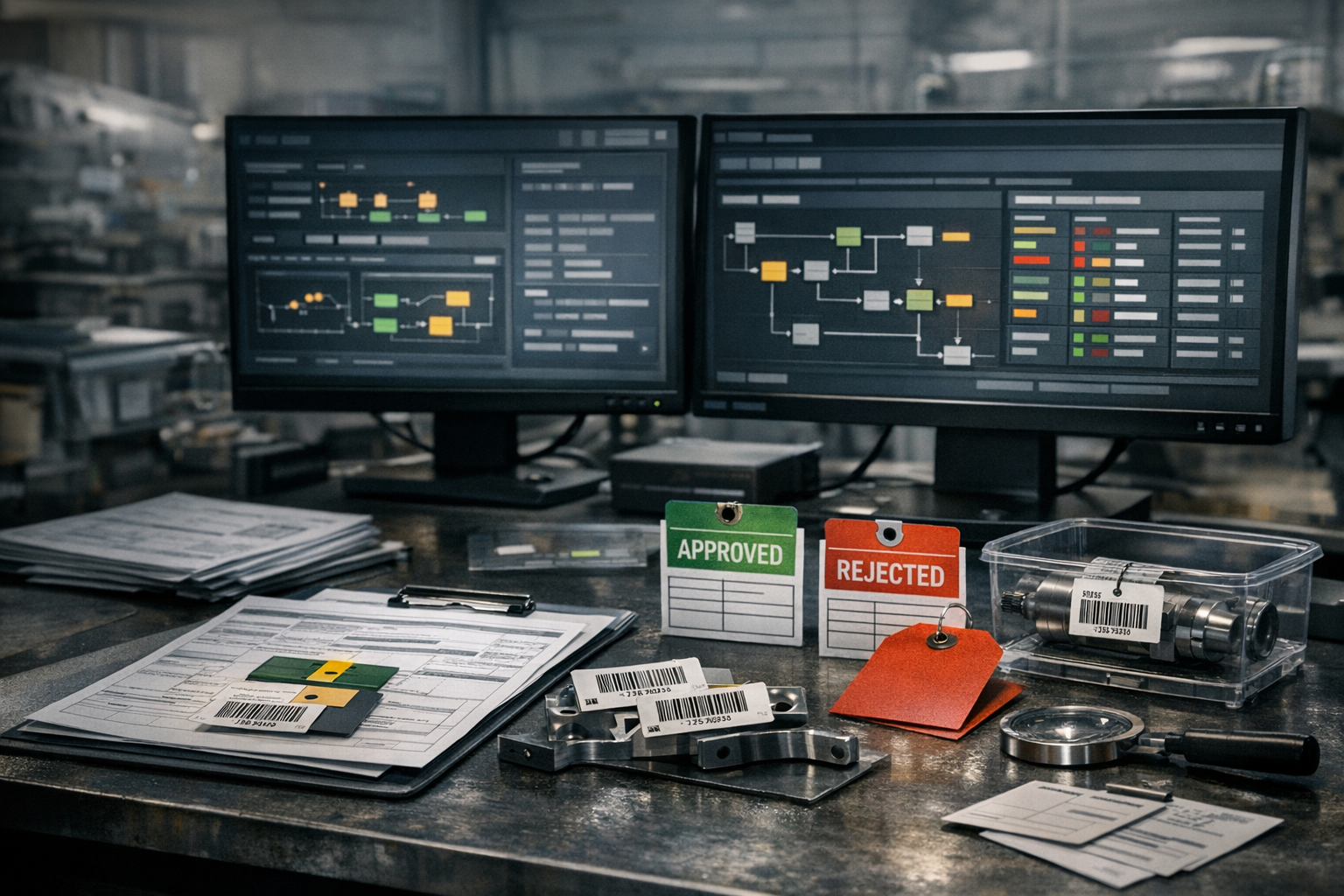
RSC Topic: Traceability & Genealogy

Lot, serial, and unit-level tracking from raw material through as-built record.

  • Forward Traceability

    Core meaning

    Forward traceability commonly refers to the ability to trace a product, batch, component, or data record **from its point of origin forward to every downstream location or use**. In industrial and manufacturing contexts, this means being able to answer questions such as:

    – Which finished products contain this specific lot of raw material?
    – Which customers received products built from this batch?
    – Which process steps, lines, or sites handled this unit after a given event?

    Forward traceability is typically paired with backward traceability (tracing from a finished product or event back to its sources).

    Use in manufacturing and regulated operations

    In manufacturing systems, forward traceability links identifiers across production and logistics records, such as:

    – Raw material lot or batch IDs
    – Intermediate and finished product IDs or serial numbers
    – Production order numbers and work orders
    – Packaging, pallet, and shipment IDs

    This linkage allows organizations to:

    – Trace all downstream WIP and finished goods that used a specific lot, tool, or process
    – Identify which shipments and customers are associated with a particular batch
    – Determine the scope of a containment or recall by listing all affected products

    Data supporting forward traceability is often stored and managed across MES, LIMS, QMS, WMS, and ERP systems, with integration needed to create an end‑to‑end trace.

    Relationship to backward traceability and full traceability

    Forward traceability:

    – Starts from an **upstream event or object** (e.g., material lot, process step, nonconformance) and follows it **downstream** to all uses and destinations.

    Backward traceability:

    – Starts from a **downstream event or object** (e.g., finished good, complaint, field failure) and tracks **upstream** to materials, processes, and equipment used.

    Many organizations describe **full traceability** as the combined ability to perform both forward and backward traceability across the product lifecycle and supply chain.

    Typical workflow scenarios

    Examples of how forward traceability is used in practice include:

    – **Nonconformance or deviation:** Starting from a nonconforming material lot, identifying all intermediate and finished products that used that lot, and listing the related work orders, lines, and customers.
    – **Recall or field action scoping:** Starting with a defective component batch, using system records to find all affected serial numbers, batches, and shipments.
    – **Process or tool issues:** Starting from a specific machine, tool, or process setting change at a given time and identifying all units produced afterwards that may be impacted.

    These scenarios rely on consistent identifiers and timestamps across OT and IT systems to support accurate forward linkage.

    Boundaries and exclusions

    Forward traceability in this context:

    – **Includes:** Tracking physical products, materials, equipment-related events, and associated records forward through manufacturing, warehousing, distribution, and customer delivery.
    – **Includes:** Digital records directly tied to those physical flows (e.g., electronic batch records, device history records, inspection records).
    – **Excludes:** General data lineage in IT-only contexts where no physical product or regulated record is involved, unless explicitly mapped to manufacturing data.

    It is related to, but distinct from, broader topics like supply chain visibility or lifecycle management, which may include planning, forecasting, and cost analysis that go beyond strict traceability.

    Common confusion and misuse

    Forward traceability is sometimes confused with:

    – **Backward traceability:** The direction is different; forward traceability starts from an origin and moves outward to all downstream uses, while backward traceability starts from a specific item or event and moves back to its sources.
    – **General tracking or monitoring:** Tracking work-in-process or shipments in real time does not by itself provide formal forward traceability unless historical linkages between lots, serials, operations, and shipments are retained and queryable.

    In requirements engineering, the term “forward traceability” can also refer to tracing from requirements to design, tests, and implementation artifacts. While conceptually similar (tracing from origin to downstream artifacts), in this site’s context the primary meaning is product and material traceability in industrial operations.

  • What is a digital thread in aerospace manufacturing and how is it different from a digital twin?

    A digital thread in aerospace manufacturing is the connected, traceable flow of product and process data across the lifecycle of a part or assembly. A digital twin is a specific virtual representation of a physical part, asset, or process that uses that data. They are related but not interchangeable.

    What is a digital thread in aerospace manufacturing?

    In aerospace, a digital thread is the set of linked data records that describe how a part or assembly moved from requirements and design through manufacturing, inspection, delivery, and often into service and repair.

    In practice, this connects to part genealogy and traceability when teams need to turn the answer into repeatable execution habits.

    In practical terms, a digital thread typically connects (via IDs and interfaces):

    • Requirements and design data from PLM and engineering (drawings, models, specifications, change orders)
    • Manufacturing definition (BOM, routing, work instructions, tooling, NC programs, process plans)
    • Execution data from MES and shopfloor systems (work orders, operation history, machine, operator, timestamp, parameters, rework)
    • Quality and compliance records (FAI, in-process and final inspection, NCRs, concessions, MRB decisions, test data)
    • Supply chain lineage (which supplier lot, serial, or batch was used where, including outsourced processing)
    • Shipping, configuration, and as-built/as-delivered structure
    • In-service and MRO data where available (maintenance history, repairs, life usage, modifications)

    The emphasis is on traceability, data relationships, and the ability to traverse the chain in either direction: from a field event back to raw material, or from a design change forward to impacted serial numbers and work orders.

    What is a digital twin?

    A digital twin is a virtual representation of a specific physical object or process, usually kept in sync with real-world data.

    In aerospace manufacturing and MRO, you will usually encounter:

    • Product twins: virtual models of a specific serialized part or aircraft configuration, sometimes down to component level and usage history.
    • Asset twins: twins of production equipment (e.g., a CNC machine or autoclave) including condition, maintenance state, and sometimes control parameters.
    • Process twins: simulations of a manufacturing cell or line used for capacity analysis, scheduling, or process optimization.

    Digital twins consume data from the digital thread (e.g., as-built configuration, process parameters, material lots) and can generate new data (predictions, recommended settings, simulated failure modes) that should be written back into that thread if it is to be auditable and usable in a regulated context.

    Key differences between digital thread and digital twin

    • Scope: The digital thread is lifecycle-wide and data-centric; a digital twin is object- or system-specific and model-centric.
    • Purpose: The thread focuses on traceability, genealogy, and answering “who/what/when/where/how” across systems. The twin focuses on behavior, performance, and “what if” analysis for a defined object or process.
    • Implementation: The thread is mostly about consistent IDs, integrations, and disciplined data capture across PLM, MES, ERP, QMS, and MRO. The twin is typically implemented as models and analytics (CAD/FEA, physics models, machine learning, or hybrid) tied to sensor or transactional data.
    • Regulated value: For auditability and compliance, the digital thread is the primary vehicle. Twins become credible and usable in regulated decisions only if their inputs, model versions, and outputs are traceable within that thread.

    How digital thread and digital twins interact

    In a mature setup, the relationship is:

    • The digital thread provides the authoritative record of requirements, configuration, processing, and quality outcomes.
    • Digital twins use that record to initialize and update models (for example, material batch, heat treatment profile, and machining parameters for a given rotor disk).
    • Simulation or predictive outputs from the twin (e.g., life predictions, early-warning indicators, optimized process windows) are written back into systems that participate in the thread and are versioned and traceable.

    Without a reasonably robust digital thread, digital twins often become siloed analytical tools whose results are difficult to validate, govern, or use consistently in MRB, certification documentation, or standard work.

    Brownfield reality and constraints

    Most aerospace manufacturers and MROs do not start with a clean slate. Typical constraints include:

    • Mixed system landscape: Legacy PLM, multiple ERPs, homegrown MES, spreadsheets, and paper travelers. The digital thread has to be layered across these systems rather than replacing them wholesale.
    • Integration complexity: Creating a usable thread requires consistent identifiers (part, serial, lot, work order, inspection record) and integration between systems. Poor master data or fragmented routing/part numbering schemes quickly limit value.
    • Validation burden: In regulated aerospace environments, any system that drives or records production or quality decisions usually must be validated or at least controlled. Building a digital thread or a twin that feeds into real decisions is not just an IT task; it touches validation, QMS, and change control.
    • Downtime and lifecycle constraints: Replacing core MES, PLM, or ERP systems “for the sake of digital thread” usually fails or stalls due to qualification burden, downtime risk, interoperability, and the long lifecycle of existing equipment and programs.

    As a result, many organizations start by strengthening the digital thread in a narrow but critical slice, for example:

    • Connecting PLM, FAI, and MES data for a subset of safety-critical parts.
    • Standardizing serialization and genealogy across one cell or program.
    • Capturing richer as-built data (parameters, tooling, inspection) in MES for future twin use, even before full twin models exist.

    Digital twins are then introduced where the business case justifies the additional modeling, sensor integration, and validation effort, typically around bottleneck assets, high-cost parts, or high-risk operations.

    Tradeoffs and failure modes to watch

    Common issues when pursuing digital thread and digital twins include:

    • Over-promising on continuity: Marketing often implies a single, seamless thread from concept to disposal. In practice, you will have partial coverage, gaps at supplier and MRO interfaces, and legacy data that remains offline. Being explicit about where the thread is strong or weak is essential.
    • Model without governance: Digital twins built outside formal change control and validation may deliver interesting insights but cannot reliably drive process limits, repair dispositions, or concessions in a regulated context.
    • Thread without consumption: Some programs invest heavily in connecting data but never operationalize it into decisions (for example, FAI, NCR, and process parameters remain disconnected from engineering changes and scheduling). The thread is only valuable if it informs planning, quality, and maintenance actions.
    • Full replacement strategies: Attempting to rip and replace all core systems to “get a digital thread platform” often creates multi-year risk, requalification burden, and significant downtime exposure. Incremental, interface-first strategies that respect existing MES/ERP/PLM/QMS investments are usually more realistic.

    How to think about them in your environment

    If you need to prioritize:

    • Treat the digital thread as the foundational work: consistent IDs, better genealogy in MES, integration of PLM change data, and robust quality and inspection records.
    • Treat digital twins as higher-layer tools that you selectively deploy where physics-based or data-driven models can improve safety, yield, maintenance, or throughput, and where you can realistically maintain and validate those models over long program lifecycles.

    Both concepts are useful, but in aerospace manufacturing and MRO, the digital thread is usually the prerequisite for making any digital twin dependable, auditable, and usable in real operational and quality decisions.

  • How can organizations transition from paper-based traceability to digital records without disrupting production?

    Transitioning from paper-based traceability to digital records without disrupting production is possible, but only if you treat it as a controlled change to your execution system, not a tooling swap. The safest approaches are incremental, parallel, and tightly governed.

    Start with scope and risk, not software features

    Before introducing any digital tool on the floor:

    In practice, this connects to part genealogy and traceability when teams need to turn the answer into repeatable execution habits.

    • Define the minimum scope for the first step: a product family, a single line/cell, or one traceability object (e.g., serials and key process parameters only).
    • Clarify regulatory and customer expectations: retention time, required data fields, signature/attribution rules, and audit expectations for electronic records.
    • List failure modes that you must avoid: lost traceability, incomplete records, ambiguous lot/serial linkage, or unvalidated electronic signatures.

    Design a digital traceability model first

    Paper forms often hide design issues that become painful when digitized. Before deployment:

    • Standardize the data model: part/serial/lot identifiers, operation numbers, machine IDs, operator IDs, defect codes, and rework flows.
    • Define genealogy rules: how lots split/merge, how subassemblies relate to top-level assemblies, and how rework/repair records attach to the original build.
    • Agree on master data ownership: which system is the system of record for parts, routings, revisions, and BOMs (often ERP/PLM), and how the digital traceability solution references them.
    • Specify when a record is “complete”: required fields, checks, and approvals before a unit can move to the next operation.

    In brownfield environments, expect to adjust this model several times as you find edge cases. Build that iteration into your plan and change-control process.

    Use a pilot and run paper and digital in parallel

    The lowest-risk approach is to avoid a big-bang cutover:

    • Select a pilot area with contained volume, representative complexity, and cooperative supervision.
    • Introduce digital traceability while keeping paper travelers/forms as the official record during the pilot.
    • Have operators record in both systems initially, then compare for completeness, timing, and error types.
    • Measure specific gaps: missing scans, incorrect lot links, time stamps out of order, or steps that operators routinely skip.

    This dual-record phase is inefficient, but it is often necessary to prove the digital process, tune the UI, and collect evidence that the electronic records are reliable before you rely on them for audits or investigations.

    Integrate carefully with existing MES, ERP, PLM, and QMS

    In most regulated plants, traceability touches multiple systems. Replacing them outright is rarely practical given validation costs and disruption risk. Instead:

    • Decide the system of record for each object: part master in ERP/PLM, work orders in ERP/MES, quality events in QMS, as-built genealogy in MES/traceability tool.
    • Use stable identifiers (work-order numbers, serials, batch IDs) so digital records can be joined to legacy systems without brittle custom logic.
    • Limit early integrations to what is essential to avoid double keying: e.g., one-way import of work orders and routings into the digital traveler, or export of completed as-built records to QMS.
    • Plan for outages and fallbacks: what happens if the network or MES is down mid-shift. Define when you revert to paper and how you later reconcile records.

    Complex, full replacement of MES/ERP traceability modules often fails in aerospace-grade environments because of qualification burden, the need to revalidate many downstream reports and interfaces, and the risk of extended downtime. A coexistence strategy, where a new digital layer gradually assumes more execution and traceability responsibility, typically carries less operational risk.

    Focus on operator experience and shop-floor practicality

    Digital traceability fails quickly if it slows operators or conflicts with how work is actually done.

    • Map the real workflow (not just the documented one): staging, inspections, rework, handoffs between cells, and informal workarounds.
    • Minimize added clicks and data entry: use barcodes/QRs, NFC, or simple picklists wherever possible instead of free-text typing.
    • Co-locate terminals or tablets where the work happens. Avoid long walks to a single shared station that becomes a bottleneck.
    • Train operators with real parts and real work orders, not only classroom demos. Validate that they can complete a typical job without external coaching.
    • Provide clear support paths on shift (supervision, engineering, IT) to resolve issues without stopping production.

    Use staged cutovers by product, cell, or shift

    Once the pilot proves that digital records are complete and reliable, move away from paper in controlled steps rather than across the entire plant at once:

    • Cut over by product family or value stream so that each team only has to manage one primary method (paper or digital) for a given job.
    • Lock down paper travelers in the cutover area: no new jobs start on paper after the agreed date, but existing paper jobs are allowed to finish.
    • Document and approve the change via your existing change-control and validation processes, including risk analysis and, where necessary, protocol-based testing.
    • Monitor the first weeks closely for missing scans, delays, or operator confusion and correct quickly.

    Validation, audit trails, and change control

    In regulated and aerospace environments, a digital traceability system must be treated as a validated, controlled system, not an informal tool.

    • Document requirements and risks for traceability: data integrity, time stamping, user attribution, and change logs.
    • Test and record evidence that the system behaves as intended for typical and edge-case workflows (rework, scrap, partial completions).
    • Ensure audit trails are accessible and can be linked back to work orders, serials, and quality records during audits or investigations.
    • Establish change-control for workflows, fields, and integrations so that future edits do not quietly invalidate validation evidence or break downstream reports.

    Measure and correct, rather than assume success

    To confirm that production is not being disrupted and that traceability is actually improving:

    • Track basic performance metrics before and after: first-pass yield, scrap, rework rate, WIP aging, and time to retrieve records during audits or investigations.
    • Monitor exception rates: missing scans, incomplete records, manual overrides, or late data entry.
    • Act on feedback from operators, supervisors, and quality engineers; many issues only appear at real production volumes.
    • Iterate in small releases rather than large redesigns, each governed by the same change-control discipline.

    With this incremental, risk-aware approach, organizations can move from paper travelers and binders to digital, queryable traceability without a single big-bang event, while maintaining production flow and audit readiness.

  • warehouse management system

    Core meaning

    A warehouse management system (WMS) is specialized software used to control, execute, and track warehouse and distribution center operations. It manages how inventory is stored, moved, counted, and picked within one or more physical warehouse locations.

    A WMS commonly:

    – Maintains inventory records at detailed location levels (e.g., aisle, rack, bin)
    – Directs receiving, put-away, picking, packing, shipping, and internal transfers
    – Supports barcode/RFID scanning and mobile devices on the warehouse floor
    – Enforces warehouse rules such as FEFO/FIFO, lot rotation, or storage constraints
    – Records traceable stock movements (who moved what, where, when, and why)
    – Interfaces with higher-level systems such as ERP, MES, and transportation systems

    Use in manufacturing and regulated operations

    In industrial and regulated environments, a WMS is used to manage raw materials, intermediates, and finished goods across warehouses and staging areas. It typically:

    – Integrates with ERP for orders, material masters, and financial posting
    – Integrates with MES or production systems for material consumption and production receipts
    – Maintains lot/batch, serial, and sometimes status information (e.g., released, quarantined)
    – Provides transaction histories that support traceability and investigations
    – Supplies operational data for inventory accuracy KPIs and cycle counting performance

    In some plants, WMS functionality may be embedded within an ERP or MES rather than deployed as a standalone system.

    Boundaries and scope

    A WMS generally includes:

    – Physical inventory control and real-time stock visibility inside warehouses
    – Operational task management (e.g., work queues for pickers, put-away tasks)
    – Location and capacity management for storage areas

    A WMS typically does **not** include:

    – Enterprise-level planning (handled by ERP, APS, or planning tools)
    – Shop-floor process control or detailed production routing (handled by MES/SCADA)
    – Transportation planning and optimization beyond basic shipping interfaces (handled by TMS)

    Common confusion and related terms

    – **WMS vs. ERP:** An ERP system holds financial, purchasing, and high-level inventory data. A WMS handles the detailed, physical execution of warehouse operations and location-level movements. In some solutions, WMS is a module within ERP.
    – **WMS vs. inventory management:** General inventory management refers to policies, planning, and accounting for stock. A WMS is a specific software system that executes and records physical inventory movements and storage.
    – **WMS vs. MES:** MES focuses on production execution (work orders, process steps, equipment states). WMS focuses on warehouse and material storage operations, even when located near or inside the plant.

    Site-context application: inventory accuracy KPIs

    In the context of inventory accuracy and KPI reviews, the WMS is often the system of record for:

    – On-hand quantities at bin or location level
    – Historical movement transactions used to analyze discrepancies
    – Cycle count results and variance records

    Inventory accuracy KPIs (e.g., location accuracy, count accuracy, value accuracy) are usually derived from data maintained and time-stamped in the WMS and reconciled against ERP or financial systems.

  • lot tracking

    Core meaning

    Lot tracking is the practice of recording, maintaining, and querying the history of materials and products using a **lot** (or batch) identifier rather than a unique serial number for each individual unit.

    A lot typically represents a group of units that share key attributes, such as:

    – Common manufacturing or receipt event (e.g., a batch made on a specific line and date)
    – Common source (e.g., same supplier shipment)
    – Common specification or grade

    In lot tracking, all units within the lot are treated as having the same traceability record for most operational and quality purposes.

    How lot tracking is used in manufacturing

    In industrial and regulated environments, lot tracking commonly refers to:

    – **Inbound materials:** Capturing supplier lot numbers at goods receipt and mapping them to internal lot IDs.
    – **In-process manufacturing:** Recording which input lots were consumed in which work orders, batches, or process orders.
    – **Finished goods:** Assigning finished product lots and linking them to the lots of raw materials, intermediates, and packaging used.
    – **Storage and logistics:** Tracking lot IDs across warehouses, locations, and transfers, often along with quantity, status, and expiration date.
    – **Recall and investigation:** Querying which lots were used in which products, and which customers or destinations received specific lots.

    Lot tracking data is often managed and synchronized across systems such as MES, ERP, WMS, LIMS, and quality systems.

    Relationship to serialization and traceability

    Lot tracking is one form of product and material traceability:

    – **Lot-level traceability:** Identifies and traces groups of units via a lot ID.
    – **Serial-level traceability:** Identifies and traces each individual unit via a unique serial number.

    In many plants, both are used together, for example:

    – Components tracked by lot
    – High-risk or regulated components tracked by serial number
    – Finished goods tracked by lot, with optional serials on specific devices

    Lot tracking usually provides coarser traceability than full serialization, but is simpler to manage and is widely used where regulatory or business requirements do not mandate unit-level tracking.

    Boundaries and exclusions

    Lot tracking **includes**:

    – Assignment and control of lot identifiers for materials and products
    – Recording material movements, consumption, and transformations at the lot/batch level
    – Maintaining the genealogy (upstream inputs and downstream outputs) of lots

    Lot tracking **does not necessarily include**:

    – Individual unit-level tracking (that is serialization, though it may coexist with lots)
    – Process parameter tracking by equipment or sensor (though these parameters may be linked to specific lots)
    – Formal certification that traceability meets any particular regulatory standard

    Lot tracking also should not be confused with **inventory valuation methods** (e.g., FIFO/LIFO), though inventory costing rules may use lot dates and attributes.

    Common confusion and terminology

    Common related terms and points of confusion:

    – **Lot vs. batch:** In many industries these are used interchangeably. Some sites use *batch* for the process event and *lot* for the commercial or inventory grouping.
    – **Lot tracking vs. batch record:** Batch records (or electronic batch records) contain detailed process and quality data. Lot tracking refers more broadly to the identification and tracing of material groups through the flow.
    – **Lot tracking vs. traceability:** Lot tracking is one implementation approach within overall product and material traceability.

    When configuring systems, it is important to distinguish whether a field or procedure is intended to capture **lot identity**, **batch execution details**, or **individual serial numbers**.

    Site context: lot tracking in MES and mixed tracking environments

    In the context of MES and integrated manufacturing systems, lot tracking commonly refers to how the MES:

    – Models and stores lot identifiers and their attributes
    – Links consumed material lots (raws, components, intermediates) to produced lots
    – Supports mixed environments where some materials are tracked by lot and others by serial number
    – Exposes genealogy queries (“which lots went into this product?” and “where did this lot go?”) for investigations and regulatory reporting

    Designing lot tracking in MES and ERP involves decisions about data granularity, integration with shop-floor data collection, and alignment with quality and regulatory requirements, especially when both serialized and non-serialized materials coexist.

  • How does ISO 9001 support traceability requirements in manufacturing?

    ISO 9001 supports traceability by requiring a structured quality management system, but it does not, by itself, guarantee detailed part-level or lot-level genealogy. It provides the framework within which you can design, implement, and maintain traceability processes, records, and supporting systems.

    What ISO 9001 actually requires regarding traceability

    ISO 9001:2015 references traceability in a focused way, mainly in the context of identification and control of outputs. The key points are:

    In practice, this connects to the ISO 9001 quality baseline when teams need to turn the answer into repeatable execution habits.

    • Identification and traceability (clause 8.5.2): You must identify outputs (materials, parts, products) as needed to ensure conformity. Where traceability is a requirement (from customer, regulation, contract, or internal policy), you must control the unique identification of the outputs and maintain the associated records.
    • Documented information (clause 7.5): You must define, control, and retain records that demonstrate conformity. Traceability records (e.g., batch numbers, work orders, travelers, inspection results) are part of this documented information.
    • Control of nonconforming outputs (clause 8.7): When you find a nonconformance, you must be able to identify impacted product and prevent unintended use or delivery. Effective traceability strongly supports this but is not fully specified by ISO 9001.
    • Planning and control (clauses 6 and 8): You must plan and control processes considering risks and customer requirements. If your risk analysis or contracts call for component genealogy or process parameter history, these become requirements your QMS must support.

    In practice, ISO 9001 expects you to define and meet your own traceability obligations (plus those from customers and regulators) and prove you are consistently doing so.

    How ISO 9001 supports manufacturing traceability in practice

    While ISO 9001 does not prescribe specific tools or data models, it supports robust traceability through several structural requirements:

    • Defined processes for identification and marking: Procedures for assigning lot numbers, serial numbers, work orders, and labels at defined points in the process.
    • Controlled routing and travelers: Requirements to plan and control production processes naturally extend to travelers, routers, or digital work orders that connect materials, operations, equipment, and inspectors.
    • Inspection and test records: ISO 9001 requires evidence of conformity. This evidence can be linked to specific batches, serial numbers, processes, and equipment, enabling basic genealogy when designed correctly.
    • Change control and revision management: Document control requirements help you track which drawing, specification, and work instruction revisions applied to which orders or lots. This is critical when evaluating historical product risk.
    • Supplier control: By requiring control of externally provided processes, products, and services, ISO 9001 supports upstream traceability (e.g., supplier lots, certificates of conformity) and their links to internal work orders.
    • Internal audits and management review: These mechanisms force periodic checking that traceability processes are followed, records are complete, and risks or gaps are being addressed.

    None of this guarantees high-resolution, end-to-end traceability. It gives you the management system scaffolding to define, monitor, and improve the traceability level your risk, customer base, and regulatory environment demand.

    Limits and common misconceptions

    There are several points that often get misunderstood in regulated or aerospace-adjacent manufacturing:

    • ISO 9001 is not a traceability standard: It does not define data models for genealogy, barcoding standards, or serialization schemes. It only requires you to control identification and related records when traceability is required.
    • Certification does not prove good traceability: An ISO 9001 certificate does not mean a supplier maintains deep component genealogy or can execute complex recall analysis quickly. Their scope, processes, and system maturity determine that.
    • Depth of traceability is contextual: ISO 9001 comfortably covers environments with only minimal batch-level traceability. Detailed part-level, feature-level, or process-parameter traceability is usually driven by sector standards (e.g., AS9100/AS9102), customer contracts, or regulatory rules, not ISO 9001 itself.
    • Brownfield constraints matter: ISO 9001 does not require you to replace legacy MES, ERP, or paper travelers. Plants often layer traceability improvements on top of existing systems, with mixed fidelity and manual bridges between them.

    Coexistence with MES, ERP, PLM, and paper in brownfield environments

    Most ISO 9001 certified plants operate in mixed-system environments, and traceability emerges from how these systems are connected and governed:

    • ERP typically owns item masters, work orders, and lot/serial number assignment at a high level.
    • MES or production systems (often partially manual) handle operation-level data such as operator IDs, timestamps, equipment used, and in-process inspection results.
    • PLM or document control systems manage drawings, specifications, and work instructions, with revision history.
    • QMS / NCR / CAPA tools store nonconformance, deviation, and corrective action records linked to parts, orders, and customers.
    • Paper travelers and logbooks remain common, especially in legacy cells or specialized processes.

    ISO 9001 supports traceability in this brownfield reality by requiring you to:

    • Define how these systems and records connect to provide the necessary traceability.
    • Control changes to master data, routings, and documents so history remains reconstructable.
    • Ensure records are retained, legible, and retrievable within defined timeframes.
    • Audit that the actual data flow matches your documented procedures.

    Full replacement of legacy systems just to “improve traceability” is often high risk in regulated, long-lifecycle environments due to validation burden, downtime constraints, and integration complexity. ISO 9001 allows incremental, layered improvements (e.g., digital travelers added on top of an existing ERP) as long as you maintain control, validation, and clear procedures.

    How to use ISO 9001 effectively to improve traceability

    To leverage ISO 9001 in a manufacturing traceability program:

    • Translate requirements into explicit traceability policies: Based on customer contracts, regulatory expectations, and risk analysis, define the required traceability depth (e.g., batch-to-batch vs. full as-built genealogy).
    • Document process controls: Define where IDs are assigned, how data is captured, who is responsible, and how exceptions are handled (rework, splitting/combining lots, re-labeling).
    • Align records with your data model: Ensure ERP, MES, QMS, and paper records carry compatible identifiers (work order, lot, serial, heat number) so you can reconstruct history without excessive manual effort.
    • Apply change control and validation: When you add or modify traceability mechanisms (e.g., introducing barcoding or digital travelers), control and validate the changes before broad rollout.
    • Audit traceability end-to-end: Periodically test whether you can trace from finished part back to material lots, key process steps, and inspection records within a reasonable time, and use audit findings to drive improvement.

    Used this way, ISO 9001 becomes a governance and assurance layer around your traceability architecture, rather than a guarantee that traceability is robust by default.

  • maintenance lineage

    Maintenance lineage commonly refers to the complete, traceable history of maintenance performed on an asset or serialized component, including what was done, when, by whom, under which instructions, and with which parts or subassemblies.

    What maintenance lineage includes

    In industrial and especially aerospace MRO environments, maintenance lineage typically covers:

    • Work and events: all inspections, repairs, overhauls, modifications, upgrades, and removals/installations.
    • Configuration changes: which part numbers, alternates, and service bulletins or engineering changes were applied at each point in time.
    • Serial-level traceability: links between parent assets (airframes, engines, major assemblies) and child components that were swapped, repaired, or scrapped.
    • Documentation and approvals: the work orders, job cards, digital travelers, signoffs, and approvals associated with each maintenance action.
    • Conditions and findings: discrepancy reports, nonconformances, and as-found/as-left conditions tied to specific tasks.

    Operationally, maintenance lineage is implemented through MRO systems, CMMS/EAM, or MES/ERP integrations that maintain a time-ordered record for each asset or serialized part. This record supports investigations, planning of future maintenance, and verification that required tasks and bulletins have been completed.

    How maintenance lineage is used

    • Regulatory and customer traceability: demonstrating the history of a part or asset for audits, incident investigations, and customer inquiries.
    • Configuration control: confirming that the current configuration is compatible, airworthy or otherwise acceptable, and aligned with applicable technical data.
    • Decision support: informing repair/replace decisions, life-limit calculations, and risk assessments based on accumulated cycles, hours, and prior findings.
    • Integration with KPIs: feeding reliability, turnaround time, and MRO performance metrics while preserving traceable links back to source maintenance records.

    Common confusion

    Maintenance lineage vs. asset history: “Asset history” is often broader, including utilization, operating conditions, and commercial events. Maintenance lineage focuses specifically on maintenance and configuration-related events.

    Maintenance lineage vs. part genealogy: “Genealogy” usually emphasizes how parts are built up and decomposed during manufacturing and overhaul. Maintenance lineage emphasizes the chronological record of maintenance tasks and changes applied over the life of the asset or component.

    Context in aerospace and MRO

    In aerospace MRO, maintenance lineage is tightly linked to repair traceability, digital as-maintained records, and compliance with airworthiness and quality requirements. Systems must preserve consistent identifiers, timestamps, and approvals so that maintenance lineage remains intact when data is exchanged between MES, ERP, MRO, and reliability analytics tools.